

In an Absolute State: Elevated Use of Absolutist Words Is a Marker Specific to Anxiety, Depression, and Suicidal Ideation
Open accessThe DOI matches its Crossref record; 73 of the 76 references it cites were found in a registry or an index; 1 of the 54 sources its claims cite were checked for support.
Abstract
Absolutist thinking is considered a cognitive distortion by most cognitive therapies for anxiety and depression. Yet, there is little empirical evidence of its prevalence or specificity. Across three studies, we conducted a text analysis of 63 Internet forums (over 6,400 members) using the Linguistic Inquiry and Word Count software to examine absolutism at the linguistic level. We predicted and found that anxiety, depression, and suicidal ideation forums contained more absolutist words than control forums ( ds > 3.14). Suicidal ideation forums also contained more absolutist words than anxiety and depression forums ( ds > 1.71). We show that these differences are more reflective of absolutist thinking than psychological distress. It is interesting that absolutist words tracked the severity of affective disorder forums more faithfully than negative emotion words. Finally, we found elevated levels of absolutist words in depression recovery forums. This suggests that absolutist thinking may be a vulnerability factor.
Overview
CoChat Summary
## TL;DR
Across three text-analysis studies of 63 Internet forums and more than 6,400 members, the paper finds that absolutist words are used more in anxiety, depression, and suicidal ideation forums than in controls. The authors argue this pattern is more specific to absolutist thinking than to general psychological distress, and that elevated absolutist language may also persist in depression recovery forums.
## Key findings
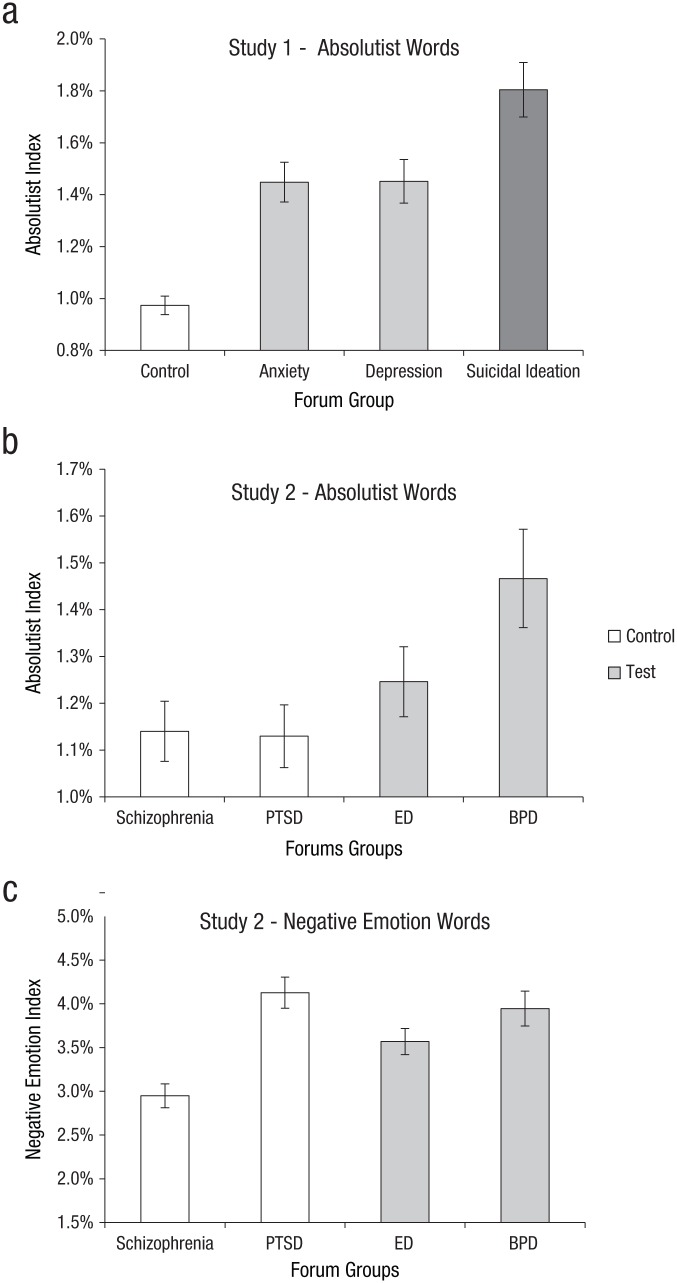
- In Study 1, the absolutist index was significantly higher in anxiety, depression, and suicidal ideation forums than in control forums: control M = 0.97%, anxiety M = 1.45% (d = 3.24), depression M = 1.45% (d = 3.14), suicidal ideation M = 1.80% (d = 4.56), all p < .001.
- Suicidal ideation forums had significantly higher absolutist use than both anxiety and depression forums (ds = 1.74 and 1.71, respectively; p < .001), while anxiety and depression did not differ significantly (p = 1.00).
- In Study 2, the absolutist index differed across mental health forums (F(3, 16) = 5.515, p = .009): BPD M = 1.47 and ED M = 1.25 were higher than PTSD M = 1.13 and schizophrenia M = 1.14, while negative emotion use did not differ between Study 2 control and test groups (M = 3.51 vs 3.71, p = .335).
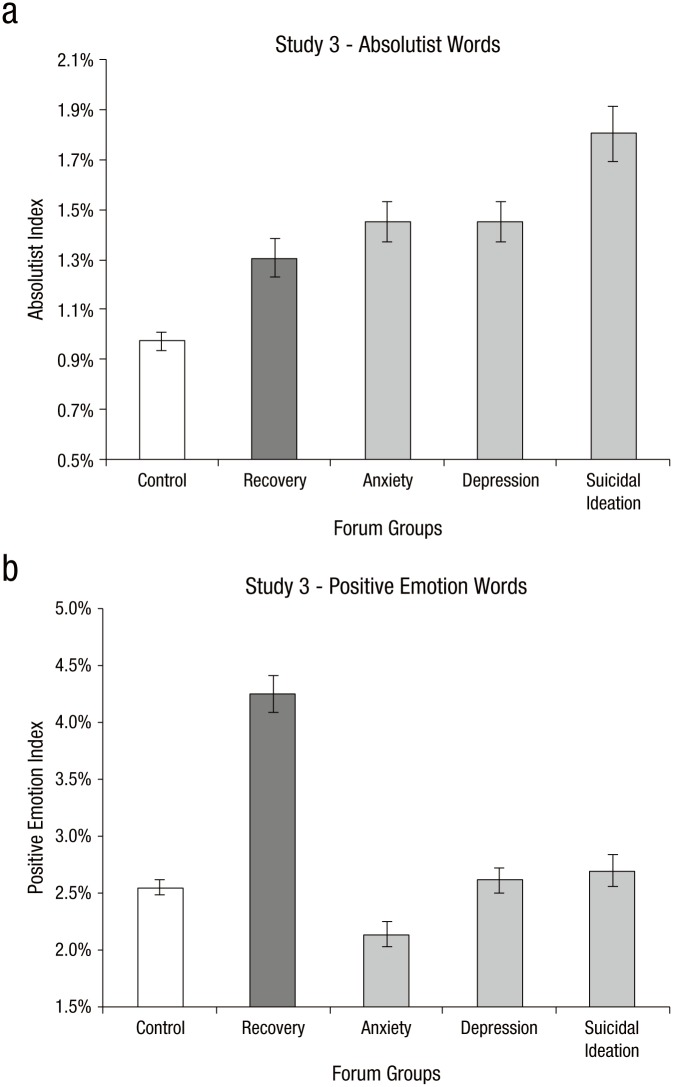
- In Study 3, recovery forums still showed elevated absolutist use versus controls (recovery M = 1.31%, p < .001, d = 0.37) and were lower than suicidal ideation forums, suggesting a possible trait-like vulnerability factor.
## Methods
- Observational text analysis of English-language Internet forums: 63 forums total, with more than 6,400 members, grouped into three studies comparing affective and nonaffective forum categories.
- Only first posts were collected; posts had to be at least 100 words, in continuous prose, and written by a representative community member. The authors aimed for 30,000 words per forum and used 1,000 bootstrap resamples plus multilevel mixed-effects models in SPSS.
- The main measure was a validated absolutist-word dictionary, contrasted with nonabsolutist words and 73 LIWC dictionaries; the authors also used confirmatory factor analysis and ANCOVA, and checked robustness with sensitivity analyses.
## Limitations
- The paper states that, because the design was large-scale and naturalistic, it had low experimental control and could only infer limited demographic characteristics from forum context.
- The identities and motivations of users were “largely unknowable,” and some users may have posted under multiple usernames or across different forums; this is an explicit limitation stated in the paper.
- The text makes evident, and the authors note, that the study is observational and cannot establish causality or within-person change over time; follow-up experimental or longitudinal studies would be needed.
Model-written summary. Check it against the paper before relying on it.
Integrity signals
Registry
Cites
Statistics
Figures
Verification
Claims the paper makes
0 Valid · 3 Not valid · 34 Not checked · 88 Own results and interpretations
A result the paper reports from its own data — it cites no other source for it, so there is none to check. The quote shows it is in the paper.
In the paper
“There was a large, significant difference in the absolutist index between the Study 1 groups, as determined by a multilevel mixed-effects model, F(3, 29) = 71.549, p < .001.”
§ In an Absolute State: Elevated Use of Absolutist Words Is a Marker Specific to Anxiety, Depression, and Suicidal Ideation > Results > Study 1
plain- Asserted: passes — The authors put it forward as true.
- Checkable: passes — It can be checked against evidence.
- Load-bearing: passes — The paper’s conclusions depend on it.
- Based: passes — The paper gives a reason why it holds.
A result the paper reports from its own data — it cites no other source for it, so there is none to check. The quote shows it is in the paper.
In the paper
“Paired comparisons revealed that the mean absolutist index for the BPD forum group (M = 1.47, SD = 1.01) was significantly greater than the PTSD (M = 1.13, SD = 0.83, p < .001, d = 0.36, 95% CI = [−0.07, −0.02]) and the schizophrenia forum groups (M = 1.14, SD = 0.86, p < .001, d = 0.35, 95% CI = [−0.07, −0.03]).”
§ In an Absolute State: Elevated Use of Absolutist Words Is a Marker Specific to Anxiety, Depression, and Suicidal Ideation > Results > Study 2
plainstates an association- Asserted: passes — The authors put it forward as true.
- Checkable: passes — It can be checked against evidence.
- Load-bearing: passes — The paper’s conclusions depend on it.
- Based: passes — The paper gives a reason why it holds.
A result the paper reports from its own data — it cites no other source for it, so there is none to check. The quote shows it is in the paper.
In the paper
“Paired comparisons showed that the absolutist index for the suicidal ideation group remained significantly greater than the control group (ps < .001, ds = 3.85–4.41), the anxiety group (ps < .001, ds = 1.39–1.71), and the depression group (ps < .001, ds = 1.37–1.69).”
§ In an Absolute State: Elevated Use of Absolutist Words Is a Marker Specific to Anxiety, Depression, and Suicidal Ideation > Results > Study 1
plainstates an association- Asserted: passes — The authors put it forward as true.
- Checkable: passes — It can be checked against evidence.
- Load-bearing: passes — The paper’s conclusions depend on it.
- Based: passes — The paper gives a reason why it holds.
A result the paper reports from its own data — it cites no other source for it, so there is none to check. The quote shows it is in the paper.
In the paper
“Like the anxiety and depression groups, the recovery group also had a significantly lower absolutist index than the suicidal ideation group (p < .001, 95% CI = [−0.06, −0.12], d = 0.50).”
§ In an Absolute State: Elevated Use of Absolutist Words Is a Marker Specific to Anxiety, Depression, and Suicidal Ideation > Results > Study 3
plainstates an association- Asserted: passes — The authors put it forward as true.
- Checkable: passes — It can be checked against evidence.
- Load-bearing: passes — The paper’s conclusions depend on it.
- Based: passes — The paper gives a reason why it holds.
A result the paper reports from its own data — it cites no other source for it, so there is none to check. The quote shows it is in the paper.
In the paper
“The highest loading words on Factor 2 were all nonabsolutist except for the absolutist word definitely.”
§ In an Absolute State: Elevated Use of Absolutist Words Is a Marker Specific to Anxiety, Depression, and Suicidal Ideation > Results > Study 1
plain- Asserted: passes — The authors put it forward as true.
- Checkable: passes — It can be checked against evidence.
- Load-bearing: unclear — It is unclear whether the paper’s conclusions depend on it.
- Based: passes — The paper gives a reason why it holds.
65 more claims
Create a free account to see all 125 claims and to verify the 2 references still open.
- Probably not a substantial claim. 44
- It may state two separate claims as one. 23
Claims other papers make about this one
Each is checked against this paper’s own text: does it say what the citing paper says it does?
The source backs part of the claim, not all of it — or backs it for a different population, condition or comparison.
In the citing paper
“The supposition is that mental distress results in over- or underestimation of threats and rewards and the use of absolute words characterises this.”
From Five studies evaluating the impact on mental health and mood of recalling, reading, and discussing fiction (2022) · cites this paper as [35]
Experimental — accuracy not yet measuredThe cited source says what the claim attributes to it.
In the citing paper
“Al-Mosaiwi and Johnstone [35] argue that the use of what they call ‘absolute words’ is a linguistic covariate of anxiety, depression, and suicidal ideation.”
From Five studies evaluating the impact on mental health and mood of recalling, reading, and discussing fiction (2022) · cites this paper as [35]
Statistics recomputed
Every reported test result, recomputed from its test statistic and degrees of freedom. A result shows as not adding up only once an independent check has confirmed it.
- ConsistentF(7, 11) = 0.754reported p = .635 · recomputed p = .635
“F(7, 11) = 0.754, p = .635”
- ConsistentF(3, 29) = 71.549reported p < .001 · recomputed p < .001
“F(3, 29) = 71.549, p < .001”
- ConsistentF(3, 3860) = 20.575reported p < .001 · recomputed p < .001
“F(3, 3860) = 20.575, p < .001”
- ConsistentF(3, 16) = 5.515reported p = .009 · recomputed p = .009
“F(3, 16) = 5.515, p = .009”
Self-check
Percentages, sums and reported differences re-computed from the paper’s own numbers.
Self-check results appear here once an independent check has confirmed them.
Citations
Cites
Mixed-effects modeling with crossed random effects for subjects and items
Baayen, R. H., Davidson, D. J., & Bates, D. M. (2008) · Journal of Memory and Language · doi:10.1016/j.jml.2007.12.005 · Cited by 8,540
(1975) · Medical Entomology and Zoology · Cited by 7,245
The Psychological Meaning of Words: LIWC and Computerized Text Analysis Methods
Tausczik, Y. R., & Pennebaker, J. W. (2010) · Journal of Language and Social Psychology · doi:10.1177/0261927x09351676 · Cited by 5,774 · cited 1×
“Text analysis research on written data from depressed and suicidal individuals has repeatedly shown elevated use of negative emotion words and pronouns (for review, see Tausczik & Pennebaker, 2010).”
Natural language processing with Python
Bird, S., Klein, E., & Loper, E. (2009) · CERN Document Server (European Organization for Nuclear Research) · Cited by 3,998
Cognitive behaviour therapy for eating disorders: a “transdiagnostic” theory and treatment
Fairburn, C. G., Cooper, Z., & Shafran, R. (2003) · Behaviour Research and Therapy · doi:10.1016/s0005-7967(02)00088-8 · Cited by 3,374
Bulletin of the Menninger Clinic
(1989) · Psychiatric Bulletin · doi:10.1192/pb.13.12.698-a · Cited by 3,365
Prevention of relapse/recurrence in major depression by mindfulness-based cognitive therapy.
Teasdale, J. D., Segal, Z. V., Williams, J. M. G., Ridgeway, V. A., Soulsby, J. M., & Lau, M. A. (2000) · Journal of Consulting and Clinical Psychology · doi:10.1037/0022-006x.68.4.615 · Cited by 3,236 · cited 2×
“It is widely acknowledged that an episode of depression increases the risk of future depressive episodes (Teasdale et al., 2000).”
The New Statistics: Why and How
Cumming, G. (2014) · Psychological Science · doi:10.1177/0956797613504966 · Cited by 3,200
Linguistic Inquiry and Word Count (LIWC): Pronounced “Luke,” . . . and Other Useful Facts
Chung, C. K., & Pennebaker, J. W. (2012) · Applied Natural Language Processing · doi:10.4018/978-1-60960-741-8.ch012 · Cited by 2,151
The psychology of suicidal behaviour
O'Connor, R. C., & Nock, M. K. (2014) · The Lancet Psychiatry · doi:10.1016/s2215-0366(14)70222-6 · Cited by 1,193
Research works printed but not linked: 2
- Ertel S. (1985). Content analysis: An alternative approach to open and closed minds. High School Journal, 68, 229– 240.
- Pennebaker J. W. Booth R. J. Boyd R. L. Francis M. E. (2015). Linguistic Inquiry and Word Count: LIWC2015. Austin, TX: Pennebaker Conglomerates.
Cited by
Trotzek, M., Koitka, S., & Friedrich, C. M. (2020) · IEEE Transactions on Knowledge and Data Engineering · doi:10.1109/tkde.2018.2885515 · Cited by 226
“A recent study based on English forum posts [19] observed an elevated use of absolutist words (e.”
BackgroundSquires, M., Tao, X., Elangovan, S., Gururajan, R., Zhou, X., Acharya, U. R., & Li, Y. (2023) · Brain Informatics · doi:10.1186/s40708-023-00188-6 · Cited by 224
“Given, the established relationship between psychological health and language use [115–119], Carrillo et al. [10] first show that a Gaussian Naive Bayes classifier could distinguish between individuals suffering from depression, and healthy controls.”
BackgroundIndividuals with depression express more distorted thinking on social media
Bathina, K. C., ten Thij, M., Lorenzo‐Luaces, L., Rutter, L. A., & Bollen, J. (2021) · Nature Human Behaviour · doi:10.1038/s41562-021-01050-7 · Cited by 174
How Are Curiosity and Interest Different? Naïve Bayes Classification of People’s Beliefs
Donnellan, E., Aslan, S., Fastrich, G. M., & Murayama, K. (2021) · Educational Psychology Review · doi:10.1007/s10648-021-09622-9 · Cited by 153
Robinson, A., Bonnette, A., Howard, K., Ceballos, N., Dailey, S., Lu, Y., & Grimes, T. (2019) · Journal of Applied Biobehavioral Research · doi:10.1111/jabr.12158 · Cited by 76
Prediction of postpartum depression using machine learning techniques from social media text
Fatima, I., Abbasi, B. U. D., Khan, S., Al‐Saeed, M., Ahmad, H. F., & Mumtaz, R. (2019) · Expert Systems · doi:10.1111/exsy.12409 · Cited by 84
“A recent research found higheruse of absolutist words in mental health-related forums (Al-Mosaiwi & Johnstone, 2018).”
BackgroundMethodA Survey of Computational Methods for Online Mental State Assessment on Social Media
Ríssola, E. A., Losada, D. E., & Crestani, F. (2021) · ACM Transactions on Computing for Healthcare · doi:10.1145/3437259 · Cited by 81
“Moreover, these lexica are usually extended with other ad hoc lexica [2, 28, 73, 84] built for specific”
BackgroundHistorical language records reveal a surge of cognitive distortions in recent decades
Bollen, J., ten Thij, M., Breithaupt, F. A., Barron, A. T. J., Rutter, L. A., Lorenzo‐Luaces, L., & Scheffer, M. (2021) · Proceedings of the National Academy of Sciences · doi:10.1073/pnas.2102061118 · Cited by 94
Acoustic and language analysis of speech for suicidal ideation among US veterans
Belouali, A., Gupta, S., Sourirajan, V., Yu, J., Allen, N. J., Alaoui, A., Dutton, M. A., & Reinhard, M. J. (2021) · BioData Mining · doi:10.1186/s13040-021-00245-y · Cited by 88
Linguistic features of suicidal thoughts and behaviors: A systematic review
Homan, S., Gabi, M., Klee, N., Bachmann, S., Moser, A.-M., Duri', M., Michel, S., Bertram, A.-M., Maatz, A., Seiler, G., et al. (2022) · Clinical Psychology Review · doi:10.1016/j.cpr.2022.102161 · Cited by 93
Revealing semantic and emotional structure of suicide notes with cognitive network science
Teixeira, A. S., Talaga, S., Swanson, T., & Stella, M. (2021) · Scientific Reports · doi:10.1038/s41598-021-98147-w · Cited by 69
Belief traps: Tackling the inertia of harmful beliefs
Scheffer, M., Borsboom, D., Nieuwenhuis, S., & Westley, F. R. (2022) · Proceedings of the National Academy of Sciences · doi:10.1073/pnas.2203149119 · Cited by 66
“, always, never, totally, ever, never, and must) (103, 104).”
Detection of Depression Severity in Social Media Text Using Transformer-Based Models
Qasim, A., Mehak, G., Hussain, N., Gelbukh, A. F., & Sidorov, G. (2025) · Information · doi:10.3390/info16020114 · Cited by 107
Victor, E., Aghajan, Z. M., Sewart, A. R., & Christian, R. (2019) · Psychological Assessment · doi:10.1037/pas0000724 · Cited by 57
Screening for Depression Using Natural Language Processing: Literature Review
Teferra, B. G., Rueda, A., Pang, H. Y. M., Valenzano, R., Samavi, R., Krishnan, S., & Bhat, V. (2024) · Interactive Journal of Medical Research · doi:10.2196/55067 · Cited by 86
“NLP techniques for depression detection often analyze textual data to extract linguistic cues, sentiment, and cognitive patterns related to depression [14,29,30,32].”
BackgroundMethodText-guided multimodal depression detection via cross-modal feature reconstruction and decomposition
Chen, Z., Wang, D., Lou, L., Zhang, S., Zhao, X., Jiang, S., Yu, J., & Xiao, J. (2024) · Information Fusion · doi:10.1016/j.inffus.2024.102861 · Cited by 62
Xezonaki, D., Paraskevopoulos, G., Potamianos, A., & Narayanan, S. S. (2020) · Interspeech (USB) · doi:10.21437/interspeech.2020-2819 · Cited by 73
“They tend to use more absolutist words [3], negatively valenced-words and the pronoun “I” [4] and mention pharmaceutical treatment for depressive disorder [5, 6].”
BackgroundUsing language in social media posts to study the network dynamics of depression longitudinally
Kelley, S., & Gillan, C. M. (2022) · Nature Communications · doi:10.1038/s41467-022-28513-3 · Cited by 75
Understanding Depression from Psycholinguistic Patterns in Social Media Texts
Trifan, A., Antunes, R., Matos, S., & Oliveira, J. L. (2020) · Lecture notes in computer science · doi:10.1007/978-3-030-45442-5_50 · Cited by 76
“A recent study on absolutist thinking, which is considered a cognitive distortion by most cognitive therapies for anxiety and depression, showed that anxiety, depression, and suicidal ideation forums contained more absolutist words than control forums [3].”
BackgroundStamatis, C. A., Meyerhoff, J., Liu, T., Sherman, G. T., Wang, H., Liu, T., Curtis, B. L., Ungar, L., & Mohr, D. C. (2022) · Depression and Anxiety · doi:10.1002/da.23286 · Cited by 50
Ríssola, E. A., Aliannejadi, M., & Crestani, F. (2022) · Information Processing & Management · doi:10.1016/j.ipm.2022.102890 · Cited by 50
Artificial intelligence and the psychology of human connection
Boyd, R. L., & Markowitz, D. M. (2026) · Perspectives on Psychological Science · doi:10.1177/17456916251404394 · Cited by 62
“…2021); (c) cognitive processing words (e.g., “think,” “because”) reflect active reasoning (R. L. Moore et al., 2021; Ta-Johnson et al., 2022; Tausczik & Pennebaker, 2010); and (d) absolutist terms (e.g., “always,” “never”) reflect more rigid thought patterns (Al-Mosaiwi & Johnstone, 2018a, 2018b).”
Beyond Modelling: Understanding Mental Disorders in Online Social Media
Ríssola, E. A., Aliannejadi, M., & Crestani, F. (2020) · Lecture notes in computer science · doi:10.1007/978-3-030-45439-5_20 · Cited by 47
“The same situation was observed when considering the set of absolutist terms 13 derived from the work of Al-Mosaiwi et al. [1], who concluded that the elevated use of absolutist words is a marker specific to anxiety, depression, and suicidal ideation.”
BackgroundFake Online Reviews: A Unified Detection Model Using Deception Theories
Abdulqader, M., Namoun, A., & Alsaawy, Y. (2022) · IEEE Access · doi:10.1109/access.2022.3227631 · Cited by 55
“We used the validated list of nineteen absolutist words which was provided by M. Al-Mosaiwi et al.[196] to calculate the ratio of using these terms in a review text.”
MethodShan, G., Lina, Z., & Zhang, D. (2020) · Information & Management · doi:10.1016/j.im.2020.103349 · Cited by 47
Dwyer, A., Neto, A. D. A., Estival, D., Li, W., Lam‐Cassettari, C., & Antoniou, M. (2021) · JMIR Mental Health · doi:10.2196/19478 · Cited by 50
“A content analysis comparing letters posted in online self-help groups for suicide, depression, and anxiety with letters posted in a control group [74] found that use of absolutist words was a better predictor of suicidal ideation than use of negative valence words or first-person pronouns [73,74] and can thus be a sp…”
BackgroundReintroducing the Effortless Assessment Research System (EARS)
Lind, M. N., Kahn, L. E., Crowley, R. N., Reed, W., Wicks, G., & Allen, N. B. (2023) · JMIR Mental Health · doi:10.2196/38920 · Cited by 56
“We also offer features that measure first-person pronoun use and absolutist language, which are related to mental health, especially indices of depression and suicide risk [4,5].”
BackgroundTRIFU, R. N., Nemeş, B., Herta, D. C., Hațegan, C. B., Talaș, D. A., & Coman, H. G. (2024) · Frontiers in Psychology · doi:10.3389/fpsyg.2024.1355734 · Cited by 61
Evaluating Acoustic and Linguistic Features of Detecting Depression Sub-Challenge Dataset
Zhang, L., Driscol, J., Chen, X., & Ghomi, R. H. (2019) · doi:10.1145/3347320.3357693 · Cited by 45
Natural language processing for cognitive therapy: Extracting schemas from thought records
Burger, F., Neerincx, M. A., & Brinkman, W. (2021) · PLoS ONE · doi:10.1371/journal.pone.0257832 · Cited by 44
Intelligent depression detection with asynchronous federated optimization
Li, J., Ming, J., Qin, Y., Zhang, R., & Ling, S. H. (2022) · Complex & Intelligent Systems · doi:10.1007/s40747-022-00729-2 · Cited by 39
“Al-Mosaiwi et al. [9] have proposed a novel model based on user-generated content.”
BackgroundThe Language of Pain: Is There a Relationship Between Metaphor Use and Adjustment to Chronic Pain?
Munday, I., Kneebone, I., Rogers, K. D., & Newton-John, T. R. O. (2021) · Pain Medicine · doi:10.1093/pm/pnaa467 · Cited by 39
Morphological characteristics of spoken language in schizophrenia patients – an exploratory study
Ziv, I., Baram, H., Bar, K., Zilberstein, V., Itzikowitz, S., Harel, E. V., & Dershowitz, N. (2021) · Scandinavian Journal of Psychology · doi:10.1111/sjop.12790 · Cited by 39
A voice without a mouth no more: The neurobiology of language and consciousness
Skipper, J. I. (2022) · Neuroscience & Biobehavioral Reviews · doi:10.1016/j.neubiorev.2022.104772 · Cited by 31
“wellbeing, mental health, and recovery from mental health problems (Al-Mosaiwi and Johnstone, 2018; D’Andrea et al., 2012; Fast and Funder, 2008; Luhmann, 2017; Pennebaker et al., 2014, 2003; Penzel et al., 2017; Pressman and Cohen, 2007; Robinson et al., 2013; Rude et al., 2004).”
Detecting Depression With Heterogeneous Graph Neural Network in Clinical Interview Transcript
Li, M., Sun, X. N., & Wang, M. (2023) · IEEE Transactions on Computational Social Systems · doi:10.1109/tcss.2023.3263056 · Cited by 36
The ‘L-factor’: Language as a transdiagnostic dimension in psychopathology
Hinzen, W., & Palaniyappan, L. K. (2024) · Progress in Neuro-Psychopharmacology and Biological Psychiatry · doi:10.1016/j.pnpbp.2024.110952 · Cited by 40
SetembroBR: a social media corpus for depression and anxiety disorder prediction
dos Santos, W. R., de Oliveira, R. L., & Paraboni, I. (2023) · Language Resources and Evaluation · doi:10.1007/s10579-022-09633-0 · Cited by 46
“The use of absolute terms (e.g., all, always, etc.) is also more strongly correlated with individuals with depression (Al-Mosaiwi & Johnstone, 2018), as well as the use of negative expressions on certain media (Seabrook et al., 2018).”
Cognitive rigidity in patients with depression and fibromyalgia
Aguilera, M., Paz, C., Compañ, V., Medina, J. C., & Feixas, G. (2019) · International Journal of Clinical and Health Psychology · doi:10.1016/j.ijchp.2019.02.002 · Cited by 43
“An ‘‘all-or-nothing’’ thinking pattern (a tendency to extreme or catastrophic thinking) has been described as a core aspect of depressive cognition (Al-Mosaiwi & Johnstone, 2018; Antoniou, Bongers, & Jansen, 2017).”
BackgroundFeature Attention Network: Interpretable Depression Detection from Social Media.
Song, H., You, J., Chung, J., & Park, J. C. (2018) · Institutional Repositories DataBase (IRDB) · Cited by 94
Approximating the Mental Lexicon from Clinical Interviews as a Support Tool for Depression Detection
Villatoro-Tello, E., Ramírez-de-la-Rosa, G., Gática-Pérez, D., Magimai.-Doss, M., & Jiménez-Salazar, H. (2021) · INTERNATIONAL CONFERENCE ON MULTIMODAL INTERACTION · doi:10.1145/3462244.3479896 · Cited by 42
Funkhouser, C. J., Trivedi, E., Li, L. Y., Helgren, F., Zhang, E., Sritharan, A., Cherner, R., Pagliaccio, D., Durham, K., Kyler, M., et al. (2023) · Journal of Child Psychology and Psychiatry · doi:10.1111/jcpp.13931 · Cited by 42
A Critical Review of Multimodal-multisensor Analytics for Anxiety Assessment
Senaratne, H., Oviatt, S. L., Ellis, K., & Melvin, G. A. (2022) · ACM Transactions on Computing for Healthcare · doi:10.1145/3556980 · Cited by 42
“, words, phrases, and ideas that denote totality, either of magnitude or probability) [1] occur in high rates in anxious populations when expressing themselves in online forums”
BackgroundZhang, Y., Folarin, A., Dineley, J., Conde, P., de Angel, V., Sun, S., Ranjan, Y., Rashid, Z., Stewart, C., Laiou, P., et al. (2024) · Journal of Affective Disorders · doi:10.1016/j.jad.2024.03.106 · Cited by 39
Jones, L. S., Anderson, E., Loades, M. E., Barnes, R., & Crawley, E. M. (2019) · Clinical Psychology & Psychotherapy · doi:10.1002/cpp.2417 · Cited by 27
“…of language use and depression: negative emotion, positive emotion, first-person pronouns, causation, insight, discrepancy, past-focus, future-focus, and absolutist words (Rude, et al., 2004; Molendijk et al., 2010; Arntz et al., 2012; Zimmermann et al., 2017; Al-Mosaiwi & Johnstone, 2018).”
BackgroundMethodInfluentialMori, K., & Haruno, M. (2020) · Journal of Personality · doi:10.1111/jopy.12578 · Cited by 28
“A text analysis of Internet forums also indicated that words used in anxiety, depression, and suicidal ideation forums were different from words used in other forums (Al-Mosaiwi & Johnstone, 2018).”
MethodCarney, J., & Robertson, C. (2022) · PLOS ONE · doi:10.1371/journal.pone.0266323 · Cited by 25
“Absolute words: Al-Mosaiwi and Johnstone [35] argue that the use of what they call ‘absolute words’ is a linguistic covariate of anxiety, depression, and suicidal ideation.”
BackgroundDepression Detection from Social Media Profiles
Станкевич, М., Smirnov, I., Kiselnikova, N. V., & Ushakova, A. (2020) · Communications in computer and information science · doi:10.1007/978-3-030-51913-1_12 · Cited by 34
Toward Linguistic Recognition of Generalized Anxiety Disorder
Rook, L., Mazza, M. C., Lefter, I., & Brazier, F. M. T. (2022) · Frontiers in Digital Health · doi:10.3389/fdgth.2022.779039 · Cited by 31
“The minimum word count for the writings was set at 100 words, which was consistent with previous studies (51).”
Herbert, C., Bendig, E., & Rojas, R. (2019) · Frontiers in Psychology · doi:10.3389/fpsyg.2018.02522 · Cited by 33
Mental Disorder Detection via Social Media Mining using Deep Learning
Kholifah, B., Syarif, I., & Badriyah, T. (2020) · Kinetik Game Technology Information System Computer Network Computing Electronics and Control · doi:10.22219/kinetik.v5i4.1120 · Cited by 32
Briffault, X., Morgiève, M., & Courtet, P. (2018) · Brain Sciences · doi:10.3390/brainsci8060098 · Cited by 23
“Automated analysis of his text messages shows significant use of a lexical field associated with anxiety, exhaustion and panic [59], while automatic analysis of his voice during communications also shows anxious elements in communications with his wife, and elements of depression and emotional restriction in his excha…”
BackgroundAbsolutist Words From Search Volume Data Predict State-Level Suicide Rates in the United States
Adam‐Troian, J., & Arciszewski, T. (2020) · Clinical Psychological Science · doi:10.1177/2167702620916925 · Cited by 23
“suicide, absolutist thinking, prediction, search query, U.S. states, open data Received 7/25/19; Revision accepted 12/29/19 Currently, it is established that increased absolutist thinking is associated with anxiety, depression, and suicidal ideation (Al-Mosaiwi & Johnstone, 2018).”
BackgroundMethodInfluentialAdam‐Troian, J., Bonetto, É., & Arciszewski, T. (2021) · Social Psychological and Personality Science · doi:10.1177/1948550620987672 · Cited by 30
“One possibility consists in gathering word counts from online sources (e.g., social media, blogs posts, online searches, see Al-Mosaiwi & Johnstone, 2018; Mooijman et al., 2018) that reflect aggregated psychological states (Pennebaker & King, 1999).”
BackgroundHiQuE: Hierarchical Question Embedding Network for Multimodal Depression Detection
Jung, J., Kang, C., Yoon, J., Kim, S., & Han, J. (2024) · ACM International Conference on Information and Knowledge Management (CIKM) · doi:10.1145/3627673.3679797 · Cited by 41
“Moreover, they often reveal negative emotions in language, utilize a higher frequency of first-person pronouns, and exhibit intense focus on specific words [3, 61, 85].”
BackgroundDuro, E. S. D., Improta, R., & Stella, M. (2025) · Emerging Trends in Drugs Addictions and Health · doi:10.1016/j.etdah.2025.100170 · Cited by 53
Neurocognition and the Suicidal Process
Rutter, S., Cipriani, N., Smith, E. C., Ramjas, E., Vaccaro, D. H., Lopez, M. M., Calabrese, W. R., Torres, D., Campos-Abraham, P., Llaguno, M., et al. (2020) · Current topics in behavioral neurosciences · doi:10.1007/7854_2020_162 · Cited by 26
Dirty laundry: The nature and substance of seeking relationship help from strangers online
Entwistle, C., Horn, A. B., Meier, T., & Boyd, R. L. (2021) · Journal of Social and Personal Relationships · doi:10.1177/02654075211046635 · Cited by 23
A Hybrid Model for Depression Detection With Transformer and Bi-directional Long Short-Term Memory
Zhang, Y., He, Y. H., Rong, L., & Ding, Y. (2022) · IEEE International Conference on Bioinformatics and Biomedicine (BIBM) · doi:10.1109/bibm55620.2022.9995184 · Cited by 32
“It has been shown that depression affects the use of language, depressed individuals tend to use more absolutist words [16], negatively valenced-words and the pronoun “I” [17] and mention pharmaceutical treatment for depressive disorder [18], [19].”
BackgroundWhat users’ musical preference on Twitter reveals about psychological disorders
Alavijeh, S. Z., Zarrinkalam, F., Noorian, Z., Mehrpour, A., & Etminani, K. (2023) · Information Processing & Management · doi:10.1016/j.ipm.2023.103269 · Cited by 29
A Dataset for Research on Depression in Social Media
Ríssola, E. A., Bahrainian, S. A., & Crestani, F. (2020) · ACM Conference on User Modeling, Adaptation and Personalization (UMAP) · doi:10.1145/3340631.3394879 · Cited by 25
“Many useful cues about an individual’s mental state [26, 27] as well as personality [22, 29], social and emotional conditions, and even personal values [5] can be discovered by examining the patterns of language use [1, 8].”
BackgroundEmotion-based Modeling of Mental Disorders on Social Media
Guo, X., Sun, Y., & Vosoughi, S. (2021) · IEEE/WIC/ACM International Conference on Web Intelligence · doi:10.1145/3486622.3493916 · Cited by 32
“However, these content-based features capture “vulnerability factors” which still exist even after patients have recovered [1] and are influenced by topical information [17], which raises doubts about the generalizability of the current unprompted”
BackgroundMethod“Because... I was told... so much”: Linguistic Indicators of Mental Health Status on Twitter
Weerasinghe, J., Morales, K., & Greenstadt, R. (2019) · Proceedings on Privacy Enhancing Technologies · doi:10.2478/popets-2019-0063 · Cited by 23
Special issue: Discourse analysis perspectives on online health communication
Koteyko, N., & Hunt, D. S. (2018) · Discourse Context & Media · doi:10.1016/j.dcm.2018.08.002 · Cited by 21
“networking sites that focuses on the lexical (Al-Mosaiwi and Johnstone, 2018) or visual (Reece and Danforth, 2017) content produced by individuals.”
BackgroundSemantic Characteristics of Schizophrenic Speech
Bar, K., Zilberstein, V., Ziv, I., Baram, H., Dershowitz, N., Itzikowitz, S., & Harel, E. V. (2019) · Workshop on Computational Linguistics and Clinical Psychology (CLPsych) · doi:10.18653/v1/w19-3010 · Cited by 27
“For example, Al-Mosaiwi and Johnstone (2018) conducted a study in which they analyzed 63 web forums, some related to mental health disorders and others used as control.”
BackgroundWang, B., Wu, Y., Taylor, N., Lyons, T., Liakata, M., Nevado‐Holgado, A. J., & Saunders, K. (2020) · Interspeech (USB) · doi:10.21437/interspeech.2020-3040 · Cited by 29
“Finally, we add the number of absolutist words per word (ABS/W) as a feature using a 19-word absolutist dictionary curated by clinical psychologists [26], who found that the online anxiety, depression, and suicidal ideation forums contained more absolutist words than the control ones.”
MethodIn Search of State and Trait Emotion Markers in Mobile-Sensed Language: Field Study
Carlier, C., Niemeijer, K., Mestdagh, M., Bauwens, M., Vanbrabant, P., Geurts, L., van Waterschoot, T., & Kuppens, P. (2022) · JMIR Mental Health · doi:10.2196/31724 · Cited by 22
“At the trait level, the exclamation marks seemed promising at first but turned nonsignificant after FDR correction, meaning this study was not able to replicate earlier findings with anxiety and depression [23,53,55-60].”
BackgroundResultInfluentialEmotion-dependent language featuring depression
Yang, C., Zhang, X., Chen, Y., Li, Y., Yu, S., Zhao, B., Wang, T., Luo, L., & Gao, S. (2023) · Journal of Behavior Therapy and Experimental Psychiatry · doi:10.1016/j.jbtep.2023.101883 · Cited by 18
Liaw, A. S., & Chua, H. N. (2022) · IEEE International Conference on Artificial Intelligence in Engineering and Technology (IICAIET) · doi:10.1109/iicaiet55139.2022.9936814 · Cited by 17
“Likes) Average Tweet Length [7] Count of Absolutist Words [19]”
BackgroundAssessing Users' Mental Status from their Journaling Behavior through Chatbots
Kawasaki, M., Yamashita, N., Lee, Y., & Nohara, K. (2020) · ACM International Conference on Intelligent Virtual Agents (IVA) · doi:10.1145/3383652.3423870 · Cited by 22
“According to [29], when people are depressed, they become too busy focusing on their own feelings and have little space for others.”
BackgroundExamining social reinforcement learning in social anxiety
Beltzer, M., Daniel, K. E., Daros, A. R., & Teachman, B. A. (2023) · Journal of Behavior Therapy and Experimental Psychiatry · doi:10.1016/j.jbtep.2022.101810 · Cited by 18
Yahya, N. H., & Rahim, H. A. (2023) · Language and Health · doi:10.1016/j.laheal.2023.10.001 · Cited by 20
Gopalakrishnan, A., Gururajan, R., Venkataraman, R., Zhou, X., Ching, K. C., Ramachandran, A. S., & Sen, M. (2023) · Brain Informatics · doi:10.1186/s40708-023-00206-7 · Cited by 25
“Many studies have attempted to identify depressed individuals by analyzing language use in social media, focusing on differences in word usage between depressed and non-depressed groups [7–12].”
BackgroundUsing absolutist word frequency from online searches to measure population mental health dynamics
Adam‐Troian, J., Bonetto, É., & Arciszewski, T. (2022) · Scientific Reports · doi:10.1038/s41598-022-06392-4 · Cited by 16
Dean, H. J., & Boyd, R. L. (2020) · Journal of Affective Disorders · doi:10.1016/j.jad.2020.01.098 · Cited by 24
Depression Detection from Social Media Texts.
Станкевич, М., Latyshev, A., Kuminskaya, E. A., Smirnov, I., & Grigoriev, O. G. (2019) · DAMDID/RCDL · Cited by 37
Advances in Emotion Recognition: Link to Depressive Disorder
Cheng, X., Wang, X., Ouyang, T.-T., & Feng, Z. (2020) · IntechOpen eBooks · doi:10.5772/intechopen.92019 · Cited by 19
“This suggests that absolutist thinking may be a vulnerability factor for relapse of affective disorder [70].”
BackgroundCohen, K. A., Shroff, A., Nook, E. C., & Schleider, J. L. (2022) · PsyArXiv (OSF Preprints) · doi:10.1016/j.brat.2022.104220 · Cited by 18
Linguistic markers of moderate and absolute natural language
Al-Mosaiwi, M., & Johnstone, T. (2018) · Personality and Individual Differences · doi:10.1016/j.paid.2018.06.004 · Cited by 19
Self-citationDepression Severity Detection Using Read Speech with a Divide-and-Conquer Approach
Kwon, N., & Kim, S. (2021) · Annual International Conference of the IEEE Engineering in Medicine and Biology Society (EMBC) · doi:10.1109/embc46164.2021.9629868 · Cited by 19
“In this regard, we use voice as researchers found that there are language patterns in the depression patients’ word usage and speech changes in their pitch, tone, pauses, etc. [5], [6], [7].”
MethodUs Versus Them? The Problem of Cognitive Distortions in Policing
Wolfe, S. E., McLean, K. D., Alpert, G. P., & Rojek, J. J. (2024) · Police Quarterly · doi:10.1177/10986111241234310 · Cited by 22
“…more likely to experience a variety of dif fi culties, including impulsive decision making, eating disorders, suicidal ideation, and borderline personality disorder among others (Al-Mosaiwi & Johnstone, 2018; Arntz & ten Haaf, 2012; Byrne et al., 2008; Litinsky & Haslam, 1998; Mobini et al., 2006).”
Baklund, L., Røssberg, J. I., & Møller, P. (2022) · EClinicalMedicine · doi:10.1016/j.eclinm.2022.101733 · Cited by 19
Depression Detection from Bangla Facebook Status using Machine Learning Approach
Billah, M., & Hassan, E. (2019) · International Journal of Computer Applications · doi:10.5120/ijca2019919314 · Cited by 18
“They uses an excessive amount of words conveying negative emotions, specially negative adjectives and adverbs – such as “lonely”, “sad” or “miserable” [13].”
BackgroundTeng, S., Liu, J., Kumar Jain, R., Chai, S., Hou, R., Tateyama, T., Lin, L., & Chen, Y.-W. (2025) · 2025 47th Annual International Conference of the IEEE Engineering in Medicine and Biology Society (EMBC) · doi:10.1109/embc58623.2025.11253093 · Cited by 12
“Identifying such patterns requires structured evaluation, yet current LLMs struggle with this task [7].”
Morini, V., Citraro, S., Sajno, E., Sansoni, M., Riva, G., Stella, M., & Rossetti, G. (2024) · Computers in Human Behavior Reports · doi:10.1016/j.chbr.2024.100542 · Cited by 21
Tracking pregnant women’s mental health through social media: an analysis of reddit posts
Dhankar, A., & Katz, A. (2023) · JAMIA Open · doi:10.1093/jamiaopen/ooad094 · Cited by 13
“25 Even though this model was not trained on data specific to pregnancy, it should be able to detect depressive posts in pregnancy-related subreddits because depressive posts tend to share similar linguistics and semantics, 26,27 and the model was trained on a dataset containing subreddit posts.”
MethodA Comprehensive Analysis of Speech Depression Recognition Systems
Hassan, A., & Bernadin, S. (2024) · IEEE SoutheastCon · doi:10.1109/southeastcon52093.2024.10500078 · Cited by 14
“Recent studies reveal a distinct acoustic profile in depressed speech, with changes in fundamental frequency and formants, high-lighting acoustic features as potential objective markers for depression detection (24)(25)(26).”
Backgroundvan Cuylenburg, H. C., & Ginige, T. N. D. S. (2021) · International Conference on UK-China Emerging Technologies (UCET) · doi:10.1109/ucet54125.2021.9674993 · Cited by 11
Robertson, C., Carney, J., & Trudell, S. (2023) · Current Research in Behavioral Sciences · doi:10.1016/j.crbeha.2023.100104 · Cited by 14
Client and Therapist Psychotherapy Sentiment Interaction Throughout Therapy
Syzdek, B. M. (2020) · Psychological Studies · doi:10.1007/s12646-020-00567-7 · Cited by 16
Miner, A. S., Fleming, S. L., Haque, A., Fries, J., Althoff, T., Wilfley, D. E., Agras, W. S., Milstein, A. S., Hancock, J. T., Asch, S. M., et al. (2022) · npj Mental Health Research · doi:10.1038/s44184-022-00020-9 · Cited by 28
“A non-judgmental stance is created and maintained in many ways, but one approach is to avoid absolutist language (e.g., “ always ” , “ never ” ) 105 .”
BackgroundMalins, S., Figueredo, G. P., Jilani, T. A., Long, Y., Andrews, J. A., Rawsthorne, M., Manolescu, C., Clos, J., Higton, F., Waldram, D., et al. (2022) · JMIR Medical Informatics · doi:10.2196/38168 · Cited by 13
“Al Mosaiwi and Johnstone [51] Fewer absolutes (always, never, and everything)”
BackgroundAng, C. S., & Venkatachala, R. (2023) · Societies · doi:10.3390/soc13050117 · Cited by 10
Abramski, K., Ciringione, L., Rossetti, G., & Stella, M. (2024) · Computers in Human Behavior · doi:10.1016/j.chb.2024.108266 · Cited by 21
The Recursive Cycle of Perceived Mindset and Psychological Distress in College
Kroeper, K. M., Hildebrand, L. K., Jiang, T., Hernandez-Colmenares, A., Brown, K., Wilk, A. V., Spencer, S. J., Heckler, A. F., & Fujita, K. (2024) · Social Psychological and Personality Science · doi:10.1177/19485506241247384 · Cited by 12
“Second, people experiencing distress tend to engage in negative thinking patterns (Beck, 2016; Shickel et al., 2020), such as overgeneralization and absolutist ‘‘all-or-nothing’’ thinking (Al-Mosaiwi & Johnstone, 2018; Antoniou et al., 2017; Yeager & Dweck, 2023).”
Identifying Depression-Related Behavior on Facebook—An Experimental Study
Kmetty, Z., & Bozsonyi, K. (2022) · Social Sciences · doi:10.3390/socsci11030135 · Cited by 14
“Three primary digital traces were studied: search engines (McCarthy 2010; Hagihara et al. 2012; Kristoufek et al. 2016; Tran et al. 2017), forums (Al-Mosaiwi and Johnstone 2018; De Choudhury et al. 2016; De Choudhury and Kiciman 2017), and social media platforms.”
BackgroundPHQ-V/GAD-V: Assessments to Identify Signals of Depression and Anxiety from Patient Video Responses
Grimm, B., Talbot, B., & Larsen, L. (2022) · Applied Sciences · doi:10.3390/app12189150 · Cited by 13
Affective Computing and Emotion-Sensing Technology for Emotion Recognition in Mood Disorders
Sinha, N. (2021) · Studies in fuzziness and soft computing · doi:10.1007/978-3-030-70111-6_16 · Cited by 13
Wu, X., Wang, Z., Zhang, H., Yuan, P., Yu, Q., Zhou, Z., & Zhao, Q. (2021) · Frontiers in Psychology · doi:10.3389/fpsyg.2021.600268 · Cited by 14
“On the other hand, because of the novelty of INL, which can help individuals to view things from multiple perspectives and improve their understanding of the same thing, INL could also improve individuals’ cognitive flexibility, which is defined as the ability of human beings to change cognitive processing strategies…”
Background
Metadata
- Authors
- Al-Mosaiwi, M., & Johnstone, T.
- Affiliations
- University of Reading (GB)
- Corresponding author
- Al-Mosaiwi, Mohammed
- Venue
- Clinical Psychological Science
- Publisher
- SAGE Publications
- Published
- 2018-01-05
- Volume
- 6
- Issue
- 4
- Pages
- 529-542
- ISSN
- 2167-7026 (ISSN-L)
- 2167-7034
- PMC
- PMC6376956
- OpenAlex
- W2769128147
- Semantic Scholar
- 3dfc2256db6a4f30cd63104166c6de6e23ffeb2e
- Cited by
- 304
- References
- 76
- Citations by year
- 2026: 41 · 2025: 37 · 2024: 34 · 2023: 25 · 2022: 51 · 2021: 40 · 2020: 31 · 2019: 30 · 2018: 15
- FWCI
- 39.26
- Type
- journal article
- Language
- en
- Update notices
- correction (2019-04-10)
- Open access
- hybrid
- doi.org
- Licence
- cc-by
- journals.sagepub.com/page/policies/text-and-data-mining-license (tdm)
- Locations
- Clinical Psychological Science (publishedVersion, cc-by)
- Europe PMC (PubMed Central) (publishedVersion, cc-by)
- PubMed Central (publishedVersion, cc-by)
- PubMed (publishedVersion)
- CentAUR (University of Reading) (submittedVersion, public-domain)
- Swinburne figshare (Swinburne University of Technology) (submittedVersion)
- Funders
- University of Reading
- Medical Research Council
- Topics
- Social Sciences › Psychology › Social Psychology › Mental Health via Writing
- Social Sciences › Psychology › Experimental and Cognitive Psychology › Anxiety, Depression, Psychometrics, Treatment, Cognitive Processes
- Social Sciences › Psychology › Clinical Psychology › Suicide and Self-Harm Studies
- Keywords
- cognitive distortions, anxiety, depression, suicidal ideation, online forums, recovery from depression, vulnerability factors
About these checks
Registry, retraction, Cites and statistics results are computed, not judged, with one exception: a printed reference that no index lists is read once by a model before it counts as a citation error. Claims are extracted by a model and kept only when their quote appears verbatim in the text; each cited source is then checked, with a model’s help, for whether it says what the claim relies on. Those verdicts can be wrong — read the claim’s quote and the cited source before relying on one.
The claim verdicts this report counts are experimental: their accuracy is not yet measured.
A language model drew the claims from the paper on 2026-10-11, under version 3 of the claim definition (model deepseek-v4.1-flash, prompt extract-v3).
A second model labelled each claim on 2026-10-11 (model jev-1.13-20260917, definition revision gold-guideline-v0.2).
Statistics and arithmetic are recomputed, not judged.
Confidence bands are shown only for fields calibrated on our annotated test set. None is calibrated yet, so no band is shown.
What counts as a claim ›How we measure confidence ›How we check this ›
Are you an author, or do you see a problem with this page? Request a review
Data sources
Bibliographic data: Semantic Scholar, OpenAlex, Crossref.
Contains information from the Semantic Scholar Academic Graph Datasets, made available under the ODC Attribution License (ODC-BY 1.0).
Semantic Scholar’s data is described in: Kinney, R., et al. (2023). The Semantic Scholar Open Data Platform. arXiv:2301.10140.
