

In an Absolute State: Elevated Use of Absolutist Words Is a Marker Specific to Anxiety, Depression, and Suicidal Ideation
Open accessThe DOI matches its Crossref record; 73 of the 76 references it cites were found in a registry or an index; 1 of the 54 sources its claims cite were checked for support.
Abstract
Absolutist thinking is considered a cognitive distortion by most cognitive therapies for anxiety and depression. Yet, there is little empirical evidence of its prevalence or specificity. Across three studies, we conducted a text analysis of 63 Internet forums (over 6,400 members) using the Linguistic Inquiry and Word Count software to examine absolutism at the linguistic level. We predicted and found that anxiety, depression, and suicidal ideation forums contained more absolutist words than control forums ( ds > 3.14). Suicidal ideation forums also contained more absolutist words than anxiety and depression forums ( ds > 1.71). We show that these differences are more reflective of absolutist thinking than psychological distress. It is interesting that absolutist words tracked the severity of affective disorder forums more faithfully than negative emotion words. Finally, we found elevated levels of absolutist words in depression recovery forums. This suggests that absolutist thinking may be a vulnerability factor.
Overview
CoChat Summary
## TL;DR
Across three text-analysis studies of 63 Internet forums and more than 6,400 members, the paper finds that absolutist words are used more in anxiety, depression, and suicidal ideation forums than in controls. The authors argue this pattern is more specific to absolutist thinking than to general psychological distress, and that elevated absolutist language may also persist in depression recovery forums.
## Key findings
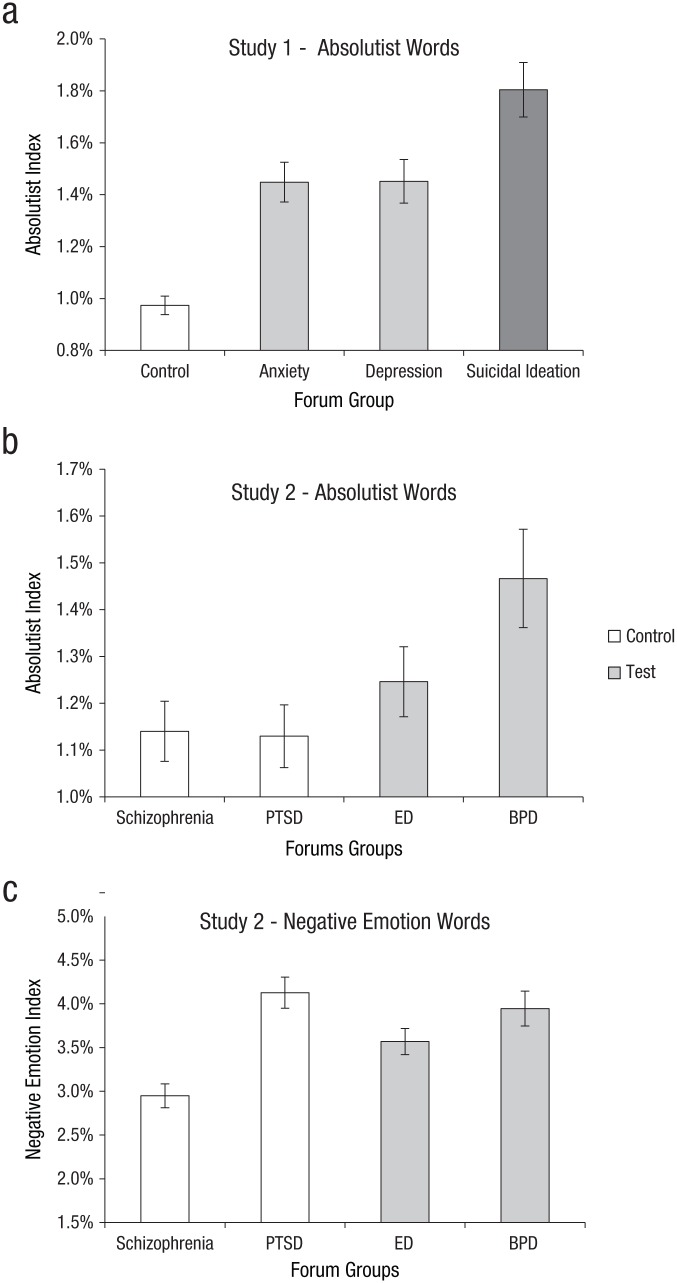
- In Study 1, the absolutist index was significantly higher in anxiety, depression, and suicidal ideation forums than in control forums: control M = 0.97%, anxiety M = 1.45% (d = 3.24), depression M = 1.45% (d = 3.14), suicidal ideation M = 1.80% (d = 4.56), all p < .001.
- Suicidal ideation forums had significantly higher absolutist use than both anxiety and depression forums (ds = 1.74 and 1.71, respectively; p < .001), while anxiety and depression did not differ significantly (p = 1.00).
- In Study 2, the absolutist index differed across mental health forums (F(3, 16) = 5.515, p = .009): BPD M = 1.47 and ED M = 1.25 were higher than PTSD M = 1.13 and schizophrenia M = 1.14, while negative emotion use did not differ between Study 2 control and test groups (M = 3.51 vs 3.71, p = .335).
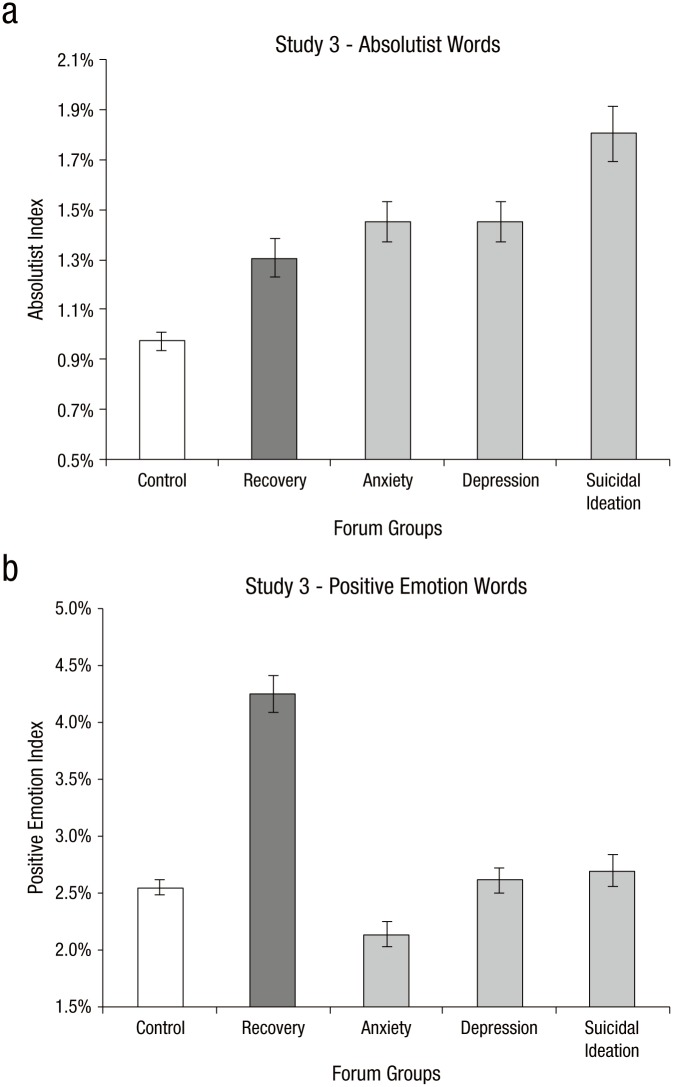
- In Study 3, recovery forums still showed elevated absolutist use versus controls (recovery M = 1.31%, p < .001, d = 0.37) and were lower than suicidal ideation forums, suggesting a possible trait-like vulnerability factor.
## Methods
- Observational text analysis of English-language Internet forums: 63 forums total, with more than 6,400 members, grouped into three studies comparing affective and nonaffective forum categories.
- Only first posts were collected; posts had to be at least 100 words, in continuous prose, and written by a representative community member. The authors aimed for 30,000 words per forum and used 1,000 bootstrap resamples plus multilevel mixed-effects models in SPSS.
- The main measure was a validated absolutist-word dictionary, contrasted with nonabsolutist words and 73 LIWC dictionaries; the authors also used confirmatory factor analysis and ANCOVA, and checked robustness with sensitivity analyses.
## Limitations
- The paper states that, because the design was large-scale and naturalistic, it had low experimental control and could only infer limited demographic characteristics from forum context.
- The identities and motivations of users were “largely unknowable,” and some users may have posted under multiple usernames or across different forums; this is an explicit limitation stated in the paper.
- The text makes evident, and the authors note, that the study is observational and cannot establish causality or within-person change over time; follow-up experimental or longitudinal studies would be needed.
Model-written summary. Check it against the paper before relying on it.
Integrity signals
Registry
Cites
Statistics
Figures
Verification
Claims the paper makes
0 Valid · 3 Not valid · 34 Not checked · 88 Own results and interpretations
A result the paper reports from its own data — it cites no other source for it, so there is none to check. The quote shows it is in the paper.
In the paper
“There was a large, significant difference in the absolutist index between the Study 1 groups, as determined by a multilevel mixed-effects model, F(3, 29) = 71.549, p < .001.”
§ In an Absolute State: Elevated Use of Absolutist Words Is a Marker Specific to Anxiety, Depression, and Suicidal Ideation > Results > Study 1
plain- Asserted: passes — The authors put it forward as true.
- Checkable: passes — It can be checked against evidence.
- Load-bearing: passes — The paper’s conclusions depend on it.
- Based: passes — The paper gives a reason why it holds.
A result the paper reports from its own data — it cites no other source for it, so there is none to check. The quote shows it is in the paper.
In the paper
“Paired comparisons revealed that the mean absolutist index for the BPD forum group (M = 1.47, SD = 1.01) was significantly greater than the PTSD (M = 1.13, SD = 0.83, p < .001, d = 0.36, 95% CI = [−0.07, −0.02]) and the schizophrenia forum groups (M = 1.14, SD = 0.86, p < .001, d = 0.35, 95% CI = [−0.07, −0.03]).”
§ In an Absolute State: Elevated Use of Absolutist Words Is a Marker Specific to Anxiety, Depression, and Suicidal Ideation > Results > Study 2
plainstates an association- Asserted: passes — The authors put it forward as true.
- Checkable: passes — It can be checked against evidence.
- Load-bearing: passes — The paper’s conclusions depend on it.
- Based: passes — The paper gives a reason why it holds.
A result the paper reports from its own data — it cites no other source for it, so there is none to check. The quote shows it is in the paper.
In the paper
“Paired comparisons showed that the absolutist index for the suicidal ideation group remained significantly greater than the control group (ps < .001, ds = 3.85–4.41), the anxiety group (ps < .001, ds = 1.39–1.71), and the depression group (ps < .001, ds = 1.37–1.69).”
§ In an Absolute State: Elevated Use of Absolutist Words Is a Marker Specific to Anxiety, Depression, and Suicidal Ideation > Results > Study 1
plainstates an association- Asserted: passes — The authors put it forward as true.
- Checkable: passes — It can be checked against evidence.
- Load-bearing: passes — The paper’s conclusions depend on it.
- Based: passes — The paper gives a reason why it holds.
A result the paper reports from its own data — it cites no other source for it, so there is none to check. The quote shows it is in the paper.
In the paper
“Like the anxiety and depression groups, the recovery group also had a significantly lower absolutist index than the suicidal ideation group (p < .001, 95% CI = [−0.06, −0.12], d = 0.50).”
§ In an Absolute State: Elevated Use of Absolutist Words Is a Marker Specific to Anxiety, Depression, and Suicidal Ideation > Results > Study 3
plainstates an association- Asserted: passes — The authors put it forward as true.
- Checkable: passes — It can be checked against evidence.
- Load-bearing: passes — The paper’s conclusions depend on it.
- Based: passes — The paper gives a reason why it holds.
A result the paper reports from its own data — it cites no other source for it, so there is none to check. The quote shows it is in the paper.
In the paper
“The highest loading words on Factor 2 were all nonabsolutist except for the absolutist word definitely.”
§ In an Absolute State: Elevated Use of Absolutist Words Is a Marker Specific to Anxiety, Depression, and Suicidal Ideation > Results > Study 1
plain- Asserted: passes — The authors put it forward as true.
- Checkable: passes — It can be checked against evidence.
- Load-bearing: unclear — It is unclear whether the paper’s conclusions depend on it.
- Based: passes — The paper gives a reason why it holds.
65 more claims
Create a free account to see all 125 claims and to verify the 2 references still open.
- Probably not a substantial claim. 44
- It may state two separate claims as one. 23
Claims other papers make about this one
Each is checked against this paper’s own text: does it say what the citing paper says it does?
The source backs part of the claim, not all of it — or backs it for a different population, condition or comparison.
In the citing paper
“The supposition is that mental distress results in over- or underestimation of threats and rewards and the use of absolute words characterises this.”
From Five studies evaluating the impact on mental health and mood of recalling, reading, and discussing fiction (2022) · cites this paper as [35]
Experimental — accuracy not yet measuredThe cited source says what the claim attributes to it.
In the citing paper
“Al-Mosaiwi and Johnstone [35] argue that the use of what they call ‘absolute words’ is a linguistic covariate of anxiety, depression, and suicidal ideation.”
From Five studies evaluating the impact on mental health and mood of recalling, reading, and discussing fiction (2022) · cites this paper as [35]
Statistics recomputed
Every reported test result, recomputed from its test statistic and degrees of freedom. A result shows as not adding up only once an independent check has confirmed it.
- ConsistentF(7, 11) = 0.754reported p = .635 · recomputed p = .635
“F(7, 11) = 0.754, p = .635”
- ConsistentF(3, 29) = 71.549reported p < .001 · recomputed p < .001
“F(3, 29) = 71.549, p < .001”
- ConsistentF(3, 3860) = 20.575reported p < .001 · recomputed p < .001
“F(3, 3860) = 20.575, p < .001”
- ConsistentF(3, 16) = 5.515reported p = .009 · recomputed p = .009
“F(3, 16) = 5.515, p = .009”
Self-check
Percentages, sums and reported differences re-computed from the paper’s own numbers.
Self-check results appear here once an independent check has confirmed them.
Citations
Cites
Mixed-effects modeling with crossed random effects for subjects and items
Baayen, R. H., Davidson, D. J., & Bates, D. M. (2008) · Journal of Memory and Language · doi:10.1016/j.jml.2007.12.005 · Cited by 8,540
(1975) · Medical Entomology and Zoology · Cited by 7,245
The Psychological Meaning of Words: LIWC and Computerized Text Analysis Methods
Tausczik, Y. R., & Pennebaker, J. W. (2010) · Journal of Language and Social Psychology · doi:10.1177/0261927x09351676 · Cited by 5,774 · cited 1×
“Text analysis research on written data from depressed and suicidal individuals has repeatedly shown elevated use of negative emotion words and pronouns (for review, see Tausczik & Pennebaker, 2010).”
Natural language processing with Python
Bird, S., Klein, E., & Loper, E. (2009) · CERN Document Server (European Organization for Nuclear Research) · Cited by 3,998
Cognitive behaviour therapy for eating disorders: a “transdiagnostic” theory and treatment
Fairburn, C. G., Cooper, Z., & Shafran, R. (2003) · Behaviour Research and Therapy · doi:10.1016/s0005-7967(02)00088-8 · Cited by 3,374
Bulletin of the Menninger Clinic
(1989) · Psychiatric Bulletin · doi:10.1192/pb.13.12.698-a · Cited by 3,365
Prevention of relapse/recurrence in major depression by mindfulness-based cognitive therapy.
Teasdale, J. D., Segal, Z. V., Williams, J. M. G., Ridgeway, V. A., Soulsby, J. M., & Lau, M. A. (2000) · Journal of Consulting and Clinical Psychology · doi:10.1037/0022-006x.68.4.615 · Cited by 3,236 · cited 2×
“It is widely acknowledged that an episode of depression increases the risk of future depressive episodes (Teasdale et al., 2000).”
The New Statistics: Why and How
Cumming, G. (2014) · Psychological Science · doi:10.1177/0956797613504966 · Cited by 3,200
Linguistic Inquiry and Word Count (LIWC): Pronounced “Luke,” . . . and Other Useful Facts
Chung, C. K., & Pennebaker, J. W. (2012) · Applied Natural Language Processing · doi:10.4018/978-1-60960-741-8.ch012 · Cited by 2,151
The psychology of suicidal behaviour
O'Connor, R. C., & Nock, M. K. (2014) · The Lancet Psychiatry · doi:10.1016/s2215-0366(14)70222-6 · Cited by 1,193
Research works printed but not linked: 2
- Ertel S. (1985). Content analysis: An alternative approach to open and closed minds. High School Journal, 68, 229– 240.
- Pennebaker J. W. Booth R. J. Boyd R. L. Francis M. E. (2015). Linguistic Inquiry and Word Count: LIWC2015. Austin, TX: Pennebaker Conglomerates.
Cited by
Items 101–200 of 308
Linguistic feature of anorexia nervosa: a prospective case–control pilot study
Cuteri, V., Minori, G., Gagliardi, G., Tamburini, F., Malaspina, E., Gualandi, P., Rossi, F., Moscano, M., Francia, V., & Parmeggiani, A. (2021) · Eating and Weight Disorders - Studies on Anorexia Bulimia and Obesity · doi:10.1007/s40519-021-01273-7 · Cited by 21
Simchon, A., Turkin, C., Svoray, T., Kloog, I., Dorman, M., & Gilead, M. (2021) · Journal of Experimental Social Psychology · doi:10.1016/j.jesp.2021.104221 · Cited by 12
Hernandez-Ramos, R., Altszyler, E., Figueroa, C. A., Avila-Garcia, P., & Aguilera, A. (2021) · Behaviour Research and Therapy · doi:10.1016/j.brat.2021.104027 · Cited by 13
Victor, E., Aghajan, Z. M., Sewart, A. R., et al. (2018) · doi:10.31234/osf.io/vqpcz · Cited by 10
Savekar, A., Tarai, S., & Singh, M. (2022) · European Journal of Applied Linguistics · doi:10.1515/eujal-2022-0022 · Cited by 12
Text classification models for personality disorders identification
Jain, D., Arora, S., Jha, C. K., & Malik, G. (2024) · Social Network Analysis and Mining · doi:10.1007/s13278-024-01219-8 · Cited by 13
“Although there are existing emotional vocabulary lists that contain words related to suicide, anxiety, void feeling, and depression McLaren (2020); Al-Mosaiwi and Johnstone (2018), there is currently no domain-specific word list that focuses specifically on mental health and personality disorders.”
Putrino, N., Casari, L. M., Mesurado, B., & Etchevers, M. J. (2019) · Psychotherapy Research · doi:10.1080/10503307.2019.1690176 · Cited by 11
“The use of absolutist words (Al-Mosaiwi & Johnstone, 2018) and negative emotional words and pronouns by depressive patients could influence the sensation of drowsiness and fatigue in psychotherapists.”
MethodDetecting Suicidal Ideations in Online Forums with Textual and Psycholinguistic Features
Yeskuatov, E., Chua, S.-L., & Foo, L. K. (2024) · Applied Sciences · doi:10.3390/app14219911 · Cited by 12
Decoding the cry for help: AI's emerging role in suicide risk assessment
Esmaeilzadeh, P. (2025) · AI and Ethics · doi:10.1007/s43681-025-00758-w · Cited by 13
“AI techniques can identify these states through: (1) Sentiment analysis and emotion recogni - tion algorithms applied to text and speech that detect linguistic markers of hopelessness [70 ].”
Weger, R., Lossio-Ventura, J. A., Rose-McCandlish, M., Shaw, J. S., Sinclair, S., Pereira, F., Chung, J. Y., & Atlas, L. Y. (2023) · JMIR Mental Health · doi:10.2196/40899 · Cited by 10
“We also hypothesized that mental health history would be associated with more negative sentiment [15,16], greater use of negative emotional words [21-25], and more first-person singular pronouns (FPSPs) [16,20-30].”
BackgroundSuicide Risk Assessment on Social Media:
Ríssola, E. A., Ramírez‐Cifuentes, D., Freire, A., & Crestani, F. (2019) · Workshop on Computational Linguistics and Clinical Psychology (CLPsych) · doi:10.18653/v1/w19-3021 · Cited by 12
“We based our work on (Al-Mosaiwi and Johnstone, 2018), who stated that the elevated use of absolutist words is a marker specific to anxiety, depression, and suicidal ideation.”
BackgroundЛингвистические характеристики текстов психически больных и здоровых людей
Ениколопов, С. Н., Medvedeva, T. I., Vorontsova, O. Y., Владимировна, Ч. Н., Кузнецова, Ю., Penkina, M. Y., Николаевич, М. А., Станкевич, М., Смирнов, И., & Любавская, А. (2018) · Психологические исследования · doi:10.54359/ps.v11i61.258 · Cited by 9
Silent Suffering: Using Machine Learning to Measure CEO Depression
Cheng, S.-Y. M., & Golshan, N. M. (2025) · Journal of Accounting Research · doi:10.1111/1475-679x.12590 · Cited by 18
Antoniou, M., Estival, D., Lam‐Cassettari, C., Li, W., Dwyer, A., & Neto, A. D. A. (2022) · JMIR Formative Research · doi:10.2196/33036 · Cited by 17
“Most have mined social media [29-33] or web-based forums [34-37] to identify linguistic patterns that might be predictive of mental health status.”
BackgroundAn End-to-End framework for extracting observable cues of depression from diary recordings
Mlakar, I., Ariöz, U., Smrke, U., Plohl, N., Šafran, V., & Rojc, M. (2024) · Expert Systems with Applications · doi:10.1016/j.eswa.2024.125025 · Cited by 10
“For the definition of an absolutist word we adopt the definition by Al-Mosaiwi, Johnstone, 2018.”
MethodWirga, M., DeBernardi, M., Wirga, A., Wirga, M. L., Banout, M., & Gulyayeva, O. (2020) · Journal of Rational-Emotive & Cognitive-Behavior Therapy · doi:10.1007/s10942-020-00341-8 · Cited by 12
“His observations are consistent not only with early insights of Pavlov, but with recent research linking semantics to anxiety, depression, suicidality, eating disorders, and borderline personality disorder (Al-Mosaiwi and Johnstone 2018).”
Laido, Z., Till, B., & Niederkrotenthaler, T. (2020) · Suicide and Life-Threatening Behavior · doi:10.1111/sltb.12636 · Cited by 9
“It has been found to be prevalent in some mental disorders (Al-Mosaiwi & Johnstone, 2018), is related to higher stress levels (Farrell, Hains, Davies, Smith, & Parton, 2004), and might therefore be seen as a marker of mental ill health.”
Background"How are you?" Estimation of anxiety, sleep quality, and mood using computational voice analysis
Kim, S., Kwon, N., O'Connell, H., Fisk, N., Ferguson, S., & Bartlett, M. (2020) · Annual International Conference of the IEEE Engineering in Medicine and Biology Society (EMBC) · doi:10.1109/embc44109.2020.9175788 · Cited by 10
“Therefore, we use a questionnaire based approach [16], [17] to consolidate responses from multiple instruments to address the target measurements.”
MethodHosseini-Saravani, S. H., Besharati, S., Calvo, H., & Gelbukh, A. F. (2020) · Lecture notes in computer science · doi:10.1007/978-3-030-60887-3_25 · Cited by 12
Linguistic features and psychological states: A machine-learning based approach
Du, X., & Sun, Y. (2022) · Frontiers in Psychology · doi:10.3389/fpsyg.2022.955850 · Cited by 9
“In terms of absolutist words, previous studies found that they are negatively related to mental health (Al-Mosaiwi and Johnstone, 2018).”
BackgroundUPF’s participation at the CLEF eRisk 2018: early risk prediction on the Internet
Ramírez‐Cifuentes, D., & Freire, A. (2018) · RECERCAT (Consorci de Serveis Universitaris de Catalunya) · Cited by 17
Lahoz-Beltrá, R., & Rodriguez, R. J. (2020) · Biosystems · doi:10.1016/j.biosystems.2020.104261 · Cited by 8
A Psychologically Informed Approach to CLPsych Shared Task 2018
Simchon, A., & Gilead, M. (2018) · Workshop on Computational Linguistics and Clinical Psychology (CLPsych) · doi:10.18653/v1/w18-0612 · Cited by 6
“Absolutist Words: In light of prior research showing that the use of absolutist words are related to mental health outcomes (Al-Mosaiwi and Johnstone, 2017).”
BackgroundDigital hermeneutics: scaled readings of online depression discourses
van de Ven, I., & van Nuenen, T. (2021) · Medical Humanities · doi:10.1136/medhum-2020-012104 · Cited by 11
LiBRA: A Linguistic Bipolar Disorder Recognition Approach
Huang, Y.-H., Chen, Y., Calderón, F., Lai, Y., Wu, S., & Chen, Y.-S. (2021) · IEEE International Conference on Information Reuse and Integration (IRI) · doi:10.1109/iri51335.2021.00037 · Cited by 7
Lorenzo‐Luaces, L., Howard, J., Edinger, A., Yan, H. Y., Rutter, L. A., Valdez, D., & Bollen, J. (2022) · JMIR Formative Research · doi:10.2196/39324 · Cited by 7
“Al-Mosaiwi and Johnstone [16] reported a similar finding with language that they deemed “absolutist.””
BackgroundLanguage Use in Mother-Adolescent Dyadic Interaction: Preliminary Results
Cariola, L. A., Hinduja, S., Bilalpur, M., Sheeber, L., Allen, N. B., Morency, L., & Cohn, J. F. (2022) · International Conference on Affective Computing and Intelligent Interaction and workshops · doi:10.1109/acii55700.2022.9953886 · Cited by 8
“hostility, which has been associated with depression [25], and in this study it might be also related with an increased negative affective arousal elicited by the problem-solving task.”
BackgroundEfe, Z., Baldofski, S., Kohls, E., Eckert, M., Saee, S., Thomas, J., Wundrack, R., & Rummel‐Kluge, C. (2024) · JMIR Formative Research · doi:10.2196/51795 · Cited by 9
“In addition, these studies showed that the use of more absolutist language, that is, superlatives and intensifiers (eg, “absolutely,” “completely,” “all,” “none,” etc), was associated with suicidality [60,77,78].”
BackgroundKolmogorova, A. V., Kalinin, A., & Вячеславовна, М. А. (2019) · Vestnik Tomskogo gosudarstvennogo universiteta · doi:10.17223/15617793/448/6 · Cited by 6
Depression Detection Using Asynchronous Federated Optimization
Li, J., Zhang, R., Cen, M., Wang, X., & Jiang, M. (2021) · IEEE International Conference on Trust, Security and Privacy in Computing and Communications (TrustCom) · doi:10.1109/trustcom53373.2021.00110 · Cited by 10
Depressed individuals express more distorted thinking on social mediaPreprint
Bathina, K. C., ten Thij, M., Lorenzo‐Luaces, L., Rutter, L. A., & Bollen, J. (2020) · arXiv (Cornell University) · doi:10.48550/arxiv.2002.02800 · Cited by 10
Xezonaki, D., Paraskevopoulos, G., Potamianos, A., & Narayanan, S. (2020) · arXiv (Cornell University) · doi:10.48550/arxiv.2006.08336 · Cited by 7
“They tend to use more absolutist words [3], negatively valenced-words and the pronoun “I” [4] and mention pharmaceutical treatment for depressive disorder [5, 6].”
BackgroundGu, L., Li, M., & Li, Y. (2025) · Journal of Affective Disorders · doi:10.1016/j.jad.2025.120765 · Cited by 9
Bidirectional LSTM and Attention for Depression Detection on Clinical Interview Transcripts
Li, M., Xu, H., Liu, W., & Liu, J. (2022) · IEEE International Conference on Information, Communication and Networks (ICICN) · doi:10.1109/icicn56848.2022.10006532 · Cited by 12
“Depression individuals tend to use more absolutist words [3], and the pronoun "I" [4].”
BackgroundNg, M. Y., Frederick, J., Fisher, A. J., Allen, N. B., Pettit, J. W., & McMakin, D. L. (2024) · JMIR Research Protocols · doi:10.2196/43931 · Cited by 11
“…we will assess word count and word sentiment through the Linguistic Inquiry and Word Count [66] Positive Emotion and Negative Emotion dictionaries, and the use of first-person pronouns (eg, “I”) and absolutist words (eg, “never”) associated with mental health [67-69], in English and Spanish.”
MethodBeech, A., Fan, H., Shu, J., Oyarzún, J. P., Nadel, P., Karaman, O. T., Vranos, S., Phelps, E. A., & Kredlow, M. A. (2025) · Journal of Affective Disorders · doi:10.1016/j.jad.2025.01.139 · Cited by 9
An Early Depression Detection Model on Social Media using Emotional and Causal Features
Zong, L., Zheng, J., Zhang, X., Liu, X., Liang, W., & Xu, B. (2023) · IEEE International Conference on Bioinformatics and Biomedicine (BIBM) · doi:10.1109/bibm58861.2023.10385946 · Cited by 5
Linguistic Markers in Individuals With Symptoms of Depression in Bi-Multilingual Context
Savekar, A., Tarai, S., & Singh, M. (2019) · Advances in medical technologies and clinical practice book series · doi:10.4018/978-1-5225-8567-1.ch012 · Cited by 7
Shapira, N., Atzil–Slonim, D., Juravski, D., Baruch, M., Stolowicz-Melman, D., Paz, A., Alfi‐Yogev, T., Azoulay, R., Singer, A., Revivo, M., et al. (2021) · Workshop on Computational Linguistics and Clinical Psychology (CLPsych) · doi:10.18653/v1/2021.clpsych-1.6 · Cited by 10
“Many studies have examined the relationship between depression and language (Trotzek et al., 2018; Yates et al., 2017; ODea et al., 2018; Ramirez-Esparza et al., 2008; Rude et al., 2004; Holtzman et al., 2017; Al-Mosaiwi and Johnstone, 2018; Ophir et al., 2020; Fineberg et al., 2016; Tackman et al., 2019; Guntuku et a…”
BackgroundFiroz, N., Beresteneva, O. G., & Aksyonov, S. V. (2023) · International Russian Automation Conference (RusAutoCon) · doi:10.1109/rusautocon58002.2023.10272795 · Cited by 6
“Furthermore, linguistic markers such as using absolutist words can serve as an indicator of depression [11].”
BackgroundInfluentialTrotzek, M., Koitka, S., & Friedrich, C. M. (2018) · Lecture notes in computer science · doi:10.1007/978-3-319-98932-7_18 · Cited by 5
Using language in social media posts to study the network dynamics of depression longitudinallyPreprint
Kelley, S., & Gillan, C. M. (2020) · doi:10.31234/osf.io/6h52d · Cited by 5
Rutter, L. A., Edinger, A., Lorenzo‐Luaces, L., ten Thij, M., Valdez, D., & Bollen, J. (2025) · Cognitive Therapy and Research · doi:10.1007/s10608-025-10580-7 · Cited by 16
“There may be elements of contagion (Al-Mosaiwi & Johnstone, 2018; Lee & Theokary, 2021) of distorted language within certain communities with depression and anxiety disorders, but this remains to be tested.”
Deep linguistic analysis for depression in social media using RoBERTa and CNN
Salameh, K., Suboh, T., ElAmayreh, R., & Alhijawi, B. (2025) · International Journal of Speech Technology · doi:10.1007/s10772-025-10218-9 · Cited by 10
Detecting depression in speech using verbal behavior analysis: a cross-cultural study
Amorese, T., Cuciniello, M., Greco, C., Sheveleva, O., Cordasco, G., Glackin, C., McConvey, G., Callejas, Z., & Esposito, A. A. (2025) · Frontiers in Psychology · doi:10.3389/fpsyg.2025.1514918 · Cited by 7
Dual Layer Cogni - Insight Deep-Mood Encoder: A Two- Tiered Approach for Depression Detection
Firoz, N., Berestneva, O., & Aksyonov, S. V. (2024) · 2024 International Russian Smart Industry Conference (SmartIndustryCon) · doi:10.1109/smartindustrycon61328.2024.10516113 · Cited by 3
“Previous research primarily emphasized NLP techniques for feature extraction in text-based depression detection [31] and developing deep learning models, with less emphasis on linguistic features like absolutist words [32], indicative of use by depressed participants.”
BackgroundProactive depression detection from Facebook text and behavior data
Hemtanon, S., Aekwarangkoon, S., & Kittiphattanabawon, N. (2022) · International Journal of Power Electronics and Drive Systems/International Journal of Electrical and Computer Engineering · doi:10.11591/ijece.v12i5.pp5027-5035 · Cited by 8
Humayun, M., Brouillette, M., Fellows, L. K., & Mayo, N. E. (2023) · Quality of Life Research · doi:10.1007/s11136-023-03475-1 · Cited by 4
Zaman, I.-R., & Trăușan-Matu, Ș. (2024) · Information · doi:10.3390/info15030123 · Cited by 5
Prompt-based mental health screening from social media text
dos Santos, W. R., & Paraboni, I. (2024) · Anais do Brazilian Workshop on Social Network Analysis and Mining (BraSNAM) · doi:10.5753/brasnam.2024.1879 · Cited by 9
Linguistische Perspektiven auf Emotion und Sprache
Kauschke, C. (2019) · J.B. Metzler eBooks · doi:10.1007/978-3-476-05353-4_41 · Cited by 9
Automatic detection of depression from text data: A systematic literacture review
Magami, F. M., & Digiampietri, L. A. (2020) · Anais do Simpósio Brasileiro de Sistemas de Informação (SBSI) · doi:10.1145/3411564.3411603 · Cited by 5
Leveraging Linguistic Characteristics for Bipolar Disorder Recognition with Gender DifferencesPreprint
Huang, Y.-H., Chen, Y., Alvarado, F. H. C., Lee, S.-R., Wu, S., Lai, Y., & Chen, Y.-S. (2019) · arXiv (Cornell University) · doi:10.48550/arxiv.1907.07366 · Cited by 5
“Figure 4: Gender top patterns depressed people tend to focus on themselves rather than engaging with others, which could explain the difference in the word usage between the groups. Al-Mosaiwi et al. [1] reported that absolute words, such as “always” and “never”, are also reliable markers for diagnosing mental illness…”
BackgroundFiroz, N., Beresteneva, O. G., Vladimirovich, A. S., & Tahsin, M. S. (2023) · Research Square · doi:10.21203/rs.3.rs-2782391/v1 · Cited by 4
Duro, E. S. D., Improta, R., & Stella, M. (2024) · doi:10.31234/osf.io/vhmqs · Cited by 4
Psychosocial dynamics of suicidality and nonsuicidal self-injury: a digital linguistic perspective
Entwistle, C., Hoemann, K., Nightingale, S. J., & Boyd, R. L. (2025) · npj Mental Health Research · doi:10.1038/s44184-025-00142-w · Cited by 6
“Likewise, suicide-focused posts have been revealed to indicate social dysfunction (i.e., fewer we-words, you-words, and social words 25,29 ) and cognitive biases (i.e., greater absolutist language, such as “ always ” , “ totally ” , re fl ecting all-or-nothing thinking 30 ).”
TalkDep: Clinically Grounded LLM Personas for Conversation-Centric Depression Screening
Wang, X., Pérez, A., Parapar, J., & Crestani, F. (2025) · ACM International Conference on Information and Knowledge Management (CIKM) · doi:10.1145/3746252.3761617 · Cited by 14
“For example, frequent use of past-tense verbs and fewer future-orientated words [1].”
Computational methods for translational brain-behavior analysis
Olaniyan, O. T., Adetunji, C. O., Adeyomoye, O., Dare, A., Adeniyi, M. J., & Enoch, A. (2022) · Elsevier eBooks · doi:10.1016/b978-0-323-90277-9.00025-0 · Cited by 3
Language use in depressed and non-depressed mothers and their adolescent offspring
Cariola, L. A., Sheeber, L., Allen, N. B., Bilalpur, M., Bird, T., Hinduja, S., Morency, L., & Cohn, J. F. (2024) · Journal of Affective Disorders · doi:10.1016/j.jad.2024.08.131 · Cited by 3
Communicating certainty via verbal probability phrases: comparing health contexts with no context
Shou, Y., Lee, L. H., Yeo, J. E., & Smithson, M. J. (2025) · BMC Family Practice · doi:10.1186/s12875-024-02687-9 · Cited by 4
Domain Knowledge Enhanced Text Mining for Identifying Mental Disorder Patterns
Shahabikargar, M., Beheshti, A., Khatami, A., Nguyen, R., Zhang, X., & Alinejad-Rokny, H. (2022) · IEEE International Conference on Data Science and Advanced Analytics (DSAA) · doi:10.1109/dsaa54385.2022.10032346 · Cited by 3
“It is constructed by merging four lexicons, namely LIWC2015 lexicon (i.e., categories related to depression instances) [37], NRC emotional lexicon [48], absolute word lexicon [63], depression Uni-gram lexicon [1].”
MethodLarge-Scale Dialog Corpus Towards Automatic Mental Disease Diagnosis
Sakishita, M., Kishimoto, T., Takinami, A., Eguchi, Y., & Kano, Y. (2019) · Studies in computational intelligence · doi:10.1007/978-3-030-24409-5_10 · Cited by 3
A unified framework for cross-domain and cross-task learning of mental health conditions
Chua, H., Caines, A., & Yannakoudakis, H. (2022) · Workshop on NLP for Positive Impact (NLP4PI) · doi:10.18653/v1/2022.nlp4pi-1.1 · Cited by 7
“…we also add the following count-based features: first-person singular pronouns which have been identified as more frequently used among depressives (Al-Mosaiwi and Johnstone, 2018) across demographic lines (Edwards and Holtzman, 2017) due to increased selffocus (Wolohan et al., 2018; Brockmeyer et…”
BackgroundMiner, A. S., Fleming, S. L., Haque, A., Fries, J., Althoff, T., Wilfley, D. E., Agras, W. S., Milstein, A. S., Hancock, J. T., Ash, S. M., et al. (2022) · medRxiv · doi:10.1101/2022.04.24.22274227 · Cited by 3
Lewis, J. A., Fraga, K. J., & Erickson, T. M. (2019) · Springer eBooks · doi:10.1007/978-3-319-28099-8_651-1 · Cited by 3
Funkhouser, C. J. (2023) · doi:10.31234/osf.io/cy7v4 · Cited by 3
Abramski, K. E., Ciringione, L., Rossetti, G., et al. (2023) · doi:10.31234/osf.io/92bek · Cited by 3
A Survey of the First Five Years of eRisk: Findings and Conclusions
Ríssola, E. A., Parapar, J., Losada, D. E., & Crestani, F. (2022) · Studies in computational intelligence · doi:10.1007/978-3-031-04431-1_3 · Cited by 5
Multimodal machine learning for video based single question mental health assessment
Grimm, B., Yilmam, P., Talbot, B., & Larsen, L. (2025) · npj Digital Medicine · doi:10.1038/s41746-025-02242-5 · Cited by 5
“Third, while previous research has typically focused on single modalities - with some studies examining text-based patterns 12,19 , others analyzing speech characteristics 15 , and still others investigating semantic content 14 .”
The Dual Imperative in AI for OCD: Bridging Ethical Frameworks and Explainable Diagnostics
Zaboski, B. A., & Muller, G. N. (2026) · AI in Medicine · doi:10.3390/aimed1030017 · Cited by 2
“Computational linguistics reveal that genuine threats typically utilize declarative, future-tense phrasing and absolutist words [53].”
Performance of Content-Based Features to Detect Depression Tendencies in Different Text Lengths
Zulkarnain, N. Z., Yusof, N. F. A., Ahmad, S. S. S., Othman, Z. B., & Hashim, A. H. (2022) · IEEE International Conference on Artificial Intelligence in Engineering and Technology (IICAIET) · doi:10.1109/iicaiet55139.2022.9936811 · Cited by 3
“Another evident word usage common in individuals with depression tendencies is absolute words [17].”
BackgroundPredicting Depression with Social Media Images
Shivangi, Sangeeta, S., & Rautela, R. (2024) · IEEE Karachi Section Humanitarian Technology Conference (KHI-HTC) · doi:10.1109/khi-htc60760.2024.10481967 · Cited by 3
“Consistent with exploration [20], depressed people are commonplace use the phrase absolutist as “usually,” “entire,” previously "For positive."”
BackgroundWhen I am sixty-four… evaluating language markers of well-being in healthy aging narratives
Meier, T., Mehl, M. R., Martin, M., & Horn, A. B. (2024) · PLoS ONE · doi:10.1371/journal.pone.0302103 · Cited by 3
Chen, Y., Ang, P. S., & Lee, C. (2024) · Emotion, space and society · doi:10.1016/j.emospa.2024.101041 · Cited by 2
One-shot intervention reduces online engagement with distorted content
Hasan, E., Epping, G. P., Lorenzo‐Luaces, L., Bollen, J., & Trueblood, J. S. (2025) · PNAS Nexus · doi:10.1093/pnasnexus/pgaf068 · Cited by 2
“Compared to healthy controls, individuals with depression exhibit different temporal usage patterns (8), use distinct language (9), and express higher levels of cognitive distortions (10, 16).”
AI listens for health conditions
Savage, N. (2025) · Nature · doi:10.1038/d41586-025-01598-8 · Cited by 2
Li, W., Kaur, W., & Wangmei, C. (2024) · International Conference on Knowledge and Systems Engineering/Proceedings · doi:10.1109/kse63888.2024.11063648 · Cited by 4
“These patterns often include an increased use of negative words, a tendency to use absolutist words, and a heightened reliance on first-person singular pronouns [9].”
Studying the language of mental illness in Romanian social media
Briciu, A., & Lupea, M. (2018) · IEEE International Conference on Intelligent Computer Communication and Processing (ICCP) · doi:10.1109/iccp.2018.8516436 · Cited by 4
Evaluation of texts written by patients with endogenous mental disorders
Enikolopov, S. N., Medvedeva, T. I., Vorontsova, O. Y., & Ivanova, P. O. (2019) · Psikhiatriya · doi:10.30629/2618-6667-2019-81-56-64 · Cited by 2
A Linguistic Study of Depression in Religious Texts
Al-Ameedi, N. A.-H. K. H. P. R. T. K. (2021) · Psychology and Education Journal · doi:10.17762/pae.v58i1.1097 · Cited by 2
“…a recent study on absolutist thinking, which is considered "a cognitive distortion by most cognitive therapies for anxiety and depression," Al-Mosaiwi and Johnstone (2018) show that depressive speech contains excessive amount of more absolutist words such as absolutely, all, always,…”
BackgroundEmerging Role of Intelligent Techniques for Effective Detection and Prediction of Mental Disorders
Jain, P. R., & Quadri, S. M. K. (2021) · Lecture notes on data engineering and communications technologies · doi:10.1007/978-981-15-9509-7_16 · Cited by 6
Koskinen, E., Tuhkanen, S., Järvensivu, M., Savander, E. È., Valkeapää, T., Valkia, K., Weiste, E., & Stevanovic, M. (2021) · Frontiers in Communication · doi:10.3389/fcomm.2021.625968 · Cited by 4
“A recent computerized big data text analysis conducted by Al-Mosaiwi and Johnstone (2018) examined the use of absolutist words, such as “always”, “nothing” or “completely”, and found that absolutist words were even better markers for mental health forums than negative emotion words.”
MethodCross-evaluation of social mining for classification of depressed online personas
Trifan, A., & Oliveira, J. L. (2021) · Berichte aus der medizinischen Informatik und Bioinformatik/Journal of integrative bioinformatics · doi:10.1515/jib-2020-0051 · Cited by 2
“– Absolutist words (Table 1) – a recent study on absolutist thinking, which is considered a cognitive distortion by most cognitive therapies for anxiety and depression, showed that anxiety, depression, and suicidal ideation forums contained more absolutist words than control forums [30].”
BackgroundBriseniou, E., Skenteris, N., Hatzoglou, C., Tsitsas, G. D., Diamantopoulos, E., Dragioti, E., & Gouva, M. (2021) · BMC Psychology · doi:10.1186/s40359-021-00671-x · Cited by 4
Branitskiy, A. A., Sharma, Y., Kotenko, I. V., Владимировна, Ф. Е., Krasov, A. V., & Ushakov, I. (2022) · Информационно-управляющие системы · doi:10.31799/1684-8853-2022-1-8-18 · Cited by 7
Language of violence: Do words matter more than we think?
Tatebe, L. C., Thomas, A., Regan, S., Stone, L., & Dicker, R. A. (2022) · Trauma Surgery & Acute Care Open · doi:10.1136/tsaco-2022-000973 · Cited by 3
Linguistic Expressions of Depressogenic Schemata
Imahori, E. (2018) · Studies in Applied Linguistics and TESOL · doi:10.7916/d8-cjc9-g216 · Cited by 5
Toward estimating personal well-being using voicePreprint
Kim, S., Kwon, N., & O'Connell, H. (2019) · arXiv (Cornell University) · doi:10.48550/arxiv.1910.10082 · Cited by 2
“2We built a dictionary with depression-related words and negative expressions, as well as common words observed from depression patients’ speech, which resulted in 486 terms [19] 3The sentiment likelihood score is generated by the binary classification model trained on Stanford Sentiment Treebank using Sentiment Neuro…”
MethodDetecting Language from Depressed Users with Korean Twitter Data
줄리우스 (2018) · Seoul National University Open Repository (Seoul National University) · Cited by 3
Wang, B., Wu, Y., Taylor, N., et al. (2020) · arXiv (Cornell University) · doi:10.48550/arxiv.2008.03408 · Cited by 2
“Finally, we add the number of absolutist words per word (ABS/W) as a feature using a 19-word absolutist dictionary curated by clinical psychologists [26], who found that the online anxiety, depression, and suicidal ideation forums contained more absolutist words than the control ones.”
MethodPersonality Disorder and Verbal BehaviorPreprint
Entwistle, C., Marceau, E. M., & Boyd, R. L. (2021) · PsyArXiv (OSF Preprints) · doi:10.31234/osf.io/3gdpx · Cited by 3
Swanson, T., Teixeira, A. S., Richson, B. N., Li, Y., Hills, T. T., Forbush, K. T., Watson, D., & Stella, M. (2021) · PsyArXiv (OSF Preprints) · doi:10.31234/osf.io/8gvr2 · Cited by 3
Twitter under Storm: Social Media Response Sensitization in the CaribbeanPreprint
Perez-Rivera, D. T., Martínez, A. J., Pons, A., Rodríguez-Natal, A., & Davila-Santana, S. A. (2020) · SocArXiv (OSF Preprints) · doi:10.31235/osf.io/8kc46 · Cited by 2
Multimodal Fusion for Depression Detection Assisted by Stacking Deep Neural NetworksPreprint
de Almeida, F. F., Aires, K. R. T., Soares, A. C. B., et al. (2024) · doi:10.36227/techrxiv.171018258.87887016/v1 · Cited by 2
Linguistic Features and Psychological States: The Case of Virginia Woolf
Du, X. (2022) · Frontiers in Psychology · doi:10.3389/fpsyg.2022.823313 · Cited by 2
Chan, C. K. Y., & Yeh, A. (2024) · Studies in Pragmatics and Discourse Analysis · doi:10.48185/spda.v5i1.1011 · Cited by 1
Multimodal Drivers of Attention Interruption to Baby Product Video Ads
Xie, W., Luan, L., Zhu, Y., Bart, Y., & Ostadabbas, S. (2024) · Lecture notes in computer science · doi:10.1007/978-3-031-78104-9_21 · Cited by 2
Early detection of depression on Twitter using machine learning techniques and pre-processing steps
Kamil, R., & Abbas, A. R. (2025) · AIP conference proceedings · doi:10.1063/5.0254606 · Cited by 1
Shi, Y., Zhang, Y., & Lei, L. (2025) · Cognitive Processing · doi:10.1007/s10339-025-01301-9 · Cited by 2
“Some studies have empirically investigated different types of cognitive distortions based on an analysis of lan - guage use by individuals with mental illness (Al-Mosaiwi and Johnstone 2018; Bathina et al. 2021; LeMoult et al. 2017 ; Rude et al. 2004 ; Zhang et al. 2022 ).”
InfluentialBao, E., Pérez, A., Otero, D., & Parapar, J. (2025) · Online Social Networks and Media · doi:10.1016/j.osnem.2025.100339 · Cited by 3
Metadata
- Authors
- Al-Mosaiwi, M., & Johnstone, T.
- Affiliations
- University of Reading (GB)
- Corresponding author
- Al-Mosaiwi, Mohammed
- Venue
- Clinical Psychological Science
- Publisher
- SAGE Publications
- Published
- 2018-01-05
- Volume
- 6
- Issue
- 4
- Pages
- 529-542
- ISSN
- 2167-7026 (ISSN-L)
- 2167-7034
- PMC
- PMC6376956
- OpenAlex
- W2769128147
- Semantic Scholar
- 3dfc2256db6a4f30cd63104166c6de6e23ffeb2e
- Cited by
- 304
- References
- 76
- Citations by year
- 2026: 41 · 2025: 37 · 2024: 34 · 2023: 25 · 2022: 51 · 2021: 40 · 2020: 31 · 2019: 30 · 2018: 15
- FWCI
- 39.26
- Type
- journal article
- Language
- en
- Update notices
- correction (2019-04-10)
- Open access
- hybrid
- doi.org
- Licence
- cc-by
- journals.sagepub.com/page/policies/text-and-data-mining-license (tdm)
- Locations
- Clinical Psychological Science (publishedVersion, cc-by)
- Europe PMC (PubMed Central) (publishedVersion, cc-by)
- PubMed Central (publishedVersion, cc-by)
- PubMed (publishedVersion)
- CentAUR (University of Reading) (submittedVersion, public-domain)
- Swinburne figshare (Swinburne University of Technology) (submittedVersion)
- Funders
- University of Reading
- Medical Research Council
- Topics
- Social Sciences › Psychology › Social Psychology › Mental Health via Writing
- Social Sciences › Psychology › Experimental and Cognitive Psychology › Anxiety, Depression, Psychometrics, Treatment, Cognitive Processes
- Social Sciences › Psychology › Clinical Psychology › Suicide and Self-Harm Studies
- Keywords
- cognitive distortions, anxiety, depression, suicidal ideation, online forums, recovery from depression, vulnerability factors
About these checks
Registry, retraction, Cites and statistics results are computed, not judged, with one exception: a printed reference that no index lists is read once by a model before it counts as a citation error. Claims are extracted by a model and kept only when their quote appears verbatim in the text; each cited source is then checked, with a model’s help, for whether it says what the claim relies on. Those verdicts can be wrong — read the claim’s quote and the cited source before relying on one.
The claim verdicts this report counts are experimental: their accuracy is not yet measured.
A language model drew the claims from the paper on 2026-10-11, under version 3 of the claim definition (model deepseek-v4.1-flash, prompt extract-v3).
A second model labelled each claim on 2026-10-11 (model jev-1.13-20260917, definition revision gold-guideline-v0.2).
Statistics and arithmetic are recomputed, not judged.
Confidence bands are shown only for fields calibrated on our annotated test set. None is calibrated yet, so no band is shown.
What counts as a claim ›How we measure confidence ›How we check this ›
Are you an author, or do you see a problem with this page? Request a review
Data sources
Bibliographic data: Semantic Scholar, OpenAlex, Crossref.
Contains information from the Semantic Scholar Academic Graph Datasets, made available under the ODC Attribution License (ODC-BY 1.0).
Semantic Scholar’s data is described in: Kinney, R., et al. (2023). The Semantic Scholar Open Data Platform. arXiv:2301.10140.
