

In an Absolute State: Elevated Use of Absolutist Words Is a Marker Specific to Anxiety, Depression, and Suicidal Ideation
Open accessThe DOI matches its Crossref record; 73 of the 76 references it cites were found in a registry or an index; 1 of the 54 sources its claims cite were checked for support.
Abstract
Absolutist thinking is considered a cognitive distortion by most cognitive therapies for anxiety and depression. Yet, there is little empirical evidence of its prevalence or specificity. Across three studies, we conducted a text analysis of 63 Internet forums (over 6,400 members) using the Linguistic Inquiry and Word Count software to examine absolutism at the linguistic level. We predicted and found that anxiety, depression, and suicidal ideation forums contained more absolutist words than control forums ( ds > 3.14). Suicidal ideation forums also contained more absolutist words than anxiety and depression forums ( ds > 1.71). We show that these differences are more reflective of absolutist thinking than psychological distress. It is interesting that absolutist words tracked the severity of affective disorder forums more faithfully than negative emotion words. Finally, we found elevated levels of absolutist words in depression recovery forums. This suggests that absolutist thinking may be a vulnerability factor.
Overview
CoChat Summary
## TL;DR
Across three text-analysis studies of 63 Internet forums and more than 6,400 members, the paper finds that absolutist words are used more in anxiety, depression, and suicidal ideation forums than in controls. The authors argue this pattern is more specific to absolutist thinking than to general psychological distress, and that elevated absolutist language may also persist in depression recovery forums.
## Key findings
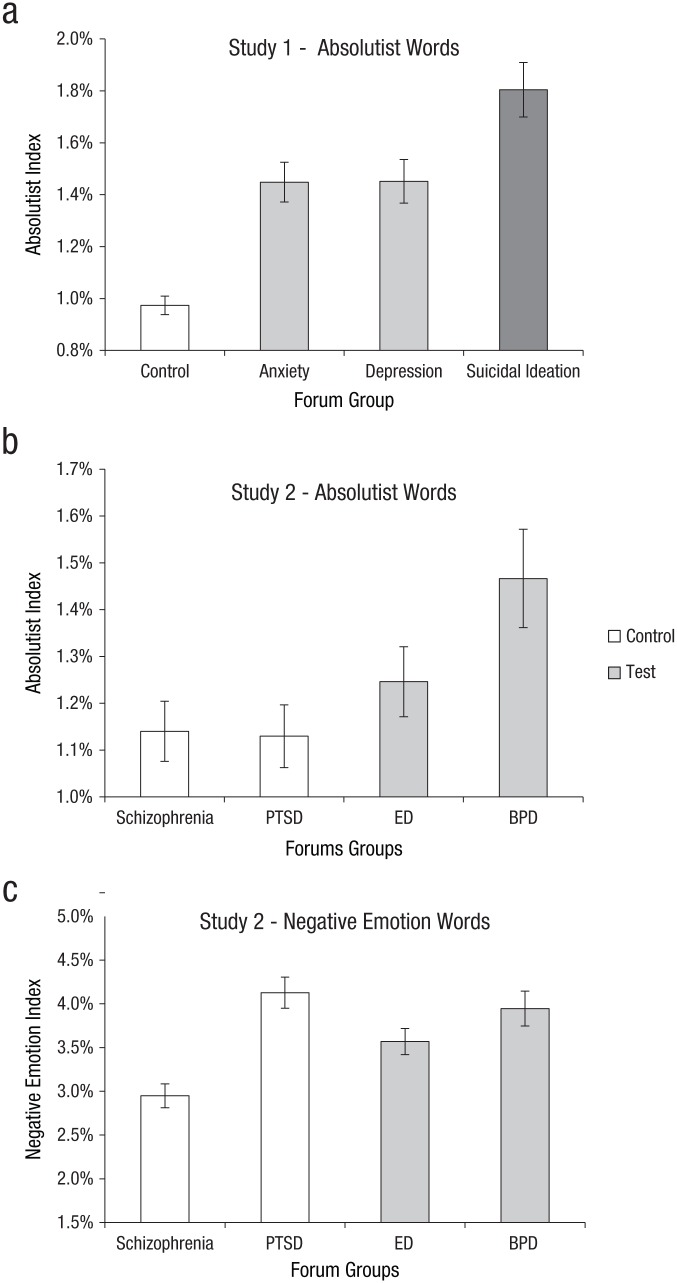
- In Study 1, the absolutist index was significantly higher in anxiety, depression, and suicidal ideation forums than in control forums: control M = 0.97%, anxiety M = 1.45% (d = 3.24), depression M = 1.45% (d = 3.14), suicidal ideation M = 1.80% (d = 4.56), all p < .001.
- Suicidal ideation forums had significantly higher absolutist use than both anxiety and depression forums (ds = 1.74 and 1.71, respectively; p < .001), while anxiety and depression did not differ significantly (p = 1.00).
- In Study 2, the absolutist index differed across mental health forums (F(3, 16) = 5.515, p = .009): BPD M = 1.47 and ED M = 1.25 were higher than PTSD M = 1.13 and schizophrenia M = 1.14, while negative emotion use did not differ between Study 2 control and test groups (M = 3.51 vs 3.71, p = .335).
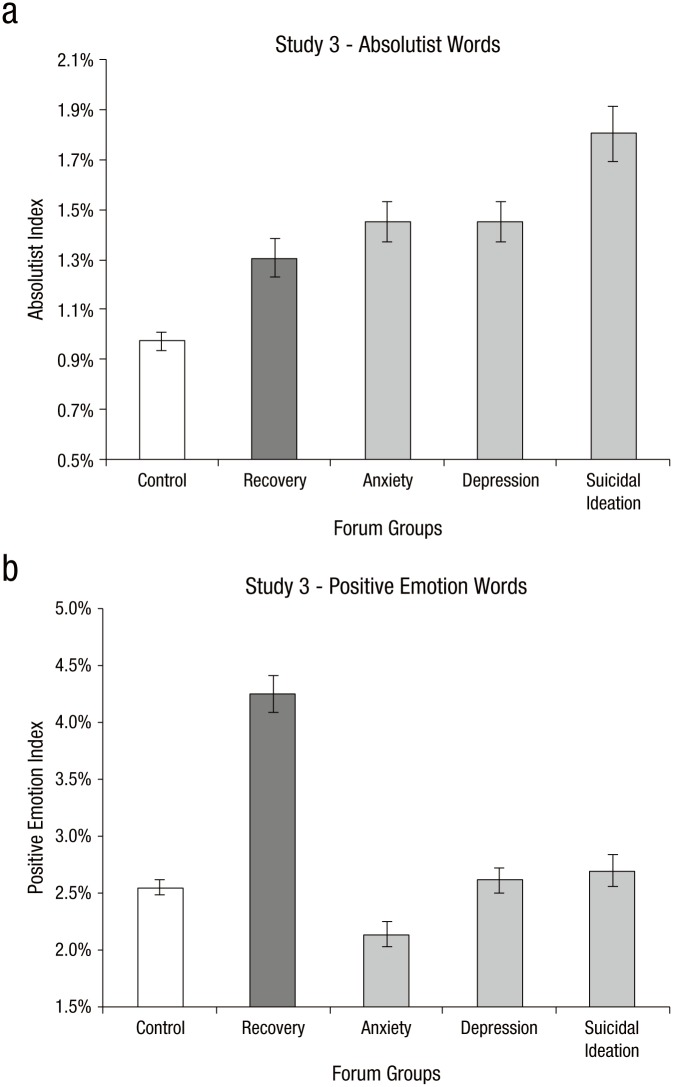
- In Study 3, recovery forums still showed elevated absolutist use versus controls (recovery M = 1.31%, p < .001, d = 0.37) and were lower than suicidal ideation forums, suggesting a possible trait-like vulnerability factor.
## Methods
- Observational text analysis of English-language Internet forums: 63 forums total, with more than 6,400 members, grouped into three studies comparing affective and nonaffective forum categories.
- Only first posts were collected; posts had to be at least 100 words, in continuous prose, and written by a representative community member. The authors aimed for 30,000 words per forum and used 1,000 bootstrap resamples plus multilevel mixed-effects models in SPSS.
- The main measure was a validated absolutist-word dictionary, contrasted with nonabsolutist words and 73 LIWC dictionaries; the authors also used confirmatory factor analysis and ANCOVA, and checked robustness with sensitivity analyses.
## Limitations
- The paper states that, because the design was large-scale and naturalistic, it had low experimental control and could only infer limited demographic characteristics from forum context.
- The identities and motivations of users were “largely unknowable,” and some users may have posted under multiple usernames or across different forums; this is an explicit limitation stated in the paper.
- The text makes evident, and the authors note, that the study is observational and cannot establish causality or within-person change over time; follow-up experimental or longitudinal studies would be needed.
Model-written summary. Check it against the paper before relying on it.
Integrity signals
Registry
Cites
Statistics
Figures
Verification
Claims the paper makes
0 Valid · 3 Not valid · 34 Not checked · 88 Own results and interpretations
A result the paper reports from its own data — it cites no other source for it, so there is none to check. The quote shows it is in the paper.
In the paper
“There was a large, significant difference in the absolutist index between the Study 1 groups, as determined by a multilevel mixed-effects model, F(3, 29) = 71.549, p < .001.”
§ In an Absolute State: Elevated Use of Absolutist Words Is a Marker Specific to Anxiety, Depression, and Suicidal Ideation > Results > Study 1
plain- Asserted: passes — The authors put it forward as true.
- Checkable: passes — It can be checked against evidence.
- Load-bearing: passes — The paper’s conclusions depend on it.
- Based: passes — The paper gives a reason why it holds.
A result the paper reports from its own data — it cites no other source for it, so there is none to check. The quote shows it is in the paper.
In the paper
“Paired comparisons revealed that the mean absolutist index for the BPD forum group (M = 1.47, SD = 1.01) was significantly greater than the PTSD (M = 1.13, SD = 0.83, p < .001, d = 0.36, 95% CI = [−0.07, −0.02]) and the schizophrenia forum groups (M = 1.14, SD = 0.86, p < .001, d = 0.35, 95% CI = [−0.07, −0.03]).”
§ In an Absolute State: Elevated Use of Absolutist Words Is a Marker Specific to Anxiety, Depression, and Suicidal Ideation > Results > Study 2
plainstates an association- Asserted: passes — The authors put it forward as true.
- Checkable: passes — It can be checked against evidence.
- Load-bearing: passes — The paper’s conclusions depend on it.
- Based: passes — The paper gives a reason why it holds.
A result the paper reports from its own data — it cites no other source for it, so there is none to check. The quote shows it is in the paper.
In the paper
“Paired comparisons showed that the absolutist index for the suicidal ideation group remained significantly greater than the control group (ps < .001, ds = 3.85–4.41), the anxiety group (ps < .001, ds = 1.39–1.71), and the depression group (ps < .001, ds = 1.37–1.69).”
§ In an Absolute State: Elevated Use of Absolutist Words Is a Marker Specific to Anxiety, Depression, and Suicidal Ideation > Results > Study 1
plainstates an association- Asserted: passes — The authors put it forward as true.
- Checkable: passes — It can be checked against evidence.
- Load-bearing: passes — The paper’s conclusions depend on it.
- Based: passes — The paper gives a reason why it holds.
A result the paper reports from its own data — it cites no other source for it, so there is none to check. The quote shows it is in the paper.
In the paper
“Like the anxiety and depression groups, the recovery group also had a significantly lower absolutist index than the suicidal ideation group (p < .001, 95% CI = [−0.06, −0.12], d = 0.50).”
§ In an Absolute State: Elevated Use of Absolutist Words Is a Marker Specific to Anxiety, Depression, and Suicidal Ideation > Results > Study 3
plainstates an association- Asserted: passes — The authors put it forward as true.
- Checkable: passes — It can be checked against evidence.
- Load-bearing: passes — The paper’s conclusions depend on it.
- Based: passes — The paper gives a reason why it holds.
A result the paper reports from its own data — it cites no other source for it, so there is none to check. The quote shows it is in the paper.
In the paper
“The highest loading words on Factor 2 were all nonabsolutist except for the absolutist word definitely.”
§ In an Absolute State: Elevated Use of Absolutist Words Is a Marker Specific to Anxiety, Depression, and Suicidal Ideation > Results > Study 1
plain- Asserted: passes — The authors put it forward as true.
- Checkable: passes — It can be checked against evidence.
- Load-bearing: unclear — It is unclear whether the paper’s conclusions depend on it.
- Based: passes — The paper gives a reason why it holds.
65 more claims
Create a free account to see all 125 claims and to verify the 2 references still open.
- Probably not a substantial claim. 44
- It may state two separate claims as one. 23
Claims other papers make about this one
Each is checked against this paper’s own text: does it say what the citing paper says it does?
The source backs part of the claim, not all of it — or backs it for a different population, condition or comparison.
In the citing paper
“The supposition is that mental distress results in over- or underestimation of threats and rewards and the use of absolute words characterises this.”
From Five studies evaluating the impact on mental health and mood of recalling, reading, and discussing fiction (2022) · cites this paper as [35]
Experimental — accuracy not yet measuredThe cited source says what the claim attributes to it.
In the citing paper
“Al-Mosaiwi and Johnstone [35] argue that the use of what they call ‘absolute words’ is a linguistic covariate of anxiety, depression, and suicidal ideation.”
From Five studies evaluating the impact on mental health and mood of recalling, reading, and discussing fiction (2022) · cites this paper as [35]
Statistics recomputed
Every reported test result, recomputed from its test statistic and degrees of freedom. A result shows as not adding up only once an independent check has confirmed it.
- ConsistentF(7, 11) = 0.754reported p = .635 · recomputed p = .635
“F(7, 11) = 0.754, p = .635”
- ConsistentF(3, 29) = 71.549reported p < .001 · recomputed p < .001
“F(3, 29) = 71.549, p < .001”
- ConsistentF(3, 3860) = 20.575reported p < .001 · recomputed p < .001
“F(3, 3860) = 20.575, p < .001”
- ConsistentF(3, 16) = 5.515reported p = .009 · recomputed p = .009
“F(3, 16) = 5.515, p = .009”
Self-check
Percentages, sums and reported differences re-computed from the paper’s own numbers.
Self-check results appear here once an independent check has confirmed them.
Citations
Cites
Mixed-effects modeling with crossed random effects for subjects and items
Baayen, R. H., Davidson, D. J., & Bates, D. M. (2008) · Journal of Memory and Language · doi:10.1016/j.jml.2007.12.005 · Cited by 8,540
(1975) · Medical Entomology and Zoology · Cited by 7,245
The Psychological Meaning of Words: LIWC and Computerized Text Analysis Methods
Tausczik, Y. R., & Pennebaker, J. W. (2010) · Journal of Language and Social Psychology · doi:10.1177/0261927x09351676 · Cited by 5,774 · cited 1×
“Text analysis research on written data from depressed and suicidal individuals has repeatedly shown elevated use of negative emotion words and pronouns (for review, see Tausczik & Pennebaker, 2010).”
Natural language processing with Python
Bird, S., Klein, E., & Loper, E. (2009) · CERN Document Server (European Organization for Nuclear Research) · Cited by 3,998
Cognitive behaviour therapy for eating disorders: a “transdiagnostic” theory and treatment
Fairburn, C. G., Cooper, Z., & Shafran, R. (2003) · Behaviour Research and Therapy · doi:10.1016/s0005-7967(02)00088-8 · Cited by 3,374
Bulletin of the Menninger Clinic
(1989) · Psychiatric Bulletin · doi:10.1192/pb.13.12.698-a · Cited by 3,365
Prevention of relapse/recurrence in major depression by mindfulness-based cognitive therapy.
Teasdale, J. D., Segal, Z. V., Williams, J. M. G., Ridgeway, V. A., Soulsby, J. M., & Lau, M. A. (2000) · Journal of Consulting and Clinical Psychology · doi:10.1037/0022-006x.68.4.615 · Cited by 3,236 · cited 2×
“It is widely acknowledged that an episode of depression increases the risk of future depressive episodes (Teasdale et al., 2000).”
The New Statistics: Why and How
Cumming, G. (2014) · Psychological Science · doi:10.1177/0956797613504966 · Cited by 3,200
Linguistic Inquiry and Word Count (LIWC): Pronounced “Luke,” . . . and Other Useful Facts
Chung, C. K., & Pennebaker, J. W. (2012) · Applied Natural Language Processing · doi:10.4018/978-1-60960-741-8.ch012 · Cited by 2,151
The psychology of suicidal behaviour
O'Connor, R. C., & Nock, M. K. (2014) · The Lancet Psychiatry · doi:10.1016/s2215-0366(14)70222-6 · Cited by 1,193
Research works printed but not linked: 2
- Ertel S. (1985). Content analysis: An alternative approach to open and closed minds. High School Journal, 68, 229– 240.
- Pennebaker J. W. Booth R. J. Boyd R. L. Francis M. E. (2015). Linguistic Inquiry and Word Count: LIWC2015. Austin, TX: Pennebaker Conglomerates.
Cited by
Items 201–300 of 308
Junias, O., Kini, P., & Chaspari, T. (2025) · IEEE-EMBS International Conference on Biomedical and Health Informatics (BHI ...) · doi:10.1109/bhi67747.2025.11269509 · Cited by 4
“Prior work suggests that individuals with depression tend to use more first-person singular pronouns, negative emotion words, and absolutist terms [2]– [4].”
Patil, J., Prajapati, K., Patel, D., Chauhan, R., & Patel, M. (2026) · Lecture notes in networks and systems · doi:10.1007/978-981-95-2872-1_7 · Cited by 5
Yang, S., Chen, J., & Tao, Y. (2025) · IEEE International Conference on Cloud Computing Technology and Science · doi:10.1109/cloudcom67567.2025.11331545 · Cited by 2
“…has consistently demonstrated that emotional disorders manifest through measurable linguistic patterns, including increased use of first-person singular pronouns, negative emotion words, and absolutist language, while showing reduced future-oriented expressions and linguistic diversity [22].”
Calaboiça, C., Santos, A., Meira, L., Ribeiro, E., Teixeira, A. S., & Ferreira, T. B. (2026) · Cognitive Therapy and Research · doi:10.1007/s10608-026-10730-5 · Cited by 1
“…conditions (Flynn et al., 2023; Kelley & Gillian, 2022 ), such as increased use of first-person singular pronouns (e.g., I, me), absolutist words (e.g., never, nothing) and negative emotion words (Al-Mosaiwi & Johnstone, 2018; Hirsch et al., 2016; Kelley & Gillian, 2022 ; Trifu et al., 2017 ).”
Shimgekar, S. R., Rodriguez, V. J., Bloom, P. A., Yoo, D. W., & Saha, K. (2026) · JMIR AI · doi:10.2196/86265 · Cited by 9
“For example, LIWC-based analyses [125] and deep neural networks [126] identify suicidal themes and psycholinguistic differences [40,127].”
Depression and anxiety characterization and detection with multimodal deep learning
Lu, T., Cho, L., Qiu, Z., Wang, Y., Niu, W., Leung, Y. W., Wang, Y., Zhang, H., Chang, W. C., Tanveer, M., et al. (2026) · Nature Mental Health · doi:10.1038/s44220-026-00632-6 · Cited by 4
“For example, text data can reveal linguistic markers such as negative sentiment or cognitive distortions, which are strongly associated with depression and anxiety 26,27 .”
Nilsson, A., Eijsbroek, V. C., Gu, Z., Kjell, K., Giorgi, S., Kotov, R., Ganesan, A. V., Schwartz, H. A., & Kjell, O. (2026) · Advances in Methods and Practices in Psychological Science · doi:10.1177/25152459261419036 · Cited by 4
Ricaurte, J. B. (2026) · Computer and Electronic Sciences Theory and Applications · doi:10.17981/cesta.07.01.2026.03 · Cited by 1
Brain rhythms of depression: A predictive processing perspective
Strube, A., & Pizzagalli, D. A. (2026) · Trends in Neurosciences · doi:10.1016/j.tins.2026.06.006 · Cited by 3
Into the void: validating a LIWC-based index of linguistic expressions of nihilism
Champion, A. R. (2026) · Behavioral Sciences of Terrorism and Political Aggression · doi:10.1080/19434472.2026.2713487 · Cited by 1
Linguistic Research on Specific Features of Suicidal Communication—Past, Present, and Future
Fekete, S., Osváth, P., Fekete, J., & Vörös, V. (2018) · Clinical Psychological Science · doi:10.1177/2167702618769885 · Cited by 1
“The study of Al-Mosaiwi and Johnstone (2018) highlights the importance of research into text analysis, in that the assessment of communication changes in several mental disorders can be a major step forward in improving their recognition and management.”
BackgroundInfluentialWhat are the affective meanings of words for individuals with a high level of trait anxiety?
Szepietowska, E. M. (2019) · Psychiatria i Psychologia Kliniczna · doi:10.15557/pipk.2019.0040
“The discourse of high-anxious people is dominated by categorical statements and contains fewer positive emotional words (Al-Mosaiwi and Johnstone, 2018; Gawda, 2007).”
Linguistic Markers in Individuals With Symptoms of Depression in Bi-Multilingual Context
Savekar, A., Tarai, S., & Singh, M. (2021) · IGI Global eBooks · doi:10.4018/978-1-6684-3690-5.ch077 · Cited by 1
Kutsuna, I., Hoshino, A., Morisugi, A., Mori, Y., Shirato, A., Takeda, M., isaji, H., & Suwa, M. (2022) · British Journal of Occupational Therapy · doi:10.1177/03080226221107773 · Cited by 3
“…that people with depression use more negative words (Dirkse et al., 2015), first-person singular pronouns (Brockmeyer et al., 2015), and absolutist words (Al-Mosaiwi and Johnstone, 2018), while showing fewer positive emotions, optimistic views, and more use of angry words (Rude et al., 2004).”
BackgroundRevealing Mental Disorders Through Stylometric Features in Write-Ups
Nipa, T. H., & Islam, A. B. M. A. A. (2023) · Lecture notes of the Institute for Computer Sciences, Social Informatics and Telecommunications Engineering · doi:10.1007/978-3-031-34776-4_14 · Cited by 1
Lexical Features and Psychological States: A Quantitative Linguistic Approach
Du, X. (2023) · Journal of Quantitative Linguistics · doi:10.1080/09296174.2023.2256211 · Cited by 2
“More importantly, to ensure robustness and representativeness, the data we used were collected with rigorous criteria (see Al-Mosaiwi and Johnstone (2018) for a detailed description of the dataset).”
BackgroundMethodChen, Y., Lee, C., & Ang, P. S. (2024) · Discourse Context & Media · doi:10.1016/j.dcm.2024.100820 · Cited by 3
Stella, M., Swanson, T., Teixeira, A. S., Richson, B. N., Li, Y., Hills, T. T., Forbush, K. T., & Watson, D. (2025) · Big Data and Cognitive Computing · doi:10.3390/bdcc9070171 · Cited by 3
Technologien und Methoden und ihr Einsatz
Nissen, H., & Jent, S. (2022) · Springer eBooks · doi:10.1007/978-3-658-34647-8_18 · Cited by 1
Joshi, D., & Patwardhan, M. S. (2022) · International Social Science Journal · doi:10.1111/issj.12368 · Cited by 1
WITHDRAWNPreprint
Delahunty, F., Arčan, M., & Johansson, R. (2019) · Thesis Commons (OSF Preprints) · doi:10.31237/osf.io/98c3q · Cited by 1
“The authors of [60] demonstrated that individuals diagnosed with depression, anxiety and suicidal ideation used a statistically significantly higher percentage of absolutist words.”
BackgroundAdam‐Troian, J., Bonetto, É., & Arciszewski, T. (2020) · PsyArXiv (OSF Preprints) · doi:10.31234/osf.io/73uea · Cited by 1
McNeilly, E. A., Mills, K. L., Kahn, L. E., Crowley, R. N., Pfeifer, J. H., & Allen, N. B. (2021) · doi:10.31234/osf.io/6gdkf · Cited by 1
A voice without a mouth no more: The neurobiology of language and consciousnessPreprint
Skipper, J. I. (2021) · doi:10.31234/osf.io/jfuws · Cited by 1
Weger, R., Lossio-Ventura, J. A., Rose-McCandlish, M., Shaw, J. S., Sinclair, S., Pereira, F., Chung, J., & Atlas, L. Y. (2022) · doi:10.31234/osf.io/xczdg · Cited by 1
Swanson, T., Teixeira, A. S., Richson, B. N., Li, Y., Hills, T. T., Forbush, K. T., Watson, D., Ciringione, L., & Stella, M. (2023) · PsyArXiv (OSF Preprints) · doi:10.31234/osf.io/m2k67 · Cited by 1
Ayyalasomayajula, M. M. T. (2024) · doi:10.36227/techrxiv.171340759.91176164/v1 · Cited by 1
USING CORPORA TO AID QUALITATIVE TEXT ANALYSIS: AN INTERDISCIPLINARY APPROACH
Olejniczak, J. (2018) · Journal of Education Culture and Society
The Impact of a Therapist's Language in Computer-Mediated Communication
Twidwell, R. E. (2019) · TopSCHOLAR (Western Kentucky University)
In-session Predictors of Self-Harm Behavior in Dialectical Behavior Therapy
Lynch, D. A. (2019) · Columbia Academic Commons (Columbia University) · doi:10.7916/d8-t1e0-xa21 · Cited by 1
Unbundling Professional Expertise
Burns, E. (2019) · Springer eBooks · doi:10.1007/978-3-030-27935-6_8 · Cited by 1
Birmingham, C. L. (2019) · Springer eBooks · doi:10.1007/978-3-030-32545-9_5
Johnson, J. E. (2020)
Machine Learning for Depression Screening in Online Communities
Trifan, A., Antunes, R., & Oliveira, J. L. (2020) · Advances in intelligent systems and computing · doi:10.1007/978-3-030-54568-0_11 · Cited by 3
Воронин, А. Н., Анатольевна, К. Т., Smirnov, I. V., & Станкевич, М. (2020) · Bulletin of the Moscow State Regional University · doi:10.18384/2224-0209-2020-3-1031
EVALUATION OF NETWORK COMUNITY SUBJECTIVITY: MATCHING DISCOURSE MARKERS AND RSA INDICATORS
Воронин, А. Н., Павлова, Н. Д., Александровна, Г. Т., Анатольевна, К. Т., & Smirnov, I. (2020) · Институт психологии Российской академии наук Социальная и экономическая психология · doi:10.38098/ipran.sep.2020.18.2.012 · Cited by 3
Forschungsfeld Sprachevolution: Methodik, Theorie und Empirie der modernen Sprachursprungsforschung
Breyl, M. (2021) · De Gruyter eBooks · doi:10.1515/9783110731361
Bova, A., & Galimberti, C. (2021) · Frontiers research topics · doi:10.3389/978-2-88971-803-0
Delahunty, F., Johansson, R., & Arčan, M. (2019) · doi:10.2196/preprints.16918
Robertson, C., Carney, J., & Trudell, S. (2021) · doi:10.31234/osf.io/v6ern
Cohen, K. A., Shroff, A., Nook, E. C., et al. (2022) · doi:10.31234/osf.io/43v6p
Lewis, J. A., Fraga, K. J., & Erickson, T. M. (2020) · Springer eBooks · doi:10.1007/978-3-319-24612-3_651 · Cited by 1
Using Absolutist Word Frequency from Online Searches to Measure Population Mental Health DynamicsPreprint
Adam‐Troian, J., Arciszewski, T., & Bonetto, É. (2021) · PsyArXiv (OSF Preprints) · doi:10.31234/osf.io/njtzc
New Research in Obsessive-Compulsive Disorder and Major Depression
Aouizerate, B., & Haffen, É. (2019) · MDPI eBooks · doi:10.3390/books978-3-03921-091-6
LINGUISTIC MARKEDNESS OF DEPRESSION
Крюкова, Н. Ф., & Владимировна, Б. О. (2022) · Вестник Тверского государственного университета Серия Филология · doi:10.26456/vtfilol/2022.2.028
The Effect of Depression Label on Verbal Communication
Kamoshida, S., Sando, N., & Wakashima, K. (2022) · International Journal of Brief Therapy and Family Science · doi:10.35783/ijbf.12.1_27
Lorenzo‐Luaces, L., Howard, J., Edinger, A., Yan, H. Y., Rutter, L. A., Valdez, D., & Bollen, J. (2022) · PsyArXiv (OSF Preprints) · doi:10.31234/osf.io/e2n9t
On the Estimation of Depression Through Social Mining
Trifan, A., Salgado, P., Ribeiro, J., & Oliveira, J. L. (2022) · Studies in computational intelligence · doi:10.1007/978-3-031-04431-1_10
Damm, H., Trotzek, M., Koitka, S., Schäfer, H., Idrissi-Yaghir, A., & Friedrich, C. M. (2022) · Studies in computational intelligence · doi:10.1007/978-3-031-04431-1_4
Beyond Risk: Individual Mental Health Trajectories from Large-Scale Social Media Data
Bollen, J., ten Thij, M., Lorenzo‐Luaces, L., & Rutter, L. A. (2022) · Studies in computational intelligence · doi:10.1007/978-3-031-04431-1_12 · Cited by 1
Belasheva, I. V. (2022) · Вестник Российского университета дружбы народов. Серия: Психология и педагогика · doi:10.22363/2313-1683-2022-19-4-798-819 · Cited by 2
Mlakar, I., Ariöz, U., Smrke, U., Plohl, N., Šafran, V., & Rojc, M. (2023) · doi:10.2196/preprints.46022
Applying process-oriented hypnosis to treat perfectionism-related depression
Criswell, S. R. (2023) · American Journal of Clinical Hypnosis · doi:10.1080/00029157.2023.2208638 · Cited by 1
“Patterns of pervasive dichotomous thinking are related to depression and suicidality as well as perfectionism (Al-Mosaiwi & Johnstone, 2018).”
BackgroundKutsuna, I., Hoshino, A., Morisugi, A., Mori, Y., Shirato, A., Takeda, M., isaji, H., & Suwa, M. (2023) · Work · doi:10.3233/wor-230083
“…depressionseverityisrelatedtotheincreaseduseof negativeemotionalwords[17],first-personsingular pronouns[18],thepasttense[19],absolutistwords [20],tautologies,emphases[21],andfillers[22],and tothedecreaseduseofpositiveemotionalwords, optimisticwords[23],andthefuturetense[24].”
Automatic classification of depressive users on Twitter including temporal analysis
García-Noguez, L. R., Tovar‐Arriaga, S., Paredes-García, W. J., Ramos-Arreguín, J. M., & Aceves-Fernández, M. A. (2023) · Network Modeling Analysis in Health Informatics and Bioinformatics · doi:10.1007/s13721-023-00434-1 · Cited by 1
“Furthermore, it has been shown that in Internet forums on depression, anxiety, and suicidal ideation, there is a high use of absolutist words (Al-Mosaiwi and Johnstone 2018), which shows that the correct selection of some words could help detect suicidal ideation in patients with depression.”
BackgroundAutomatic analysis of X (Twitter) data for supporting depression diagnosis
Królak, A., Wiktorski, T., & Żmudzińska, A. (2023) · Human Technology · doi:10.14254/1795-6889.2023.19-3.4
“…Preotiuc-Pietro et al., 2015), using words related to negative emotions, associated with depression anxiety and illness (Nguyen et al., 2014; Jung, Park & Song, 2017; Guntuku et al., 2017), as well as frequent use of absolute words such as “always”, “never”, “entire” (Al-Mosaiwi & Johnstone, 2018).”
BackgroundPERCEIVING MENTAL AILMENTS IN SOCIAL MEDIA THROUGH EMOTIONAL PATTERNS THE CASE OF ANOREXIA
B.REVATHI, B. R. (2022) · Journal of Science and Technology · doi:10.46243/jst.2022.v7.i09.pp41-49
One shot intervention reduces online engagement with distorted content.Preprint
Hasan, E., Epping, G. P., Lorenzo‐Luaces, L., et al. (2024) · doi:10.31234/osf.io/47cqw
Birmingham, C. L. (2024) · Springer eBooks · doi:10.1007/978-3-031-55637-1_5
Nair, P., Wu, S. F., Peh, G., & Omar, N. A. (2024) · Routledge Open Research · doi:10.12688/routledgeopenres.18506.1
Depression Tendency Estimation Method Using AI Chatbot
Indo, R., Tochishita, F., Miwa, H., Nomiyama, D., & Kude, S. (2024) · Lecture notes on data engineering and communications technologies · doi:10.1007/978-3-031-72322-3_1
Depression Detection Based on Multilevel Semantic Features
Yao, X., Ying, L., He, T., Ren, L., Xu, R., & Mao, K. (2024) · Lecture notes in computer science · doi:10.1007/978-3-031-72353-7_4
Naïve Observers’ Perceptions of Hospitalized and Community Adolescents’ Depressive Symptoms
Tironi, M., Rozenberg, A., McLoughlin, M., Shkel, J., Cervantes, B. R., Reyes, A. D. L., Sharp, C., & Borelli, J. L. (2024) · Behavior Therapy · doi:10.1016/j.beth.2024.12.002
Speech markers of psychedelic-induced psychological changePreprint
Kuć, J., McAlpine, R. G., Sellers, A., Blackburne, G., Lametti, D., & Skipper, J. I. (2025) · bioRxiv · doi:10.1101/2025.04.16.649217 · Cited by 1
“For instance, depression correlates with increased use of absolutist terms and self-referential language [36–38], psychological wellbeing is reflected in patterns of emotional word use and cognitive processing terms [39], stress responses manifest in shifts in function words and emotional…”
Brahim, L., Ennouni, A., Jallaglag, A., Sabri, A., Aghoutane, B., & Aarab, A. (2025) · Lecture notes in networks and systems · doi:10.1007/978-3-031-88304-0_50
Feel flows: Language use patterns in the lyrics of Brian Wilson of the Beach Boys
Pfeifer, V. A., Naffah, A. G., & Mehl, M. R. (2025) · Psychology of Music · doi:10.1177/03057356251342808
“Last, All-or-None Thinking, a variable reflecting thinking in extremes using words such as “always” and “never” has been suggested to relate to anxiety, depression, and suicidal ideation, tracking severity of these disorders more closely than Emotional Tone (Al-Mosaiwi & Johnstone, 2018).”
The Power of Words: Analyzing Sales Role-Playing Performance Using LIWC Linguistic Insights
Kemp, A., McDougal, E. R., Flink, N. A., & Dingus, R. (2025) · Journal of Marketing Education · doi:10.1177/02734753251352444 · Cited by 4
“Absolutist language, characterized by terms such as “always,” “never,” and “completely,” has been likened to cognitive rigidity and black and white thinking (Al-Mosaiwi & Johnstone, 2018).”
Lin, Q., Zhang, J., Wang, W., Tan, C., Wu, X., & Zhao, J. (2025) · Depression and Anxiety · doi:10.1155/da/1671972 · Cited by 4
“Research analyzing word usage on internet forums related to depression, anxiety, and suicidal thoughts found a trend of “ absolutism ” in language, with individuals or potential patients more frequently using polarized words such as “ always ” and “ never ” [25].”
Ishikawa, T., & Chakraborty, S. (2025) · doi:10.2196/preprints.82175
Neurobiological footprints of suicide: in relation to molecular genetics, and functional genomics
Kundu, S. R., & Sarkar, J. (2025) · Elsevier eBooks · doi:10.1016/b978-0-443-33112-1.00011-2
Shimgekar, S. R., Rodriguez, V. J., Bloom, P. A., Yoo, D. W., & Saha, K. (2025) · doi:10.2196/preprints.86265 · Cited by 1
Zhao, X., Yang, H., Wang, D., Tang, B., & Zheng, Y. (2025) · IEEE Transactions on Affective Computing · doi:10.1109/taffc.2025.3630478
“For instance, individuals with depression often exhibit negative emotional expressions in their language, show an increased frequency of first-person pronoun usage, and are more likely to use certain depression-related lexical items during conversations [16], [17], [18].”
Felletár, F., Vincze, V., Gosztolya, G., Hoffmann, I., Babarczy, A., & Unoka, Z. (2025) · Borderline Personality Disorder and Emotion Dysregulation · doi:10.1186/s40479-025-00324-0 · Cited by 2
Wang, Z. (2025) · Language & Communication · doi:10.1016/j.langcom.2025.09.006
Abutara, A., Kissimoto, A., de Aguiar, F. O., Otani, V. H. O., Uchida, R. R., & Marques, L. M. (2025) · Frontiers in Psychology · doi:10.3389/fpsyg.2025.1690926 · Cited by 1
Ireland, M. E., & Pennebaker, J. W. (2026) · Elsevier eBooks · doi:10.1016/b978-0-323-95504-1.01142-x
Barros, J. R. A., dos Santos, L. K. D. N. B., & Vargas, F. D. O. O. (2026) · Revista Contemporânea · doi:10.56083/rcv6n2-044
Depression Detection Using Stacking Ensemble with Pronoun-Based Linguistic Features
Kashyap, P., & Rout, J. K. (2025) · International Conference on Intelligent Systems and Embedded Design (ISED) · doi:10.1109/ised67359.2025.11405380
Interpretable learning for detection of cognitive distortions from natural language texts
Kolonin, A., & Arinicheva, A. (2026) · PeerJ Computer Science · doi:10.7717/peerj-cs.3699
Chu, A. M. Y., Lam, B. S. Y., Tsang, J. T. Y., Tiwari, A., Chan, J. N. L., & So, M. K. P. (2026) · JMIR Biomedical Engineering · doi:10.2196/91138
Milintsevich, K. (2024) · theses.fr (ABES) · doi:10.70675/b486d74cz4a3az42fezb96cz4b01aa529c8b · Cited by 19
Speech markers of psychological change following a psychedelic 5-MeO-DMT retreat
Kuc, J., McAlpine, R. G., Sellers, A., Blackburne, G., Lametti, D. R., & Skipper, J. I. (2026) · Journal of Psychopharmacology · doi:10.1177/02698811261443690
“For instance, depression correlates with increased use of absolutist terms and self-referential language (Al-Mosaiwi and Johnstone, 2018; Tølbøll, 2019; Zimmermann et al., 2017), psychological well-being is reflected in patterns of emotional word use and cognitive processing terms (Tov et al.,…”
Screening anxiety via contrastive autobiographical recall
Shahid, S. I., Najaran, M. H. T., Förster, F., & Steuber, V. (2026) · Frontiers in Digital Health · doi:10.3389/fdgth.2026.1798100 · Cited by 1
“In clinical and mental-health related text, anxiety has been associated with detectable linguistic signatures, including rigid or absolutist framing and other stylistic markers, although effects are heterogeneous across individuals and contexts (11, 12).”
Chen, H.-C., Chang, Y.-C., & Chen, Y.-X. (2026) · IEEE Conference on Artificial Intelligence (CAI) · doi:10.1109/cai68641.2026.11536306
“Absolutist terms (e.g., “always,” “never,” “completely”) are strong linguistic markers of anxiety and depression (Al-Mosaiwi & Johnstone, 2018).”
Natural Language Processing for Mental Health: Analyzing Language Patterns for Depression Detection
Satpute, R. S., & Bode, S. (2025) · International Conference on Emerging Engineering Technologies and Applications (IC-EETA) · doi:10.1109/ic-eeta66496.2025.11548335
The Unbounded Function Bias: How Bounded Capacities Become Limitless BeliefsPreprint
Bahtişen, G. (2026) · SSRN Electronic Journal · doi:10.2139/ssrn.6884743 · Cited by 1
Ta, V. P., Swafford, I. M., Lindsey, P., Efinger, L., Kohler, J., Fernandez, M., Torres, V. A., Gulliver, S. B., & Morissette, S. B. (2026) · PLoS ONE · doi:10.1371/journal.pone.0350551
“This finding aligns with prior research showing that increased use of negatively valenced language reliably signals psychological distress and inter-nalizing symptoms across a diverse range of populations [46,48].”
Linguistic Inquiry and Word Count (LIWC)
Lazarević, L. B. (2026) · Springer eBooks · doi:10.1007/978-3-031-52643-5_27-1
Senanayake, A., & Liang, Z. (2026) · ACM International Conference on Bioinformatics, Computational Biology, and Health Informatics (ACM-BCB) · doi:10.1145/3807503.3819474
“Initial work leveraged psycholinguistic markers and affective lexicons to identify anxiety-related language patterns, offering interpretability but relying on static, context-insensitive features [3, 8, 48, 50].”
Rutter, L. A., Edinger, A., ten Thij, M., Lorenzo‐Luaces, L., Valdez, D., & Bollen, J. (2026) · Journal of Medical Internet Research · doi:10.2196/95023
“Previous research has shown that detailed indicators of behavior [1,24], mood and affect [25], cognitive vulnerability [26,27], and social relationships [28] can be extracted from social media content for millions of individuals.”
Affect and mental state detection for mental health care
Lefter, I., & Sano, A. (2026) · Elsevier eBooks · doi:10.1016/b978-0-443-33151-0.00016-2
Badli, N. H. B. M., Danuri, M. S. N. M., Rahman, R. A., Ahmad, C. W. S. B. C. W., & Rahman, K. B. A. (2026) · Communications in computer and information science · doi:10.1007/978-981-92-4305-1_7
Meng, Y., Wang, Y., Wang, W., & Niu, J. (2026) · Research Square · doi:10.21203/rs.3.rs-10363546/v1
Predictive linguistic markers of suicidal ideation in autobiographical memory narratives
Ballı, M., Sabitay, I. K., Güçlü, O., Gülgöz, S., & Eser, H. Y. (2026) · Psychiatry Research · doi:10.1016/j.psychres.2026.117396
Drugas, M. I., Tiba, A., Trip, S., & Vlad, B. (2026) · Journal of Rational-Emotive & Cognitive-Behavior Therapy · doi:10.1007/s10942-026-00676-8
“Absolutist and superlative language is an established linguistic marker of affective dysregulation (Al-Mosaiwi & Johnstone, 2018), and convergence between such linguistic markers and PIB self-reports would provide method-independent validation of the extreme-positive-cognition construct.”
Menne, F., Dörr, F., Tröger, J., König, A., Schräder, J., Immel, D., Hurlemann, R., Barton, S., & Wagels, L. (2026) · Annals of General Psychiatry · doi:10.1186/s12991-026-00691-0
“…demonstrate a higher frequency of words related to sadness [29] and a “dichotomous” cognitive style characterized by the use of absolutist words [30], recent evidence suggests these patterns are accompanied by structural shifts, such as shorter sentence lengths and an increased reliance on…”
Metadata
- Authors
- Al-Mosaiwi, M., & Johnstone, T.
- Affiliations
- University of Reading (GB)
- Corresponding author
- Al-Mosaiwi, Mohammed
- Venue
- Clinical Psychological Science
- Publisher
- SAGE Publications
- Published
- 2018-01-05
- Volume
- 6
- Issue
- 4
- Pages
- 529-542
- ISSN
- 2167-7026 (ISSN-L)
- 2167-7034
- PMC
- PMC6376956
- OpenAlex
- W2769128147
- Semantic Scholar
- 3dfc2256db6a4f30cd63104166c6de6e23ffeb2e
- Cited by
- 304
- References
- 76
- Citations by year
- 2026: 41 · 2025: 37 · 2024: 34 · 2023: 25 · 2022: 51 · 2021: 40 · 2020: 31 · 2019: 30 · 2018: 15
- FWCI
- 39.26
- Type
- journal article
- Language
- en
- Update notices
- correction (2019-04-10)
- Open access
- hybrid
- doi.org
- Licence
- cc-by
- journals.sagepub.com/page/policies/text-and-data-mining-license (tdm)
- Locations
- Clinical Psychological Science (publishedVersion, cc-by)
- Europe PMC (PubMed Central) (publishedVersion, cc-by)
- PubMed Central (publishedVersion, cc-by)
- PubMed (publishedVersion)
- CentAUR (University of Reading) (submittedVersion, public-domain)
- Swinburne figshare (Swinburne University of Technology) (submittedVersion)
- Funders
- University of Reading
- Medical Research Council
- Topics
- Social Sciences › Psychology › Social Psychology › Mental Health via Writing
- Social Sciences › Psychology › Experimental and Cognitive Psychology › Anxiety, Depression, Psychometrics, Treatment, Cognitive Processes
- Social Sciences › Psychology › Clinical Psychology › Suicide and Self-Harm Studies
- Keywords
- cognitive distortions, anxiety, depression, suicidal ideation, online forums, recovery from depression, vulnerability factors
About these checks
Registry, retraction, Cites and statistics results are computed, not judged, with one exception: a printed reference that no index lists is read once by a model before it counts as a citation error. Claims are extracted by a model and kept only when their quote appears verbatim in the text; each cited source is then checked, with a model’s help, for whether it says what the claim relies on. Those verdicts can be wrong — read the claim’s quote and the cited source before relying on one.
The claim verdicts this report counts are experimental: their accuracy is not yet measured.
A language model drew the claims from the paper on 2026-10-11, under version 3 of the claim definition (model deepseek-v4.1-flash, prompt extract-v3).
A second model labelled each claim on 2026-10-11 (model jev-1.13-20260917, definition revision gold-guideline-v0.2).
Statistics and arithmetic are recomputed, not judged.
Confidence bands are shown only for fields calibrated on our annotated test set. None is calibrated yet, so no band is shown.
What counts as a claim ›How we measure confidence ›How we check this ›
Are you an author, or do you see a problem with this page? Request a review
Data sources
Bibliographic data: Semantic Scholar, OpenAlex, Crossref.
Contains information from the Semantic Scholar Academic Graph Datasets, made available under the ODC Attribution License (ODC-BY 1.0).
Semantic Scholar’s data is described in: Kinney, R., et al. (2023). The Semantic Scholar Open Data Platform. arXiv:2301.10140.
