

A Critical and Comprehensive Sociological Theory of Race and Racism
Open accessThe DOI matches its Crossref record; 61 of the 61 references it cites were found in a registry or an index; 7 of the 72 sources its claims cite were checked for support.
Abstract
This article contests the contention that sociology lacks a sound theoretical approach to the study of race and racism, instead arguing that a comprehensive and critical sociological theory of race and racism exists. This article outlines this theory of race and racism, drawing from the work of key scholars in and around the field. This consideration of the state of race theory in sociology leads to four contentions regarding what a critical and comprehensive theory of race and racism should do: (1) bring race and racism together into the same analytical framework; (2) articulate the connections between racist ideologies and racist structures; (3) lead us towards the elimination of racial oppression; and (4) include an intersectional analysis.
Overview
CoChat Summary
TL;DR
Golash-Boza contests the claim that sociology lacks a sound theoretical approach to race and racism, arguing that a comprehensive and critical sociological theory already exists. She synthesizes key scholarship to outline four requirements for such a theory: bring race and racism together, link racist ideologies and structures, aim toward eliminating racial oppression, and include intersectionality.
Key findings
- The paper argues a critical and comprehensive theory of race and racism should do four things: (1) bring race and racism into the same analytical framework; (2) articulate connections between racist ideologies and racist structures; (3) lead toward elimination of racial oppression; and (4) include an intersectional analysis.
- Racism is defined as both (1) the ideology that races are populations whose physical differences are linked to significant cultural and social differences and that innate hierarchical differences can be measured and judged, and (2) the micro- and macro-level practices that subordinate races believed inferior.
- Using mass deportation as an empirical example, the paper states that the 1996 AEDPA and IIRIRA laws led to the deportation of 5 million people between 1997 and 2015; 98 percent of deportees were sent to Latin America and the Caribbean and 90 percent were men, despite no raced or gendered language in the Immigration and Nationality Act.
- The paper also argues that gendered and racialized “controlling images” — such as the black male “thug,” the black female “welfare queen,” and the Arab male “terrorist” — help justify inequalities and articulate with structures such as the prison-industrial complex and welfare and immigration restrictions.
Methods
- Design: theoretical/conceptual essay that synthesizes existing sociological and critical race scholarship rather than presenting new empirical research.
- Data/sample: no new data; the argument draws on work by scholars including Eduardo Bonilla-Silva, Joe Feagin, Charles Mills, Patricia Hill Collins, Carol Camp Yeakey, Zulema Valdez, Amanda Lewis, Dorothy Roberts, and Wendy Leo Moore, with illustrative empirical examples such as mass deportation.
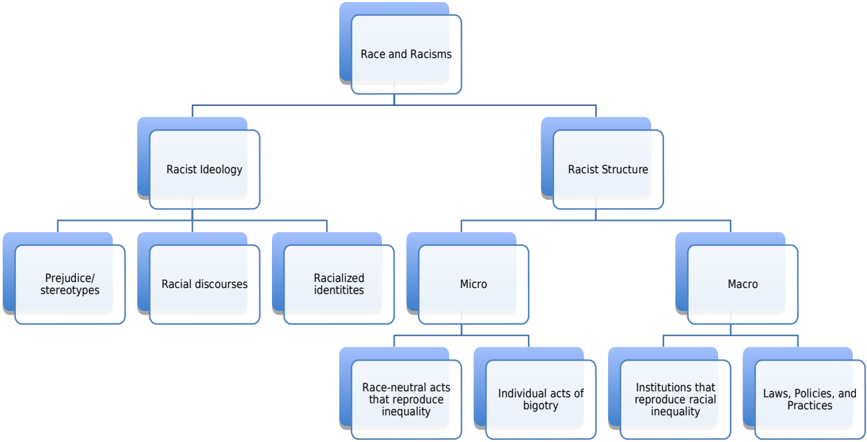
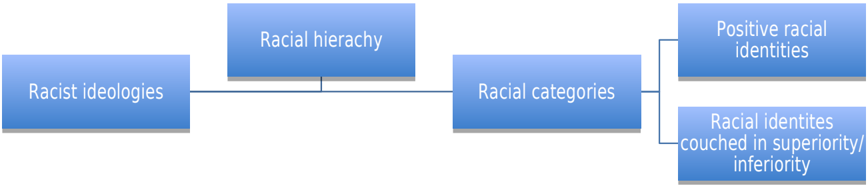
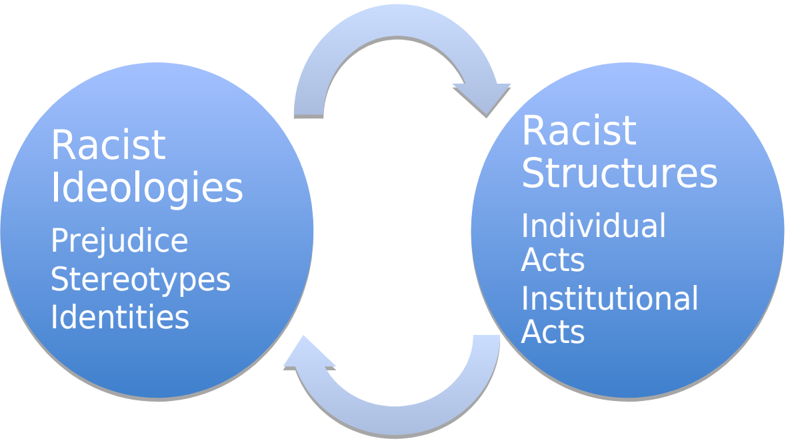
- Analysis: conceptual framework building, including figures that visualize the theory of race and racism, racist ideologies and racial identities, and racist ideologies and racist structures; the paper defines race and racism, reviews individual/institutional/structural racism, and argues for intersectionality.
Limitations
- The paper does not include a formal limitations section. It acknowledges that more work is needed to grapple with race, class, and gender not just as discourses or ideologies but also as structures or systems of oppression, and it states that empirical examples reveal the need for an intersectional framework in most areas of race scholarship.
- Evident from the text: as a theoretical synthesis, the paper does not systematically test its framework against new data; its empirical examples are illustrative rather than exhaustive.
- The author states her positionality as a tenured professor and a white woman and as a committed anti-racist, but does not frame this as a limitation.
Model-written summary. Check it against the paper before relying on it.
Integrity signals
Registry
Cites
Statistics
Figures
Verification
Claims the paper makes
7 Valid · 6 Not valid · 64 Not checked · 55 Own results and interpretations
Every source the paper cites for this claim was checked and supports it.
In the paper
“the work of Collins (2004) helps us perceive that an understanding of how racial ideologies are promulgated must be intersectional.”
What the sources say
- Supportedcites Collins (2004) matched to “Black Sexual Politics: African Americans, Gender, and the New Racism” (2004) source
The Introduction (p. 13) says that intersectional analysis treats race, gender, sexuality, and other systems of power as mutually constructing, and that centering their interaction offers new insight for antiracist scholarship. The Introduction (p. 7) also describes Black gender ideology as arising from the relationship between gender and race and being used to justify discrimination. Together, these passages support the citing sentence’s paraphrase. (LLM, conf=0.89)
plain- Asserted: passes — The authors put it forward as true.
- Checkable: unclear — It is unclear whether it could be checked against evidence.
- Load-bearing: passes — The paper’s conclusions depend on it.
- Based: passes — The paper gives a reason why it holds.
- Supported
Every source the paper cites for this claim was checked and supports it.
In the paper
“The state has the 'material and symbolic resources to impose the categories, classificatory schemes, and modes of social counting and accounting with which bureaucrats, judges, teachers, and doctors must work and to which non-state actors must refer' (Brubaker and Cooper 2000: 16).”
What the sources say
- Supportedcites Brubaker and Cooper 2000 matched to “Beyond “identity”” (2000) source
Split into 2 atoms — 2 confirmed, 0 partially supported, 0 disputed, 0 misattributed, 0 unverifiable. Expand the claim to see per-atom verdicts.
plainstates a cause- Asserted: passes — The authors put it forward as true.
- Checkable: passes — It can be checked against evidence.
- Load-bearing: passes — The paper’s conclusions depend on it.
- Based: passes — The paper gives a reason why it holds.
- Supported
The cited sources support only part of this claim — read each source’s verdict below.
In the paper
“Collins contends that 'controlling images' (2004: 165) - gendered depictions of African Americans in the media - define hegemonic masculinity in opposition by showing what it is not.”
What the sources say
- Partly supportedcites Collins (2004) matched to “Black Sexual Politics: African Americans, Gender, and the New Racism” (2004) sourceExperimental — accuracy not yet measured
The Introduction (pp. 7, 21) says Black gender ideology shapes ideas about masculinity and that media images provide social scripts for how to behave as a Black man or woman. The passages do not establish the more specific claim that controlling images define hegemonic masculinity by showing what it is not. (LLM, conf=0.79)
plainstates a cause- Asserted: passes — The authors put it forward as true.
- Checkable: passes — It can be checked against evidence.
- Load-bearing: unclear — It is unclear whether the paper’s conclusions depend on it.
- Based: passes — The paper gives a reason why it holds.
- Partly supported
The cited sources support only part of this claim — read each source’s verdict below.
In the paper
“In addition, Collins' analysis can be extended to other groups, as the idea of 'controlling images' also can be applied to Latinos, Native Americans, Asians, and Arabs.”
What the sources say
- Partly supportedcites Collins (2004) matched to “Black Sexual Politics: African Americans, Gender, and the New Racism” (2004) sourceExperimental — accuracy not yet measured
In the introduction (page not supplied), Collins says that many of her arguments may apply to Puerto Ricans, indigenous peoples, Chicanos, Vietnamese, and Cambodians, while stressing each group’s distinctive history. This supports extending her analysis to several of the groups named, but the passage does not specifically extend the idea of controlling images to them or mention Arabs. (LLM, conf=0.82)
plain- Asserted: passes — The authors put it forward as true.
- Checkable: passes — It can be checked against evidence.
- Load-bearing: unclear — It is unclear whether the paper’s conclusions depend on it.
- Based: passes — The paper gives a reason why it holds.
- Partly supported
Every source the paper cites for this claim was checked and supports it.
In the paper
“'Controlling images' (Collins 2004) of black, Latino, and Arab men as threatening have served as discursive fodder for the implementation of state repression.”
What the sources say
- Supportedcites Collins 2004 matched to “Black Sexual Politics: African Americans, Gender, and the New Racism” (2004) source
The citation is attached to the term “controlling images,” rather than to the sentence’s full claim about three groups and state repression. The “Overall Organization of the Volume” section describes representations of Black masculinity that help structure racism and are deployed to defend the treatment of African Americans in social institutions. That supports the cited concept; the application to Latino and Arab men is the citing authors’ extension. (LLM, conf=0.85)
plainstates a cause- Asserted: passes — The authors put it forward as true.
- Checkable: passes — It can be checked against evidence.
- Load-bearing: passes — The paper’s conclusions depend on it.
- Based: passes — The paper gives a reason why it holds.
- Supported
50 more claims
Create a free account to see all 132 claims and every source verdict.
- Probably not a substantial claim. 58
- It may state two separate claims as one. 35
Self-check
Percentages, sums and reported differences re-computed from the paper’s own numbers.
Each contradiction between two passages listed here was confirmed by an independent check.
Rated minor: it would not touch a result — a value no result rests on, a p-value that stays on the same side of the significance level, or a conflict that is clerical, resolved elsewhere in the paper, or outside its own findings.
In the paper
§ Individual, Institutional, and Structural Racism
“The arguments and concepts Yeakey (1979: 203) laid out in her essay continue to be relevant today.”
§ Works Cited
“Yeakey, C. 1979. 'Ethnicity as a Dimension of Human Diversity.' In Human Diversity and Pedagogy (pp. 5.1-5.49). Educational Testing Services, Princeton, NJ.”
Rated minor: it would not touch a result — a value no result rests on, a p-value that stays on the same side of the significance level, or a conflict that is clerical, resolved elsewhere in the paper, or outside its own findings.
In the paper
§ Individual, Institutional, and Structural Racism
“Societies that have racialized social systems differentially allocate 'economic, political, social, and even psychological rewards to groups along racial lines' (1997:442).”
§ Works Cited
“Bonilla-Silva, E. 1997. Rethinking Racism : Toward a Structural Interpretation. American Sociological Review , 62 (3), 465-480.”
Citations
Cites
Mapping the Margins: Intersectionality, Identity Politics, and Violence against Women of Color
Crenshaw, K. (1991) · Stanford Law Review · doi:10.2307/1229039 · Cited by 32,792
Racial Formation in the United States
Omi, M., & Winant, H. (2014) · doi:10.4324/9780203076804 · Cited by 3,510
Marx, K. (2021) · The New Economic Sociology · doi:10.2307/j.ctv1f886rp.17 · Cited by 3,199
Coloniality of Power and Eurocentrism in Latin America
Quijano, A. (2000) · International Sociology · doi:10.1177/0268580900015002005 · Cited by 3,190
Brubaker, R., & Cooper, F. (2000) · Theory and Society · doi:10.1023/a:1007068714468 · Cited by 3,139 · cited 1×
“The state has the “material and symbolic resources to impose the categories, classificatory schemes, and modes of social counting and accounting with which bureaucrats, judges, teachers, and doctors must work and to which nonstate actors must refer” (Brubaker and Cooper 2000:16).”
BackgroundRethinking Racism: Toward a Structural Interpretation
Bonilla-Silva, E. (1997) · American Sociological Review · doi:10.2307/2657316 · Cited by 2,760
(2004) · Choice Reviews Online · doi:10.5860/choice.41-3121 · Cited by 2,721
Davis, K. (2008) · Feminist Theory · doi:10.1177/1464700108086364 · Cited by 2,539
(2000) · The Journal of Negro Education · Cited by 2,472
(2010) · Encyclopedia of African American Education · doi:10.4135/9781412971966.n136 · Cited by 2,316
Research works printed but not linked: 3
- Friedman, S. R. 1969. How is Racism Maintained? Et al (2) 18-21
- Marx Karl, 1848, The German Ideology
- Smedley, A. 1999. Race in North America: Origin of a worldview . Westview Press: Boulder, CO.
Cited by
A Theory of Racialized Organizations
Ray, V. (2019) · American Sociological Review · doi:10.1177/0003122418822335 · Cited by 1,994
“Race scholarship from a structural perspective typically focuses on macro-level structures with great depth and power (Golash-Boza 2016).”
BackgroundA Global Critical Race and Racism Framework: Racial Entanglements and Deep and Malleable Whiteness
Christian, M. (2019) · Sociology of Race and Ethnicity · doi:10.1177/2332649218783220 · Cited by 237
“…critical race and racism (GCRR) framework that “retools,” as Jung (2015) did, Bonilla-Silva’s national racialized social systems approach by adding global and historical dimensions and structuring the framework around what Golash-Boza (2016) visualized as “racist structure” and “racist ideology.””
BackgroundNazroo, J. Y., Bhui, K. S., & Rhodes, J. (2020) · Sociology of Health & Illness · doi:10.1111/1467-9566.13001 · Cited by 232
“Operating alongside and in interaction with other axes of domination, such as class and gender (Byrne 2015, Golash-Boza 2016, Phillips 2010, Song 2014), race/ethnicity remains a key determinant of social location, status and power.”
BackgroundAI generates covertly racist decisions about people based on their dialect
Hofmann, V., Kalluri, P. R., Jurafsky, D., & King, S. (2024) · Nature · doi:10.1038/s41586-024-07856-5 · Cited by 233
The structural roots of food insecurity: How racism is a fundamental cause of food insecurity
Bowen, S., Elliott, S., & Hardison‐Moody, A. (2021) · Sociology Compass · doi:10.1111/soc4.12846 · Cited by 167
Whatever Happened to Socialization?
Guhin, J., Calarco, J. M., & Miller‐Idriss, C. (2021) · Annual Review of Sociology · doi:10.1146/annurev-soc-090320-103012 · Cited by 200
García, S. J. (2017) · Sociology of Race and Ethnicity · doi:10.1177/2332649217713315 · Cited by 171
Racial Microaggressions and Sense of Belonging at a Historically White University
Lewis, J. A., Mendenhall, R. M., Ojiemwen, A., Thomas, M., Riopelle, C., Harwood, S. A., & Huntt, M. B. (2019) · American Behavioral Scientist · doi:10.1177/0002764219859613 · Cited by 218
“Many historical and contemporary CRT scholars in sociology have articulated the ways that race and racism are perpetuated in U.S. society through an examination of institutional, structural, systemic, and color-blind racism (Bonilla-Silva, 1997; Bracey, 2015; Feagin, 2006; Golash-Boza, 2016).”
BackgroundCritical Race Theory, Afro-Pessimism, and Racial Progress Narratives
Ray, V. E., Randolph, A., Underhill, M. R., & Luke, D. J. (2017) · Sociology of Race and Ethnicity · doi:10.1177/2332649217692557 · Cited by 148
Racism without Hatred? Racist Humor and the Myth of “Colorblindness”
Pérez, R. (2017) · Sociological Perspectives · doi:10.1177/0731121417719699 · Cited by 150
Family Structure, Risks, and Racial Stratification in Poverty
Williams, D. T., & Baker, R. (2021) · Social Problems · doi:10.1093/socpro/spab018 · Cited by 115
Williams, D. T. (2019) · Population Research and Policy Review · doi:10.1007/s11113-019-09538-x · Cited by 109
“I am not suggesting settler colonialism is the only useful conceptual framework, I present and highlight settler colonialism only for illustrative purposes (for a review on additional race theories, see Golash-Boza 2016).”
BackgroundHomegrown foreigners: how Christian nationalism and nativist attitudes impact Muslim civil liberties
Dahab, R., & Omori, M. K. (2018) · Ethnic and Racial Studies · doi:10.1080/01419870.2018.1506142 · Cited by 95
“Both dimensions normalize the Muslim as foreigners, and thus legitimize various forms of aggression in their everyday life (Cainkar 2009; Golash-Boza 2016).”
BackgroundDisrupting White Supremacy and Anti-Black Racism in Educational Organizations
Diamond, J. B., & Gomez, L. M. (2023) · Educational Researcher · doi:10.3102/0013189x231161054 · Cited by 126
Theorizing race and settler colonialism within U.S. sociology
McKay, D. L., Vinyeta, K., & Norgaard, K. M. (2020) · Sociology Compass · doi:10.1111/soc4.12821 · Cited by 105
Toward an economic sociology of race
Hirschman, D., & Garbes, L. (2019) · Socio-Economic Review · doi:10.1093/ser/mwz054 · Cited by 99
Re-imagining the marketplace: addressing race in academic marketing research
Grier, S. A., Thomas, K. D., & Johnson, G. D. (2019) · Consumption Markets & Culture · doi:10.1080/10253866.2017.1413800 · Cited by 86
“The idea of “race” includes the socially constructed belief that individuals can be hierarchically divided into discrete and exclusive groups based on perceived physical and cultural traits (Golash-Boza 2016).”
BackgroundAdvancing healthcare equity through dissemination and implementation science
Baumann, A. A., Shelton, R. C., Kumanyika, S., & Haire-Joshu, D. L. (2023) · Health Services Research · doi:10.1111/1475-6773.14175 · Cited by 116
Racial and Ethnic Differences in Perceptions of Everyday Discrimination
Gong, F., Xu, J., & Takeuchi, D. T. (2016) · Sociology of Race and Ethnicity · doi:10.1177/2332649216681587 · Cited by 93
Alvarez, C. (2022) · Journal of Racial and Ethnic Health Disparities · doi:10.1007/s40615-021-01215-0 · Cited by 104
“A central aspect of systematic racism is the disproportionate allocation of material resources leading to real material consequences including environmental and health disparities [15, 16].”
BackgroundPerpetual Inferiority: Whites’ Racial Ideology toward Latinos
Lacayo, C. O. (2017) · Sociology of Race and Ethnicity · doi:10.1177/2332649217698165 · Cited by 83
“(Golash-Boza 2016:3) Notions of race in the United States are based on deeming whites1 superior and African Americans inferior.”
BackgroundFeely, M., & Bosk, E. A. (2021) · Race and Social Problems · doi:10.1007/s12552-021-09313-8 · Cited by 99
“…inequality have focused on individual explanations, situating unequal outcomes as a result of prejudiced attitudes and belief about the inferiority of Black and Brown people and the superiority of Whites that are expressed through discriminatory behaviors (Bonilla-Silva 1997; Golash-Boza 2016).”
BackgroundThe Counter-Deficit Lens in Educational Research: Interrogating Conceptions of Structural Oppression
Kolluri, S., & Tichavakunda, A. A. (2022) · Review of Educational Research · doi:10.3102/00346543221125225 · Cited by 99
“In challenging deficit understandings of different marginalized populations, scholars are challenging the ideological beliefs and attitudes (Golash-Boza, 2016).”
BackgroundInfluentialIntegrating Race, Racism, and Critical Consciousness in Black Parents' Engagement With Schools
Marchand, A. D., Vassar, R. R., Diemer, M. A., & Rowley, S. J. (2019) · Journal of Family Theory & Review · doi:10.1111/jftr.12344 · Cited by 120
James, A. G., Coard, S. I., Fine, M. A., & Rudy, D. (2018) · Journal of Family Theory & Review · doi:10.1111/jftr.12262 · Cited by 70
Anti‐racism in U.S. early childhood education: Foundational principles
Escayg, K. (2020) · Sociology Compass · doi:10.1111/soc4.12764 · Cited by 69
Racial Oppression and Racial Projects in Consumer Markets: A Racial Formation Theory Approach
Crockett, D. (2021) · Journal of Consumer Research · doi:10.1093/jcr/ucab050 · Cited by 71
Digital prediction technologies in the justice system: The implications of a ‘race-neutral’ agenda
Ugwudike, P. (2020) · Theoretical Criminology · doi:10.1177/1362480619896006 · Cited by 86
“But it draws on themes from the sociology of race to argue that the liberal race neutrality frame invoked to legitimize such technologies obfuscate the structural conditions that can racialize their outcomes (Bonilla-Silva, 2015; Feagin, 2013; Golash-Boza, 2016; Goldberg, 2015; Vickerman, 2013).”
BackgroundMethodInfluentialBlack Caregivers’ Perspectives on Racism in ASD Services: Toward Culturally Responsive ABA Practice
Čolić, M., Araiba, S., Lovelace, T. S., & Dababnah, S. (2021) · Behavior Analysis in Practice · doi:10.1007/s40617-021-00577-5 · Cited by 66
“Race is a “socially constructed belief that the human race can be divided into biologically discrete and exclusive groups” that are based on physical, cultural, or social classifications (Golash-Boza, 2016, p. 130; see alsoMatsuda et al., 2020, for their attempt to operationally define racism).”
BackgroundInfluentialThe Enduring Significance of Ethno-Racial Inequalities in Poverty in the U.S., 1993–2017
Baker, R., Brady, D., Parolin, Z., & Williams, D. T. (2021) · Population Research and Policy Review · doi:10.1007/s11113-021-09679-y · Cited by 71
Baker, R., & O’Connell, H. A. (2022) · Journal of Marriage and the Family · doi:10.1111/jomf.12837 · Cited by 62
Norgaard, K. M., Reed, R., & Bacon, J. M. (2017) · Sociology of Race and Ethnicity · doi:10.1177/2332649217706518 · Cited by 60
“The theory of racial formation has become the central explanation for race, racism, and racial outcomes in the discipline of sociology (Golash-Boza 2016; Saperstein, Penner, and Light 2013).”
BackgroundInfluentialRacial formation and education: A critical analysis of the Sewell report
Tikly, L. P. (2022) · Ethnicities · doi:10.1177/14687968211061882 · Cited by 61
“…theory can be considered complementary to CRT and to ideas of systemic and institutionalised racism in that it allows for a more nuanced understanding of how intersecting and competing racial projects have, at an aggregate level, worked to sustain White supremacy (Golash-Boza, 2013, 2016).”
BackgroundRace in the Marketplace: Crossing Critical Boundaries
Sobande, F. (2019) · Springer eBooks · doi:10.1007/978-3-030-11711-5 · Cited by 53
The Funk of White Souls: Toward a Du Boisian Theory of the White Church
Mayrl, D. (2022) · Sociology of Religion · doi:10.1093/socrel/srac009 · Cited by 47
Westbrook, L. (2023) · Gender & Society · doi:10.1177/08912432231171172 · Cited by 53
“Like gender, race as a social system/structure (Bonilla-Silva 1997; Golash-Boza 2016) plays a significant role in the matrix of violence.”
BackgroundKnighton, J.-S., Dogan, J., Hargons, C., & Stevens-Watkins, D. (2022) · Ethnicity & Health · doi:10.1080/13557858.2020.1818695 · Cited by 38
“An ideology of presumed superiority of the White race is often perpetuated through individual and institutional-level practices (Golash-Boza 2016).”
BackgroundRacism and the mechanisms maintaining racial stratification in Black families
Williams, D. T. (2023) · Journal of Family Theory & Review · doi:10.1111/jftr.12511 · Cited by 43
Can Buildings be Racist? A Critical Sociology of Architecture and the Built Environment
Fu, A. S. (2021) · Sociological Inquiry · doi:10.1111/soin.12478 · Cited by 38
Rodríguez‐García, D. (2022) · Social Sciences · doi:10.3390/socsci11010013 · Cited by 54
“Simply put, racism cannot exist without the constructed idea of race, so we need to consider these topics together (Golash-Boza 2016).”
BackgroundThe inferior white: Politics and practices of racialization of people from the Middle East in the US
Khoshneviss, H. (2018) · Ethnicities · doi:10.1177/1468796818798481 · Cited by 41
“Whiteness, instead of being defined by and for itself, is constructed through negation with the ‘impure,’ ‘pervert,’ and ‘inferior’ (Collins, 1986; Du Bois [1920] 2007; Golash-Boza, 2016; James, 2008; Jordan, 1974).”
BackgroundRacialized Organizations and Color-Blind Racial Ideology in Brazil
Carrillo, I. R. (2020) · Sociology of Race and Ethnicity · doi:10.1177/2332649220943223 · Cited by 34
Bridging critical race theory and migration: Moving beyond assimilation theories
García, S. J. (2017) · Sociology Compass · doi:10.1111/soc4.12484 · Cited by 53
A Critical Assessment of Comparative Sociology of Race and Ethnicity
Suzuki, K. (2017) · Sociology of Race and Ethnicity · doi:10.1177/2332649217708580 · Cited by 38
Liévanos, R. S. (2019) · Race and Social Problems · doi:10.1007/s12552-019-09260-5 · Cited by 40
Racialized Discourse in Seattle Rental Ad Texts
Kennedy, I. A., Hess, C., Paullada, A., & Chasins, S. (2020) · Social Forces · doi:10.1093/sf/soaa075 · Cited by 39
“…accounts of racial discrimination focus on racially biased treatment of one individual by another, alternatives suggest that discriminatory outcomes can occur without explicit connection to race on the part of the actor (Pager and Shepherd 2008, Reskin 2012, Bracey 2015, Golash-Boza 2016).”
BackgroundCritical environmental justice and the nature of the firm
Carrillo, I. R., & Pellow, D. N. (2021) · Agriculture and Human Values · doi:10.1007/s10460-021-10193-2 · Cited by 43
“Advancing this inquiry responds to calls for the deeper study of how ideology and institutions interact to sustain inequality (Bell and York 2010; Golash-Boza 2016; Hirschman and Garbes 2019; Hughey et al.”
BackgroundStandardizing Biases: Selection Devices and the Quantification of Race
Hirschman, D., & Bosk, E. A. (2019) · Sociology of Race and Ethnicity · doi:10.1177/2332649219844797 · Cited by 42
“…identify racially disproportionate outcomes as resulting from some combination of explicit prejudice and implicit bias, sociologists of race have long argued that both historical and contemporary racial inequality must be understood as structural and systemic (Bonilla-Silva 1997; Golash-Boza 2016).”
BackgroundMasculinity Attitudes Across Rural, Suburban, and Urban Areas in the United States
Silva, T. J. (2021) · Men and Masculinities · doi:10.1177/1097184x211017186 · Cited by 44
“Regardless of spatial context, institutional racism operates such that Black men experience marginalization across America, as do Latinos (Bonilla-Silva 2019; Collins 2004; Golash-Boza 2016).”
BackgroundJoseph, T. D., & Golash‐Boza, T. (2021) · Social Sciences · doi:10.3390/socsci10090345 · Cited by 48
Self-citationNotes toward an anticolonial environmental sociology of race
Murphy, M. W. (2020) · Environmental Sociology · doi:10.1080/23251042.2020.1862979 · Cited by 34
“…of analyzing the significance that race/racism plays in the modern world (Bonilla-Silva 1997; Feagin 2001, 2006; Treitler 2013; Omi and Winant 2014; Golash-Boza 2016), colonialism and imperialism are given a minor role, if given one at all, within predominant sociological theories of race…”
BackgroundPlaisime, M. V., Jipguep-Akhtar, M. C., & Belcher, H. M. E. (2023) · SSM - Qualitative Research in Health · doi:10.1016/j.ssmqr.2023.100312 · Cited by 48
Lac, V. T., Diamond, J. B., & Velázquez, M. D. C. (2020) · Equity & Excellence in Education · doi:10.1080/10665684.2020.1758976 · Cited by 33
Brown, T. H., Hargrove, T. W., Homan, P., & Adkins, D. E. (2023) · Demography · doi:10.1215/00703370-10740718 · Cited by 36
O’Neill, K. K., Kennedy, I. A., & Harris, A. (2021) · Sociology of Race and Ethnicity · doi:10.1177/23326492211057817 · Cited by 35
“…to success and the exacerbation of their effects in BIPOC communities— are (re)produced by racialized social systems (Bonilla-Silva 1997; Golash-Boza 2016; Ray 2019), implicating racism in both present realities of unequal contact with the legal system and the historical processes…”
BackgroundCritical Race Theory and Empirical Sociology
Christian, M. M., Seamster, L., & Ray, V. E. (2019) · American Behavioral Scientist · doi:10.1177/0002764219859646 · Cited by 38
“Thus, as Golash-Boza (2016) states, “There is no good reason to study race other than working toward the elimination of racial oppression” (p. 130).”
BackgroundShiao, J. L., & Woody, A. (2020) · Sociological Perspectives · doi:10.1177/0731121420964239 · Cited by 48
“This finding confirms our own sense 506 Sociological Perspectives 64(4) that many scholars of structural racism regard preexisting, active, and cultural racial dominance to be indivisible constructs, even within the page limits of journal articles (e.g., Golash-Boza 2016).”
BackgroundResultRacial Stratification Among Latinos in the Mortgage Market
Loya, J. (2021) · Race and Social Problems · doi:10.1007/s12552-021-09326-3 · Cited by 38
Co‐brand partnerships making space for the next black girl: Backlash in social justice branding
Smith, D. C., James, C. D., & Griffiths, M. A. (2021) · Psychology and Marketing · doi:10.1002/mar.21566 · Cited by 35
“Connecting to prejudice racism is defined as ways of thinking, structures, individual acts, institutional, arrangements, and practices that reproduce racial inequalities (Golash‐Boza, 2016).”
BackgroundInfluentialRace and Ideology in a Pandemic: White Privilege and Patterns of Risk Perception during COVID-19
Vargas, N., Mora, G. C., & Gleeson, S. (2021) · Social Problems · doi:10.1093/socpro/spab037 · Cited by 34
“These powerful effects are rooted in the fact that a white-dominated racial hierarchy has structured U.S. institutions and communities for centuries (Bonilla-Silva 1997; Feagin 2013; Golash-Boza 2016; Mills 1993; Romero 2008).”
Background“Daniel was racist”: Individualizing racism when teaching about the Civil Rights Movement
Wills, J. S. (2019) · Theory & Research in Social Education · doi:10.1080/00933104.2019.1583620 · Cited by 29
“structural and systemic understandings and second, recognizing the dialectical relationship between racist ideologies and racist structures in constituting systemic racism (Bonilla-Silva, 1996, 2010, 2015a, 2015b; Golash-Boza, 2016; Omi & Winant, 2015).”
BackgroundInfluentialUs versus Them: Race, Crime, and Gentrification in Chicago Neighborhoods
Doering, J. (2020) · doi:10.1093/oso/9780190066574.001.0001 · Cited by 64
Whose gendered voices matter?: Race and gender in the articulation of /s/ in Bakersfield, California
Calder, J., & King, S. (2022) · Journal of Sociolinguistics · doi:10.1111/josl.12584 · Cited by 26
Merolla, D. M. (2017) · Sociology of Race and Ethnicity · doi:10.1177/2332649217727552 · Cited by 30
Assessments of Environmental Injustice among Black Americans
Parris, C. L., Hegtvedt, K. A., & Johnson, C. (2020) · Social Currents · doi:10.1177/2329496520950808 · Cited by 25
“Although the Civil Rights Movement of the 1960s brought about substantial change in de jure racism, systemic racism is still rampant in every social institution today (BonillaSilva 2018; Delgado and Stefancic 2001; Golash-Boza 2016).”
BackgroundAsian American Diversity and Growth
Tran, V. C. (2024) · Annual Review of Sociology · doi:10.1146/annurev-soc-031021-012617 · Cited by 34
Racial disparities without racism: Some conceptual & analytical considerations
Williams, D. T. (2023) · Sociology Compass · doi:10.1111/soc4.13182 · Cited by 27
Racial Ideology and White Youth: From Middle Childhood to Adolescence
Hagerman, M. A. (2019) · Sociology of Race and Ethnicity · doi:10.1177/2332649219853309 · Cited by 26
Rai, R. (2021) · Asian Ethnicity · doi:10.1080/14631369.2020.1869518 · Cited by 21
Towards a Theory of the Racialization of Space
Tuttle, S. (2022) · American Behavioral Scientist · doi:10.1177/00027642211066051 · Cited by 34
“…racial privileges and disadvantages, and in relation to ideologies, stereotypical imagery, and discriminatory institutional and interpersonal behaviors (see also Golash-Boza 2016), the racialization of space entails overlapping and dialectically related physical, mental, and social facets of space.”
BackgroundThe Sociology of Race & Racism: Key Concepts, Contributions & Debates
Lewis, A. E., Hagerman, M. A., & Forman, T. A. (2019) · Equity & Excellence in Education · doi:10.1080/10665684.2019.1627958 · Cited by 29
“More recently several sociologists have debated whether we are in need of new comprehensive theories of race and racism.4 In a review piece responding to these conversations, Tanya Golash-Boza (2016) draws links between key theories of race and racism and suggests that sociology already has a comprehensive theory, hig…”
BackgroundInfluentialThe U.S. Racial Structure and Ethno-Racial Inequality in Urban Neighborhood Crime, 2010–2013
Krivo, L. J., Lyons, C. J., & Vélez, M. B. (2020) · Sociology of Race and Ethnicity · doi:10.1177/2332649220948551 · Cited by 26
“ethno-racial inequality, crime, violence, racial structure, neighborhoods Krivo et al. 351 interactions—characterizes the U.S. social order (see Bonilla-Silva 2001; Golash-Boza 2016).”
Diverging Disparities: Race, Parental Income, and Children’s Math Scores, 1960 to 2009
Conwell, J. A. (2021) · Sociology of Education · doi:10.1177/0038040720963279 · Cited by 16
Social Movement Framing Tasks and Contemporary Racisms: Diagnostic and Prognostic Forms
Smith, W. P. (2020) · Sociology of Race and Ethnicity · doi:10.1177/2332649220922564 · Cited by 24
“…and practices” that are “responsible for the reproduction of racial domination” (BonillaSilva 2015:75, emphasis added), “reproduce racial inequality” (Golash-Boza 2016:131, emphasis added), and “amount to discrimination” (Macpherson 1999:n.p., emphasis added)—we can define as racist those…”
BackgroundInfluentialWho is Policing the Community? A Comprehensive Review of Discrimination in Police Departments
Ray, V. E., Ortiz, K. S., & Nash, J. L. (2017) · Sociology Compass · doi:10.1111/soc4.12539 · Cited by 22
Antiracist and racist discourse as antagonistic and overlapping
Archakis, Α., & Tsakona, V. (2024) · Pragmatics & beyond. New series · doi:10.1075/pbns.341.01arc · Cited by 22
Facecraft: Race Reification in Psychological Research With Faces
Martinez, J. E. (2023) · Perspectives on Psychological Science · doi:10.1177/17456916231194953 · Cited by 25
“…real consequences (Richeson & Sommers, 2016; Roberts & Rizzo, 2021), an influence from constructionist theories that posit that social-political-historical processes produce races that people live by, defend, reject, or transform (Bonilla-Silva, 1997; Golash-Boza, 2016; Omi & Winant, 2015).”
A migrant’s public apology as an instance of internalized racism: A Greek case study
Archakis, Α., & Tsakona, V. (2024) · Pragmatics & beyond. New series · doi:10.1075/pbns.341.09arc · Cited by 18
“My Color Doesn’t Lie”: Race, Gender, and Nativism among Nurses in the Netherlands
Cottingham, M. D., & Andringa, L. (2020) · Global Qualitative Nursing Research · doi:10.1177/2333393620972958 · Cited by 24
“While racial categories are widely recognized by scholars as a social construct without biological foundation, the social ramifications of phenotypical differences (namely, skin color) remain relevant for shaping social interactions, including interactions that result in differential treatment (Golash-Boza, 2016).”
BackgroundAllidina, S., & Cunningham, W. A. (2023) · Personality and Social Psychology Review · doi:10.1177/10888683231172255 · Cited by 34
“…with work detailing the social and structural influences both on how these dimensions come to exist in the first place (Cosmides et al., 2003; Golash-Boza, 2016; Machery & Faucher, 2005; Pietraszewski et al., 2014) and on how certain groups become located at different points on these…”
Fiske, A., Blacker, S., Geneviève, L. D., Willem, T., Fritzsche, M.-C., Buyx, A., Celi, L. A., & McLennan, S. (2025) · The Lancet Digital Health · doi:10.1016/j.landig.2025.01.003 · Cited by 26
IS “RACE” MODERN? Disambiguating the Question
Hochman, A. (2019) · Du Bois Review Social Science Research on Race · doi:10.1017/s1742058x19000286 · Cited by 33
The Norm among the Exceptional? Experiences of Latino Students in Elite Institutions
Pan, Y. D., & Reyes, D. V. (2020) · Sociological Inquiry · doi:10.1111/soin.12354 · Cited by 18
Marrow, H. B., Tropp, L. R., van der Linden, M., Okamoto, D. G., & Jones‐Correa, M. (2019) · Du Bois Review Social Science Research on Race · doi:10.1017/s1742058x19000249 · Cited by 16
Advancing the Scientific Study of Structural Racism: Concepts, Measures, and Methods
Brown, T. H., Homan, P., & Ray, V. E. (2025) · Annual Review of Sociology · doi:10.1146/annurev-soc-090924-021305 · Cited by 22
Racismo y antirracismo: comprender para transformar
Buraschi, D., & Idáñez, M. J. A. (2019) · Ediciones de la Universidad de Castilla-La Mancha eBooks · doi:10.18239/atena.16.2019 · Cited by 34
Stewart, M. D. (2020) · Sociology of Race and Ethnicity · doi:10.1177/2332649219901130 · Cited by 18
Diskriminasi Ras Dan Hak Asasi Manusia Di Amerika Serikat: Studi Kasus Pembunuhan George Floyd
Saputri, O. B. (2020) · Jurnal Sosiologi Pendidikan Humanis · doi:10.17977/um021v5i2p120-133 · Cited by 16
Manifest Destinies: The Making of the Mexican American Race
Korver–Glenn, E. (2019) · Sociology of Race and Ethnicity · doi:10.1177/2332649219827835 · Cited by 16
Stoll, L. C., Lilley, T. G., & Block, R. (2021) · Journal of Interpersonal Violence · doi:10.1177/0886260518807912 · Cited by 14
When questions do not yield answers: Foreclosures of racial knowledge production
Henricks, K. (2016) · Sociology Compass · doi:10.1111/soc4.12414 · Cited by 15
Stockstill, C., & Carson, G. (2021) · Ethnic and Racial Studies · doi:10.1080/01419870.2021.1900584 · Cited by 20
“Prejudice links micro-, meso-, and macro-levels of society, especially when prejudice generates unequal ETHNIC AND RACIAL STUDIES 897 allocation of resources via discrimination (Golash-Boza 2016; Park and Buriel 2007; Ray 2019; Winant 2000).”
BackgroundRacial Gaslighting in a Non-Racial France
Beaman, J. (2022) · Contemporary French and Francophone Studies · doi:10.1080/17409292.2022.2107261 · Cited by 17
Utilizing a theory of racialized organizations within sport management research and practice
Howe, J. E., Keaton, A. C. I., & Rockhill, C. A. (2023) · European Sport Management Quarterly · doi:10.1080/16184742.2023.2237024 · Cited by 15
“The meso-level focus is vital as considerable scholarship related to racist ideologies and structures takes a micro or macro-level approach (Golash-Boza, 2016), ultimately limiting understandings of how organizational structures perpetuate inequity.”
Analytic racecraft: Race-based averages create illusory group differences in perceptions of racismPreprint
Martinez, J. E. (2020) · doi:10.31234/osf.io/kfpjg · Cited by 14
Delegitimizing Racialized Brands
Veresiu, E. (2022) · Journal of the Association for Consumer Research · doi:10.1086/722694 · Cited by 19
Byrd, T., Ingram, L. A., & Okpara, N. (2022) · Women s Health · doi:10.1177/17455057221133830 · Cited by 24
Ifatunji, M. A. (2024) · Sociology of Race and Ethnicity · doi:10.1177/23326492241252917 · Cited by 16
“…some offer an “. . . intersectional approach insofar as it looks at two distinct axes of inequality race and ethnicity within a structural context of white supremacy” (italics added; Cornell and Hartmann [1998] 2007; García 2017; Golash-Boza 2016; Treitler 2013b; Valdez and Golash-Boza 2017a:2260).”
Rethinking pubertal research: Embracing intersectionality
Carter, R., & Seaton, E. K. (2025) · Child Development Perspectives · doi:10.1111/cdep.12527 · Cited by 18
Divide in Ferguson: Social Media, Social Context, and Division
Park, Y. J., Jones-Jang, S. M., Lee, H., & Yang, G. S. (2018) · Social Media + Society · doi:10.1177/2056305118789630 · Cited by 16
Metadata
- Authors
- Golash-Boza, T.
- Affiliations
- University of California, Merced, CA, USA
- Venue
- Sociology of Race and Ethnicity
- Publisher
- SAGE Publications
- Published
- 2016-02-23
- Volume
- 2
- Issue
- 2
- Pages
- 129-141
- ISSN
- 2332-6492 (ISSN-L)
- 2332-6506
- OpenAlex
- W2309830406
- Cited by
- 321
- References
- 60
- Citations by year
- 2026: 16 · 2025: 36 · 2024: 34 · 2023: 42 · 2022: 40 · 2021: 39 · 2020: 51 · 2019: 30 · 2018: 17 · 2017: 13 · 2016: 3
- FWCI
- 47.76
- Type
- journal article
- Language
- en
- Open access
- green
- escholarship.org
- Licence
- journals.sagepub.com/page/policies/text-and-data-mining-license (tdm)
- Locations
- Sociology of Race and Ethnicity (publishedVersion)
- eScholarship (California Digital Library) (submittedVersion)
- Funders
- University of California Merced
- Topics
- Social Sciences › Gender Studies › Feminist Theory and Gender Studies
- Social Sciences › Sociology and Political Science › Social Movements and Cultural Identity
- Social Sciences › Sociology and Political Science › Race, History, and American Society
- Keywords
- race theory, racism, critical race theory, racist ideology, racial oppression, intersectionality
About these checks
Registry, retraction, Cites and statistics results are computed, not judged, with one exception: a printed reference that no index lists is read once by a model before it counts as a citation error. Claims are extracted by a model and kept only when their quote appears verbatim in the text; each cited source is then checked, with a model’s help, for whether it says what the claim relies on. Those verdicts can be wrong — read the claim’s quote and the cited source before relying on one.
The claim verdicts this report counts are experimental: their accuracy is not yet measured.
A language model drew the claims from the paper on 2026-09-30, under version 3 of the claim definition (model deepseek-v4.1-flash, prompt extract-v3).
A second model labelled each claim on 2026-09-30 (model jev-1.13-20260917, definition revision gold-guideline-v0.2).
Cited sources are checked with a language model’s help (gpt-6-sol).
Statistics and arithmetic are recomputed, not judged.
Confidence bands are shown only for fields calibrated on our annotated test set. None is calibrated yet, so no band is shown.
What counts as a claim ›How we measure confidence ›How we check this ›
Are you an author, or do you see a problem with this page? Request a review
Data sources
Bibliographic data: Semantic Scholar, OpenAlex, Crossref.
Contains information from the Semantic Scholar Academic Graph Datasets, made available under the ODC Attribution License (ODC-BY 1.0).
Semantic Scholar’s data is described in: Kinney, R., et al. (2023). The Semantic Scholar Open Data Platform. arXiv:2301.10140.
