

A Critical and Comprehensive Sociological Theory of Race and Racism
Open accessThe DOI matches its Crossref record; 61 of the 61 references it cites were found in a registry or an index; 7 of the 72 sources its claims cite were checked for support.
Abstract
This article contests the contention that sociology lacks a sound theoretical approach to the study of race and racism, instead arguing that a comprehensive and critical sociological theory of race and racism exists. This article outlines this theory of race and racism, drawing from the work of key scholars in and around the field. This consideration of the state of race theory in sociology leads to four contentions regarding what a critical and comprehensive theory of race and racism should do: (1) bring race and racism together into the same analytical framework; (2) articulate the connections between racist ideologies and racist structures; (3) lead us towards the elimination of racial oppression; and (4) include an intersectional analysis.
Overview
CoChat Summary
TL;DR
Golash-Boza contests the claim that sociology lacks a sound theoretical approach to race and racism, arguing that a comprehensive and critical sociological theory already exists. She synthesizes key scholarship to outline four requirements for such a theory: bring race and racism together, link racist ideologies and structures, aim toward eliminating racial oppression, and include intersectionality.
Key findings
- The paper argues a critical and comprehensive theory of race and racism should do four things: (1) bring race and racism into the same analytical framework; (2) articulate connections between racist ideologies and racist structures; (3) lead toward elimination of racial oppression; and (4) include an intersectional analysis.
- Racism is defined as both (1) the ideology that races are populations whose physical differences are linked to significant cultural and social differences and that innate hierarchical differences can be measured and judged, and (2) the micro- and macro-level practices that subordinate races believed inferior.
- Using mass deportation as an empirical example, the paper states that the 1996 AEDPA and IIRIRA laws led to the deportation of 5 million people between 1997 and 2015; 98 percent of deportees were sent to Latin America and the Caribbean and 90 percent were men, despite no raced or gendered language in the Immigration and Nationality Act.
- The paper also argues that gendered and racialized “controlling images” — such as the black male “thug,” the black female “welfare queen,” and the Arab male “terrorist” — help justify inequalities and articulate with structures such as the prison-industrial complex and welfare and immigration restrictions.
Methods
- Design: theoretical/conceptual essay that synthesizes existing sociological and critical race scholarship rather than presenting new empirical research.
- Data/sample: no new data; the argument draws on work by scholars including Eduardo Bonilla-Silva, Joe Feagin, Charles Mills, Patricia Hill Collins, Carol Camp Yeakey, Zulema Valdez, Amanda Lewis, Dorothy Roberts, and Wendy Leo Moore, with illustrative empirical examples such as mass deportation.
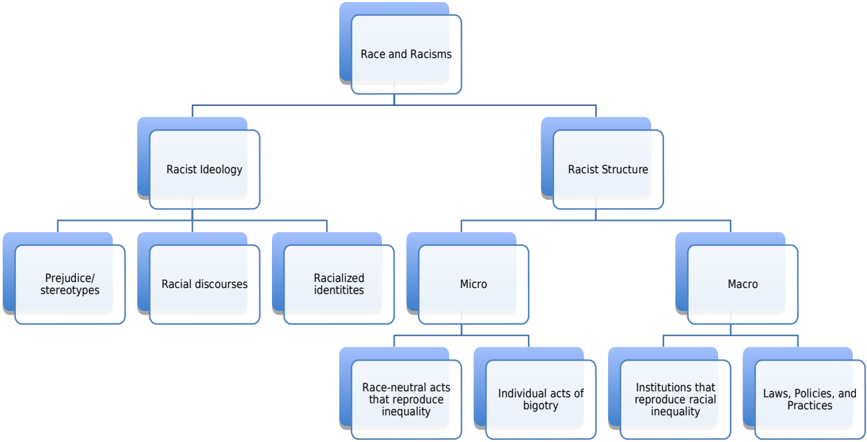
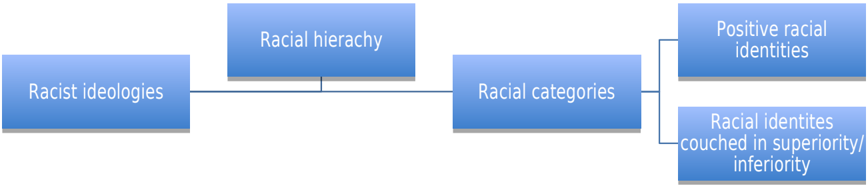
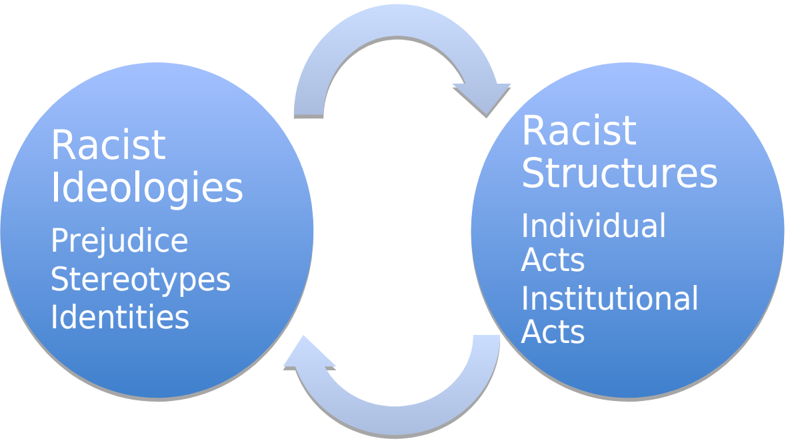
- Analysis: conceptual framework building, including figures that visualize the theory of race and racism, racist ideologies and racial identities, and racist ideologies and racist structures; the paper defines race and racism, reviews individual/institutional/structural racism, and argues for intersectionality.
Limitations
- The paper does not include a formal limitations section. It acknowledges that more work is needed to grapple with race, class, and gender not just as discourses or ideologies but also as structures or systems of oppression, and it states that empirical examples reveal the need for an intersectional framework in most areas of race scholarship.
- Evident from the text: as a theoretical synthesis, the paper does not systematically test its framework against new data; its empirical examples are illustrative rather than exhaustive.
- The author states her positionality as a tenured professor and a white woman and as a committed anti-racist, but does not frame this as a limitation.
Model-written summary. Check it against the paper before relying on it.
Integrity signals
Registry
Cites
Statistics
Figures
Verification
Claims the paper makes
7 Valid · 6 Not valid · 64 Not checked · 55 Own results and interpretations
Every source the paper cites for this claim was checked and supports it.
In the paper
“the work of Collins (2004) helps us perceive that an understanding of how racial ideologies are promulgated must be intersectional.”
What the sources say
- Supportedcites Collins (2004) matched to “Black Sexual Politics: African Americans, Gender, and the New Racism” (2004) source
The Introduction (p. 13) says that intersectional analysis treats race, gender, sexuality, and other systems of power as mutually constructing, and that centering their interaction offers new insight for antiracist scholarship. The Introduction (p. 7) also describes Black gender ideology as arising from the relationship between gender and race and being used to justify discrimination. Together, these passages support the citing sentence’s paraphrase. (LLM, conf=0.89)
plain- Asserted: passes — The authors put it forward as true.
- Checkable: unclear — It is unclear whether it could be checked against evidence.
- Load-bearing: passes — The paper’s conclusions depend on it.
- Based: passes — The paper gives a reason why it holds.
- Supported
Every source the paper cites for this claim was checked and supports it.
In the paper
“The state has the 'material and symbolic resources to impose the categories, classificatory schemes, and modes of social counting and accounting with which bureaucrats, judges, teachers, and doctors must work and to which non-state actors must refer' (Brubaker and Cooper 2000: 16).”
What the sources say
- Supportedcites Brubaker and Cooper 2000 matched to “Beyond “identity”” (2000) source
Split into 2 atoms — 2 confirmed, 0 partially supported, 0 disputed, 0 misattributed, 0 unverifiable. Expand the claim to see per-atom verdicts.
plainstates a cause- Asserted: passes — The authors put it forward as true.
- Checkable: passes — It can be checked against evidence.
- Load-bearing: passes — The paper’s conclusions depend on it.
- Based: passes — The paper gives a reason why it holds.
- Supported
The cited sources support only part of this claim — read each source’s verdict below.
In the paper
“Collins contends that 'controlling images' (2004: 165) - gendered depictions of African Americans in the media - define hegemonic masculinity in opposition by showing what it is not.”
What the sources say
- Partly supportedcites Collins (2004) matched to “Black Sexual Politics: African Americans, Gender, and the New Racism” (2004) sourceExperimental — accuracy not yet measured
The Introduction (pp. 7, 21) says Black gender ideology shapes ideas about masculinity and that media images provide social scripts for how to behave as a Black man or woman. The passages do not establish the more specific claim that controlling images define hegemonic masculinity by showing what it is not. (LLM, conf=0.79)
plainstates a cause- Asserted: passes — The authors put it forward as true.
- Checkable: passes — It can be checked against evidence.
- Load-bearing: unclear — It is unclear whether the paper’s conclusions depend on it.
- Based: passes — The paper gives a reason why it holds.
- Partly supported
The cited sources support only part of this claim — read each source’s verdict below.
In the paper
“In addition, Collins' analysis can be extended to other groups, as the idea of 'controlling images' also can be applied to Latinos, Native Americans, Asians, and Arabs.”
What the sources say
- Partly supportedcites Collins (2004) matched to “Black Sexual Politics: African Americans, Gender, and the New Racism” (2004) sourceExperimental — accuracy not yet measured
In the introduction (page not supplied), Collins says that many of her arguments may apply to Puerto Ricans, indigenous peoples, Chicanos, Vietnamese, and Cambodians, while stressing each group’s distinctive history. This supports extending her analysis to several of the groups named, but the passage does not specifically extend the idea of controlling images to them or mention Arabs. (LLM, conf=0.82)
plain- Asserted: passes — The authors put it forward as true.
- Checkable: passes — It can be checked against evidence.
- Load-bearing: unclear — It is unclear whether the paper’s conclusions depend on it.
- Based: passes — The paper gives a reason why it holds.
- Partly supported
Every source the paper cites for this claim was checked and supports it.
In the paper
“'Controlling images' (Collins 2004) of black, Latino, and Arab men as threatening have served as discursive fodder for the implementation of state repression.”
What the sources say
- Supportedcites Collins 2004 matched to “Black Sexual Politics: African Americans, Gender, and the New Racism” (2004) source
The citation is attached to the term “controlling images,” rather than to the sentence’s full claim about three groups and state repression. The “Overall Organization of the Volume” section describes representations of Black masculinity that help structure racism and are deployed to defend the treatment of African Americans in social institutions. That supports the cited concept; the application to Latino and Arab men is the citing authors’ extension. (LLM, conf=0.85)
plainstates a cause- Asserted: passes — The authors put it forward as true.
- Checkable: passes — It can be checked against evidence.
- Load-bearing: passes — The paper’s conclusions depend on it.
- Based: passes — The paper gives a reason why it holds.
- Supported
50 more claims
Create a free account to see all 132 claims and every source verdict.
- Probably not a substantial claim. 58
- It may state two separate claims as one. 35
Self-check
Percentages, sums and reported differences re-computed from the paper’s own numbers.
Each contradiction between two passages listed here was confirmed by an independent check.
Rated minor: it would not touch a result — a value no result rests on, a p-value that stays on the same side of the significance level, or a conflict that is clerical, resolved elsewhere in the paper, or outside its own findings.
In the paper
§ Individual, Institutional, and Structural Racism
“The arguments and concepts Yeakey (1979: 203) laid out in her essay continue to be relevant today.”
§ Works Cited
“Yeakey, C. 1979. 'Ethnicity as a Dimension of Human Diversity.' In Human Diversity and Pedagogy (pp. 5.1-5.49). Educational Testing Services, Princeton, NJ.”
Rated minor: it would not touch a result — a value no result rests on, a p-value that stays on the same side of the significance level, or a conflict that is clerical, resolved elsewhere in the paper, or outside its own findings.
In the paper
§ Individual, Institutional, and Structural Racism
“Societies that have racialized social systems differentially allocate 'economic, political, social, and even psychological rewards to groups along racial lines' (1997:442).”
§ Works Cited
“Bonilla-Silva, E. 1997. Rethinking Racism : Toward a Structural Interpretation. American Sociological Review , 62 (3), 465-480.”
Citations
Cites
Mapping the Margins: Intersectionality, Identity Politics, and Violence against Women of Color
Crenshaw, K. (1991) · Stanford Law Review · doi:10.2307/1229039 · Cited by 32,792
Racial Formation in the United States
Omi, M., & Winant, H. (2014) · doi:10.4324/9780203076804 · Cited by 3,510
Marx, K. (2021) · The New Economic Sociology · doi:10.2307/j.ctv1f886rp.17 · Cited by 3,199
Coloniality of Power and Eurocentrism in Latin America
Quijano, A. (2000) · International Sociology · doi:10.1177/0268580900015002005 · Cited by 3,190
Brubaker, R., & Cooper, F. (2000) · Theory and Society · doi:10.1023/a:1007068714468 · Cited by 3,139 · cited 1×
“The state has the “material and symbolic resources to impose the categories, classificatory schemes, and modes of social counting and accounting with which bureaucrats, judges, teachers, and doctors must work and to which nonstate actors must refer” (Brubaker and Cooper 2000:16).”
BackgroundRethinking Racism: Toward a Structural Interpretation
Bonilla-Silva, E. (1997) · American Sociological Review · doi:10.2307/2657316 · Cited by 2,760
(2004) · Choice Reviews Online · doi:10.5860/choice.41-3121 · Cited by 2,721
Davis, K. (2008) · Feminist Theory · doi:10.1177/1464700108086364 · Cited by 2,539
(2000) · The Journal of Negro Education · Cited by 2,472
(2010) · Encyclopedia of African American Education · doi:10.4135/9781412971966.n136 · Cited by 2,316
Research works printed but not linked: 3
- Friedman, S. R. 1969. How is Racism Maintained? Et al (2) 18-21
- Marx Karl, 1848, The German Ideology
- Smedley, A. 1999. Race in North America: Origin of a worldview . Westview Press: Boulder, CO.
Cited by
Items 201–300 of 321
Critical Race Theory and Higher Education Research: In the Shadow of Bricolage
Jogie, M. (2021) · Emerald Group Publishing Limited eBooks · doi:10.1108/s2056-375220210000007002 · Cited by 5
Davis, S. (2017) · Cited by 3
White Identity, Conservatism, and Resistance to COVID-19 Mitigation Strategies
Grindal, M., Huft, J., & Sarathchandra, D. (2025) · Youth · doi:10.3390/youth5010019 · Cited by 2
Lepp, H., & Alvero, A. (2025) · Social Science Computer Review · doi:10.1177/08944393251366242 · Cited by 5
“…studies: political ideologies and how they affect citizens and noncitizens; gender ideologies and expectations of how people should behave and act based on their gender; racial ideologies and how countries “ do ” race; and so on (Davis & Greenstein, 2009; Golash-Boza, 2016; Walder 2009).”
Arriaga, F., & Rodriguez, S. (2021) · Cited by 2
Gender, Epistemic Violence, and Indigenous Resistance
Moodie, N. (2022) · Oxford University Press eBooks · doi:10.1093/oxfordhb/9780197528778.013.20 · Cited by 2
Making the invisible visible: examining Black women in Black Lives Matter
Estes, M. L., Straub, A. M., & León-Corwin, M. (2023) · Sociological Spectrum · doi:10.1080/02732173.2023.2245936 · Cited by 5
The Role of Structural Racism for Inequality in Family Poverty: Why Context Matters
Baker, R. (2023) · National symposium on family issues · doi:10.1007/978-3-031-44115-8_1 · Cited by 2
The Flint Water Crisis and the Perpetuation of Environmental Racism in Flint, Michigan (2014–2018)
Ademodi, O. I. (2024) · Journal of African American Studies · doi:10.1007/s12111-024-09666-5 · Cited by 3
“I Know How to Get Around Your ‘No’”: A Follow-Up of the FACES Psychoeducational Intervention
Pearson, J. N., Outlaw, J. K., Stewart-Ginsburg, J. H., & Martin, D. L. M. (2024) · Intellectual and developmental disabilities · doi:10.1352/1934-9556-62.5.406 · Cited by 3
“bigotry, and unequal access to quality care and resources (Golash-Boza, 2016).”
Agency, Structure, and Organization: School-Wide Approaches to Dismantling Injustice
Cruz, R. A., Shin, C., & McClam, R. (2024) · Journal of Cases in Educational Leadership · doi:10.1177/15554589241288866 · Cited by 2
“Scholars and practitioners seeking to challenge racism must engage with this dialectical relationship between (agency-centered) ideology and structure in school context (see Golash-Boza, 2016; Ray, 2019).”
Do brand allyship efforts in the black American community require financial investment?
Leak, R. L., McNeil, K. R., Stone, G. W., & Henderson, R. G. (2025) · Journal of Product & Brand Management · doi:10.1108/jpbm-02-2024-4965 · Cited by 2
Wang, L. W. (2025) · Internal Medicine Journal · doi:10.1111/imj.70059 · Cited by 2
Race, Institutions, and American Homicide: A Du Boisian Test of Institutional Anomie Theory
Reid, J. C., & Stults, B. J. (2025) · Race and Justice · doi:10.1177/21533687251360735 · Cited by 2
“…the most salient forms of social strati fi cation since the founding of the United States (Alexander, 2010; Bonilla-Silva, 1997; Durant & Knottnerusi, 1999; Feagin & Ducey, 2018; Golash-Boza, 2016; Massey, 2007; Omi & Winant, 2014; Reid, 2025, 2024a; Sampson et al., 2018; Smedley & Smedley, 2012).”
James, A. G., Noltemeyer, A. L., Roberts, D., & Bush, K. R. (2021) · Springer series on child and family studies · doi:10.1007/978-3-030-70262-5_30 · Cited by 2
Fanonian analysis of racism and postcolonial structures of othering
Mirončuka, K. (2023) · HYBRIDA · doi:10.7203/hybrida.6.26240 · Cited by 2
“In contrast, at an institutional level, racism is either a failure to acknowledge the Other (racial or societal minority) (Elias, 2023, p. 5) or allocates different societal benefits to the Self versus the Other (Golash-Boza, 2016, p. 133).”
Jafry, Z., Chui, K. K. H., Stopka, T. J., & Corlin, L. (2022) · Children · doi:10.3390/children9091296 · Cited by 3
“The covariates included were the age of the child (in years) [20,32], the sex of the child (female or male) [21,22,32], the race/ethnicity of the child (Hispanic, non-Hispanic Asian, non-Hispanic Black, non-Hispanic White, or 2+ races/non-Hispanic other, considering the social construct of race/ethnicity as a proxy fo…”
BackgroundRacial Discrimination and Poverty Reduction for Sustainable Development
Ahmed, U. A., Aktar, M. A., & Alam, M. M. (2020) · Encyclopedia of the UN sustainable development goals · doi:10.1007/978-3-319-69625-6_10-1 · Cited by 4
Towards an Economic Sociology of RacePreprint
Hirschman, D., & Garbes, L. (2019) · SocArXiv (OSF Preprints) · doi:10.31235/osf.io/jrktq · Cited by 3
The Sociology of the Symbolic LandscapePreprint
Voyer, A. M., & Lund, A. (2018) · SocArXiv (OSF Preprints) · doi:10.31235/osf.io/8gbj9 · Cited by 3
Nichols, H., Swanson, T., Roberts, J., Tchocksi, R.-K., Turnipseed, M., Anderson, C., & Russo‐Tait, T. (2026) · bioRxiv (Cold Spring Harbor Laboratory) · doi:10.64898/2026.06.21.733226 · Cited by 2
Racial Displacement in Action? Safety Activism and Its Racial Entanglements
Doering, J. (2020) · Oxford University Press eBooks · doi:10.1093/oso/9780190066574.003.0003 · Cited by 1
Deeb‐Sossa, N., Torreiro‐Casal, M., & Medel‐Herrero, A. (2024) · Latino Studies · doi:10.1057/s41276-024-00482-2 · Cited by 1
Wedell, E., & Chaney, K. E. (2024) · Personality and Individual Differences · doi:10.1016/j.paid.2024.112904 · Cited by 1
“Study 1 recruited U.S. undergraduate participants at a Northeastern U.S. university.”
BackgroundMethodInfluentialRacial Knowledge and the Tenets of Critical Race Theory: Is Opposition to CRT Due to Ignorance?
Eidelman, S., Jabr, M. M., Vance, E., Roweton, M. A., & Eubanks, A. D. (2025) · Personality and Social Psychology Bulletin · doi:10.1177/01461672251321993 · Cited by 2
“Another possible explanation is ignorance about race as a concept and/or racism as a system of oppression (Golash-Boza, 2016); opponents of CRT may know little about the history of race in America, the aftereffects of past mistreat-ment, and how these aftereffects combine with ongoing practices to…”
Social Psychological Perspectives on Age and Aging
Schafer, M. H. (2025) · Handbooks of sociology and social research · doi:10.1007/978-3-031-93138-3_8 · Cited by 2
Cumulative disadvantage and perceptions of unfair treatment
Broman, C. L., Kelly, M. D. A., Bista, S., & Smith, T. D. (2026) · Ethnic and Racial Studies · doi:10.1080/01419870.2025.2604842 · Cited by 1
Race/Ethnicity and Sleep Disparities
Bray, N. C., Broman, C. L., & Kelly, M. D. A. (2026) · Current Psychology · doi:10.1007/s12144-025-08870-0 · Cited by 1
“This often leads to differential access to educa - tion, housing, jobs, wealth, healthcare, societal power, and prestige (Bonilla-Silva, 2014; Golash-Boza, 2016; Vargas, et al., 2016).”
A Study of Teachers' Emotional and Contextual Reasoning for Engaging or Avoiding Race Talk
Alvarez, A. J. (2026) · Urban Education · doi:10.1177/00420859261424910 · Cited by 1
“As Golash-Boza (2016) argues, racial knowledge is most transformative when developed through collective struggle and accountability, not isolated acts of exposure or empathy.”
Byrd, W. C. (2017) · Ethnic and Racial Studies · doi:10.1080/01419870.2017.1344261 · Cited by 3
Bedın, C. (2021) · Romance Studies · doi:10.1080/02639904.2021.2002556 · Cited by 1
“Dal punto di vista terminologico, la razza è una costruzione sociale usata per classificare le persone che vivono in una determinata società sulla base di caratteristiche che si ritengono fisse e immutate nel tempo (Golash-Boza 2016; Ann Morning 2011).”
BackgroundTazanu, P. M. (2019) · International Journal of Critical Diversity Studies · doi:10.13169/intecritdivestud.2.2.0006 · Cited by 1
Against Race, Toward the Abolition of Racism
Torres, M. (2022) · Sociology of Race and Ethnicity · doi:10.1177/23326492221136168 · Cited by 3
(2023) · Policy Press eBooks · doi:10.2307/jj.3279115 · Cited by 6
Poudel, A., Dance, L., & Marvin, S. (2024) · Sociology Compass · doi:10.1111/soc4.13193 · Cited by 1
Kim, J. (2024) · Ethnic and Racial Studies · doi:10.1080/01419870.2024.2399731 · Cited by 1
“Racial ideology refers to “broad mental and moral frameworks … that social groups use to make sense of the world, to decide what is right and wrong,” and to justify or pro-blematize the current social structure that results in racial (in)equality (Bonilla-Silva 2001, 62; also see Golash-Boza 2016).”
Museus, S. D. (2022) · Higher education · doi:10.1007/978-3-030-94844-3_5-1 · Cited by 1
Human Rights and Racial Inequality Shifts in Contemporary United States
Liang, C. (2023) · Lecture Notes in Education Psychology and Public Media · doi:10.54254/2753-7048/6/20220964
Race, Organizations, and Movements
Wooten, M. E. (2020) · Oxford University Press eBooks · doi:10.1093/obo/9780199756384-0237 · Cited by 1
Diverging Disparities: Race, Parental Income, and Children's Math Scores, 1960-2009Preprint
Conwell, J. A. (2020) · SocArXiv (OSF Preprints) · doi:10.31235/osf.io/rcb4s · Cited by 1
Racial Discrimination and Poverty Reduction for Sustainable Development
Ahmed, U. A., Aktar, M. A., & Alam, M. M. (2021) · Encyclopedia of the UN sustainable development goals · doi:10.1007/978-3-319-95714-2_10 · Cited by 3
"Becoming American": Exploring Exposure to the US and Health Among Latina/os
Martinez-Cardoso, A. (2018) · Deep Blue (University of Michigan)
Seattle Rental Ad Texts and Processes of Segregation
Kennedy, I. (2019) · ResearchWorks at the University of Washington (University of Washington)
Nolden, M. (2020) · Springer eBooks · doi:10.1007/978-3-658-08357-1_73
Racial Identities and Political Standpoints: Expected and Unexpected Alignments
Doering, J. (2020) · Oxford University Press eBooks · doi:10.1093/oso/9780190066574.003.0007
A Brief History of Living Together
Doering, J. (2020) · Oxford University Press eBooks · doi:10.1093/oso/9780190066574.003.0002
“White Vigilantes?”: Two Case Studies of Positive Loitering
Doering, J. (2020) · Oxford University Press eBooks · doi:10.1093/oso/9780190066574.003.0006
“You’ve Got Reason to Be Afraid”: Crime and Race in Electoral Campaigning
Doering, J. (2020) · Oxford University Press eBooks · doi:10.1093/oso/9780190066574.003.0004
Crime and Gentrification beyond Black and White
Doering, J. (2020) · Oxford University Press eBooks · doi:10.1093/oso/9780190066574.003.0008
Resisting Gentrification and Criminalization
Doering, J. (2020) · Oxford University Press eBooks · doi:10.1093/oso/9780190066574.003.0005
Introduction: The Battle over Race, Crime, and Gentrification
Doering, J. (2020) · Oxford University Press eBooks · doi:10.1093/oso/9780190066574.003.0001
Bigotries Originate from the Billionaires, Not from the PublicPreprint
Zuesse, E. (2020) · SSRN Electronic Journal · doi:10.2139/ssrn.3664756
Zhang, T. (2020) · Carolina Digital Repository (University of North Carolina at Chapel Hill) · doi:10.17615/2cqn-v962
Black middle-class neighborhoods in Louisville through multiple lenses.
Wheeler, J. (2020) · ThinkIR: The University of Louisville's Institutional Repository (University of Louisville) · doi:10.18297/etd/3387
Dismantling Systemic Racism and Structuration Theory
Misir, P. (2021) · SpringerBriefs in public health · doi:10.1007/978-3-030-88766-7_5 · Cited by 1
Paint it White: Segregationist Logics in Advertising and the Electric Guitar
Chaudhary, A. R. (2022) · Sociological Forum · doi:10.1111/socf.12782 · Cited by 1
Hagerman, M. A., & Heath, C. (2020) · Oxford University Press eBooks · doi:10.1093/obo/9780199756384-0242
Masculinity, Everyday Racism, and Gaming
Ortiz, S. M. (2022) · Oxford University Press eBooks · doi:10.1093/oxfordhb/9780197510636.013.49
Wells, K. (2022) · Dominican Scholar (Dominican University of California) · doi:10.33015/dominican.edu/2022.at.04
Larnell, T. B., & Molina, K. M. (2020) · Springer eBooks · doi:10.1007/978-3-030-39903-0_832
RACIAL PROBLEMS IN ZADIE SMITH’S 'ON BEAUTY'
Fahma, A. N., Basuki, I., & Wardani, L. D. P. (2021) · LEKSEMA Jurnal Bahasa dan Sastra · doi:10.22515/ljbs.v6i2.4276
“The elite reproduces the practice of racism in ethnic or racial groups against groups that are considered ‘inferior’ below the human line (Grosfoguel, 2016).”
BackgroundNolden, M. (2019) · Springer Reference Sozialwissenschaften · doi:10.1007/978-3-658-08460-8_73-1
Larnell, T. B., & Molina, K. M. (2018) · Springer eBooks · doi:10.1007/978-1-4614-6439-6_832-2
Doering, J. (2020) · Oxford University Press eBooks · doi:10.1093/oso/9780190066574.003.0009
Leyro, S. P. (2018) · Wiley eBooks · doi:10.1002/9781119113799.ch22
Timming, A. R. (2019) · Edward Elgar Publishing eBooks · doi:10.4337/9781788977913.00012
Tichavakunda, A. (2018) · State University of New York Press eBooks · doi:10.1353/book.100126
Racism as a Structural Determinant of Health
Evans, L. (2022) · Oxford University Press eBooks · doi:10.1093/obo/9780199756797-0215
Race, Racism, and Critical Consciousness: Exploring Black Parents' Engagement in Schools
Vassar, R. R. (2019) · American Educational Research Association Annual Meeting (AERA) · doi:10.3102/1442484
How School Community Members Discuss Power During a Community School Implementation: A Case Study
Benton, J. (2021) · American Educational Research Association Annual Meeting (AERA) · doi:10.3102/1685473
Allen, J. (2021) · ThinkIR: The University of Louisville's Institutional Repository (University of Louisville) · doi:10.18297/etd/3708
Invisible privilege in Asia: Introduction to special section
Kathiravelu, L., & Dorairajoo, S. (2022) · Current Sociology · doi:10.1177/00113921221132311
“…section on ‘Invisible Privilege in Asia’ is committed to expanding theoretical debates in race and ethnic studies, which has been previously critiqued as a field that has focused more on the gathering of empirical observations than the development of theory (Golash-Boza, 2016; Walker, 2011).”
REPRESENTATION OF RACIAL DISCRIMINATION IN KASI LEMMONS™S HARRIET
Simanjorang, A. V., & Bahri, S. (2022) · LINGUISTICA · doi:10.24114/jalu.v11i3.39600
La pensée colorblind à l’épreuve du ghetto : retour réflexif sur un terrain étatsunien
Moigne, Y. L. (2022) · E-rea · doi:10.4000/erea.15753
Murji, K. (2017) · Policy Press eBooks · doi:10.51952/9781447319597.bm001
Merging the Subfields of Racialization and Media Policy
Smith, J. A., & Craig, R. (2023) · Emerald Group Publishing Limited eBooks · doi:10.1108/978-1-80455-736-520231001
Christophersen, K. (2023) · PDXScholar (Portland State University) · doi:10.15760/etd.3569
Tracking-related experiences of second-generation Asian Indian students in the USA
Banerjee, D., & Bhattacharya, A. D. (2023) · Frontiers in Education · doi:10.3389/feduc.2023.1183462
Strangely Hesitant about Anti-Blackness: A Comment on Quadlin and Montgomery (2022)
Oeur, F. B., & Robinson, C. C. (2023) · Social Psychology Quarterly · doi:10.1177/01902725231204877
Representation of Racial Discrimination in Kasi Lemmons™ Harriet
Simanjorang, A. V., & Bahri, S. (2023) · TRANSFORM Journal of English Language Teaching and Learning · doi:10.24114/tj.v12i1.47255
The racial formation not taken: Occupational careers and the making of jazz album covers, 1950–1969
Büyükokutan, B. (2024) · Poetics · doi:10.1016/j.poetic.2024.101870 · Cited by 2
Wilson, S., & Rea‐Sandin, G. (2024) · Elsevier eBooks · doi:10.1016/b978-0-323-96023-6.00116-0 · Cited by 1
The racial and ethnic socialisation continuum: racial oppression and resistance in Latinx families
Dueñas, M. D. (2024) · Identities · doi:10.1080/1070289x.2024.2337468
“Whites, the dominant group, receive the most material and psychological benefits while other groups receive less, based on hierarchical distributions of resources (Bonilla-Silva 1997; Feagin 2013; Golash-Boza 2016; Lewis 2004).”
Η ποικιλομορφία και η πολυλειτουργικότητα του ρατσισμού σε άρθρα μεταναστευτικής εφημερίδας
Αρχάκης, Α., & Tsakona, V. (2024) · Παιδαγωγικά ρεύματα στο Αιγαίο · doi:10.12681/revmata.37707
Doering, J. (2020) · Oxford University Press eBooks · doi:10.1093/oso/9780190066574.002.0006
Doering, J. (2020) · Oxford University Press eBooks · doi:10.1093/oso/9780190066574.002.0003
Doering, J. (2020) · Oxford University Press eBooks · doi:10.1093/oso/9780190066574.005.0001
Us and them: colonialism and racism in remote Aboriginal healthcare discourse
Wicks, M. M., Hampshire, C., Campbell, J., Graham, S., Maple-Brown, L. J., & Kirkham, R. (2024) · Ethnic and Racial Studies · doi:10.1080/01419870.2024.2396989 · Cited by 4
“Race, as socially constructed, posits that humanity can be divided and classified into discrete hierarchical groups based on physical and cultural traits (Golash-Boza 2016).”
Native for a Day: Non‐Native Perceptions of Native American Life
Welch, L. E., & McDermott, M. (2024) · Sociological Inquiry · doi:10.1111/soin.12645
Osae-Brown, F. (2025) · Equity in Education & Society · doi:10.1177/27526461251314893
“Controlled systems of domination and racism steeped in history and politics, racisms work to discriminate against disenfranchised groups, based on professed physical and cultural differences (Golash-Boza, 2016).”
Fostering a Sense of Community for African American Counselor Educators in an Online Setting
Richburg, M. J., Burson, A., & Smith, D. (2025) · Open Journal of Social Sciences · doi:10.4236/jss.2025.131014 · Cited by 1
Nolden, M. (2025) · Springer Reference Sozialwissenschaften · doi:10.1007/978-3-658-08460-8_73-2
Learning as action? How white racial ignorance limits equity work in schools and communities
Miller, E. O. (2025) · International Journal of Qualitative Studies in Education · doi:10.1080/09518398.2025.2502075 · Cited by 1
From Social Movement to Policy: Anti-racism at a Crossroads
Dupont, P. (2025) · Palgrave politics of identity and citizenship series · doi:10.1007/978-3-031-87360-7_1
Reflections on my engagement with QuantCrit: operating as a lens or corrective surgery?
Russell, M. (2025) · Current Opinion in Behavioral Sciences · doi:10.1016/j.cobeha.2025.101548
Willis, L., Carver-Thomas, D., & Darling‐Hammond, L. (2025) · Routledge eBooks · doi:10.4324/9781003568087-1
Migration, Urbanization, and InclusionPreprint
Castañeda, E., Zapata, R., & Beck, K. (2025) · SSRN Electronic Journal · doi:10.2139/ssrn.5351579
La criminalización de la migración como herramienta populista entre 2001-2024
Midence, M. B. B., Haylock, V. A. F., Cáceres, A., & Alvarado, L. C. (2025) · Tekné. · doi:10.69845/tekn.v3i1.487
Metadata
- Authors
- Golash-Boza, T.
- Affiliations
- University of California, Merced, CA, USA
- Venue
- Sociology of Race and Ethnicity
- Publisher
- SAGE Publications
- Published
- 2016-02-23
- Volume
- 2
- Issue
- 2
- Pages
- 129-141
- ISSN
- 2332-6492 (ISSN-L)
- 2332-6506
- OpenAlex
- W2309830406
- Cited by
- 321
- References
- 60
- Citations by year
- 2026: 16 · 2025: 36 · 2024: 34 · 2023: 42 · 2022: 40 · 2021: 39 · 2020: 51 · 2019: 30 · 2018: 17 · 2017: 13 · 2016: 3
- FWCI
- 47.76
- Type
- journal article
- Language
- en
- Open access
- green
- escholarship.org
- Licence
- journals.sagepub.com/page/policies/text-and-data-mining-license (tdm)
- Locations
- Sociology of Race and Ethnicity (publishedVersion)
- eScholarship (California Digital Library) (submittedVersion)
- Funders
- University of California Merced
- Topics
- Social Sciences › Gender Studies › Feminist Theory and Gender Studies
- Social Sciences › Sociology and Political Science › Social Movements and Cultural Identity
- Social Sciences › Sociology and Political Science › Race, History, and American Society
- Keywords
- race theory, racism, critical race theory, racist ideology, racial oppression, intersectionality
About these checks
Registry, retraction, Cites and statistics results are computed, not judged, with one exception: a printed reference that no index lists is read once by a model before it counts as a citation error. Claims are extracted by a model and kept only when their quote appears verbatim in the text; each cited source is then checked, with a model’s help, for whether it says what the claim relies on. Those verdicts can be wrong — read the claim’s quote and the cited source before relying on one.
The claim verdicts this report counts are experimental: their accuracy is not yet measured.
A language model drew the claims from the paper on 2026-09-30, under version 3 of the claim definition (model deepseek-v4.1-flash, prompt extract-v3).
A second model labelled each claim on 2026-09-30 (model jev-1.13-20260917, definition revision gold-guideline-v0.2).
Cited sources are checked with a language model’s help (gpt-6-sol).
Statistics and arithmetic are recomputed, not judged.
Confidence bands are shown only for fields calibrated on our annotated test set. None is calibrated yet, so no band is shown.
What counts as a claim ›How we measure confidence ›How we check this ›
Are you an author, or do you see a problem with this page? Request a review
Data sources
Bibliographic data: Semantic Scholar, OpenAlex, Crossref.
Contains information from the Semantic Scholar Academic Graph Datasets, made available under the ODC Attribution License (ODC-BY 1.0).
Semantic Scholar’s data is described in: Kinney, R., et al. (2023). The Semantic Scholar Open Data Platform. arXiv:2301.10140.
