

A Critical and Comprehensive Sociological Theory of Race and Racism
Open accessThe DOI matches its Crossref record; 61 of the 61 references it cites were found in a registry or an index; 7 of the 72 sources its claims cite were checked for support.
Abstract
This article contests the contention that sociology lacks a sound theoretical approach to the study of race and racism, instead arguing that a comprehensive and critical sociological theory of race and racism exists. This article outlines this theory of race and racism, drawing from the work of key scholars in and around the field. This consideration of the state of race theory in sociology leads to four contentions regarding what a critical and comprehensive theory of race and racism should do: (1) bring race and racism together into the same analytical framework; (2) articulate the connections between racist ideologies and racist structures; (3) lead us towards the elimination of racial oppression; and (4) include an intersectional analysis.
Overview
CoChat Summary
TL;DR
Golash-Boza contests the claim that sociology lacks a sound theoretical approach to race and racism, arguing that a comprehensive and critical sociological theory already exists. She synthesizes key scholarship to outline four requirements for such a theory: bring race and racism together, link racist ideologies and structures, aim toward eliminating racial oppression, and include intersectionality.
Key findings
- The paper argues a critical and comprehensive theory of race and racism should do four things: (1) bring race and racism into the same analytical framework; (2) articulate connections between racist ideologies and racist structures; (3) lead toward elimination of racial oppression; and (4) include an intersectional analysis.
- Racism is defined as both (1) the ideology that races are populations whose physical differences are linked to significant cultural and social differences and that innate hierarchical differences can be measured and judged, and (2) the micro- and macro-level practices that subordinate races believed inferior.
- Using mass deportation as an empirical example, the paper states that the 1996 AEDPA and IIRIRA laws led to the deportation of 5 million people between 1997 and 2015; 98 percent of deportees were sent to Latin America and the Caribbean and 90 percent were men, despite no raced or gendered language in the Immigration and Nationality Act.
- The paper also argues that gendered and racialized “controlling images” — such as the black male “thug,” the black female “welfare queen,” and the Arab male “terrorist” — help justify inequalities and articulate with structures such as the prison-industrial complex and welfare and immigration restrictions.
Methods
- Design: theoretical/conceptual essay that synthesizes existing sociological and critical race scholarship rather than presenting new empirical research.
- Data/sample: no new data; the argument draws on work by scholars including Eduardo Bonilla-Silva, Joe Feagin, Charles Mills, Patricia Hill Collins, Carol Camp Yeakey, Zulema Valdez, Amanda Lewis, Dorothy Roberts, and Wendy Leo Moore, with illustrative empirical examples such as mass deportation.
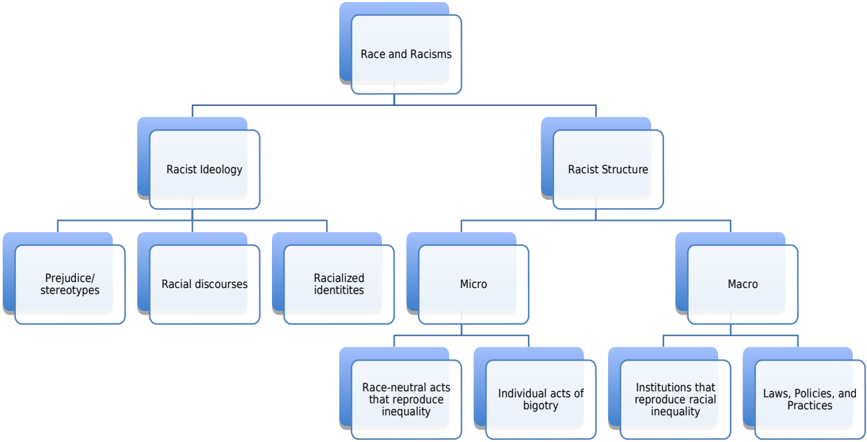
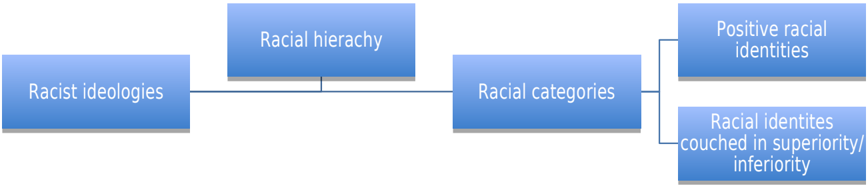
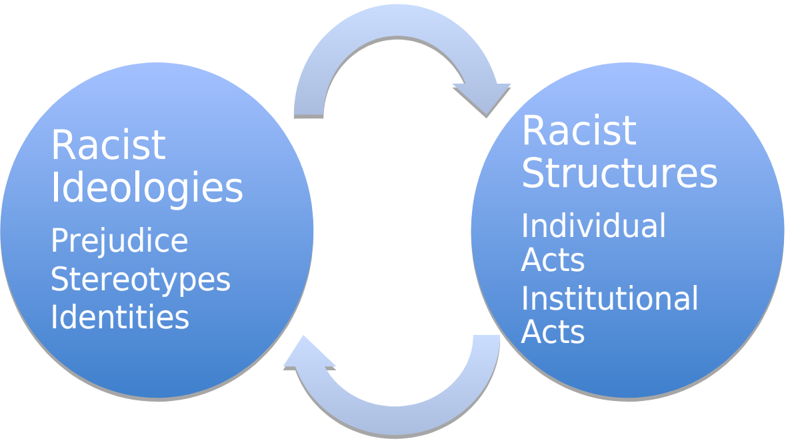
- Analysis: conceptual framework building, including figures that visualize the theory of race and racism, racist ideologies and racial identities, and racist ideologies and racist structures; the paper defines race and racism, reviews individual/institutional/structural racism, and argues for intersectionality.
Limitations
- The paper does not include a formal limitations section. It acknowledges that more work is needed to grapple with race, class, and gender not just as discourses or ideologies but also as structures or systems of oppression, and it states that empirical examples reveal the need for an intersectional framework in most areas of race scholarship.
- Evident from the text: as a theoretical synthesis, the paper does not systematically test its framework against new data; its empirical examples are illustrative rather than exhaustive.
- The author states her positionality as a tenured professor and a white woman and as a committed anti-racist, but does not frame this as a limitation.
Model-written summary. Check it against the paper before relying on it.
Integrity signals
Registry
Cites
Statistics
Figures
Verification
Claims the paper makes
7 Valid · 6 Not valid · 64 Not checked · 55 Own results and interpretations
Every source the paper cites for this claim was checked and supports it.
In the paper
“the work of Collins (2004) helps us perceive that an understanding of how racial ideologies are promulgated must be intersectional.”
What the sources say
- Supportedcites Collins (2004) matched to “Black Sexual Politics: African Americans, Gender, and the New Racism” (2004) source
The Introduction (p. 13) says that intersectional analysis treats race, gender, sexuality, and other systems of power as mutually constructing, and that centering their interaction offers new insight for antiracist scholarship. The Introduction (p. 7) also describes Black gender ideology as arising from the relationship between gender and race and being used to justify discrimination. Together, these passages support the citing sentence’s paraphrase. (LLM, conf=0.89)
plain- Asserted: passes — The authors put it forward as true.
- Checkable: unclear — It is unclear whether it could be checked against evidence.
- Load-bearing: passes — The paper’s conclusions depend on it.
- Based: passes — The paper gives a reason why it holds.
- Supported
Every source the paper cites for this claim was checked and supports it.
In the paper
“The state has the 'material and symbolic resources to impose the categories, classificatory schemes, and modes of social counting and accounting with which bureaucrats, judges, teachers, and doctors must work and to which non-state actors must refer' (Brubaker and Cooper 2000: 16).”
What the sources say
- Supportedcites Brubaker and Cooper 2000 matched to “Beyond “identity”” (2000) source
Split into 2 atoms — 2 confirmed, 0 partially supported, 0 disputed, 0 misattributed, 0 unverifiable. Expand the claim to see per-atom verdicts.
plainstates a cause- Asserted: passes — The authors put it forward as true.
- Checkable: passes — It can be checked against evidence.
- Load-bearing: passes — The paper’s conclusions depend on it.
- Based: passes — The paper gives a reason why it holds.
- Supported
The cited sources support only part of this claim — read each source’s verdict below.
In the paper
“Collins contends that 'controlling images' (2004: 165) - gendered depictions of African Americans in the media - define hegemonic masculinity in opposition by showing what it is not.”
What the sources say
- Partly supportedcites Collins (2004) matched to “Black Sexual Politics: African Americans, Gender, and the New Racism” (2004) sourceExperimental — accuracy not yet measured
The Introduction (pp. 7, 21) says Black gender ideology shapes ideas about masculinity and that media images provide social scripts for how to behave as a Black man or woman. The passages do not establish the more specific claim that controlling images define hegemonic masculinity by showing what it is not. (LLM, conf=0.79)
plainstates a cause- Asserted: passes — The authors put it forward as true.
- Checkable: passes — It can be checked against evidence.
- Load-bearing: unclear — It is unclear whether the paper’s conclusions depend on it.
- Based: passes — The paper gives a reason why it holds.
- Partly supported
The cited sources support only part of this claim — read each source’s verdict below.
In the paper
“In addition, Collins' analysis can be extended to other groups, as the idea of 'controlling images' also can be applied to Latinos, Native Americans, Asians, and Arabs.”
What the sources say
- Partly supportedcites Collins (2004) matched to “Black Sexual Politics: African Americans, Gender, and the New Racism” (2004) sourceExperimental — accuracy not yet measured
In the introduction (page not supplied), Collins says that many of her arguments may apply to Puerto Ricans, indigenous peoples, Chicanos, Vietnamese, and Cambodians, while stressing each group’s distinctive history. This supports extending her analysis to several of the groups named, but the passage does not specifically extend the idea of controlling images to them or mention Arabs. (LLM, conf=0.82)
plain- Asserted: passes — The authors put it forward as true.
- Checkable: passes — It can be checked against evidence.
- Load-bearing: unclear — It is unclear whether the paper’s conclusions depend on it.
- Based: passes — The paper gives a reason why it holds.
- Partly supported
Every source the paper cites for this claim was checked and supports it.
In the paper
“'Controlling images' (Collins 2004) of black, Latino, and Arab men as threatening have served as discursive fodder for the implementation of state repression.”
What the sources say
- Supportedcites Collins 2004 matched to “Black Sexual Politics: African Americans, Gender, and the New Racism” (2004) source
The citation is attached to the term “controlling images,” rather than to the sentence’s full claim about three groups and state repression. The “Overall Organization of the Volume” section describes representations of Black masculinity that help structure racism and are deployed to defend the treatment of African Americans in social institutions. That supports the cited concept; the application to Latino and Arab men is the citing authors’ extension. (LLM, conf=0.85)
plainstates a cause- Asserted: passes — The authors put it forward as true.
- Checkable: passes — It can be checked against evidence.
- Load-bearing: passes — The paper’s conclusions depend on it.
- Based: passes — The paper gives a reason why it holds.
- Supported
50 more claims
Create a free account to see all 132 claims and every source verdict.
- Probably not a substantial claim. 58
- It may state two separate claims as one. 35
Self-check
Percentages, sums and reported differences re-computed from the paper’s own numbers.
Each contradiction between two passages listed here was confirmed by an independent check.
Rated minor: it would not touch a result — a value no result rests on, a p-value that stays on the same side of the significance level, or a conflict that is clerical, resolved elsewhere in the paper, or outside its own findings.
In the paper
§ Individual, Institutional, and Structural Racism
“The arguments and concepts Yeakey (1979: 203) laid out in her essay continue to be relevant today.”
§ Works Cited
“Yeakey, C. 1979. 'Ethnicity as a Dimension of Human Diversity.' In Human Diversity and Pedagogy (pp. 5.1-5.49). Educational Testing Services, Princeton, NJ.”
Rated minor: it would not touch a result — a value no result rests on, a p-value that stays on the same side of the significance level, or a conflict that is clerical, resolved elsewhere in the paper, or outside its own findings.
In the paper
§ Individual, Institutional, and Structural Racism
“Societies that have racialized social systems differentially allocate 'economic, political, social, and even psychological rewards to groups along racial lines' (1997:442).”
§ Works Cited
“Bonilla-Silva, E. 1997. Rethinking Racism : Toward a Structural Interpretation. American Sociological Review , 62 (3), 465-480.”
Citations
Cites
Mapping the Margins: Intersectionality, Identity Politics, and Violence against Women of Color
Crenshaw, K. (1991) · Stanford Law Review · doi:10.2307/1229039 · Cited by 32,792
Racial Formation in the United States
Omi, M., & Winant, H. (2014) · doi:10.4324/9780203076804 · Cited by 3,510
Marx, K. (2021) · The New Economic Sociology · doi:10.2307/j.ctv1f886rp.17 · Cited by 3,199
Coloniality of Power and Eurocentrism in Latin America
Quijano, A. (2000) · International Sociology · doi:10.1177/0268580900015002005 · Cited by 3,190
Brubaker, R., & Cooper, F. (2000) · Theory and Society · doi:10.1023/a:1007068714468 · Cited by 3,139 · cited 1×
“The state has the “material and symbolic resources to impose the categories, classificatory schemes, and modes of social counting and accounting with which bureaucrats, judges, teachers, and doctors must work and to which nonstate actors must refer” (Brubaker and Cooper 2000:16).”
BackgroundRethinking Racism: Toward a Structural Interpretation
Bonilla-Silva, E. (1997) · American Sociological Review · doi:10.2307/2657316 · Cited by 2,760
(2004) · Choice Reviews Online · doi:10.5860/choice.41-3121 · Cited by 2,721
Davis, K. (2008) · Feminist Theory · doi:10.1177/1464700108086364 · Cited by 2,539
(2000) · The Journal of Negro Education · Cited by 2,472
(2010) · Encyclopedia of African American Education · doi:10.4135/9781412971966.n136 · Cited by 2,316
Research works printed but not linked: 3
- Friedman, S. R. 1969. How is Racism Maintained? Et al (2) 18-21
- Marx Karl, 1848, The German Ideology
- Smedley, A. 1999. Race in North America: Origin of a worldview . Westview Press: Boulder, CO.
Cited by
Items 101–200 of 321
Liévanos, R. S., Evans, C. R., & Light, R. (2021) · International Journal of Environmental Research and Public Health · doi:10.3390/ijerph18052217 · Cited by 15
Developing anti-racist undergraduate nursing education: themes and action
Playfair, C., Hunt, G., & DaCosta, C. (2023) · British Journal of Nursing · doi:10.12968/bjon.2023.32.15.736 · Cited by 17
Gamez, R. (2023) · Anthropology & Education Quarterly · doi:10.1111/aeq.12477 · Cited by 16
Race and Genre Ambiguity in the Critical Reception of Popular Music
van Venrooij, A., Miller, C. N., & Schmutz, V. (2021) · Sociological Inquiry · doi:10.1111/soin.12470 · Cited by 15
Ambiguity, consciousness, and plantation afterlives in Brazil’s racial capitalism
Carrillo, I. R. (2024) · The Journal of Peasant Studies · doi:10.1080/03066150.2024.2407172 · Cited by 13
“While racial discrimination can refer to individual acts of bigotry or institutional and structural mistreatment (Golash-Boza 2016), I allowed respondents to answer based on their own interpretations.”
Contextual Factors in Ethnic-Racial Socialization in White Families in the United States
Nieri, T. A., & Huft, J. (2023) · Societies · doi:10.3390/soc13050114 · Cited by 16
What is QuantCrit doing in a nice field like family science?
Williams, D. T., Curtis, M. G., Boe, J. L., & Jensen, T. M. (2024) · Journal of Marriage and the Family · doi:10.1111/jomf.13022 · Cited by 14
Theorizing a Racialized Congressional Workplace
Jones, J. R. (2019) · Emerald Group Publishing Limited eBooks · doi:10.1108/s0733-558x20190000060010 · Cited by 12
Racial and Other Sociodemographic Disparities in Terrorism Sting Operations
Norris, J. J., & Grol-Prokopczyk, H. (2018) · Sociology of Race and Ethnicity · doi:10.1177/2332649218756136 · Cited by 12
Tearing Down to Take Up Space: Dismantling White Spaces in the United States
Embrick, D. G., Moore, W. L., & Ramirez, M. A. (2022) · American Behavioral Scientist · doi:10.1177/00027642211066034 · Cited by 12
“As scholars, we must consider being more deliberate in conceptualizing how to do research that matters in the world Embrick et al. 11 Embrick et al. 1593 and then getting that research to the public and policy makers (see also Golash-Boza, 2016).”
BackgroundOn the Ecomateriality of Racial-colonial Domination in Rhode Island
Murphy, M. W. (2021) · Emerald Group Publishing Limited eBooks · doi:10.1108/s0198-871920210000038009 · Cited by 12
Jones, N., Brown, K., Duran, E. B., Heitz, K., Kelekay, J., Rothschild‐Elyassi, G., & Raymond, G. (2022) · City and Community · doi:10.1177/15356841221123820 · Cited by 14
“…of how structural racism reproduces racial and spatial inequalities generally and in criminal legal contexts (Armenta 2017; Delgado 2018; Golash-Boza 2016; Manning, Hartmann, and Gerteis 2015; Milner 2020; Steinmetz, Schaefer, and Henderson 2017; Vargas and McHarris 2017).4 Nicole…”
BackgroundLatino/a Sociology: Toward a New Paradigm
Zinn, M. B., & Mirandé, A. (2020) · Sociology of Race and Ethnicity · doi:10.1177/2332649220971326 · Cited by 12
Slemon, A., Dahinten, V. S., Stones, C., Bungay, V., & Varcoe, C. (2021) · Health Sociology Review · doi:10.1080/14461242.2021.1969980 · Cited by 17
“recognizes such categories as socially constructed and functioning to create and perpetuate social power structures (Golash-Boza, 2016).”
BackgroundArredondo, A., & Bustamante, J. J. (2019) · Sociological Inquiry · doi:10.1111/soin.12273 · Cited by 10
MUSLIM AMERICAN DOUBLE CONSCIOUSNESS
Islam, I. (2020) · Du Bois Review Social Science Research on Race · doi:10.1017/s1742058x20000235 · Cited by 11
“Golash-Boza (2016) argues that race and racisms operate in a dialectical process, in which race, racial ideologies, racist practices, and racial structures work within a racialized social system to produce racism and racial inequalities.”
BackgroundReyna, C. V. (2022) · Journal of Marriage and the Family · doi:10.1111/jomf.12866 · Cited by 16
In the Name of Love: White Organizations and Racialized Emotions
Diefendorf, S., & Pascoe, C. J. (2023) · Social Problems · doi:10.1093/socpro/spad019 · Cited by 14
Shiao, J. L. (2023) · Socius Sociological Research for a Dynamic World · doi:10.1177/23780231231174830 · Cited by 14
“…process that classifies people into racial groups on the basis of real or imagined corporeal attributes and positions them relative to other groups within national systems of social stratification further embedded within a global system of White supremacy (Bonilla-Silva 1997; Golash-Boza 2016).”
BackgroundRace/ethnic inequalities in health: moving beyond confusion to focus on fundamental causes
Nazroo, J. Y. (2024) · Oxford Open Economics · doi:10.1093/ooec/odad020 · Cited by 23
“Operating alongside and in interaction with other areas of inequality, such as class and gender (Phillips, 2010; Song, 2014; Byrne, 2015; Golash-Boza, 2016), which will be touched on briefly in the concluding section of this commentary, race/ethnicity remains a key determinant of social location,…”
BackgroundSandwiched between groups: Upward career experiences of South African Indian women
Carrim, N. M. H. (2021) · South African Journal of Business Management · doi:10.4102/sajbm.v52i1.2150 · Cited by 12
“Race, according to organisational scholars, shapes career attainment (Ferguson & Koning, 2018; Golash-Boza, 2016).”
BackgroundEisen, D. B. (2020) · Teaching Sociology · doi:10.1177/0092055x20930338 · Cited by 13
“Instructors should strive for these types of learning environments because scholarly endeavors about race and racism should seek to disrupt the racist systems and ideologies in the hope of ending them rather than simply teaching about them (Golash-Boza 2016).”
BackgroundFilipinos Love Serving Others: Negotiating a Filipino Identity in Hawai’i
Eisen, D. B. (2018) · Sociological Perspectives · doi:10.1177/0731121418817251 · Cited by 14
The Dynamic Racial Structure and Disparities in Neighborhood Crime Change
Lyons, C. J., Vélez, M. B., & Krivo, L. J. (2022) · Social Problems · doi:10.1093/socpro/spac013 · Cited by 12
Obremski, D., Friedrich, P., Schäper, P., & Lugrin, B. (2023) · International Conference on Affective Computing and Intelligent Interaction and workshops · doi:10.1109/acii59096.2023.10388206 · Cited by 12
“However, recent studies in education, health care and various other areas disclose deep-rooted bias and open discrimination against people of different cultural backgrounds or ethnicity as well as persisting intergroup insecurities [17], [19].”
BackgroundZimmermann, C. R. (2024) · Sociology of Education · doi:10.1177/00380407241228581 · Cited by 21
“In line with sociological theories of racism (Bonilla-Silva 2015; Golash-Boza 2016) that emphasize how racist ideologies and structures interact, these racialized and gendered depictions of Black males affect their social experiences across an array of social institutions (Rios 2011).”
“Tú, como eres negra, harás de lobo”. El debate pendiente sobre la cuestión de la raza en España.
Rodríguez‐García, D., Jordana, T. H., & Reche, C. R. (2021) · Perifèria Revista d investigació i formació en Antropologia · doi:10.5565/rev/periferia.833 · Cited by 14
White Women Who Lead: God, Girlfriends, and Diversity Projects in a National Evangelical Ministry
Burke, K., & McDowell, A. (2020) · Sociology of Race and Ethnicity · doi:10.1177/2332649220903759 · Cited by 12
From the Editorial Board: College Readiness: A Critical Race Theory Perspective
Majors, A. T. (2019) · The High School journal/The High school journal · doi:10.1353/hsj.2019.0005 · Cited by 9
“Whiteness as Property: Past and Present Use of Racial Advantage in College Readiness Most critical race theorists agree that racial oppression and exclusion in systems like education exist as a result of the exertion of power to maintain White supremacy (Golash-Boza, 2016).”
BackgroundInfluentialImporting American racial reasoning to social science research in Sweden
Voyer, A. M., & Lund, A. (2020) · Sociologisk Forskning · doi:10.37062/sf.57.21982 · Cited by 15
Understanding Morality in a Racialized Society
Robinson, C. C., & Rosino, M. L. (2023) · Handbooks of sociology and social research · doi:10.1007/978-3-031-32022-4_31 · Cited by 8
Bey, G. (2020) · IntechOpen eBooks · doi:10.5772/intechopen.92248 · Cited by 15
Lee, P., & Kao, Y.-C. (2022) · International Journal of Taiwan Studies · doi:10.1163/24688800-05020006 · Cited by 8
Museus, S. D. (2023) · Higher education · doi:10.1007/978-3-031-06696-2_5 · Cited by 11
Working at the Intersection of Race and Public Policy
Lewis, A. E., & Embrick, D. G. (2016) · Sociology of Race and Ethnicity · doi:10.1177/2332649216651071 · Cited by 8
A Jim Crow State of Mind: The Racialization of Space in the McKinney, Texas Pool Party Incident
Combs, B. H. (2019) · American Behavioral Scientist · doi:10.1177/0002764219859617 · Cited by 12
“Golash-Boza (2016) outlines four things “a critical and comprehensive theory of racism should do.””
BackgroundThe pains of racism and economic adversity in young Londoners’ lives: sketching the contours
Phillips, C. (2020) · Journal of Ethnic and Migration Studies · doi:10.1080/1369183x.2020.1850246 · Cited by 9
Controlling Images of Neighborhoods in Gentrification Coverage
Rucks‐Ahidiana, Z. (2024) · Social Problems · doi:10.1093/socpro/spae014 · Cited by 8
Toward a Theory of Racialized Institutional Logics in Education
Woulfin, S. L., & Yurkofsky, M. M. (2025) · Educational Administration Quarterly · doi:10.1177/0013161x251322886 · Cited by 12
“Although such racial frames still exist (Feagin, 2013; Golash-Boza, 2016), scholars argue that a set of “ more covert ” ideas, rationalizations, and practices that reproduce racial inequality have become dominant (Bonilla-Silva, 1997; Mills, 1999).”
Black lives matter and imagined futures of racial dynamics in the US
Durham, S. (2023) · Social movement studies · doi:10.1080/14742837.2023.2204425 · Cited by 12
“From a CRT perspective, racism is an ordinary and everyday experience built into the structure of society and foundational to one’s worldview (Delgado & Stefancic, 2017; Golash-Boza, 2016).”
BackgroundDimick, M. (2023) · Historical Materialism · doi:10.1163/1569206x-bja10016 · Cited by 7
Making Minorities or Honorary Whites? Examining Multiracial Self-Concept
Jones, J., & Frank, R. (2023) · Social Psychology Quarterly · doi:10.1177/01902725231177646 · Cited by 7
Making a Case for Afrofuturism as a Critical Qualitative Inquiry Method for Liberation
Eseonu, T., & Okoye, F. (2023) · Public Integrity · doi:10.1080/10999922.2023.2251277 · Cited by 17
“Young people did not always recognise how laws, policies, practices and social institutions (Golash-Boza, 2016) negatively impacted their lives.”
Reproducing a White Elite: The Chief Officers’ ‘Club’ in the London Metropolitan Police Service
Clarke, A., & Smith, C. (2023) · Work Employment and Society · doi:10.1177/09500170231199415 · Cited by 29
“The ‘idea of race is inextricably linked to notions of white or European superiority that became concretized during the colonization of the Americas and the concomitant enslavement of Africans’ (Golash-Boza, 2016: 130).”
Rosselli, M., Tappen, R. M., & Newman, D. M. (2018) · Archives of Clinical Neuropsychology · doi:10.1093/arclin/acy037 · Cited by 7
Facecraft: race reification in psychological research with facesPreprint
Martinez, J. E. (2022) · doi:10.31234/osf.io/wqkd6 · Cited by 5
Schoenfeld, H., Walker, C., & Rosa, M. (2025) · Criminology · doi:10.1111/1745-9125.12397 · Cited by 10
Luo, Y., Gligorić, K., & Jurafsky, D. (2024) · Proceedings of the International AAAI Conference on Web and Social Media · doi:10.1609/icwsm.v18i1.31367 · Cited by 22
“…, which asserts faithfulness to something’s ethnic origins and thus implicitly situates it outside the mainstream (Boch, Jim ´ enez, and Roesler 2021), and prototypicality , a related form of the “outsider gaze” that asserts all X are alike (Rhodes, Leslie, and Tworek 2012; Golash-Boza 2016).”
BackgroundTwenty-Five Years of Charles Mills’s Racial Contract in Sociology
Maghbouleh, N. (2022) · Sociology of Race and Ethnicity · doi:10.1177/23326492221119888 · Cited by 7
León, K. S., & Cervantes, A. G. (2022) · Journal of Criminal Justice Education · doi:10.1080/10511253.2022.2155204 · Cited by 8
Systemic Racism and Implicit Bias Influencing US School Counseling
Vannest, R. J., Grey, L. D., Vannest, J. L., et al. (2023) · International Journal for the Advancement of Counselling · doi:10.1007/s10447-023-09527-y · Cited by 6
“Systemic racism includes ingrained processes in societal institutions that continually create more burdens for some and fewer ben‑ efits for others based on race (Golash‑Boza, 2016).”
BackgroundThe Formation of Territories Free of Transgenics: Race, Space, and Mobilisation in Colombia
Vidal, N. H. (2022) · Antipode · doi:10.1111/anti.12840 · Cited by 7
Antiracism amidst empire? Understanding the United States' relationship to whiteness
Nicholls, H. (2022) · Sociology Compass · doi:10.1111/soc4.13017 · Cited by 6
Valuing Black lives and the ‘Good Death’ in the United States
Cain, C. (2021) · Sociology of Health & Illness · doi:10.1111/1467-9566.13310 · Cited by 6
Shifting Educational Measurement from an Agent of Systemic Racism to an Anti-Racist Endeavor
Russell, M. (2023) · Applied Measurement in Education · doi:10.1080/08957347.2023.2217555 · Cited by 13
“Some analysts also classify various commonplace insults and racial slights as forms of overt individual racism, particularly when these insults and slights draw on ideas that are well-understood as prejudiced (Golash-Boza, 2016).”
BackgroundRacial Disparities in the Criminal Legal System: Shadows of Doubt and Beyond
Agan, A. (2024) · Journal of Economic Literature · doi:10.1257/jel.20221569 · Cited by 9
Zimmermann, C. R., & Keynton, R. (2021) · Race Ethnicity and Education · doi:10.1080/13613324.2021.1890567 · Cited by 5
“While race is often thought to be a biological characteristic of individuals, race is, in fact, a sociopolitical concept (Bonilla-Silva 2015; Golash-Boza 2016; Roberts 2012).”
BackgroundDiversity as Immigration Governmentality: Insights from France
Doytcheva, M. (2021) · Social Sciences · doi:10.3390/socsci10070237 · Cited by 12
“…CRT highlights in particular the ability of racialized systems to produce everyday, organizational, and structural dominance based on “epistemologies of ignorance” and other “epistemic maneuvers” by hegemonic whiteness to hamper social change (Mueller 2017; Mills 1997; see also Golash-Boza 2016).”
BackgroundCritical Race Theory: A Multicultural Disrupter
Reece, R. (2024) · Genealogy · doi:10.3390/genealogy8030103 · Cited by 13
“Conceptualizing the construction of race in sociology is not new (see Hatch 2007; Golash-Boza 2016; Christian et al. 2019).”
BackgroundRacial/Ethnic Minority Families
Roy, R. N., James, A. G., & Brown, T. L. (2020) · Journal of Family and Economic Issues · doi:10.1007/s10834-020-09712-w · Cited by 5
“The socially constructed categories of race have not only been used to establish policies restricting families’ access and opportunities to housing and education, but they have also left a legacy of disadvantage and mistrust (Golash-Boza 2016).”
BackgroundMinniear, M. J., & Atkin, A. L. (2022) · Journal of Applied Communication Research · doi:10.1080/00909882.2022.2107401 · Cited by 7
“created to justify the unfair treatment of groups (Golash-Boza, 2016).”
BackgroundQueer and Trans People of Colour in the UK: Possibilities for Intersectional Richness
Davis, S. (2022) · Routledge eBooks · doi:10.4324/9780429437694 · Cited by 12
Viano, S. L., Baker, D. J., Ford, K. S., & Johnston‐Guerrero, M. P. (2024) · Educational Researcher · doi:10.3102/0013189x241227901 · Cited by 6
Byrd, W. C. (2018) · Sociology of Race and Ethnicity · doi:10.1177/2332649218810290 · Cited by 6
“The culture-structure nexus shaping racial inequalities (Golash-Boza 2016; Valdez and Golash-Boza 2017) is framed as partially the result of individual “bad apples” who need to unlearn their tabooed and unevolved views of race and class (Bonilla-Silva 2017; Mueller 2017).”
BackgroundInfluentialOlivier, J., Clair, M., & Denis, J. S. (2019) · Wiley eBooks · doi:10.1002/9781405165518.wbeos1238 · Cited by 5
Joshi, M., Finney, N., & Hale, J. M. (2025) · Journal of Ethnic and Migration Studies · doi:10.1080/1369183x.2025.2505707 · Cited by 5
“(Golash-Boza 2016, 131) Racisms manifest at various levels.”
“WE’RE JUST SEPARATE FROM EVERYBODY”: Culture, Class, and the Racialization of Muslim Newcomer Youth
Leo, A. (2020) · Du Bois Review Social Science Research on Race · doi:10.1017/s1742058x20000090 · Cited by 3
“Race can be viewed as a social construction that relies on the fallacious belief that individuals can be divided into biologically discrete categories on the basis of both physical and cultural traits (Golash-Boza 2016; Omi and Winant, 1994).”
BackgroundLegacies of Slavery and their Enduring Harms
Gill, S. R. (2021) · Genocide Studies and Prevention · doi:10.5038/1911-9933.15.3.1833 · Cited by 11
Empowering students to confront environmental injustice: Dialogue, theory, empathy, and partnership
Chiles, R. M., Ard, K. J., Teixeira-Poit, S. M., Flora, C. B., Williams, R., & Grady, C. (2022) · SN Social Sciences · doi:10.1007/s43545-022-00564-9 · Cited by 5
Approches critiques du racisme, perspectives franco-américaines
Doytcheva, M. (2023) · Revue du MAUSS · doi:10.3917/rdm1.060.0205 · Cited by 4
Racism and Ethnic Inequality in a Time of Crisis
(2023) · Policy Press eBooks · doi:10.47674/9781447368847 · Cited by 7
Zimmermann, C. R., & Cannady, E. (2023) · Social Problems · doi:10.1093/socpro/spad028 · Cited by 6
Geographies of race in Poland and Central and Eastern Europe
Balogun, B., & Ohia-Nowak, M. A. (2024) · Ethnic and Racial Studies · doi:10.1080/01419870.2024.2400301 · Cited by 8
“This fundamental insight underscores the idea that any comprehensive study of race theory must begin with or at the very least incorporate the context of European colonialism, which continues to shape and influence social life at local and global levels (Golash-Boza 2016, 131).”
Anti-racist Text and Talk: A Critical Discourse Studies Approach to Black Feminism
Limerick, P. (2021) · REiLA Journal of Research and Innovation in Language · doi:10.31849/reila.v3i2.6797 · Cited by 5
Representations and consequences of race in AI systems
Yi, A., & Turner, B. L. (2024) · Current Opinion in Psychology · doi:10.1016/j.copsyc.2024.101831 · Cited by 19
Raced and Gendered Logics of Immigration Law Enforcement in the United States
Golash‐Boza, T. (2018) · Oxford University Press eBooks · doi:10.1093/oso/9780198814887.003.0015 · Cited by 4
Self-citationThorne, S. E. (2020) · Nursing Inquiry · doi:10.1111/nin.12386 · Cited by 5
Seebruck, R., & Savage, S. V. (2019) · Social Problems · doi:10.1093/socpro/spz030 · Cited by 7
RETRACTED: ‘Beyond the Floyd Narrative’ : Reviewing racism through the lens of social psychiatry
Banerjee, D., Vijayakumar, H. G., & Dcruz, M. M. (2020) · International Journal of Social Psychiatry · doi:10.1177/0020764020950773 · Cited by 4
RetractedBlack Caregivers’ Perspectives on Racism in ASD Services: Towards Culturally Responsive ABA PracticePreprint
Čolić, M., Araiba, S., Lovelace, T. S., & Dababnah, S. (2021) · PsyArXiv (OSF Preprints) · doi:10.31234/osf.io/rp9am · Cited by 5
Racial control under the guise of terror threat: policing of US Muslim, Arab, and SWANA communities
Cainkar, L. (2023) · Critical Studies on Terrorism · doi:10.1080/17539153.2023.2166194 · Cited by 4
“As sociologists Bonilla-Silva (1997) and Golash-Boza (2016) have shown, ideological efforts on the part of the powerful to characterise a group as either part of the dominant “us” or a racial other must be paired with structural activities or these distinctions cannot be sustained.”
BackgroundRacism in Czech football (1993–2023): ‘different day, same old story’
Divišová, V. (2025) · International Review for the Sociology of Sport · doi:10.1177/10126902251329599 · Cited by 3
“To truly understand how racism operates and persists in society, research must address both aspects: (1) racism as an ideology of racial domination and (2) racism as practices that subordinate groups in accordance with this ideology (Golash-Boza, 2016).”
Specifying Race: The Colonial Constitution of Race in a Set-Theoretic Framework
Vincent, L. (2025) · Sociological Theory · doi:10.1177/07352751251395706 · Cited by 3
“Following scholars who conceptualize race as both a discursive formation and a material practice (e.g., Fields and Fields 2012; Golash-Boza 2016; Hesse 2007; Locke 1992; Wolfe 2016), this work considers “race” multivalent.”
Verhaeghe, P. (2025) · Sociology Compass · doi:10.1111/soc4.70141 · Cited by 3
Cooper, M. N., Barnaby, C. Y., Updegrove, A. H., Cho, A., & Dixon, A. (2023) · Journal of Criminal Justice Education · doi:10.1080/10511253.2023.2269049 · Cited by 7
“…europeans created racial categories to justify the colonization of Native Americans and enslavement of Africans that they were already carrying out (Golash-Boza, 2016). in this sense, the material disparities that europeans manufactured existed prior to the social construction of racial…”
Racially Informed Ethnic Heterogeneity in Asian American Intermarriage and Assimilation
Lee, J. (2024) · Sociology of Race and Ethnicity · doi:10.1177/23326492241287166 · Cited by 4
“No space for race”: Advanced Placement as a racialized organization and a culture trap
Kolluri, S. (2025) · Race Ethnicity and Education · doi:10.1080/13613324.2025.2488742 · Cited by 4
“Additionally, Golash-Boza (2016) differentiates between racist ideologies and racist structures – both of which are enacted through individual interactions and systemic processes.”
Far-Right Extremism and the Sociology of Race and Racism
Winter, A. (2025) · doi:10.1093/9780197690161.003.0010 · Cited by 3
Rigby, D., Esposito, M. H., Brown, T. H., Lee, H. E., & Clark, S. (2025) · Routledge eBooks · doi:10.1080/01419870.2025.2570482 · Cited by 4
Gendered tri-racial stratification and health disparities
Erving, C. L. (2020) · Social Science Research · doi:10.1016/j.ssresearch.2020.102427 · Cited by 3
Chouhy, C., & Unnever, J. D. (2022) · Race and Social Problems · doi:10.1007/s12552-022-09365-4 · Cited by 5
“On the other hand, the racialized experiences of Latinx individuals in the U.S. are heterogeneous (Barrera, 2008; Golash-Boza & Darity, 2008; Golash-Boza, 2016a).”
BackgroundJohnson, G. D., Thomas, K. D., Harrison, A. K., & Grier, S. A. (2019) · Springer eBooks · doi:10.1007/978-3-030-11711-5_1 · Cited by 4
The Counter-Deficit Lens in Educational Research: Interrogating Conceptions of Structural Oppression
Kolluri, S. (2022) · American Educational Research Association Annual Meeting (AERA) · doi:10.3102/1884642 · Cited by 3
Diversity in German-speaking medical ethics and humanities
Fiske, A., & McLennan, S. (2022) · Journal of Bioethical Inquiry · doi:10.1007/s11673-022-10215-6 · Cited by 4
“As many social theorists have demonstrated, race is an ever-shifting social construct and a political category, with material consequences, that is a product of colonial encounters (Golash-Boza 2016; Crenshaw et al. 1995).”
BackgroundNorris, J. J., McFall, J. P., & Grol-Prokopczyk, H. (2023) · Journal of Policing Intelligence and Counter Terrorism · doi:10.1080/18335330.2023.2266712 · Cited by 4
“Stereotypes can be understood as ‘ controlling images ’ (such as Muslims as terrorists) used to justify discriminatory policies (Golash-Boza, 2016, pp. 6 – 7), in part by facilitating the dehumanisation of disfavoured groups (Kteily, Bruneau, Waytz, & Cotterill, 2015).”
BackgroundOgunrotifa, A. B. (2023) · Socialism and Democracy · doi:10.1080/08854300.2022.2310469 · Cited by 3
“This has further demonstrated that an individual act of bigotry does not sustain racism, as Golash-Boza (2016) argued, but it is the structural context of racialisation undertaken by the American ruling class and the state that does so.”
Living in a world with(out) racism: everyday reflexivity among older White Dutch
van Roessel, M. A. U. D. J. E., & Dumitrica, D. (2024) · Ethnic and Racial Studies · doi:10.1080/01419870.2024.2346199 · Cited by 4
“Opening towards reflexive (self-)questioning thus becomes intertwined with both personal experiences and hegemonic race and racism discourses (Emirbayer and Desmond 2012; Fillieule 2013; Fisher, Wauthier, and Gajjala 2020; Golash-Boza 2016; McCluney et al. 2020; Smaje 1997).”
Dialect on Trial: An Experimental Examination of Raciolinguistic Ideologies and Character Judgments
Dunbar, A., King, S., & Vaughn, C. R. (2024) · Race and Justice · doi:10.1177/21533687241258772 · Cited by 4
“Depending on how often and when they employ AAVE features, anti-Black tropes, like “ gangster ” or “ thug, ” can be triggered and mapped onto the speaker (Golash-Boza, 2016; Collins, 2002).”
Avoiding equity detours on the way to a more justice-oriented learning sciences
Learning Towards Justice Team (2025) · Journal of the Learning Sciences · doi:10.1080/10508406.2025.2468213 · Cited by 9
“For example, critical race theorists and others have long argued that race is a malleable social construct (e.g., Bonilla-Silva, 1999; Golash-Boza, 2016; Omi & Winant, 2014; Roberts, 2011).”
Tackling racism: moving beyond rhetoric to turn theory into practice
Nazroo, J. Y. (2022) · BMJ · doi:10.1136/bmj.o1597 · Cited by 8
Metadata
- Authors
- Golash-Boza, T.
- Affiliations
- University of California, Merced, CA, USA
- Venue
- Sociology of Race and Ethnicity
- Publisher
- SAGE Publications
- Published
- 2016-02-23
- Volume
- 2
- Issue
- 2
- Pages
- 129-141
- ISSN
- 2332-6492 (ISSN-L)
- 2332-6506
- OpenAlex
- W2309830406
- Cited by
- 321
- References
- 60
- Citations by year
- 2026: 16 · 2025: 36 · 2024: 34 · 2023: 42 · 2022: 40 · 2021: 39 · 2020: 51 · 2019: 30 · 2018: 17 · 2017: 13 · 2016: 3
- FWCI
- 47.76
- Type
- journal article
- Language
- en
- Open access
- green
- escholarship.org
- Licence
- journals.sagepub.com/page/policies/text-and-data-mining-license (tdm)
- Locations
- Sociology of Race and Ethnicity (publishedVersion)
- eScholarship (California Digital Library) (submittedVersion)
- Funders
- University of California Merced
- Topics
- Social Sciences › Gender Studies › Feminist Theory and Gender Studies
- Social Sciences › Sociology and Political Science › Social Movements and Cultural Identity
- Social Sciences › Sociology and Political Science › Race, History, and American Society
- Keywords
- race theory, racism, critical race theory, racist ideology, racial oppression, intersectionality
About these checks
Registry, retraction, Cites and statistics results are computed, not judged, with one exception: a printed reference that no index lists is read once by a model before it counts as a citation error. Claims are extracted by a model and kept only when their quote appears verbatim in the text; each cited source is then checked, with a model’s help, for whether it says what the claim relies on. Those verdicts can be wrong — read the claim’s quote and the cited source before relying on one.
The claim verdicts this report counts are experimental: their accuracy is not yet measured.
A language model drew the claims from the paper on 2026-09-30, under version 3 of the claim definition (model deepseek-v4.1-flash, prompt extract-v3).
A second model labelled each claim on 2026-09-30 (model jev-1.13-20260917, definition revision gold-guideline-v0.2).
Cited sources are checked with a language model’s help (gpt-6-sol).
Statistics and arithmetic are recomputed, not judged.
Confidence bands are shown only for fields calibrated on our annotated test set. None is calibrated yet, so no band is shown.
What counts as a claim ›How we measure confidence ›How we check this ›
Are you an author, or do you see a problem with this page? Request a review
Data sources
Bibliographic data: Semantic Scholar, OpenAlex, Crossref.
Contains information from the Semantic Scholar Academic Graph Datasets, made available under the ODC Attribution License (ODC-BY 1.0).
Semantic Scholar’s data is described in: Kinney, R., et al. (2023). The Semantic Scholar Open Data Platform. arXiv:2301.10140.
