

Low Dose Ketamine Infusion for Comorbid Posttraumatic Stress Disorder and Chronic Pain: A Randomized Double-Blind Clinical Trial
Open accessThe DOI matches its Crossref record; 40 of the 40 references it cites were found in a registry or an index; none of the 19 sources its claims cite is checked for support yet.
Abstract
Objective To date, treatment options (i.e. psychotherapy, antidepressant medications) for patients with posttraumatic stress disorder (PTSD), are relatively few, and considering their limited efficacy, novel therapies have gained interest among researchers and treatment providers alike. Among patients with chronic pain (CP) about one third experience comorbid PTSD, which further complicates their already challenging pharmacological regimens. Low dose ketamine infusion has shown promise in PTSD, and in treatment of CP, however they have not been studied in comorbid population and under rigorous control conditions. Methods We compared the effects of a single dose of either ketamine (0.5 mg/kg) or ketorolac (15 mg) over a 40-minute of IV infusion in CP patients with and without PTSD, in double blind, randomized study. Measures were collected before, during, one day and seven days after the infusion. A planned sample size of 40 patients randomly assigned to treatment order was estimated to provide 80% power to detect a hypothesized treatment difference after the infusion. Main Outcome and Measures: The primary outcome measures were change in PTSD symptom severity assessed with the Impact of Event Scale–Revised (IES-R) and Visual Analogue Scale (VAS) for pain administered by a study clinician 24 hours post infusion. Secondary outcome measures included Impact of Event Scale–Revised (IES-R), VAS and Brief Pain Inventory (Short Form) for pain 1 week after the infusion. Results Both treatments offered comparable improvement of PTSD and CP symptoms that persisted for 7 days after the infusion. Patients with comorbid PTSD and CP experienced less dissociative side effects compared to the CP group. Surprisingly, ketorolac infusion resulted in dissociative symptoms in CP patients only. Conclusions This first prospective study comparing effects of subanesthetic ketamine versus ketorolac infusions for comorbid PTSD and CP, suggests that both ketamine and ketorolac might offer meaningful and durable response for both PTSD and CP symptoms.
Overview
CoChat Summary
## TL;DR
This randomized double-blind clinical trial found that single low-dose infusions of ketamine and ketorolac produced comparable improvements in PTSD and chronic pain symptoms over 7 days in veterans with chronic pain, including those with comorbid PTSD. The study also reported fewer dissociative side effects in the comorbid PTSD+chronic pain group than in chronic pain alone, and unexpectedly saw dissociative symptoms with ketorolac in chronic pain patients.
## Key findings
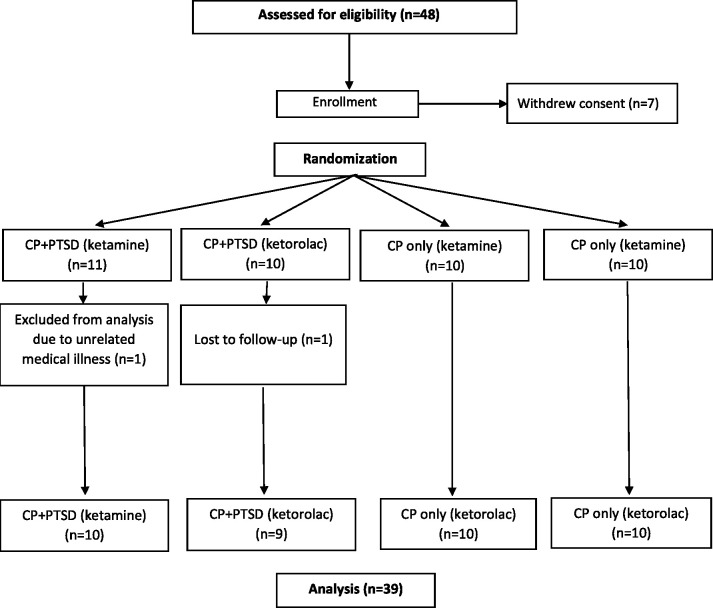
- 41 participants were randomized after 48 completed consent; participants were ages 29 to 65.
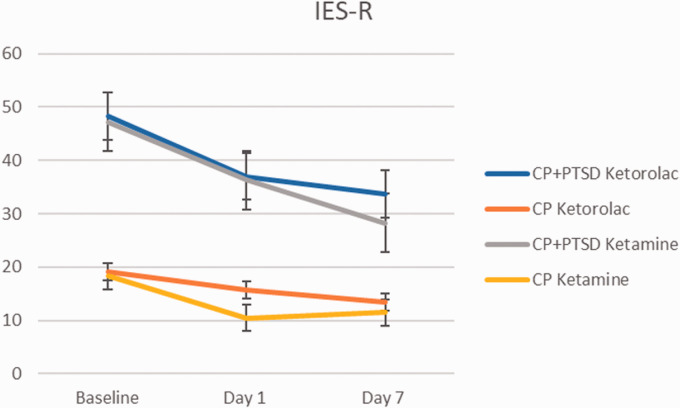
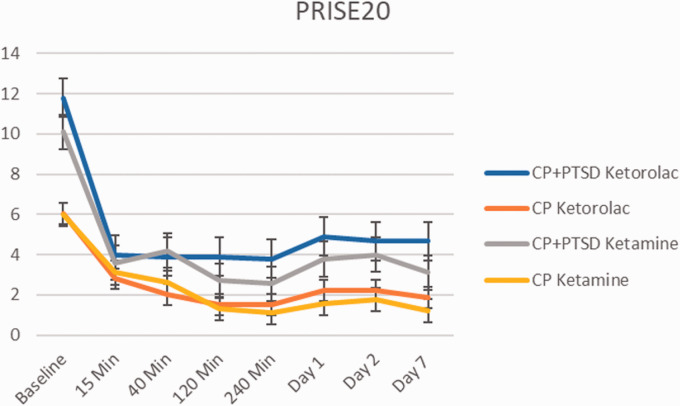
- In the CP+PTSD group, PTSD symptoms decreased significantly from baseline to 7 days post-infusion in both medication groups (F(1, 52) = 9.35, p < 0.01), with significant decreases at 1 day (t(32.59)=2.33, p = 0.03) and 7 days (t(27.53)=2.93, p < 0.01); there was no significant medication effect.
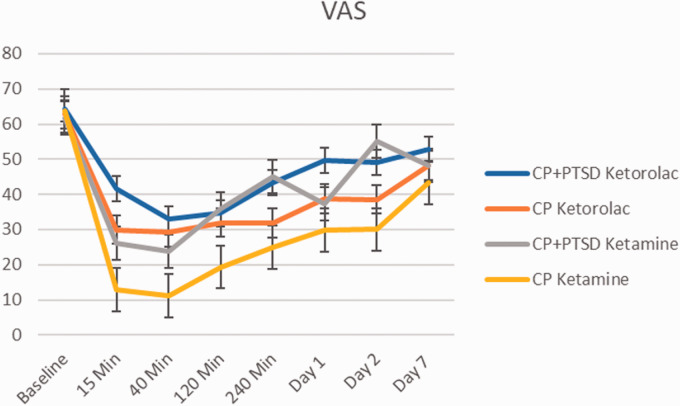
- For pain, there were significant immediate effects on VAS of medication (F(1,148)=14.69, p<0.001) and time (F(1,148)=26.55, p<0.001); in the CP group, ketamine had lower pain scores than ketorolac (M = 26.78 vs 52.2; t(74)=2.18, p < 0.001).
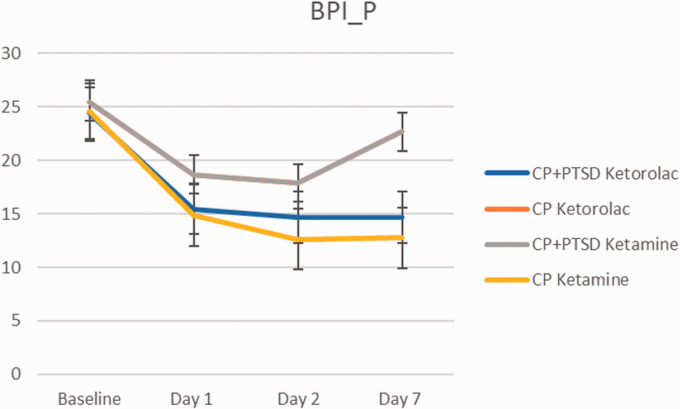
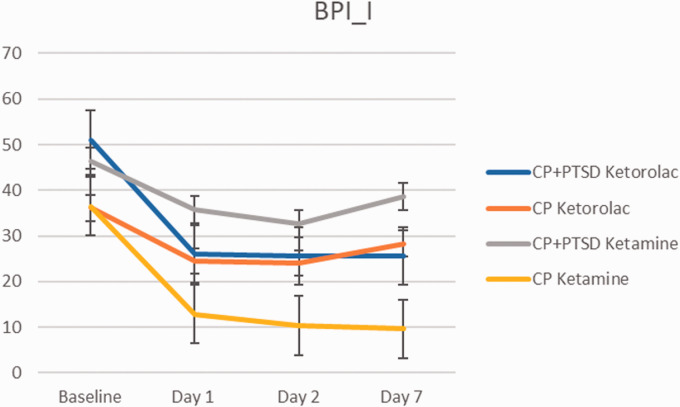
- On the BPI pain scale, pain and interference scores changed over time, with group-by-medication interactions; in the CP group, ketorolac was associated with greater pain than ketamine (M = 21.17 vs 16.61; t(69.9)=2.14, p = 0.035), and for pain interference the CP group also showed ketorolac > ketamine (M = 28.25 vs 18.05; t(70.6)=2.5, p = 0.01).
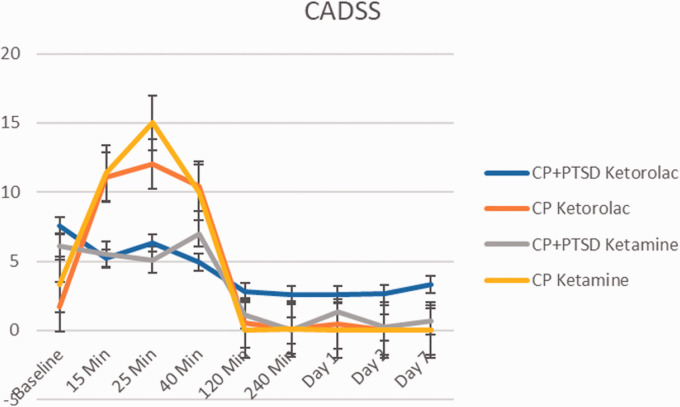
- Dissociative symptoms differed by diagnosis and medication: in the CP group, ketamine had greater dissociative symptom endorsement than ketorolac (M = 4.45 vs 0.53; t(88.4) = -3.98, p < 0.001), while the CP+PTSD group showed no significant ketamine-ketorolac difference.
## Methods
- Design: Outpatient randomized, double-blind clinical trial comparing a single 40-minute IV infusion of ketamine (0.5 mg/kg) versus ketorolac (15 mg); participants and staff were blinded except the anesthesiologist.
- Sample/data: 41 eligible participants from the Ann Arbor VA outpatient pain clinic (enrolled January 2018 to June 2019), ages 18 to 65, divided into chronic pain only vs chronic pain + PTSD groups; all were veterans per the study’s framing.
- Analysis: Repeated-measures ANOVAs assessed changes in PTSD symptoms, pain, dissociation, and side effects across baseline and follow-up time points; Bonferroni corrections were used for multiple tests.
## Limitations
- The paper explicitly states that group sizes were very modest, so findings need replication in larger cohorts.
- The paper explicitly notes the lack of an inactive placebo (normal saline) control and says this limits interpretation; it also says including a PTSD-without-chronic-pain group would better isolate medication effects.
- The paper explicitly says it does not address depression or suicidal ideation (suicidal ideation was an exclusion criterion), limiting assessment of broader therapeutic benefit.
- Evident from the text: the study’s outcomes were followed only to 7 days, so it cannot establish longer-term durability beyond one week.
Model-written summary. Check it against the paper before relying on it.
Integrity signals
Registry
Cites
Statistics
Figures
Verification
Claims the paper makes
0 Valid · 0 Not valid · 13 Not checked · 59 Own results and interpretations
A result the paper reports from its own data — it cites no other source for it, so there is none to check. The quote shows it is in the paper.
In the paper
“Post-hoc t-test analyses revealed that in the CP group, ketamine administration was associated with greater average dissociative symptom endorsement (M = 4.45, SD = 9.04) throughout the infusion compared to ketorolac (M = 0.53, SD = 1.21; t(88.4) = -3.98, p < 0.001).”
§ Low Dose Ketamine Infusion for Comorbid Posttraumatic Stress Disorder and Chronic Pain: A Randomized Double-Blind Clinical Trial > Results > Dissociative Symptoms and Side Effects
plainstates an association- Asserted: passes — The authors put it forward as true.
- Checkable: passes — It can be checked against evidence.
- Load-bearing: unclear — It is unclear whether the paper’s conclusions depend on it.
- Based: passes — The paper gives a reason why it holds.
A result the paper reports from its own data — it cites no other source for it, so there is none to check. The quote shows it is in the paper.
In the paper
“While both groups had improved VAS scores on Day 7, post-hoc t-tests revealed that the CP+PTSD group had significantly greater pain improvement (M= -30.61, SD= 17.71) compared to the CP group (M= -14.28, SD= 15.87); t(33.6)=2.91, p < 0.001.”
§ Low Dose Ketamine Infusion for Comorbid Posttraumatic Stress Disorder and Chronic Pain: A Randomized Double-Blind Clinical Trial > Results > VAS Results
plain- Asserted: passes — The authors put it forward as true.
- Checkable: passes — It can be checked against evidence.
- Load-bearing: passes — The paper’s conclusions depend on it.
- Based: passes — The paper gives a reason why it holds.
A result the paper reports from its own data — it cites no other source for it, so there is none to check. The quote shows it is in the paper.
In the paper
“Patients with comorbid PTSD and CP experienced less dissociative side effects compared to the CP group.”
- Also stated in: § Discussion · plain
“Additional interesting observation in the current study is that both ketamine and ketorolac infusions were associated with fewer dissociative symptoms in CP+PTSD than in CP group.”
- Also stated in: § Discussion · hedged
“We found that patients with comorbid PTSD and CP may be less prone to experiencing dissociative side effects of pain treatment compared to CP only group.”
§ Low Dose Ketamine Infusion for Comorbid Posttraumatic Stress Disorder and Chronic Pain: A Randomized Double-Blind Clinical Trial > Abstract > Results
plain- Asserted: passes — The authors put it forward as true.
- Checkable: passes — It can be checked against evidence.
- Load-bearing: passes — The paper’s conclusions depend on it.
- Based: passes — The paper gives a reason why it holds.
- Also stated in: § Discussion · plain
A result the paper reports from its own data — it cites no other source for it, so there is none to check. The quote shows it is in the paper.
In the paper
“Within the CP group, ketorolac (M = 21.17, SD = 9.66) was associated with greater pain compared to ketamine (M = 16.61, SD = 8.56; t(69.9) = 2.14, p = 0.035.”
§ Low Dose Ketamine Infusion for Comorbid Posttraumatic Stress Disorder and Chronic Pain: A Randomized Double-Blind Clinical Trial > Results > BPI Pain Scale 7 Days Post Infusion
plainstates an association- Asserted: passes — The authors put it forward as true.
- Checkable: passes — It can be checked against evidence.
- Load-bearing: unclear — It is unclear whether the paper’s conclusions depend on it.
- Based: passes — The paper gives a reason why it holds.
A result the paper reports from its own data — it cites no other source for it, so there is none to check. The quote shows it is in the paper.
In the paper
“There was not a significant symptom change from one day post-infusion through seven days post-infusion (t(31.75)= 0.92, p = 0.37).”
§ Low Dose Ketamine Infusion for Comorbid Posttraumatic Stress Disorder and Chronic Pain: A Randomized Double-Blind Clinical Trial > Results > IES-R 1-Day and 7 Days Post Infusion
plain- Asserted: passes — The authors put it forward as true.
- Checkable: passes — It can be checked against evidence.
- Load-bearing: unclear — It is unclear whether the paper’s conclusions depend on it.
- Based: passes — The paper gives a reason why it holds.
26 more claims
Create a free account to see all 72 claims and to verify the 19 references still open.
- It may state two separate claims as one. 25
- Probably not a substantial claim. 23
Claims other papers make about this one
Each is checked against this paper’s own text: does it say what the citing paper says it does?
The source backs part of the claim, not all of it — or backs it for a different population, condition or comparison.
In the citing paper
“one randomized, controlled trial (n = 40) found that ketamine successfully decreased symptoms of both chronic pain and PTSD”
From Ketamine in neuropsychiatric disorders: an update (2024) · cites this paper as [107]
Experimental — accuracy not yet measuredThe source backs part of the claim, not all of it — or backs it for a different population, condition or comparison.
In the citing paper
“Al though only investigated in 1 RCT, no AEs and welltolerated medication responses were reported. 44”
From The Effectiveness of Interventions for Improving Chronic Pain Symptoms Among People With Mental Illness: A Systematic Review (2024) · cites this paper as [44]
Experimental — accuracy not yet measuredThe cited source says what the claim attributes to it.
In the citing paper
“an effect that lasted seven days post-infusion [107]”
From Ketamine in neuropsychiatric disorders: an update (2024) · cites this paper as [107]
The cited source says what the claim attributes to it.
In the citing paper
“Two trials included short-term followup outcomes: 1 of the 2 reported improved pain se verity, 44 but the other surprisingly reported worse selfreported pain in the intervention from baseline to follow-up. 34”
From The Effectiveness of Interventions for Improving Chronic Pain Symptoms Among People With Mental Illness: A Systematic Review (2024) · cites this paper as [44]
The cited source says what the claim attributes to it.
In the citing paper
“One trial implemented a pharmacolo gical-based intervention, 44 one included a MCI, 29 and the other 2 included body-based interventions. 33,34”
From The Effectiveness of Interventions for Improving Chronic Pain Symptoms Among People With Mental Illness: A Systematic Review (2024) · cites this paper as [44]
1 more claim about this paper
Create a free account to see every claim other papers make about this one.
Statistics that don’t add up
Each reported p-value recomputed from its test statistic and degrees of freedom, each partial η² from its F, and each ratio, mean difference or B printed with a p checked against its own confidence interval.
Rated minor: it would not touch a result — a value no result rests on, a p-value that stays on the same side of the significance level, or a conflict that is clerical, resolved elsewhere in the paper, or outside its own findings.
In the paper
“F(1, 327) = 10.17, p < 0.001”
§ Low Dose Ketamine Infusion for Comorbid Posttraumatic Stress Disorder and Chronic Pain: A Randomized Double-Blind Clinical Trial > Results > Dissociative Symptoms and Side Effects
Reported p < .001 · recomputed p = .002
Rated minor: it would not touch a result — a value no result rests on, a p-value that stays on the same side of the significance level, or a conflict that is clerical, resolved elsewhere in the paper, or outside its own findings.
In the paper
“F(1, 137) = 7.30, p = 0.007”
§ Low Dose Ketamine Infusion for Comorbid Posttraumatic Stress Disorder and Chronic Pain: A Randomized Double-Blind Clinical Trial > Results > Bpi Pain Interference Scale 7 Days Post Infusion
Reported p = .007 · recomputed p = .008
Rated minor: it would not touch a result — a value no result rests on, a p-value that stays on the same side of the significance level, or a conflict that is clerical, resolved elsewhere in the paper, or outside its own findings.
In the paper
“t(74) = 2.18, p < 0.001”
§ Low Dose Ketamine Infusion for Comorbid Posttraumatic Stress Disorder and Chronic Pain: A Randomized Double-Blind Clinical Trial > Results > VAS Results
Reported p < .001 · recomputed p = .032
Rated minor: it would not touch a result — a value no result rests on, a p-value that stays on the same side of the significance level, or a conflict that is clerical, resolved elsewhere in the paper, or outside its own findings.
In the paper
“t(33.6)=2.91, p < 0.001”
§ Low Dose Ketamine Infusion for Comorbid Posttraumatic Stress Disorder and Chronic Pain: A Randomized Double-Blind Clinical Trial > Results > VAS Results
Reported p < .001 · recomputed p = .006
Rated minor: it would not touch a result — a value no result rests on, a p-value that stays on the same side of the significance level, or a conflict that is clerical, resolved elsewhere in the paper, or outside its own findings.
In the paper
“F(1, 137) = 8.24, p = 0.004”
§ Low Dose Ketamine Infusion for Comorbid Posttraumatic Stress Disorder and Chronic Pain: A Randomized Double-Blind Clinical Trial > Results > Bpi Pain Interference Scale 7 Days Post Infusion
Reported p = .004 · recomputed p = .005
Statistics recomputed
Every reported test result, recomputed from its test statistic and degrees of freedom. A result shows as not adding up only once an independent check has confirmed it.
- Doesn’t add upt(74) = 2.18reported p < .001 · recomputed p = .032
“t(74) = 2.18, p < .001”
- Doesn’t add upt(33.6) = 2.91reported p < .001 · recomputed p = .006
“t(33.6)=2.91, p < .001”
- Doesn’t add upF(1, 137) = 8.24reported p = .004 · recomputed p = .005
“F(1, 137) = 8.24, p = .004”
- Doesn’t add upF(1, 137) = 7.3reported p = .007 · recomputed p = .008
“F(1, 137) = 7.30, p = .007”
- Doesn’t add upF(1, 327) = 10.17reported p < .001 · recomputed p = .002
“F(1, 327) = 10.17, p < .001”
26 more recomputed tests
Create a free account to see every test the Stats check recomputed.
Self-check
Percentages, sums and reported differences re-computed from the paper’s own numbers.
Self-check results appear here once an independent check has confirmed them.
Citations
Cites
R: A Language and Environment for Statistical Computing
R Core Team (2025) · doi:10.32614/r.manuals · Cited by 352,181
Kessler, R. C., Chiu, W. T., Demler, O., & Walters, E. E. (2005) · Archives of General Psychiatry · doi:10.1001/archpsyc.62.6.617 · Cited by 12,052
The development of a Clinician-Administered PTSD Scale
Blake, D. D., Weathers, F. W., Nagy, L. M., Kaloupek, D. G., Gusman, F. D., Charney, D. S., & Keane, T. M. (1995) · Journal of Traumatic Stress · doi:10.1002/jts.2490080106 · Cited by 5,024
Treede, R.-D., Rief, W., Barke, A., Aziz, Q., Bennett, M. I., Benoliel, R., Cohen, M., Evers, S., Finnerup, N. B., First, M. B., et al. (2019) · Pain · doi:10.1097/j.pain.0000000000001384 · Cited by 3,478 · cited 1×
“CP diagnosis was defined as having symptoms of CP of at least 6months duration as defined by the International Association for the Study of Pain (IASP).(14) PTSD diagnosis was established based on DSM-V using the Clinician-Administered PTSD Scale-5 (CAPS-5)(15,16) administered by master’s level clinician; with symptom…”
MethodBremner, J. D., Krystal, J. H., Putnam, F. W., Southwick, S. M., Marmar, C., Charney, D. S., & Mazure, C. M. (1998) · Journal of Traumatic Stress · doi:10.1023/a:1024465317902 · Cited by 817
The Link between Depression and Chronic Pain: Neural Mechanisms in the Brain
Sheng, J., Liu, S., Wang, Y., Cui, R., & Zhang, X. (2017) · Neural Plasticity · doi:10.1155/2017/9724371 · Cited by 775 · cited 1×
“Many CP patients cope with depressive symptoms, and depression and CP share common neurobiological pathways.(23) Hence the treatment of CP may treat the pain and reduce the depressive symptoms.”
BackgroundFulton, J. J., Calhoun, P. S., Wagner, H. R., Schry, A. R., Hair, L. P., Feeling, N., Elbogen, E., & Beckham, J. C. (2015) · Journal of Anxiety Disorders · doi:10.1016/j.janxdis.2015.02.003 · Cited by 693 · cited 1×
“Prevalence rates for PTSD are significantly higher among military veterans, with current estimates of up to 23%.(1) Furthermore, prevalence rates of PTSD in patients with CP have been estimated at 35%.”
BackgroundKetamine: A Review of Clinical Pharmacokinetics and Pharmacodynamics in Anesthesia and Pain Therapy
Peltoniemi, M. A., Hagelberg, N. M., Olkkola, K. T., & Saari, T. I. (2016) · Clinical Pharmacokinetics · doi:10.1007/s40262-016-0383-6 · Cited by 672
Feder, A., Parides, M. K., Murrough, J. W., Perez, A. M., Morgan, J. E., Saxena, S., Kirkwood, K., aan het Rot, M., Lapidus, K. A. B., Wan, L.-B., et al. (2014) · JAMA Psychiatry · doi:10.1001/jamapsychiatry.2014.62 · Cited by 613 · cited 3×
“Previous studies examining the effect of ketamine on symptoms of PTSD have not examined comorbidity of PTSD and CP symptoms.(7) Thus, the current study focused on CP patients with and without a diagnosis of PTSD.”
BackgroundInfluentialSchwenk, E. S., Viscusi, E. R., Buvanendran, A., Hurley, R. W., Wasan, A. D., Narouze, S., Bhatia, A., Davis, F. N., Hooten, W. M., & Cohen, S. P. (2018) · Regional Anesthesia and Pain Medicine · doi:10.1097/aap.0000000000000806 · Cited by 584
Ketamine and postoperative pain – a quantitative systematic review of randomised trials
Elia, N., & Tramèr, M. R. (2005) · Pain · doi:10.1016/j.pain.2004.09.036 · Cited by 567
Sigtermans, M. J., van Hilten, J. J., Bauer, M. C. R., Arbous, S. M., Marinus, J., Sarton, E. Y., & Dahan, A. (2009) · Pain · doi:10.1016/j.pain.2009.06.023 · Cited by 467 · cited 2×
“However, no evidence has been reported on improvement of depressive symptoms following long term ketamine treatment in CRPS patients.(9) It is possible that the antidepressant effects of ketamine in CP patients are short-lived.”
BackgroundKetamine reduces muscle pain, temporal summation, and referred pain in fibromyalgia patients
Graven-Nielsen, T., Kendall, S. A., Henriksson, K. G., Bengtsson, M., Sörensen, J., Johnson, A., Gerdle, B., & Arendt-Nielsen, L. (2000) · Pain · doi:10.1016/s0304-3959(99)00308-5 · Cited by 416
Inflammation and post‐traumatic stress disorder
Hori, H., & Kim, Y. (2019) · Psychiatry and Clinical Neurosciences · doi:10.1111/pcn.12820 · Cited by 407 · cited 6×
“Our study sought to examine the effects of a single low dose ketamine infusion as compared to the IV infusion of active placebo (nonsteroidal anti-inflammatory agent – ketorolac) on CP and PTSD symptoms in a double-blind randomized trial of US military veterans with and without PTSD.”
BackgroundInfluentialCohen, S. P., Bhatia, A., Buvanendran, A., Schwenk, E. S., Wasan, A. D., Hurley, R. W., Viscusi, E. R., Narouze, S., Davis, F. N., Ritchie, E. C., et al. (2018) · Regional Anesthesia and Pain Medicine · doi:10.1097/aap.0000000000000808 · Cited by 350
Comparison of selected pain assessment tools for use with the elderly
Herr, K. A., & Mobily, P. R. (1993) · Applied Nursing Research · doi:10.1016/s0897-1897(05)80041-2 · Cited by 302
Bell, R. F., Dahl, J. B., Moore, R. A., & Kalso, E. (2005) · Acta Anaesthesiologica Scandinavica · doi:10.1111/j.1399-6576.2005.00814.x · Cited by 296
Self-Rated Global Measure of the Frequency, Intensity, and Burden of Side Effects
WISNIEWSKI, S. R., RUSH, A. J., BALASUBRAMANI, G. K., TRIVEDI, M. H., & NIERENBERG, A. A. (2006) · Journal of Psychiatric Practice · doi:10.1097/00131746-200603000-00002 · Cited by 288
Correll, G. E., Maleki, J., Gracely, E. J., Muir, J. J., & Harbut, R. E. (2004) · Pain Medicine · doi:10.1111/j.1526-4637.2004.04043.x · Cited by 271
Malmberg, A. B., & Yaksh, T. L. (1993) · Anesthesiology · doi:10.1097/00000542-199308000-00012 · Cited by 269 · cited 1×
“In addition, ketorolac may have central analgesic effects as its subarachnoid administration has been demonstrated to have a direct action by blocking hyperalgesia caused by substance P and stimulation of NMDA receptors.(26,27) While the efficacy of NSAID has yet to be examined in treatment of PTSD symptoms, a study u…”
BackgroundPosttraumatic Stress Disorder, Cardiovascular, and Metabolic Disease: A Review of the Evidence
Dedert, E. A., Calhoun, P. S., Watkins, L. L., Sherwood, A., & Beckham, J. C. (2010) · Annals of Behavioral Medicine · doi:10.1007/s12160-010-9165-9 · Cited by 263 · cited 6×
“Our study sought to examine the effects of a single low dose ketamine infusion as compared to the IV infusion of active placebo (nonsteroidal anti-inflammatory agent – ketorolac) on CP and PTSD symptoms in a double-blind randomized trial of US military veterans with and without PTSD.”
BackgroundInfluentialJouguelet-Lacoste, J., La Colla, L., Schilling, D., & Chelly, J. E. (2015) · Pain Medicine · doi:10.1111/pme.12619 · Cited by 246
Albott, C. S., Lim, K. O., Forbes, M. K., Erbes, C., Tye, S. J., Grabowski, J. G., Thuras, P., Batres-y-Carr, T. M., Wels, J., & Shiroma, P. R. (2018) · The Journal of Clinical Psychiatry · doi:10.4088/jcp.17m11634 · Cited by 159 · cited 1×
“Furthermore, repeated IV ketamine infusions on 3 days per week schedule over 12-day period were associated with PTSD and depression symptom relief for up to 41 and 20 days, respectively.(8) These initial reports suggest that the effects of low dose ketamine infusions may have a more extended impact on PTSD symptomatol…”
BackgroundRauch, S. A. M., Kim, H. M., Powell, C., Tuerk, P. W., Simon, N. M., Acierno, R., Allard, C. B., Norman, S. B., Venners, M. R., Rothbaum, B. O., et al. (2019) · JAMA Psychiatry · doi:10.1001/jamapsychiatry.2018.3412 · Cited by 145 · cited 1×
“To-date, treatment options for United States veterans with PTSD have predominantly included psychotherapies such as prolonged exposure and cognitive processing therapy, and medications including selective serotonin reuptake inhibitors (SSRIs).(3) However, novel treatments, such as ketamine infusion, that may offer bet…”
Self-citationMulti-Day Low Dose Ketamine Infusion for the Treatment of Complex Regional Pain Syndrome
Goldberg, M. E. (2005) · Pain Physician · doi:10.36076/ppj.2005/8/175 · Cited by 127
Conceptualizing and Treating Comorbid Chronic Pain and PTSD
Bosco, M. A., Gallinati, J. L., & Clark, M. E. (2013) · Pain Research and Treatment · doi:10.1155/2013/174728 · Cited by 116
Diagnostic Utility of the Impact of Event Scale–Revised in Two Samples of Survivors of War
Morina, N., Ehring, T., & Priebe, S. (2013) · PLoS ONE · doi:10.1371/journal.pone.0083916 · Cited by 102
Noppers, I., Niesters, M., Swartjes, M., Bauer, M., Aarts, L., Geleijnse, N., Mooren, R., Dahanl, A., & Sarton, E. (2011) · European Journal of Pain · doi:10.1016/j.ejpain.2011.03.008 · Cited by 95
Lee, B., Sur, B., Yeom, M., Shim, I., Lee, H., & Hahm, D.-H. (2016) · The Korean Journal of Physiology & Pharmacology · doi:10.4196/kjpp.2016.20.4.357 · Cited by 81 · cited 1×
“While the efficacy of NSAID has yet to be examined in treatment of PTSD symptoms, a study using a rat model of PTSD showed that treatment with another NSAID ibuprofen reduced both inflammatory cytokine levels and behavioral symptoms associated with the model.(28) The use of ketorolac in the current study was to contro…”
Resultvan Huijstee, J., & Vermetten, E. H. G. J. M. (2017) · Current topics in behavioral neurosciences · doi:10.1007/7854_2017_33 · Cited by 79
Patil, S., & Anițescu, M. (2011) · Pain Medicine · doi:10.1111/j.1526-4637.2011.01241.x · Cited by 76 · cited 2×
“The self-report measures used in our study have been validated for assessment of symptoms of CP and have previously been utilized in ketamine clinical trials.(11,29) In our study, ketamine infusion was associated with reduction of BPI-pain and interference scales in CPþPTSD group that persisted for at least 48 hours a…”
BackgroundMethodHartberg, J., Garrett-Walcott, S., & Gioannis, A. D. (2017) · Psychopharmacology · doi:10.1007/s00213-017-4786-3 · Cited by 71
Asmundson, G. J. G., Bonin, M. F., Frombach, I. K., & Norton, G. R. (2000) · Behaviour Research and Therapy · doi:10.1016/s0005-7967(99)00101-1 · Cited by 65 · cited 1×
“Furthermore, prevalence rates of PTSD in patients with CP have been estimated at 35%.(2) To-date, treatment options for United States veterans with PTSD have predominantly included psychotherapies such as prolonged exposure and cognitive processing therapy, and medications including selective serotonin reuptake inhibi…”
BackgroundGnanavel, S., & Robert, R. S. (2013) · CHEST Journal · doi:10.1378/chest.13-1691 · Cited by 65
D’Andrea, D., & Sewell, R. A. (2013) · Biological Psychiatry · doi:10.1016/j.biopsych.2013.04.019 · Cited by 44
Remission From Behavioral Dysregulation in a Child With PTSD After Receiving Procedural Ketamine
Donoghue, A. C., Roback, M. G., & Cullen, K. R. (2015) · PEDIATRICS · doi:10.1542/peds.2014-4152 · Cited by 30
Effects of ketamine on major depressive disorder in a patient with posttraumatic stress disorder.
Womble, A. L. (2013) · PubMed · Cited by 27
Xu, J. J., Herndon, C. M., Anderson, S., Getson, P., Foorsov, V., Harbut, R. E., Moskovitz, P. A., & Harden, R. N. (2018) · Pain Medicine · doi:10.1093/pm/pny024 · Cited by 27 · cited 1×
“The self-report measures used in our study have been validated for assessment of symptoms of CP and have previously been utilized in ketamine clinical trials.(11,29) In our study, ketamine infusion was associated with reduction of BPI-pain and interference scales in CPþPTSD group that persisted for at least 48 hours a…”
MethodAshworth, H. L., Ong, C. A., Seed, P. T., & Venn, P. J. H. (2002) · Anaesthesia · doi:10.1046/j.1365-2044.2002.02568.x · Cited by 11 · cited 1×
“In addition, ketorolac may have central analgesic effects as its subarachnoid administration has been demonstrated to have a direct action by blocking hyperalgesia caused by substance P and stimulation of NMDA receptors.(26,27) While the efficacy of NSAID has yet to be examined in treatment of PTSD symptoms, a study u…”
Background(1994) · PubMed
Cited by
Abdallah, C. G., Roache, J. D., Gueorguieva, R., Averill, L. A., Young-McCaughan, S., Shiroma, P. R., Purohit, P., Brundige, A., Murff, W., Ahn, K.-H., et al. (2022) · Neuropsychopharmacology · doi:10.1038/s41386-022-01266-9 · Cited by 111
Ketamine in neuropsychiatric disorders: an update
Johnston, J. N., Kadriu, B., Kraus, C., Henter, I. D., & Zarate, C. A. (2024) · Neuropsychopharmacology · doi:10.1038/s41386-023-01632-1 · Cited by 108
“For example, one randomized, controlled trial ( n = 40) found that ketamine successfully decreased symptoms of both chronic pain and PTSD, an effect that lasted seven days post-infusion [107].”
BackgroundInfluentialThe Psychedelic Future of Post-Traumatic Stress Disorder Treatment
Zaretsky, T. G., Jagodnik, K. M., Barsic, R., Antonio, J. H., Bonanno, P. A., MacLeod, C., Pierce, C., Carney, H., Morrison, M. T., Saylor, C. F., et al. (2024) · Current Neuropharmacology · doi:10.2174/1570159x22666231027111147 · Cited by 104
Singewald, N., Sartori, S. B., Reif, A., & Holmes, A. (2023) · Neuropharmacology · doi:10.1016/j.neuropharm.2023.109418 · Cited by 68
Whittaker, E., Dadabayev, A. R., Joshi, S. A., & Glue, P. (2021) · Therapeutic Advances in Psychopharmacology · doi:10.1177/20451253211056743 · Cited by 56
Self-citation
Metadata
- Authors
- Dadabayev, A. R., Joshi, S. A., Reda, M. H., Lake, T., Hausman, M. S., Domino, E., & Liberzon, I.
- Affiliations
- VA Ann Arbor Healthcare System (US)
- University of Michigan (US)
- Wayne State University (US)
- Texas A&M University (US)
- Corresponding author
- Dadabayev, Alisher R.
- Venue
- Chronic Stress
- Publisher
- SAGE Publications
- Published
- 2020-01
- Volume
- 4
- Pages
- 2470547020981670-2470547020981670
- ISSN
- 2470-5470 (ISSN-L)
- PMC
- PMC7758557
- OpenAlex
- W3114255450
- Cited by
- 37
- References
- 40
- Citations by year
- 2026: 3 · 2025: 7 · 2024: 10 · 2023: 11 · 2022: 5 · 2021: 1
- FWCI
- 1.70
- Type
- journal article
- Language
- en
- Open access
- gold
- doi.org
- Licence
- Locations
- Chronic Stress (publishedVersion, cc-by-nc)
- Europe PMC (PubMed Central) (publishedVersion, cc-by-nc)
- PubMed Central (publishedVersion, cc-by-nc)
- PubMed (publishedVersion)
- DOAJ (DOAJ: Directory of Open Access Journals) (submittedVersion, cc-by-sa)
- Topics
- Social Sciences › Psychology › Clinical Psychology › Posttraumatic Stress Disorder Research
- Health Sciences › Medicine › Pharmacology (medical) › Treatment of Major Depression
- Health Sciences › Medicine › Anesthesiology and Pain Medicine › Anesthesia and Pain Management
- Keywords
- ketamine infusion, ketorolac, post-traumatic stress disorder, chronic pain, low-dose ketamine, analgesic effect, Impact of Event Scale
About these checks
Registry, retraction, Cites and statistics results are computed, not judged, with one exception: a printed reference that no index lists is read once by a model before it counts as a citation error. Claims are extracted by a model and kept only when their quote appears verbatim in the text; each cited source is then checked, with a model’s help, for whether it says what the claim relies on. Those verdicts can be wrong — read the claim’s quote and the cited source before relying on one.
A language model drew the claims from the paper on 2026-10-11, under version 3 of the claim definition (model deepseek-v4.1-flash, prompt extract-v3).
A second model labelled each claim on 2026-10-11 (model jev-1.13-20260917, definition revision gold-guideline-v0.2).
Statistics and arithmetic are recomputed, not judged.
Confidence bands are shown only for fields calibrated on our annotated test set. None is calibrated yet, so no band is shown.
What counts as a claim ›How we measure confidence ›How we check this ›
Are you an author, or do you see a problem with this page? Request a review
Data sources
Bibliographic data: Semantic Scholar, OpenAlex, Crossref.
Contains information from the Semantic Scholar Academic Graph Datasets, made available under the ODC Attribution License (ODC-BY 1.0).
Semantic Scholar’s data is described in: Kinney, R., et al. (2023). The Semantic Scholar Open Data Platform. arXiv:2301.10140.
