

Physiologically based trimester-specific serum ferritin thresholds for iron deficiency in US pregnant women
Open accessThe DOI matches its Crossref record; 42 of the 42 references it cites were found in a registry or an index.
Abstract
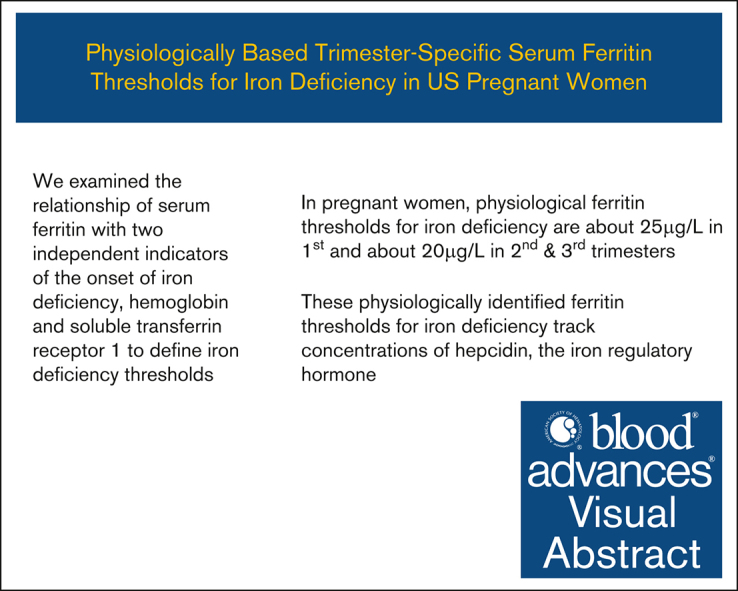
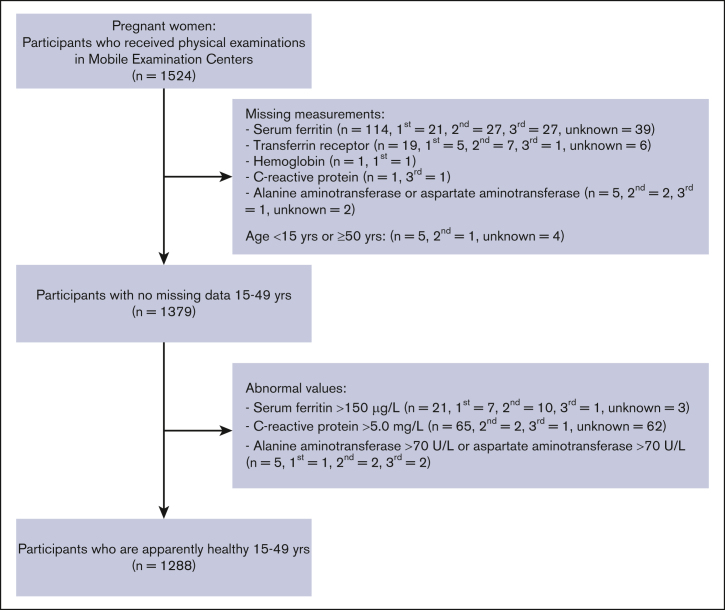
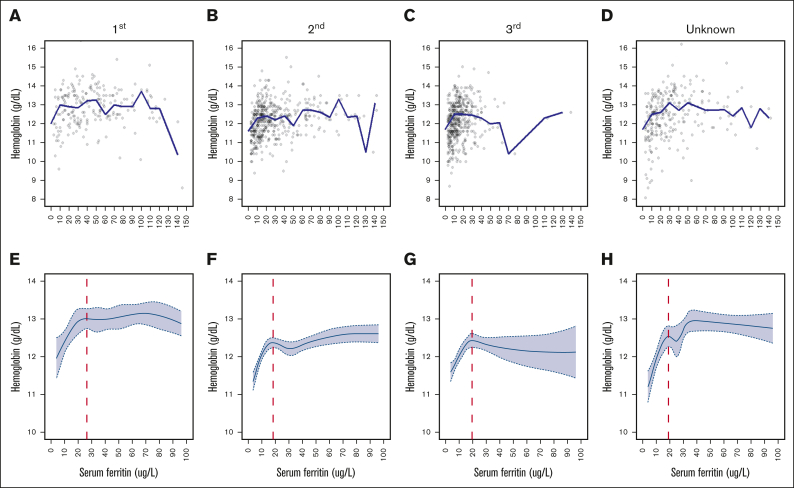
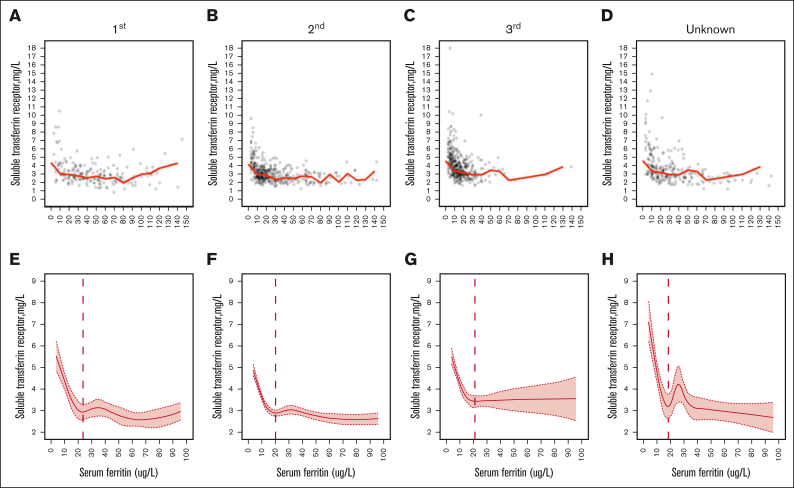
Serum ferritin (SF) concentration is the most widely used indicator for iron deficiency (ID). During pregnancy, the World Health Organization recently recommended SF thresholds for ID of <15 μg/L for the first trimester of pregnancy, based on expert opinion, and made no recommendations for the second and third trimesters. We examined the relationship of SF with 2 independent indicators of the onset of iron-deficient erythropoiesis, hemoglobin and soluble transferrin receptor 1, in cross-sectional data from US National Health and Nutrition Examination Survey for 1999 to 2010 and 2015 to 2018. We included 1288 pregnant women aged 15 to 49 years and excluded women with inflammation or potential liver disease. We used restricted cubic spline (RCS) regression analysis to determine SF thresholds for iron-deficient erythropoiesis. SF decreased during pregnancy; geometric mean SF was higher during the first and lower during the second and third trimesters. Using RCS analysis, the SF thresholds identified during pregnancy were <25.8 μg/L (18.1-28.5) during first trimester, <18.3 μg/L (16.3-22.9) during second trimester, and <19.0 μg/L (14.4- 26.1) during third trimester. These SF threshold levels track concentrations of hepcidin, the iron-regulatory hormone controlling the mobilization of iron stores. An SF concentration of <15 μg/L as the criterion for ID may underestimate the true prevalence of ID throughout pregnancy. In our study, an additional 1 of every 10 pregnant women would be recognized as iron deficient by using the physiologically based thresholds at SF of ∼25 μg/L during the first and ∼20 μg/L during the second and third trimesters.
Overview
The claims and statistics of this paper haven’t been checked yet.
Free: it reads the open-access text and checks the first 5 claims that cite a source we can check. Create a free account to check every claim.
Integrity signals
Registry
Cites
Statistics
Figures
Verification
Claims the paper makes
The claims and statistics of this paper haven’t been checked yet.
Free: it reads the open-access text and checks the first 5 claims that cite a source we can check. Create a free account to check every claim.
Claims other papers make about this one
Each is checked against this paper’s own text: does it say what the citing paper says it does?
The source backs part of the claim, not all of it — or backs it for a different population, condition or comparison.
In the citing paper
“Additionally, one out of ten pregnant women would be recognized as ID using SF thresholds of 25 ng/mL during the first trimester and 20 ng/mL during the second and third trimesters [28].”
From Defining Global Thresholds for Serum Ferritin: A Challenging Mission in Establishing the Iron Deficiency Diagnosis in This Era of Striving for Health Equity (2025) · cites this paper as [28]
Experimental — accuracy not yet measuredThe cited source says what the claim attributes to it.
In the citing paper
“A very recent paper by Mei et al. [28] analyzed the relationship of SF with two independent indicators of the onset of iron-deficient erythropoiesis (Hb and the soluble transferrin receptor) of 1288 pregnant women between the ages of 15 and 49. It excluded those who were experiencing inflammation or potential liver disease.”
From Defining Global Thresholds for Serum Ferritin: A Challenging Mission in Establishing the Iron Deficiency Diagnosis in This Era of Striving for Health Equity (2025) · cites this paper as [28]
The cited source says what the claim attributes to it.
In the citing paper
“According to the authors, an SF of <15 ng/mL could underestimate the true prevalence of ID throughout pregnancy.”
From Defining Global Thresholds for Serum Ferritin: A Challenging Mission in Establishing the Iron Deficiency Diagnosis in This Era of Striving for Health Equity (2025) · cites this paper as [28]
Self-check
Percentages, sums and reported differences re-computed from the paper’s own numbers.
The self-check needs the paper’s full text.
Citations
Cites
Bootstrap confidence intervals
DiCiccio, T. J., & Efron, B. (1996) · Statistical Science · doi:10.1214/ss/1032280214 · Cited by 2,286
Biomarkers of Nutrition for Development—Folate Review
Bailey, L. B., Stover, P. J., McNulty, H., Fenech, M. F., Gregory, J. F., Mills, J. L., Pfeiffer, C. M., Fazili, Z., Zhang, M., Ueland, P. M., et al. (2015) · The Journal of Nutrition · doi:10.3945/jn.114.206599 · Cited by 1,136
Pasricha, S.-R., Tye-Din, J., Muckenthaler, M. U., & Swinkels, D. W. (2021) · The Lancet · doi:10.1016/s0140-6736(20)32594-0 · Cited by 1,069
Recommendations to Prevent and Control Iron Deficiency in the United States: (547762006-001)
(1998) · PsycEXTRA Dataset · doi:10.1037/e547762006-001 · Cited by 815 · cited 1×
“16 In healthy pregnant women, we hypothesized that the clinical onset of ID without anemia could be identi fi ed in a similar manner by a correspondence between the SF concentration at which both decreases in Hb and increases in sTfR1 begin.”
Iron requirements in pregnancy and strategies to meet them
Bothwell, T. H. (2000) · The American Journal of Clinical Nutrition · doi:10.1093/ajcn/72.1.257s · Cited by 687 · cited 3×
“17,21 Plasma sTfR1 varies with erythropoietic and placental needs during the course of pregnancy.”
Daily oral iron supplementation during pregnancy
Peña-Rosas, J. P., De-Regil, L. M., Dowswell, T., & Viteri, F. E. (2012) · Cochrane Database of Systematic Reviews · doi:10.1002/14651858.cd004736.pub4 · Cited by 615
Daily oral iron supplementation during pregnancy
Peña-Rosas, J. P., De-Regil, L. M., Garcia-Casal, M. N., & Dowswell, T. (2015) · Cochrane Database of Systematic Reviews · doi:10.1002/14651858.cd004736.pub5 · Cited by 565
(1998) · PubMed · Cited by 498
Hepcidin and Iron in Health and Disease
Nemeth, E., & Ganz, T. (2023) · Annual Review of Medicine · doi:10.1146/annurev-med-043021-032816 · Cited by 457 · cited 1×
“49 17-20, 40 During the fi rst trimester , the mean hepcidin concentration is little changed from prepregnancy levels, because early minor increases IDA de fi ned as both ID and anemia.”
Soluble transferrin receptor for the evaluation of erythropoiesis and iron status
Beguin, Y. (2003) · Clinica Chimica Acta · doi:10.1016/s0009-8981(03)00005-6 · Cited by 454
Means, R. T. (2020) · Nutrients · doi:10.3390/nu12020447 · Cited by 349
Biomarkers of Nutrition for Development (BOND)—Iron Review
Lynch, S., Pfeiffer, C. M., Georgieff, M. K., Brittenham, G., Fairweather-Tait, S., Hurrell, R. F., McArdle, H. J., & Raiten, D. J. (2018) · The Journal of Nutrition · doi:10.1093/jn/nxx036 · Cited by 336 · cited 1×
“45,46 Our previous results in children and nonpregnant women and the results in this study of pregnant women add to the evidence that a small amount of storage iron, indicated by the SF thresholds from the NHANES data, may be present during the initial development of ID. 45-47 By identifying ID in…”
Self-citationHallberg, L., Bengtsson, C., Lapidus, L., Lindstedt, G., Lundberg, P., & Hultén, L. (1993) · British Journal of Haematology · doi:10.1111/j.1365-2141.1993.tb03225.x · Cited by 246 · cited 2×
“44,45 Physiologically, ID is present when the iron circulating in the blood cannot provide the amounts required for red blood cell production, tissue needs, and, in pregnancy, fetal and placental needs.”
Dietary determinants of iron stores in a free-living elderly population: The Framingham Heart Study
Fleming, D., Jacques, P., Dallal, G., Tucker, K., Wilson, P., & Wood, R. (1998) · The American Journal of Clinical Nutrition · doi:10.1093/ajcn/67.4.722 · Cited by 178
Serum transferrin receptor: a specific marker of iron deficiency in pregnancy
Åkesson, A., Bjellerup, P., Berglund, M., Bremme, K. A., & Vahter, M. (1998) · American Journal of Clinical Nutrition · doi:10.1093/ajcn/68.6.1241 · Cited by 162 · cited 3×
“14 Given the array of hemodynamic, hormonal, and in fl ammatory alterations occurring during the course of pregnancy, we hypothesized that Hb and sTfR1 would vary by trimester in a similar manner among populations of healthy women with adequate iron stores.”
Biology of Anemia: A Public Health Perspective
Brittenham, G. M., Moir-Meyer, G., Abuga, K. M., Datta-Mitra, A., Cerami, C., Green, R., Pasricha, S., & Atkinson, S. H. (2023) · Journal of Nutrition · doi:10.1016/j.tjnut.2023.07.018 · Cited by 162
Self-citationThe incidence, complications, and treatment of iron deficiency in pregnancy
Benson, A. E., Shatzel, J. J., Ryan, K. S., Hedges, M. A., Martens, K., Aslan, J. E., & Lo, J. O. (2022) · European Journal of Haematology · doi:10.1111/ejh.13870 · Cited by 159 · cited 2×
“25 In this study, we extend a physiologically based method of determining SF thresholds for ID by examining the relationship of SF with Hb and sTfR1 during each trimester of pregnancy in cross-sectional population data.”
Mei, Z., Addo, O. Y., Jefferds, M. E., Sharma, A. J., Flores-Ayala, R. C., & Brittenham, G. M. (2021) · The Lancet Haematology · doi:10.1016/s2352-3026(21)00168-x · Cited by 155
Self-citationRecommendations to Prevent and Control Iron Deficiency in the United States
&NA; (1998) · Clinical Nurse Specialist · doi:10.1097/00002800-199809000-00021 · Cited by 142
Serum ferritin thresholds for the diagnosis of iron deficiency in pregnancy: A systematic review
Daru, J., Allotey, J., Peña‐Rosas, J. P., & Khan, K. S. (2017) · Transfusion Medicine · doi:10.1111/tme.12408 · Cited by 138
Iron Homeostasis During Pregnancy: Maternal, Placental, and Fetal Regulatory Mechanisms
Sangkhae, V., Fisher, A. L., Ganz, T., & Nemeth, E. (2023) · Annual Review of Nutrition · doi:10.1146/annurev-nutr-061021-030404 · Cited by 125 · cited 3×
“17 The molecular mechanism(s) underlying the suppression of hepcidin during the second and third tri-mesters have not been characterized but have been suggested to be of placental origin.”
The iron regulatory hormone hepcidin is decreased in pregnancy: a prospective longitudinal study
van Santen, S., Kroot, J. J., Zijderveld, G., Wiegerinck, E. T. G., Spaanderman, M. E. A., & Swinkels, D. W. (2012) · Clinical Chemistry and Laboratory Medicine (CCLM) · doi:10.1515/cclm-2012-0576 · Cited by 117 · cited 1×
“19 In contrast, SF threshold concentrations for ID of about 20 μ g/L did not differ signi fi cantly during the second and third trimesters but both were lower than the threshold of about 25 μ g/L during the fi rst trimester.”
Serum ferritin in healthy Danes: relation to marrow haemosiderin iron stores.
Milman, N. T., Pedersen, N. S., & Visfeldt, J. (1983) · PubMed · Cited by 98
Iron needs during pregnancy: do we need to rethink our targets?
Beaton, G. H. (2000) · American Journal of Clinical Nutrition · doi:10.1093/ajcn/72.1.265s · Cited by 86 · cited 1×
“51 Our study is subject to the limitations common to analysis of Hb and sTfR1 in cross-sectional data from NHANES that have been previously described, including identifying healthy individuals, changes in laboratory methods, 7 and, during pregnancy, the lack of information about the use of iron…”
Iron deficiency anaemia in pregnancy: A contemporary review
Benson, C. S., Shah, A., Frise, M. C., & Frise, C. J. (2021) · Obstetric Medicine · doi:10.1177/1753495x20932426 · Cited by 85
Iron deficiency, pregnancy, and neonatal development
Ataíde, R., Fielding, K., Pasricha, S., & Bennett, C. (2023) · International Journal of Gynecology & Obstetrics · doi:10.1002/ijgo.14944 · Cited by 84
[Generalized Additive Models]: Comment
Stone, C. J. (1986) · Statistical Science · doi:10.1214/ss/1177013607 · Cited by 83
The Measurement of Serum Transferrin Receptor
Cook, J. D. (1999) · The American Journal of the Medical Sciences · doi:10.1016/s0002-9629(15)40630-5 · Cited by 73
Kolbe-Busch, S., Lotz, J., Hafner, G., Blanckaert, N. J. C., Claeys, G., Togni, G., Carlsen, J., Röddiger, R., & Thomas, L. (2002) · Clinical Chemistry and Laboratory Medicine (CCLM) · doi:10.1515/cclm.2002.091 · Cited by 58
Bohn, M. K., & Adeli, K. (2021) · Critical Reviews in Clinical Laboratory Sciences · doi:10.1080/10408363.2021.1978923 · Cited by 56 · cited 1×
“48 The physiologically based method estimates the mean SF threshold concentrations for ID during each trimester of pregnancy.”
Pre-pregnancy iron reserves, iron supplementation during pregnancy, and birth weight
Aranda, N., Ribot, B., Garcia, E., Viteri, F. E., & Arija, V. (2011) · Early Human Development · doi:10.1016/j.earlhumdev.2011.06.003 · Cited by 55
Identifying and treating iron deficiency anemia in pregnancy
Lewkowitz, A. K., & Tuuli, M. G. (2023) · Hematology · doi:10.1182/hematology.2023000474 · Cited by 42
Iron Metabolism in Normal and Pathological Pregnancies and Fetal Consequences
Mégier, C., Peoc’h, K., Puy, V., & Cordier, A.-G. (2022) · Metabolites · doi:10.3390/metabo12020129 · Cited by 41
The Measurement of Serum Transferrin Receptor
Cook, J. D. (1999) · The American Journal of the Medical Sciences · doi:10.1097/00000441-199910000-00006 · Cited by 36
Addo, O. Y., Mei, Z., Hod, E. A., Jefferds, M. E., Sharma, A. J., Flores-Ayala, R. C., Spitalnik, S. L., & Brittenham, G. M. (2022) · Blood Advances · doi:10.1182/bloodadvances.2022007066 · Cited by 32 · cited 1×
“7-9 The World Health Organization (WHO) recently determined that insuf fi cient data are available to revise the current SF threshold for ID of <15 μ g/L for the fi rst trimester of pregnancy, which was based on expert opinion; WHO made no recommendations for the second and third trimesters.”
Self-citationHedengran, K. K., Nelson, D., Andersen, M. R., Stender, S., & Szecsi, P. B. (2015) · The Journal of Maternal-Fetal & Neonatal Medicine · doi:10.3109/14767058.2015.1052396 · Cited by 30 · cited 2×
“49 17-20, 40 During the fi rst trimester , the mean hepcidin concentration is little changed from prepregnancy levels, because early minor increases IDA de fi ned as both ID and anemia.”
The interplay between maternal–infant anemia and iron deficiency
Davidson, E. M., Simpson, J. A., & Fowkes, F. J. I. (2022) · Nutrition Reviews · doi:10.1093/nutrit/nuac066 · Cited by 26
Mei, Z., Addo, O. Y., Jefferds, M. E., Sharma, A. J., Flores‐Ayala, R. C., Pfeiffer, C. M., & Brittenham, G. M. (2023) · Journal of Nutrition · doi:10.1016/j.tjnut.2023.01.035 · Cited by 25
Self-citationSerum ferritin, cobalt excretion and body iron status.
Sorbie, J., VALBERG, L. S., Corbett, W. E. N., & Ludwig, J. (1975) · PubMed Central · Cited by 24
Moreno‐Reyes, R., Corvilain, B., Daelemans, C., Wolff, F., Peña, C., & Vandevijvere, S. (2021) · Thyroid · doi:10.1089/thy.2021.0286 · Cited by 22 · cited 1×
“25,26 ID with anemia is linked to preterm birth, placental abruption, preeclampsia, eclampsia, cesarean delivery, decreased quality of life, postpartum hemorrhage, hysterectomy, antenatal and postnatal maternal sepsis, need for blood transfusion, and, if severe, maternal death.”
Pathophysiology of Iron Homeostasis
Brittenham, G. M. (2017) · Elsevier eBooks · doi:10.1016/b978-0-323-35762-3.00035-4 · Cited by 16
Self-citationMilman, N. T. (2023) · Journal of Neonatal-Perinatal Medicine · doi:10.3233/npm-231210 · Cited by 5 · cited 1×
“43 The physiologically based SF thresholds from this study are higher than those from the current WHO ( 15 μ g/L, fi rst trimester only) and the current CDC ( ≤ 15 μ g/L) guidelines, which identify a more advanced stage of established ID.”
Research works printed but not linked: 4
- 24. Hillman RS, Finch CA. Vol. 4. F.A. Davis; 1974. (Red Cell Manual).
- 37. Bland M. 4th ed. Oxford University Press; 2015. Introduction to medical statistics; p. 125. Chapter 9.
- 38. Tukey JW. Addison-Wesley; 1977. Exploratory Data Analysis.
- 40. Harrel F. Logistic Regression, and Survival Analysis. 2nd ed. Springer (Springer Series in Statistics); 2001. Regression modeling strategies: with applications to linear models.
Cited by
McCarthy, E. K., Schneck, D. D., Basu, S., Xenopoulos-Oddsson, A., McCarthy, F. P., Murray, D. M., Georgieff, M., & Kiely, M. E. (2025) · Journal of Nutrition · doi:10.1016/j.tjnut.2025.11.009 · Cited by 28
Cancado, R. D., Leite, L. A. C., & Muñoz, M. (2025) · Diagnostics · doi:10.3390/diagnostics15030289 · Cited by 19
Iron Deficiency Without Anemia and Reduced Basal Ganglia Iron Content in Youths
Fiani, D., Kim, J.-W., Hu, M., Salas, R., Heilbronner, S. R., Powers, J. M., Haque, M. E., Dinh, S., Huang, X., Worthy, D. A., et al. (2025) · JAMA Network Open · doi:10.1001/jamanetworkopen.2025.16687 · Cited by 10
Cost-effectiveness of iron deficiency screening in pregnancy across ferritin-based thresholds
Wang, D., Sra, M. S., Ng, D. Q., Tadepalli, A., Rinaldi, K., Ito, S., Cuker, A. C., & Goshua, G. (2026) · Blood Advances · doi:10.1182/bloodadvances.2026020143 · Cited by 6
“…strong grounds against using lower historic ranges based on flawed sampling and incorrect assumptions regarding the low prevalence of ID. 14,32,33,73 Our model also represents an important proof of concept for the implementation of population-wide ID screening in pregnancy, which may be…”
Rethinking ferritin thresholds: towards a physiological-based definition of iron deficiency
Fan, B. E. (2025) · The Lancet Global Health · doi:10.1016/s2214-109x(25)00266-9 · Cited by 4
Metadata
- Authors
- Mei, Z., Addo, O. Y., Jefferds, M. E. D., Flores-Ayala, R. C., & Brittenham, G. M.
- Affiliations
- Centers for Disease Control and Prevention (US)
- 1Division of Nutrition, Physical Activity, and Obesity, National Center for Chronic Disease Prevention and Health Promotion, Centers for Disease Control and Prevention, Atlanta, GA
- Columbia University (US)
- Corresponding author
- Mei, Zuguo
- Venue
- Blood Advances
- Publisher
- American Society of Hematology
- Published
- 2024-07-12
- Volume
- 8
- Issue
- 14
- Pages
- 3745-3753
- ISSN
- 2473-9529 (ISSN-L)
- 2473-9537
- PMC
- PMC11296244
- OpenAlex
- W4398250523
- Cited by
- 16
- References
- 42
- Citations by year
- 2026: 9 · 2025: 6 · 2024: 1
- FWCI
- 4.96
- Type
- journal article
- Language
- en
- Open access
- gold
- doi.org
- Licence
- Locations
- Blood Advances (publishedVersion, cc-by-nc-nd)
- PubMed Central (publishedVersion, cc-by-nc-nd)
- PubMed (publishedVersion)
- Funders
- Centers for Disease Control and Prevention
- Topics
- Health Sciences › Medicine › Hematology › Iron Metabolism and Disorders
- Health Sciences › Nursing › Nutrition and Dietetics › Trace Elements in Health
- Health Sciences › Medicine › Genetics (clinical) › Hemoglobinopathies and Related Disorders
- Keywords
- serum ferritin, iron deficiency, pregnancy, iron-deficient erythropoiesis, hemoglobin, hepcidin, iron regulation, iron deficiency prevalence, pregnant women
- MeSH terms
- Iron Deficiencies, Adolescent, Adult, Cross-Sectional Studies, Female, Ferritins, Humans, Iron, Middle Aged, Pregnancy, Pregnancy Trimesters, Receptors, Transferrin, United States, Anemia, Iron-Deficiency, Young Adult
About these checks
Registry, retraction, Cites and statistics results are computed, not judged, with one exception: a printed reference that no index lists is read once by a model before it counts as a citation error. Claims are extracted by a model and kept only when their quote appears verbatim in the text; each cited source is then checked, with a model’s help, for whether it says what the claim relies on. Those verdicts can be wrong — read the claim’s quote and the cited source before relying on one.
Statistics and arithmetic are recomputed, not judged.
Confidence bands are shown only for fields calibrated on our annotated test set. None is calibrated yet, so no band is shown.
What counts as a claim ›How we measure confidence ›How we check this ›
Are you an author, or do you see a problem with this page? Request a review
Data sources
Bibliographic data: Semantic Scholar, OpenAlex, Crossref.
Contains information from the Semantic Scholar Academic Graph Datasets, made available under the ODC Attribution License (ODC-BY 1.0).
Semantic Scholar’s data is described in: Kinney, R., et al. (2023). The Semantic Scholar Open Data Platform. arXiv:2301.10140.
