

Microplastic and plastic pollution: impact on respiratory disease and health
Open accessThe DOI matches its Crossref record; 158 of the 158 references it cites were found in a registry or an index.
Abstract
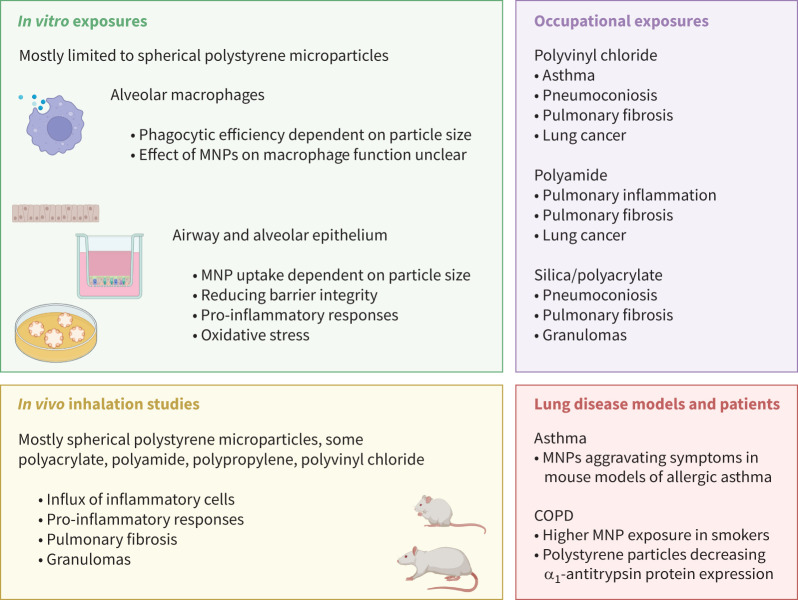
Throughout their lifecycle, from production to use and upon disposal, plastics release chemicals and particles known as micro- and nanoplastics (MNPs) that can accumulate in the environment. MNPs have been detected in different locations of the human body, including in our lungs. This is likely a consequence of MNP exposure through the air we breathe. Yet, we still lack a comprehensive understanding of the impact that MNP exposure may have on respiratory disease and health. In this review, we have collated the current body of evidence on the implications of MNP inhalation on human lung health from in vitro,in vivo and occupational exposure studies. We focused on interactions between MNP pollution and different specific lung-resident cells and respiratory diseases. We conclude that it is evident that MNPs possess the capacity to affect lung tissue in disease and health. Yet, it remains unclear to which extent this occurs upon exposure to ambient levels of MNPs, emphasising the need for a more comprehensive evaluation of environmental MNP exposure levels in everyday life.
Overview
The claims and statistics of this paper haven’t been checked yet.
Free: it reads the open-access text and checks the first 5 claims that cite a source we can check. Create a free account to check every claim.
Integrity signals
Registry
Cites
Statistics
Figures
Verification
Claims the paper makes
The claims and statistics of this paper haven’t been checked yet.
Free: it reads the open-access text and checks the first 5 claims that cite a source we can check. Create a free account to check every claim.
Claims other papers make about this one
Each is checked against this paper’s own text: does it say what the citing paper says it does?
The source backs part of the claim, not all of it — or backs it for a different population, condition or comparison.
In the citing paper
“Due to limited data on the abundance and size of particles smaller than 1 µm, which have a higher probability of penetrating to the deeper areas of lung tissues, effects on human health via respiratory inhalation are also not well established [128].”
From Environmental consequences of interacting effects of changes in stratospheric ozone, ultraviolet radiation, and climate: UNEP Environmental Effects Assessment Panel, Update 2024 (2025) · cites this paper as [128]
Experimental — accuracy not yet measuredThe cited source says what the claim attributes to it.
In the citing paper
“Although MP have been detected in human biological samples such as blood (Leonard et al., 2024), urine (Pironti et al., 2022) and in human lung tissue (Vasse & Melgert, 2024), the evidence of exposure to MP associated with biological alterations that may lead to development of diseases in humans is still limited.”
From Airborne microplastic exposure and urinary oxidative damage biomarkers in populations living in traffic-congested areas (2026) · cites this paper as Vasse & Melgert, 2024
Self-check
Percentages, sums and reported differences re-computed from the paper’s own numbers.
The self-check needs the paper’s full text.
Citations
Cites
Lost at sea: where is all the plastic?
Thompson, R. C., Olsen, Y., Mitchell, R. P., Davis, A., Rowland, S. J., John, A. W. G., McGonigle, D., & Russell, A. E. (2004) · Science · doi:10.1126/science.1094559 · Cited by 7,765
Health Effects of Fine Particulate Air Pollution: Lines that Connect
Pope, C. A., & Dockery, D. W. (2006) · Journal of the Air & Waste Management Association · doi:10.1080/10473289.2006.10464485 · Cited by 6,583 · cited 1×
“Given the established lung health risks associated with particle inhalation [7, 8], this new form of particle pollution raises concerns, especially in a world that exponentially increases its plastics use [9].”
BackgroundKLEPEIS, N. E., NELSON, W. C., OTT, W. R., ROBINSON, J. P., TSANG, A. M., SWITZER, P., BEHAR, J. V., HERN, S. C., & ENGELMANN, W. H. (2001) · Journal of Exposure Science & Environmental Epidemiology · doi:10.1038/sj.jea.7500165 · Cited by 4,803 · cited 1×
“This is concerning because most people spend more than 90% of their time indoors [22].”
BackgroundDegradation rates of plastics in the environment
Chamas, A., Moon, H., Zheng, J., Qiu, Y., Tabassum, T., Jang, J. H., Abu-Omar, M., Scott, S. L., & Suh, S. (2020) · ACS Sustainable Chemistry & Engineering · doi:10.1021/acssuschemeng.9b06635 · Cited by 3,463 · cited 1×
“Owing to their durability, plastics can take anywhere from decades to millennia to biodegrade [10].”
BackgroundPlastics, the environment and human health: current consensus and future trends
Thompson, R. C., Moore, C. J., vom Saal, F. S., & Swan, S. H. (2009) · Philosophical Transactions of the Royal Society B: Biological Sciences · doi:10.1098/rstb.2009.0053 · Cited by 3,032 · cited 1×
“During use these agents have been shown to leach out and contribute to adverse health effects of plastics use [14].”
BackgroundHartmann, N. B., Hüffer, T., Thompson, R. C., Hassellöv, M., Verschoor, A., Daugaard, A. E., Rist, S., Karlsson, T., Brennholt, N., Cole, M., et al. (2019) · Environmental Science & Technology · doi:10.1021/acs.est.8b05297 · Cited by 2,881 · cited 1×
“Fragments less than 5 mm in size are classified as microplastics (ranging between 5 mm and 1 µm) and those less than 1 µm are called nanoplastics [11].”
BackgroundMicroplastics and human health
Vethaak, A. D., & Legler, J. (2021) · Science · doi:10.1126/science.abe5041 · Cited by 1,537
Detection of microplastics in human lung tissue using μFTIR spectroscopy
Jenner, L. C., Rotchell, J. M., Bennett, R. T., Cowen, M., Tentzeris, V., & Sadofsky, L. R. (2022) · Science of The Total Environment · doi:10.1016/j.scitotenv.2022.154907 · Cited by 1,536
Presence of airborne microplastics in human lung tissue
Amato-Lourenço, L. F., Carvalho-Oliveira, R., Júnior, G. R., dos Santos Galvão, L., Ando, R. A., & Mauad, T. (2021) · Journal of Hazardous Materials · doi:10.1016/j.jhazmat.2021.126124 · Cited by 1,329 · cited 1×
“Three more recent studies, however, did investigate plastic particles and fibres in peripheral lung tissue, and found predominantly polypropylene and polyethylene/polyethylene terephthalate MNPs in lung tissue [25 – 27].”
ResultChronic obstructive pulmonary disease
Christenson, S. A., Smith, B. M., Bafadhel, M., & Putcha, N. (2022) · The Lancet · doi:10.1016/s0140-6736(22)00470-6 · Cited by 1,219 · cited 1×
“COPD can develop due to genetic risk factors or upon chronic exposure to irritants such as cigarette smoke [120].”
Background
Research works printed but not linked: 1
- Bahners T, Ehler P, Hengstberger M. Erste Untersuchungen zur Erfassung und Charakterisierung textiler Feinstaübe. [Initial studies to record and characterize textile fine dust.] Melliand Textbilber 1994; 75: 24– 30.
Cited by
Items 101–174 of 174
Ecological and functional roles of plant microbiomes in environmental detoxification
Selim, S., Adhikary, K., Sarkar, R., Ganguly, K., Misra, A., Kashmiry, A. A., Alshareef, S. A., Alkhatib, S. N., Hagagy, N. I., & Maiti, R. (2026) · Frontiers in Microbiology · doi:10.3389/fmicb.2026.1883316 · Cited by 1
“In this context, understanding natural biological systems that can with-stand and transform environmental pollutants has emerged as a critical scientific priority (Vasse and Melgert, 2024).”
Tu, C., Yang, J., Liao, J., Hu, R., Feng, Y., Wu, D., Xia, Y., Wan, D., Tang, J., Yuan, X., et al. (2026) · iMeta · doi:10.1002/imt2.70156 · Cited by 1
Marfella, R., Prattichizzo, F., La Grotta, R., Pellegrini, V., Metallo, A., Graciotti, L., Fulgenzi, G., Spadoni, T., Sardu, C., Marfella, L. V., et al. (2026) · The Lancet Regional Health - Europe · doi:10.1016/j.lanepe.2026.101804 · Cited by 1
“35 Whether exposure to ambient levels of MPs in the general population and the related accumulation in the lungs are pathogenic phenomena is now being actively explored.”
Kasturi, F. E. M., Singh, B. K. D., Kumar, S., & Ramli, M. D. C. (2026) · Microplastics · doi:10.3390/microplastics5030171 · Cited by 1
“Future research should focus on longitudinal human cohorts, occupationally exposed people and environmentally relevant exposure models, to determine whether microplastics influence asthma susceptibility, severity or exacerbation [64,65].”
InfluentialBeigh, S., Dar, S. A., Jawed, A., Qamar, W., & Sharma, R. (2026) · Critical Reviews in Oncology/Hematology · doi:10.1016/j.critrevonc.2026.105606 · Cited by 1
Hacia un sistema de salud sustentable en Chile: el papel de los hospitales verdes
Ferrarezi Junior, C., & Sanhueza, M. B. (2025) · Revista Médica Clínica Las Condes · doi:10.1016/j.rmclc.2025.08.005 · Cited by 1
Chowdhury, I. U., Zawad, A. N. M. S., Chy, T. T., Ahmed, M. M., Fardaus, J., Hossain, J., Borkot, M., Alvi, A. A., Rahaman, M. A., Sadman, M., et al. (2025) · SSRN Electronic Journal · doi:10.2139/ssrn.5877230 · Cited by 1
Navasumrit, P., Chompoobut, C., Rattanayut, P., Kuntinuguntanon, A., Waeya, S., Kanitwithayanun, J., & Ruchirawat, M. (2026) · Journal of Hazardous Materials Advances · doi:10.1016/j.hazadv.2026.101571
Pouwels, S. D., ter Haar, E. A. M. D., Heijink, I. H., Hylkema, M. N., Koster, T. D., Kuks, P. J. M., Maassen, S., Slebos, D., Vasse, G. F., de Vries, M., et al. (2024) · Respiration · doi:10.1159/000541655
“Yet, in occupational exposure studies, microplastic exposure has been associated with the development of asthma, pulmonary fi brosis, and lung cancer [25].”
Self-citationMicroplastics and potential damage to human cells
Waring, R. H., & Mitchell, S. C. (2025) · Elsevier eBooks · doi:10.1016/b978-0-443-22210-8.00026-2 · Cited by 1
Microplastics in humans: Current evidence of presence and their role in organ toxicity
Prasad Ankita, B., Gore Anita, B., Shinde Nitin, G., Petare Jayshri, M., & Jiwatode Vilas, R. (2025) · International Journal of Biology Sciences · doi:10.33545/26649926.2025.v7.i6c.372
Budak, N. Z., Bozdemir, R., & Budak, Y. (2025) · Özgür Yayınları eBooks · doi:10.58830/ozgur.pub817.c3445
Engineered Nanomaterials in Rodent Models of Allergic Lung Disease
Tisch, L. J., Bartone, R. D., & Bonner, J. C. (2025) · Springer eBooks · doi:10.1007/978-3-031-93871-9_5
Microplastiques, nanoplastiques : quels effets sur la santé ?
Body–Malapel, M. (2024) · The Conversation · doi:10.64628/aak.gtuyah34a
Sources and Types of Environmental Contaminants
Joshi, H., Gaur, A., Joshi, H. C., & Pant, G. (2025) · Springer eBooks · doi:10.1007/978-981-96-7878-5_3 · Cited by 1
Kaur, G., Imam, F., Effah, F., Decker, A. D., Garcia, M. A., Campen, M. J., & Rahman, I. (2025) · bioRxiv (Cold Spring Harbor Laboratory) · doi:10.64898/2025.11.30.691449
“The versatility, durability and low production cost of plastics make them an ideal choice for a wide array of applications in the twentieth century (Xu, Lin et al. 2022, Vasse and Melgert 2024).”
InfluentialPlastics in Every Breath: The Silent Respiratory Health Threat We Cannot Avoid
Lucas, M., & Sharma, I. (2025) · Respirology · doi:10.1002/resp.70192
Hodnocení vlivů teploty na vývin plynných zplodin při zahřívání granulátů pro vstřikovací lisy
Pelech, V. (2025) · DSpace VŠB-TUO (VŠB-TUO)
Pandey, K., & Rajput, J. (2026) · Springer eBooks · doi:10.1007/978-3-032-04754-0_10
Pelech, V., Lesňák, M., & Skrizovska, M. (2026) · SSRN Electronic Journal · doi:10.2139/ssrn.6160764
Association between exposure to microplastics and lipid disorders: A case-control study
Lu, W., Xu, X., Fan, L., Zhang, H., Zhong, C., Tu, C., Shen, H., Qiu, L., Lan, M., He, M., et al. (2026) · Journal of Advanced Research · doi:10.1016/j.jare.2026.02.020
Microplastics and respiratory health
Kelly, F. J., & Fussell, J. C. (2026) · Annals of the American Thoracic Society · doi:10.1093/annalsats/aaoag035
Effects of micro-and-nano plastics on various organ systems in health
Pandey, A. K., Mishra, S., & Pandey, A. K. (2025) · doi:10.26634/djcp.2.1.22591
Microplastics and Human Health: A Global Public Health Crisis
Lal, P., Yadav, A., & Singh, Y. P. (2026) · Indian Journal of Community Medicine · doi:10.4103/ijcm.ijcm_715_25
The Impact of Microplastics on Human Health: An Urgent Public Health Concern
Kökoğlu, K., Mıhçıokur, H., & Uyanık, İ. (2026) · Journal of Clinical Practice and Research · doi:10.14744/cpr.2026.39138
“65 Specifically, MP fibers can trigger alveolar macrophages and airway epithelial cells to produce pro‑inflammatory cytokines, potentially resulting in chronic airway inflammation.”
Shankar, A. (2026) · Oxford Journal of Student Scholarship · doi:10.65161/reczgq4cplabdg4dt
Вовед во токсикологија на храна
Kavrakovski, Z. (2026) · doi:10.55302/m435379k
THE IMPACT OF MICROPLASTICS ON MALE FERTILITY
Czapla, M., Szada-Borzyszkowski, K., Owczarenko, K., Wróbel, B., Wójcik, L., Gadzalski, K., & Filipski, M. (2026) · International Journal of Innovative Technologies in Social Science · doi:10.31435/ijitss.1(49).2026.4663
Sun, H.-M., Wang, J., Wu, X., Chen, Z.-L., Yang, H., Lin, Z., Li, S.-X., Qu, Z., Chen, H., & Yao, S. (2026) · The Science of The Total Environment · doi:10.1016/j.scitotenv.2026.181770
Toxicology of micro- and nano-plastics and occupational health: a comprehensive literature review
Rim, K.-T. (2026) · Toxicology and Environmental Health Sciences · doi:10.1007/s13530-026-00320-z
Hu, X., Yuan, X., Cao, X., Su, J., Zhang, P., Guo, Y., Zhang, F., & Ding, W. (2026) · Environment & Health · doi:10.1021/envhealth.5c00830
The airborne trouble: nanoplastics inhalation and neurotoxicity
Prosperi, G., & Vecchioli, S. F. (2026) · Advances in neurotoxicology · doi:10.1016/bs.ant.2026.03.006
Mohsin, U. M. J. U., Ting, K. N., Fang, C.-M., Tshai, K. Y., Selvam, S. B., Gibbins, C., Marsh, G. E., & Lee, M. K. (2026) · Life Sciences Medicine and Biomedicine · doi:10.28916/lsmb.10.1.2026.206
“…important to note, however, that most MPs in the gastrointestinal system are ingested rather than inhaled, originating from sources such as contaminated food, leaching from food containers, and MPs present in drinking water (Banerjee & Shelver, 2021; Vasse & Melgert, 2024; Q. Zhang et al., 2020).”
Ruan, H., Zhang, B., Xu, Q., Liu, Y., & Zhang, D. (2026) · Journal of Applied Toxicology · doi:10.1002/jat.70261
Morataya-Reyes, M., Villacorta, A., Egea, R., Martín-Pérez, J., Gutiérrez-García, J., Pastor, S., Marcos, R., & Hernández, A. (2026) · International Journal of Molecular Sciences · doi:10.3390/ijms27115031
“Inhalation represents a primary route of exposure, placing the bronchial epithelium at the frontline of potential NPL-induced toxicity [5,6].”
Dovizio, M., Fink, D., Gatta, M., Bruno, A., Milillo, C., D’Ascanio, F., Ameen, F., Carlo, P. D., Chiacchiaretta, P., Lanuti, P., et al. (2026) · International Journal of Molecular Sciences · doi:10.3390/ijms27114887
“Many of these additives, including bisphenols, phthalates, per-and polyfluoroalkyl substances, and brominated and organophosphate flame retardants, have been associated with potential health risks [32].”
InfluentialSafdari, F., Jorfi, S., Fard, N. J. H., Babaei, A. A., Takdastan, A., & Ahmadi, M. (2026) · Waste Management · doi:10.1016/j.wasman.2026.115646
Ogan, N., Tuna, A., Koç, M., Candemir, İ. Ç., & Günay, E. (2026) · Research Square · doi:10.21203/rs.3.rs-10095928/v1
Mishra, V., & Kiran, U. V. (2026) · Journal of Ecophysiology and Occupational Health · doi:10.18311/jeoh/2026/54241
Trillo-Hernández, E. A., Robles-Machuca, M., Tiznado‐Hernández, M. E., & Casas‐Godoy, L. (2026) · Estudios Sociales Revista de Alimentación Contemporánea y Desarrollo Regional · doi:10.24836/es.v36i67.1734
Bang, I. J., Kim, M.-S., Han, Y., Kim, G. E., Lim, J. E., Park, J. Y., Yoo, J., Jang, Y. S., 이, 범., Kwak, M., et al. (2026) · Toxicological Research · doi:10.1007/s43188-026-00372-w · Cited by 1
“This section first summarizes exposure delivery and dosimetry considerations for inhalation-relevant MPS, followed by toxicant-specific applications focusing on particulate matter, complex air-borne mixtures, micro-/nanoplastics, and engineered particles (Table 7) [251, 256, 257].”
InfluentialJaafarzadeh, N., Jahedi, F., Takdastan, A., Ahmadi, M., & Shoushtari, M. H. (2026) · Journal of Toxicology · doi:10.1155/jt/5139238
Majda, A., Sławatyniec, O., Sobieraj, W., Pająk, J., Kamosińska, A., Łuniewska, W., Modrzyk, M., Kucharski, K., & Kowal, A. (2026) · Journal of Education Health and Sport · doi:10.12775/jehs.2026.94.73019
Yang, Y., Chu, J., Fu, Y., Zhang, K., Wang, X., & Yuan, B. (2026) · Toxicology Research · doi:10.1093/toxres/tfag043
Afitijagun, I. P., Edo, G. I., Orogu, J. O., Emumejaye, K., Iwanegbe, I., Oghroro, E. E. A., Owheruo, J. O., Yousif, E. A., Jikah, A. N., Igbuku, U. A., et al. (2026) · Journal of Materials Science Materials in Engineering · doi:10.1186/s40712-026-00533-7
“Workers in industries like the manufacturing of synthetic fab-rics and plastics are particularly vulnerable to airborne microplastic contamination because of their extended interaction (Limsiriwong and Winijkul 2023; Vasse and Melgert 2024) (Fig.”
Micronanoplastics and inflammation in lungs of children undergoing pulmonary surgical resection
Shen, L., Tang, Y., Ran, Y., Tang, H., Li, Y., & Wu, Y. (2026) · American Journal of Respiratory and Critical Care Medicine · doi:10.1093/ajrccm/aamag398
Mirra, D., Panico, F., Meersman, Y. D., Spaziano, G., Altieri, S., Caiazzo, E., Bracke, K. R., Iovino, P., Marfella, R., Lubritto, C., et al. (2026) · Scientific Reports · doi:10.1038/s41598-026-61077-6
“Similar reductions in TEER upon exposure to environmental pollutants, including plastics and particulate matter, have been widely reported in airway epithelial models 55–57 .”
Hernández-Calderón, M. L., Gallegos-Moreno, A., Miranda-Camacho, A. Y., Aguillón-Gutiérrez, D. R., & Díaz-Barriga, S. (2026) · Fly · doi:10.1080/19336934.2026.2707706
“Such exposure can occur through ingestion of contaminated food and beverages [6–13], inhalation of airborne microplastics [14,15], and dermal contact via personal care products, cosmetics, textiles, and dust [16].”
Ismail, S. N. S., Mustafa, H. F., Ezani, E., Nurdin, A., Udin, N. M., & Shamsuddin, A. S. (2026) · Environmental Monitoring and Assessment · doi:10.1007/s10661-026-15741-z
“…degradation of plastics can irritate the respiratory tract and mucous membranes, aggravate existing lung conditions and contribute to symptoms such as cough, sore throat, runny nose, nasal blockage, eye irritation, nausea and headache (Kazemi et al., 2026; Saha & Saha, 2024; Vasse & Melgert, 2024).”
Pyroplastic particulate matter from fire events adds a hidden dimension of plastic pollution
Panneerselvan, L., Kandaiah, R., Demokritou, P., Anand, M. P., Franklin, G., Vardoulakis, S., Manivannan, A. C., Kuppusamy, G., & Thavamani, P. (2026) · Communications Earth & Environment · doi:10.1038/s43247-026-03945-7 · Cited by 2
“Generally, atmospheric particulate plastics have been reported to enter the human body through inhalation, ingestion, and skin absorption, potentially causing health consequences such as in fl ammation, oxidative stress, and respiratory diseases 132 – 134 .”
Markuszewski, P., Mazurkiewicz, M., Stawiarz, K., Śmiszek, M., Trzebiatowska, P. J., Ferrero, L., Budhavant, K. B., Zawadzki, M., Waleczek, A., Makuch, P., et al. (2026) · doi:10.5194/egusphere-2026-4321
Yurtsever, F. M., Arya, S., Marakova, E., Velluvakandy, R., Odehnalová, E., Hejč, J., Heger, Z., & Pumera, M. (2026) · ACS Nano · doi:10.1021/acsnano.6c02432
Zhang, K., Liu, K., Huang, Q., Gao, S., & Yao, J. (2026) · Journal of Testing and Evaluation · doi:10.1520/jte20260146
Seeley, M. E., Hale, R. C., Mehlhorn, A., & Wargo, A. R. (2026) · Environmental Toxicology and Chemistry · doi:10.1093/etojnl/vgag233
Kaur, G., Faizan, M. I., Effah, F., Decker, A. D., Garcia, M. A., Campen, M. J., & Rahman, I. (2026) · Toxicological Sciences · doi:10.1093/toxsci/kfag121
Baniaghil, M. A., Ryahi, A., Keikhaei, N., & Farrokhpour, M. (2026) · Journal of Current Biomedical Reports · doi:10.66224/jcbior.7.2.365
“challenges, contamination risks, and difficulties separating MP exposure from smoking and other particulate exposures prevent causal interpretation [38,39].”
An, J. H., Mo, H. M. M., Yang, H. J., & Kim, Y. M. (2026) · American Journal of Rhinology and Allergy · doi:10.1177/19458924261488144
Impacts and Mechanisms of Airborne Microplastics on Human Health: MPs and Their Toxicity
Sinha, S., Ghosh, P., Kumari, A., Mukherjee, O., Mitra, S., & Roy, D. (2026) · doi:10.1021/bk-2026-1531.ch005
Low-cost microwave sensor for detecting the first generation of microplastic in aqueous media
Desbas, J. (2024) · RIUnB Institutional Repository (University of Brasília) · doi:10.26512/2024.11.d.51752
Microplastics and Human Health: Risks, Realities and Sustainable Alternatives for Food Packaging
Pagidoju, S., Puppala, J., Elangovan, R. D., Motapalukula, S. K., Guguloth, S., & Garlapati, V. R. (2026) · IntechOpen eBooks · doi:10.5772/intechopen.1016338
Dental Microplastics Negatively Impact the Digestive and Respiratory Systems
Lang, K. (2026) · Oxford Journal of Student Scholarship · doi:10.65161/recagpgter5lgpnti
Inhalation Injury: Update on Pathogenesis, Emerging Hazards, and Management
Akgün, M., & Nemery, B. (2026) · Balkan Medical Journal · doi:10.4274/balkanmedj.galenos.2026.2026-7-35
Bryliński, Ł., Brylińska, K., Sado, J., Kraśnik, K., Smyk, M., Komar, O., Woliński, F., Flieger, M., Flieger, J., Teresiński, G., et al. (2026) · International Journal of Molecular Sciences · doi:10.3390/ijms27188306
“…air pollution, enter the respiratory tract, where they can penetrate to various depths: particles with a diameter of less than 2.5 µ m can penetrate deep into lung tissue; those between 2.5 and 100 µ m are considered inhalable and will settle in the smaller and larger airways, respectively [15].”
InfluentialPolystyrene-associated pulmonary fibrosis: a summary based on the available evidence and prospects
Sang, S., Liu, Y., Zhao, H., Wang, B., Lv, G., Feng, S., & Wang, K. (2026) · Frontiers in Immunology · doi:10.3389/fimmu.2026.1953398
“Microplastic exposure can further aggravates the progress of the original lung lesions (5).”
Zahir, N. H. M., Azid, A., Amin, S. N. S. M., & Samsudin, M. S. (2025) · International Journal of Environmental Sciences · doi:10.64252/nvkbzf35
Micro- and nanoplastic exposure and human health
Wu, W., Wang, Y., Shi, J., Feng, H., Ren, H., Huang, H., Lv, W., Xiao, Z., & Zhou, Y. (2026) · Journal of Advanced Research · doi:10.1016/j.jare.2026.10.009
Mishra, P., Sundaray, J. K., Behera, B., & Bhattacharya, M. (2026) · Springer eBooks · doi:10.1007/978-3-032-29108-0_5
Surubhotla, N. (2025) · Digital Scholarship - Texas Southern University (Texas Southern University)
Wu, J., Chen, K., Jin, H., Yu, Z., Li, B., Liu, W., & Yang, X. (2026) · Journal of Hazardous Materials Advances · doi:10.1016/j.hazadv.2026.101678
Tyre-related additives in the terrestrial environment: Contamination of soils and plants
Villarejo, L. (2025) · Infoscience (Ecole Polytechnique Fédérale de Lausanne)
Kawecki, A., Pietrzak, M., Jutel, M., & Zemelka‐Wiącek, M. (2026) · Molecules · doi:10.3390/molecules31213826
Neutrophil–Nanoplastic Interaction via Mac-1 (CD11b/CD18) Drives Neutrophil Dysfunction
Lee, H., Cho, J., & Hyun, Y. (2026) · Immune Network · doi:10.4110/in.2026.26.e28
Recent Advances in Flexible Humidity Sensors for Sleep-Disordered Breathing Monitoring
劉, 小., Meng, W., 程远娟, & Li, C. (2026) · ACS Applied Nano Materials · doi:10.1021/acsanm.6c04492
Zhang, F., You, H., Wang, Y., Ning, X., Qian, Z., Jiang, Y., Wu, D., Liu, L., Yang, X., Zhao, X., et al. (2026) · Frontiers in Public Health · doi:10.3389/fpubh.2026.1993065
Metadata
- Authors
- Vasse, G. F., & Melgert, B. N.
- Affiliations
- University Medical Center Groningen (NL)
- Corresponding author
- Melgert, Barbro N.
- Venue
- European Respiratory Review
- Publisher
- European Respiratory Society (ERS)
- Published
- 2024-04-30
- Volume
- 33
- Issue
- 172
- Pages
- 230226
- ISSN
- 0905-9180 (ISSN-L)
- 1600-0617
- PMC
- PMC11262622
- OpenAlex
- W4400211555
- Semantic Scholar
- 106356546e9c609f43ac6e89aa04389d10d55a16
- Cited by
- 146
- References
- 155
- Citations by year
- 2026: 69 · 2025: 64 · 2024: 13
- FWCI
- 3.76
- Type
- journal article
- Language
- en
- Open access
- diamond
- doi.org
- Licence
- Locations
- European Respiratory Review (publishedVersion, cc-by-nc)
- PubMed Central (publishedVersion, cc-by-nc)
- PubMed (publishedVersion)
- DOAJ (DOAJ: Directory of Open Access Journals) (submittedVersion)
- University of Groningen research database (University of Groningen / Centre for Information Technology) (submittedVersion, cc-by-nc)
- Funders
- ZonMw (458001101)
- Topics
- Physical Sciences › Environmental Science › Pollution › Microplastics and Plastic Pollution
- Physical Sciences › Environmental Science › Health, Toxicology and Mutagenesis › Air Quality and Health Impacts
- Health Sciences › Medicine › Pulmonary and Respiratory Medicine › Occupational and environmental lung diseases
- Keywords
- microplastics, nanoplastics, plastic pollution, respiratory diseases, lung health, inhalation exposure, occupational exposure, ambient air pollution, human exposure assessment
- MeSH terms
- Microplastics, Air Pollutants, Animals, Humans, Lung, Plastics, Respiratory Tract Diseases, Risk Factors, Occupational Exposure, Risk Assessment, Inhalation Exposure
About these checks
Registry, retraction, Cites and statistics results are computed, not judged, with one exception: a printed reference that no index lists is read once by a model before it counts as a citation error. Claims are extracted by a model and kept only when their quote appears verbatim in the text; each cited source is then checked, with a model’s help, for whether it says what the claim relies on. Those verdicts can be wrong — read the claim’s quote and the cited source before relying on one.
Statistics and arithmetic are recomputed, not judged.
Confidence bands are shown only for fields calibrated on our annotated test set. None is calibrated yet, so no band is shown.
What counts as a claim ›How we measure confidence ›How we check this ›
Are you an author, or do you see a problem with this page? Request a review
Data sources
Bibliographic data: Semantic Scholar, OpenAlex, Crossref.
Contains information from the Semantic Scholar Academic Graph Datasets, made available under the ODC Attribution License (ODC-BY 1.0).
Semantic Scholar’s data is described in: Kinney, R., et al. (2023). The Semantic Scholar Open Data Platform. arXiv:2301.10140.
