

The DOI matches its Crossref record; 123 of the 123 references it cites were found in a registry or an index.
The impact of outdoor air pollution on COVID-19: a review of evidence from in vitro , animal, and human studies
Open accessAbstract
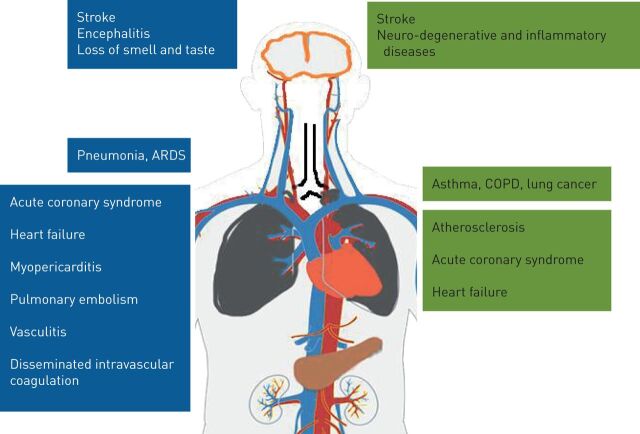
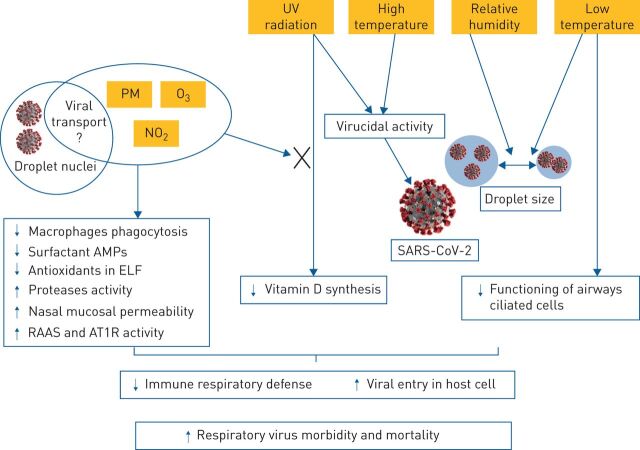
Studies have pointed out that air pollution may be a contributing factor to the coronavirus disease 2019 (COVID-19) pandemic. However, the specific links between air pollution and severe acute respiratory syndrome-coronavirus-2 infection remain unclear. Here we provide evidence from in vitro , animal and human studies from the existing literature. Epidemiological investigations have related various air pollutants to COVID-19 morbidity and mortality at the population level, however, those studies suffer from several limitations. Air pollution may be linked to an increase in COVID-19 severity and lethality through its impact on chronic diseases, such as cardiopulmonary diseases and diabetes. Experimental studies have shown that exposure to air pollution leads to a decreased immune response, thus facilitating viral penetration and replication. Viruses may persist in air through complex interactions with particles and gases depending on: 1) chemical composition; 2) electric charges of particles; and 3) meteorological conditions such as relative humidity, ultraviolet (UV) radiation and temperature. In addition, by reducing UV radiation, air pollutants may promote viral persistence in air and reduce vitamin D synthesis. Further epidemiological studies are needed to better estimate the impact of air pollution on COVID-19. In vitro and in vivo studies are also strongly needed, in particular to more precisely explore the particle–virus interaction in air.
Overview
The claims and statistics of this paper haven’t been checked yet.
Run the check — free, no account needed. It reads the open-access text and checks the sources it cites.
Integrity signals
Registry
Cites
Statistics
Figures
Verification
Claims the paper makes
The claims and statistics of this paper haven’t been checked yet.
Run the check — free, no account needed. It reads the open-access text and checks the sources it cites.
Self-check
Percentages, sums and reported differences re-computed from the paper’s own numbers.
The self-check needs the paper’s full text.
Citations
Cites
A novel coronavirus from patients with pneumonia in China, 2019
Zhu, N., Zhang, D., Wang, W., Li, X., Yang, B., Song, J., Zhao, X., Huang, B., Shi, W., Lu, R., et al. (2020) · New England Journal of Medicine · doi:10.1056/nejmoa2001017 · Cited by 28,244
Zhou, F., Yu, T., Du, R., Fan, G., Liu, Y., Liu, Z., Xiang, J., Wang, Y., Song, B., Gu, X., et al. (2020) · The Lancet · doi:10.1016/s0140-6736(20)30566-3 · Cited by 27,263
Hoffmann, M., Kleine-Weber, H., Schroeder, S., Krüger, N., Herrler, T., Erichsen, S., Schiergens, T. S., Herrler, G., Wu, N.-H., Nitsche, A., et al. (2020) · Cell · doi:10.1016/j.cell.2020.02.052 · Cited by 20,286
Wu, Z., & McGoogan, J. M. (2020) · JAMA · doi:10.1001/jama.2020.2648 · Cited by 17,016
Aerosol and surface stability of SARS-CoV-2 as compared with SARS-CoV-1
van Doremalen, N., Bushmaker, T., Morris, D. H., Holbrook, M. G., Gamble, A., Williamson, B. N., Tamin, A., Harcourt, J. L., Thornburg, N. J., Gerber, S. I., et al. (2020) · New England Journal of Medicine · doi:10.1056/nejmc2004973 · Cited by 9,951
Endothelial cell infection and endotheliitis in COVID-19
Varga, Z., Flammer, A. J., Steiger, P., Haberecker, M., Andermatt, R., Zinkernagel, A. S., Mehra, M. R., Schuepbach, R. A., Ruschitzka, F., & Moch, H. (2020) · The Lancet · doi:10.1016/s0140-6736(20)30937-5 · Cited by 6,358
The contribution of outdoor air pollution sources to premature mortality on a global scale
Lelieveld, J., Evans, J. S., Fnais, M., Giannadaki, D., & Pozzer, A. (2015) · Nature · doi:10.1038/nature15371 · Cited by 5,977
Comorbidity and its impact on 1590 patients with covid-19 in China: a nationwide analysis
Guan, W.-J., Liang, W.-H., Zhao, Y., Liang, H.-R., Chen, Z.-S., Li, Y.-M., Liu, X.-Q., Chen, R.-C., Tang, C.-L., Wang, T., et al. (2020) · European Respiratory Journal · doi:10.1183/13993003.00547-2020 · Cited by 3,680
Johnson, C. O., Nguyen, M., Roth, G. A., Nichols, E., Alam, S., Abate, D., Abd-Allah, F., Abdelalim, A., Abraha, H. N., Abu-Rmeileh, N. M., et al. (2019) · The Lancet Neurology · doi:10.1016/s1474-4422(19)30034-1 · Cited by 3,449
COVID-19 and the cardiovascular system
Zheng, Y.-Y., Ma, Y.-T., Zhang, J.-Y., & Xie, X. (2020) · Nature Reviews Cardiology · doi:10.1038/s41569-020-0360-5 · Cited by 2,970
Research works printed but not linked: 1
- 10.1146/annurevvirology-012420-022445 · DOI
Cited by
Sorted by citations
Items 201–223 of 223
Synergistic Effects of Environmental Factors on the Spread of Corona Virus
Ali, M., Farhat, S. M., Abbasi, S. W., & Ishtiaq, A. (2022) · Springer series on bio- and neurosystems · doi:10.1007/978-3-031-10031-4_32
Abraham, A., & Abbas, I. (2023) · BENTHAM SCIENCE PUBLISHERS eBooks · doi:10.2174/9789815123883123010006
Brunori, D., Frajese, G. V., & Sarno, E. (2023) · International Journal of Environmental Research and Public Health · doi:10.3390/ijerph20156481
Bart, A. A., Ekaterina, S. A., Semyon, Y. V., & Ishmatov, A. N. (2023) · XXVIII Международный симпозиум «Оптика атмосферы и океана. Физика атмосферы» · doi:10.1117/12.2690936
Ishmatoff, A. N., Bart, A. A., Strebkova, E. A., & Yakovlev, S. V. (2023) · XXVIII Международный симпозиум «Оптика атмосферы и океана. Физика атмосферы» · doi:10.1117/12.2688604
Wardono, H. R. I., Susanti, R., Wijayanti, Y., & Cahyati, W. H. (2024) · International Journal of Public Health Science (IJPHS) · doi:10.11591/ijphs.v13i3.24124
Salsabila, N. B., Jalaludin, J., Suhaimi, N. F., Mansor, W. N. W., & Sumantri, A. (2024) · International Journal of Environmental Health Research · doi:10.1080/09603123.2024.2390479
The impact of COVID-19: consequences of a 3-Year struggle in Iran
Omranikhoo, H., Salari, H., Keshavarz, K., Rajabi, M., & Rezaee, M. (2025) · BMC Infectious Diseases · doi:10.1186/s12879-025-10955-x
Ramanathan, J. (2025) · Springer eBooks · doi:10.1007/978-3-031-80029-0_2
Boccuni, F., Ferrante, R., Tombolini, F., Iavicoli, S., & Pingue, P. (2025) · Sustainability · doi:10.3390/su17114803
Covid-19: ¿por qué las vacunas afectan de manera distinta a cada persona?
de la Fuente, J., & Gortázar, C. (2022) · doi:10.64628/aao.99xtkgkrw
Application of air quality sensors in urban planning of cities
Nikkath, S. N., & Selvi, S. T. (2025) · Elsevier eBooks · doi:10.1016/b978-0-443-33973-8.00002-3
Conditional persistence? Historical disease exposure and government response to COVID-19
Lindskog, A., & Olsson, O. (2026) · Journal of Comparative Economics · doi:10.1016/j.jce.2026.01.003
De l'origine des maladies : la médecine environnementale : une nouvelle grille de lecture
Reis, J. J. (2022) · theses.fr (ABES) · doi:10.70675/b037ce62z054bz4048z9f93ze0a70c6c1357
Ambient Air Pollution and Risk of ARDS and Mortality in Moderate to Severe COVID ‐19
Kim, S., Joo, H., Kang, H. S., Yeo, C. D., Lee, J. M., Kim, H. W., Kim, S. Y., Park, Y. H., Shin, M., Lee, J. H., et al. (2026) · Respirology · doi:10.1002/resp.70250
Rebreathing Life into Philosophical Understandings of Breath: Breathlessness and Phenomenology
Williams, T. (2026) · Handbooks in philosophy · doi:10.1007/978-3-031-75780-8_14-1
Karagözlü, M., Yonucu, F., Agbor, V. O., Shirgir, B., & Aşır, S. (2026) · Royal Society of Chemistry eBooks · doi:10.1039/9781837677771-00291
Spatial and neighborhood data in the collaborative cohort of cohorts for COVID-19 Research (C4R)
Hirsch, J. A., Besser, L. M., Jimenez, M. P., Dickinson, S. T., Cornelius, T. M., Francisco, S. T., Lawin, K., Magid, H. S. A., Albrecht, S. S., Allen, N. B., et al. (2026) · PLoS ONE · doi:10.1371/journal.pone.0352170
Yuen, K.-F., Miao, Y., Wang, P.-J., Jiang, H., Chung, K.-F., & Tong, H. (2026) · Environmental Science Atmospheres · doi:10.1039/d6ea00072j
Air pollution and mortality in European regions and cities: the effects of smart cities projects
Casamassima, A., Castells‐Quintana, D., & Simeone, E. (2026) · Environmental Impact Assessment Review · doi:10.1016/j.eiar.2026.108671 · Cited by 2
Metadata
- Authors
- Bourdrel, T., Annesi-Maesano, I., Alahmad, B., Maesano, C. N., & Bind, M.-A.
- Affiliations
- Hôpitaux Universitaires de Strasbourg (FR)
- Harvard University (US)
- Inserm (FR)
- Corresponding author
- Bourdrel, Thomas
- Venue
- European Respiratory Review
- Publisher
- European Respiratory Society (ERS)
- Published
- 2021-02-09
- Volume
- 30
- Issue
- 159
- Pages
- 200242
- ISSN
- 0905-9180 (ISSN-L)
- 1600-0617
- PMC
- PMC7879496
- OpenAlex
- W3128253629
- Cited by
- 224
- References
- 119
- Citations by year
- 2026: 9 · 2025: 25 · 2024: 29 · 2023: 41 · 2022: 70 · 2021: 50
- FWCI
- 4.12
- Type
- journal article
- Language
- en
- Open access
- diamond
- doi.org
- Licence
- Locations
- European Respiratory Review (publishedVersion, cc-by-nc)
- PubMed Central (publishedVersion, cc-by-nc)
- PubMed (publishedVersion)
- HAL (submittedVersion, other-oa)
- DOAJ (DOAJ: Directory of Open Access Journals) (submittedVersion, cc-by-sa)
- Funders
- National Institutes of Health (DP5OD021412)
- Topics
- Physical Sciences › Environmental Science › Global and Planetary Change › COVID-19 impact on air quality
- Physical Sciences › Environmental Science › Health, Toxicology and Mutagenesis › Air Quality and Health Impacts
- Health Sciences › Medicine › Pulmonary and Respiratory Medicine › Infection Control and Ventilation
- Keywords
- outdoor air pollution, COVID-19 pandemic, SARS-CoV-2, air pollutants, immune response, vitamin D synthesis, ultraviolet radiation, relative humidity, weather conditions, cardiopulmonary disease, diabetes mellitus, COVID-19 mortality, COVID-19 severity
- MeSH terms
- COVID-19, SARS-CoV-2, Air Pollutants, Air Pollution, Animals, Environmental Exposure, Humans, Prognosis, Risk Factors, Severity of Illness Index, Risk Assessment, Host-Pathogen Interactions
About these checks
Registry, retraction, Cites and statistics results are computed, not judged, with one exception: a printed reference that no index lists is read once by a model before it counts as a citation error. Claims are extracted by a model and kept only when their quote appears verbatim in the text; each cited source is then checked, with a model’s help, for whether it says what the claim relies on. Those verdicts can be wrong — read the claim’s quote and the cited source before relying on one.
Statistics and arithmetic are recomputed, not judged.
Confidence bands are shown only for fields calibrated on our annotated test set. None is calibrated yet, so no band is shown.
What counts as a claim ›How we measure confidence ›How we check this ›
Are you an author, or do you see a problem with this page? Request a review
