

Sap6, a secreted aspartyl proteinase, participates in maintenance the cell surface integrity of Candida albicans
Open accessThe DOI matches its Crossref record; 53 of the 53 references it cites were found in a registry or an index.
Abstract
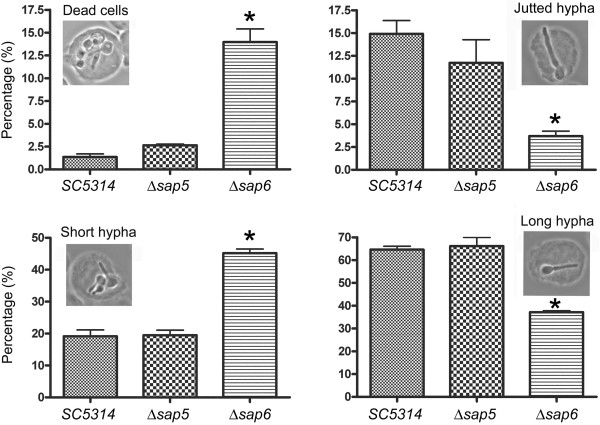
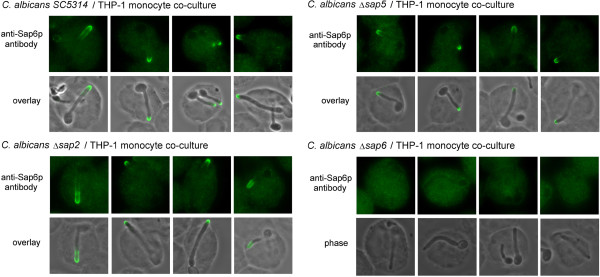
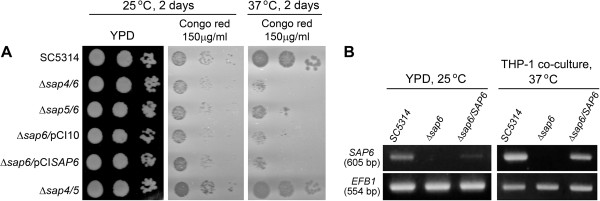
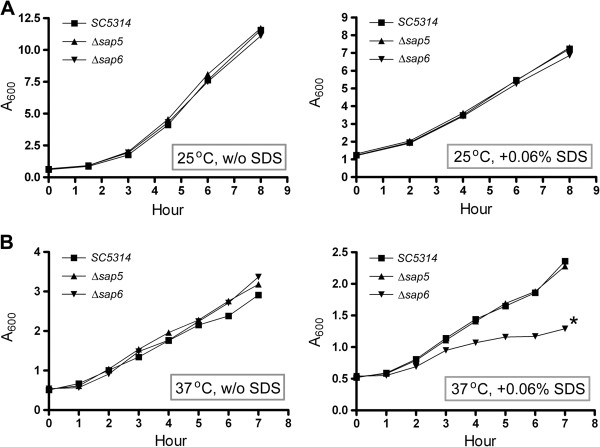
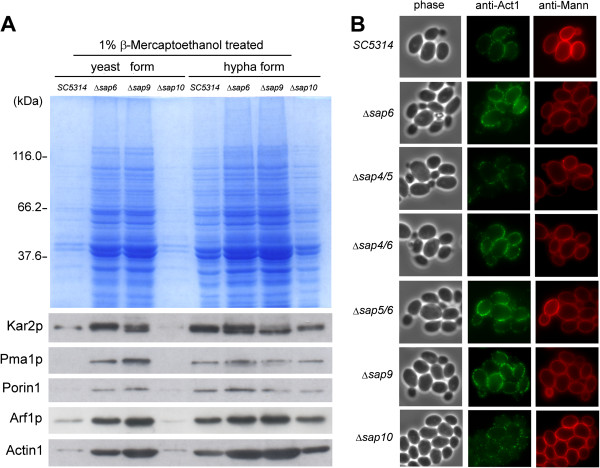
BACKGROUND: The polymorphic species Candida albicans is the major cause of candidiasis in humans. The secreted aspartyl proteinases (Saps) of C. albicans, encoded by a family of 10 SAP genes, have been investigated as the virulent factors during candidiasis. However, the biological functions of most Sap proteins are still uncertain. In this study, we applied co-culture system of C. albicans and THP-1 human monocytes to explore the pathogenic roles and biological functions of Sap proteinases. RESULTS: After 1 hr of co-culture of C. albicans strains and THP-1 human monocytes at 37°C, more than 60% of the THP-1-engulfed wild type and Δsap5 Candida cells were developing long hyphae. However, about 50% of THP-1-engulfed Δsap6 Candida cells were generating short hyphae, and more dead Candida cells were found in Δsap6 strain that was ingested by THP-1 cells (about 15% in Δsap6 strain vs. 2 ~ 2.5% in SC5314 and Δsap5 strains). The immunofluorescence staining demonstrated that the Sap6 is the major hyphal tip located Sap protein under THP-1 phagocytosis. The sap6-deleted strains (Δsap6, Δsap4/6, and Δsap5/6) appeared slower growth on Congo red containing solid medium at 25°C, and the growth defect was exacerbated when cultured at 37°C in Congo red or SDS containing medium. In addition, more proteins were secreted from Δsap6 strain and the β-mercaptoethanol (β-ME) extractable surface proteins from Δsap6 mutant were more abundant than that of extracted from wild type strain, which included the plasma membrane protein (Pma1p), the ER-chaperone protein (Kar2p), the protein transport-related protein (Arf1p), the cytoskeleton protein (Act1), and the mitochondrial outer membrane protein (porin 1). Moreover, the cell surface accessibility was increased in sap6-deleted strains. CONCLUSION: From these results, we speculated that the cell surface constitution of C. albicans Δsap6 strain was defect. This may cause the more accessible of β-ME to disulfide-bridged cell surface components and may weaken the resistance of Δsap6 strain encountering phagocytosis of THP-1 cells. Sap6 protein displays a significant function involving in maintenance the cell surface integrity.
Overview
The claims and statistics of this paper haven’t been checked yet.
Free: it reads the open-access text and checks the first 5 claims that cite a source we can check. Create a free account to check every claim.
Integrity signals
Registry
Cites
Statistics
Figures
Verification
Claims the paper makes
The claims and statistics of this paper haven’t been checked yet.
Free: it reads the open-access text and checks the first 5 claims that cite a source we can check. Create a free account to check every claim.
Claims other papers make about this one
Each is checked against this paper’s own text: does it say what the citing paper says it does?
The cited source says what the claim attributes to it.
In the citing paper
“Other upregulated genes associated with pathogenesis included SAP6 (66), GLK1 and PHO112 (67), and PLB1 (68) and the transcription factor GAT1 as well as its regulation targets DUR1,2 and MEP2 (69).”
From Inhibition of Classical and Alternative Modes of Respiration in Candida albicans Leads to Cell Wall Remodeling and Increased Macrophage Recognition (2019) · cites this paper as [66]
Self-check
Percentages, sums and reported differences re-computed from the paper’s own numbers.
The self-check needs the paper’s full text.
Citations
Cites
Current protocols in molecular biology
Sargent, T. (1988) · Analytical Biochemistry · doi:10.1016/0003-2697(88)90147-9 · Cited by 7,205
Isolation and characterization
Turksen, K. (2006) · Humana Press eBooks · Cited by 2,145
Isogenic strain construction and gene mapping in Candida albicans.
Fonzi, W. A., & Irwin, M. Y. (1993) · Genetics · doi:10.1093/genetics/134.3.717 · Cited by 1,687
Nosocomial Bloodstream Infections in United States Hospitals: A Three‐Year Analysis
Edmond, M. B., Wallace, S. E., McClish, D. K., Pfaller, M. A., Jones, R. N., & Wenzel, R. P. (1999) · Clinical Infectious Diseases · doi:10.1086/520192 · Cited by 1,387
Virulence factors of Candida albicans
Calderone, R. A., & Fonzi, W. A. (2001) · Trends in Microbiology · doi:10.1016/s0966-842x(01)02094-7 · Cited by 1,331 · cited 2×
“albicans, ten secreted aspartyl proteinase (Sap 1 ~ 10) were identified and categorized to a Sap protein family [18-22], which have been investigated as the virulent factors during candidiasis [2,23,24].”
BackgroundGillum, A. M., Tsay, E. Y. H., & Kirsch, D. R. (1984) · Molecular and General Genetics MGG · doi:10.1007/bf00328721 · Cited by 1,251
Candida albicans Secreted Aspartyl Proteinases in Virulence and Pathogenesis
Naglik, J. R., Challacombe, S. J., & Hube, B. (2003) · Microbiology and Molecular Biology Reviews · doi:10.1128/mmbr.67.3.400-428.2003 · Cited by 1,179 · cited 2×
“albicans, ten secreted aspartyl proteinase (Sap 1 ~ 10) were identified and categorized to a Sap protein family [18-22], which have been investigated as the virulent factors during candidiasis [2,23,24].”
BackgroundCell Wall Integrity Signaling in Saccharomyces cerevisiae
Levin, D. E. (2005) · Microbiology and Molecular Biology Reviews · doi:10.1128/mmbr.69.2.262-291.2005 · Cited by 1,136
Cell Wall Assembly in Saccharomyces cerevisiae
Lesage, G., & Bussey, H. (2006) · Microbiology and Molecular Biology Reviews · doi:10.1128/mmbr.00038-05 · Cited by 849 · cited 1×
“Numerous molecules have been identified to participate in cell wall construction and cell wall integrity signaling [14-16], including a group of yapsin family proteins.”
BackgroundCell wall construction in Saccharomyces cerevisiae
Klis, F. M., Boorsma, A., & De Groot, P. W. J. (2006) · Yeast · doi:10.1002/yea.1349 · Cited by 759
Cited by
Muthamil, S., Balasubramaniam, B., Balamurugan, K., & Pandian, S. K. (2018) · Frontiers in Microbiology · doi:10.3389/fmicb.2018.02835 · Cited by 93
Cao, S., Guo, M., Wang, C., Xu, W., Shi, T., Tong, G., Zhen, C., Cheng, H., Yang, C., Elsheery, N. I., et al. (2019) · BMC Plant Biology · doi:10.1186/s12870-019-1865-0 · Cited by 89
Zawrotniak, M., Bochenska, O., Karkowska-Kuleta, J., Seweryn-Ozog, K., Aoki, W., Ueda, M., Kozik, A., & Rapala-Kozik, M. (2017) · Frontiers in Cellular and Infection Microbiology · doi:10.3389/fcimb.2017.00414 · Cited by 81
Virulence and Biofilms As Promising Targets in Developing Antipathogenic Drugs Against Candidiasis
Khan, M. S., Alshehrei, F. M., Alghamdi, S., Bamaga, M. A., Althubiani, A. S., & Alam, M. Z. (2020) · Future Science OA · doi:10.2144/fsoa-2019-0027 · Cited by 72
Muthamil, S., Devi, V. A., Balasubramaniam, B., Balamurugan, K., & Pandian, S. K. (2018) · Journal of Basic Microbiology · doi:10.1002/jobm.201700529 · Cited by 66
Metadata
- Authors
- Buu, L.-M., & Chen, Y.-C.
- Affiliations
- National Kaohsiung Normal University (TW)
- National Taiwan University (TW)
- Corresponding author
- Buu, Leh-Miauh
- ORCID
- Chen, Yee-Chun
- Venue
- Journal of Biomedical Science
- Published
- 2013-12
- Volume
- 20
- Issue
- 1
- Pages
- 101-101
- ISSN
- 1021-7770 (ISSN-L)
- 1423-0127
- PMC
- PMC3890532
- OpenAlex
- W2144236384
- Cited by
- 27
- References
- 53
- Citations by year
- 2026: 2 · 2025: 3 · 2024: 4 · 2023: 3 · 2021: 2 · 2020: 1 · 2019: 2 · 2018: 3 · 2017: 1 · 2016: 3 · 2015: 3
- FWCI
- 1.45
- Type
- journal article
- Language
- en
- Open access
- diamond
- doi.org
- Licence
- cc-by
- Locations
- Journal of Biomedical Science (publishedVersion, cc-by)
- Europe PMC (PubMed Central) (publishedVersion, cc-by)
- PubMed Central (publishedVersion, cc-by)
- PubMed (publishedVersion)
- Funders
- National Science Council
- National Taiwan University Hospital
- National Taiwan University
- Topics
- Health Sciences › Medicine › Infectious Diseases › Antifungal resistance and susceptibility
- Life Sciences › Biochemistry, Genetics and Molecular Biology › Molecular Biology › Fungal and yeast genetics research
- Health Sciences › Medicine › Infectious Diseases › Fungal Infections and Studies
- Keywords
- Candida albicans, SAP6, secreted aspartyl proteinases, hyphal morphogenesis, phagocytosis, THP-1 cells, SAP5, Congo red, cell surface proteins, virulence factors, candidiasis
- MeSH terms
- Candida albicans, Cell Line, Fluorescent Antibody Technique, Fungal Proteins, Humans, Membrane Proteins, Monocytes, Aspartic Acid Endopeptidases, Reverse Transcriptase Polymerase Chain Reaction, Protein Transport
About these checks
Registry, retraction, Cites and statistics results are computed, not judged, with one exception: a printed reference that no index lists is read once by a model before it counts as a citation error. Claims are extracted by a model and kept only when their quote appears verbatim in the text; each cited source is then checked, with a model’s help, for whether it says what the claim relies on. Those verdicts can be wrong — read the claim’s quote and the cited source before relying on one.
Statistics and arithmetic are recomputed, not judged.
Confidence bands are shown only for fields calibrated on our annotated test set. None is calibrated yet, so no band is shown.
What counts as a claim ›How we measure confidence ›How we check this ›
Are you an author, or do you see a problem with this page? Request a review
How to cite
Cite CoChat for the checks on this page, and the paper for its own findings.
- This page
- CoChat. (2026). Citation check: Sap6, a secreted aspartyl proteinase, participates in maintenance the cell surface integrity of Candida albicans. https://app.cochat.ai/papers/10.1186/1423-0127-20-101
- The paper
- Buu, L.-M., & Chen, Y.-C. (2013). Sap6, a secreted aspartyl proteinase, participates in maintenance the cell surface integrity of Candida albicans. Journal of Biomedical Science. https://doi.org/10.1186/1423-0127-20-101
Data sources
Bibliographic data: Semantic Scholar, OpenAlex, Crossref.
Contains information from the Semantic Scholar Academic Graph Datasets, made available under the ODC Attribution License (ODC-BY 1.0).
Semantic Scholar’s data is described in: Kinney, R., et al. (2023). The Semantic Scholar Open Data Platform. arXiv:2301.10140.
