

Optimizing transformations for automated, high throughput analysis of flow cytometry data
Open accessThe DOI matches its Crossref record; 27 of the 27 references it cites were found in a registry or an index.
Abstract
BACKGROUND: In a high throughput setting, effective flow cytometry data analysis depends heavily on proper data preprocessing. While usual preprocessing steps of quality assessment, outlier removal, normalization, and gating have received considerable scrutiny from the community, the influence of data transformation on the output of high throughput analysis has been largely overlooked. Flow cytometry measurements can vary over several orders of magnitude, cell populations can have variances that depend on their mean fluorescence intensities, and may exhibit heavily-skewed distributions. Consequently, the choice of data transformation can influence the output of automated gating. An appropriate data transformation aids in data visualization and gating of cell populations across the range of data. Experience shows that the choice of transformation is data specific. Our goal here is to compare the performance of different transformations applied to flow cytometry data in the context of automated gating in a high throughput, fully automated setting. We examine the most common transformations used in flow cytometry, including the generalized hyperbolic arcsine, biexponential, linlog, and generalized Box-Cox, all within the BioConductor flowCore framework that is widely used in high throughput, automated flow cytometry data analysis. All of these transformations have adjustable parameters whose effects upon the data are non-intuitive for most users. By making some modelling assumptions about the transformed data, we develop maximum likelihood criteria to optimize parameter choice for these different transformations. RESULTS: We compare the performance of parameter-optimized and default-parameter (in flowCore) data transformations on real and simulated data by measuring the variation in the locations of cell populations across samples, discovered via automated gating in both the scatter and fluorescence channels. We find that parameter-optimized transformations improve visualization, reduce variability in the location of discovered cell populations across samples, and decrease the misclassification (mis-gating) of individual events when compared to default-parameter counterparts. CONCLUSIONS: Our results indicate that the preferred transformation for fluorescence channels is a parameter- optimized biexponential or generalized Box-Cox, in accordance with current best practices. Interestingly, for populations in the scatter channels, we find that the optimized hyperbolic arcsine may be a better choice in a high-throughput setting than current standard practice of no transformation. However, generally speaking, the choice of transformation remains data-dependent. We have implemented our algorithm in the BioConductor package, flowTrans, which is publicly available.
Overview
The claims and statistics of this paper haven’t been checked yet.
Free: it reads the open-access text and checks the first 5 claims that cite a source we can check. Create a free account to check every claim.
Integrity signals
Registry
Cites
Statistics
Figures
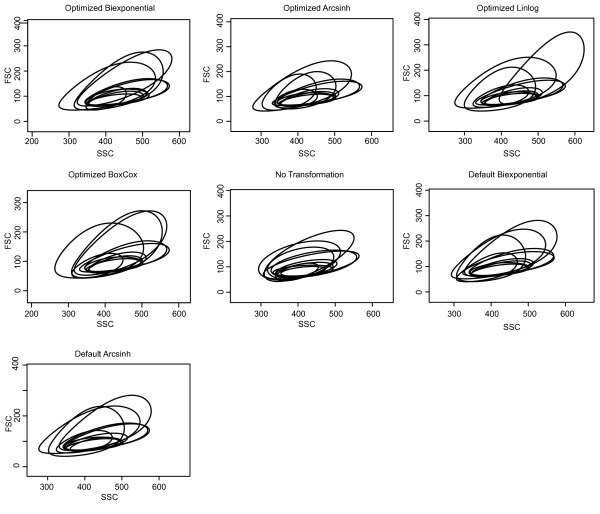
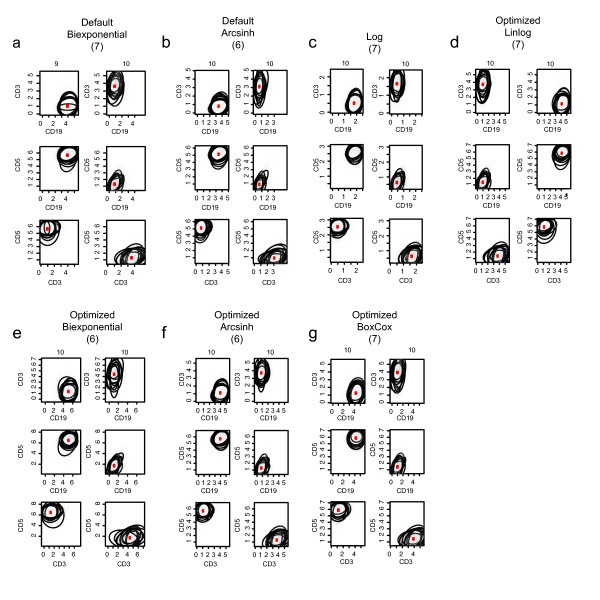
Verification
Claims the paper makes
The claims and statistics of this paper haven’t been checked yet.
Free: it reads the open-access text and checks the first 5 claims that cite a source we can check. Create a free account to check every claim.
Claims other papers make about this one
Each is checked against this paper’s own text: does it say what the citing paper says it does?
The source backs part of the claim, not all of it — or backs it for a different population, condition or comparison.
In the citing paper
“Different transformation approaches such as the biexponential, arcsinh, and hyperlog display can be used, and the optimal transformation depends on the specific data and cannot always be computationally predicted [83].”
From Guidelines for the use of flow cytometry and cell sorting in immunological studies (third edition) (2021) · cites this paper as [83]
Experimental — accuracy not yet measured
Self-check
Percentages, sums and reported differences re-computed from the paper’s own numbers.
The self-check needs the paper’s full text.
Citations
Cites
An Analysis of Transformations
Box, G. E. P., & Cox, D. R. (1964) · Journal of the Royal Statistical Society Series B: Statistical Methodology · doi:10.1111/j.2517-6161.1964.tb00553.x · Cited by 15,052 · cited 1×
“We use maximum likelihood methods to estimate the parameters of each transformation (generalized arcsinh, generalized Box-Cox, linlog, and biexponential) following established methods [19].”
MethodBioconductor: open software development for computational biology and bioinformatics
Gentleman, R. C., Carey, V. J., Bates, D. M., Bolstad, B., Dettling, M., Dudoit, S., Ellis, B., Gautier, L., Ge, Y., Gentry, J., et al. (2004) · Genome Biology · doi:10.1186/gb-2004-5-10-r80 · Cited by 12,172 · cited 3×
“We perform our analysis within the flowCore framework in BioConductor, which is the predominant tool set in use for automated, high throughput flow data analysis.”
MethodR: A Language for Data Analysis and Graphics
Ihaka, R., & Gentleman, R. (1996) · Journal of Computational and Graphical Statistics · doi:10.1080/10618600.1996.10474713 · Cited by 11,220
On the generalized distance in statistics
Mahalanobis, P. C. (1936) · DOAJ (DOAJ: Directory of Open Access Journals) · Cited by 6,068
Hierarchical Clustering Schemes
Johnson, S. C. (1967) · Psychometrika · doi:10.1007/bf02289588 · Cited by 4,897 · cited 1×
“This involved a modified single linkage agglomerative clustering approach to group corresponding populations across samples [23].”
MethodR: A Language for Data Analysis and Graphics
Ihaka, R., & Gentleman, R. C. (1996) · Journal of Computational and Graphical Statistics · doi:10.2307/1390807 · Cited by 4,245
flowCore: a Bioconductor package for high throughput flow cytometry
Hahne, F., LeMeur, N., Brinkman, R. R., Ellis, B., Haaland, P., Sarkar, D., Spidlen, J., Strain, E., & Gentleman, R. (2009) · BMC Bioinformatics · doi:10.1186/1471-2105-10-106 · Cited by 581 · cited 1×
“This package integrates with the existing FCM data analysis tools in BioConductor and uses existing data structures data manipulation paradigms from the flowCore framework [22,25].”
MethodInterpreting flow cytometry data: a guide for the perplexed
Herzenberg, L. A., Tung, J., Moore, W. A., Herzenberg, L. A., & Parks, D. R. (2006) · Nature Immunology · doi:10.1038/ni0706-681 · Cited by 464 · cited 1×
“The underpinning principle is to choose a transformation that facilitates cell population gating, visualization, and intersample comparison, by obtaining a representation wherein cell populations are well resolved across the full range of the data [6,12,15-17].”
BackgroundAutomated high-dimensional flow cytometric data analysis
Pyne, S., Hu, X., Wang, K., Rossin, E., Lin, T.-I., Maier, L. M., Baecher-Allan, C., McLachlan, G. J., Tamayo, P., Hafler, D. A., et al. (2009) · Proceedings of the National Academy of Sciences · doi:10.1073/pnas.0903028106 · Cited by 285 · cited 2×
“Background Flow cytometry (FCM) is increasingly moving to-wards automated methods to deal with the quantities of data generated by high throughput, high-content screening [1-11].”
MethodAutomated gating of flow cytometry data via robust model‐based clustering
Lo, K., Brinkman, R. R., & Gottardo, R. (2008) · Cytometry Part A · doi:10.1002/cyto.a.20531 · Cited by 264 · cited 10×
“Background Flow cytometry (FCM) is increasingly moving to-wards automated methods to deal with the quantities of data generated by high throughput, high-content screening [1-11].”
BackgroundMethodInfluentialSelf-citationParks, D. R., Roederer, M., & Moore, W. A. (2006) · Cytometry Part A · doi:10.1002/cyto.a.20258 · Cited by 246
flowClust: a Bioconductor package for automated gating of flow cytometry data
Lo, K., Hahne, F., Brinkman, R. R., & Gottardo, R. (2009) · BMC Bioinformatics · doi:10.1186/1471-2105-10-145 · Cited by 185 · cited 1×
“The generalized Box-Cox has been adapted and applied to FCM data in the context of automated gating within a multivariate-t mixture modelling framework [4,6,18].”
MethodSelf-citationA Survey of Flow Cytometry Data Analysis Methods
Bashashati, A., & Brinkman, R. R. (2009) · Advances in Bioinformatics · doi:10.1155/2009/584603 · Cited by 135 · cited 2×
“In such a setting, the impact of data transformation has received relatively little attention [6,14,15].”
BackgroundResultPer‐channel basis normalization methods for flow cytometry data
Hahne, F., Khodabakhshi, A. H., Bashashati, A., Wong, C., Gascoyne, R. D., Weng, A. P., Seyfert‐Margolis, V., Bourcier, K., Asare, A., Lumley, T., et al. (2010) · Cytometry Part A · doi:10.1002/cyto.a.20823 · Cited by 128 · cited 2×
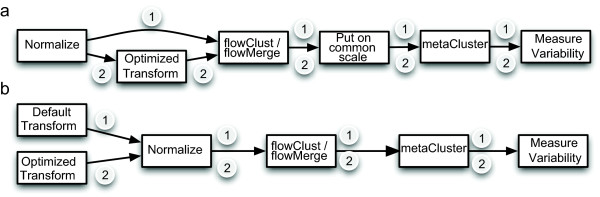
“To assess the performance of different transformations the data were normalized, gated using flowClust/flowMerge, and the discovered populations were clustered across data sets (metaclustered) [21].”
MethodSelf-citationMerging Mixture Components for Cell Population Identification in Flow Cytometry
Finak, G., Bashashati, A., Brinkman, R. R., & Gottardo, R. (2009) · Advances in Bioinformatics · doi:10.1155/2009/247646 · Cited by 102 · cited 9×
“This package integrates with the existing FCM data analysis tools in BioConductor and uses existing data structures data manipulation paradigms from the flowCore framework [22,25].”
BackgroundMethodInfluentialSelf-citationMixture modeling approach to flow cytometry data
Boedigheimer, M. J., & Ferbas, J. (2008) · Cytometry Part A · doi:10.1002/cyto.a.20553 · Cited by 92 · cited 3×
“Background Flow cytometry (FCM) is increasingly moving to-wards automated methods to deal with the quantities of data generated by high throughput, high-content screening [1-11].”
BackgroundMethodHyperlog—A flexible log‐like transform for negative, zero, and positive valued data
Bagwell, C. B. (2005) · Cytometry Part A · doi:10.1002/cyto.a.20114 · Cited by 79 · cited 3×
“Carefully chosen data transformations and corresponding parameters have been suggested to overcome some of the problems surrounding manual FCM analysis and gating [12,13].”
BackgroundMethodFlowFP: A Bioconductor Package for Fingerprinting Flow Cytometric Data
Rogers, W. T., & Holyst, H. A. (2009) · Advances in Bioinformatics · doi:10.1155/2009/193947 · Cited by 71 · cited 1×
“Background Flow cytometry (FCM) is increasingly moving to-wards automated methods to deal with the quantities of data generated by high throughput, high-content screening [1-11].”
MethodAutomatic Clustering of Flow Cytometry Data with Density-Based Merging
Walther, G., Zimmerman, N., Moore, W., Parks, D., Meehan, S., Belitskaya, I., Pan, J., & Herzenberg, L. (2009) · Advances in Bioinformatics · doi:10.1155/2009/686759 · Cited by 52 · cited 3×
“A variety of automated gating algorithms have been proposed to identify distinct cell sub-populations [1,6-10].”
BackgroundMethodFlow cytometry histograms: Transformations, resolution, and display
Novo, D. J., & Wood, J. C. S. (2008) · Cytometry Part A · doi:10.1002/cyto.a.20592 · Cited by 43 · cited 2×
“In such a setting, the impact of data transformation has received relatively little attention [6,14,15].”
BackgroundCytometric fingerprinting: Quantitative characterization of multivariate distributions
Rogers, W. T., Moser, A. R., Holyst, H. A., Bantly, A. D., Mohler, E. R., Scangas, G. A., & Moore, J. S. (2008) · Cytometry Part A · doi:10.1002/cyto.a.20545 · Cited by 40 · cited 3×
“Background Flow cytometry (FCM) is increasingly moving to-wards automated methods to deal with the quantities of data generated by high throughput, high-content screening [1-11].”
BackgroundMethodThe curvHDR method for gating flow cytometry samples
Naumann, U., Luta, G., & WAND, M. P. (2010) · BMC Bioinformatics · doi:10.1186/1471-2105-11-44 · Cited by 30 · cited 4×
“Background Flow cytometry (FCM) is increasingly moving to-wards automated methods to deal with the quantities of data generated by high throughput, high-content screening [1-11].”
BackgroundMethodInfluentialAutomation in high‐content flow cytometry screening
Naumann, U., & WAND, M. P. (2009) · Cytometry Part A · doi:10.1002/cyto.a.20754 · Cited by 29 · cited 4×
“Background Flow cytometry (FCM) is increasingly moving to-wards automated methods to deal with the quantities of data generated by high throughput, high-content screening [1-11].”
BackgroundMethodInfluentialRocha, M. P., Fdez‐Riverola, F., Shatkay, H., & Corchado, J. M. (2010) · Advances in intelligent and soft computing · doi:10.1007/978-3-642-13214-8 · Cited by 21
Modified box‐cox transform for modulating the dynamic range of flow cytometry data
Dvorak, J. A., & Banks, S. M. (1989) · Cytometry · doi:10.1002/cyto.990100622 · Cited by 7 · cited 2×
“…and related transformations such as the linear-logarithmic and hyperlog transforms, power transformations such as the generalized Box-Cox, which includes the logarithm as a special case, and the biexponential and related transformations such as the logicle and generalized arcsinh [6,12,13,17].”
BackgroundGosink, J. J., Means, G., Rees, W. A., Su, C., & Rand, H. A. (2009) · Advances in Bioinformatics · doi:10.1155/2009/809469 · Cited by 6 · cited 2×
“Background Flow cytometry (FCM) is increasingly moving to-wards automated methods to deal with the quantities of data generated by high throughput, high-content screening [1-11].”
MethodRecent Bioinformatics Advances in the Analysis of High Throughput Flow Cytometry Data
Gottardo, R., Brinkman, R. R., Luta, G., & WAND, M. P. (2009) · Advances in Bioinformatics · doi:10.1155/2009/461763 · Cited by 2
Self-citation
Cited by
Guidelines for the use of flow cytometry and cell sorting in immunological studies (second edition)
Cossarizza, A., Chang, H., Radbruch, A., Acs, A., Adam, D., Adam‐Klages, S., Agace, W. W., Aghaeepour, N., Akdis, M., Allez, M., et al. (2019) · European Journal of Immunology · doi:10.1002/eji.201970107 · Cited by 979
Guidelines for the use of flow cytometry and cell sorting in immunological studies *
Cossarizza, A., Chang, H., Radbruch, A., Akdis, M., Andrä, I., Annunziato, F., Bacher, P., Barnaba, V., Battistini, L., Bauer, W. M., et al. (2017) · European Journal of Immunology · doi:10.1002/eji.201646632 · Cited by 542
Guidelines for the use of flow cytometry and cell sorting in immunological studies (third edition)
Cossarizza, A., Chang, H., Radbruch, A., Abrignani, S., Addo, R., Akdis, M., Andrä, I., Andreata, F., Annunziato, F., Arranz, E., et al. (2021) · European Journal of Immunology · doi:10.1002/eji.202170126 · Cited by 531
The end of gating? An introduction to automated analysis of high dimensional cytometry data
Mair, F., Hartmann, F. J., Mrdjen, D., Tosevski, V., Krieg, C., & Becher, B. (2016) · European Journal of Immunology · doi:10.1002/eji.201545774 · Cited by 234
Immune monitoring using mass cytometry and related high-dimensional imaging approaches
Hartmann, F. J., & Bendall, S. C. (2020) · Nature Reviews Rheumatology · doi:10.1038/s41584-019-0338-z · Cited by 200
Metadata
- Authors
- Finak, G., Perez, J.-M., Weng, A., & Gottardo, R.
- Affiliations
- Fred Hutch Cancer Center (US)
- Montreal Clinical Research Institute (CA)
- Terry Fox Research Institute (CA)
- Corresponding author
- Finak, Greg
- Venue
- BMC Bioinformatics
- Published
- 2010-11-04
- Volume
- 11
- Issue
- 1
- Pages
- 546-546
- ISSN
- 1471-2105 (ISSN-L)
- PMC
- PMC3243046
- OpenAlex
- W1976192231
- Cited by
- 99
- References
- 27
- Citations by year
- 2026: 4 · 2025: 5 · 2024: 9 · 2023: 6 · 2022: 7 · 2021: 7 · 2020: 12 · 2019: 14 · 2018: 8 · 2017: 6 · 2016: 2 · 2015: 5 · 2014: 4 · 2013: 4 · 2012: 4
- FWCI
- 1.93
- Type
- journal article
- Language
- en
- Open access
- gold
- doi.org
- Licence
- cc-by
- creativecommons.org/licenses/by/2.0 (tdm)
- Locations
- BMC Bioinformatics (publishedVersion, cc-by)
- Europe PMC (PubMed Central) (publishedVersion, cc-by)
- PubMed Central (publishedVersion, cc-by)
- PubMed (publishedVersion)
- DOAJ (DOAJ: Directory of Open Access Journals) (submittedVersion)
- Funders
- National Institutes of Health
- Canadian Institutes of Health Research
- National Institute of Biomedical Imaging and Bioengineering (R01EB008400)
- Topics
- Life Sciences › Biochemistry, Genetics and Molecular Biology › Biophysics › Cell Image Analysis Techniques
- Life Sciences › Biochemistry, Genetics and Molecular Biology › Molecular Biology › Single-cell and spatial transcriptomics
- Life Sciences › Biochemistry, Genetics and Molecular Biology › Molecular Biology › Gene expression and cancer classification
- Keywords
- automated gating, high-throughput flow cytometry, parameter optimization, maximum likelihood estimation, Bioconductor
- MeSH terms
- Algorithms, Cells, Data Interpretation, Statistical, Flow Cytometry, Databases, Factual
About these checks
Registry, retraction, Cites and statistics results are computed, not judged, with one exception: a printed reference that no index lists is read once by a model before it counts as a citation error. Claims are extracted by a model and kept only when their quote appears verbatim in the text; each cited source is then checked, with a model’s help, for whether it says what the claim relies on. Those verdicts can be wrong — read the claim’s quote and the cited source before relying on one.
Statistics and arithmetic are recomputed, not judged.
Confidence bands are shown only for fields calibrated on our annotated test set. None is calibrated yet, so no band is shown.
What counts as a claim ›How we measure confidence ›How we check this ›
Are you an author, or do you see a problem with this page? Request a review
Data sources
Bibliographic data: Semantic Scholar, OpenAlex, Crossref.
Contains information from the Semantic Scholar Academic Graph Datasets, made available under the ODC Attribution License (ODC-BY 1.0).
Semantic Scholar’s data is described in: Kinney, R., et al. (2023). The Semantic Scholar Open Data Platform. arXiv:2301.10140.
