

Novel metaheuristic for parameter estimation in nonlinear dynamic biological systems
Open accessThe DOI matches its Crossref record; 58 of the 58 references it cites were found in a registry or an index.
Abstract
Background: We consider the problem of parameter estimation (model calibration) in nonlinear dynamic models of biological systems. Due to the frequent ill-conditioning and multi-modality of many of these problems, traditional local methods usually fail (unless initialized with very good guesses of the parameter vector). In order to surmount these difficulties, global optimization (GO) methods have been suggested as robust alternatives. Currently, deterministic GO methods can not solve problems of realistic size within this class in reasonable computation times. In contrast, certain types of stochastic GO methods have shown promising results, although the computational cost remains large. Rodriguez-Fernandez and coworkers have presented hybrid stochastic-deterministic GO methods which could reduce computation time by one order of magnitude while guaranteeing robustness. Our goal here was to further reduce the computational effort without loosing robustness. Results: We have developed a new procedure based on the scatter search methodology for nonlinear optimization of dynamic models of arbitrary (or even unknown) structure (i.e. black-box models). In this contribution, we describe and apply this novel metaheuristic, inspired by recent developments in the field of operations research, to a set of complex identification problems and we make a critical comparison with respect to the previous (above mentioned) successful methods. Conclusion: Robust and efficient methods for parameter estimation are of key importance in systems biology and related areas. The new metaheuristic presented in this paper aims to ensure the proper solution of these problems by adopting a global optimization approach, while keeping the computational effort under reasonable values. This new metaheuristic was applied to a set of three challenging parameter estimation problems of nonlinear dynamic biological systems, outperforming very significantly all the methods previously used for these benchmark problems.
Overview
The claims and statistics of this paper haven’t been checked yet.
Free: it reads the open-access text and checks the first 5 claims that cite a source we can check. Create a free account to check every claim.
Integrity signals
Registry
Cites
Statistics
Figures
Verification
Claims the paper makes
The claims and statistics of this paper haven’t been checked yet.
Free: it reads the open-access text and checks the first 5 claims that cite a source we can check. Create a free account to check every claim.
Claims other papers make about this one
Each is checked against this paper’s own text: does it say what the citing paper says it does?
The cited source says what the claim attributes to it.
In the citing paper
“For example, scatter search has proved to be a very efficient method when the local search phase is performed by a specialized local method [114,116].”
From Reverse engineering and identification in systems biology: strategies, perspectives and challenges (2014) · cites this paper as [114]
In the citing paper
“Therefore, based on the current status of the NP issue [111], approximate methods (such as stochastic algorithms and metaheuristics) are a more attractive alternative for problems of realistic size [112–114].”
From Reverse engineering and identification in systems biology: strategies, perspectives and challenges (2014) · cites this paper as [114]
Self-check
Percentages, sums and reported differences re-computed from the paper’s own numbers.
The self-check needs the paper’s full text.
Citations
Cites
Storn, R., & Price, K. (1997) · Journal of Global Optimization · doi:10.1023/a:1008202821328 · Cited by 29,569 · cited 1×
“Our tests and comparisons indicate that DE [28] and SRES [29] are one of the most competitive algorithms, with the additional advantage of being able to handle arbitrary constraints if needed.”
MethodSystem Identification: Theory for the User
Lennart Ljung, A. (1987) · Cited by 17,690
Nonlinear Regression Analysis and Its Applications
Bates, D. M., & Watts, D. G. (1988) · Wiley Series in Probability and Statistics · doi:10.1002/9780470316757 · Cited by 3,979
Ljung, L. (1999) · Wiley Encyclopedia of Electrical and Electronics Engineering · doi:10.1002/047134608x.w1046 · Cited by 3,778
Stochastic ranking for constrained evolutionary optimization
Runarsson, T. P., & Yao, X. (2000) · IEEE Transactions on Evolutionary Computation · doi:10.1109/4235.873238 · Cited by 1,807 · cited 1×
“Our tests and comparisons indicate that DE [28] and SRES [29] are one of the most competitive algorithms, with the additional advantage of being able to handle arbitrary constraints if needed.”
MethodSNOPT: An SQP Algorithm for Large-Scale Constrained Optimization
Gill, P. E., Murray, W., & Saunders, M. A. (2002) · SIAM Journal on Optimization · doi:10.1137/s1052623499350013 · Cited by 1,587 · cited 1×
“ The user can choose a number of different local solvers such us SQP methods like fmincon (The MathWorks Inc.), SOLNP [34], SNOPT [ 35 ], direct methods like Nomad [36] for the cases of very noisy data, and others specifically designed for parameter estimation problems such as N2FB/DN2FB [37].”
MethodProgram DYNAFIT for the Analysis of Enzyme Kinetic Data: Application to HIV Proteinase
Kuzmič, P. (1996) · Analytical Biochemistry · doi:10.1006/abio.1996.0238 · Cited by 1,495 · cited 2×
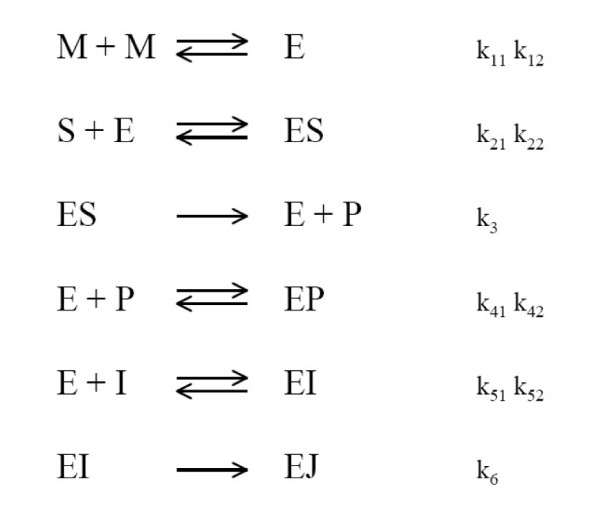
“This problem consists of the estimation of a number of rate constants of a model for the reaction mechanism of irreversible inhibition of HIV proteinase as originally studied by Kuzmic [52] (Figure 7).”
MethodHEURISTICS FOR INTEGER PROGRAMMING USING SURROGATE CONSTRAINTS
Glover, F. (1977) · Decision Sciences · doi:10.1111/j.1540-5915.1977.tb01074.x · Cited by 1,363
Identification of parametric models : from experimental data
Walter, É., & Pronzato, L. (1997) · Cited by 1,197
Parameter estimation in biochemical pathways: a comparison of global optimization methods
Moles, C. G., Mendes, P., & Banga, J. R. (2003) · Genome Research · doi:10.1101/gr.1262503 · Cited by 858 · cited 4×
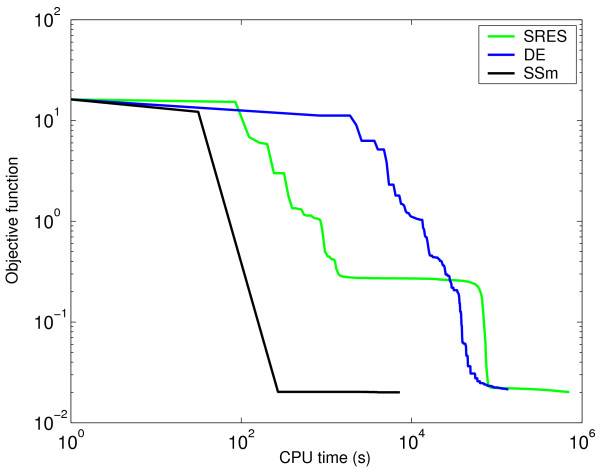
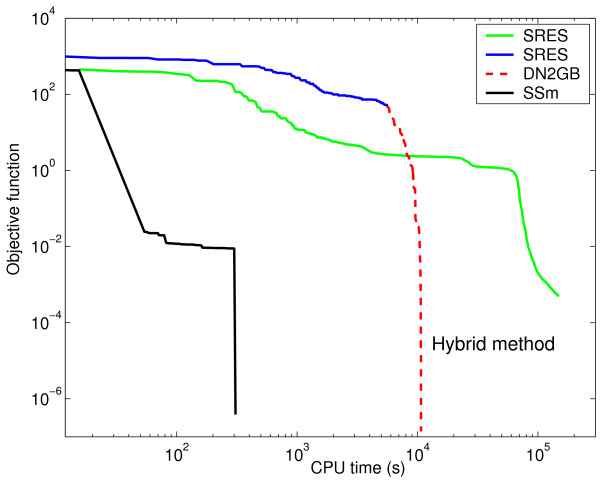
“In short, using SSm we have reduced the computation time from two days [19] to a couple of minutes, while ensuring robustness.”
BackgroundMethodInfluentialSelf-citationMendes, P., & Kell, D. (1998) · Bioinformatics · doi:10.1093/bioinformatics/14.10.869 · Cited by 676 · cited 1×
“We considered the same problem solved by Kuzmic [52] and Mendes and Kell [53] fitting five of the rate constants to the experimental data.”
MethodSystem identification (2nd ed.): theory for the user
Lennart Ljung, A. (1999) · Prentice Hall PTR eBooks · Cited by 594
Metabolomics and systems biology: making sense of the soup
KELL, D. (2004) · Current Opinion in Microbiology · doi:10.1016/j.mib.2004.04.012 · Cited by 529 · cited 1×
“Modelling approaches are central in systems biology and provide new ways towards the analysis of omics data, ultimately leading to a greater understanding of the language of cells and organisms [1-3].”
BackgroundAlgorithm 573: NL2SOL—An Adaptive Nonlinear Least-Squares Algorithm [E4]
Dennis, J. E., Gay, D. M., & Welsch, R. E. (1981) · ACM Transactions on Mathematical Software · doi:10.1145/355958.355966 · Cited by 405 · cited 1×
“ The user can choose a number of different local solvers such us SQP methods like fmincon (The MathWorks Inc.), SOLNP [34], SNOPT [35], direct methods like Nomad [36] for the cases of very noisy data, and others specifically designed for parameter estimation problems such as N2FB/DN2FB [ 37 ].”
MethodGlobal identifiability of nonlinear models of biological systems
Audoly, S., Bellu, G., D'Angio, L., Saccomani, M. P., & Cobelli, C. (2001) · IEEE Transactions on Biomedical Engineering · doi:10.1109/10.900248 · Cited by 325 · cited 1×
“Assessing a priori global identifiability is very difficult for nonlinear dynamic models, although techniques based on differential algebra have shown very promising results [42].”
BackgroundScatter Search: Methodology and Implementations in C
(2003) · Operations Research/Computer Science Interfaces Series · doi:10.1007/978-1-4615-0337-8 · Cited by 316
A hybrid approach for efficient and robust parameter estimation in biochemical pathways
Rodriguez-Fernandez, M., Mendes, P., & Banga, J. R. (2006) · Biosystems · doi:10.1016/j.biosystems.2005.06.016 · Cited by 304 · cited 7×
“Rod-riguez-Fernandez and coworkers [13] combined a global and a local optimization method in a sequential, two-phase hybrid method in order to speedup the stochastic global optimization methods while retaining their robustness.”
BackgroundMethodResultInfluentialSelf-citationDecoupling dynamical systems for pathway identification from metabolic profiles
Voit, E. O., & Almeida, J. (2004) · Bioinformatics · doi:10.1093/bioinformatics/bth140 · Cited by 294 · cited 1×
“Examples of recent efforts in the particular case of bio-chemical pathways are the works of Sugimoto and cow-orkers [14], Voit and Almeida [15], Rodriguez-Fernandez and coworkers [13] and Polisetty and coworkers [16].”
BackgroundLaguna, M., & Martí, R. (2005) · Journal of Global Optimization · doi:10.1007/s10898-004-1936-z · Cited by 223 · cited 1×
“It was first introduced by Glover [30] as a heuristic for integer programming, although it has been extended for other problem classes more recently [31,32].”
BackgroundTjoa, I. B., & Biegler, L. T. (1991) · Industrial & Engineering Chemistry Research · doi:10.1021/ie00050a015 · Cited by 203 · cited 1×
“Tjoa and Biegler [50] also considered this problem and used a robust local estimation approach to estimate the unknown parameters.”
BackgroundGlobal optimization for the parameter estimation of differential-algebraic systems
Esposito, W. R., & Floudas, C. A. (2000) · Industrial & Engineering Chemistry Research · doi:10.1021/ie990486w · Cited by 188 · cited 1×
“Although very significant advances have been recently made [24-26], these methods have a number of requirements about the dynamics of the system, and currently they do not seem to be applicable to problems with a relatively large number of parameters.”
BackgroundSome Problems Associated with the Analysis of Multiresponse Data
Box, G. E. P., Hunter, W. G., Macgregor, J. F., & Erjavec, J. (1973) · Technometrics · doi:10.1080/00401706.1973.10489009 · Cited by 184 · cited 2×
“Box and coworkers [ 46 ] tried, in a first instance, to solve this problem without analyzing the multiresponse data, finding parameter values which provided an unsatisfactory data fit.”
BackgroundMethodZak, D. E., Gonye, G. E., Schwaber, J. S., & Doyle, F. J. (2003) · Genome Research · doi:10.1101/gr.1198103 · Cited by 177 · cited 1×
“In an experimental situation, the parameters values will not be known a priori, and the identifiability analysis will be an important step in an iterative process involving experimental design and parameter estimation [45].”
MethodModelling Methodology for Physiology and Medicine
(2014) · Elsevier eBooks · doi:10.1016/c2012-0-06031-0 · Cited by 176
Cho, K.-H., Shin, S.-Y., Kolch, W., & Wolkenhauer, O. (2003) · SIMULATION · doi:10.1177/0037549703040943 · Cited by 172
Frontiers in Global Optimization
(2004) · Nonconvex Optimization and Its Applications · doi:10.1007/978-1-4613-0251-3 · Cited by 168
Numerical Data Fitting in Dynamical Systems
Schittkowski, K. (2002) · Applied Optimization · doi:10.1007/978-1-4419-5762-7 · Cited by 166 · cited 1×
“In this work, we have followed the so-called single shooting approach [18], where an initial value problem (IVP, i.e., the systems dynamics) is solved as an inner problem of the master NLP problem.”
MethodEvolutionary optimization with data collocation for reverse engineering of biological networks
Tsai, K.-Y., & Wang, F.-S. (2005) · Bioinformatics · doi:10.1093/bioinformatics/bti099 · Cited by 164 · cited 1×
“The importance of using global optimization methods for parameter estimation in systems biology has been increasingly recognized in recent years [16,20-23].”
BackgroundGlobal optimization for parameter estimation of differential-algebraic systems
Čižniar, M., Podmajerský, M., Hirmajer, T., Fikar, M., & Latifi, A. (2009) · Chemical Papers · doi:10.2478/s11696-009-0017-7 · Cited by 163
A comparison of complete global optimization solvers
Neumaier, A., Shcherbina, O., Huyer, W., & Vinkó, T. (2005) · Mathematical Programming · doi:10.1007/s10107-005-0585-4 · Cited by 162 · cited 1×
“…our metaheuristic was based on a recent review comparing a number of global optimization solvers over a set of over 1000 constrained GO problems [33], in which a solver based on scatter search proved to be the best among all the stochastic solvers, and the best among all methods for black-box…”
MethodIterative approach to model identification of biological networks
Gadkar, K. G., Gunawan, R., & Doyle, F. J. (2005) · BMC Bioinformatics · doi:10.1186/1471-2105-6-155 · Cited by 156
Kell, D. B. (2006) · The FEBS Journal · doi:10.1111/j.1742-4658.2006.05136.x · Cited by 148 · cited 1×
“Modelling approaches are central in systems biology and provide new ways towards the analysis of omics data, ultimately leading to a greater understanding of the language of cells and organisms [1-3].”
BackgroundSimulation methods for optimal experimental design in systems biology
Faller, D., Klingmüller, U., & Timmer, J. (2003) · SIMULATION · doi:10.1177/0037549703040937 · Cited by 137 · cited 1×
“Regarding this problem, we can distinguish between structural and practical (or a posteriori) identifiability [41].”
BackgroundThe MINPACK-2 test problem collection
Lab., I. (. S. A. N., Averick, B. M., USDOE, W., Carter, R. G., Xue, G., & Morè, J. J. (1992) · doi:10.2172/79972 · Cited by 136 · cited 1×
“As pointed out by Averick and coworkers [51], the solution of this problem is not difficult to obtain from initial values of p which are close to the global solution, but becomes increasingly difficult to solve from more remote starting points.”
BackgroundWhy, when, and how biochemists should use least squares
Johnson, M. L. (1992) · Analytical Biochemistry · doi:10.1016/0003-2697(92)90356-c · Cited by 133
A Rigorous Global Optimization Algorithm for Problems with Ordinary Differential Equations
Papamichail, I., & Adjiman, C. S. (2002) · Journal of Global Optimization · doi:10.1023/a:1016259507911 · Cited by 130 · cited 1×
“Although very significant advances have been recently made [24-26], these methods have a number of requirements about the dynamics of the sys-tem, and currently they do not seem to be applicable to problems with a relatively large number of parameters.”
BackgroundKremling, A., Fischer, S., Gadkar, K., Doyle, F. J., Sauter, T., Bullinger, E., Allgöwer, F., & Gilles, E. D. (2004) · Genome Research · doi:10.1101/gr.1226004 · Cited by 127 · cited 1×
“the model building cycle) should also contain other elements like optimal experimental design and model discrimination steps [9-13].”
BackgroundNumerical Data Fitting in Dynamical Systems: A Practical Introduction with Applications and Software
Schittkowski, K. (2013) · Cited by 113
Pattern search algorithms for mixed variable general constrained optimization problems
Abramson, M. A., Dennis, J. E., & Audet, C. (2003) · Rice Research Repository (Rice University) · Cited by 111
Parameter estimation in cardiac ionic models
Dokos, S., & Lovell, N. H. (2004) · Progress in Biophysics and Molecular Biology · doi:10.1016/j.pbiomolbio.2004.02.002 · Cited by 98 · cited 1×
“However, it has been argued that these techniques have somewhat limited applicability [43,44].”
BackgroundIdentification of metabolic system parameters using global optimization methods
Polisetty, P. K., Voit, E. O., & Gatzke, E. P. (2006) · Theoretical Biology and Medical Modelling · doi:10.1186/1742-4682-3-4 · Cited by 93
Confidence regions of estimated parameters for ecological systems
Marsili-Libelli, S., Guerrizio, S., & Checchi, N. (2003) · Ecological Modelling · doi:10.1016/s0304-3800(03)00068-1 · Cited by 92 · cited 1×
“Moreover, it is equally important to find a realistic measure of the precision of those parameters [38,39].”
BackgroundThe dynamic systems approach to control and regulation of intracellular networks
Wolkenhauer, O., Ullah, M., Wellstead, P., & Cho, K.-H. (2005) · FEBS Letters · doi:10.1016/j.febslet.2005.02.008 · Cited by 88 · cited 1×
“A common approach to model inter-and intra-cellular dynamic processes is by means of dynamic models, usually consisting of sets of differential equations [6].”
MethodModel identification of signal transduction networks from data using a state regulator problem.
Gadkar, K. G., Doyle III, F. J., & Varner, J. (2005) · Systems Biology · doi:10.1049/sb:20045029 · Cited by 75 · cited 2×
“Parameter identifiability tests should be performed prior to the estimation process to ensure that the parameter estimation problem is well-posed [11].”
BackgroundGlobal Optimization of Bioprocesses using Stochastic and Hybrid Methods
Banga, J. R., Moles, C. G., & Alonso, A. A. (2004) · Nonconvex optimization and its applications · doi:10.1007/978-1-4613-0251-3_3 · Cited by 63
Self-citationReverse engineering of biochemical equations from time-course data by means of genetic programming
Sugimoto, M., Kikuchi, S., & Tomita, M. (2004) · Biosystems · doi:10.1016/j.biosystems.2004.11.003 · Cited by 62 · cited 1×
“Examples of recent efforts in the particular case of biochemical pathways are the works of Sugimoto and coworkers [14], Voit and Almeida [15], Rodriguez-Fernandez and coworkers [13] and Polisetty and coworkers [16].”
BackgroundlibSRES: a C library for stochastic ranking evolution strategy for parameter estimation
Ji, X., & Xu, Y. (2005) · Bioinformatics · doi:10.1093/bioinformatics/bti753 · Cited by 58 · cited 1×
“The importance of using global optimization methods for parameter estimation in systems biology has been increasingly recognized in recent years [16,20-23].”
BackgroundBioprocess Model Identification
Vanrolleghem, P. A., & Dochain, D. (1998) · Springer eBooks · doi:10.1007/978-94-015-9111-9_10 · Cited by 52 · cited 1×
“However, the confidence intervals obtained with the Fisher method are statistically optimistic due to the use of a linear approximation of the non-linear model in the neighborhood of the best parameter estimates [40].”
MethodGlobally optimised parameters for a model of mitotic control in frog egg extracts.
Zwolak, J. W., Tyson, J. J., & Watson, L. T. (2005) · IEE Proceedings - Systems Biology · doi:10.1049/ip-syb:20045032 · Cited by 49 · cited 1×
“The importance of using global optimization methods for parameter estimation in systems biology has been increasingly recognized in recent years [16,20-23].”
BackgroundGrid Cellware: the first grid-enabled tool for modelling and simulating cellular processes
Dhar, P. K., Meng, T. C., Somani, S., Li, Y., Sakharkar, K. R., Krishnan, A. V., Ridwan, A. B. M., Wah, S. H. K., Chitre, M., & Zhu, H. (2004) · Bioinformatics · doi:10.1093/bioinformatics/bti143 · Cited by 42 · cited 1×
“The importance of using global optimization methods for parameter estimation in systems biology has been increasingly recognized in recent years [16,20-23].”
BackgroundRate of the Thermal Isomerization of α-Pinene in the Liquid Phase1
Fuguitt, R. E., & Hawkins, J. E. (1947) · Journal of the American Chemical Society · doi:10.1021/ja01194a047 · Cited by 42
Baker, C., Bocharov, G. A., Paul, C. A. H., & Rihan, F. A. (2004) · Applied Numerical Mathematics · doi:10.1016/j.apnum.2004.08.014 · Cited by 38 · cited 1×
“However, it has been argued that these techniques have somewhat limited applicability [43,44].”
BackgroundAn integrated approach for inference and mechanistic modeling for advancing drug development
Aksenov, S. V., Church, B., Dhiman, A., Georgieva, A., Sarangapani, R., Helmlinger, G., & Khalil, I. G. (2005) · FEBS Letters · doi:10.1016/j.febslet.2005.02.012 · Cited by 35 · cited 1×
“For example, model-based approaches can provide a rational framework to guide drug development, taking into account the effects of possible new drugs on bio-Published chemical pathways and physiology [5].”
MethodGuay, M., & McLean, D. D. (1995) · Computers & Chemical Engineering · doi:10.1016/0098-1354(94)00120-0 · Cited by 34 · cited 1×
“This can be false for even small problems [54].”
BackgroundSome Problems Associated with the Analysis of Multiresponse Data
Box, G. E. P., Hunter, W. G., MacGregor, J. F., et al. (1973) · Technometrics · doi:10.2307/1266823 · Cited by 33
Modelling and simulation for metabolomics data analysis
Mendes, P., Camacho, D. M., & de la Fuente, A. (2005) · Biochemical Society Transactions · doi:10.1042/bst20051427 · Cited by 32 · cited 1×
“Background Modelling approaches are central in systems biology and provide new ways towards the analysis of omics data, ultimately leading to a greater understanding of the language of cells and organisms [1-3].”
BackgroundConvex underestimators for variational and optimal control problems
Singer, A. B., Bok, J.-K., & Bartona, P. I. (2001) · Computer-aided chemical engineering/Computer aided chemical engineering · doi:10.1016/s1570-7946(01)80122-x · Cited by 14 · cited 1×
“Although very significant advances have been recently made [24-26], these methods have a number of requirements about the dynamics of the system, and currently they do not seem to be applicable to problems with a relatively large number of parameters.”
BackgroundGuay, M. (1995) · Computers & Chemical Engineering · doi:10.1016/0098-1354(94)00120-d · Cited by 4
Research works printed but not linked: 3
- Ye Y Interior algorithms for linear, quadratic and linearly constrained non-linear programming PhD thesis 1987 Department of ESS, Stanford University
- Dolan ED Moré JJ Munson TS Benchmarking optimization problems with COPS 3.0 Technical Report ANL/MCS-TM-273 Argonne National Laboratory 2004
- Hunter WG McGregor JF The Estimation of Common Parameters from Several Responses: Some Actual Examples Unpublished Report 1967 The Department of Statistics. University of Winsconsin
Cited by
On Identifiability of Nonlinear ODE Models and Applications in Viral Dynamics
Miao, H., Xia, X., Perelson, A. S., & Wu, H. (2011) · SIAM Review · doi:10.1137/090757009 · Cited by 610
“[92, 93] proposed an alternative approach for practical identifiability analysis of ODE models by examining the correlations between model parameters.”
MethodInfluentialStructural identifiability of systems biology models: a critical comparison of methods
Chis, O.-T., Banga, J. R., & Balsa-Canto, E. (2011) · PLoS ONE · doi:10.1371/journal.pone.0027755 · Cited by 448
“Local analyses are based on the computation of local sensitivities, the Fisher Information Matrix, the covariance matrix, or the Hessian of the least-squares function [14,15].”
MethodSelf-citationPenas, D. R., González, P., Egea, J. A., Doallo, R., & Banga, J. R. (2017) · BMC Bioinformatics · doi:10.1186/s12859-016-1452-4 · Cited by 385
“Scatter search is a promising metaheuristic that in sequential implementations has been shown to outperform other state of the art stochastic global optimization methods [35, 44–50].”
BackgroundSelf-citationSystems biology: parameter estimation for biochemical models
Ashyraliyev, M., Fomekong‐Nanfack, Y., Kaandorp, J. A., & Blom, J. G. (2009) · The FEBS Journal · doi:10.1111/j.1742-4658.2008.06844.x · Cited by 323
Lessons Learned from Quantitative Dynamical Modeling in Systems Biology
Raue, A., Schilling, M., Bachmann, J., Matteson, A., Schelke, M., Kaschek, D., Hug, S., Kreutz, C., Harms, B. D., Theis, F. J., et al. (2013) · PLoS ONE · doi:10.1371/journal.pone.0074335 · Cited by 306
“SSmGO is part of the toolbox Scatter Search for Global Optimization for Matlab [20,21].”
Method
Metadata
- Authors
- Rodriguez-Fernandez, M., Egea, J. A., & Banga, J. R.
- Affiliations
- Consejo Superior de Investigaciones Científicas (ES)
- Corresponding author
- Banga, Julio R
- ORCID
- Banga, Julio R
- Venue
- BMC Bioinformatics
- Published
- 2006-11-02
- Volume
- 7
- Issue
- 1
- Pages
- 483-483
- ISSN
- 1471-2105 (ISSN-L)
- PMC
- PMC1654195
- OpenAlex
- W1600765471
- Cited by
- 278
- References
- 58
- Citations by year
- 2026: 8 · 2025: 2 · 2024: 9 · 2023: 8 · 2022: 10 · 2021: 10 · 2020: 9 · 2019: 10 · 2018: 22 · 2017: 16 · 2016: 13 · 2015: 15 · 2014: 25 · 2013: 18 · 2012: 12
- FWCI
- 16.34
- Type
- journal article
- Language
- en
- Open access
- gold
- doi.org
- Licence
- cc-by
- Locations
- BMC Bioinformatics (publishedVersion, cc-by)
- PubMed (publishedVersion)
- DIGITAL.CSIC (Spanish National Research Council (CSIC)) (submittedVersion)
- DOAJ (DOAJ: Directory of Open Access Journals) (submittedVersion, cc-by-sa)
- Funders
- Xunta de Galicia
- Topics
- Physical Sciences › Computer Science › Artificial Intelligence › Metaheuristic Optimization Algorithms Research
- Life Sciences › Biochemistry, Genetics and Molecular Biology › Molecular Biology › Gene Regulatory Network Analysis
- Physical Sciences › Engineering › Control and Systems Engineering › Control Systems and Identification
- Keywords
- parameter estimation, model calibration, metaheuristic optimization, scatter search, global optimization, black-box models, systems biology, parameter identifiability
- MeSH terms
- Bicyclic Monoterpenes, Algorithms, Computers, Models, Chemical, Models, Theoretical, Numerical Analysis, Computer-Assisted, Software, Stochastic Processes, Models, Statistical, HIV Protease Inhibitors, Nonlinear Dynamics, Computational Biology, Monoterpenes, Systems Biology
About these checks
Registry, retraction, Cites and statistics results are computed, not judged, with one exception: a printed reference that no index lists is read once by a model before it counts as a citation error. Claims are extracted by a model and kept only when their quote appears verbatim in the text; each cited source is then checked, with a model’s help, for whether it says what the claim relies on. Those verdicts can be wrong — read the claim’s quote and the cited source before relying on one.
Statistics and arithmetic are recomputed, not judged.
Confidence bands are shown only for fields calibrated on our annotated test set. None is calibrated yet, so no band is shown.
What counts as a claim ›How we measure confidence ›How we check this ›
Are you an author, or do you see a problem with this page? Request a review
Data sources
Bibliographic data: Semantic Scholar, OpenAlex, Crossref.
Contains information from the Semantic Scholar Academic Graph Datasets, made available under the ODC Attribution License (ODC-BY 1.0).
Semantic Scholar’s data is described in: Kinney, R., et al. (2023). The Semantic Scholar Open Data Platform. arXiv:2301.10140.
