

Natural history of SLC11 genes in vertebrates: tales from the fish world
Open accessThe DOI matches its Crossref record; 99 of the 100 references it cites were found in a registry or an index.
Abstract
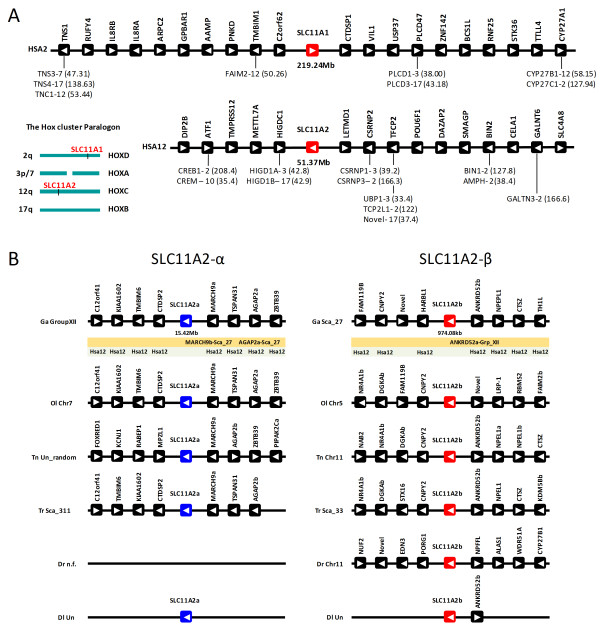
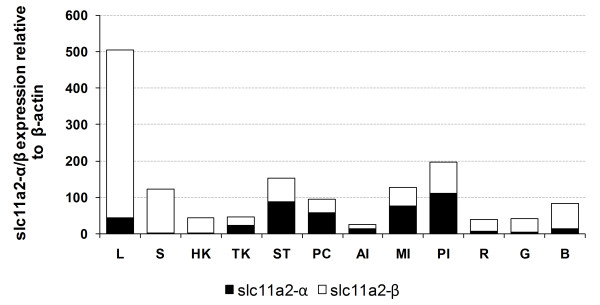
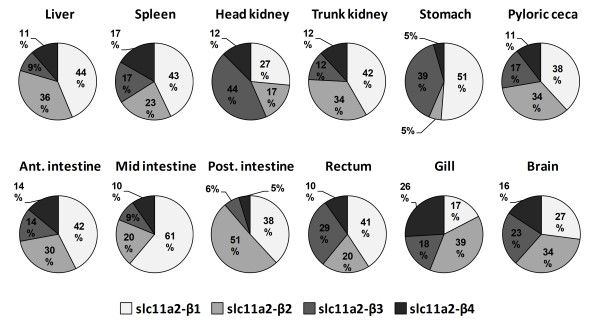
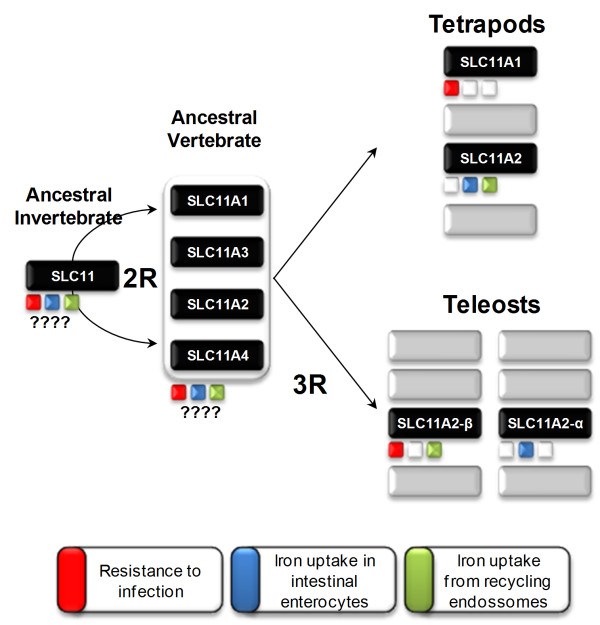
Background: The SLC11A1/Nramp1 and SLC11A2/Nramp2 genes belong to the SLC11/Nramp family of transmembrane divalent metal transporters, with SLC11A1 being associated with resistance to pathogens and SLC11A2 involved in intestinal iron uptake and transferrin-bound iron transport. Both members of the SLC11 gene family have been clearly identified in tetrapods; however SLC11A1 has never been documented in teleost fish and is believed to have been lost in this lineage during early vertebrate evolution. In the present work we characterized the SLC11 genes in teleosts and evaluated if the roles attributed to mammalian SLC11 genes are assured by other fish specific SLC11 gene members. Results: Two different SLC11 genes were isolated in the European sea bass (Dicentrarchus. labrax), and named slc11a2-α and slc11a2-β, since both were found to be evolutionary closer to tetrapods SLC11A2, through phylogenetic analysis and comparative genomics. Induction of slc11a2-α and slc11a2-β in sea bass, upon iron modulation or exposure to Photobacterium damselae spp. piscicida, was evaluated in in vivo or in vitro experimental models. Overall, slc11a2-α was found to respond only to iron deficiency in the intestine, whereas slc11a2-β was found to respond to iron overload and bacterial infection in several tissues and also in the leukocytes. Conclusions: Our data suggests that despite the absence of slc11a1, its functions have been undertaken by one of the slc11a2 duplicated paralogs in teleost fish in a case of synfunctionalization, being involved in both iron metabolism and response to bacterial infection. This study provides, to our knowledge, the first example of this type of sub-functionalization in iron metabolism genes, illustrating how conserving the various functions of the SLC11 gene family is of crucial evolutionary importance.
Overview
The claims and statistics of this paper haven’t been checked yet.
Free: it reads the open-access text and checks the first 5 claims that cite a source we can check. Create a free account to check every claim.
Integrity signals
Registry
Cites
Statistics
Figures
Verification
Claims the paper makes
The claims and statistics of this paper haven’t been checked yet.
Free: it reads the open-access text and checks the first 5 claims that cite a source we can check. Create a free account to check every claim.
Claims other papers make about this one
Each is checked against this paper’s own text: does it say what the citing paper says it does?
The cited source says what the claim attributes to it.
In the citing paper
“This view is supported by most of the direct experimental evidence, by the involvement of Nramp1 in iron recycling from senescent erythrocytes [47], by the similarity of Nramp1 to DMT1 whose transport properties are well characterized, and by the evidence that the function of Nramp1 may be carried out in teleost fish by a duplicated paralog of DMT1 [48].”
From Iron and infection (2018) · cites this paper as [48]
Self-check
Percentages, sums and reported differences re-computed from the paper’s own numbers.
The self-check needs the paper’s full text.
Citations
Cites
The neighbor-joining method: a new method for reconstructing phylogenetic trees.
(1987) · Molecular Biology and Evolution · doi:10.1093/oxfordjournals.molbev.a040454 · Cited by 59,715 · cited 1×
“Additional phylogenetic trees were constructed using Bayesian inference, with MrBayes v3.1.2 [99,100] and Maximum-Parsimony and Neighbor-Joining method of Saitou and Nei [ 101 ], with MEGA5.”
MethodInfluentialTamura, K., Peterson, D., Peterson, N., Stecher, G., Nei, M., & Kumar, S. (2011) · Molecular Biology and Evolution · doi:10.1093/molbev/msr121 · Cited by 39,969
MrBayes 3: Bayesian phylogenetic inference under mixed models
Ronquist, F., & Huelsenbeck, J. P. (2003) · Bioinformatics · doi:10.1093/bioinformatics/btg180 · Cited by 29,077 · cited 1×
“Additional phylogenetic trees were constructed using Bayesian inference, with MrBayes v3.1.2 [ 99 ,100] and Maximum-Parsimony and Neighbor-Joining method of Saitou and Nei [101], with MEGA5.”
MethodInfluentialMRBAYES: Bayesian inference of phylogenetic trees.
Huelsenbeck, J. P., & Ronquist, F. (2001) · Bioinformatics · doi:10.1093/bioinformatics/17.8.754 · Cited by 21,937 · cited 2×
“The clarification of the evolutionary scenario along with the functional data suggests a curious and complex pattern of sub-functionalization [88] and paralog functional equivalence, a process previously named as synfunctionalization [89, 90 ]: the fish specific paralog slc11a2-a retained in part the original mammalia…”
BackgroundMethodInfluentialMultiple sequence alignment with hierarchical clustering
Corpet, F. (1988) · Nucleic Acids Research · doi:10.1093/nar/16.22.10881 · Cited by 5,393 · cited 1×
“Sequence analysis and alignment Both strands of the cDNA were sequenced and assembled using Multalin [95, 96 ] and by manual comparison of overlapping electropherograms.”
MethodThe National Center for Biotechnology Information
Benson, D., Boguski, M., Lipman, D. J., & Ostell, J. (1990) · Genomics · doi:10.1016/0888-7543(90)90583-g · Cited by 5,126
Genome Sequence of the Nematode C. elegans : A Platform for Investigating Biology
The C. elegans Sequencing Consortium* (1998) · Science · doi:10.1126/science.282.5396.2012 · Cited by 4,485
Preservation of Duplicate Genes by Complementary, Degenerative Mutations
Force, A., Lynch, M., Pickett, F. B., Amores, A., Yan, Y.-L., & Postlethwait, J. (1999) · Genetics · doi:10.1093/genetics/151.4.1531 · Cited by 3,529
Cloning and characterization of a mammalian proton-coupled metal-ion transporter
Gunshin, H., Mackenzie, B., Berger, U. V., Gunshin, Y., Romero, M. F., Boron, W. F., Nussberger, S., Gollan, J. L., & Hediger, M. A. (1997) · Nature · doi:10.1038/41343 · Cited by 3,166 · cited 5×
“This is in accordance with previous findings that intestinal metal uptake in teleost fish occurs mainly in the posterior portion of the intestine [46,47], unlike mammals, where uptake occurs primarily in the duodenum [23].”
BackgroundResultInfluentialNemeth, E., Rivera, S., Gabayan, V., Keller, C., Taudorf, S., Pedersen, B. K., & Ganz, T. (2004) · Journal of Clinical Investigation · doi:10.1172/jci200420945 · Cited by 2,650
Research works printed but not linked: 1
- Swofford DL PAUP*. Phylogenetic Analysis Using Parsimony (*and Other Methods). Version 4 2003 Sunderland, Massachusetts: Sinauer Associates
Cited by
Ganz, T. (2018) · International Journal of Hematology · doi:10.1007/s12185-017-2366-2 · Cited by 270
“Positional cloning of the gene responsible, named natural-resistance-associated macrophage protein 1, eventually revealed it as a divalent metal transporter, homologous to divalent metal transporter 1 (DMT1).”
Molecular Mechanism of Nramp-Family Transition Metal Transport
Bozzi, A. T., & Gaudet, R. (2021) · Journal of Molecular Biology · doi:10.1016/j.jmb.2021.166991 · Cited by 113
Multiple Hepcidins in a Teleost Fish, Dicentrarchus labrax: Different Hepcidins for Different Roles
Neves, J. V., Caldas, C., Vieira, I. H., Ramos, M. F., & Rodrigues, P. (2015) · The Journal of Immunology · doi:10.4049/jimmunol.1501153 · Cited by 92
Self-citationExpansion of the APC superfamily of secondary carriers
Vastermark, A., Wollwage, S., Houle, M. E., Rio, R., & Saier, M. H. (2014) · Proteins: Structure, Function, and Bioinformatics · doi:10.1002/prot.24643 · Cited by 91
“The topological diversity of CstA family members is complex as different members display 13, 15, 16 and 18 putative TMSs.”
Kwong, R. W. M. (2024) · Journal of Comparative Physiology B · doi:10.1007/s00360-024-01565-1 · Cited by 73
“…expression of dmt1 or fpn transcripts has been demonstrated in a number of fishes, including both freshwa - ter and marine species (Dorschner and Phillips 1999; Saeij et al. 1999; Sibthorpe et al. 2004; Cooper et al. 2006, 2007; Neves et al. 2011; Wang and Wang 2016a; Chandrapalan and Kwong 2020).”
Metadata
- Authors
- Neves, J. V., Wilson, J. M., Kuhl, H., Reinhardt, R., Castro, L. F. C., & Rodrigues, P. N.
- Affiliations
- Instituto de Biologia Molecular e Celular (PT)
- Centro Interdisciplinar de Investigação Marinha e Ambiental (PT)
- Max Planck Institute for Molecular Genetics (DE)
- Universidade do Porto (PT)
- Corresponding author
- Rodrigues, Pedro NS
- ORCID
- Venue
- BMC Evolutionary Biology
- Published
- 2011-04-18
- Volume
- 11
- Issue
- 1
- Pages
- 106-106
- ISSN
- 1471-2148 (ISSN-L)
- PMC
- PMC3103463
- OpenAlex
- W1799172745
- Cited by
- 24
- References
- 100
- Citations by year
- 2026: 2 · 2024: 1 · 2022: 2 · 2021: 3 · 2019: 1 · 2018: 2 · 2017: 3 · 2016: 2 · 2015: 2 · 2014: 1 · 2013: 1 · 2012: 3
- FWCI
- 0.85
- Type
- journal article
- Language
- en
- Open access
- gold
- doi.org
- Licence
- Locations
- BMC Evolutionary Biology (publishedVersion, cc-by)
- PubMed Central (publishedVersion, cc-by)
- PubMed (publishedVersion)
- DOAJ (DOAJ: Directory of Open Access Journals) (submittedVersion, cc-by-sa)
- Funders
- International Business Machines Corporation
- Fundação para a Ciência e a Tecnologia (SFRH/BD/29203/2006)
- Topics
- Life Sciences › Immunology and Microbiology › Immunology › Aquaculture disease management and microbiota
- Health Sciences › Medicine › Hematology › Iron Metabolism and Disorders
- Life Sciences › Agricultural and Biological Sciences › Aquatic Science › Aquaculture Nutrition and Growth
- Keywords
- NRAMP1, DMT1, teleosts, Dicentrarchus labrax, iron metabolism, iron transport, iron overload, iron deficiency, Photobacterium damselae, bacterial infection, gene duplication, subfunctionalization, gene family evolution, vertebrate evolution
- MeSH terms
- Natural Resistance-associated Macrophage Protein 1, Solute Carrier Family 11, Member 2, Amino Acid Sequence, Animals, Bass, Gene Expression Regulation, Humans, Iron, Molecular Sequence Data, Phylogeny, Sequence Alignment, Cation Transport Proteins
About these checks
Registry, retraction, Cites and statistics results are computed, not judged, with one exception: a printed reference that no index lists is read once by a model before it counts as a citation error. Claims are extracted by a model and kept only when their quote appears verbatim in the text; each cited source is then checked, with a model’s help, for whether it says what the claim relies on. Those verdicts can be wrong — read the claim’s quote and the cited source before relying on one.
Statistics and arithmetic are recomputed, not judged.
Confidence bands are shown only for fields calibrated on our annotated test set. None is calibrated yet, so no band is shown.
What counts as a claim ›How we measure confidence ›How we check this ›
Are you an author, or do you see a problem with this page? Request a review
Data sources
Bibliographic data: Semantic Scholar, OpenAlex, Crossref.
Contains information from the Semantic Scholar Academic Graph Datasets, made available under the ODC Attribution License (ODC-BY 1.0).
Semantic Scholar’s data is described in: Kinney, R., et al. (2023). The Semantic Scholar Open Data Platform. arXiv:2301.10140.
