

Evidence for divergent selection between the molecular forms of Anopheles gambiae: role of predation
Open accessThe DOI matches its Crossref record; 51 of the 51 references it cites were found in a registry or an index.
Abstract
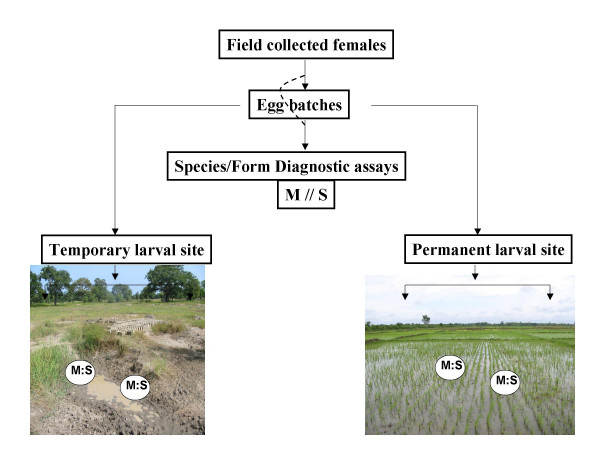
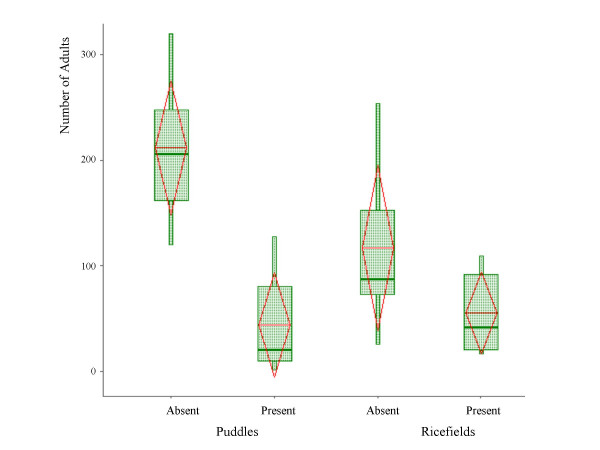
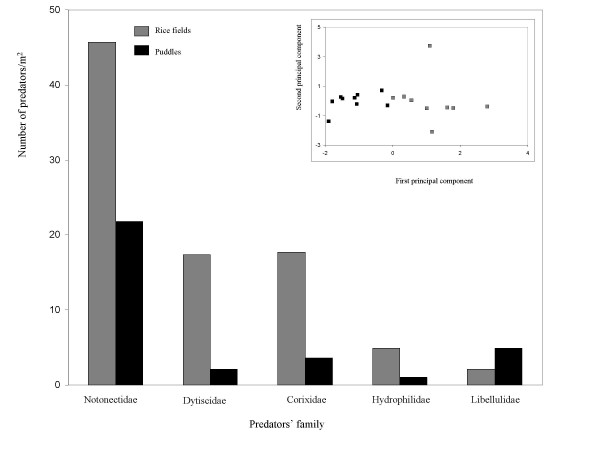
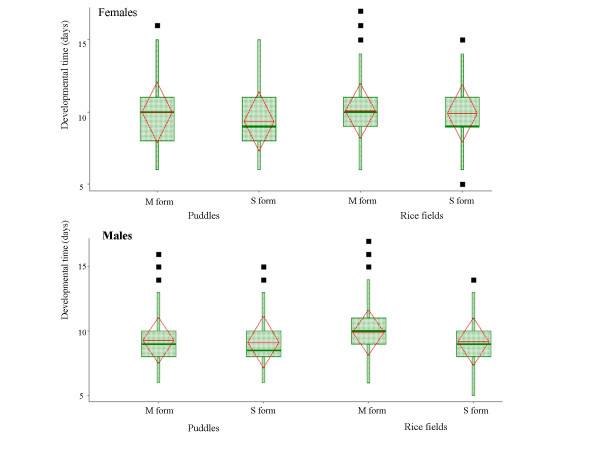
BACKGROUND: The molecular forms of Anopheles gambiae are undergoing speciation. They are characterized by a strong assortative mating and they display partial habitat segregation. The M form is mostly found in flooded/irrigated areas whereas the S form dominates in the surrounding areas, but the ecological factors that shape this habitat segregation are not known. Resource competition has been demonstrated between species undergoing divergent selection, but resource competition is not the only factor that can lead to divergence. RESULTS: In a field experiment using transplantation of first instar larvae, we evaluated the role of larval predators in mediating habitat segregation between the forms. We found a significant difference in the ability of the molecular forms to exploit the different larval sites conditioned on the presence of predators. In absence of predation, the molecular forms outcompeted each other in their respective natural habitats however, the developmental success of the M form was significantly higher than that of the S form in both habitats under predator pressure. CONCLUSION: Our results provide the first empirical evidence for specific adaptive differences between the molecular forms and stress the role of larval predation as one of the mechanisms contributing to their divergence.
Overview
The claims and statistics of this paper haven’t been checked yet.
Free: it reads the open-access text and checks the first 5 claims that cite a source we can check. Create a free account to check every claim.
Integrity signals
Registry
Cites
Statistics
Figures
Verification
Claims the paper makes
The claims and statistics of this paper haven’t been checked yet.
Free: it reads the open-access text and checks the first 5 claims that cite a source we can check. Create a free account to check every claim.
Claims other papers make about this one
Each is checked against this paper’s own text: does it say what the citing paper says it does?
The source backs part of the claim, not all of it — or backs it for a different population, condition or comparison.
In the citing paper
“This could be a response to the lower overall productivity of more permanent sites (Diabate et al., 2008; Diabate et al., 2005; Diuk-Wasser et al., 2005).”
From The molecular forms of Anopheles gambiae: a phenotypic perspective (2008) · cites this paper as Diabate et al., 2008
Experimental — accuracy not yet measuredThe source backs part of the claim, not all of it — or backs it for a different population, condition or comparison.
In the citing paper
“Consistent with that hypothesis, recent results suggest that the length of the hydroperiod of larval habitats is the principal ecological factor producing divergence between the molecular forms through selection mediated by predation and competition (Diabate et al., 2008).”
From The molecular forms of Anopheles gambiae: a phenotypic perspective (2008) · cites this paper as Diabate et al., 2008
Experimental — accuracy not yet measuredThe source backs part of the claim, not all of it — or backs it for a different population, condition or comparison.
In the citing paper
“Field experiments demonstrated that the S form outperforms the M form in the absence of predators whereas the reverse is true if predator pressure increases.”
From The molecular forms of Anopheles gambiae: a phenotypic perspective (2008) · cites this paper as Diabate et al., 2008
Experimental — accuracy not yet measuredThe source backs part of the claim, not all of it — or backs it for a different population, condition or comparison.
In the citing paper
“This may be explained by the adaptation of An. coluzzii larvae to predator pressure in the wild and the vector's ability to outcompete sibling species in natural environments [39].”
From Sibling species of the major malaria vector Anopheles gambiae display divergent preferences for aquatic breeding sites in southern Nigeria (2024) · cites this paper as [39]
Experimental — accuracy not yet measuredThe cited source says what the claim attributes to it.
In the citing paper
“Larval adaptations to exploit temporary vs. ‘permanent’ freshwater habitats account for discontinuities in distribution of the molecular forms (Diabate et al. 2008) and provide evidence for ecological speciation (e.g., (Schluter, 2001).”
From The molecular forms of Anopheles gambiae: a phenotypic perspective (2008) · cites this paper as Diabate et al. 2008
2 more claims about this paper
Create a free account to see every claim other papers make about this one.
Self-check
Percentages, sums and reported differences re-computed from the paper’s own numbers.
The self-check needs the paper’s full text.
Citations
Cites
Systematics and the Origin of Species: On Ernst Mayr's 100th Anniversary
(2005) · National Academies Press eBooks · doi:10.17226/11310 · Cited by 3,454
The scent of death: Chemosensory assessment of predation risk by prey animals
Kats, L. B., & Dill, L. M. (1998) · Écoscience · doi:10.1080/11956860.1998.11682468 · Cited by 1,441
Genomic islands of speciation in Anopheles gambiae
Turner, T. L., Hahn, M. W., & Nuzhdin, S. V. (2005) · PLoS Biology · doi:10.1371/journal.pbio.0030285 · Cited by 734
Fanello, C., Santolamazza, F., & Della Torre, A. (2002) · Medical and Veterinary Entomology · doi:10.1046/j.1365-2915.2002.00393.x · Cited by 517
Ecological Causes of Adaptive Radiation
Schluter, D. (1996) · The American Naturalist · doi:10.1086/285901 · Cited by 465
A Polytene Chromosome Analysis of the Anopheles gambiae Species Complex
Coluzzi, M., Sabatini, A., della Torre, A., Di Deco, M. A., & Petrarca, V. (2002) · Science · doi:10.1126/science.1077769 · Cited by 447 · cited 1×
“Coluzzi and others have hypothesized that human-made modifications of the African environment have created new ecological niches in marginal habitats and, thus, new opportunities for specialisation for this mosquito species [7,9,10].”
BackgroundOlfactory assessment of predation risk in the aquatic environment
Wisenden, B. D. (2000) · Philosophical Transactions of the Royal Society of London. Series B: Biological Sciences · doi:10.1098/rstb.2000.0668 · Cited by 410
Molecular evidence of incipient speciation within Anopheles gambiae s.s. in West Africa
Torre, A. D., Fanello, C., Akogbeto, M., Dossou‐yovo, J., Favia, G., Petrarca, V., & Coluzzi, M. (2001) · Insect Molecular Biology · doi:10.1046/j.1365-2583.2001.00235.x · Cited by 316
Chromosomal inversion intergradation and incipient speciation in Anopheles gambiae
Coluzzi, M., Petrarca, V., & di Deco, M. A. (1985) · Bolletino di zoologia · doi:10.1080/11250008509440343 · Cited by 312
(1998) · PubMed · Cited by 296
Research works printed but not linked: 1
- Mayr E Systematic and the origin of species 1942 Columbia University Press
Cited by
Items 101–136 of 136
Calhoon, L. M. (2013) · eScholarship (California Digital Library) · Cited by 1
Comparative Analysis of Heterochromatin in the Anopheles gambiae Complex
Sharma, A. (2016) · VTechWorks (Virginia Tech)
Paton, D. G. (2013) · Keele Research Repository (Keele University)
Efficacy of vegetable oil extracts for control of insect pests of tomato in southern Benin
Sotondji, F. A., Azonkpin, S., SAGBO, R. M., Dannon, E. A., Kpindou, O. K. D., & Daniel, C. C. (2022) · African Crop Science Journal · doi:10.4314/acsj.v30i2.8
“Treatments were administered per week (Diabaté et al., 2008; Gnago et al., 2010).”
ResultNiang, A., Maïga, H., Sawadogo, S. P., Konaté, L., Faye, O., Lee, Y., Dabiré, R. K., Diabaté, A., & Tripet, F. (2022) · Scientific Reports · doi:10.1038/s41598-022-14865-9 · Cited by 2
Self-citationApetogbo, Y., Ahadji‐Dabla, K. M., Soma, D. D., Amoudji, A. D., Koffi, E., Akagankou, K. I., Bamogo, R., Ngaffo, K. L., Maiga, S., Atcha-Oubou, R. T., et al. (2022) · Research Square · doi:10.21203/rs.3.rs-1871004/v1
Self-citationGovoétchan, R., Sovi, A., Osse, R. A., & Akogbeto, M. C. (2022) · International Journal of Mosquito Research · doi:10.22271/23487941.2022.v9.i6a.639
“is dependant to temporary breeding sites ([26]).”
Mahenge, H. H., Muyaga, L. L., Nkya, J. D., Kifungo, K., Kahamba, N. F., Ngowo, H. S., & Kaindoa, E. W. (2022) · bioRxiv (Cold Spring Harbor Laboratory) · doi:10.1101/2022.12.03.518970
Taconet, P., Porciani, A., Soma, D. D., Mouline, K., Simard, F., Koffi, A. A., Pennetier, C., Dabiré, R. K., Mangeas, M., & Moiroux, N. (2021) · Figshare · doi:10.6084/m9.figshare.14880656
Self-citationTaconet, P., Porciani, A., Soma, D. D., Mouline, K., Simard, F., Koffi, A. A., Pennetier, C., Dabiré, R. K., Mangeas, M., & Moiroux, N. (2021) · Figshare · doi:10.6084/m9.figshare.14880653
Self-citationEbhodaghe, F. I., Sánchez-Vargas, I., Isaac, C., Foy, B. D., & Hemming‐Schroeder, E. (2024) · Figshare · doi:10.6084/m9.figshare.26686161
Ebhodaghe, F. I., Sánchez-Vargas, I., Isaac, C., Foy, B. D., & Hemming‐Schroeder, E. (2024) · Figshare · doi:10.6084/m9.figshare.26686158
Taconet, P., Porciani, A., Soma, D. D., Mouline, K., Simard, F., Koffi, A. A., Pennetier, C., Dabiré, R. K., Mangeas, M., & Moiroux, N. (2021) · Figshare · doi:10.6084/m9.figshare.14880662
Self-citationEbhodaghe, F. I., Sánchez-Vargas, I., Isaac, C., Foy, B. D., & Hemming‐Schroeder, E. (2024) · Figshare · doi:10.6084/m9.figshare.26686155
Yovogan, B., Sovi, A., Djènontin, A., Adoha, C. J., Akinro, B., Accrombessi, M., Dangbénon, E., Koukpo, C. Z., Affolabi, Z.-K., Agboho, P. A., et al. (2024) · Figshare · doi:10.6084/m9.figshare.24946514
Ebhodaghe, F. I., Sánchez-Vargas, I., Isaac, C., Foy, B. D., & Hemming‐Schroeder, E. (2024) · Figshare · doi:10.6084/m9.figshare.26686167
Ebhodaghe, F. I., Sánchez-Vargas, I., Isaac, C., Foy, B. D., & Hemming‐Schroeder, E. (2024) · Figshare · doi:10.6084/m9.figshare.26686170
Taconet, P., Porciani, A., Soma, D. D., Mouline, K., Simard, F., Koffi, A. A., Pennetier, C., Dabiré, R. K., Mangeas, M., & Moiroux, N. (2021) · Figshare · doi:10.6084/m9.figshare.14880659
Self-citationAkpodiete, N. O., & Tripet, F. (2021) · Figshare · doi:10.6084/m9.figshare.13532666
Akpodiete, N. O., & Tripet, F. (2021) · Figshare · doi:10.6084/m9.figshare.13532660
Taconet, P., Porciani, A., Soma, D. D., Mouline, K., Simard, F., Koffi, A. A., Pennetier, C., Dabiré, R. K., Mangeas, M., & Moiroux, N. (2021) · Figshare · doi:10.6084/m9.figshare.14880665
Self-citationAkpodiete, N. O., & Tripet, F. (2021) · Figshare · doi:10.6084/m9.figshare.13532663
Ebhodaghe, F. I., Sánchez-Vargas, I., Isaac, C., Foy, B. D., & Hemming‐Schroeder, E. (2024) · Figshare · doi:10.6084/m9.figshare.26686152
Ebhodaghe, F. I., Sánchez-Vargas, I., Isaac, C., Foy, B. D., & Hemming‐Schroeder, E. (2024) · Figshare · doi:10.6084/m9.figshare.26686149
Ebhodaghe, F. I., Sánchez-Vargas, I., Isaac, C., Foy, B. D., & Hemming‐Schroeder, E. (2024) · Figshare · doi:10.6084/m9.figshare.26686164
Taconet, P., Porciani, A., Soma, D. D., Mouline, K., Simard, F., Koffi, A. A., Pennetier, C., Dabiré, R. K., Mangeas, M., & Moiroux, N. (2021) · Figshare · doi:10.6084/m9.figshare.14880668
Self-citationTapsoba, M., Guelbeogo, W. M., Sanou, A., Zongo, S., Gogue, C., Débé, S., Arnett, K., Davis, K. M., Shannon, J., Digre, P., et al. (2025) · Parasites & Vectors · doi:10.1186/s13071-025-07190-3 · Cited by 4
“Conversely, Banfora showed a co-dominance of An. gambiae s.s. and An. coluzzii , likely due to more permanent water sources such as a semi-permanent river and perennial ponds, which are the preferred breeding sites of An. coluzzii [49, 50].”
Malaria entomological surveillance in Kinshasa Province: A longitudinal studyPreprint
Vulu, F., Kashamuka, M. M., Banek, K., Francois-Zafka, R., Mampuya, P. N., Atibu, J., Emch, M., Mwapasa, V., Juliano, J. J., Parr, J. B., et al. (2025) · bioRxiv (Cold Spring Harbor Laboratory) · doi:10.64898/2025.12.22.695884
Redmond, S. N. (2015) · theses.fr (ABES) · doi:10.70675/b284d1d6zafbfz4ed8z9570za9323034ff5f · Cited by 1
“Moreover there are clear signs of adaptation to particular larval ecosystems between incipient species (Lehmann & Diabate 2008) and – significantly for attempts to control by copepod predation – significant differences in predator avoidance are seen between molecular forms.”
BackgroundOuedraogo, J. C., Gnankiné, O., Ouédraogo, T., Séré, B. V., Farma, J., Sougue, E., Dabiré, R. K., Diabaté, A., Müller, R., & Sawadogo, S. P. (2026) · Journal of Medical Entomology · doi:10.1093/jme/tjag057
Self-citationFouet, C., Rios, D. E., Ashu, F. A., Pinch, M., Hernandez, C. A., Ambadiang, M. M., Kamgang, B., & Kamdem, C. (2026) · BMC Genomics · doi:10.1186/s12864-026-12994-3
“These sister species diverged recently and are undergoing ecological differentiation across the continent [47–49].”
Malaria entomological surveillance in Kinshasa Province: A longitudinal study
Vulu, F., Kashamuka, M. M., Banek, K., Francois-Zafka, R., Mampuya, P. N., Atibu, J., Emch, M., Mwapasa, V., Juliano, J. J., Parr, J. B., et al. (2026) · PLOS Global Public Health · doi:10.1371/journal.pgph.0006984 · Cited by 1
Metadata
- Authors
- Diabaté, A., Dabiré, R. K., Heidenberger, K., Crawford, J., Lamp, W. O., Culler, L. E., & Lehmann, T.
- Affiliations
- National Institutes of Health (US)
- Centre Muraz (BF)
- University of Maryland, College Park (US)
- Corresponding author
- Diabaté, Abdoulaye
- Venue
- BMC Evolutionary Biology
- Published
- 2008
- Volume
- 8
- Issue
- 1
- Pages
- 5
- ISSN
- 1471-2148 (ISSN-L)
- PMC
- PMC2217532
- OpenAlex
- W1980259576
- Cited by
- 136
- References
- 48
- Citations by year
- 2026: 5 · 2025: 5 · 2024: 13 · 2023: 4 · 2022: 11 · 2021: 16 · 2020: 4 · 2019: 7 · 2018: 1 · 2017: 3 · 2016: 3 · 2015: 7 · 2014: 8 · 2013: 14 · 2012: 8
- FWCI
- 8.90
- Type
- journal article
- Language
- en
- Open access
- gold
- doi.org
- Licence
- cc-by
- Locations
- BMC Evolutionary Biology (publishedVersion, cc-by)
- PubMed Central (publishedVersion, cc-by)
- PubMed (publishedVersion)
- DOAJ (DOAJ: Directory of Open Access Journals) (submittedVersion, cc-by-sa)
- University Libraries (University of Maryland) (submittedVersion)
- Digital Repository at the University of Maryland (University of Maryland College Park)
- Funders
- National Institutes of Health
- Centers for Disease Control and Prevention
- Topics
- Health Sciences › Medicine › Public Health, Environmental and Occupational Health › Malaria Research and Control
- Life Sciences › Agricultural and Biological Sciences › Ecology, Evolution, Behavior and Systematics › Diptera species taxonomy and behavior
- Life Sciences › Agricultural and Biological Sciences › Ecology, Evolution, Behavior and Systematics › Animal Behavior and Reproduction
- Keywords
- Anopheles gambiae, M and S molecular forms, divergent selection, larval predation, habitat partitioning, speciation, larval competition, larval development
- MeSH terms
- Animals, Anopheles, Larva, Predatory Behavior, Selection, Genetic, Ecosystem
About these checks
Registry, retraction, Cites and statistics results are computed, not judged, with one exception: a printed reference that no index lists is read once by a model before it counts as a citation error. Claims are extracted by a model and kept only when their quote appears verbatim in the text; each cited source is then checked, with a model’s help, for whether it says what the claim relies on. Those verdicts can be wrong — read the claim’s quote and the cited source before relying on one.
Statistics and arithmetic are recomputed, not judged.
Confidence bands are shown only for fields calibrated on our annotated test set. None is calibrated yet, so no band is shown.
What counts as a claim ›How we measure confidence ›How we check this ›
Are you an author, or do you see a problem with this page? Request a review
Data sources
Bibliographic data: Semantic Scholar, OpenAlex, Crossref.
Contains information from the Semantic Scholar Academic Graph Datasets, made available under the ODC Attribution License (ODC-BY 1.0).
Semantic Scholar’s data is described in: Kinney, R., et al. (2023). The Semantic Scholar Open Data Platform. arXiv:2301.10140.
