

Age modifies the genotype-phenotype relationship for the bitter receptor TAS2R38.
Open accessThe DOI matches its Crossref record; 63 of the 63 references it cites were found in a registry or an index.
Abstract
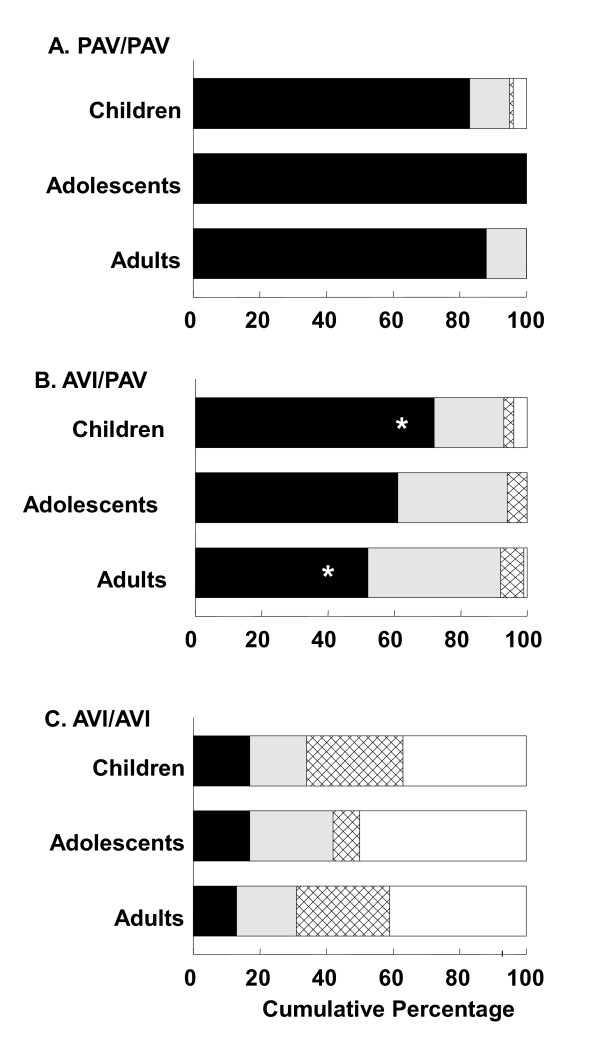
Background: The purpose of this study was to investigate the effect of TAS2R38 haplotypes and age on human bitter taste perception. Results: Children (3 to 10 yrs), adolescents (11 to 19 yrs) and adults (mostly mothers, 20 to 55 yrs (N = 980) were measured for bitter taste thresholds for 6-n-propylthiouracil (PROP) and genotyped for three polymorphisms of the AS2R38 gene (A49P, V262A, I296V). Subjects were grouped by haplotype and age, as well as sex and race/ethnicity, and compared for PROP thresholds. Subjects with the same haplotype were similar in bitter threshold regardless of race/ethnicity (all ages) or sex (children and adolescents; all p-values > 0.05) but age was a modifier of the genotype-phenotype relationship. Specifically, AVI/PAV heterozygous children could perceive a bitter taste at lower PROP concentrations than could heterozygous adults, with the thresholds of heterozygous adolescents being intermediate (p < 0.001). Similar age effects were not observed for subjects with the PAV/PAV or AVI/AVI homozygous haplotypes (p > 0.05) perhaps because there is less variation in taste perception among these homozygotes. Conclusions: These data imply that the change in PROP bitter sensitivity which occurs over the lifespan (from bitter sensitive to less so) is more common in people with a particular haplotype combination, i.e., AVI/PAV heterozygotes.
Overview
The claims and statistics of this paper haven’t been checked yet.
Free: it reads the open-access text and checks the first 5 claims that cite a source we can check. Create a free account to check every claim.
Integrity signals
Registry
Cites
Statistics
Figures
Verification
Claims the paper makes
The claims and statistics of this paper haven’t been checked yet.
Free: it reads the open-access text and checks the first 5 claims that cite a source we can check. Create a free account to check every claim.
Claims other papers make about this one
Each is checked against this paper’s own text: does it say what the citing paper says it does?
The source backs part of the claim, not all of it — or backs it for a different population, condition or comparison.
In the citing paper
“Because children are more sensitive to bitter tastes than are adults (45, 57), some children may be more sensitive to the unpleasant aftertastes of these LCS.”
From Sweetness and Food Preference (2012) · cites this paper as [57]
Experimental — accuracy not yet measured
Self-check
Percentages, sums and reported differences re-computed from the paper’s own numbers.
The self-check needs the paper’s full text.
Citations
Cites
Nonparametric Statistics for the Behavioral Sciences
Guitton, H., & Siegel, S. (1958) · Revue économique · doi:10.2307/3498751 · Cited by 35,245
Handbook of Sensory Physiology
Sanders, M. D. (1975) · British Journal of Ophthalmology · doi:10.1136/bjo.59.2.111-c · Cited by 7,166
Scheet, P., & Stephens, M. (2006) · The American Journal of Human Genetics · doi:10.1086/502802 · Cited by 1,941 · cited 1×
“Haplotypes were identified by tracing the parental origin of the alleles when possible, or otherwise they were inferred by expectation-maximization methods using an algorithm implemented by the computer program fastPHASE [59].”
MethodT2Rs Function as Bitter Taste Receptors
Chandrashekar, J., Mueller, K. L., Hoon, M. A., Adler, E., Feng, L., Guo, W., Zuker, C. S., & Ryba, N. J. P. (2000) · Cell · doi:10.1016/s0092-8674(00)80706-0 · Cited by 1,401 · cited 1×
“PROP bitterness is not entirely explained by alleles of the TAS2R38 gene [12,35-37] and these other modifiers (like taste papillae number) could be age-sensitive and more influential in heterozygous diplotypes [38].”
BackgroundHandbook of Sensory Physiology,
(1973) · Archives of Neurology · doi:10.1001/archneur.1973.00490200090018 · Cited by 1,058
Kim, U.-K., Jorgenson, E., Coon, H., Leppert, M., Risch, N., & Drayna, D. (2003) · Science · doi:10.1126/science.1080190 · Cited by 904 · cited 7×
“The differences in allele frequencies we found replicated those reported by others [11].”
BackgroundResultInfluentialToxic constituents of plant foodstuffs
(1981) · Food and Cosmetics Toxicology · doi:10.1016/0015-6264(81)90458-2 · Cited by 885
PTC/PROP tasting: Anatomy, psychophysics, and sex effects
Bartoshuk, L. M., Duffy, V. B., & Miller, I. J. (1994) · Physiology & Behavior · doi:10.1016/0031-9384(94)90361-1 · Cited by 813 · cited 1×
“Bitter sensitivity to PROP and PTC have been assessed in the past in two ways (threshold versus intensity) and each method has several variations [26,48-50].”
BackgroundBufe, B., Breslin, P. A. S., Kuhn, C., Reed, D. R., Tharp, C. D., Slack, J. P., Kim, U.-K., Drayna, D., & Meyerhof, W. (2005) · Current Biology · doi:10.1016/j.cub.2005.01.047 · Cited by 708 · cited 4×
“Adults heterozygous for the TAS2R38 gene do not express mRNA of each haplotype in a one-to-one proportion [12], so it is possible that heterozygous children might have a skewed expression pattern, perhaps over expressing the taster allele.”
BackgroundInfluentialSelf-citationGenetic variation in a human odorant receptor alters odour perception
Keller, A., Zhuang, H., Chi, Q., Vosshall, L. B., & Matsunami, H. (2007) · Nature · doi:10.1038/nature06162 · Cited by 661 · cited 1×
“Alleles of a particular smell receptor predict the threshold to this odorant [47].”
Background
Research works printed but not linked: 1
- Ehrhardt VS Vergleichende Geschmacksprufung von PTC und Conteben Homo 1952 3 153 162
Cited by
Items 101–184 of 184
Mao, Z., Cheng, W., Li, Z., Yao, M., & Sun, K. (2023) · Pharmacogenomics and Personalized Medicine · doi:10.2147/pgpm.s390201 · Cited by 11
“Bitterness perception based on the TAS2R38 genotype can vary depending on age where children with the AVI haplotype have higher sensitivity to bitter agonists compared to adults.(29) Genotyping studies have shown that children with the more bitter-sensitive PAV/AVI and PAV/PAV diplotypes may be more inclined to take s…”
BackgroundShizukuda, S., Marchini, J. S., Adell, A., Santos, M. A., Brandão, C., de Lima, C. M. M., da Cunha, S. F. D. C., Itikawa, E. N., & Silvah, J. H. (2018) · Nutrire · doi:10.1186/s41110-018-0069-y · Cited by 11
The relationship between disgust sensitivity and BMI: Is the food disgusting or am I?
Spinelli, S., Cunningham, C., Pierguidi, L., Dinnella, C., Monteleone, E., & White, T. L. (2021) · Food Quality and Preference · doi:10.1016/j.foodqual.2021.104222 · Cited by 14
Biological and Experiential Factors That Impact the Acceptance of Complementary Foods
Mennella, J. A. (2025) · Annals of Nutrition and Metabolism · doi:10.1159/000542296 · Cited by 10
“…discovered that, compared to adults, children as a group have higher sucrose thresholds (are less sensitive) and lower bitter (e.g., propylthiouracil) thresholds (are more sensitive) than adults [18, 19], and children preferred higher concentrations of sweet, salt, and sour than did adults [8].”
Self-citationAge Variation in Bitter Taste Perception in Relation to the Tas2r38 Taste Receptor Phenotype
Negri, R., Smarrazzo, A., Galatola, M., Maio, A., Idelson, P. I., Sticco, M., Biongiovanni, C., Franzese, A., Greco, L., Risso, D. S., et al. (2015) · International Journal Of Nutrition · doi:10.14302/issn.2379-7835.ijn-14-591 · Cited by 9
“[27] who reported that AVI/PAV children, but not adults, perceived a bitter taste at low PROP concentrations, whereas no such effect occurred in AVI or PAV homozygous.”
Automated Classification of 6-n-Propylthiouracil Taster Status with Machine Learning
Naciri, L. C., Mastinu, M., Crnjar, R., Barbarossa, I. T., & Melis, M. (2022) · Nutrients · doi:10.3390/nu14020252 · Cited by 9
“Several studies have shown relationships between PROP phenotype or genotype and longevity [51], age [52,53], or a number of health parameters, including antioxidant status [54], body mass index (BMI) [13,55–57], metabolic changes [58,59], smoking status [60–62], alcohol consumption [24], respiratory infections [63,64]…”
BackgroundBrain Development in Infants: Structure and Experience
Richards, J. E., & Conte, S. (2020) · Cambridge University Press eBooks · doi:10.1017/9781108351959.004 · Cited by 18
Mani, E., Ford, R., Pierguidi, L., Spinelli, S., Ramsey, I., Monteleone, E., & Dinnella, C. (2022) · Journal of Texture Studies · doi:10.1111/jtxs.12683 · Cited by 9
Action in Development: Plasticity, Variability, and Flexibility
Rachwani, J., Hoch, J. E., & Adolph, K. E. (2020) · Cambridge University Press eBooks · doi:10.1017/9781108351959.017 · Cited by 17
Eggplant Flour Addition in Cookie: Nutritional Enrichment Alternative for Children
Soares, J. M., Teixeira, F., de Oliveira, M. L., do Amaral, L. A., de Almeida, T. D. S. F., de Souza, G. H. O., Hokama, L. M., Menegassi, B., dos Santos, E. F., & Novello, D. (2022) · Foods · doi:10.3390/foods11121667 · Cited by 8
“In childhood, particularly, these compounds are noticed more intensely, once that children are more sensitive to the bitter taste when compared to adults [10].”
BackgroundLeite, I. C. R., Júnior, J. C. D. S., de Sousa, C. C. S., Lima, A. V., & Miranda‐Vilela, A. L. (2018) · Nutrition Research · doi:10.1016/j.nutres.2017.12.013 · Cited by 8
Infant Object Manipulation and Play
Tamis‐LeMonda, C. S., & Lockman, J. J. (2020) · Cambridge University Press eBooks · doi:10.1017/9781108351959.019 · Cited by 10
Nunes, C. B., Lim, W. Y., Dy, Q., Ong, J., & Hwang, L. (2025) · European Journal of Nutrition · doi:10.1007/s00394-025-03718-6 · Cited by 8
“The effect of the TAS2R38 genotype on PROP perception and vegetable preferences is stronger among children than adults [87].”
Spector, A. C., le Roux, C. W., Munger, S. D., Travers, S. P., Sclafani, A. J., & Mennella, J. A. (2015) · Journal of Parenteral and Enteral Nutrition · doi:10.1177/0148607115617438 · Cited by 10
“Children have sensory systems that detect and prefer the once rare calorie- and mineral-rich foods that taste sweet or salty,(101) while rejecting the potentially toxic ones that taste bitter.(102,103) Such age-related changes in taste perception and preference, documented by experimental research during the past cent…”
Self-citationInfant Vocal Learning and Speech Production
Warlaumont, A. S. (2020) · Cambridge University Press eBooks · doi:10.1017/9781108351959.022 · Cited by 13
Pharmacogenetics of Taste: Turning Bitter Pills Sweet?
Nagtegaal, M. J., Swen, J. J., Hanff, L. M., Schimmel, K. J. M., & Guchelaar, H. (2013) · Pharmacogenomics · doi:10.2217/pgs.13.229 · Cited by 7
The Development of Infant Feeding
Mennella, J. A., Forestell, C. A., Ventura, A. K., & Fisher, J. O. (2020) · Cambridge University Press eBooks · doi:10.1017/9781108351959.010 · Cited by 12
Self-citationA Study on Phenylthiocarbamide Tasting in Bagatha Tribes in India
Padmavathi, M., & Mic, H. (2013) · Cited by 6
A chewable pediatric preparation of ibuprofen is palatable and acceptable to children
Barnett, S., & Bhatt, A. (2020) · Paediatric and Neonatal Pain · doi:10.1002/pne2.12013 · Cited by 6
Dagan, O., & Sagi‐Schwartz, A. (2020) · Cambridge University Press eBooks · doi:10.1017/9781108351959.025 · Cited by 12
Vinuthalakshmi, K., Sheik, N., & Mustak, M. S. (2019) · Meta Gene · doi:10.1016/j.mgene.2019.100549 · Cited by 6
Mitsven, S. G., Messinger, D. S., Moffitt, J., & Ahn, Y. A. (2020) · Cambridge University Press eBooks · doi:10.1017/9781108351959.027 · Cited by 6
Naciri, L. C., Mastinu, M., Crnjar, R., Barbarossa, I. T., & Melis, M. (2023) · Computational and Structural Biotechnology Journal · doi:10.1016/j.csbj.2023.01.029 · Cited by 6
“These results are consistent with data showing that the penetrance of the TAS2R38 gene (i.e. the degree to which environmental factors impact the phenotypic expression of a trait), varies with age [62].”
ResultTesta, G. T. L. (2013) · Journal of Nutrition & Food Sciences · doi:10.4172/2155-9600.1000238 · Cited by 6
“Children generally dislike vegetables for many reasons, such as their texture, fibrous and hard to eat, or their taste that is often strong and bitter [22-25].”
BackgroundScudine, K. G. D. O., de Moraes, K. S. G. N., Miyagui, S. A., Lamy, E., Lopes, M. F., Hilasaca-Mamani, M., & Castelo, P. M. (2023) · Journal of Texture Studies · doi:10.1111/jtxs.12748 · Cited by 5
Mennella, J. A., Bobowski, N. K., & Liem, D. G. (2017) · Elsevier eBooks · doi:10.1016/b978-0-323-37101-8.00009-6 · Cited by 9
Self-citationHuman T2R38 Bitter Taste Receptor Expression and COVID-19: From Immunity to Prognosis
Bethineedi, L. D., Baghsheikhi, H., Soltani, A., Mafi, Z., Samieefar, N., Seraj, S. S., & Tabari, M. A. K. (2023) · Avicenna Journal of Medical Biotechnology · doi:10.18502/ajmb.v15i2.12022 · Cited by 5
“Phenotypic perception of phenylthiouracil bitter sensitivity throughout the course of a person's life has been assessed, and found that sensitivity to the T2R38 agonist, phenylthiouracil, decreases as they get older 40,41 .”
BackgroundZakharova, I. N., Dmitriyeva, Y. A., Борисовна, М. Е., & Каsyanova, A. N. (2018) · Rossiyskiy Vestnik Perinatologii i Pediatrii (Russian Bulletin of Perinatology and Pediatrics) · doi:10.21508/1027-4065-2018-63-4-23-29 · Cited by 5
Understanding and Evaluating the Moral World in Infancy
Hamlin, J. K., & Sitch, M. J. (2020) · Cambridge University Press eBooks · doi:10.1017/9781108351959.028 · Cited by 6
TAS2R38 bitterness receptor genetic variation is associated with diet quality in Koreans
Kim, H. Y., & Choi, J. (2024) · Appetite · doi:10.1016/j.appet.2024.107561 · Cited by 4
Mennella, J. A., Kan, M., Lowenthal, E. D., Saraiva, L. R., Mainland, J. D., Himes, B. E., & Pepino, M. Y. (2023) · International Journal of Molecular Sciences · doi:10.3390/ijms241713050 · Cited by 5
“Because of the pronounced age-related changes in taste preferences and sensitivity [41] and differences among genetic ancestry groups, pediatric research is needed to determine whether sensitivities to ibuprofen and other APIs change with age and which chemesthetic or taste sensations predict nonadherence to a medicat…”
Self-citationRegulation of Salivary Secretion
Carpenter, G. H., & de Carvalho, P. M. (2017) · Springer eBooks · doi:10.1007/978-3-319-43513-8_11 · Cited by 4
Cheok, A. D., & Karunanayaka, K. T. (2018) · Human-computer interaction series · doi:10.1007/978-3-319-73864-2_2 · Cited by 5
Altıntaş, D. U., Türktaş, İ., Arga, M., Çokuğraş, H. C., Civelek, E., Keskin, Ö., Büyüktiryaki, B., Ertem, D., Aydoğan, M., Ecevıt, Ç. Ö., et al. (2022) · Allergologia et Immunopathologia · doi:10.15586/aei.v50i4.520 · Cited by 5
Making Sense of Normative Functions and Information in Neurobiological Systems
Kraemer, D. M. (2012) · DukeSpace (Duke University) · Cited by 4
PROP taste status has limited impact on wine flavour perception and acceptability by consumers
Criado, C., Muñoz‐González, C., Fernández‐Ruiz, V., Arroyo, T., Cabellos, J. M., Palacios, A., & Pozo‐Bayón, M. Á. (2024) · Food Quality and Preference · doi:10.1016/j.foodqual.2024.105150 · Cited by 3
Maurer, D. M. (2020) · Cambridge University Press eBooks · doi:10.1017/9781108351959.006 · Cited by 4
Infant Learning in the Digital Age
Rusnak, S. N., & Barr, R. (2020) · Cambridge University Press eBooks · doi:10.1017/9781108351959.016 · Cited by 4
The Development of Touch Perception and Body Representation
Bremner, A. J. (2020) · Cambridge University Press eBooks · doi:10.1017/9781108351959.009 · Cited by 3
Hayne, H., & Herbert, J. S. (2020) · Cambridge University Press eBooks · doi:10.1017/9781108351959.012 · Cited by 3
The Infant’s Visual World: The Everyday Statistics for Visual Learning
Jayaraman, S., & Smith, L. B. (2020) · Cambridge University Press eBooks · doi:10.1017/9781108351959.020 · Cited by 4
Nagai, A., Kubota, M., Sakai, M., & Higashiyama, Y. (2014) · PubMed · doi:10.6133/apjcn.2014.23.3.04 · Cited by 2
“Tasters Non-tasters p value Reference values Number 33 21 Age (year) 21 (19-24) 20 (18-22) <0.”
BackgroundEmbodied Brain Model for Understanding Functional Neural Development of Fetuses and Infants
Yamada, Y., Kanazawa, H., & Kuniyoshi, Y. (2020) · Cambridge University Press eBooks · doi:10.1017/9781108351959.001 · Cited by 5
Number of children needed to evaluate products made in cooking workshops
Novello, D., dos Anjos, A., Soares, J. M., Castagnoli, J. D. L., de Oliveira, M. L., Machado, K. M. C., & dos Santos, E. F. (2021) · Food Quality and Preference · doi:10.1016/j.foodqual.2021.104301 · Cited by 2
Diet–Gene Interactions: Haptoglobin Genotype and Nutrient Status
Cahill, L. E., & Rimm, E. B. (2015) · Springer eBooks · doi:10.1007/978-3-319-22431-2_7 · Cited by 2
Mastication, Salivation and their Interactions during Eating
Carpenter, G. H., & Blissett, A. (2017) · Wiley eBooks · doi:10.1002/9781118991640.ch2 · Cited by 4
Wiernicka, A., Piwczyńska, K., Mika-Stępkowska, P., Kazimierska, D., Socha, P., & Rybak, A. (2022) · Gastrointestinal Disorders · doi:10.3390/gidisord4040023 · Cited by 1
“, AVI/PAV heterozygotes, are more likely to change sensitivity to bitterness 6-PROP over time (gradual decrease in bitterness sensitivity) [13].”
BackgroundGotow, N., Nagai, Y., Taguchi, T., Kino, Y., Ogino, H., & Kobayakawa, T. (2025) · Food Research International · doi:10.1016/j.foodres.2025.117429 · Cited by 2
Amso, D., & Tummeltshammer, K. S. (2020) · Cambridge University Press eBooks · doi:10.1017/9781108351959.007 · Cited by 2
Genetic variation in taste sensitivity to phenylthiocarbamide in six populations of Manipur, India
Shah, A., & Afzal, M. (2015) · DergiPark (Istanbul University) · Cited by 1
Infant Word Learning and Emerging Syntax
Levine, D., Hirsh‐Pasek, K., & Golinkoff, R. M. (2020) · Cambridge University Press eBooks · doi:10.1017/9781108351959.023 · Cited by 3
Infants’ Perception of Auditory Patterns
Cirelli, L. K., & Trehub, S. E. (2020) · Cambridge University Press eBooks · doi:10.1017/9781108351959.008 · Cited by 1
Early Knowledge About Space and Quantity
Newcombe, N. S. (2020) · Cambridge University Press eBooks · doi:10.1017/9781108351959.015 · Cited by 1
The Mirror Neuron System and Social Cognition
Fox, N. A., Salo, V. C., Debnath, R., Morales, S., & Smith, E. G. (2020) · Cambridge University Press eBooks · doi:10.1017/9781108351959.018 · Cited by 1
Consumer Testing with Children – Challenges and Opportunities
Donadini, G., & Spigno, G. (2021) · Royal Society of Chemistry eBooks · doi:10.1039/9781839163333-00066 · Cited by 1
Oakes, L. M. (2020) · Cambridge University Press eBooks · doi:10.1017/9781108351959.014 · Cited by 1
Einfluss von Geschmacksempfinden und Nahrungspräferenzen auf die kindliche Gewichtsentwicklung
Overberg, J. (2013) · Universitätsbibliothek der FU Berlin Hochschulschriftenstelle u. Dokumentenserver · doi:10.17169/refubium-8113 · Cited by 1
Prop phenotype, dietary variety, and the risk of obesity in women
Shafaie, Y. (2012) · Rutgers University Community Repository (Rutgers University) · doi:10.7282/t3xs5tbq
“Also, a change in PROP sensitivity as a factor of age is more commonly seen in individuals with the heterozygous PAV/AVI haplotype 8 (Mennella et al 2010).”
BackgroundPioltine, M. B. (2016) · Digital Library of Theses and Dissertations (Universidade de São Paulo) · doi:10.11606/d.5.2016.tde-24022016-090956
Do Salivary Proteins Play a Role in Tasting Bitter Substances?
Carpenter, G. H. (2015) · ACS symposium series · doi:10.1021/bk-2015-1191.ch014
Sweetness and Food Preference 1-3
Drewnowski, A., Mennella, J. A., & Johnson, S. L. (2012) · Cited by 1
Self-citationAnatomy and Physiology of Gustation
Hawkes, C. H., & Doty, R. L. (2018) · Cambridge University Press eBooks · doi:10.1017/9781139192446.003
Smith, J. L., Mudd‐Martin, G., Estus, S., Lennie, T. A., & Chung, M. L. (2020) · The Journal of Cardiovascular Nursing · doi:10.1097/jcn.0000000000000692
“Americans of European descent tend to have a greater prevalence of the AVI haplotype as well as the rare AAV haplotype.(36) Also, there are some differences in the effect of the haplotype inherited; for example, in 1 study on smoking behaviors, researchers found that PAV haplotype was more prevalent among nonsmokers.”
BackgroundLampl, M. (2020) · Cambridge University Press eBooks · doi:10.1017/9781108351959.002
Hespos, S. J., & Anderson, E. M. (2020) · Cambridge University Press eBooks · doi:10.1017/9781108351959.013 · Cited by 1
Dual Language Exposure and Early Learning
Brito, N. H. (2020) · Cambridge University Press eBooks · doi:10.1017/9781108351959.024
Reh, R. K., & Werker, J. F. (2020) · Cambridge University Press eBooks · doi:10.1017/9781108351959.021 · Cited by 1
Development During Infancy in Children Later Diagnosed with Autism Spectrum Disorder
Falck‐Ytter, T., & Jones, E. J. H. (2020) · Cambridge University Press eBooks · doi:10.1017/9781108351959.005
Dynamic Epigenetic Impact of the Environment on the Developing Brain
Champagne, F. A. (2020) · Cambridge University Press eBooks · doi:10.1017/9781108351959.003 · Cited by 1
Masis, N., McCaffrey, J., Johnson, S. L., & Chapman‐Novakofski, K. (2021) · Journal of School Health · doi:10.1111/josh.13015 · Cited by 1
Lockman, J. J., & Tamis‐LeMonda, C. S. (2020) · Cambridge University Press eBooks · doi:10.1017/9781108351959.031
Lockman, J. J., & Tamis‐LeMonda, C. S. (2020) · Cambridge University Press eBooks · doi:10.1017/9781108351959.030
Mennella, J. A. (2012) · Elsevier eBooks · doi:10.1016/b978-1-4377-0435-8.00009-3
Self-citationDetermining Individual Variation in Ability to Discriminate
Spinelli, S., Dinnella, C., & Monteleone, E. (2024) · Wiley eBooks · doi:10.1002/9781118635353.ch4
Flores-Carrasco, S. V., Roco-Videla, Á., & Aguilera-Eguía, R. A. (2024) · Salud Ciencia y Tecnología · doi:10.56294/saludcyt20251026
Uchida, T., Jiang, Z., Zhao, Z., Kimura, S., Onodera, T., & Toko, K. (2025) · Chemosensors · doi:10.3390/chemosensors13050186
“…in that it enables molecular recognition of bitter compounds as made by multiple human bitter taste receptors, and it is considered to have potential applications in bitterness assessment in the pharmaceutical industry as well as in the search for agonists and antagonists of bitter taste receptors.”
McCaughey, S. A., Forestell, C. A., & Mennella, J. A. (2025) · Elsevier eBooks · doi:10.1016/b978-0-443-10944-7.00009-3 · Cited by 3
Self-citationShaping the Palate: Factors Influencing the Development of Food Preferences
Forestell, C. A. (2026) · Elsevier eBooks · doi:10.1016/b978-0-443-29139-5.00073-2
Regulation of Salivary Secretion
Kawashima, N., Carpenter, G. H., & de Carvalho, P. M. (2026) · Springer eBooks · doi:10.1007/978-3-032-07458-4_11
Ben-Harb, S. (2017) · theses.fr (ABES) · doi:10.70675/892eccefz40b0z4753z8851zf5dd6c53bdfe
Mohammadpour, Z., Brooker, P. G., Hendrie, G. A., Heilbronn, L. K., & Page, A. J. (2026) · Nutrition Research · doi:10.1016/j.nutres.2026.07.001
Qiao, C., Hu, J., Zhang, X., Gong, Z., Wang, K., Huang, C., & Du, R. (2026) · European Journal of Pharmaceutics and Biopharmaceutics · doi:10.1016/j.ejpb.2026.115203
Metadata
- Authors
- Mennella, J. A., Pepino, M. Y., Duke, F. F., & Reed, D. R.
- Affiliations
- Monell Chemical Senses Center (US)
- Corresponding author
- Reed, Danielle R
- Venue
- BMC Genetics
- Published
- 2010-07-01
- Volume
- 11
- Issue
- 1
- Pages
- 60-60
- ISSN
- 1471-2156 (ISSN-L)
- PMC
- PMC3087510
- OpenAlex
- W2159207807
- Cited by
- 185
- References
- 63
- Citations by year
- 2026: 4 · 2025: 6 · 2024: 7 · 2023: 7 · 2022: 6 · 2021: 11 · 2020: 39 · 2019: 5 · 2018: 13 · 2017: 16 · 2016: 12 · 2015: 15 · 2014: 11 · 2013: 14 · 2012: 11
- FWCI
- 10.01
- Type
- journal article
- Language
- en
- Open access
- gold
- doi.org
- Licence
- cc-by
- Locations
- BMC Genetics (publishedVersion, cc-by)
- Europe PMC (PubMed Central) (publishedVersion, cc-by)
- PubMed Central (publishedVersion, cc-by)
- PubMed (publishedVersion)
- DOAJ (DOAJ: Directory of Open Access Journals) (submittedVersion, cc-by-sa)
- Funders
- National Institute on Alcohol Abuse and Alcoholism (R01AA009523, AA09523)
- National Institute on Drug Abuse (T32DA07313, T32DA007313)
- National Institute on Deafness and Other Communication Disorders (R03DC003509, R01DC004698, DC004698)
- Eunice Kennedy Shriver National Institute of Child Health and Human Development (HD 37119, R01HD037119)
- Topics
- Health Sciences › Nursing › Nutrition and Dietetics › Biochemical Analysis and Sensing Techniques
- Life Sciences › Neuroscience › Sensory Systems › Olfactory and Sensory Function Studies
- Life Sciences › Neuroscience › Sensory Systems › Ion Channels and Receptors
- Keywords
- TAS2R38, bitter taste perception, PROP sensitivity, age effects, genotype-phenotype correlation, haplotypes, children, adolescents, lifespan development, sex differences, race and ethnicity
- MeSH terms
- Taste Receptors, Type 2, Adolescent, Adult, Age Factors, Child, Child, Preschool, Ethnicity, Female, Genotype, Haplotypes, Humans, Male, Middle Aged, Polymorphism, Genetic, Sex Factors, Taste Threshold, Receptors, G-Protein-Coupled
About these checks
Registry, retraction, Cites and statistics results are computed, not judged, with one exception: a printed reference that no index lists is read once by a model before it counts as a citation error. Claims are extracted by a model and kept only when their quote appears verbatim in the text; each cited source is then checked, with a model’s help, for whether it says what the claim relies on. Those verdicts can be wrong — read the claim’s quote and the cited source before relying on one.
Statistics and arithmetic are recomputed, not judged.
Confidence bands are shown only for fields calibrated on our annotated test set. None is calibrated yet, so no band is shown.
What counts as a claim ›How we measure confidence ›How we check this ›
Are you an author, or do you see a problem with this page? Request a review
Data sources
Bibliographic data: Semantic Scholar, OpenAlex, Crossref.
Contains information from the Semantic Scholar Academic Graph Datasets, made available under the ODC Attribution License (ODC-BY 1.0).
Semantic Scholar’s data is described in: Kinney, R., et al. (2023). The Semantic Scholar Open Data Platform. arXiv:2301.10140.
