

Age modifies the genotype-phenotype relationship for the bitter receptor TAS2R38.
Open accessThe DOI matches its Crossref record; 63 of the 63 references it cites were found in a registry or an index.
Abstract
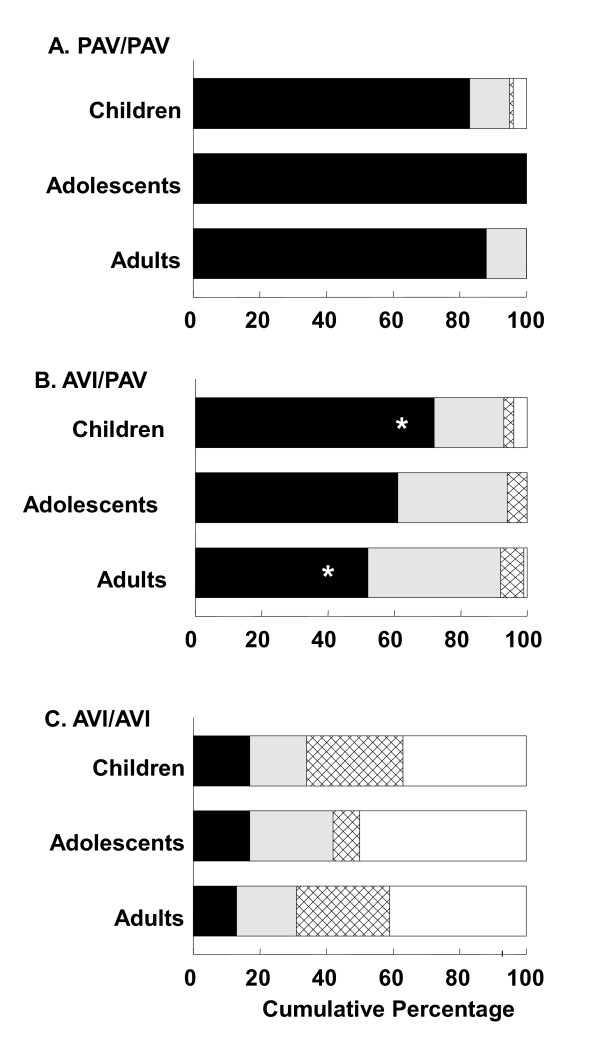
Background: The purpose of this study was to investigate the effect of TAS2R38 haplotypes and age on human bitter taste perception. Results: Children (3 to 10 yrs), adolescents (11 to 19 yrs) and adults (mostly mothers, 20 to 55 yrs (N = 980) were measured for bitter taste thresholds for 6-n-propylthiouracil (PROP) and genotyped for three polymorphisms of the AS2R38 gene (A49P, V262A, I296V). Subjects were grouped by haplotype and age, as well as sex and race/ethnicity, and compared for PROP thresholds. Subjects with the same haplotype were similar in bitter threshold regardless of race/ethnicity (all ages) or sex (children and adolescents; all p-values > 0.05) but age was a modifier of the genotype-phenotype relationship. Specifically, AVI/PAV heterozygous children could perceive a bitter taste at lower PROP concentrations than could heterozygous adults, with the thresholds of heterozygous adolescents being intermediate (p < 0.001). Similar age effects were not observed for subjects with the PAV/PAV or AVI/AVI homozygous haplotypes (p > 0.05) perhaps because there is less variation in taste perception among these homozygotes. Conclusions: These data imply that the change in PROP bitter sensitivity which occurs over the lifespan (from bitter sensitive to less so) is more common in people with a particular haplotype combination, i.e., AVI/PAV heterozygotes.
Overview
The claims and statistics of this paper haven’t been checked yet.
Free: it reads the open-access text and checks the first 5 claims that cite a source we can check. Create a free account to check every claim.
Integrity signals
Registry
Cites
Statistics
Figures
Verification
Claims the paper makes
The claims and statistics of this paper haven’t been checked yet.
Free: it reads the open-access text and checks the first 5 claims that cite a source we can check. Create a free account to check every claim.
Claims other papers make about this one
Each is checked against this paper’s own text: does it say what the citing paper says it does?
The source backs part of the claim, not all of it — or backs it for a different population, condition or comparison.
In the citing paper
“Because children are more sensitive to bitter tastes than are adults (45, 57), some children may be more sensitive to the unpleasant aftertastes of these LCS.”
From Sweetness and Food Preference (2012) · cites this paper as [57]
Experimental — accuracy not yet measured
Self-check
Percentages, sums and reported differences re-computed from the paper’s own numbers.
The self-check needs the paper’s full text.
Citations
Cites
Nonparametric Statistics for the Behavioral Sciences
Guitton, H., & Siegel, S. (1958) · Revue économique · doi:10.2307/3498751 · Cited by 35,245
Handbook of Sensory Physiology
Sanders, M. D. (1975) · British Journal of Ophthalmology · doi:10.1136/bjo.59.2.111-c · Cited by 7,166
Scheet, P., & Stephens, M. (2006) · The American Journal of Human Genetics · doi:10.1086/502802 · Cited by 1,941 · cited 1×
“Haplotypes were identified by tracing the parental origin of the alleles when possible, or otherwise they were inferred by expectation-maximization methods using an algorithm implemented by the computer program fastPHASE [59].”
MethodT2Rs Function as Bitter Taste Receptors
Chandrashekar, J., Mueller, K. L., Hoon, M. A., Adler, E., Feng, L., Guo, W., Zuker, C. S., & Ryba, N. J. P. (2000) · Cell · doi:10.1016/s0092-8674(00)80706-0 · Cited by 1,401 · cited 1×
“PROP bitterness is not entirely explained by alleles of the TAS2R38 gene [12,35-37] and these other modifiers (like taste papillae number) could be age-sensitive and more influential in heterozygous diplotypes [38].”
BackgroundHandbook of Sensory Physiology,
(1973) · Archives of Neurology · doi:10.1001/archneur.1973.00490200090018 · Cited by 1,058
Kim, U.-K., Jorgenson, E., Coon, H., Leppert, M., Risch, N., & Drayna, D. (2003) · Science · doi:10.1126/science.1080190 · Cited by 904 · cited 7×
“The differences in allele frequencies we found replicated those reported by others [11].”
BackgroundResultInfluentialToxic constituents of plant foodstuffs
(1981) · Food and Cosmetics Toxicology · doi:10.1016/0015-6264(81)90458-2 · Cited by 885
PTC/PROP tasting: Anatomy, psychophysics, and sex effects
Bartoshuk, L. M., Duffy, V. B., & Miller, I. J. (1994) · Physiology & Behavior · doi:10.1016/0031-9384(94)90361-1 · Cited by 813 · cited 1×
“Bitter sensitivity to PROP and PTC have been assessed in the past in two ways (threshold versus intensity) and each method has several variations [26,48-50].”
BackgroundBufe, B., Breslin, P. A. S., Kuhn, C., Reed, D. R., Tharp, C. D., Slack, J. P., Kim, U.-K., Drayna, D., & Meyerhof, W. (2005) · Current Biology · doi:10.1016/j.cub.2005.01.047 · Cited by 708 · cited 4×
“Adults heterozygous for the TAS2R38 gene do not express mRNA of each haplotype in a one-to-one proportion [12], so it is possible that heterozygous children might have a skewed expression pattern, perhaps over expressing the taster allele.”
BackgroundInfluentialSelf-citationGenetic variation in a human odorant receptor alters odour perception
Keller, A., Zhuang, H., Chi, Q., Vosshall, L. B., & Matsunami, H. (2007) · Nature · doi:10.1038/nature06162 · Cited by 661 · cited 1×
“Alleles of a particular smell receptor predict the threshold to this odorant [47].”
BackgroundThe distribution of the human blood groups and other polymorphisms
(1983) · Revue Francaise de Transfusion et Immuno-hématologie · doi:10.1016/s0338-4535(83)80126-3 · Cited by 598
Genetic and environmental determinants of bitter perception and sweet preferences.
Mennella, J. A., Pepino, M. Y., & Reed, D. R. (2005) · Pediatrics · doi:10.1542/peds.2004-1582 · Cited by 576 · cited 9×
“To try to understand this issue, in an earlier study, we assessed children and their mothers (N = 257) for the first genetic variant site (A49P) of the TAS2R38 gene and measured their PROP thresholds.”
BackgroundMethodResultInfluentialSelf-citationThe receptors and coding logic for bitter taste
Mueller, K. L., Hoon, M. A., Erlenbach, I., Chandrashekar, J., Zuker, C. S., & Ryba, N. J. P. (2005) · Nature · doi:10.1038/nature03352 · Cited by 524 · cited 1×
“Some investigators hypothesize that this sense provides information so that people do not ingest bitter-tasting toxic chemicals [1].”
BackgroundIs the bitter rejection response always adaptive?
Glendinning, J. I. (1994) · Physiology & Behavior · doi:10.1016/0031-9384(94)90369-7 · Cited by 511 · cited 1×
“Likewise, liquid formulations of medicines are avoided or refused by children because of their repellent taste [56,57].”
BackgroundTHE MEASUREMENT OF TASTE SENSITIVITY TO PHENYLTHIOUREA (P.T.C.)
HARRIS, H., & KALMUS, H. (1949) · Annals of Eugenics · doi:10.1111/j.1469-1809.1949.tb02419.x · Cited by 460 · cited 3×
“Bitter sensitivity to PROP and PTC have been assessed in the past in two ways (threshold versus intensity) and each method has several variations [26,48-50].”
BackgroundResultThe Relationship between Chemical Constitution and Taste
Fox, A. L. (1932) · Proceedings of the National Academy of Sciences · doi:10.1073/pnas.18.1.115 · Cited by 445 · cited 1×
“Some people can detect these compounds at low concentrations, whereas others need much higher concentrations or cannot detect them at all [7,8].”
BackgroundBitter Receptor Gene (TAS2R38), 6‐n‐Propylthiouracil (PROP) Bitterness and Alcohol Intake
Duffy, V. B., Davidson, A. C., Kidd, J. R., Kidd, K. K., Speed, W. C., Pakstis, A. J., Reed, D. R., Snyder, D. J., & Bartoshuk, L. M. (2004) · Alcoholism: Clinical and Experimental Research · doi:10.1097/01.alc.0000145789.55183.d4 · Cited by 385
Self-citationNatural Selection and Molecular Evolution in PTC, a Bitter-Taste Receptor Gene
Wooding, S., Kim, U.-K., Bamshad, M. J., Larsen, J., Jorde, L. B., & Drayna, D. (2004) · The American Journal of Human Genetics · doi:10.1086/383092 · Cited by 342 · cited 6×
“Regarding race/ethnicity, allele frequencies for the TAS2R38 gene vary by racial/ ethnic group and therefore when two racial groups are compared, they differ in phenotype because they differ in genotype [18].”
BackgroundInfluentialEarly Determinants of Fruit and Vegetable Acceptance
Forestell, C. A., & Mennella, J. A. (2007) · Pediatrics · doi:10.1542/peds.2007-0858 · Cited by 333 · cited 1×
“Children need to be given repeated opportunities to learn to like bitter-tasting vegetables [55], maybe more so if they have bitter sensitive genotypes and the reluctance of parents and caregivers to offer foods that are initially rejected must be overcome [55].”
BackgroundSelf-citationSupertasting and PROP Bitterness Depends on More Than the TAS2R38 Gene
Hayes, J. E., Bartoshuk, L. M., Kidd, J. R., & Duffy, V. B. (2008) · Chemical Senses · doi:10.1093/chemse/bjm084 · Cited by 314 · cited 1×
“PROP bitterness is not entirely explained by alleles of the TAS2R38 gene [12,35-37] and these other modifiers (like taste papillae number) could be age-sensitive and more influential in heterozygous diplotypes [38].”
BackgroundThe genetics of phenylthiocarbamide perception
Sun-Wei Guo, D. R. R. (2001) · Annals of Human Biology · doi:10.1080/03014460151056310 · Cited by 312 · cited 4×
“This result is probably explained by sexual maturation, because half of our subjects were children and sex effects for this trait are not typically found until after puberty [6] and the adults were almost all women.”
BackgroundResultInfluentialGenetics of Sensory Thresholds: Taste for Phenyl Thio Carbamide
Blakeslee, A. F. (1932) · Proceedings of the National Academy of Sciences · doi:10.1073/pnas.18.1.120 · Cited by 274 · cited 4×
“Early family studies suggested this bimodality in taste response was due to alleles in a single gene [8,9].”
BackgroundResultInfluentialPreferences for Sweet and Salty in 9- to 15-Year-Old and Adult Humans
Desor, J. A., Greene, L. S., & Maller, O. (1975) · Science · doi:10.1126/science.1188365 · Cited by 235 · cited 1×
“In fact, they live in different worlds than adults in many sensory realms: sounds [51], smells [25,46], tastes [52] and irritants [53], but these differences are especially striking for bitter taste.”
BackgroundAnliker, J., Bartoshuk, L., Ferris, A., & Hooks, L. (1991) · The American Journal of Clinical Nutrition · doi:10.1093/ajcn/54.2.316 · Cited by 226 · cited 3×
“The forcedchoice procedures and concentrations of PROP used were based on previous research [24,32].”
BackgroundMethodResultIndependent evolution of bitter-taste sensitivity in humans and chimpanzees
Wooding, S., Bufe, B., Grassi, C., Howard, M. T., Stone, A. C., Vazquez, M., Dunn, D. M., Meyerhof, W., Weiss, R. B., & Bamshad, M. J. (2006) · Nature · doi:10.1038/nature04655 · Cited by 210 · cited 2×
“Thus heterozygosity is common and may be due to balancing natural selection as a result of as yet unknown beneficial properties of the minor allele [18,22].”
BackgroundSnyder, L. H. (1931) · Science · doi:10.1126/science.74.1910.151 · Cited by 196 · cited 1×
“Early family studies suggested this bimodality in taste response was due to alleles in a single gene [8,9].”
BackgroundTepper, B. J., Koelliker, Y., Zhao, L., Ullrich, N. V., Lanzara, C., D'Adamo, P., Ferrara, A., Ulivi, S., Esposito, L., & Gasparini, P. (2008) · Obesity · doi:10.1038/oby.2008.357 · Cited by 193 · cited 1×
“The gene which accounts for this taste trait is TAS2R38, a member of the family of taste receptors that respond to bitter stimuli [12-16] and the milestones of this discovery have recently been summarized [17].”
BackgroundVariability in a taste-receptor gene determines whether we taste toxins in food
Sandell, M. A., & Breslin, P. A. S. (2006) · Current Biology · doi:10.1016/j.cub.2006.08.049 · Cited by 189 · cited 1×
“Thus it is likely that the benefit of the taster allele is to detect thyroid poisons [42].”
BackgroundOptimizing oral medications for children
Mennella, J. A., & Beauchamp, G. K. (2008) · Clinical Therapeutics · doi:10.1016/j.clinthera.2008.11.018 · Cited by 188 · cited 2×
“Likewise, liquid formulations of medicines are avoided or refused by children because of their repellent taste [56,57].”
BackgroundSelf-citationDevelopment of brief methods to classify individuals by PROP taster status
Tepper, B. J., Christensen, C. M., & Cao, J. (2001) · Physiology & Behavior · doi:10.1016/s0031-9384(01)00500-5 · Cited by 175 · cited 1×
“Bitter sensitivity to PROP and PTC have been assessed in the past in two ways (threshold versus intensity) and each method has several variations [26,48-50].”
BackgroundToward a New Vocabulary of Human Genetic Variation
Sankar, P. L., & Cho, M. K. (2002) · Science · doi:10.1126/science.1074447 · Cited by 169
High-throughput microarray detection of olfactory receptor gene expression in the mouse
Zhang, X., Rogers, M., Tian, H., Zhang, X., Zou, D.-J., Liu, J., Ma, M., Shepherd, G. M., & Firestein, S. J. (2004) · Proceedings of the National Academy of Sciences · doi:10.1073/pnas.0405350101 · Cited by 168 · cited 1×
“Studies of olfactory genes in the mouse demonstrate that the pattern of gene expression changes during development, with receptor genes turning off forever early in life and others only turning on in adulthood [45].”
BackgroundWang, J. C. C., Hinrichs, A. L., Bertelsen, S. E., Stock, H., Budde, J., Dick, D. M., Bucholz, K. K., Rice, J. P., Saccone, N. L., Edenberg, H. J., et al. (2007) · Alcoholism Clinical and Experimental Research · doi:10.1111/j.1530-0277.2006.00297.x · Cited by 162 · cited 4×
“One qualification to previous predictions mentioned above was that the molecular characterization of this genetic locus revealed three sites of genetic variation (A49P, V262A, and I296V) which are found in two common (AVI and PAV), two less common (AAI and AAV) and two rare haplotypes (PVI and PAI) [11,18-21].”
BackgroundInfluentialSREBP-2 regulates gut peptide secretion through intestinal bitter taste receptor signaling in mice
Jeon, T.-I., Zhu, B., Larson, J. L., & Osborne, T. F. (2008) · Journal of Clinical Investigation · doi:10.1172/jci36461 · Cited by 157 · cited 1×
“Another point to consider is that taste receptors are also found in the gut and stimulate hormone secretion [44] and their expression is dependent on diet [44].”
BackgroundRecent Advances in Biological Psychiatry
Wortis, J. (1966) · Springer eBooks · doi:10.1007/978-1-4899-7313-9 · Cited by 157
Localization of a Gene for Bitter-Taste Perception to Human Chromosome 5p15
Reed, D. R., Nanthakumar, E., North, M., Bell, C., Bartoshuk, L. M., & Price, R. A. (1999) · The American Journal of Human Genetics · doi:10.1086/302367 · Cited by 148 · cited 1×
“PROP bitterness is not entirely explained by alleles of the TAS2R38 gene [12,35-37] and these other modifiers (like taste papillae number) could be age-sensitive and more influential in heterozygous diplotypes [38].”
BackgroundSelf-citationA marker of growth differs between adolescents with high vs. low sugar preference
Coldwell, S. E., Oswald, T. K., & Reed, D. R. (2009) · Physiology & Behavior · doi:10.1016/j.physbeh.2008.12.010 · Cited by 140 · cited 1×
“If true, why this change would occur during adolescence is not known, but it may be triggered by signals that brain and body growth are complete [34].”
BackgroundSelf-citationTimpson, N. J., Christensen, M. B., Lawlor, D. A., Gaunt, T. R., Day, I. N. M., Ebrahim, S. B. J., & Smith, G. D. (2005) · American Journal of Clinical Nutrition · doi:10.1093/ajcn/81.5.1005 · Cited by 132 · cited 3×
“One qualification to previous predictions mentioned above was that the molecular characterization of this genetic locus revealed three sites of genetic variation (A49P, V262A, and I296V) which are found in two common (AVI and PAV), two less common (AAI and AAV) and two rare haplotypes (PVI and PAI) [11,18-21].”
BackgroundAdult-Like Odor Preferences and Aversions in Three-Year-Old Children
Schmidt, H. J., & Beauchamp, G. K. (1988) · Child Development · doi:10.1111/j.1467-8624.1988.tb03266.x · Cited by 124 · cited 1×
“If the solution tasted like water, they were told to give it to a stuffed toy of Big BirdTM (a likeable, well-known television character puppet), but if it tasted “yucky” or bitter, they should give it to Oscar the Grouch,TM so that he can “throw it in his trash can” [58].”
BackgroundTaste-testing the Anthropoid Apes
Fisher, R. A., Ford, E. B., & Huxley, J. S. (1939) · Nature · doi:10.1038/144750a0 · Cited by 122 · cited 1×
“Both the taster and nontaster alleles have been preserved since the time of the Neanderthals [39] and so it is presumed that both alleles must do important work [22,40].”
BackgroundChanges in sensitivity to the odor of androstenone during adolescence.
Dorries, K., Schmidt, H., Beauchamp, G. K., & Wysocki, C. (1989) · Developmental Psychobiology · doi:10.1002/dev.420220502 · Cited by 118 · cited 2×
“In fact, they live in different worlds than adults in many sensory realms: sounds [51], smells [25,46], tastes [52] and irritants [53], but these differences are especially striking for bitter taste.”
BackgroundResultDevelopmental changes in masked thresholds
Schneider, B. A., Trehub, S. E., Morrongiello, B. A., & Thorpe, L. A. (1989) · The Journal of the Acoustical Society of America · doi:10.1121/1.398604 · Cited by 115 · cited 1×
“In fact, they live in different worlds than adults in many sensory realms: sounds [51], smells [25,46], tastes [52] and irritants [53], but these differences are especially striking for bitter taste.”
BackgroundLawless, H. T. (1980) · Chemical Senses · doi:10.1093/chemse/5.3.247 · Cited by 97 · cited 1×
“Bitter sensitivity to PROP and PTC have been assessed in the past in two ways (threshold versus intensity) and each method has several variations [26, 48-50 ].”
MethodAge, Sex and Taste Sensitivity
Glanville, E. V., Kaplan, A. R., & Fischer, R. (1964) · Journal of Gerontology · doi:10.1093/geronj/19.4.474 · Cited by 93 · cited 1×
“Previous investigators noted that people who were less sensitive to this class of bitter compounds seemed to lose their sensitivity faster as they got older, concluding that gene penetrance might differ by age and genotype [30,31].”
BackgroundPhenylthiocarbamide: A 75-Year Adventure in Genetics and Natural Selection
Wooding, S. (2006) · Genetics · doi:10.1093/genetics/172.4.2015 · Cited by 93
Toxic constituents of plant foodstuffs
Liener, I. E. (1970) · Proceedings of The Nutrition Society · doi:10.1079/pns19700010 · Cited by 93 · cited 2×
“Humans would not have encountered PROP or PTC in their natural environment but structurally related compounds are found normally in some plants [41] and these chemicals are potent thyroid toxins [3].”
BackgroundKALMUS, H. (1971) · Handbook of sensory physiology · doi:10.1007/978-3-642-65245-5_9 · Cited by 81
Prodi, D. A., Drayna, D., Forabosco, P., Palmas, M. A., Maestrale, G. B., Piras, D., Pirastu, M., & Angius, A. (2004) · Chemical Senses · doi:10.1093/chemse/bjh074 · Cited by 75 · cited 1×
“The gene which accounts for this taste trait is TAS2R38, a member of the family of taste receptors that respond to bitter stimuli [12-16] and the milestones of this discovery have recently been summarized [17].”
BackgroundBitter taste perception in Neanderthals through the analysis of the TAS2R38 gene
Lalueza-Fox, C., Gigli, E., de la Rasilla, M., Fortea, J., & Rosas, A. (2009) · Biology Letters · doi:10.1098/rsbl.2009.0532 · Cited by 72 · cited 2×
“Lalueza-Fox C, Gigli E, de la Rasilla M, Fortea J, Rosas A: Bitter taste perception in Neanderthals through the analysis of the TAS2R38 gene.”
BackgroundKeller, K., Reid, A., MacDougall, M., Cassano, H., Song, J. L., Deng, L., Lanzano, P., Chung, W. K., & Kissileff, H. R. (2009) · Obesity · doi:10.1038/oby.2009.306 · Cited by 60
Effect of age and sex on the elicitation of irritant contact dermatitis
Patil, S., & Maïbach, H. I. (1994) · Contact Dermatitis · doi:10.1111/j.1600-0536.1994.tb00594.x · Cited by 57 · cited 1×
“In fact, they live in different worlds than adults in many sensory realms: sounds [51], smells [25,46], tastes [52] and irritants [53], but these differences are especially striking for bitter taste.”
BackgroundA STUDY OF THE PROTEINS OF THE CASTOR BEAN, WITH SPECIAL REFERENCE TO THE ISOLATION OF RICIN
Osborne, T. B., Mendel, L. B., & Harris, I. F. (1905) · American Journal of Physiology-Legacy Content · doi:10.1152/ajplegacy.1905.14.3.259 · Cited by 55 · cited 1×
“, like ricin and castor beans) which render them inedible [2].”
BackgroundWHISSELL-BUECHY, D. (1990) · Chemical Senses · doi:10.1093/chemse/15.1.39 · Cited by 53 · cited 1×
“Previous investigators noted that people who were less sensitive to this class of bitter compounds seemed to lose their sensitivity faster as they got older, concluding that gene penetrance might differ by age and genotype [30,31].”
BackgroundDivergent taste responsiveness to fruit of the tree Antidesma bunius
Henkin, R. I., & Gillis, W. T. (1977) · Nature · doi:10.1038/265536a0 · Cited by 50 · cited 1×
“One piece of evidence that supports the hypothesis that the nontaster form has a function is that it has an intact reading frame and is not a pseudogene [11] and therefore it might be able to detect bitter molecules from a different chemical class [43].”
BackgroundTimpson, N. J., Heron, J. E., Day, I. N. M., Ring, S. M., Bartoshuk, L. M., Horwood, J. P., Emmett, P. M., & Smith, G. D. (2007) · BMC Genetics · doi:10.1186/1471-2156-8-51 · Cited by 50 · cited 4×
“One qualification to previous predictions mentioned above was that the molecular characterization of this genetic locus revealed three sites of genetic variation (A49P, V262A, and I296V) which are found in two common (AVI and PAV), two less common (AAI and AAV) and two rare haplotypes (PVI and PAI) [11,18-21].”
BackgroundInfluentialTaste Reactions to Antithyroid Substances
Boyd, W. C. (1950) · Science · doi:10.1126/science.112.2901.153 · Cited by 43
Direct assessment of the effect of age on P.T.C. sensitivity
KALMUS, H., & TROTTER, A. W. R. (1962) · Annals of Human Genetics · doi:10.1111/j.1469-1809.1962.tb01321.x · Cited by 42 · cited 2×
“These findings are consistent with our earlier studies of children and their mothers which examined the effect of one TAS2R38 genotype (A49P) [32] as well as research of others who observed age-related changes in the perception of PTC and PROP [8,23-26,28,29].”
BackgroundResultQuinine Dimorphism: A Cardinal Determinant of Taste Sensitivity
FISCHER, R., & Griffin, F. (1963) · Nature · doi:10.1038/200343a0 · Cited by 37 · cited 1×
“However this poison detection system is not perfect because not everyone perceives the intensity of a fixed bitter stimulus in the same way [4,5].”
BackgroundVanEtten, C. H. (1969) · Elsevier eBooks · doi:10.1016/b978-0-12-395739-9.50009-x · Cited by 34
Psychosocial correlates of 6-n-propylthiouracil (PROP) ratings in a birth cohort
McAnally, H. M., Poulton, R., Hancox, R. J., Prescott, J., & Welch, D. (2007) · Appetite · doi:10.1016/j.appet.2007.07.005 · Cited by 15 · cited 1×
“PROP bitterness is not entirely explained by alleles of the TAS2R38 gene [12,35-37] and these other modifiers (like taste papillae number) could be age-sensitive and more influential in heterozygous diplotypes [38].”
BackgroundPHENYLTHIOCARBAMIDE AND MENTAL IMMATURITY
Karam, E., & FREIRE‐MAIA, N. (1967) · The Lancet · doi:10.1016/s0140-6736(67)90474-6 · Cited by 9 · cited 2×
“These findings are consistent with our earlier studies of children and their mothers which examined the effect of one TAS2R38 genotype (A49P) [32] as well as research of others who observed age-related changes in the perception of PTC and PROP [8,23-26,28,29].”
BackgroundResultOdeigah, P. G. C., & Obieze, A. C. (1986) · PubMed · Cited by 5
Research works printed but not linked: 1
- Ehrhardt VS Vergleichende Geschmacksprufung von PTC und Conteben Homo 1952 3 153 162
Cited by
Early Influences on the Development of Food Preferences
Ventura, A. K., & Worobey, J. (2013) · Current Biology · doi:10.1016/j.cub.2013.02.037 · Cited by 626
“Compared to adults, children are more sensitive to bitter tastes [51,74,75].”
BackgroundOntogeny of taste preferences: basic biology and implications for health
Mennella, J. A. (2014) · The American Journal of Clinical Nutrition · doi:10.3945/ajcn.113.067694 · Cited by 443
Self-citationThe sweetness and bitterness of childhood: Insights from basic research on taste preferences
Mennella, J. A., & Bobowski, N. K. (2015) · Physiology & Behavior · doi:10.1016/j.physbeh.2015.05.015 · Cited by 399
“Although one may expect individuals with the heterozygous TAS2R38 genotype (PAV/AVI) to have a sensitivity to PROP intermediate to that of both homozygous genotypes (PAV/PAV and AVI/AVI), as a group these individuals show a wide range of sensitivities [66, 68].”
BackgroundInfluentialSelf-citationDrewnowski, A., Mennella, J. A., Johnson, S. L., & Bellisle, F. (2012) · The Journal of Nutrition · doi:10.3945/jn.111.149575 · Cited by 347
“Because children are more sensitive to bitter tastes than are adults (45,57), some children may be more sensitive to the unpleasant aftertastes of these LCS.”
BackgroundSelf-citationThe Bad Taste of Medicines: Overview of Basic Research on Bitter Taste
Mennella, J. A., Spector, A. C., Reed, D. R., & Coldwell, S. E. (2013) · Clinical Therapeutics · doi:10.1016/j.clinthera.2013.06.007 · Cited by 296
“Based on the procedures of Anliker et al,(139) children were presented, in succession, with samples of water and then 3 increasing concentrations of PROP (56, 180, and 560 μM) and were asked to taste the sample without swallowing.(137,140,141) If the solution tasted like “water” or “nothing,” then they were asked to g…”
MethodSelf-citation
Metadata
- Authors
- Mennella, J. A., Pepino, M. Y., Duke, F. F., & Reed, D. R.
- Affiliations
- Monell Chemical Senses Center (US)
- Corresponding author
- Reed, Danielle R
- Venue
- BMC Genetics
- Published
- 2010-07-01
- Volume
- 11
- Issue
- 1
- Pages
- 60-60
- ISSN
- 1471-2156 (ISSN-L)
- PMC
- PMC3087510
- OpenAlex
- W2159207807
- Cited by
- 185
- References
- 63
- Citations by year
- 2026: 4 · 2025: 6 · 2024: 7 · 2023: 7 · 2022: 6 · 2021: 11 · 2020: 39 · 2019: 5 · 2018: 13 · 2017: 16 · 2016: 12 · 2015: 15 · 2014: 11 · 2013: 14 · 2012: 11
- FWCI
- 10.01
- Type
- journal article
- Language
- en
- Open access
- gold
- doi.org
- Licence
- cc-by
- Locations
- BMC Genetics (publishedVersion, cc-by)
- Europe PMC (PubMed Central) (publishedVersion, cc-by)
- PubMed Central (publishedVersion, cc-by)
- PubMed (publishedVersion)
- DOAJ (DOAJ: Directory of Open Access Journals) (submittedVersion, cc-by-sa)
- Funders
- National Institute on Alcohol Abuse and Alcoholism (R01AA009523, AA09523)
- National Institute on Drug Abuse (T32DA07313, T32DA007313)
- National Institute on Deafness and Other Communication Disorders (R03DC003509, R01DC004698, DC004698)
- Eunice Kennedy Shriver National Institute of Child Health and Human Development (HD 37119, R01HD037119)
- Topics
- Health Sciences › Nursing › Nutrition and Dietetics › Biochemical Analysis and Sensing Techniques
- Life Sciences › Neuroscience › Sensory Systems › Olfactory and Sensory Function Studies
- Life Sciences › Neuroscience › Sensory Systems › Ion Channels and Receptors
- Keywords
- TAS2R38, bitter taste perception, PROP sensitivity, age effects, genotype-phenotype correlation, haplotypes, children, adolescents, lifespan development, sex differences, race and ethnicity
- MeSH terms
- Taste Receptors, Type 2, Adolescent, Adult, Age Factors, Child, Child, Preschool, Ethnicity, Female, Genotype, Haplotypes, Humans, Male, Middle Aged, Polymorphism, Genetic, Sex Factors, Taste Threshold, Receptors, G-Protein-Coupled
About these checks
Registry, retraction, Cites and statistics results are computed, not judged, with one exception: a printed reference that no index lists is read once by a model before it counts as a citation error. Claims are extracted by a model and kept only when their quote appears verbatim in the text; each cited source is then checked, with a model’s help, for whether it says what the claim relies on. Those verdicts can be wrong — read the claim’s quote and the cited source before relying on one.
Statistics and arithmetic are recomputed, not judged.
Confidence bands are shown only for fields calibrated on our annotated test set. None is calibrated yet, so no band is shown.
What counts as a claim ›How we measure confidence ›How we check this ›
Are you an author, or do you see a problem with this page? Request a review
Data sources
Bibliographic data: Semantic Scholar, OpenAlex, Crossref.
Contains information from the Semantic Scholar Academic Graph Datasets, made available under the ODC Attribution License (ODC-BY 1.0).
Semantic Scholar’s data is described in: Kinney, R., et al. (2023). The Semantic Scholar Open Data Platform. arXiv:2301.10140.
