

The DOI matches its Crossref record; 76 of the 77 references it cites were found in a registry or an index.
Signed weighted gene co-expression network analysis of transcriptional regulation in murine embryonic stem cells
Open accessAbstract
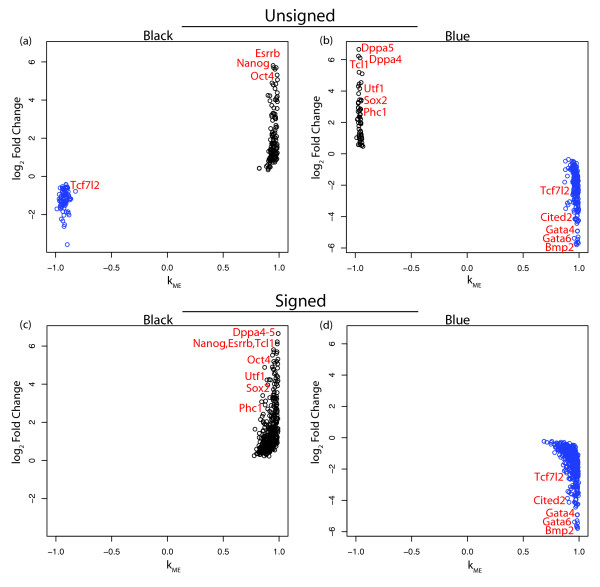
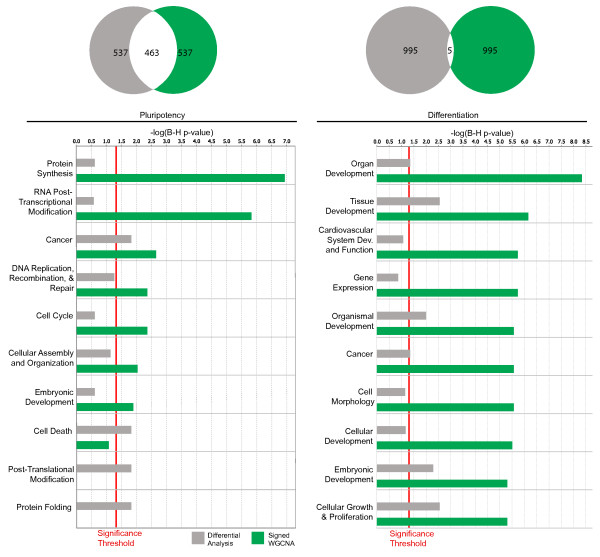
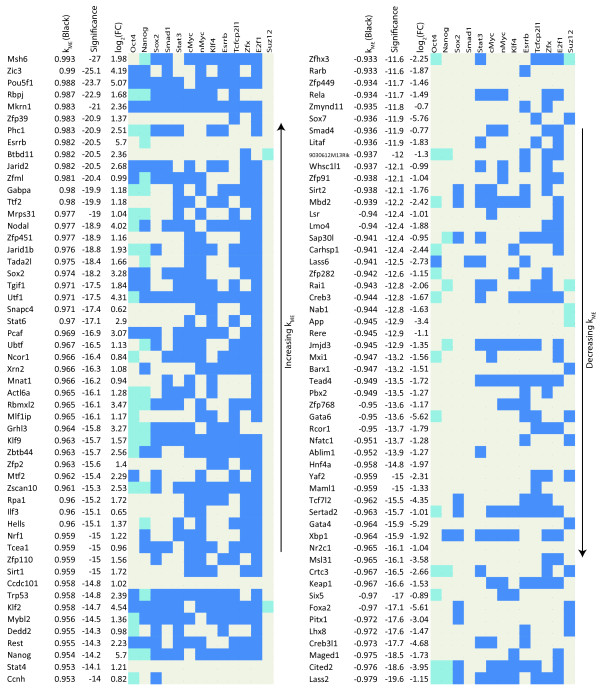
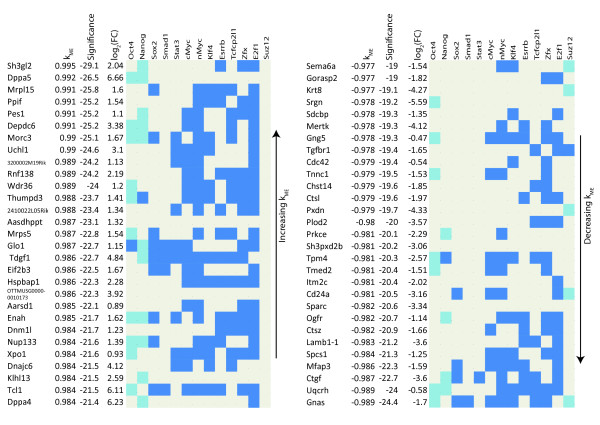
Background: Recent work has revealed that a core group of transcription factors (TFs) regulates the key characteristics of embryonic stem (ES) cells: pluripotency and self-renewal. Current efforts focus on identifying genes that play important roles in maintaining pluripotency and self-renewal in ES cells and aim to understand the interactions among these genes. To that end, we investigated the use of unsigned and signed network analysis to identify pluripotency and differentiation related genes. Results: We show that signed networks provide a better systems level understanding of the regulatory mechanisms of ES cells than unsigned networks, using two independent murine ES cell expression data sets. Specifically, using signed weighted gene co-expression network analysis (WGCNA), we found a pluripotency module and a differentiation module, which are not identified in unsigned networks. We confirmed the importance of these modules by incorporating genome-wide TF binding data for key ES cell regulators. Interestingly, we find that the pluripotency module is enriched with genes related to DNA damage repair and mitochondrial function in addition to transcriptional regulation. Using a connectivity measure of module membership, we not only identify known regulators of ES cells but also show that Mrpl15, Msh6, Nrf1, Nup133, Ppif, Rbpj, Sh3gl2, and Zfp39, among other genes, have important roles in maintaining ES cell pluripotency and self-renewal. We also report highly significant relationships between module membership and epigenetic modifications (histone modifications and promoter CpG methylation status), which are known to play a role in controlling gene expression during ES cell self-renewal and differentiation. Conclusion: Our systems biologic re-analysis of gene expression, transcription factor binding, epigenetic and gene ontology data provides a novel integrative view of ES cell biology.
Overview
The claims and statistics of this paper haven’t been checked yet.
Run the check — free, no account needed. It reads the open-access text and checks the sources it cites.
Integrity signals
Registry
Cites
Statistics
Figures
Verification
Claims the paper makes
The claims and statistics of this paper haven’t been checked yet.
Run the check — free, no account needed. It reads the open-access text and checks the sources it cites.
Claims other papers make about this one
Each is checked against this paper’s own text: does it say what the citing paper says it does?
The cited source says what the claim attributes to it.
In the citing paper
“A signed method creates networks where biologically meaningful modules (such as those representing a specific biological process) are better separated [37].”
From Gene co-expression analysis for functional classification and gene–disease predictions (2017) · cites this paper as [37]
Self-check
Percentages, sums and reported differences re-computed from the paper’s own numbers.
The self-check needs the paper’s full text.
Citations
Cites
WGCNA: an R package for weighted correlation network analysis
Langfelder, P., & Horvath, S. (2008) · BMC Bioinformatics · doi:10.1186/1471-2105-9-559 · Cited by 27,252
Self-citationTakahashi, K., & Yamanaka, S. (2006) · Cell · doi:10.1016/j.cell.2006.07.024 · Cited by 26,673 · cited 2×
“the four TFs that can reprogram differentiated cells into a pluripotency state [3].”
BackgroundInduction of Pluripotent Stem Cells from Adult Human Fibroblasts by Defined Factors
Takahashi, K., Tanabe, K., Ohnuki, M., Narita, M., Ichisaka, T., Tomoda, K., & Yamanaka, S. (2007) · Cell · doi:10.1016/j.cell.2007.11.019 · Cited by 20,221
Induced Pluripotent Stem Cell Lines Derived from Human Somatic Cells
Yu, J., Vodyanik, M. A., Smuga-Otto, K., Antosiewicz-Bourget, J., Frane, J. L., Tian, S., Nie, J., Jonsdottir, G. A., Ruotti, V., Stewart, R., et al. (2007) · Science · doi:10.1126/science.1151526 · Cited by 10,310 · cited 9×
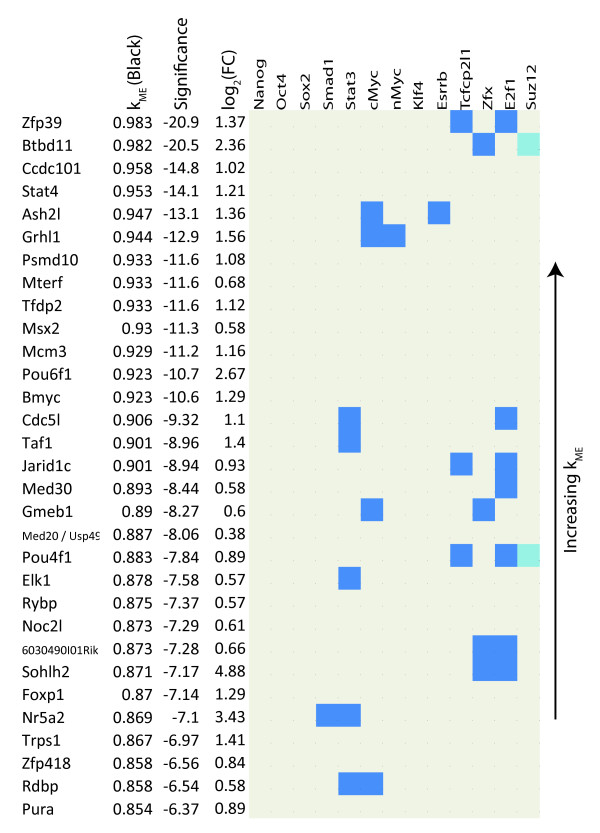
“Figure 9 shows genes with relatively high that lack binding by the TFs Nanog, Oct4, Sox2, and Klf4 [10,11] and have low binding (≤ 2) by other TFs that maintain pluripotency (Smad1, Stat3, cMyc, nMyc, Esrrb, Tcfcp2l1, Zfx, and E2f1).”
BackgroundInfluentialDAVID: Database for Annotation, Visualization, and Integrated Discovery
Dennis, G., Sherman, B. T., Hosack, D. A., Yang, J., Gao, W., Lane, H. C., & Lempicki, R. A. (2003) · Genome Biology · doi:10.1186/gb-2003-4-5-p3 · Cited by 9,327 · cited 3×
“ment using the Database for Annotation Visualization and Integrated Discovery (DAVID) [53].”
MethodInfluentialA General Framework for Weighted Gene Co-Expression Network Analysis
Zhang, B., & Horvath, S. (2005) · Statistical Applications in Genetics and Molecular Biology · doi:10.2202/1544-6115.1128 · Cited by 5,684 · cited 29×
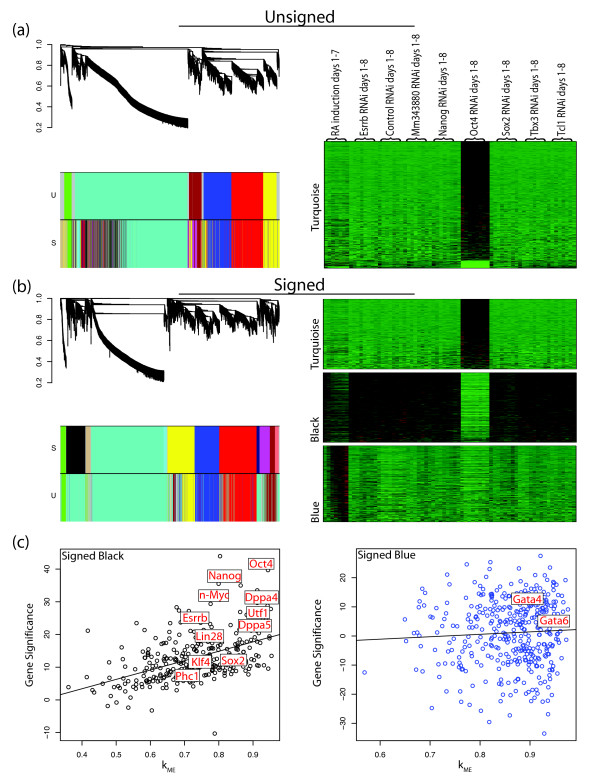
“It is important to reiterate that the pluripotency/self-renewal black module was only found using signed WGCNA.”
BackgroundMethodInfluentialSelf-citationA bivalent chromatin structure marks key developmental genes in embryonic stem cells
Bernstein, B. E., Mikkelsen, T. S., Xie, X., Kamal, M., Huebert, D. J., Cuff, J., Fry, B., Meissner, A., Wernig, M., Plath, K., et al. (2006) · Cell · doi:10.1016/j.cell.2006.02.041 · Cited by 5,361 · cited 1×
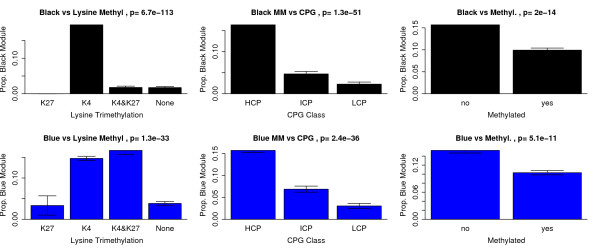
“Recent studies suggest that chromatin structure and epigenetic modifications, like histone modification and DNA methylation, play a role in controlling gene expression during ES cell self-renewal and differentiation [46-51].”
BackgroundSelf-citationHierarchical Organization of Modularity in Metabolic Networks
Ravasz, E., Somera, A. L., Mongru, D. A., Oltvai, Z. N., & Barabási, A.-L. (2002) · Science · doi:10.1126/science.1073374 · Cited by 4,224 · cited 7×
“Specifically, we define the proximity as the topological overlap measure (TOM) [35-37] which can also be defined for weighted networks [19].”
BackgroundInfluentialGenome-wide maps of chromatin state in pluripotent and lineage-committed cells
Mikkelsen, T. S., Ku, M., Jaffe, D. B., Issac, B., Lieberman, E., Giannoukos, G., Alvarez, P., Brockman, W., Kim, T.-K., Koche, R. P., et al. (2007) · Nature · doi:10.1038/nature06008 · Cited by 4,129 · cited 10×
“Recent studies suggest that chromatin structure and epigenetic modifications, like histone modification and DNA methylation, play a role in controlling gene expression during ES cell self-renewal and differentiation [46-51].”
BackgroundMethodInfluentialThe Homeoprotein Nanog Is Required for Maintenance of Pluripotency in Mouse Epiblast and ES Cells
Mitsui, K., Tokuzawa, Y., Itoh, H., Segawa, K., Murakami, M., Takahashi, K., Maruyama, M., Maeda, M., & Yamanaka, S. (2003) · Cell · doi:10.1016/s0092-8674(03)00393-3 · Cited by 3,192 · cited 1×
“Several studies have identified the targets of these TFs and the mechanism by which they regulate them [4,8,17].”
Background
Cited by
Sorted by citations
Items 201–255 of 255
A long-lived seabird buffers the cost of phenological mismatch by modulating stress responsePreprint
Fernandes, F. A. N., Bardon, G., Paris, J. R., Cristofari, R., Ferrer, J., Ancona, L., Greco, S., Gerdol, M., Vallas, B., Carette, P., et al. (2025) · bioRxiv (Cold Spring Harbor Laboratory) · doi:10.1101/2025.07.10.663151 · Cited by 2
“…= “signed” , in order to exclusively detect positive correlations amongst genes, avoiding the confounding influence of negative correlations (Mason et al., 2009; van Dam et al., 2018), minModuleSize = 30 to filter out modules with less than 30 genes, corType= “bicor” ( i.e. , bidweight…”
Networks Between Categorical or Discretized Numeric Variables
Horvath, S. (2011) · Springer eBooks · doi:10.1007/978-1-4419-8819-5_14
Self-citationRigidity and flexibility of biological
Csermely, P. (2012)
ProCoNA: Protein Co-expression Network Analysis
Gibbs, D. L. (2013)
Jiang, T., Jiang, C., Shu, J.-H., & Xu, Y.-J. (2017) · Brazilian Journal of Medical and Biological Research · doi:10.1590/1414-431x20176416
“Network strategies, such as co-expression networks, have been largely performed to select the initial significant gene lists, and the potential functional roles are predicted based on a post-hoc application (25).”
MethodEvolutionary, structural and functional features of cellular signalling networks
Lang, B. (2012) · Apollo (University of Cambridge) · doi:10.17863/cam.39120
“Co-expression analysis can be used to identify functionally related genes (Mason et al., 2009; Nayak et al., 2009).”
Roberts, W. R., & Roalson, E. H. (2019) · bioRxiv (Cold Spring Harbor Laboratory) · doi:10.1101/817221
Gorky, J. M., Vadigepalli, R., & Schwaber, J. S. (2020) · bioRxiv (Cold Spring Harbor Laboratory) · doi:10.1101/2020.03.11.987982
Penalized Bayesian Model Selection and Prediction for Gene Regulation in Higher Organisms
Levinson, M. D. (2013) · eScholarship (California Digital Library)
Altman, R. B. (2012) · Faculty Opinions – Post-Publication Peer Review of the Biomedical Literature · doi:10.3410/f.13489114.14866259
Dunn, S.-J. (2019) · Faculty Opinions – Post-Publication Peer Review of the Biomedical Literature · doi:10.3410/f.722129179.793567423
von Geldern, T. W. (2011) · Faculty Opinions – Post-Publication Peer Review of the Biomedical Literature · doi:10.3410/f.7831956.8884055
(2020) · PeerJ · doi:10.7287/peerj.8778v0.1/reviews/1
“We used signed networks here (“networkType” and “TOMType” parameters) because this type is considered more robust to biological functions with more specific expression patterns (Mason et al., 2009; Song, Langfelder & Horvath, 2012).”
MethodIdentification of prognosis-related genes in Burkitt Lymphoma by integrated bioinformatic analysis.Preprint
Xu, Y., Wang, G., Zhang, M., & Yang, J. (2023) · Research Square · doi:10.21203/rs.3.rs-2815983/v1
Rewiring driven evolution of quenched frustrated signed network
Kožić, S. B., Giampaolo, S. M., & Zlatić, V. (2024) · Journal of Physics Complexity · doi:10.1088/2632-072x/ad1a1a
“These networks have proven particularly useful in uncovering regulatory mechanisms [27], disease progression [29], and drug targets [30], shedding light on the underlying principles governing life’s fundamental processes and offering valuable insights for biomedical research and therapeutic…”
BackgroundApproaches to construct and analyze stem cells regulatory networks
Randhawa, V., & Pathania, S. (2024) · Elsevier eBooks · doi:10.1016/b978-0-443-13222-3.00029-0
Additional file 10 of Is human blood a good surrogate for brain tissue in transcriptional studies?
Cai, C., Langfelder, P., Fuller, T. F., Oldham, M. C., Luo, R., van den Berg, L. H., Ophoff, R. A., & Horvath, S. (2021) · Figshare · doi:10.6084/m9.figshare.14436200
Self-citationAdditional file 8 of Is human blood a good surrogate for brain tissue in transcriptional studies?
Cai, C., Langfelder, P., Fuller, T. F., Oldham, M. C., Luo, R., van den Berg, L. H., Ophoff, R. A., & Horvath, S. (2021) · Figshare · doi:10.6084/m9.figshare.14436263
Self-citationAdditional file 7 of Is human blood a good surrogate for brain tissue in transcriptional studies?
Cai, C., Langfelder, P., Fuller, T. F., Oldham, M. C., Luo, R., van den Berg, L. H., Ophoff, R. A., & Horvath, S. (2021) · Figshare · doi:10.6084/m9.figshare.14436260
Self-citationAdditional file 11 of Is human blood a good surrogate for brain tissue in transcriptional studies?
Cai, C., Langfelder, P., Fuller, T. F., Oldham, M. C., Luo, R., van den Berg, L. H., Ophoff, R. A., & Horvath, S. (2021) · Figshare · doi:10.6084/m9.figshare.14436203
Self-citationAdditional file 12 of Is human blood a good surrogate for brain tissue in transcriptional studies?
Cai, C., Langfelder, P., Fuller, T. F., Oldham, M. C., Luo, R., van den Berg, L. H., Ophoff, R. A., & Horvath, S. (2021) · Figshare · doi:10.6084/m9.figshare.14436206
Self-citationAdditional file 15 of Is human blood a good surrogate for brain tissue in transcriptional studies?
Cai, C., Langfelder, P., Fuller, T. F., Oldham, M. C., Luo, R., van den Berg, L. H., Ophoff, R. A., & Horvath, S. (2021) · Figshare · doi:10.6084/m9.figshare.14436215
Self-citationAdditional file 9 of Is human blood a good surrogate for brain tissue in transcriptional studies?
Cai, C., Langfelder, P., Fuller, T. F., Oldham, M. C., Luo, R., van den Berg, L. H., Ophoff, R. A., & Horvath, S. (2021) · Figshare · doi:10.6084/m9.figshare.14436266
Self-citationAdditional file 6 of Is human blood a good surrogate for brain tissue in transcriptional studies?
Cai, C., Langfelder, P., Fuller, T. F., Oldham, M. C., Luo, R., van den Berg, L. H., Ophoff, R. A., & Horvath, S. (2021) · Figshare · doi:10.6084/m9.figshare.14436257
Self-citationAdditional file 4 of Is human blood a good surrogate for brain tissue in transcriptional studies?
Cai, C., Langfelder, P., Fuller, T. F., Oldham, M. C., Luo, R., van den Berg, L. H., Ophoff, R. A., & Horvath, S. (2021) · Figshare · doi:10.6084/m9.figshare.14436251
Self-citationAdditional file 14 of Is human blood a good surrogate for brain tissue in transcriptional studies?
Cai, C., Langfelder, P., Fuller, T. F., Oldham, M. C., Luo, R., van den Berg, L. H., Ophoff, R. A., & Horvath, S. (2021) · Figshare · doi:10.6084/m9.figshare.14436212
Self-citationAdditional file of Is human blood a good surrogate for brain tissue in transcriptional studies?
Cai, C., Langfelder, P., Fuller, T. F., Oldham, M. C., Luo, R., van den Berg, L. H., Ophoff, R. A., & Horvath, S. (2021) · Figshare · doi:10.6084/m9.figshare.14436197
Self-citationAdditional file 13 of Is human blood a good surrogate for brain tissue in transcriptional studies?
Cai, C., Langfelder, P., Fuller, T. F., Oldham, M. C., Luo, R., van den Berg, L. H., Ophoff, R. A., & Horvath, S. (2021) · Figshare · doi:10.6084/m9.figshare.14436209
Self-citationGenetic and environmental contributions to eigengene expressionPreprint
Gillespie, N. A., Bell, T. R., Hearn, G. C., Hess, J., Tsuang, M. T., Lyons, M. J., Franz, C. E., Kremen, W. S., & Glatt, S. J. (2024) · bioRxiv (Cold Spring Harbor Laboratory) · doi:10.1101/2024.05.13.593914
Gillespie, N. A., Bell, T. R., Hearn, G. C., Hess, J., Tsuang, M. T., Lyons, M. J., Franz, C. E., Kremen, W. S., & Glatt, S. J. (2024) · American Journal of Medical Genetics Part B Neuropsychiatric Genetics · doi:10.1002/ajmg.b.33003
“WGCNA is a well-validated method for identifying genes associated with traits (DiLeo et al., 2011; Fuller et al., 2007; Langfelder & Horvath, 2008; MacLennan et al., 2009; Mason et al., 2009; Plaisier et al., 2009; Winden et al., 2011; Zhang & Horvath, 2005).”
Yang, M., Shi, Y., Shen, S., Yan, B., Yang, L., & Li, L. (2024) · bioRxiv (Cold Spring Harbor Laboratory) · doi:10.1101/2024.12.01.626232
Apodaca, S., Campos, E. E., Calupiña, K. D., Davies, C., Longhi, S. A., Kamenetzky, L., Zago, M. P., & Schijman, A. G. (2025) · bioRxiv (Cold Spring Harbor Laboratory) · doi:10.1101/2025.09.17.676751
Additional file 23 of Is human blood a good surrogate for brain tissue in transcriptional studies?
Cai, C., Langfelder, P., Fuller, T. F., Oldham, M. C., Luo, R., van den Berg, L. H., Ophoff, R. A., & Horvath, S. (2021) · Figshare · doi:10.6084/m9.figshare.14436242
Self-citationAdditional file 18 of Is human blood a good surrogate for brain tissue in transcriptional studies?
Cai, C., Langfelder, P., Fuller, T. F., Oldham, M. C., Luo, R., van den Berg, L. H., Ophoff, R. A., & Horvath, S. (2021) · Figshare · doi:10.6084/m9.figshare.14436224
Self-citationAdditional file 1 of Is human blood a good surrogate for brain tissue in transcriptional studies?
Cai, C., Langfelder, P., Fuller, T. F., Oldham, M. C., Luo, R., van den Berg, L. H., Ophoff, R. A., & Horvath, S. (2021) · Figshare · doi:10.6084/m9.figshare.14436230
Self-citationAdditional file 17 of Is human blood a good surrogate for brain tissue in transcriptional studies?
Cai, C., Langfelder, P., Fuller, T. F., Oldham, M. C., Luo, R., van den Berg, L. H., Ophoff, R. A., & Horvath, S. (2021) · Figshare · doi:10.6084/m9.figshare.14436221
Self-citationAdditional file 19 of Is human blood a good surrogate for brain tissue in transcriptional studies?
Cai, C., Langfelder, P., Fuller, T. F., Oldham, M. C., Luo, R., van den Berg, L. H., Ophoff, R. A., & Horvath, S. (2021) · Figshare · doi:10.6084/m9.figshare.14436227
Self-citationAdditional file 2 of Is human blood a good surrogate for brain tissue in transcriptional studies?
Cai, C., Langfelder, P., Fuller, T. F., Oldham, M. C., Luo, R., van den Berg, L. H., Ophoff, R. A., & Horvath, S. (2021) · Figshare · doi:10.6084/m9.figshare.14436245
Self-citationAdditional file 16 of Is human blood a good surrogate for brain tissue in transcriptional studies?
Cai, C., Langfelder, P., Fuller, T. F., Oldham, M. C., Luo, R., van den Berg, L. H., Ophoff, R. A., & Horvath, S. (2021) · Figshare · doi:10.6084/m9.figshare.14436218
Self-citationAdditional file 3 of Is human blood a good surrogate for brain tissue in transcriptional studies?
Cai, C., Langfelder, P., Fuller, T. F., Oldham, M. C., Luo, R., van den Berg, L. H., Ophoff, R. A., & Horvath, S. (2021) · Figshare · doi:10.6084/m9.figshare.14436248
Self-citationAdditional file 5 of Is human blood a good surrogate for brain tissue in transcriptional studies?
Cai, C., Langfelder, P., Fuller, T. F., Oldham, M. C., Luo, R., van den Berg, L. H., Ophoff, R. A., & Horvath, S. (2021) · Figshare · doi:10.6084/m9.figshare.14436254
Self-citationAdditional file 22 of Is human blood a good surrogate for brain tissue in transcriptional studies?
Cai, C., Langfelder, P., Fuller, T. F., Oldham, M. C., Luo, R., van den Berg, L. H., Ophoff, R. A., & Horvath, S. (2021) · Figshare · doi:10.6084/m9.figshare.14436239
Self-citationAdditional file 21 of Is human blood a good surrogate for brain tissue in transcriptional studies?
Cai, C., Langfelder, P., Fuller, T. F., Oldham, M. C., Luo, R., van den Berg, L. H., Ophoff, R. A., & Horvath, S. (2021) · Figshare · doi:10.6084/m9.figshare.14436236
Self-citationAdditional file 20 of Is human blood a good surrogate for brain tissue in transcriptional studies?
Cai, C., Langfelder, P., Fuller, T. F., Oldham, M. C., Luo, R., van den Berg, L. H., Ophoff, R. A., & Horvath, S. (2021) · Figshare · doi:10.6084/m9.figshare.14436233
Self-citationPositivity in linear Gaussian structural equation models
Lodhia, A., Hütter, J.-C., Uhler, C., & Zwiernik, P. (2026) · Electronic Journal of Statistics · doi:10.1214/26-ejs2493
“In fields such as finance [2], psychometrics [25, 29, 21] and biology (see [18] and further discussion in [17, Section 1.1]), positive dependence naturally arises [3].”
InfluentialChen, Y., Chen, Y., Wan, Y., Guo, W., Huang, B., Long, Q., He, Y., & Cha, P. (2026) · Frontiers in Genetics · doi:10.3389/fgene.2026.1784429
“The co-expression network analysis was performed using the WGCNA package in R (Zhang and Horvath, 2005; Horvath and Dong, 2008; Mason et al., 2009).”
Correlation network construction for molecular data based on cross validation framework
Chalise, P., Sarker, I., & Li, Y. (2026) · Computers in Biology and Medicine · doi:10.1016/j.compbiomed.2026.111775
Dou, K., Pan, Y., Yao, Y., Tian, X., Guo, N., & Liu, G. (2026) · Applied Microbiology and Biotechnology · doi:10.1007/s00253-026-13885-z
“Co-expression network analysis was performed using the WGCNA package (version 1.71) in R (version 4.1.2) as previously described (Mason et al. 2009).”
InfluentialNiu, J., Zhu, H., Sun, Z., Wei, Y., Cheng, G., & Luan, M. (2026) · Life · doi:10.3390/life16091459
“73 [28,29] in R 4.4.3.”
InfluentialGene co-expression networks reveal differential developmental modularity in mammalian limbs
Howenstine, A., & Sears, K. E. (2026) · Developmental Biology · doi:10.1016/j.ydbio.2026.09.006
Wang, Q., Zhai, Z., Lian, Q., Song, D., & Li, J. J. (2026) · Cell Systems · doi:10.1016/j.cels.2026.101762 · Cited by 4
Metadata
- Authors
- Mason, M. J., Fan, G., Plath, K., Zhou, Q., & Horvath, S.
- Affiliations
- University of California, Los Angeles (US)
- Corresponding author
- Zhou, Qing
- Horvath, Steve
- Venue
- BMC Genomics
- Published
- 2009-07-20
- Volume
- 10
- Issue
- 1
- Pages
- 327-327
- ISSN
- 1471-2164 (ISSN-L)
- PMC
- PMC2727539
- OpenAlex
- W2138720219
- Cited by
- 243
- References
- 77
- Citations by year
- 2026: 8 · 2025: 10 · 2024: 12 · 2023: 12 · 2022: 18 · 2021: 34 · 2020: 18 · 2019: 18 · 2018: 18 · 2017: 12 · 2016: 10 · 2015: 8 · 2014: 14 · 2013: 22 · 2012: 11
- FWCI
- 3.89
- Type
- journal article
- Language
- en
- Open access
- gold
- doi.org
- Licence
- cc-by
- Locations
- BMC Genomics (publishedVersion, cc-by)
- PubMed Central (publishedVersion, cc-by)
- PubMed (publishedVersion)
- DOAJ (DOAJ: Directory of Open Access Journals) (submittedVersion)
- eScholarship (California Digital Library) (submittedVersion)
- The HKU Scholars Hub (University of Hong Kong) (submittedVersion)
- Funders
- National Science Foundation (0805491)
- National Institutes of Health (1dp2od001686-01)
- National Cancer Institute (P50CA092131, P30CA016042)
- National Institute of General Medical Sciences (P01GM081621)
- National Institute of Allergy and Infectious Diseases (U19AI063603)
- National Institute of Diabetes and Digestive and Kidney Diseases (R01DK072206, DK-072206)
- Topics
- Life Sciences › Biochemistry, Genetics and Molecular Biology › Molecular Biology › Pluripotent Stem Cells Research
- Life Sciences › Biochemistry, Genetics and Molecular Biology › Molecular Biology › Bioinformatics and Genomic Networks
- Life Sciences › Biochemistry, Genetics and Molecular Biology › Molecular Biology › Gene Regulatory Network Analysis
- Keywords
- mouse embryonic stem cells, pluripotency, self-renewal, gene co-expression network, transcriptional regulation, transcription factor binding, DNA repair, mitochondrial function, histone modifications, promoter CpG methylation, epigenetic regulation, module membership
- MeSH terms
- Animals, Chromatin, DNA, DNA Damage, DNA Repair, Gene Expression Regulation, Protein Binding, Transcription Factors, Transcription, Genetic, CpG Islands, DNA Methylation, Gene Expression Profiling, Pluripotent Stem Cells, Mice, Gene Regulatory Networks, Embryonic Stem Cells
About these checks
Registry, retraction, Cites and statistics results are computed, not judged, with one exception: a printed reference that no index lists is read once by a model before it counts as a citation error. Claims are extracted by a model and kept only when their quote appears verbatim in the text; each cited source is then checked, with a model’s help, for whether it says what the claim relies on. Those verdicts can be wrong — read the claim’s quote and the cited source before relying on one.
Statistics and arithmetic are recomputed, not judged.
Confidence bands are shown only for fields calibrated on our annotated test set. None is calibrated yet, so no band is shown.
What counts as a claim ›How we measure confidence ›How we check this ›
Are you an author, or do you see a problem with this page? Request a review
