

Transcriptome sequencing in an ecologically important tree species: assembly, annotation, and marker discovery
Open accessThe DOI matches its Crossref record; 75 of the 75 references it cites were found in a registry or an index.
Abstract
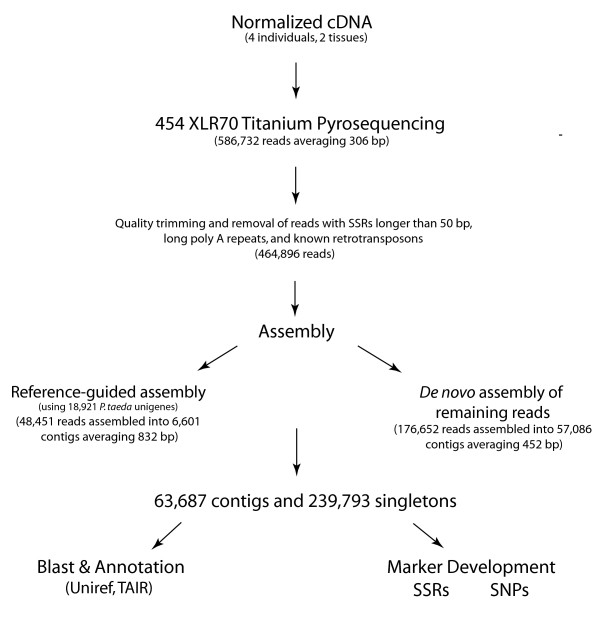
BACKGROUND: Massively parallel sequencing of cDNA is now an efficient route for generating enormous sequence collections that represent expressed genes. This approach provides a valuable starting point for characterizing functional genetic variation in non-model organisms, especially where whole genome sequencing efforts are currently cost and time prohibitive. The large and complex genomes of pines (Pinus spp.) have hindered the development of genomic resources, despite the ecological and economical importance of the group. While most genomic studies have focused on a single species (P. taeda), genomic level resources for other pines are insufficiently developed to facilitate ecological genomic research. Lodgepole pine (P. contorta) is an ecologically important foundation species of montane forest ecosystems and exhibits substantial adaptive variation across its range in western North America. Here we describe a sequencing study of expressed genes from P. contorta, including their assembly and annotation, and their potential for molecular marker development to support population and association genetic studies. RESULTS: We obtained 586,732 sequencing reads from a 454 GS XLR70 Titanium pyrosequencer (mean length: 306 base pairs). A combination of reference-based and de novo assemblies yielded 63,657 contigs, with 239,793 reads remaining as singletons. Based on sequence similarity with known proteins, these sequences represent approximately 17,000 unique genes, many of which are well covered by contig sequences. This sequence collection also included a surprisingly large number of retrotransposon sequences, suggesting that they are highly transcriptionally active in the tissues we sampled. We located and characterized thousands of simple sequence repeats and single nucleotide polymorphisms as potential molecular markers in our assembled and annotated sequences. High quality PCR primers were designed for a substantial number of the SSR loci, and a large number of these were amplified successfully in initial screening. CONCLUSIONS: This sequence collection represents a major genomic resource for P. contorta, and the large number of genetic markers characterized should contribute to future research in this and other pines. Our results illustrate the utility of next generation sequencing as a basis for marker development and population genomics in non-model species.
Overview
The claims and statistics of this paper haven’t been checked yet.
Free: it reads the open-access text and checks the first 5 claims that cite a source we can check. Create a free account to check every claim.
Integrity signals
Registry
Cites
Statistics
Figures


Verification
Claims the paper makes
The claims and statistics of this paper haven’t been checked yet.
Free: it reads the open-access text and checks the first 5 claims that cite a source we can check. Create a free account to check every claim.
Claims other papers make about this one
Each is checked against this paper’s own text: does it say what the citing paper says it does?
The cited source says what the claim attributes to it.
In the citing paper
“Furthermore, large collections of ESTs have proven invaluable for functional genomics and molecular marker development [9-13].”
The cited source says what the claim attributes to it.
In the citing paper
“Due to its long read length and appearance ahead of the other two platforms, Roche GS FLX has been the most widely used platform for de novo transcriptome sequencing in many organisms, such as chestnut [19], pine [10], olive [44], ginseng [20], A. thaliana [45,46], maize [47], Artemisia annua [48], fish [18], insects [49,50], and worms [17].”
The cited source says what the claim attributes to it.
In the citing paper
“The newly developed high throughput sequencing technology, i.e. Next Generation Sequencing (NGS), including the Roche/454 Genome Sequencer FLX Instrument, the ABI SOLiD System, and the Illumina Genome Analyser, is a powerful and cost-efficient tool for advanced research in many areas, including re-sequencing, microRNA expression profiling, DNA methylation, especially de novo transcriptome”
The cited source says what the claim attributes to it.
In the citing paper
“Like [10,19], if we assumed that the number of genes in sweetpotato was commensurate with that in Arabidopsis (25,000 genes, [62]), our annotated unigenes (20,755 genes with unique protein accession numbers) would likely represent more than 80% of genes in sweetpotato.”
The cited source says what the claim attributes to it.
In the citing paper
“Nonetheless, only 40% of reads were assembled into unigenes, which is less than that reported for 454 transciptome assemblies (e.g., 88% [11], 90% [17], 48% [10]).”
Self-check
Percentages, sums and reported differences re-computed from the paper’s own numbers.
The self-check needs the paper’s full text.
Citations
Cites
Gapped BLAST and PSI-BLAST: a new generation of protein database search programs
Altschul, S. (1997) · Nucleic Acids Research · doi:10.1093/nar/25.17.3389 · Cited by 73,302 · cited 7×
“These contigs were then aligned to UniRef50 using BLASTx with an E value threshold of 10-4.”
MethodInfluentialProceedings of the National Academy of Sciences of the United States of America
Dowling, J. E., & Wald, G. (2009) · Nutrition Reviews · doi:10.1111/j.1753-4887.1981.tb06752.x · Cited by 17,893
The Proceedings of the National Academy of Sciences
Richards, J. W. (1915) · Science · doi:10.1126/science.42.1074.161 · Cited by 13,983
Conesa, A., Götz, S., García-Gómez, J. M., Terol, J., Talón, M., & Robles, M. (2005) · Bioinformatics · doi:10.1093/bioinformatics/bti610 · Cited by 11,495
Genome sequencing in microfabricated high-density picolitre reactors
Margulies, M., Egholm, M., Altman, W. E., Attiya, S., Bader, J. S., Bemben, L. A., Berka, J., Braverman, M. S., Chen, Y.-J., Chen, Z., et al. (2005) · Nature · doi:10.1038/nature03959 · Cited by 7,693 · cited 2×
“For example 30-50% of the mammalian genome is composed of retroelements [9], and they comprise a substantial proportion of most plant genomes [49,50].”
BackgroundMethodMolecular Markers, Natural History and Evolution
Avise, J. C. (1994) · Springer eBooks · doi:10.1007/978-1-4615-2381-9 · Cited by 5,242
Environmental genome shotgun sequencing of the sargasso sea
Venter, J. C., Remington, K., Heidelberg, J. F., Halpern, A. L., Rusch, D., Eisen, J. A., Wu, D., Paulsen, I., Nelson, K. E., Nelson, W., et al. (2004) · Science · doi:10.1126/science.1093857 · Cited by 4,376 · cited 1×
“Such findings point to the utility of largescale transcriptome sequencing and annotation for detecting parasites or symbionts present in sampled in tissues, just as is done more generally in environmental genomics [47].”
BackgroundThe evolutionary dynamics of repetitive DNA in eukaryotes
Charlesworth, B., Sniegowski, P., & Stephan, W. (1994) · Nature · doi:10.1038/371215a0 · Cited by 1,623 · cited 1×
“Retrotransposons are known to play a prominent role in the evolution of genome size and complexity across eukaryotes [48].”
BackgroundUniRef: comprehensive and non-redundant UniProt reference clusters
Suzek, B. E., Huang, H., McGarvey, P., Mazumder, R., & Wu, C. H. (2007) · Bioinformatics · doi:10.1093/bioinformatics/btm098 · Cited by 1,613
The power and promise of population genomics: from genotyping to genome typing
Luikart, G., England, P. R., Tallmon, D., Jordan, S., & Taberlet, P. (2003) · Nature Reviews Genetics · doi:10.1038/nrg1226 · Cited by 1,365 · cited 2×
“The thousands of SNP and SSR markers in our 454 ESTs should enable population genomic and gene-based association studies [53,66].”
Background
Research works printed but not linked: 1
- Lotan JE Baumgartner DM The role of cone serotiny in lodgepole pine forests Symposium Proceedings 1975 Washington State University, Pullman, Washington, USA 471 495
Cited by
Current trends in microsatellite genotyping
GUICHOUX, E., LAGACHE, L., WAGNER, S., CHAUMEIL, P., LÉGER, P., LEPAIS, O., LEPOITTEVIN, C., MALAUSA, T., REVARDEL, E., SALIN, F., et al. (2011) · Molecular Ecology Resources · doi:10.1111/j.1755-0998.2011.03014.x · Cited by 937
“In our survey, only one study reported the use of more than one genotype at the sequencing stage, but available polymorphism data were not used to select candidate SSRs (Parchman et al. 2010).”
BackgroundMethodInfluentialSNP Markers and Their Impact on Plant Breeding
Mammadov, J., Aggarwal, R., Buyyarapu, R., & Kumpatla, S. (2012) · International Journal of Plant Genomics · doi:10.1155/2012/728398 · Cited by 500
“This methodology was successfully applied in several plant genomes, including maize [23], canola [24], eucalyptus [25], sugarcane [26], tree species [27], wheat [28], avocado [29], and black currant [30].”
MethodZalapa, J. E., Cuevas, H., Zhu, H., Steffan, S., Senalik, D., Zeldin, E., McCown, B., Harbut, R., & Simon, P. (2012) · American Journal of Botany · doi:10.3732/ajb.1100394 · Cited by 471
Amberg, J. J., Goforth, R. R., & Sepúlveda, M. S. (2013) · Sexual Development · doi:10.1159/000354280 · Cited by 477
Genome‐wide association genetics of an adaptive trait in lodgepole pine
PARCHMAN, T. L., GOMPERT, Z., MUDGE, J., SCHILKEY, F. D., BENKMAN, C. W., & BUERKLE, C. A. (2012) · Molecular Ecology · doi:10.1111/j.1365-294x.2012.05513.x · Cited by 465
“We aligned the consensus sequences containing SNPs to 322 000 contig and singleton sequences from a Pinus contorta whole transcriptome sequencing project (Parchman et al. 2010) to assess the proportion of these sequences that might represent transcribed regions.”
MethodSelf-citation
Metadata
- Authors
- Parchman, T. L., Geist, K. S., Grahnen, J. A., Benkman, C. W., & Buerkle, C. A.
- Affiliations
- University of Wyoming (US)
- Beloit College (US)
- Corresponding author
- Parchman, Thomas L
- Venue
- BMC Genomics
- Published
- 2010
- Volume
- 11
- Issue
- 1
- Pages
- 180
- ISSN
- 1471-2164 (ISSN-L)
- PMC
- PMC2851599
- OpenAlex
- W2123405262
- Cited by
- 446
- References
- 73
- Citations by year
- 2026: 3 · 2025: 5 · 2024: 4 · 2023: 7 · 2022: 5 · 2021: 17 · 2020: 28 · 2019: 15 · 2018: 24 · 2017: 20 · 2016: 32 · 2015: 37 · 2014: 52 · 2013: 59 · 2012: 74
- FWCI
- 25.64
- Type
- journal article
- Language
- en
- Open access
- gold
- doi.org
- Licence
- cc-by
- Locations
- BMC Genomics (publishedVersion, cc-by)
- Europe PMC (PubMed Central) (publishedVersion, cc-by)
- PubMed Central (publishedVersion, cc-by)
- PubMed (publishedVersion)
- DOAJ (DOAJ: Directory of Open Access Journals) (submittedVersion)
- Funders
- National Science Foundation (0344503, 0701757)
- University of Wyoming
- National Institutes of Health
- Division of Biological Infrastructure
- Division of Environmental Biology
- Topics
- Life Sciences › Biochemistry, Genetics and Molecular Biology › Molecular Biology › Genomics and Phylogenetic Studies
- Life Sciences › Biochemistry, Genetics and Molecular Biology › Genetics › Genetic Mapping and Diversity in Plants and Animals
- Life Sciences › Biochemistry, Genetics and Molecular Biology › Genetics › Genetic diversity and population structure
- Keywords
- lodgepole pine, expressed genes, transcriptome assembly, genome annotation, molecular markers, microsatellite markers, single nucleotide polymorphisms, retrotransposons, population genomics, non-model organisms, cDNA sequencing
- MeSH terms
- Genetic Markers, Trees, Genes, Plant, Sequence Analysis, DNA, DNA Primers, DNA, Complementary, Minisatellite Repeats, Retroelements, DNA, Plant, Genome, Plant, Expressed Sequence Tags, Contig Mapping, Polymorphism, Single Nucleotide, Gene Expression Profiling, Genomics, Pinus
About these checks
Registry, retraction, Cites and statistics results are computed, not judged, with one exception: a printed reference that no index lists is read once by a model before it counts as a citation error. Claims are extracted by a model and kept only when their quote appears verbatim in the text; each cited source is then checked, with a model’s help, for whether it says what the claim relies on. Those verdicts can be wrong — read the claim’s quote and the cited source before relying on one.
Statistics and arithmetic are recomputed, not judged.
Confidence bands are shown only for fields calibrated on our annotated test set. None is calibrated yet, so no band is shown.
What counts as a claim ›How we measure confidence ›How we check this ›
Are you an author, or do you see a problem with this page? Request a review
How to cite
Cite CoChat for the checks on this page, and the paper for its own findings.
- This page
- CoChat. (2026). Citation check: Transcriptome sequencing in an ecologically important tree species: assembly, annotation, and marker discovery. https://app.cochat.ai/papers/10.1186/1471-2164-11-180
- The paper
- Parchman, T. L., Geist, K. S., Grahnen, J. A., Benkman, C. W., & Buerkle, C. A. (2010). Transcriptome sequencing in an ecologically important tree species: assembly, annotation, and marker discovery. BMC Genomics. https://doi.org/10.1186/1471-2164-11-180
Data sources
Bibliographic data: Semantic Scholar, OpenAlex, Crossref.
Contains information from the Semantic Scholar Academic Graph Datasets, made available under the ODC Attribution License (ODC-BY 1.0).
Semantic Scholar’s data is described in: Kinney, R., et al. (2023). The Semantic Scholar Open Data Platform. arXiv:2301.10140.
