

A sweetpotato gene index established by de novo assembly of pyrosequencing and Sanger sequences and mining for gene-based microsatellite markers
Open accessThe DOI matches its Crossref record; 28 of the 28 references it cites were found in a registry or an index.
Abstract
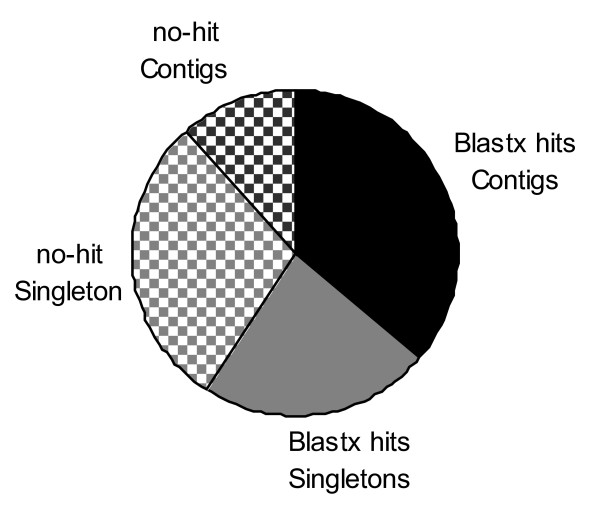
BACKGROUND: Sweetpotato (Ipomoea batatas (L.) Lam.), a hexaploid outcrossing crop, is an important staple and food security crop in developing countries in Africa and Asia. The availability of genomic resources for sweetpotato is in striking contrast to its importance for human nutrition. Previously existing sequence data were restricted to around 22,000 expressed sequence tag (EST) sequences and ~ 1,500 GenBank sequences. We have used 454 pyrosequencing to augment the available gene sequence information to enhance functional genomics and marker design for this plant species. RESULTS: Two quarter 454 pyrosequencing runs used two normalized cDNA collections from stems and leaves from drought-stressed sweetpotato clone Tanzania and yielded 524,209 reads, which were assembled together with 22,094 publically available expressed sequence tags into 31,685 sets of overlapping DNA segments and 34,733 unassembled sequences. Blastx comparisons with the UniRef100 database allowed annotation of 23,957 contigs and 15,342 singletons resulting in 24,657 putatively unique genes. Further, 27,119 sequences had no match to protein sequences of UniRef100database. On the basis of this gene index, we have identified 1,661 gene-based microsatellite sequences, of which 223 were selected for testing and 195 were successfully amplified in a test panel of 6 hexaploid (I. batatas) and 2 diploid (I. trifida) accessions. CONCLUSIONS: The sweetpotato gene index is a useful source for functionally annotated sweetpotato gene sequences that contains three times more gene sequence information for sweetpotato than previous EST assemblies. A searchable version of the gene index, including a blastn function, is available at http://www.cipotato.org/sweetpotato_gene_index.
Overview
The claims and statistics of this paper haven’t been checked yet.
Free: it reads the open-access text and checks the first 5 claims that cite a source we can check. Create a free account to check every claim.
Integrity signals
Registry
Cites
Statistics
Figures
Verification
Claims the paper makes
The claims and statistics of this paper haven’t been checked yet.
Free: it reads the open-access text and checks the first 5 claims that cite a source we can check. Create a free account to check every claim.
Claims other papers make about this one
Each is checked against this paper’s own text: does it say what the citing paper says it does?
The source backs part of the claim, not all of it — or backs it for a different population, condition or comparison.
In the citing paper
“The former used leaf and stem of an African landrace, and the latter used only the roots of a new edible variety as materials.”
From Digital Gene Expression Analysis Based on Integrated De Novo Transcriptome Assembly of Sweet Potato [Ipomoea batatas (L.) Lam.] (2012) · cites this paper as [11]
Experimental — accuracy not yet measuredThe source backs part of the claim, not all of it — or backs it for a different population, condition or comparison.
In the citing paper
“Researchers usually chose only one assembler to assembly a transcriptome [11], [12], [17]–[19].”
From Digital Gene Expression Analysis Based on Integrated De Novo Transcriptome Assembly of Sweet Potato [Ipomoea batatas (L.) Lam.] (2012) · cites this paper as [11]
Experimental — accuracy not yet measuredThe source backs part of the claim, not all of it — or backs it for a different population, condition or comparison.
In the citing paper
“Although the former released a sweet potato gene index, it was assembled with the existing ESTs, and the sequences mainly contained short open reading frames (ORFs) [11].”
From Digital Gene Expression Analysis Based on Integrated De Novo Transcriptome Assembly of Sweet Potato [Ipomoea batatas (L.) Lam.] (2012) · cites this paper as [11]
Experimental — accuracy not yet measuredThe cited source says what the claim attributes to it.
In the citing paper
“The sweet potato genes identified in this study are 18% and 40% more than previously reported by Schafleitner et al. [11] and Wang et al. [12], respectively.”
From Digital Gene Expression Analysis Based on Integrated De Novo Transcriptome Assembly of Sweet Potato [Ipomoea batatas (L.) Lam.] (2012) · cites this paper as [11]
The cited source says what the claim attributes to it.
In the citing paper
“The final assembly had more transcripts with longer ORFs than any single assembly and the recently released SPGI [11] (Table 2).”
From Digital Gene Expression Analysis Based on Integrated De Novo Transcriptome Assembly of Sweet Potato [Ipomoea batatas (L.) Lam.] (2012) · cites this paper as [11]
9 more claims about this paper
Create a free account to see every claim other papers make about this one.
Self-check
Percentages, sums and reported differences re-computed from the paper’s own numbers.
The self-check needs the paper’s full text.
Citations
Cites
Conesa, A., Götz, S., García-Gómez, J. M., Terol, J., Talón, M., & Robles, M. (2005) · Bioinformatics · doi:10.1093/bioinformatics/bti610 · Cited by 11,495
Pahlich, E., & Gerlitz, C. (1980) · Phytochemistry · doi:10.1016/0031-9422(80)85004-7 · Cited by 10,599 · cited 1×
“2). DNA extraction was done according to [ 28 ] for SSR analysis, and PCR”
MethodChevreux, B., Pfisterer, T., Drescher, B., Driesel, A. J., Müller, W. E. G., Wetter, T., & Suhai, S. (2004) · Genome Research · doi:10.1101/gr.1917404 · Cited by 1,050 · cited 1×
“However, only a few software packages claim to be suitable for hybrid assembly of the relatively short 454 reads with Sanger sequences [17-20].”
BackgroundBentley, D. R. (2006) · Current Opinion in Genetics & Development · doi:10.1016/j.gde.2006.10.009 · Cited by 803 · cited 1×
“It is widely used for genome resequencing [12], de novo sequencing of small genomes [e.”
MethodZhu, Y. Y., Machleder, E. M., Chenchik, A., Li, R., & Siebert, P. D. (2001) · BioTechniques · doi:10.2144/01304pf02 · Cited by 776 · cited 1×
“using the SMART approach [23], normalized according to [24], and amplified.”
MethodRapid transcriptome characterization for a nonmodel organism using 454 pyrosequencing
VERA, J. C., WHEAT, C. W., FESCEMYER, H. W., FRILANDER, M. J., CRAWFORD, D. L., HANSKI, I., & MARDEN, J. H. (2008) · Molecular Ecology · doi:10.1111/j.1365-294x.2008.03666.x · Cited by 714 · cited 1×
“, [13]], SNP detection [14,15], or transcriptome sequencing [16].”
BackgroundEvaluation of next generation sequencing platforms for population targeted sequencing studies
Harismendy, O., Ng, P. C., Strausberg, R. L., Wang, X., Stockwell, T. B., Beeson, K. Y., Schork, N. J., Murray, S. S., Topol, E. J., Levy, S., et al. (2009) · Genome Biology · doi:10.1186/gb-2009-10-3-r32 · Cited by 614 · cited 1×
“At low cost, it provides a huge amount of sequence information at relative low error frequency [11].”
BackgroundAggressive assembly of pyrosequencing reads with mates
Miller, J. R., Delcher, A. L., Koren, S., Venter, E., Walenz, B. P., Brownley, A., Johnson, J., Li, K., Mobarry, C., & Sutton, G. (2008) · Bioinformatics · doi:10.1093/bioinformatics/btn548 · Cited by 602 · cited 1×
“However, only a few software packages claim to be suitable for hybrid assembly of the relatively short 454 reads with Sanger sequences [17-20].”
BackgroundLow, J. W., Arimond, M., Osman, N., Cunguara, B., Zano, F., & Tschirley, D. (2007) · The Journal of Nutrition · doi:10.1093/jn/137.5.1320 · Cited by 561
The TIGR Gene Indices: analysis of gene transcript sequences in highly sampled eukaryotic species
Quackenbush, J. (2001) · Nucleic Acids Research · doi:10.1093/nar/29.1.159 · Cited by 460 · cited 1×
“nil, a near relative of sweetpotato, a gene index has been established based on 61,199 EST and 133 mature transcripts (ETs), resulting in 11,754 tentative consensus sequences (contigs), 9,721 EST-singletons, and 39 ET singletons [22], http://compbio.”
BackgroundSNP discovery via 454 transcriptome sequencing
Barbazuk, W. B., Emrich, S. J., Chen, H. D., Li, L., & Schnable, P. S. (2007) · The Plant Journal · doi:10.1111/j.1365-313x.2007.03193.x · Cited by 405 · cited 1×
“, [13]], SNP detection [14,15], or transcriptome sequencing [16].”
BackgroundA Novel Method for SNP Detection Using a New Duplex-Specific Nuclease From Crab Hepatopancreas
Shagin, D. A., Rebrikov, D. V., Kozhemyako, V. B., Altshuler, I. M., Shcheglov, A. S., Zhulidov, P. A., Bogdanova, E. A., Staroverov, D. B., Rasskazov, V. A., & Lukyanov, S. (2002) · Genome Research · doi:10.1101/gr.547002 · Cited by 253 · cited 1×
“using the SMART approach [23], normalized according to [24], and amplified.”
Methodda Maia, L. C., Palmieri, D. A., de Souza, V. Q., Kopp, M. M., de Carvalho, F. I. F., & Costa de Oliveira, A. (2008) · International Journal of Plant Genomics · doi:10.1155/2008/412696 · Cited by 231
Chlamydia trachomatis: Genome sequence analysis of lymphogranuloma venereum isolates
Thomson, N. R., Holden, M. T. G., Carder, C., Lennard, N., Lockey, S. J., Marsh, P., Skipp, P., O’Connor, C. D., Goodhead, I., Norbertzcak, H., et al. (2008) · Genome Research · doi:10.1101/gr.7020108 · Cited by 227 · cited 1×
“, [13]], SNP detection [14,15], or transcriptome sequencing [16].”
BackgroundThe TIGR Plant Transcript Assemblies database
Childs, K. L., Hamilton, J. P., Zhu, W., Ly, E., Cheung, F., Wu, H., Rabinowicz, P. D., Town, C. D., Buell, C. R., & Chan, A. P. (2007) · Nucleic Acids Research · doi:10.1093/nar/gkl785 · Cited by 188
Sequence characterization of microsatellites in diploid and polyploid Ipomoea
Buteler, M. I., Jarret, R. L., & LaBonte, D. R. (1999) · Theoretical and Applied Genetics · doi:10.1007/s001220051216 · Cited by 175 · cited 1×
“php/products/arrays/?task=details&species=Sweetpotato%20Microarray%20PICME_SWP_15K_1, linkage maps [4,5], and some 130 published microsatellite (SSR) markers [6-10].”
BackgroundRobust and highly informative microsatellite-based genetic identity kit for potato
Ghislain, M., Núñez, J., del Rosario Herrera, M., Pignataro, J., Guzman, F., Bonierbale, M., & Spooner, D. M. (2009) · Molecular Breeding · doi:10.1007/s11032-008-9240-0 · Cited by 173 · cited 1×
“The obtained fragments were separated on a Li-Cor 4300 (LI-COR Biosciences, Lincoln, NE, USA) and analyzed essentially as described in [ 29 ].”
MethodBundock, P. C., Eliott, F. G., Ablett, G. A., Benson, A. D., Casu, R. E., Aitken, K. S., & Henry, R. J. (2009) · Plant Biotechnology Journal · doi:10.1111/j.1467-7652.2009.00401.x · Cited by 169 · cited 1×
“, [13]], SNP detection [14,15], or transcriptome sequencing [16].”
BackgroundSweetpotato in Sub-Saharan Africa
Low, J. W., Lynam, J., Lemaga, B., Crissman, C. C., Barker, I., Thiele, G., Namanda, S., Wheatley, C., & Andrade, M. (2009) · Springer eBooks · doi:10.1007/978-1-4020-9475-0_16 · Cited by 159 · cited 1×
“Main reasons for low yields in Africa are, besides lack of high-quality planting material, fertilizers and irrigation, prevailing insect pests, and viral diseases [3].”
BackgroundA genetic linkage map of sweetpotato [Ipomoea batatas (L.) Lam.] based on AFLP markers
Kriegner, A., Cervantes-Flores, J. C., Burg, K., Mwanga, R. O. M., & Zhang, D. (2003) · Molecular Breeding · doi:10.1023/a:1022870917230 · Cited by 132
Cervantes-Flores, J. C., Yencho, G. C., Kriegner, A., Pecota, K. V., Faulk, M. A., Mwanga, R. O. M., & Sosinski, B. (2007) · Molecular Breeding · doi:10.1007/s11032-007-9150-6 · Cited by 112 · cited 1×
“php/products/arrays/?task=details&species=Sweetpotato%20Microarray%20PICME_SWP_15K_1, linkage maps [4,5], and some 130 published microsatellite (SSR) markers [6-10].”
BackgroundBlast2GO goes grid: developing a grid-enabled prototype for functional genomics analysis.
Aparício, G., Götz, S., Conesa, A., Segrelles, D., Blanquer, I., García, J. M., Hernández, V., Robles, M., & Talón, M. (2006) · PubMed · Cited by 71
Next generation transcriptomes for next generation genomes using est2assembly
Papanicolaou, A., Stierli, R., ffrench-Constant, R. H., & Heckel, D. G. (2009) · BMC Bioinformatics · doi:10.1186/1471-2105-10-447 · Cited by 69 · cited 1×
“However, only a few software packages claim to be suitable for hybrid assembly of the relatively short 454 reads with Sanger sequences [17-20].”
BackgroundDevelopment and Characterization of Microsatellite Markers in Sweetpotato
Hu, J., Nakatani, M., Mizuno, K., & Fujimura, T. (2004) · Breeding Science · doi:10.1270/jsbbs.54.177 · Cited by 67 · cited 2×
“Microsatellites for sweetpotato have been identified in ESTs previously [10].”
BackgroundMicrosatellite analysis of genetic diversity in sweetpotato varieties from Latin America.
Zhang, D. P., Carbajulca, D., Ojeda, L., Rossel, G., Milla‐Lewis, S. R., Herrera, C., & Ghislain, M. (2001) · Cited by 44
Self-citationPAVE: Program for assembling and viewing ESTs
Soderlund, C. A., Johnson, E., Bomhoff, M., & Descour, A. S. (2009) · BMC Genomics · doi:10.1186/1471-2164-10-400 · Cited by 41 · cited 1×
“However, only a few software packages claim to be suitable for hybrid assembly of the relatively short 454 reads with Sanger sequences [17-20].”
BackgroundTseng, Y. T., Lo, H.-F., & Hwang, S. (2002) · Chinese Culture University Repository · Cited by 36
Development and characterization of microsatellite markers in sweetpotato
胡, 景. (2004) · Terrestrial Environment Research Center (University of Tsukuba) · Cited by 23
Research works printed but not linked: 2
- Jarret RL Bowen N Simple sequence repeats (SSRs) for sweet potato germplasm characterization Plant Gen Res Newsletter 1994 100 9 11
- Doyle JJ Doyle JL A rapid DNA isolation procedure for small quantities of fresh leaf tissue Phytochem Bulletin 1987 19 11 15
Cited by
Zalapa, J. E., Cuevas, H., Zhu, H., Steffan, S., Senalik, D., Zeldin, E., McCown, B., Harbut, R., & Simon, P. (2012) · American Journal of Botany · doi:10.3732/ajb.1100394 · Cited by 471
Wang, Z., Fang, B., Chen, J., Zhang, X., Luo, Z., Huang, L., Chen, X., & Li, Y. (2010) · BMC Genomics · doi:10.1186/1471-2164-11-726 · Cited by 433
“In addition, to date, only about 300 SSR markers were developed for sweetpotato [4-6].”
BackgroundHaplotype-resolved sweet potato genome traces back its hexaploidization history
Yang, J., Moeinzadeh, M.-H., Kuhl, H., Helmuth, J., Xiao, P., Haas, S., Liu, G., Zheng, J., Sun, Z., Fan, W., et al. (2017) · Nature Plants · doi:10.1038/s41477-017-0002-z · Cited by 370
Application of Genomic Tools in Plant Breeding
M. Perez-de-Castro, A., Vilanova, S., Canizares, J., Pascual, L., M. Blanca, J., J. Diez, M., Prohens, J., & Pico, B. (2012) · Current Genomics · doi:10.2174/138920212800543084 · Cited by 280
Firon, N., LaBonte, D., Villordon, A., Kfir, Y., Solis, J., Lapis, E., Perlman, T., Doron-Faigenboim, A., Hetzroni, A., Althan, L., et al. (2013) · BMC Genomics · doi:10.1186/1471-2164-14-460 · Cited by 182
“The sweetpotato root transcript sequences generated in this study thus add to the recently accumulated sweetpotato sequences [18-21] which can be used for the discovery of new genes involved in root development and functioning and in the initiation of SR formation.”
BackgroundSelf-citation
Metadata
- Authors
- Schafleitner, R., Tincopa, L. R., Palomino, O., Rossel, G., Robles, R. F., Alagon, R., Rivera, C., Quispe, C., Rojas, L., Pacheco, J. A., Solis, J., Cerna, D., Young Kim, J., Hou, J., & Simon, R.
- Affiliations
- International Potato Center (PE)
- Louisiana State University (US)
- Corresponding author
- Schafleitner, Roland
- Venue
- BMC Genomics
- Published
- 2010-10-26
- Volume
- 11
- Issue
- 1
- Pages
- 604-604
- ISSN
- 1471-2164 (ISSN-L)
- PMC
- PMC3017860
- OpenAlex
- W2130605589
- Cited by
- 95
- References
- 28
- Citations by year
- 2025: 1 · 2024: 3 · 2023: 1 · 2022: 3 · 2021: 3 · 2020: 16 · 2019: 5 · 2018: 4 · 2017: 17 · 2016: 8 · 2015: 8 · 2014: 8 · 2013: 5 · 2012: 5
- FWCI
- 2.35
- Type
- journal article
- Language
- en
- Open access
- gold
- doi.org
- Licence
- cc-by
- creativecommons.org/licenses/by/2.0 (tdm)
- Locations
- BMC Genomics (publishedVersion, cc-by)
- PubMed Central (publishedVersion, cc-by)
- PubMed (publishedVersion)
- CGSPace A Repository of Agricultural Research Outputs (Consultative Group for International Agricultural Research) (submittedVersion, other-oa)
- DOAJ (DOAJ: Directory of Open Access Journals) (submittedVersion)
- Greater South Information System
- Topics
- Life Sciences › Biochemistry, Genetics and Molecular Biology › Molecular Biology › Genomics and Phylogenetic Studies
- Life Sciences › Biochemistry, Genetics and Molecular Biology › Genetics › Genetic Mapping and Diversity in Plants and Animals
- Life Sciences › Agricultural and Biological Sciences › Horticulture › Cocoa and Sweet Potato Agronomy
- Keywords
- Ipomoea batatas, gene index, de novo genome assembly, 454 pyrosequencing, expressed sequence tags, genome annotation, drought stress, functional genomics, marker-assisted selection, Ipomoea trifida
- MeSH terms
- Base Sequence, Temperature, Genes, Plant, Sequence Analysis, DNA, Microsatellite Repeats, Expressed Sequence Tags, Contig Mapping, Ipomoea batatas, Data Mining, Molecular Sequence Annotation
About these checks
Registry, retraction, Cites and statistics results are computed, not judged, with one exception: a printed reference that no index lists is read once by a model before it counts as a citation error. Claims are extracted by a model and kept only when their quote appears verbatim in the text; each cited source is then checked, with a model’s help, for whether it says what the claim relies on. Those verdicts can be wrong — read the claim’s quote and the cited source before relying on one.
Statistics and arithmetic are recomputed, not judged.
Confidence bands are shown only for fields calibrated on our annotated test set. None is calibrated yet, so no band is shown.
What counts as a claim ›How we measure confidence ›How we check this ›
Are you an author, or do you see a problem with this page? Request a review
Data sources
Bibliographic data: Semantic Scholar, OpenAlex, Crossref.
Contains information from the Semantic Scholar Academic Graph Datasets, made available under the ODC Attribution License (ODC-BY 1.0).
Semantic Scholar’s data is described in: Kinney, R., et al. (2023). The Semantic Scholar Open Data Platform. arXiv:2301.10140.
