

The DOI matches its Crossref record; 42 of the 43 references it cites were found in a registry or an index.
Cell-type specific gene expression profiles of leukocytes in human peripheral blood
Open accessAbstract
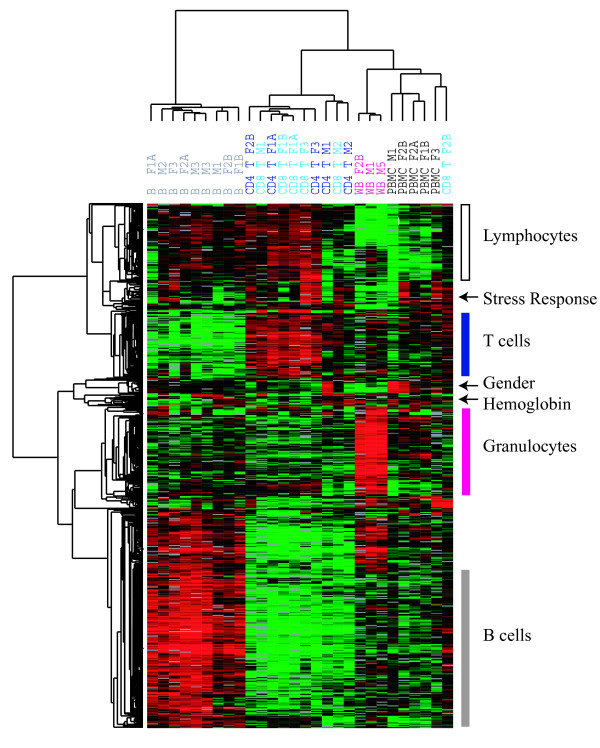
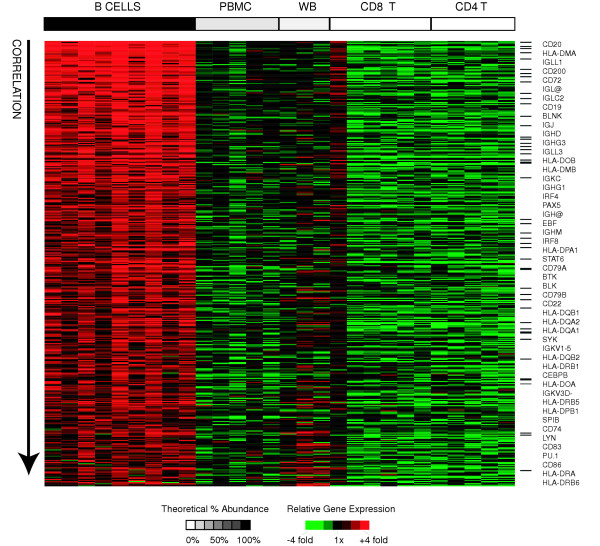
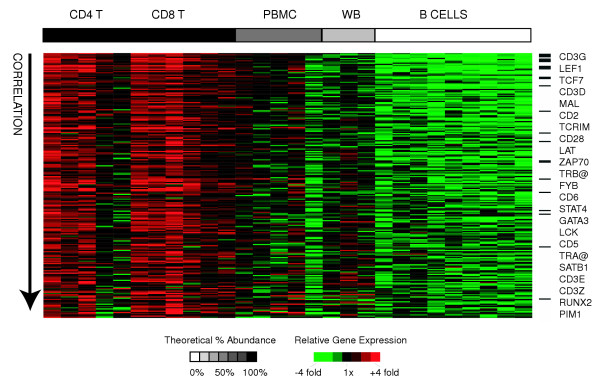
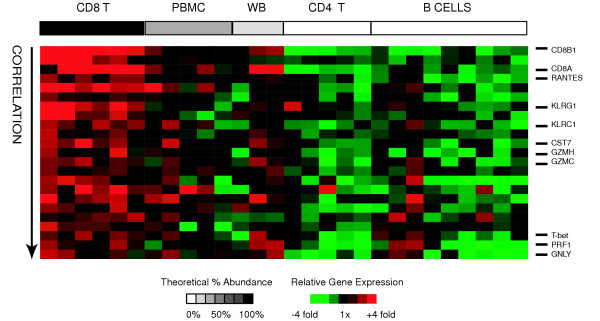
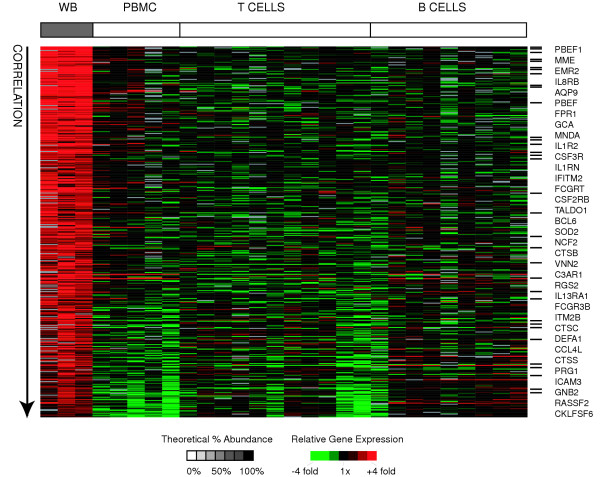
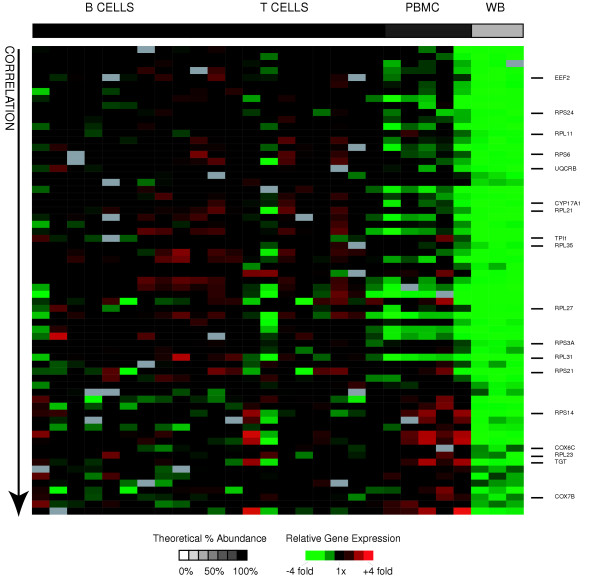
Background: Blood is a complex tissue comprising numerous cell types with distinct functions and corresponding gene expression profiles. We attempted to define the cell type specific gene expression patterns for the major constituent cells of blood, including B-cells, CD4+ T-cells, CD8+ T-cells, lymphocytes and granulocytes. We did this by comparing the global gene expression profiles of purified B-cells, CD4+ T-cells, CD8+ T-cells, granulocytes, and lymphocytes using cDNA microarrays. Results: Unsupervised clustering analysis showed that similar cell populations from different donors share common gene expression profiles. Supervised analyses identified gene expression signatures for B-cells (427 genes), T-cells (222 genes), CD8+ T-cells (23 genes), granulocytes (411 genes), and lymphocytes (67 genes). No statistically significant gene expression signature was identified for CD4+ cells. Genes encoding cell surface proteins were disproportionately represented among the genes that distinguished among the lymphocyte subpopulations. Lymphocytes were distinguishable from granulocytes based on their higher levels of expression of genes encoding ribosomal proteins, while granulocytes exhibited characteristic expression of various cell surface and inflammatory proteins. Conclusion: The genes comprising the cell-type specific signatures encompassed many of the genes already known to be involved in cell-type specific processes, and provided clues that may prove useful in discovering the functions of many still unannotated genes. The most prominent feature of the cell type signature genes was the enrichment of genes encoding cell surface proteins, perhaps reflecting the importance of specialized systems for sensing the environment to the physiology of resting leukocytes.
Overview
The claims and statistics of this paper haven’t been checked yet.
Run the check — free, no account needed. It reads the open-access text and checks the sources it cites.
Integrity signals
Registry
Cites
Statistics
Figures
Verification
Claims the paper makes
The claims and statistics of this paper haven’t been checked yet.
Run the check — free, no account needed. It reads the open-access text and checks the sources it cites.
Claims other papers make about this one
Each is checked against this paper’s own text: does it say what the citing paper says it does?
The check wasn’t confident either way, so it gives no verdict — never disputed.
In the citing paper
“Inspired by models and algorithms developed for detecting contamination in DNA sequencing18, demuxlet is fast, accurate, scalable, and compatible with standard input formats17, 19, 20.”
From Multiplexed droplet single-cell RNA-sequencing using natural genetic variation (2018) · cites this paper as [19]
Experimental — accuracy not yet measured
Self-check
Percentages, sums and reported differences re-computed from the paper’s own numbers.
The self-check needs the paper’s full text.
Citations
Cites
Gene Ontology: tool for the unification of biology
Ashburner, M., Ball, C. A., Blake, J. A., Botstein, D., Butler, H., Cherry, J. M., Davis, A. P., Dolinski, K., Dwight, S. S., Eppig, J. T., et al. (2000) · Nature Genetics · doi:10.1038/75556 · Cited by 43,206
Harrison's Principles of Internal Medicine.
(1988) · Annals of Internal Medicine · doi:10.7326/0003-4819-108-3-499_2 · Cited by 12,528
In silico prediction of protein-protein interactions in human macrophages
Souiai, O., Guerfali, F. Z., Miled, S. B., Brun, C., & Benkahla, A. (2014) · BMC Research Notes · doi:10.1186/1756-0500-7-157 · Cited by 10,785
Significance analysis of microarrays applied to the ionizing radiation response
Tusher, V. G., Tibshirani, R., & Chu, G. (2001) · Proceedings of the National Academy of Sciences · doi:10.1073/pnas.091062498 · Cited by 10,568
Distinct types of diffuse large B-cell lymphoma identified by gene expression profiling
Alizadeh, A. A., Eisen, M. B., Davis, R. E., Ma, C., Lossos, I. S., Rosenwald, A., Boldrick, J. C., Sabet, H., Tran, T., Yu, X., et al. (2000) · Nature · doi:10.1038/35000501 · Cited by 9,925
Self-citationHarrison's Principles of Internal Medicine
Somberg, J. C. (2005) · American Journal of Therapeutics · doi:10.1097/01.mjt.0000179344.69594.75 · Cited by 2,123
Identifying biological themes within lists of genes with EASE
Hosack, D. A., Dennis, G., Sherman, B. T., Lane, H. C., & Lempicki, R. A. (2003) · Genome biology · doi:10.1186/gb-2003-4-10-r70 · Cited by 1,961
[12] DNA arrays for analysis of gene expression
Eisen, M. B., & Brown, P. O. (1999) · Methods in enzymology on CD-ROM/Methods in enzymology · doi:10.1016/s0076-6879(99)03014-1 · Cited by 1,043
Self-citationIndividuality and variation in gene expression patterns in human blood
Whitney, A. R., Diehn, M., Popper, S. J., Alizadeh, A. A., Boldrick, J. C., Relman, D. A., & Brown, P. O. (2003) · Proceedings of the National Academy of Sciences · doi:10.1073/pnas.252784499 · Cited by 775
Self-citationHigh-fidelity mRNA amplification for gene profiling
Wang, E., Miller, L. D., Ohnmacht, G. A., Liu, E. T., & Marincola, F. M. (2000) · Nature Biotechnology · doi:10.1038/74546 · Cited by 675
Research works printed but not linked: 1
- Kuby J: Immunology. 1997, W. H. Freeman and Company, 3
Cited by
Sorted by citations
Phenotypic and molecular characterization of the claudin-low intrinsic subtype of breast cancer
Prat, A., Parker, J. S., Karginova, O. A., Fan, C., Livasy, C., Herschkowitz, J. I., He, X., & Perou, C. M. (2010) · Breast Cancer Research · doi:10.1186/bcr2635 · Cited by 2,290
A single-cell atlas of the peripheral immune response in patients with severe COVID-19
Wilk, A. J., Rustagi, A., Zhao, N. Q., Roque, J., Martínez-Colón, G. J., McKechnie, J. L., Ivison, G. T., Ranganath, T., Vergara, R., Hollis, T., et al. (2020) · Nature Medicine · doi:10.1038/s41591-020-0944-y · Cited by 1,493
Multiplexed droplet single-cell RNA-sequencing using natural genetic variation
Kang, H. M., Subramaniam, M., Targ, S., Nguyen, M., Maliskova, L., McCarthy, E., Wan, E., Wong, S., Byrnes, L., Lanata, C. M., et al. (2018) · Nature Biotechnology · doi:10.1038/nbt.4042 · Cited by 1,101
“However, for each cell type, the variance across individuals 22, 30 is also higher than the variance across synthetic replicates (Lin’s concordance = 0.007–0.20) suggesting additional inter-individual variability not due to cell type composition (Supplementary Fig.”
BackgroundInfluentialBroz, M. L., Binnewies, M., Boldajipour, B., Nelson, A. E., Pollack, J. L., Erle, D. J., Barczak, A., Rosenblum, M. D., Daud, A., Barber, D. L., et al. (2014) · Cancer Cell · doi:10.1016/j.ccell.2014.09.007 · Cited by 1,207
Systematic comparison of single-cell and single-nucleus RNA-sequencing methods
Ding, J., Adiconis, X., Simmons, S. K., Kowalczyk, M. S., Hession, C. C., Marjanovic, N. D., Hughes, T. K., Wadsworth, M. H., Burks, T., Nguyen, L. T., et al. (2020) · Nature Biotechnology · doi:10.1038/s41587-020-0465-8 · Cited by 871
Metadata
- Authors
- Palmer, C., Diehn, M., Alizadeh, A. A., & Brown, P. O.
- Affiliations
- Stanford Medicine (US)
- Howard Hughes Medical Institute (US)
- Corresponding author
- Brown, Patrick O
- Venue
- BMC Genomics
- Published
- 2006-05-16
- Volume
- 7
- Issue
- 1
- Pages
- 115-115
- ISSN
- 1471-2164 (ISSN-L)
- PMC
- PMC1479811
- OpenAlex
- W2116830437
- Cited by
- 331
- References
- 43
- Citations by year
- 2026: 8 · 2025: 7 · 2024: 13 · 2023: 12 · 2022: 15 · 2021: 27 · 2020: 26 · 2019: 31 · 2018: 23 · 2017: 31 · 2016: 12 · 2015: 16 · 2014: 18 · 2013: 17 · 2012: 15
- FWCI
- 3.26
- Type
- journal article
- Language
- en
- Open access
- gold
- doi.org
- Licence
- Locations
- BMC Genomics (publishedVersion, cc-by)
- PubMed Central (publishedVersion, cc-by)
- PubMed (publishedVersion)
- DOAJ (DOAJ: Directory of Open Access Journals) (submittedVersion)
- Funders
- Howard Hughes Medical Institute
- National Institute of General Medical Sciences (T32GM007365, GM 07365)
- Topics
- Life Sciences › Biochemistry, Genetics and Molecular Biology › Molecular Biology › Gene expression and cancer classification
- Life Sciences › Biochemistry, Genetics and Molecular Biology › Molecular Biology › Bioinformatics and Genomic Networks
- Life Sciences › Immunology and Microbiology › Immunology › T-cell and B-cell Immunology
- Keywords
- cell type-specific gene expression, leukocytes, B cells, CD4+ T cells, CD8+ T cells, granulocytes, lymphocytes, gene expression signatures, cell surface proteins, ribosomal proteins, inflammatory proteins, peripheral blood
- MeSH terms
- Adult, B-Lymphocytes, Blood Cells, Cell Separation, Female, Genes, Granulocytes, Humans, Leukocytes, Male, Middle Aged, Organ Specificity, CD4-Positive T-Lymphocytes, T-Lymphocyte Subsets, CD8-Positive T-Lymphocytes, Oligonucleotide Array Sequence Analysis, Gene Expression Profiling
About these checks
Registry, retraction, Cites and statistics results are computed, not judged, with one exception: a printed reference that no index lists is read once by a model before it counts as a citation error. Claims are extracted by a model and kept only when their quote appears verbatim in the text; each cited source is then checked, with a model’s help, for whether it says what the claim relies on. Those verdicts can be wrong — read the claim’s quote and the cited source before relying on one.
Statistics and arithmetic are recomputed, not judged.
Confidence bands are shown only for fields calibrated on our annotated test set. None is calibrated yet, so no band is shown.
What counts as a claim ›How we measure confidence ›How we check this ›
Are you an author, or do you see a problem with this page? Request a review
