

Prevalence and characterization of Salmonella enterica from the feces of cattle, poultry, swine and hedgehogs in Burkina Faso and their comparison to human Salmonella isolates
Open accessThe DOI matches its Crossref record; 46 of the 47 references it cites were found in a registry or an index.
Abstract
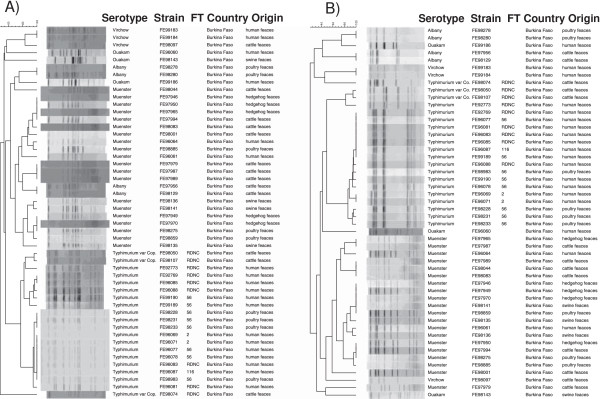
BACKGROUND: Production and wild animals are major sources of human salmonellosis and animals raised for food also play an important role in transmission of antimicrobial resistant Salmonella strains to humans. Furthermore, in sub-Saharan Africa non-typhoidal Salmonella serotypes are common bloodstream isolates in febrile patients. Yet, little is known about the environmental reservoirs and predominant modes of transmission of these pathogens. The purpose of this study was to discover potential sources and distribution vehicles of Salmonella by isolating strains from apparently healthy slaughtered food animals and wild hedgehogs and by determining the genetic relatedness between the strains and human isolates. For this purpose, 729 feces samples from apparently healthy slaughtered cattle (n = 304), poultry (n = 350), swine (n = 50) and hedgehogs (n = 25) were examined for the presence of Salmonella enterica in Burkina Faso. The isolates were characterized by serotyping, antimicrobial-susceptibility testing, phage typing, and pulsed-field gel electrophoresis (PFGE) with XbaI and BlnI restriction enzymes. RESULTS: Of the 729 feces samples, 383 (53%) contained Salmonella, representing a total of 81 different serotypes. Salmonella was present in 52% of the cattle, 55% of the poultry, 16% of the swine and 96% of the hedgehog feces samples. Antimicrobial resistance was detected in 14% of the isolates. S. Typhimurium isolates from poultry and humans (obtained from a previous study) were multiresistant to the same antimicrobials (ampicillin, chloramphenicol, streptomycin, sulfonamides and trimethoprim), had the same phage type DT 56 and were closely related in PFGE. S. Muenster isolates from hedgehogs had similar PFGE patterns as the domestic animals. CONCLUSIONS: Based on our results it seems that production and wild animals can share the same Salmonella serotypes and potentially transmit some of them to humans. As the humans and animals often live in close vicinity in Africa and the hygiene control of the meat retail chain is defective, high Salmonella carriage rates of the animals can pose a major public health risk in Burkina Faso. This underlines the necessity for a joint and coordinated surveillance and monitoring programs for salmonellosis in Africa.
Overview
The claims and statistics of this paper haven’t been checked yet.
Free: it reads the open-access text and checks the first 5 claims that cite a source we can check. Create a free account to check every claim.
Integrity signals
Registry
Cites
Statistics
Figures
Verification
Claims the paper makes
The claims and statistics of this paper haven’t been checked yet.
Free: it reads the open-access text and checks the first 5 claims that cite a source we can check. Create a free account to check every claim.
Claims other papers make about this one
Each is checked against this paper’s own text: does it say what the citing paper says it does?
The source backs part of the claim, not all of it — or backs it for a different population, condition or comparison.
In the citing paper
“Twelve of these 16 serotypes have already been detected in food animals or edible vegetables in Burkina Faso, between 2008 and 2018”
From Contamination of street food with multidrug-resistant Salmonella, in Ouagadougou, Burkina Faso (2021) · cites this paper as [32]
Experimental — accuracy not yet measured
Self-check
Percentages, sums and reported differences re-computed from the paper’s own numbers.
The self-check needs the paper’s full text.
Citations
Cites
Methods for dilution antimicrobial susceptibility tests for bacteria that grow aerobically
Ferraro, M. J. (2000) · Medical Entomology and Zoology · Cited by 17,254
Methods for dilution antimicrobial susceptibility tests for bacteria that grow aerobically
Ferraro, M. J. (2000) · Cited by 16,875
The Global Burden of Nontyphoidal Salmonella Gastroenteritis
Majowicz, S. E., Musto, J., Scallan, E., Angulo, F. J., Kirk, M., O’Brien, S. J., Jones, T. F., Fazil, A., & Hoekstra, R. M. (2010) · Clinical Infectious Diseases · doi:10.1086/650733 · Cited by 2,442 · cited 1×
“8 million cases of gastroenteritis each year, with 155 000 deaths [1].”
BackgroundWHO estimates of the causes of death in children
Bryce, J., Boschi-Pinto, C., Shibuya, K., & Black, R. E. (2005) · The Lancet · doi:10.1016/s0140-6736(05)71877-8 · Cited by 2,096
Invasive non-typhoidal salmonella disease: an emerging and neglected tropical disease in Africa
Feasey, N. A., Dougan, G., Kingsley, R. A., Heyderman, R. S., & Gordon, M. A. (2012) · The Lancet · doi:10.1016/s0140-6736(11)61752-2 · Cited by 1,014 · cited 1×
“Typhimurium isolates from poultry further in order to know if the invasive genotype also occurs in animals as the environmental reservoirs and host ranges of invasive salmonella strains in Africa are still unknown [35].”
BackgroundRole of Nonhost Environments in the Lifestyles of Salmonella and Escherichia coli
Winfield, M. D., & Groisman, E. A. (2003) · Applied and Environmental Microbiology · doi:10.1128/aem.69.7.3687-3694.2003 · Cited by 732 · cited 1×
“Hedgehog feces might infect both cattle and swine foraging freely, since Salmonella can persist in the environment for several months to more than a year [41,42].”
BackgroundHendriksen, R. S., Vieira, A. R., Karlsmose, S., Lo Fo Wong, D. M. A., Jensen, A. B., Wegener, H. C., & Aarestrup, F. M. (2011) · Foodborne Pathogens and Disease · doi:10.1089/fpd.2010.0787 · Cited by 633
The Isolation of Antibiotic-Resistant Salmonella from Retail Ground Meats
White, D. G., Zhao, S., Sudler, R., Ayers, S., Friedman, S., Chen, S., McDermott, P. F., McDermott, S., Wagner, D. D., & Meng, J. (2001) · New England Journal of Medicine · doi:10.1056/nejmoa010315 · Cited by 549 · cited 1×
“Multiresistant Salmonella may acquire their resistance genes from microbiota of production animals before being transmitted to humans through food chain [11,12].”
BackgroundKingsley, R. A., Msefula, C. L., Thomson, N. R., Kariuki, S., Holt, K. E., Gordon, M. A., Harris, D., Clarke, L., Whitehead, S., Sangal, V., et al. (2009) · Genome Research · doi:10.1101/gr.091017.109 · Cited by 540 · cited 1×
“This is a typical pattern found in the Salmonella strains with a subSaharan distinct genotype causing epidemic invasive disease [30].”
BackgroundBacteriophage-typing designations of Salmonella typhimurium
Anderson, E. S., Ward, L. R., de Saxe, M. J., & de Sa, J. D. H. (1977) · Journal of Hygiene · doi:10.1017/s0022172400056187 · Cited by 531 · cited 1×
“Copenhagen) were further phage typed [45].”
Research works printed but not linked: 7
- [4]4. Acha PN, Szyfres B: Salmonellosis. In Zoonoses and Communicable Diseases Common to Man and Animals, Volume I: Bacterioses and Mycoses. 3rd edition.
- [5]5. Edited by Acha PN, Szyfres B. Washington, D.C: Pan American Health Organization; 2001:233-246.
- [7]7. Thorns CJ: Bacterial food-borne zoonoses. Rev Sci Tech 2000, 19:226-239.
- [10]10. Glaser CA, Angulo FJ, Rooney J: Animal-associated opportunistic infections in HIV-infected persons. Clin Infect Dis 1994, 18:14-24.
- [11]11. Riley PY, Chomel BB: Hedgehog zoonoses. Emerg Infect Dis 2005, 11:1-5.
- [16]16. CDC: African pygmy hedgehog-associated salmonellosis. MMWR Morb Mortal Wkly Rep 1995, 44:462-463.
- [44]44. Kagambèga A, Martikainen O, Siitonen A, Traoré AS, Barro N, Haukka K: Prevalence of diarrheagenic Escherichia coli virulence genes in the feces of slaughtered cattle, chickens, and pigs in Burkina Faso. MicrobiologyOpen 2012, 1:276-284.
Cited by
Items 101–147 of 147
Antimicrobial Resistance Paradigm and One-Health Approach
Singh, K. S., Anand, S. K., Dholpuria, S., Sharma, J. K., & Shouche, Y. S. (2020) · Sustainable agriculture reviews · doi:10.1007/978-3-030-53024-2_1 · Cited by 8
Rouamba, S. S., Somda, N. S., Tapsoba, F., Somda, A. B., OUÉDRAOGO, M.-L. P., Kabré, E., Sangaré, L., & Savadogo, A. (2022) · Journal of Life Science and Biomedicine · doi:10.51145/jlsb.2022.1 · Cited by 6
“[16] reported the presence of Salmonella in the faeces of”
BackgroundChawla, K., Saxena, S. S., Agre, V. C., Sharma, A. K., Piveteau, P., & Sharma, S. (2025) · Food Research International · doi:10.1016/j.foodres.2025.117806 · Cited by 6
Bellil, Z., Mairi, A., Kendi, S., & Touati, A. (2023) · Future Microbiology · doi:10.2217/fmb-2022-0239 · Cited by 5
Gresse, R., Cappellozza, B. I., Capern, L. C., Knudsen, T. T. M., & Copani, G. (2024) · Journal of Animal Science · doi:10.1093/jas/skae304 · Cited by 5
Konaté, A., Guessennd, N., Kouadio, F. K., Dembelé, R., Kagambèga, A., Kouadio, I. K., Cissé, H., Ouattara, M. B., Kaboré, W. A. D., Bertin, T. K., et al. (2019) · Archives of Clinical Microbiology · doi:10.36648/1989-8436.10.2.90 · Cited by 4
“This resistance could be explained by contamination of children by direct contact between mothers and children due to lack of individual and collective hygiene rules and/or by contact with animals [18,19].”
BackgroundSelf-citationRamtahal, M. A., Amoako, D. G., Ismail, A., Bester, L. A., Abia, A. L. K., & Essack, S. Y. (2022) · Acta Tropica · doi:10.1016/j.actatropica.2022.106620 · Cited by 4
Chaudhary, P. K., Salam, S. M. A., Reza, M. A., & Ahaduzzaman, M. (2019) · DergiPark (Istanbul University) · Cited by 4
Bedekelabou, A. P., Oyetola, W. D., Abiezer, D. R., & Rianatou, B. A. (2021) · African Journal of Microbiology Research · doi:10.5897/ajmr2020.9446 · Cited by 7
“Ivory Coast Attien et al. (2013) Beef, pig and Poultry Carcass Healthy Vendors Staphylococcus spp. CASFM NO NO M Coulibaly et al. (2010) Poultry Carcass Healthy Abattoir/Vendors Salmonella spp. NS NO NO H Gblossi Bernadette et al. (2012) Poultry Organs/caeca Healthy Abattoir Camplylobacter spp. CLSI NO NO H Rene et al…”
BackgroundPerez, S., Barreto, M., & Retamal, P. (2021) · Austral journal of veterinary sciences · doi:10.4067/s0719-81322021000200133 · Cited by 3
A Quick Review of the Prevalence of Important Infectious Poultry Diseases all Around the World
Harat, S. G., & Ansari, F. (2023) · Recent Advances in Food Nutrition & Agriculture · doi:10.2174/012772574x273102231020111604 · Cited by 3
Metiner, K., Sığırcı, B. D., & Çetinkaya, H. (2023) · Acta Veterinaria Brno · doi:10.2754/avb202392030309 · Cited by 2
Microbial source tracking of human and animal fecal contamination in Ecuadorian households
Jesser, K. J., Albán, V., Lobos, A. E., Gallard-Gongora, J. F., Trueba, G. A., Lee, G. O., Eisenberg, J. N. S., Harwood, V. J., & Lévy, K. (2025) · Applied and Environmental Microbiology · doi:10.1128/aem.01694-25 · Cited by 3
Touglo, K., Sanni, Y. J., Amegan, L., Akolly, K., Nuto, Y., Halatoko, W. A., Sadji, A. Y., Bidjada, B., Djeri, B., Karou, S. D., et al. (2023) · Advances in Microbiology · doi:10.4236/aim.2023.1310032 · Cited by 3
Prevalence of Salmonella in Fresh Produce Tomatoes Sold in Open Market in Ouagadougou, Burkina Faso
Bognini, H., Kagambèga, A., Tiendrébéogo, W. P. B., Sawadogo, A., Barro, N., Knight-Jones, T., & Dione, M. M. (2023) · Food and Nutrition Sciences · doi:10.4236/fns.2023.1412079 · Cited by 4
Self-citationLocal and crossbred chicken production systems in the region of Ouagadougou, Burkina Faso
Tindano, K., & Savadogo, K. (2025) · Revue d’élevage et de médecine vétérinaire des pays tropicaux · doi:10.19182/remvt.37435 · Cited by 2
Survey of Salmonella infections in broiler farms in Iran during 2013-2014: a cross-sectional study
Ansari, F., Bokaie, S., Peighambari, S. M., Fallah, M. H., Tehrani, F., Abolfazl, R., Ghafouri, S. A., Maryam, S., & Pourjafar, H. (2020) · Iranian Journal of Microbiology · doi:10.18502/ijm.v12i5.4600 · Cited by 2
“ir infected with Salmonella is one of the major sources of Salmonellosis in humans (2); however, the origin and the modes of transmission of this infection are not well studied in developing countrie (1).”
BackgroundCige, H., Omotosho, O., & Ibrahim, A. M. (2023) · Journal of Applied Veterinary Sciences/Journal of Applied Veterinary Sciences · doi:10.21608/javs.2023.179843.1200 · Cited by 2
Epidemiology and Public Health Importance of Bovine Salmonellosis
Adere, T. (2023) · Journal Healthcare Treatment Development · doi:10.55529/jhtd.34.11.21 · Cited by 2
Zoonosis of Public Health Interest
Bastidas, G. (2022) · IntechOpen eBooks · doi:10.5772/intechopen.100934 · Cited by 2
Kahsay, A. G., Dejene, T. A., & Kassaye, E. (2025) · BMC Infectious Diseases · doi:10.1186/s12879-025-12092-x · Cited by 2
“[28], Italy (9.6”
InfluentialBarbarulo, S., Rampacci, E., Primavilla, S., Stefanetti, V., & Passamonti, F. (2026) · Antibiotics · doi:10.3390/antibiotics15010046 · Cited by 1
Karama, I., Valia, D., Tamber, S., Tahita, M. C., Lompo, P., Yougbaré, S., Rao, M., Flint, A., Weedmark, K. A., Garba, Z., et al. (2026) · Microorganisms · doi:10.3390/microorganisms14020294 · Cited by 1
“While some studies have explored avian Salmonella carriage and resistance in urban settings [22,24,25], data on rural populations remain limited.”
Self-citationFagbamila, I. O., Hernandez‐Segura, A., van den Beld, M. J. C., Mooijman, K. A., Orsini, M., Ajayi, O. T., Ngulukun, S. S., Jambalang, A. R., Sati, N. M., Emennaa, P. E., et al. (2022) · Microbiology Resource Announcements · doi:10.1128/mra.00489-22 · Cited by 1
“Moreover, Salmonella can lead to economic losses (3, 4).”
BackgroundHéma, A., Soulama, B. I., Sawadogo, J., Ouedraogo, A. Z., Hien, D., Nébié, I., Houard, S. A., Ouédraogo, A., Tiono, A. B., Sanou, M., et al. (2025) · BMC Microbiology · doi:10.1186/s12866-025-04515-1 · Cited by 3
“Furthermore, research has demonstrated genetic links between Salmonella strains from animal sources and human clinical isolates, highlighting the importance of zoonotic transmission in this setting [13, 17].”
Appiah, P. O., Tetteh‐Quarcoo, P. B., Ayeh-Kumi, P. F., Odoom, A., & Donkor, E. S. (2026) · Zoonoses and Public Health · doi:10.1111/zph.70063 · Cited by 1
“…2021; Gedeno et al. 2022; Ezeamagu et al. 2021; Cige et al. 2023; Tshitshi et al. 2020; Eguale et al. 2014; Touglo et al. 2025; Dekker et al. 2019; Kagambèga et al. 2021, 2013, 2011; Asfaw et al. 2023; Worku et al. 2022; Boko et al. 2013; Djuikoue et al. 2023; Tadesse et al. 2024; Bawa et al.…”
Bauerfeind, R., von Graevenitz, A., Kimmig, P., Schiefer, H. G., Schwarz, T. F., Slenczka, W., & Zahner, H. (2015) · ASM Press eBooks · doi:10.1128/9781555819262.ch2 · Cited by 2
Invasive Infections with Nontyphoidal Salmonella in Sub-Saharan Africa
Mahon, B. E., & Fields, P. I. (2016) · ASM Press eBooks · doi:10.1128/9781555819453.ch18 · Cited by 2
Jibril, A. H., Dalsgaard, A., Okeke, I. N., Ibrahim, A., & Olsen, J. E. (2024) · Journal of Applied Microbiology · doi:10.1093/jambio/lxae293 · Cited by 2
Edward, K., Ibekwe, V. I., Amadi, E. S., & Umeh, S. I. (2021) · Bacterial Empire · doi:10.36547/be.262 · Cited by 1
“Sources and modes of transmission of non-typhoidal Salmonella are not well understood in Africa due to absence of coordinated natural epidemiological surveillance systems (Kagambega et al., 2013).”
BackgroundHassan, E. R., & Alhatami, A. O. (2019) · Kufa Journal For Veterinary Medical Sciences · doi:10.36326/kjvs/2019/v10i13331 · Cited by 1
“done in Gambia and Burkina Faso observed relatively high prevalence (67% and 55% respectively) (21, 22).”
BackgroundReview on Prevalence and Antimicrobial Resistance of Poultry Salmonella in Ethiopia
Haile, T. (2023) · International Journal of Zoology and Animal Biology · doi:10.23880/izab-16000542 · Cited by 2
Risk-based tools to prevent excreta-bornedisease transmission in semi-arid ruralcommunities
Peres, M. R. (2017) · Cited by 1
Prevalence and antimicrobial resistance of animal Salmonellosis in EthiopiaPreprint
Kahsay, A. G. (2020) · Research Square · doi:10.21203/rs.3.rs-16482/v1
“Salmonella was isolated from 383 (53%) of the total of 729 fecal samples including 159 (52%) of the cattle feces, 192 (55%) of the chicken feces, 8 (16%) of the swine feces and 24 (96%) of the hedgehog feces in Burkinafaso (27).”
BackgroundIweriebor, B. C., Egbule, O. S., Igwaran, A., & Obi, L. C. (2021) · Malaysian Journal of Microbiology · doi:10.21161/mjm.211115 · Cited by 2
Serovariedades de Salmonella sp. en brotes de tifosis aviar ocurridos en ponedoras comerciales
Soria, M. (2021) · El Servicio de Difusión de la Creación Intelectual (National University of La Plata) · doi:10.35537/10915/123664
Severe Infant Meningoencephalitis Caused by Salmonella Apeyeme: A Case Report
Srisingh, K., Srijuntongsiri, S., Apiraknapanon, Y., Chuenkeson, T., Chinnarakbumrung, R., & Phuaksaman, C. (2021) · Infectious Microbes & Diseases · doi:10.1097/im9.0000000000000074
Taylor-Robinson, A. W., & Omitola, O. O. (2022) · IntechOpen eBooks · doi:10.5772/intechopen.106142 · Cited by 2
Hasan, M. I., Islam, M. S., Ansari, W. K., Chowdhury, G. A., Das, S., & Anower, A. K. M. M. (2021) · Journal of Bioscience and Agriculture Research · doi:10.18801/jbar.280221.289
Ezzat, M., Youssef, F., Eid, A., & Hashem, M. A. (2024) · Advances in Animal and Veterinary Sciences · doi:10.17582/journal.aavs/2024/12.s1.310.319
Baghbadorani, M. K., Lotfollahzadeh, S., Sasani, F., خانی, ف. م., & Zafari, M. (2025) · SSRN Electronic Journal · doi:10.2139/ssrn.5379214
Circulating of Salmonella Strains in West Africa: Lacks of Surveillance and Research
Solange, K.-N., Malatala, N. M. E., Bernadette, G. G., Monique, A.-S. A., Romuald, K. C., Ouattara, Z., Emmanuella, A., Barro, N., & Germain, K. T. (2025) · IntechOpen eBooks · doi:10.5772/intechopen.1012676
Self-citationKpoda, D. S., Somda, N. S., Compaoré, M. K. A., Bockarie, Y. M., Tankoano, A., Andjibaye, N. M., & Dabiré, A. M. (2025) · Revista Argentina de Microbiología · doi:10.1016/j.ram.2025.11.003
Das, L. M., Narvaez, D. G. P., Taechachokevivat, N., Kimball, A. D., Neves, R. C., & Slizovskiy, I. B. (2026) · bioRxiv (Cold Spring Harbor Laboratory) · doi:10.64898/2026.06.12.731891
Drissa, Z., Yameogo, V., Meda, R. N.-T., Sanou, S., Koama, B. K., Yerbanga, R. S., Kam, S. E., Zongo, E., Gnada, K., Ouédraogo, G. A., et al. (2026) · BMC Microbiology · doi:10.1186/s12866-026-05394-w
Séré, A. P., Sanou, A., Roamba, E. N., Ouattara, N., Dakuyo, R., Kaboré, K., Konaté, K., Kaboré, D., & Dicko, M. H. (2026) · Environmental Monitoring and Assessment · doi:10.1007/s10661-026-16056-9
“…food safety and exposure surveillance studies conducted in low-resource settings in sub-Saharan Africa (Degaga et al., 2022; Dinede et al., 2023; Kagambèga et al., 2013) and does not invalidate the prevalence estimates, which rest on a standardised culture-based protocol with selective…”
Dongmo, M., Nji, A. M., Bughe, R. N., Tah, C. F., Mbacham, W. F., & Kamdem, S. L. S. (2026) · MicrobiologyOpen · doi:10.1002/mbo3.70441
“…the Lorenz formula n = with the following parameters, Z (1 − a /2) as a standard normal variable (1.96) at 5%, assuming a Salmonella contamination prevalence of 10% reported by Kagambèga et al. (2013) in Burkina Faso on meat carcasses, with a type I error ( p < 0.05) and a 95% confidence level.”
Influential
Metadata
- Authors
- Kagambèga, A., Lienemann, T., Aulu, L., Traoré, A. S., Barro, N., Siitonen, A., & Haukka, K.
- Affiliations
- Université Joseph Ki-Zerbo (BF)
- Finnish Institute for Health and Welfare (FI)
- University of Helsinki (FI)
- Corresponding author
- Kagambèga, Assèta
- Venue
- BMC Microbiology
- Published
- 2013
- Volume
- 13
- Issue
- 1
- Pages
- 253
- ISSN
- 1471-2180 (ISSN-L)
- PMC
- PMC3828578
- OpenAlex
- W2062827298
- Semantic Scholar
- 44f18a71ce639176af37d9c16d60b76c0c4a92ea
- Cited by
- 144
- References
- 47
- Citations by year
- 2026: 5 · 2025: 14 · 2024: 4 · 2023: 11 · 2022: 16 · 2021: 21 · 2020: 11 · 2019: 14 · 2018: 12 · 2017: 17 · 2016: 10 · 2015: 7 · 2014: 2
- FWCI
- 9.43
- Type
- journal article
- Language
- en
- Open access
- gold
- doi.org
- Licence
- cc-by
- Locations
- BMC Microbiology (publishedVersion, cc-by)
- Europe PMC (PubMed Central) (publishedVersion, cc-by)
- PubMed Central (publishedVersion, cc-by)
- PubMed (publishedVersion)
- Työväentutkimus Vuosikirja (submittedVersion)
- STM:n Hallinnonalan avoin julkaisuarkisto (Julkari) (submittedVersion)
- Funders
- Academy of Finland (122600)
- Terveyden ja hyvinvoinnin laitos
- Topics
- Life Sciences › Agricultural and Biological Sciences › Food Science › Salmonella and Campylobacter epidemiology
- Life Sciences › Agricultural and Biological Sciences › Food Science › Listeria monocytogenes in Food Safety
- Life Sciences › Immunology and Microbiology › Microbiology › Escherichia coli research studies
- Keywords
- Salmonella enterica, non-typhoidal Salmonella, zoonotic transmission, hedgehogs, cattle, poultry, pigs, antimicrobial resistance, Salmonella typhimurium, serotyping, pulsed-field gel electrophoresis, phage typing, environmental reservoirs, Burkina Faso, food safety
- MeSH terms
- Animals, Bacteriophage Typing, Burkina Faso, Carrier State, Cattle, Feces, Hedgehogs, Humans, Microbial Sensitivity Tests, Poultry, Salmonella Infections, Animal, Serotyping, Swine, Prevalence, Electrophoresis, Gel, Pulsed-Field, Molecular Epidemiology, Salmonella enterica, Molecular Typing
About these checks
Registry, retraction, Cites and statistics results are computed, not judged, with one exception: a printed reference that no index lists is read once by a model before it counts as a citation error. Claims are extracted by a model and kept only when their quote appears verbatim in the text; each cited source is then checked, with a model’s help, for whether it says what the claim relies on. Those verdicts can be wrong — read the claim’s quote and the cited source before relying on one.
Statistics and arithmetic are recomputed, not judged.
Confidence bands are shown only for fields calibrated on our annotated test set. None is calibrated yet, so no band is shown.
What counts as a claim ›How we measure confidence ›How we check this ›
Are you an author, or do you see a problem with this page? Request a review
Data sources
Bibliographic data: Semantic Scholar, OpenAlex, Crossref.
Contains information from the Semantic Scholar Academic Graph Datasets, made available under the ODC Attribution License (ODC-BY 1.0).
Semantic Scholar’s data is described in: Kinney, R., et al. (2023). The Semantic Scholar Open Data Platform. arXiv:2301.10140.
