

Prevalence and characterization of Salmonella enterica from the feces of cattle, poultry, swine and hedgehogs in Burkina Faso and their comparison to human Salmonella isolates
Open accessThe DOI matches its Crossref record; 46 of the 47 references it cites were found in a registry or an index.
Abstract
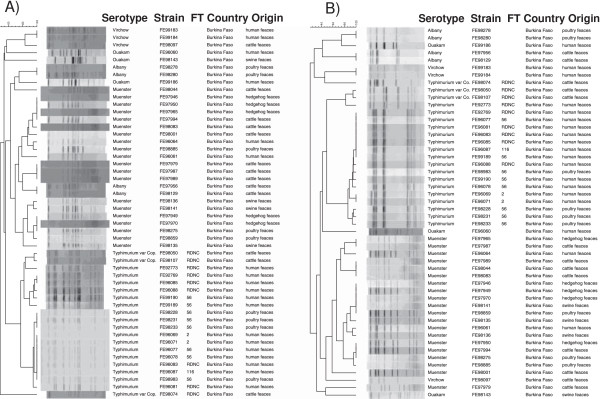
BACKGROUND: Production and wild animals are major sources of human salmonellosis and animals raised for food also play an important role in transmission of antimicrobial resistant Salmonella strains to humans. Furthermore, in sub-Saharan Africa non-typhoidal Salmonella serotypes are common bloodstream isolates in febrile patients. Yet, little is known about the environmental reservoirs and predominant modes of transmission of these pathogens. The purpose of this study was to discover potential sources and distribution vehicles of Salmonella by isolating strains from apparently healthy slaughtered food animals and wild hedgehogs and by determining the genetic relatedness between the strains and human isolates. For this purpose, 729 feces samples from apparently healthy slaughtered cattle (n = 304), poultry (n = 350), swine (n = 50) and hedgehogs (n = 25) were examined for the presence of Salmonella enterica in Burkina Faso. The isolates were characterized by serotyping, antimicrobial-susceptibility testing, phage typing, and pulsed-field gel electrophoresis (PFGE) with XbaI and BlnI restriction enzymes. RESULTS: Of the 729 feces samples, 383 (53%) contained Salmonella, representing a total of 81 different serotypes. Salmonella was present in 52% of the cattle, 55% of the poultry, 16% of the swine and 96% of the hedgehog feces samples. Antimicrobial resistance was detected in 14% of the isolates. S. Typhimurium isolates from poultry and humans (obtained from a previous study) were multiresistant to the same antimicrobials (ampicillin, chloramphenicol, streptomycin, sulfonamides and trimethoprim), had the same phage type DT 56 and were closely related in PFGE. S. Muenster isolates from hedgehogs had similar PFGE patterns as the domestic animals. CONCLUSIONS: Based on our results it seems that production and wild animals can share the same Salmonella serotypes and potentially transmit some of them to humans. As the humans and animals often live in close vicinity in Africa and the hygiene control of the meat retail chain is defective, high Salmonella carriage rates of the animals can pose a major public health risk in Burkina Faso. This underlines the necessity for a joint and coordinated surveillance and monitoring programs for salmonellosis in Africa.
Overview
The claims and statistics of this paper haven’t been checked yet.
Free: it reads the open-access text and checks the first 5 claims that cite a source we can check. Create a free account to check every claim.
Integrity signals
Registry
Cites
Statistics
Figures
Verification
Claims the paper makes
The claims and statistics of this paper haven’t been checked yet.
Free: it reads the open-access text and checks the first 5 claims that cite a source we can check. Create a free account to check every claim.
Claims other papers make about this one
Each is checked against this paper’s own text: does it say what the citing paper says it does?
The source backs part of the claim, not all of it — or backs it for a different population, condition or comparison.
In the citing paper
“Twelve of these 16 serotypes have already been detected in food animals or edible vegetables in Burkina Faso, between 2008 and 2018”
From Contamination of street food with multidrug-resistant Salmonella, in Ouagadougou, Burkina Faso (2021) · cites this paper as [32]
Experimental — accuracy not yet measured
Self-check
Percentages, sums and reported differences re-computed from the paper’s own numbers.
The self-check needs the paper’s full text.
Citations
Cites
Methods for dilution antimicrobial susceptibility tests for bacteria that grow aerobically
Ferraro, M. J. (2000) · Medical Entomology and Zoology · Cited by 17,254
Methods for dilution antimicrobial susceptibility tests for bacteria that grow aerobically
Ferraro, M. J. (2000) · Cited by 16,875
The Global Burden of Nontyphoidal Salmonella Gastroenteritis
Majowicz, S. E., Musto, J., Scallan, E., Angulo, F. J., Kirk, M., O’Brien, S. J., Jones, T. F., Fazil, A., & Hoekstra, R. M. (2010) · Clinical Infectious Diseases · doi:10.1086/650733 · Cited by 2,442 · cited 1×
“8 million cases of gastroenteritis each year, with 155 000 deaths [1].”
BackgroundWHO estimates of the causes of death in children
Bryce, J., Boschi-Pinto, C., Shibuya, K., & Black, R. E. (2005) · The Lancet · doi:10.1016/s0140-6736(05)71877-8 · Cited by 2,096
Invasive non-typhoidal salmonella disease: an emerging and neglected tropical disease in Africa
Feasey, N. A., Dougan, G., Kingsley, R. A., Heyderman, R. S., & Gordon, M. A. (2012) · The Lancet · doi:10.1016/s0140-6736(11)61752-2 · Cited by 1,014 · cited 1×
“Typhimurium isolates from poultry further in order to know if the invasive genotype also occurs in animals as the environmental reservoirs and host ranges of invasive salmonella strains in Africa are still unknown [35].”
BackgroundRole of Nonhost Environments in the Lifestyles of Salmonella and Escherichia coli
Winfield, M. D., & Groisman, E. A. (2003) · Applied and Environmental Microbiology · doi:10.1128/aem.69.7.3687-3694.2003 · Cited by 732 · cited 1×
“Hedgehog feces might infect both cattle and swine foraging freely, since Salmonella can persist in the environment for several months to more than a year [41,42].”
BackgroundHendriksen, R. S., Vieira, A. R., Karlsmose, S., Lo Fo Wong, D. M. A., Jensen, A. B., Wegener, H. C., & Aarestrup, F. M. (2011) · Foodborne Pathogens and Disease · doi:10.1089/fpd.2010.0787 · Cited by 633
The Isolation of Antibiotic-Resistant Salmonella from Retail Ground Meats
White, D. G., Zhao, S., Sudler, R., Ayers, S., Friedman, S., Chen, S., McDermott, P. F., McDermott, S., Wagner, D. D., & Meng, J. (2001) · New England Journal of Medicine · doi:10.1056/nejmoa010315 · Cited by 549 · cited 1×
“Multiresistant Salmonella may acquire their resistance genes from microbiota of production animals before being transmitted to humans through food chain [11,12].”
BackgroundKingsley, R. A., Msefula, C. L., Thomson, N. R., Kariuki, S., Holt, K. E., Gordon, M. A., Harris, D., Clarke, L., Whitehead, S., Sangal, V., et al. (2009) · Genome Research · doi:10.1101/gr.091017.109 · Cited by 540 · cited 1×
“This is a typical pattern found in the Salmonella strains with a subSaharan distinct genotype causing epidemic invasive disease [30].”
BackgroundBacteriophage-typing designations of Salmonella typhimurium
Anderson, E. S., Ward, L. R., de Saxe, M. J., & de Sa, J. D. H. (1977) · Journal of Hygiene · doi:10.1017/s0022172400056187 · Cited by 531 · cited 1×
“Copenhagen) were further phage typed [45].”
Threlfall, E. J. (2002) · FEMS Microbiology Reviews · doi:10.1016/s0168-6445(02)00092-x · Cited by 497 · cited 1×
“Multiresistant Salmonella may acquire their resistance genes from microbiota of production animals before being transmitted to humans through food chain [11,12].”
BackgroundFoodborne Infections and Intoxications
(2021) · Elsevier eBooks · doi:10.1016/c2018-0-02948-5 · Cited by 349
Epidemic Salmonella typhimurium DT 104--a truly international multiresistant clone
Threlfall, E. J. (2000) · Journal of Antimicrobial Chemotherapy · doi:10.1093/jac/46.1.7 · Cited by 317 · cited 1×
“Typhimurium infection in both man and animals [37].”
BackgroundSupplement 2002 (no. 46) to the Kauffmann–White scheme
Popoff, M. Y., Bockemühl, J., & Gheesling, L. L. (2004) · Research in Microbiology · doi:10.1016/j.resmic.2004.04.005 · Cited by 282
Ungemach, F. R., Müller-Bahrdt, D., & Abraham, G. (2006) · International Journal of Medical Microbiology · doi:10.1016/j.ijmm.2006.01.059 · Cited by 229 · cited 1×
“This practice leads into a possibility that bacterial resistance developing in the food animals transfers to the human population thus posing a risk for public health by spreading of the resistance [34].”
BackgroundInvasive Non‐Typhi Salmonella Disease in Africa
Morpeth, S. C., Ramadhani, H. O., & Crump, J. A. (2009) · Clinical Infectious Diseases · doi:10.1086/603553 · Cited by 221 · cited 1×
“In Africa, non-typhoidal Salmonella has consistently been reported as a leading cause of bacteremia among immuno-compromised people, infants and newborns [2,3].”
BackgroundKariuki, S., Revathi, G., Kariuki, N., Kiiru, J., Mwituria, J., Muyodi, J., Githinji, J. W., Kagendo, D., Munyalo, A., & Hart, C. A. (2006) · Journal of Medical Microbiology · doi:10.1099/jmm.0.46375-0 · Cited by 216 · cited 1×
“However, the sources and transmission routes of Salmonella in developing countries are poorly understood due to the lack of coordinated national epidemiological surveillance systems [4,5].”
BackgroundBacterial food-borne zoonoses: -EN- -FR- -ES-
THORNS, C. J. (2000) · Revue Scientifique et Technique de l'OIE · doi:10.20506/rst.19.1.1219 · Cited by 205 · cited 1×
“In general, the primary sources of salmonellosis are considered to be food-producing animals such as cattle, poultry and swine [6].”
BackgroundBacterial and viral etiology of childhood diarrhea in Ouagadougou, Burkina Faso
Bonkoungou, I. J. O., Haukka, K., Österblad, M., Hakanen, A. J., Traoré, A. S., Barro, N., & Siitonen, A. (2013) · BMC Pediatrics · doi:10.1186/1471-2431-13-36 · Cited by 166
Self-citationHarbottle, H., White, D. G., McDermott, P. F., Walker, R. D., & Zhao, S. (2006) · Journal of Clinical Microbiology · doi:10.1128/jcm.00019-06 · Cited by 159 · cited 1×
“PFGE provides valuable phylogenetic-relationship inference for Salmonella at serotype and strain level [38,39].”
BackgroundAntimicrobial susceptibility and serovars of Salmonella from chickens and humans in Ibadan, Nigeria
Fashae, K., Ogunsola, F., Aarestrup, F. M., & Hendriksen, R. S. (2010) · The Journal of Infection in Developing Countries · doi:10.3855/jidc.909 · Cited by 128 · cited 1×
“In comparison, only 11% of chicken reared at intensive poultry farms in Nigeria were found to be infected [21].”
BackgroundGlaser, C. A., Angulo, F. J., & Rooney, J. A. (1994) · Clinical Infectious Diseases · doi:10.1093/clinids/18.1.14 · Cited by 125
GILLESPIE, I. A., O'BRIEN, S. J., ADAK, G. K., WARD, L. R., & SMITH, H. R. (2005) · Epidemiology and Infection · doi:10.1017/s0950268805004474 · Cited by 116 · cited 1×
“The pathogens are mainly disseminated by trade in animals and uncooked animal food products [7].”
BackgroundMolla, B. Z., Alemayehu, D., & Salah, W. (2003) · Ethiopian Journal of Health Development · doi:10.4314/ejhd.v17i1.9782 · Cited by 99 · cited 1×
“In Ethiopia, 4% of the feces of slaughtered cattle were contaminated by Salmonella [23].”
BackgroundFood-Borne Infections and Intoxications.
(1953) · JAMA · doi:10.1001/jama.1953.03690100101040 · Cited by 80
Cardinale, É., Perrier-Gros-Claude, J.-D., Rivoal, K., Rose, V., Tall, F., Mead, G. C., & Salvat, G. (2005) · Journal of Applied Microbiology · doi:10.1111/j.1365-2672.2005.02618.x · Cited by 78 · cited 16×
“The dendrograms showing the grouping of the PFGE patterns were generated in BioNumerics using the composite of the patterns and the unweighted pair group method with arithmetic mean algorithm (UPGMA) with dice-predicted similarity value, 1% band optimization and 0,7% tolerance.”
MethodInfluentialSalmonella bacteraemia among young children at a rural hospital in western Zaire
Green, S. D. R., & Cheesbrough, J. (1993) · Annals of Tropical Paediatrics · doi:10.1080/02724936.1993.11747624 · Cited by 77 · cited 2×
“Typhimurium strains is a serious public health problem in Africa and they are significantly associated with increased mortality [31].”
BackgroundKagambèga, A., Martikainen, O., Siitonen, A., Traore, A. S., Barro, N., & Haukka, K. (2012) · MicrobiologyOpen · doi:10.1002/mbo3.30 · Cited by 74 · cited 2×
“We have previously shown the production animals to be potential carriers of virulent Escherichia coli to humans as well [43].”
BackgroundSelf-citationDione, M. M., Ikumapayi, U. N., Saha, D., Mohammed, N. I., Geerts, S., Ieven, M., Adegbola, R. A., & Antonio, M. (2011) · PLoS Neglected Tropical Diseases · doi:10.1371/journal.pntd.0001148 · Cited by 70 · cited 2×
“In Gambia, the detected rate of Salmonella in chicken feces was higher, 67% [20], than what we detected from the chicken feces.”
BackgroundNational surveillance of Salmonella enterica in food-producing animals in Japan
Ishihara, K., Takahashi, T., MORIOKA, A., Kojima, A., Kijima, M., Asai, T., & Tamura, Y. (2009) · Acta veterinaria Scandinavica · doi:10.1186/1751-0147-51-35 · Cited by 62 · cited 5×
“was isolated from 36% of the broiler fecal samples [19].”
BackgroundInfluentialKagambèga, A., Haukka, K., Siitonen, A., Traoré, A. S., & Barro, N. (2011) · Journal of Food Protection · doi:10.4315/0362-028x.jfp-11-124 · Cited by 44 · cited 4×
“However, our previous study on the prevalence of enteric bacteria on retail meats sold at the markets in Ouagadougou, Burkina Faso, revealed that 37% of the chicken, 13% of the beef intestines, and 7% of the mutton samples were contaminated by Salmonella [13].”
BackgroundResultInfluentialSelf-citationGaul, S. B., Wedel, S. D., Erdman, M. M., Harris, D. L., Harris, I. T., Ferris, K. E., & Hoffman, L. J. (2006) · Journal of Clinical Microbiology · doi:10.1128/jcm.00962-06 · Cited by 43 · cited 1×
“PFGE provides valuable phylogenetic-relationship inference for Salmonella at serotype and strain level [38,39].”
BackgroundMilnes, A., Sayers, A. R., STEWART, I., Clifton-Hadley, F. A., Davies, R., Newell, D. G., Cook, A. J. C., Evans, S. J., Smith, R. P., & Paiba, G. A. (2009) · Epidemiology and Infection · doi:10.1017/s095026880900199x · Cited by 42
Kikuvi, G. M., Ombui, J. N., & Mitema, E. S. (2010) · The Journal of Infection in Developing Countries · doi:10.3855/jidc.446 · Cited by 41 · cited 5×
“Salmonella contamination rates for pigs reported in literature vary from 9% to 23% in Europe [18,22,24], to 3% of porcine fecal samples in Japan [19] and 8% in Kenya [25].”
BackgroundInfluentialSalmonella Infections: Clinical, Immunological and Molecular Aspects
Maskell, D. (2006) · Cambridge University Press eBooks · doi:10.1017/cbo9780511525360 · Cited by 37
Lepage, P., Bogaerts, J., Nsengumuremyi, F., Hitimana, D. G., Van Goethem, C., Vandepitte, J., & Butzler, J. P. (1984) · Journal of Antimicrobial Chemotherapy · doi:10.1093/jac/14.suppl_b.153 · Cited by 37 · cited 3×
“Lepage P, Bogaerts J, Nsengumuremyi F, Hitimana DG, Van Goethem C, Vandepitte J, Butzler JP: Severe multiresistant Salmonella typhimurium systemic infections in Central Africa - clinical features and treatment in a paediatric department.”
BackgroundParker, C. T., Huynh, S., Quiñones, B., Harris, L. J., & Mandrell, R. E. (2010) · Applied and Environmental Microbiology · doi:10.1128/aem.03053-09 · Cited by 36
Makaya, P. V., Matope, G., & Pfukenyi, D. M. (2012) · Avian Pathology · doi:10.1080/03079457.2012.667558 · Cited by 32
Kariuki, S., Gilks, C. F., Kimari, J. N., Muyodi, J., Waiyaki, P. G., & Hart, C. A. (1999) · Journal of Medical Microbiology · doi:10.1099/00222615-48-11-1037 · Cited by 29 · cited 1×
“This phage type was in Kenya among the most common phage type from adult patients [36].”
BackgroundHedgehog zoonoses [1] (multiple letters)
Behr, M. J., Chomel, B. B., & Riley, P. Y. (2005) · Emerging infectious diseases · Cited by 29
African pygmy hedgehog--associated Salmonella tilene in Canada.
Craig, C., Styliadis, S., Woodward, D. J., & Werker, D. (1997) · PubMed · Cited by 29
Kagambèga, A., Barro, N., Traoré, A. S., Siitonen, A., & Haukka, K. (2012) · Foodborne Pathogens and Disease · doi:10.1089/fpd.2011.1071 · Cited by 23 · cited 4×
“Derby was the most common serotype we detected in the chicken feces, as it was in the chicken carcasses [13,14].”
BackgroundResultInfluentialSelf-citationSurvey of Salmonella serovars in broilers and laying breeding reproducers in east of Algeria
Ayachi, A., Alloui, N., Bennoune, O., & Kassah-Laouar, A. (2009) · The Journal of Infection in Developing Countries · doi:10.3855/jidc.562 · Cited by 16
Antibiotic resistance mechanisms inSalmonellaspecies causing bacteraemia in Malawi and Kenya
Leegaard, T. M., van Gestel, M. H., Petit, P. L. C., & van de Klundert, J. A. M. (1996) · Apmis · doi:10.1111/j.1699-0463.1996.tb00721.x · Cited by 16
Stopforth, J. D., Lopes, M., Shultz, J. E., Miksch, R. R., & Samadpour, M. (2006) · Journal of Food Protection · doi:10.4315/0362-028x-69.6.1452 · Cited by 13 · cited 1×
“The process of removing the gastrointestinal tract during slaughtering of food animals is regarded as one of the most important sources of carcass and organ contamination with Salmonella at abattoirs [8].”
BackgroundDetection ofSalmonellain Finishing Pigs on Farm and at Slaughter in Piedmont, Italy
Lomonaco, S., Decastelli, L., Bianchi, D. M., Nucera, D. M., Grassi, M. A., Sperone, V., & Civera, T. (2008) · Zoonoses and Public Health · doi:10.1111/j.1863-2378.2008.01192.x · Cited by 13 · cited 2×
“Since previously S. Tilene has mainly been recovered from African pigmy hedgehogs kept as pets in North America or Europe [15,16], we included hedgehogs, which are common on the grassy pastures in Burkina Faso and also consumed as food, in our study.”
Background
Research works printed but not linked: 7
- [4]4. Acha PN, Szyfres B: Salmonellosis. In Zoonoses and Communicable Diseases Common to Man and Animals, Volume I: Bacterioses and Mycoses. 3rd edition.
- [5]5. Edited by Acha PN, Szyfres B. Washington, D.C: Pan American Health Organization; 2001:233-246.
- [7]7. Thorns CJ: Bacterial food-borne zoonoses. Rev Sci Tech 2000, 19:226-239.
- [10]10. Glaser CA, Angulo FJ, Rooney J: Animal-associated opportunistic infections in HIV-infected persons. Clin Infect Dis 1994, 18:14-24.
- [11]11. Riley PY, Chomel BB: Hedgehog zoonoses. Emerg Infect Dis 2005, 11:1-5.
- [16]16. CDC: African pygmy hedgehog-associated salmonellosis. MMWR Morb Mortal Wkly Rep 1995, 44:462-463.
- [44]44. Kagambèga A, Martikainen O, Siitonen A, Traoré AS, Barro N, Haukka K: Prevalence of diarrheagenic Escherichia coli virulence genes in the feces of slaughtered cattle, chickens, and pigs in Burkina Faso. MicrobiologyOpen 2012, 1:276-284.
Cited by
Manyi-Loh, C., Mamphweli, S., Meyer, E., & Okoh, A. (2018) · Molecules · doi:10.3390/molecules23040795 · Cited by 1,808
Persistent Infection and Long-Term Carriage of Typhoidal and Nontyphoidal Salmonellae
Gal-Mor, O. (2018) · Clinical Microbiology Reviews · doi:10.1128/cmr.00088-18 · Cited by 209
“More than 50% of cattle that were recently screened for Salmonella in Burkina Faso (West Africa) (224) and more than 20% of cattle screened in northeast Spain (225) were found to be contaminated with diverse NTS, indicating that persistent Salmonella infection in livestock is not uncommon and that bovine peripheral ly…”
BackgroundInfluentialThomas, K. M., de Glanville, W. A., Barker, G. C., Benschop, J., Buza, J. J., Cleaveland, S., Davis, M. A., French, N. P., Mmbaga, B. T., Prinsen, G., et al. (2019) · International Journal of Food Microbiology · doi:10.1016/j.ijfoodmicro.2019.108382 · Cited by 178
Prevalence of foodborne pathogens in food from selected African countries – A meta-analysis
Paudyal, N., Anihouvi, V. B., Hounhouigan, J. D., Matsheka, M. I., Sekwati‐Monang, B., Amoa‐Awua, W. K., Atter, A., Ackah, N. B., Mbugua, S. K., Asagbra, A. E., et al. (2017) · International Journal of Food Microbiology · doi:10.1016/j.ijfoodmicro.2017.03.002 · Cited by 175
Selaledi, L., Hassan, Z. M., Manyelo, T. G., & Mabelebele, M. (2020) · Antibiotics · doi:10.3390/antibiotics9090594 · Cited by 177
Metadata
- Authors
- Kagambèga, A., Lienemann, T., Aulu, L., Traoré, A. S., Barro, N., Siitonen, A., & Haukka, K.
- Affiliations
- Université Joseph Ki-Zerbo (BF)
- Finnish Institute for Health and Welfare (FI)
- University of Helsinki (FI)
- Corresponding author
- Kagambèga, Assèta
- Venue
- BMC Microbiology
- Published
- 2013
- Volume
- 13
- Issue
- 1
- Pages
- 253
- ISSN
- 1471-2180 (ISSN-L)
- PMC
- PMC3828578
- OpenAlex
- W2062827298
- Semantic Scholar
- 44f18a71ce639176af37d9c16d60b76c0c4a92ea
- Cited by
- 144
- References
- 47
- Citations by year
- 2026: 5 · 2025: 14 · 2024: 4 · 2023: 11 · 2022: 16 · 2021: 21 · 2020: 11 · 2019: 14 · 2018: 12 · 2017: 17 · 2016: 10 · 2015: 7 · 2014: 2
- FWCI
- 9.43
- Type
- journal article
- Language
- en
- Open access
- gold
- doi.org
- Licence
- cc-by
- Locations
- BMC Microbiology (publishedVersion, cc-by)
- Europe PMC (PubMed Central) (publishedVersion, cc-by)
- PubMed Central (publishedVersion, cc-by)
- PubMed (publishedVersion)
- Työväentutkimus Vuosikirja (submittedVersion)
- STM:n Hallinnonalan avoin julkaisuarkisto (Julkari) (submittedVersion)
- Funders
- Academy of Finland (122600)
- Terveyden ja hyvinvoinnin laitos
- Topics
- Life Sciences › Agricultural and Biological Sciences › Food Science › Salmonella and Campylobacter epidemiology
- Life Sciences › Agricultural and Biological Sciences › Food Science › Listeria monocytogenes in Food Safety
- Life Sciences › Immunology and Microbiology › Microbiology › Escherichia coli research studies
- Keywords
- Salmonella enterica, non-typhoidal Salmonella, zoonotic transmission, hedgehogs, cattle, poultry, pigs, antimicrobial resistance, Salmonella typhimurium, serotyping, pulsed-field gel electrophoresis, phage typing, environmental reservoirs, Burkina Faso, food safety
- MeSH terms
- Animals, Bacteriophage Typing, Burkina Faso, Carrier State, Cattle, Feces, Hedgehogs, Humans, Microbial Sensitivity Tests, Poultry, Salmonella Infections, Animal, Serotyping, Swine, Prevalence, Electrophoresis, Gel, Pulsed-Field, Molecular Epidemiology, Salmonella enterica, Molecular Typing
About these checks
Registry, retraction, Cites and statistics results are computed, not judged, with one exception: a printed reference that no index lists is read once by a model before it counts as a citation error. Claims are extracted by a model and kept only when their quote appears verbatim in the text; each cited source is then checked, with a model’s help, for whether it says what the claim relies on. Those verdicts can be wrong — read the claim’s quote and the cited source before relying on one.
Statistics and arithmetic are recomputed, not judged.
Confidence bands are shown only for fields calibrated on our annotated test set. None is calibrated yet, so no band is shown.
What counts as a claim ›How we measure confidence ›How we check this ›
Are you an author, or do you see a problem with this page? Request a review
Data sources
Bibliographic data: Semantic Scholar, OpenAlex, Crossref.
Contains information from the Semantic Scholar Academic Graph Datasets, made available under the ODC Attribution License (ODC-BY 1.0).
Semantic Scholar’s data is described in: Kinney, R., et al. (2023). The Semantic Scholar Open Data Platform. arXiv:2301.10140.
