

The DOI matches its Crossref record; 41 of the 41 references it cites were found in a registry or an index.
Error-dependent modulation of speech-induced auditory suppression for pitch-shifted voice feedback
Open accessAbstract
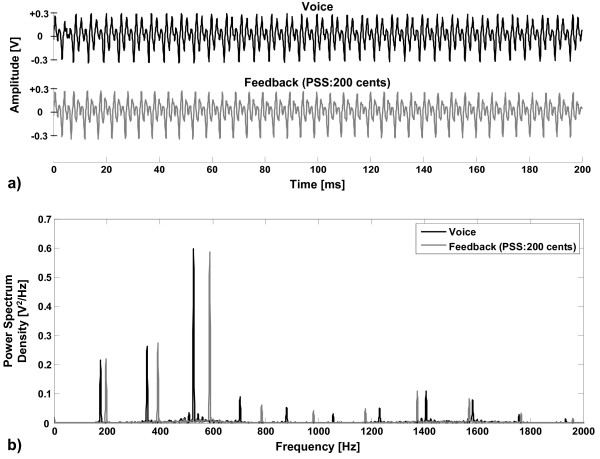
BACKGROUND: The motor-driven predictions about expected sensory feedback (efference copies) have been proposed to play an important role in recognition of sensory consequences of self-produced motor actions. In the auditory system, this effect was suggested to result in suppression of sensory neural responses to self-produced voices that are predicted by the efference copies during vocal production in comparison with passive listening to the playback of the identical self-vocalizations. In the present study, event-related potentials (ERPs) were recorded in response to upward pitch shift stimuli (PSS) with five different magnitudes (0, +50, +100, +200 and +400 cents) at voice onset during active vocal production and passive listening to the playback. RESULTS: Results indicated that the suppression of the N1 component during vocal production was largest for unaltered voice feedback (PSS: 0 cents), became smaller as the magnitude of PSS increased to 200 cents, and was almost completely eliminated in response to 400 cents stimuli. CONCLUSIONS: Findings of the present study suggest that the brain utilizes the motor predictions (efference copies) to determine the source of incoming stimuli and maximally suppresses the auditory responses to unaltered feedback of self-vocalizations. The reduction of suppression for 50, 100 and 200 cents and its elimination for 400 cents pitch-shifted voice auditory feedback support the idea that motor-driven suppression of voice feedback leads to distinctly different sensory neural processing of self vs. non-self vocalizations. This characteristic may enable the audio-vocal system to more effectively detect and correct for unexpected errors in the feedback of self-produced voice pitch compared with externally-generated sounds.
Overview
The claims and statistics of this paper haven’t been checked yet.
Run the check — free, no account needed. It reads the open-access text and checks the sources it cites.
Integrity signals
Registry
Cites
Statistics
Figures
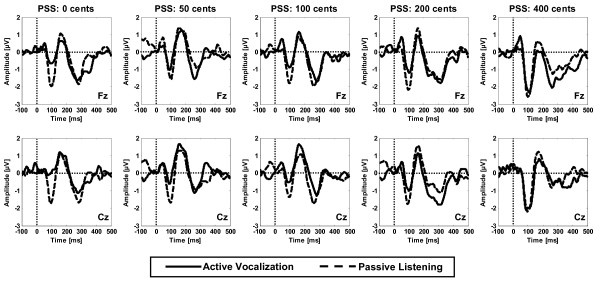
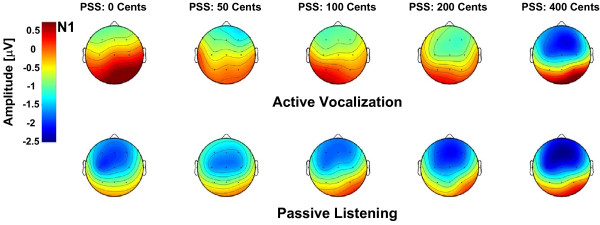
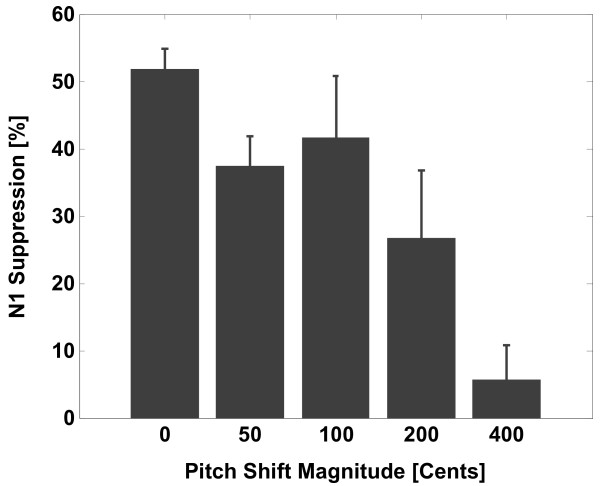
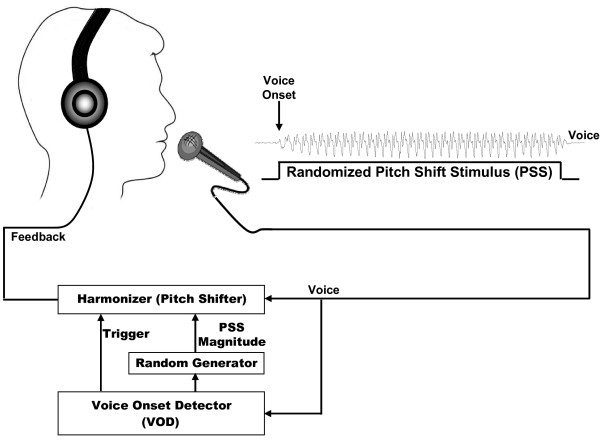
Verification
Claims the paper makes
The claims and statistics of this paper haven’t been checked yet.
Run the check — free, no account needed. It reads the open-access text and checks the sources it cites.
Claims other papers make about this one
Each is checked against this paper’s own text: does it say what the citing paper says it does?
The cited source says what the claim attributes to it.
In the citing paper
“The results of the inner speech experiment mirror those of previous studies which have found sensory attenuation to overt speech to be reduced or eliminated if auditory feedback deviates from what would normally be expected; e.g., by pitch-shifting the feedback or providing foreign-language feedback (Heinks-Maldonado et al., 2006; Behroozmand and Larson, 2011; Behroozmand et al., 2011; Behroozmand”
From Neurophysiological evidence of efference copies to inner speech (2017) · cites this paper as Behroozmand and Larson, 2011
The cited source says what the claim attributes to it.
In the citing paper
“The results of the inner speech experiment mirror those of previous studies which have found sensory attenuation to overt speech to be reduced or eliminated if auditory feedback deviates from what would normally be expected; e.g., by pitch-shifting the feedback or providing foreign-language feedback (Heinks-Maldonado et al., 2006; Behroozmand and Larson, 2011; Behroozmand et al., 2011; Behroozmand”
From Neurophysiological evidence of efference copies to inner speech (2017) · cites this paper as Behroozmand et al., 2011
The cited source says what the claim attributes to it.
In the citing paper
“This result, which is consistent with numerous previous studies in the sensory attenuation literature (Heinks-Maldonado et al., 2006; Behroozmand and Larson, 2011; Behroozmand et al., 2011; Behroozmand et al., 2016; Larson and Robin, 2016), was identical to the corresponding contrast in the inner speech experiment, in which participants had to produce phonemes in inner, as opposed to overt, speech”
From Neurophysiological evidence of efference copies to inner speech (2017) · cites this paper as Behroozmand and Larson, 2011
Self-check
Percentages, sums and reported differences re-computed from the paper’s own numbers.
The self-check needs the paper’s full text.
Citations
Cites
The cortical organization of speech processing
Hickok, G., & Poeppel, D. (2007) · Nature Reviews Neuroscience · doi:10.1038/nrn2113 · Cited by 5,495
An internal model for sensorimotor integration
Wolpert, D. M., Ghahramani, Z., & Jordan, M. I. (1995) · Science · doi:10.1126/science.7569931 · Cited by 3,553
Hickok, G., & Poeppel, D. (2004) · Cognition · doi:10.1016/j.cognition.2003.10.011 · Cited by 2,212
Neural basis of the spontaneous optokinetic response produced by visual inversion
Sperry, R. W. (1950) · Journal of Comparative and Physiological Psychology · doi:10.1037/h0055479 · Cited by 1,789
Central cancellation of self-produced tickle sensation
Blakemore, S.-J., Wolpert, D. M., & Frith, C. D. (1998) · Nature Neuroscience · doi:10.1038/2870 · Cited by 1,467
Relations between the central Nervous System and the peripheral organs
Holst, E. V. (1954) · The British Journal of Animal Behaviour · doi:10.1016/s0950-5601(54)80044-x · Cited by 1,104
Why canʼt you tickle yourself?
Blakemore, S.-J., Wolpert, D., & Frith, C. (2000) · NeuroReport · doi:10.1097/00001756-200008030-00002 · Cited by 904
Spatio-Temporal Prediction Modulates the Perception of Self-Produced Stimuli
Blakemore, S.-J., Frith, C. D., & Wolpert, D. M. (1999) · Journal of Cognitive Neuroscience · doi:10.1162/089892999563607 · Cited by 829
Neural mechanisms underlying auditory feedback control of speech
Tourville, J. A., Reilly, K. J., & Guenther, F. H. (2008) · NeuroImage · doi:10.1016/j.neuroimage.2007.09.054 · Cited by 649
Neuronal mechanisms of visual stability
Wurtz, R. H. (2008) · Vision Research · doi:10.1016/j.visres.2008.03.021 · Cited by 619
Cited by
Sorted by citations
Items 101–158 of 158
The Brain's Sensitivity to Sensory Error Can Be Modulated by Altering Perceived Variability
Tang, D.-L., Parrell, B., Beach, S. D., & Niziolek, C. A. (2024) · Journal of Neuroscience · doi:10.1523/jneurosci.0024-24.2024 · Cited by 8
Motor and visual influences on auditory neural processing during speaking and listening
Sato, M. (2022) · Cortex · doi:10.1016/j.cortex.2022.03.013 · Cited by 9
Griffiths, O., Jack, B. N., Pearson, D., Elijah, R., Mifsud, N. G., Han, N., Libesman, S., Barreiros, A. R., Turnbull, L., Balzan, R., et al. (2022) · NeuroImage: Clinical · doi:10.1016/j.nicl.2022.103290 · Cited by 5
Changes in Articulatory Control Pre– and Post–Facial Transplant: A Case Report
Grigos, M. I., LeBlanc, É. M., Hagedorn, C., Diaz-Siso, J. R., Plana, N. M., & Rodriguez, E. D. (2019) · Journal of Speech Language and Hearing Research · doi:10.1044/2018_jslhr-s-18-0147 · Cited by 8
Brumberg, J. S., & Pitt, K. M. (2019) · Journal of Speech Language and Hearing Research · doi:10.1044/2019_jslhr-s-msc18-18-0198 · Cited by 8
Suchý, D., Behroozmand, R., & Railo, H. (2025) · NeuroImage · doi:10.1016/j.neuroimage.2025.121269 · Cited by 9
Self-citationKorzyukov, O. A., Tapaskar, N., Pflieger, M. E., Behroozmand, R., Lodhavia, A., Patel, S. A., Robin, D. A., & Larson, C. R. (2014) · Clinical Neurophysiology · doi:10.1016/j.clinph.2014.09.016 · Cited by 7
Self-citationSemantic focus mediates pitch auditory feedback control in phrasal prosody
Hilger, A., Cole, J., & Larson, C. R. (2022) · Language Cognition and Neuroscience · doi:10.1080/23273798.2022.2116060 · Cited by 6
Self-citationBehroozmand, R., Sarmukadam, K., & Fridriksson, J. (2023) · Clinical Neurophysiology · doi:10.1016/j.clinph.2023.02.176 · Cited by 6
Self-citationMiller, C. A., Behroozmand, R., Etler, C. P., Nourski, K. V., Reale, R. A., Oya, H., Kawasaki, H., & Greenlee, J. D. W. (2021) · eNeuro · doi:10.1523/eneuro.0181-20.2020 · Cited by 6
Self-citationYuan, R., & Bottjer, S. W. (2018) · Journal of Neurophysiology · doi:10.1152/jn.00714.2018 · Cited by 6
Zhang, Y., Sarmukadam, K., Wang, Y., & Behroozmand, R. (2024) · Neuropsychologia · doi:10.1016/j.neuropsychologia.2024.108944 · Cited by 5
Self-citationBeach, S. D., Tang, D.-L., Kiran, S., & Niziolek, C. A. (2024) · Neurobiology of Language · doi:10.1162/nol_a_00139 · Cited by 5
Vocalizing and singing reveal complex patterns of corollary discharge function in schizophrenia
Ford, J. M., Roach, B. J., & Mathalon, D. H. (2021) · International Journal of Psychophysiology · doi:10.1016/j.ijpsycho.2021.02.013 · Cited by 5
Tan, S., Jia, Y., Jariwala, N., Zhang, Z., Brent, K., Houde, J. F., Nagarajan, S. S., & Subramaniam, K. (2024) · Scientific Reports · doi:10.1038/s41598-024-55275-3 · Cited by 6
Towards a conative account of mental imagery
Patel, S. (2022) · Philosophical Psychology · doi:10.1080/09515089.2022.2148521 · Cited by 5
Effects of Cortical Stimulation on Feedback‐Dependent Vocal Control in Non‐Human Primates
Eliades, S. J., & Tsunada, J. (2022) · The Laryngoscope · doi:10.1002/lary.30175 · Cited by 3
Patel, S. A., Hebert, K. R., Korzyukov, O. A., & Larson, C. R. (2023) · PLoS ONE · doi:10.1371/journal.pone.0269326 · Cited by 6
Self-citationSensitivity to syllable stress regularities in externally but not self‐triggered speech in Dutch
Emmendorfer, A. K., Bonte, M. L., Jansma, B. M., & Kotz, S. A. (2023) · European Journal of Neuroscience · doi:10.1111/ejn.16003 · Cited by 5
Auditory-vocal control system is object for predictive processing within seconds time range
Korzyukov, O. A., Lee, Y., Bronder, A., Wagner, M., Gumenyuk, V., Larson, C. R., & Hammer, M. J. (2020) · Brain Research · doi:10.1016/j.brainres.2020.146703 · Cited by 3
Self-citationCai, X., Yin, Y., & Zhang, Q. (2023) · Bilingualism Language and Cognition · doi:10.1017/s1366728923000019 · Cited by 4
Peng, B., Dong, K., Liu, Q., Li, J., Zhao, Y., Huang, X., Chen, M., Wu, X., Dai, G., Liu, D., et al. (2025) · Psychophysiology · doi:10.1111/psyp.70054 · Cited by 2
Zhang, Y., Sarmukadam, K., Nejati, V., & Behroozmand, R. (2025) · Neuropsychologia · doi:10.1016/j.neuropsychologia.2025.109202 · Cited by 3
Self-citationVocal Error Monitoring in the Primate Auditory Cortex
Eliades, S. J., & Tsunada, J. (2025) · Journal of Neuroscience · doi:10.1523/jneurosci.0090-25.2025 · Cited by 2
Ma, Y., Niu, Z., Zhang, X., Zhang, Y., Liu, Z., Yu, K., & Wang, R. (2025) · Neuropsychologia · doi:10.1016/j.neuropsychologia.2025.109309 · Cited by 2
From Voice to Self: An Integrative Framework on Self-Voice Processing
Orepić, P., & Pinheiro, A. P. (2026) · Perspectives on Psychological Science · doi:10.1177/17456916261422585 · Cited by 2
The integration mechanisms of feedforward and feedback control in speech motor system
Cai, X. F., & Zhang, Q. (2020) · Advances in Psychological Science · doi:10.3724/sp.j.1042.2020.00588 · Cited by 2
Do Corollary Discharges Contain Information About the Volume of Inner Speech? An ERP Study
Berryman, K., Whitford, T. J., Pelley, M. E. L., & Jack, B. N. (2025) · Journal of Cognitive Neuroscience · doi:10.1162/jocn_a_02318 · Cited by 3
Duggirala, S. X., Honcamp, H., Schwartze, M., van Amelsvoort, T., Pinheiro, A. P., Linden, D. E. J., & Kotz, S. A. (2025) · Psychiatry Research · doi:10.1016/j.psychres.2025.116461 · Cited by 1
Electrophysiological correlates of phonological and temporal regularities in speech processing
Emmendorfer, A. K. (2022) · doi:10.26481/dis.20220222ae · Cited by 2
Acoustic and Neurophysiological Aspects of Lombard EffectPreprint
Castro, C., Rivera, L. Z., Prado, P., Cuadros, J., Cortés, J. P., Weinstein, A., Espinoza, V. M., & Zañartu, M. (2022) · bioRxiv (Cold Spring Harbor Laboratory) · doi:10.1101/2022.09.30.510383 · Cited by 2
Task-Dependent Modulation of Auditory Feedback Control of Vocal Intensity
Hilger, A., Levant, S., Kim, J. H., Lester‐Smith, R. A., & Larson, C. R. (2022) · Journal of Voice · doi:10.1016/j.jvoice.2022.08.004 · Cited by 1
Self-citationFeedback and feedforward control of intonation in cerebellar ataxia
Hilger, A., Cole, J., & Larson, C. (2025) · Language Cognition and Neuroscience · doi:10.1080/23273798.2025.2541696 · Cited by 1
Self-citationRegression to the mean explains perception of action consequences
Johnen, S., & Zimmermann, E. (2025) · Proceedings of the Royal Society B Biological Sciences · doi:10.1098/rspb.2025.1715 · Cited by 1
Rivera, L. Z., Castro, C., Cuadros, J., Cortés, J. P., Weinstein, A., Espinoza, V. M., Prado, P., & Zañartu, M. (2026) · Scientific Reports · doi:10.1038/s41598-026-49995-x · Cited by 3
Event-Related Potential Correlates of Learning to Produce Novel Foreign Phonemes
Railo, H., Varjonen, A., Lehtonen, M., & Sikka, P. (2022) · Neurobiology of Language · doi:10.1162/nol_a_00080 · Cited by 1
Perceptual formant discrimination during speech movement planning
Wang, H., Ali, Y., & Max, L. (2024) · PLoS ONE · doi:10.1371/journal.pone.0301514 · Cited by 2
Emmendorfer, A. K., Bonte, M. L., Jansma, B. M., & Kotz, S. A. (2021) · bioRxiv (Cold Spring Harbor Laboratory) · doi:10.1101/2021.05.04.442414 · Cited by 1
Knowing what's next: The role of the cerebellum in generating predictions
Knolle, F. (2012) · MPG.PuRe (Max Planck Society)
PERCEPTUAL PROCESSING OF AUDITORY FEEDBACK DURING SPEECH PRODUCTION AND ITS NEURAL SUBSTRATES
Zheng, Z. Z. (2012) · QSpace (Queen's University Library)
Effects of COMT polymorphism on the cortical processing of vocal pitch regulation
Zhang, S., Wang, W., Zhang, B., Liu, P., & Liu, H. (2018) · Neuroreport · doi:10.1097/wnr.0000000000001142
The Neurobiology of Human Vocalization: A Quantitative Meta-Analytic Approach
Weston, Z. M. (2018) · University of New Hampshire Scholars Repository (University of New Hampshire at Manchester)
Exploration of Speech Induced Suppression using Functional Near-Infrared Spectroscopy (fNIRS)Preprint
Walczak, E. (2023) · bioRxiv (Cold Spring Harbor Laboratory) · doi:10.1101/2023.03.05.531176 · Cited by 2
Distinct role of central predictive mechanisms in tactile suppressionPreprint
Arikan, B. E. (2023) · PsyArXiv (OSF Preprints) · doi:10.31234/osf.io/rqs9p · Cited by 1
The role of prediction and attention in phantom voice perception
Duggirala, S. X. (2024) · Research Publications (Maastricht University) · doi:10.26481/dis.20240423sd
Beño‐Ruiz‐de‐la‐Sierra, R. M. (2024) · UVaDOC UVaDOC University of Valladolid Documentary Repository (University of Valladolid) · doi:10.35376/10324/72377
Motor-based prediction mediates implicit vocal imitation
Wu, Y., Han, Z., & Tian, X. (2025) · NeuroImage · doi:10.1016/j.neuroimage.2025.121169
What's the point of talking? Auditory targets and communicative goals
Meekings, S., & Scott, S. K. (2025) · Journal of Neurolinguistics · doi:10.1016/j.jneuroling.2025.101262
Themelis, L. Z., Konstantoulaki, A., Klein, C., Vatakis, A., & Smyrnis, N. (2025) · Experimental Brain Research · doi:10.1007/s00221-025-07088-7
Oscillatory brain indexes of auditory-induced predictions about contingences during vocalizations
Korzyukov, O. A., Gumenyuk, V., & Larson, C. R. (2025) · Experimental Brain Research · doi:10.1007/s00221-025-07130-8
Self-citationWelp, S., Hildelbrandt, A., Magezi, D. A., Voss, M., & Kaltwasser, L. (2026) · Scientific Reports · doi:10.21203/rs.3.rs-7255973/v1
Formant variability is related to vowel duration across speakers
Tang, D.-L., Niziolek, C. A., & Parrell, B. (2025) · JASA Express Letters · doi:10.1121/10.0039754
Richthofer, S. C., Grafe, F., & Röer, J. P. (2025) · Experimental Psychology (formerly Zeitschrift für Experimentelle Psychologie) · doi:10.1027/1618-3169/a000654
Auditory cortex modulates call duration in rats
Tang, W., Concha‐Miranda, M., & Brecht, M. (2026) · Communications Biology · doi:10.1038/s42003-026-09608-9
Zhang, Y., & Behroozmand, R. (2026) · NeuroImage · doi:10.1016/j.neuroimage.2026.121845
Self-citationA shared cortical manifold links sensory error to motor planningPreprint
Zempolich, G., Zhou, W., Holey, B. E., Williams, A. H., & Schneider, D. M. (2026) · bioRxiv (Cold Spring Harbor Laboratory) · doi:10.64898/2026.08.02.742317
Chang, Y., Guo, Q., Zhao, S., Li, T., Wu, X., Liu, D., 戴光艳, Zhu, X., Chen, X., Wang, L., et al. (2026) · iScience · doi:10.1016/j.isci.2026.117790
Behroozmand, R., Venezia, J. H., Sarmukadam, K., Rorden, C., Bonilha, L., Hickok, G. S., & Fridriksson, J. (2026) · Clinical Neurophysiology · doi:10.1016/j.clinph.2026.2112438
Self-citation
Metadata
- Authors
- Behroozmand, R., & Larson, C. R.
- Affiliations
- Northwestern University (US)
- Corresponding author
- Behroozmand, Roozbeh
- Venue
- BMC Neuroscience
- Published
- 2011-06-06
- Volume
- 12
- Issue
- 1
- Pages
- 54-54
- ISSN
- 1471-2202 (ISSN-L)
- PMC
- PMC3120724
- OpenAlex
- W2085269432
- Cited by
- 158
- References
- 41
- Citations by year
- 2026: 8 · 2025: 16 · 2024: 13 · 2023: 11 · 2022: 10 · 2021: 6 · 2020: 11 · 2019: 9 · 2018: 14 · 2017: 6 · 2016: 10 · 2015: 11 · 2014: 6 · 2013: 15 · 2012: 10
- FWCI
- 5.04
- Type
- journal article
- Language
- en
- Open access
- gold
- doi.org
- Licence
- Locations
- BMC Neuroscience (publishedVersion, cc-by)
- PubMed Central (publishedVersion, cc-by)
- PubMed (publishedVersion)
- DOAJ (DOAJ: Directory of Open Access Journals) (submittedVersion, cc-by-sa)
- Funders
- National Institutes of Health
- National Institute on Deafness and Other Communication Disorders (R01DC006243)
- Topics
- Life Sciences › Neuroscience › Cognitive Neuroscience › Neuroscience and Music Perception
- Life Sciences › Neuroscience › Cognitive Neuroscience › Neurobiology of Language and Bilingualism
- Social Sciences › Psychology › Experimental and Cognitive Psychology › Phonetics and Phonology Research
- Keywords
- efference copy, phonation, N1 component, event-related potentials
- MeSH terms
- Acoustic Stimulation, Adult, Brain Mapping, Electroencephalography, Evoked Potentials, Female, Humans, Male, Pitch Perception, Speech, Speech Acoustics, Feedback, Physiological
About these checks
Registry, retraction, Cites and statistics results are computed, not judged, with one exception: a printed reference that no index lists is read once by a model before it counts as a citation error. Claims are extracted by a model and kept only when their quote appears verbatim in the text; each cited source is then checked, with a model’s help, for whether it says what the claim relies on. Those verdicts can be wrong — read the claim’s quote and the cited source before relying on one.
Statistics and arithmetic are recomputed, not judged.
Confidence bands are shown only for fields calibrated on our annotated test set. None is calibrated yet, so no band is shown.
What counts as a claim ›How we measure confidence ›How we check this ›
Are you an author, or do you see a problem with this page? Request a review
