

The DOI matches its Crossref record; 42 of the 43 references it cites were found in a registry or an index, and 1 are not checked yet.
Volumetric associations between uncinate fasciculus, amygdala, and trait anxiety
Open accessAbstract
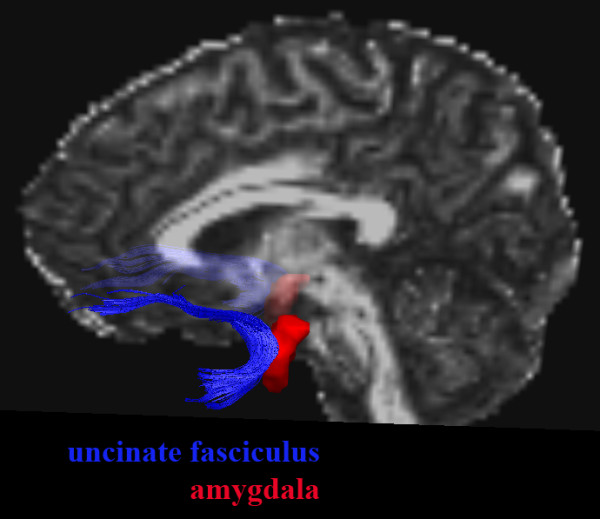
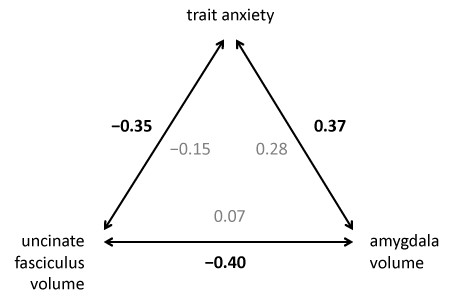
BACKGROUND: Recent investigations of white matter (WM) connectivity suggest an important role of the uncinate fasciculus (UF), connecting anterior temporal areas including the amygdala with prefrontal-/orbitofrontal cortices, for anxiety-related processes. Volume of the UF, however, has rarely been investigated, but may be an important measure of structural connectivity underlying limbic neuronal circuits associated with anxiety. Since UF volumetric measures are newly applied measures, it is necessary to cross-validate them using further neural and behavioral indicators of anxiety. RESULTS: In a group of 32 subjects not reporting any history of psychiatric disorders, we identified a negative correlation between left UF volume and trait anxiety, a finding that is in line with previous results. On the other hand, volume of the left amygdala, which is strongly connected with the UF, was positively correlated with trait anxiety. In addition, volumes of the left UF and left amygdala were inversely associated. CONCLUSIONS: The present study emphasizes the role of the left UF as candidate WM fiber bundle associated with anxiety-related processes and suggests that fiber bundle volume is a WM measure of particular interest. Moreover, these results substantiate the structural relatedness of UF and amygdala by a non-invasive imaging method. The UF-amygdala complex may be pivotal for the control of trait anxiety.
Overview
The claims and statistics of this paper haven’t been checked yet.
Run the check — free, no account needed. It reads the open-access text and checks the sources it cites.
Integrity signals
Registry
Cites
Statistics
Figures
Verification
Claims the paper makes
The claims and statistics of this paper haven’t been checked yet.
Run the check — free, no account needed. It reads the open-access text and checks the sources it cites.
Claims other papers make about this one
Each is checked against this paper’s own text: does it say what the citing paper says it does?
In the citing paper
“Structural abnormalities, such as reduced grey matter volume in the mPFC and weaker integrity of the uncinate fasciculus, have been reported in adults with anxious temperament and anxiety disorders24–28.”
From Multimodal evidence for delayed threat extinction learning in adolescence and young adulthood (2019) · cites this paper as [25]
In the citing paper
“Notably, weaker structural integrity of the uncinate fasciculus has been found in populations with anxious temperament24–27,32, suggesting that this tract may play a crucial role in anxiety aetiology.”
From Multimodal evidence for delayed threat extinction learning in adolescence and young adulthood (2019) · cites this paper as [25]
Self-check
Percentages, sums and reported differences re-computed from the paper’s own numbers.
The self-check needs the paper’s full text.
Citations
Cites
Advances in functional and structural MR image analysis and implementation as FSL
Smith, S. M., Jenkinson, M., Woolrich, M. W., Beckmann, C. F., Behrens, T. E. J., Johansen-Berg, H., Bannister, P. R., De Luca, M., Drobnjak, I., Flitney, D. E., et al. (2004) · NeuroImage · doi:10.1016/j.neuroimage.2004.07.051 · Cited by 13,630
Etkin, A., & Wager, T. D. (2007) · American Journal of Psychiatry · doi:10.1176/appi.ajp.2007.07030504 · Cited by 3,391 · cited 1×
“The amygdala has been shown to be part of a limbic network that is hyper-responsive in individuals with increased anxiety [9] and in patients with anxiety disorders [10].”
BackgroundAnxiety, sensitivity, anxiety frequency, and the prediction of fearfulness
Reiss, S., Peterson, R. A., Gursky, D. M., & McNally, R. J. (1986) · Behaviour Research and Therapy · doi:10.1016/0005-7967(86)90143-9 · Cited by 3,169
A CLASSIFICATION OF HAND PREFERENCE BY ASSOCIATION ANALYSIS
Annett, M. (1970) · British Journal of Psychology · doi:10.1111/j.2044-8295.1970.tb01248.x · Cited by 2,271
Reproducibility of quantitative tractography methods applied to cerebral white matter
Wakana, S., Caprihan, A., Panzenboeck, M. M., Fallon, J. H., Perry, M., Gollub, R. L., Hua, K., Zhang, J., Jiang, H., Dubey, P., et al. (2007) · NeuroImage · doi:10.1016/j.neuroimage.2007.02.049 · Cited by 1,686
A diffusion tensor imaging tractography atlas for virtual in vivo dissections.
CATANI, M., & THIEBAUTDESCHOTTEN, M. (2008) · Cortex · doi:10.1016/j.cortex.2008.05.004 · Cited by 1,642
Puzzlingly High Correlations in fMRI Studies of Emotion, Personality, and Social Cognition
Vul, E., Harris, C., Winkielman, P., & Pashler, H. (2009) · Perspectives on Psychological Science · doi:10.1111/j.1745-6924.2009.01125.x · Cited by 1,475 · cited 1×
“9) [34] can principally be obtained with the applied methods.”
MethodRegional dissociations within the hippocampus-memory and anxiety
Bannerman, D. M., Rawlins, J. N. P., McHugh, S. B., Deacon, R. M. J., Yee, B. K., Bast, T., Zhang, W.-N., Pothuizen, H. H. J., & Feldon, J. (2004) · Neuroscience & Biobehavioral Reviews · doi:10.1016/j.neubiorev.2004.03.004 · Cited by 1,462
Type I and Type II error concerns in fMRI research: re-balancing the scale
Lieberman, M. D., & Cunningham, W. A. (2009) · Social Cognitive and Affective Neuroscience · doi:10.1093/scan/nsp052 · Cited by 1,342
Cortical pathways to the mammalian amygdala
McDonald, A. J. (1998) · Progress in Neurobiology · doi:10.1016/s0301-0082(98)00003-3 · Cited by 1,303
Research works printed but not linked: 5
- Laux L, Glanzmann P, Schaffner P, Spielberger CD: Das State-Trait-Angstinventar - Manual. 1981, Weinheim: Beltz
- Hautzinger M, Bailer M, Worall H, Keller F: Beck-Depressions-Inventar (BDI) - Testhandbuch. 1995, Bern, Göttingen, Toronto, Seattle: Huber
- Eggert D: Eysenck-Persönlichkeits-Inventar E-P-I. Handanweisung für die Durchführung und Auswertung. 1983, Göttingen, Toronto, Zürich: Hogrefe
- Eysenck HJ, Eysenck SBG: Manual of the Eysenck Personality Inventory. 1964, London: University of London Press
- Wang R, Benner T, Sorensen AG, Wedeen VJ: Diffusion Toolkit: A software package for diffusion imaging data processing and tractography. Proc Intl Soc Mag Reson Med. 2007, 15: 3720.
Cited by
Sorted by citations
Dissecting the uncinate fasciculus: disorders, controversies and a hypothesis.
Von Der Heide, R. J., Skipper, L. M., Klobusicky, E., & Olson, I. R. (2013) · Brain · doi:10.1093/brain/awt094 · Cited by 829
Brühl, A. B., Delsignore, A., Komossa, K., & Weidt, S. (2014) · Neuroscience & Biobehavioral Reviews · doi:10.1016/j.neubiorev.2014.08.003 · Cited by 439
Baur, V., Hänggi, J., Langer, N., & Jäncke, L. (2013) · Biological Psychiatry · doi:10.1016/j.biopsych.2012.06.003 · Cited by 258
Self-citationQin, S., Young, C. B., Duan, X., Chen, T., Supekar, K., & Menon, V. (2014) · Biological Psychiatry · doi:10.1016/j.biopsych.2013.10.006 · Cited by 249
Happy heart syndrome: role of positive emotional stress in takotsubo syndrome
Ghadri, J. R., Sarcon, A. K., Diekmann, J., Bataiosu, R. D., Cammann, V. L., Jurisic, S., Napp, L. C., Jaguszewski, M. J., Scherff, F., Brugger, P., et al. (2016) · European Heart Journal · doi:10.1093/eurheartj/ehv757 · Cited by 187
Self-citation
Metadata
- Authors
- Baur, V., Hänggi, J., & Jäncke, L.
- Affiliations
- University of Zurich (CH)
- Corresponding author
- Baur, Volker
- Venue
- BMC Neuroscience
- Published
- 2012-01-04
- Volume
- 13
- Issue
- 1
- Pages
- 4-4
- ISSN
- 1471-2202 (ISSN-L)
- PMC
- PMC3398321
- OpenAlex
- W2158476113
- Cited by
- 121
- References
- 43
- Citations by year
- 2026: 2 · 2025: 6 · 2024: 6 · 2023: 7 · 2022: 7 · 2021: 8 · 2020: 11 · 2019: 10 · 2018: 11 · 2017: 11 · 2016: 10 · 2015: 11 · 2014: 9 · 2013: 9 · 2012: 3
- FWCI
- 7.73
- Type
- journal article
- Language
- en
- Open access
- gold
- doi.org
- Licence
- Locations
- BMC Neuroscience (publishedVersion, cc-by)
- Europe PMC (PubMed Central) (publishedVersion, cc-by)
- PubMed Central (publishedVersion, cc-by)
- PubMed (publishedVersion)
- Zurich Open Repository and Archive (University of Zurich) (acceptedVersion, cc-by)
- DOAJ (DOAJ: Directory of Open Access Journals) (submittedVersion, cc-by-sa)
- Zurich Open Repository and Archive (University of Zurich)
- Funders
- Universität Zürich
- Topics
- Health Sciences › Medicine › Radiology, Nuclear Medicine and Imaging › Advanced Neuroimaging Techniques and Applications
- Social Sciences › Psychology › Experimental and Cognitive Psychology › Anxiety, Depression, Psychometrics, Treatment, Cognitive Processes
- Life Sciences › Neuroscience › Cognitive Neuroscience › Neural and Behavioral Psychology Studies
- Keywords
- uncinate fasciculus, amygdala, trait anxiety, white matter volume, structural connectivity, limbic system, anterior temporal lobe
- MeSH terms
- Adult, Amygdala, Anxiety Disorders, Brain Mapping, Female, Hippocampus, Humans, Functional Laterality, Male, Nerve Fibers, Myelinated, Neural Pathways, Psychometrics, Young Adult
About these checks
Registry, retraction, Cites and statistics results are computed, not judged, with one exception: a printed reference that no index lists is read once by a model before it counts as a citation error. Claims are extracted by a model and kept only when their quote appears verbatim in the text; each cited source is then checked, with a model’s help, for whether it says what the claim relies on. Those verdicts can be wrong — read the claim’s quote and the cited source before relying on one.
Statistics and arithmetic are recomputed, not judged.
Confidence bands are shown only for fields calibrated on our annotated test set. None is calibrated yet, so no band is shown.
What counts as a claim ›How we measure confidence ›How we check this ›
Are you an author, or do you see a problem with this page? Request a review
