

The DOI matches its Crossref record; 51 of the 51 references it cites were found in a registry or an index.
Salicylic acid alleviates decreases in photosynthesis under heat stress and accelerates recovery in grapevine leaves
Open accessAbstract
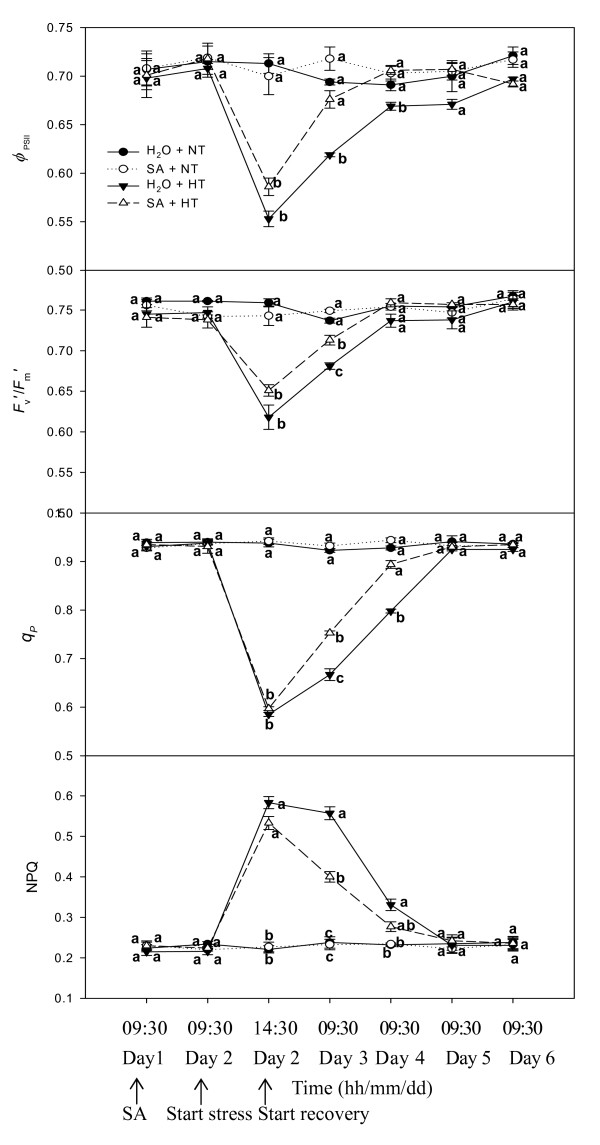
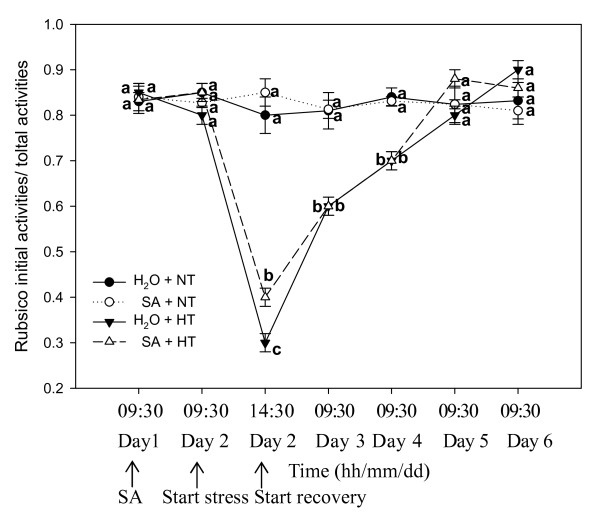
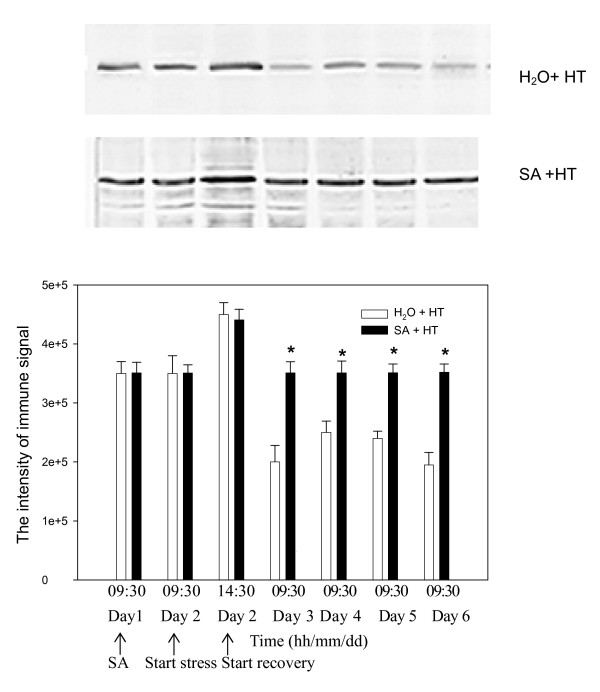
BACKGROUND: Although the effect of salicylic acid (SA) on photosynthesis of plants including grapevines has been investigated, very little is yet known about the effects of SA on carbon assimilation and several components of PSII electron transport (donor side, reaction center and acceptor side). In this study, the impact of SA pretreatment on photosynthesis was evaluated in the leaves of young grapevines before heat stress (25 degrees C), during heat stress (43 degrees C for 5 h), and through the following recovery period (25 degrees C). Photosynthetic measures included gas exchange parameters, PSII electron transport, energy dissipation, and Rubisco activation state. The levels of heat shock proteins (HSPs) in the chloroplast were also investigated. RESULTS: SA did not significantly (P < 0.05) influence the net photosynthesis rate (Pn) of leaves before heat stress. But, SA did alleviate declines in Pn and Rubisco activation state, and did not alter negative changes in PSII parameters (donor side, acceptor side and reaction center QA) under heat stress. Following heat treatment, the recovery of Pn in SA-treated leaves was accelerated compared with the control (H2O-treated) leaves, and, donor and acceptor parameters of PSII in SA-treated leaves recovered to normal levels more rapidly than in the controls. Rubisco, however, was not significantly (P < 0.05) influenced by SA. Before heat stress, SA did not affect level of HSP 21, but the HSP21 immune signal increased in both SA-treated and control leaves during heat stress. During the recovery period, HSP21 levels remained high through the end of the experiment in the SA-treated leaves, but decreased in controls. CONCLUSION: SA pretreatment alleviated the heat stress induced decrease in Pn mainly through maintaining higher Rubisco activation state, and it accelerated the recovery of Pn mainly through effects on PSII function. These effects of SA may be related in part to enhanced levels of HSP21.
Overview
The claims and statistics of this paper haven’t been checked yet.
Run the check — free, no account needed. It reads the open-access text and checks the sources it cites.
Integrity signals
Registry
Cites
Statistics
Figures
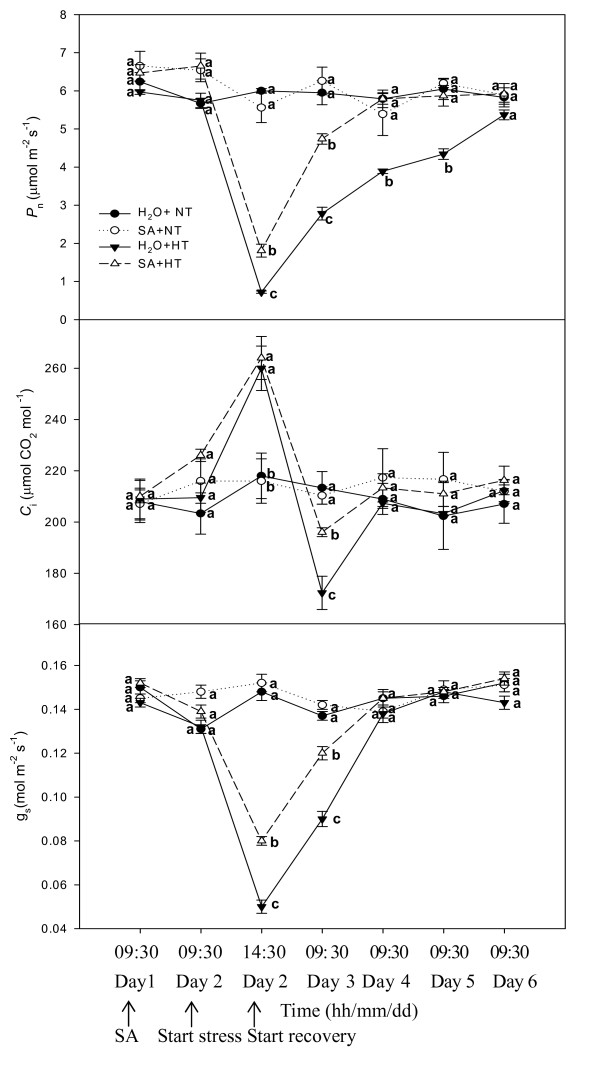
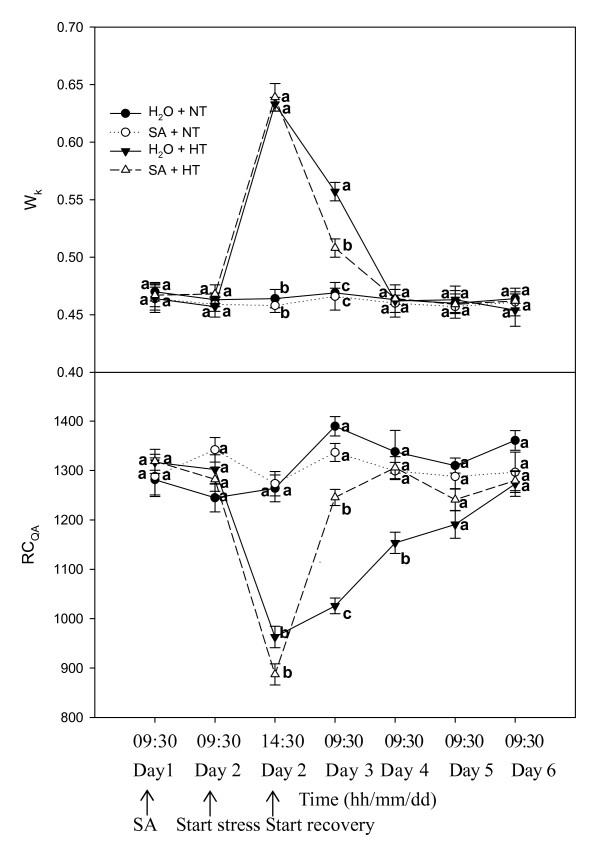
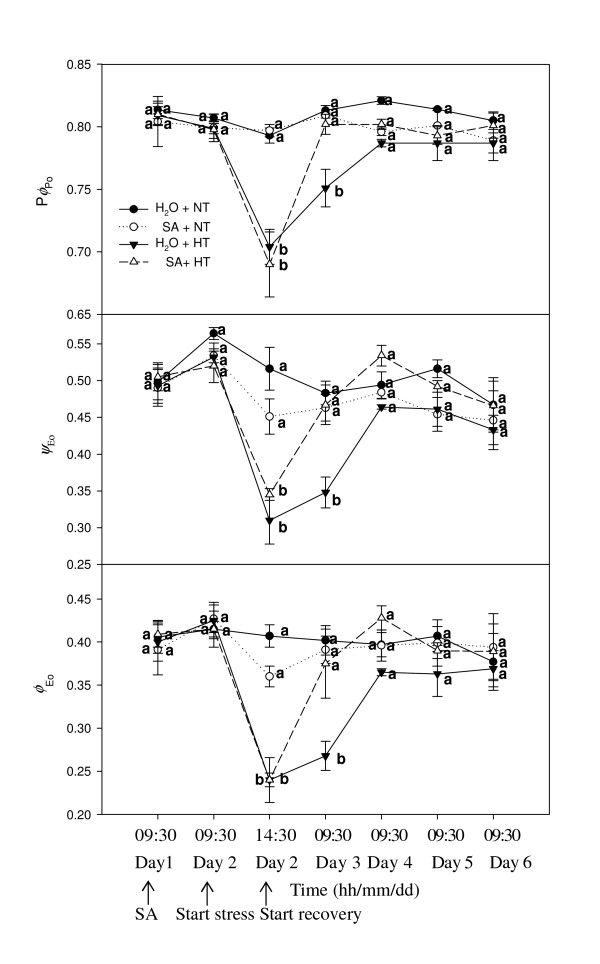
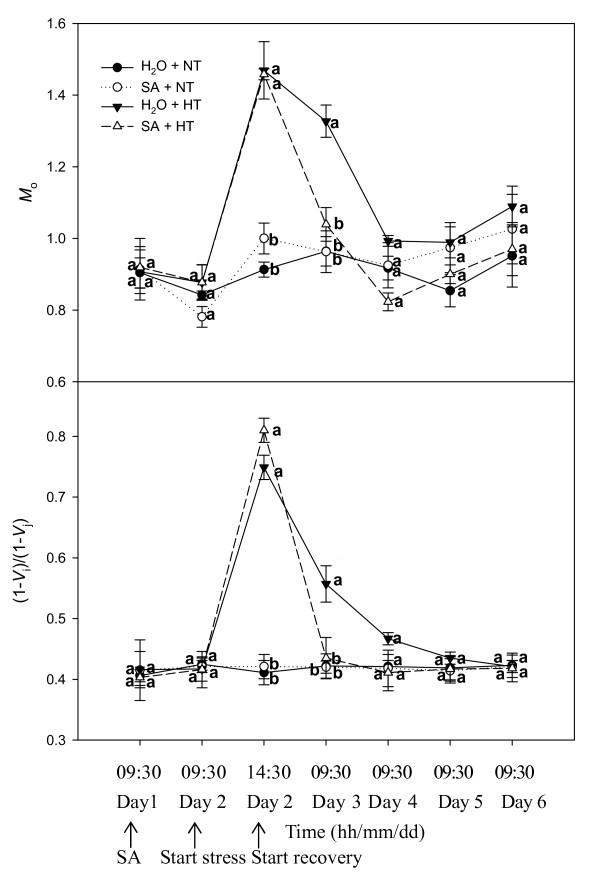
Verification
Claims the paper makes
The claims and statistics of this paper haven’t been checked yet.
Run the check — free, no account needed. It reads the open-access text and checks the sources it cites.
Claims other papers make about this one
Each is checked against this paper’s own text: does it say what the citing paper says it does?
The source backs part of the claim, not all of it — or backs it for a different population, condition or comparison.
In the citing paper
“It has been also reported that plants exposed to heat stress for even a short time experience the inhibition of the OEC and the reaction center of PSII (Wang et al. 2010, Hamdani et al. 2011), although the former is more sensitive to heat than the latter.”
From Photosynthesis under stressful environments: An overview (2013) · cites this paper as Wang et al. 2010
Experimental — accuracy not yet measuredThe source backs part of the claim, not all of it — or backs it for a different population, condition or comparison.
In the citing paper
“High temperature can damage the ultrastructure of the thylakoid membrane, thereby modulating its biochemical properties (Berry andBjörkman 1980, Wang et al. 2010).”
From Photosynthesis under stressful environments: An overview (2013) · cites this paper as Wang et al. 2010
Experimental — accuracy not yet measured
Self-check
Percentages, sums and reported differences re-computed from the paper’s own numbers.
The self-check needs the paper’s full text.
Citations
Cites
Bradford, M. M. (1976) · Analytical Biochemistry · doi:10.1016/0003-2697(76)90527-3 · Cited by 255,302
Photosynthetic Response and Adaptation to Temperature in Higher Plants
Berry, J., & Bjorkman, O. (1980) · Annual Review of Plant Physiology · doi:10.1146/annurev.pp.31.060180.002423 · Cited by 3,063
Role of plant heat-shock proteins and molecular chaperones in the abiotic stress response
Wang, W., Vinocur, B. J., Shoseyov, O., & Altman, A. (2004) · Trends in Plant Science · doi:10.1016/j.tplants.2004.03.006 · Cited by 2,759
The use of chlorophyll fluorescence nomenclature in plant stress physiology
van Kooten, O., & Snel, J. F. H. (1990) · Photosynthesis Research · doi:10.1007/bf00033156 · Cited by 2,314
Role of Salicylic Acid in Plants
Raskin, I. (1992) · Annual Review of Plant Physiology and Plant Molecular Biology · doi:10.1146/annurev.pp.43.060192.002255 · Cited by 1,346
Insulin Staining of ES Cell Progeny from Insulin Uptake
Rajagopal, J., Anderson, W. J., Kume, S., Martinez, O. I., & Melton, D. A. (2003) · Science · doi:10.1126/science.1077838 · Cited by 931
Influence of Climate, Soil, and Cultivar on Terroir
van Leeuwen, C., Friant, P., Choné, X., Trégoat, O., Koundouras, S., & Dubourdieu, D. (2004) · American Journal of Enology and Viticulture · doi:10.5344/ajev.2004.55.3.207 · Cited by 818
Demmig‐Adams, B., Adams, W. W., Barker, D. H., Logan, B. A., Bowling, D. R., & Verhoeven, A. S. (1996) · Physiologia Plantarum · doi:10.1034/j.1399-3054.1996.980206.x · Cited by 800
Induction of Abiotic Stress Tolerance by Salicylic Acid Signaling
Horváth, E., Szalai, G., & Janda, T. (2007) · Journal of Plant Growth Regulation · doi:10.1007/s00344-007-9017-4 · Cited by 772
Climate and Management Contributions to Recent Trends in U.S. Agricultural Yields
Lobell, D. B., & Asner, G. P. (2003) · Science · doi:10.1126/science.1078475 · Cited by 740
Salvucci, M. E., & Crafts‐Brandner, S. J. (2004) · Physiologia Plantarum · doi:10.1111/j.0031-9317.2004.0173.x · Cited by 732
Senaratna, T., Touchell, D. H., Bunn, E., & Dixon, K. W. (2000) · Plant Growth Regulation · doi:10.1023/a:1006386800974 · Cited by 716
Dat, J. F., López-Delgado, H. A., Foyer, C. H., & Scott, I. M. (1998) · PLANT PHYSIOLOGY · doi:10.1104/pp.116.4.1351 · Cited by 618
Response of barley grains to the interactive e.ect of salinity and salicylic acid
El‐Tayeb, M. A. (2005) · Plant Growth Regulation · doi:10.1007/s10725-005-4928-1 · Cited by 613
Arfan, M., Athar, H., & Ashraf, M. (2006) · Journal of Plant Physiology · doi:10.1016/j.jplph.2006.05.010 · Cited by 519
Salicylic acid induced physiological and biochemical changes in wheat seedlings under water stress
Singh, B., & Usha, K. (2003) · Plant Growth Regulation · doi:10.1023/a:1022556103536 · Cited by 509
Wise, R. R., OLSON, A. J., Schrader, S. M., & Sharkey, T. D. (2004) · Plant Cell & Environment · doi:10.1111/j.1365-3040.2004.01171.x · Cited by 508
Donor side capacity of Photosystem II probed by chlorophyll a fluorescence transients
Strasser, B. J. (1997) · Photosynthesis Research · doi:10.1023/a:1005896029778 · Cited by 472
Srivastava, A., Guissé, B., Greppin, H., & Strasser, R. J. (1997) · Biochimica et Biophysica Acta (BBA) - Bioenergetics · doi:10.1016/s0005-2728(97)00017-0 · Cited by 459
Changes in Salicylic Acid and Antioxidants during Induced Thermotolerance in Mustard Seedlings
Dat, J. F., Foyer, C. H., & Scott, I. M. (1998) · PLANT PHYSIOLOGY · doi:10.1104/pp.118.4.1455 · Cited by 407
de Ronde, J. A., Cress, W., Krüger, G. H. J., Strasser, R. J., & Staden, J. V. (2004) · Journal of Plant Physiology · doi:10.1016/j.jplph.2004.01.014 · Cited by 395
Munné‐Bosch, S., & Peñuelas, J. (2003) · Planta · doi:10.1007/s00425-003-1037-0 · Cited by 377
Neta‐Sharir, I., Isaacson, ., Lurie, S., & Weiss, D. W. (2005) · The Plant Cell · doi:10.1105/tpc.105.031914 · Cited by 365
Clarke, S., Mur, L. A. J., Wood, J. E., & Scott, I. M. (2004) · The Plant Journal · doi:10.1111/j.1365-313x.2004.02054.x · Cited by 341
Wohlgemuth, H., Mittelstrass, K., Kschieschan, S., Bender, J., Weigel, H., Overmyer, K., Kangasjärvi, J., Sandermann, H., & Langebartels, C. (2002) · Plant Cell & Environment · doi:10.1046/j.1365-3040.2002.00859.x · Cited by 333
Heckathorn, S. A., Downs, C. A., Sharkey, T. D., & Coleman, J. S. (1998) · PLANT PHYSIOLOGY · doi:10.1104/pp.116.1.439 · Cited by 320
Strauss, A. J., Krüger, G. H. J., Strasser, R. J., & van Heerden, P. D. R. (2005) · Environmental and Experimental Botany · doi:10.1016/j.envexpbot.2005.01.011 · Cited by 298
Wang, L., & Li, S. (2005) · Plant Science · doi:10.1016/j.plantsci.2005.09.005 · Cited by 269
Self-citationCao, J., & Jee, G. (1990) · Biochimica et Biophysica Acta (BBA) - Bioenergetics · doi:10.1016/0005-2728(90)90018-y · Cited by 263
Plants and high temperature stress.
Weis, E., & Berry, J. A. (1988) · PubMed · Cited by 232
YAMORI, W., SUZUKI, K., NOGUCHI, K., NAKAI, M., & TERASHIMA, I. (2006) · Plant, Cell & Environment · doi:10.1111/j.1365-3040.2006.01550.x · Cited by 221
Induction of thermotolerance in potato microplants by acetylsalicylic acid and H2O2
López-Delgado, H. A., Dat, J. F., Foyer, C. H., & Scott, I. M. (1998) · Journal of Experimental Botany · doi:10.1093/jexbot/49.321.713 · Cited by 215
Heat shock and recovery are mediated by different translational mechanisms.
DiDomenico, B., Bugaisky, G., & Lindquist, S. (1982) · Proceedings of the National Academy of Sciences · doi:10.1073/pnas.79.20.6181 · Cited by 205
Rubisco activation state decreases with increasing nitrogen content in apple leaves
Cheng, L., & Fuchigami, L. H. (2000) · Journal of Experimental Botany · doi:10.1093/jexbot/51.351.1687 · Cited by 203
ArabidopsishotMutants Define Multiple Functions Required for Acclimation to High Temperatures
Hong, S., Lee, U., & Vierling, E. (2003) · PLANT PHYSIOLOGY · doi:10.1104/pp.102.017145 · Cited by 198
Delfine, S., Alvino, A., Zacchini, M., & Loreto, F. (1998) · Australian Journal of Plant Physiology · doi:10.1071/pp97161 · Cited by 188
Havaux, M., TARDY, F., Ravenel, J., CHANU, D., & Parot, P. H. (1996) · Plant Cell & Environment · doi:10.1111/j.1365-3040.1996.tb00014.x · Cited by 149
Plant Growth Regulators Can Enhance the Recovery of Kentucky Bluegrass Sod from Heat Injury
Zhang, X., Ervin, E. H., & Schmidt, R. E. (2003) · Crop Science · doi:10.2135/cropsci2003.9520 · Cited by 135
Tardy, F., & Havaux, M. (1997) · Biochimica et Biophysica Acta (BBA) - Biomembranes · doi:10.1016/s0005-2736(97)00168-5 · Cited by 114
Structure and Thermal Stability of Photosystem II Reaction Centers Studied by Infrared Spectroscopy
Rivas, J. D. L., & Barber, J. (1997) · Biochemistry · doi:10.1021/bi970684w · Cited by 81
Molecular mechanism of high-temperature-induced inhibition of acceptor side of Photosystem II
Pospı́šil, P., & Tyystjärvi, E. (1999) · Photosynthesis Research · doi:10.1023/a:1006369009170 · Cited by 79
Heat-induced Multiple Effects on PSII in Wheat Plants
Lu, C.-M., & Zhang, J. (2000) · Journal of Plant Physiology · doi:10.1016/s0176-1617(00)80315-6 · Cited by 77
Recent Precipitation Trends in Hungary in the Context of Larger Scale Climatic Changes
Domonkos, P. (2003) · Natural Hazards · doi:10.1023/a:1023690014955 · Cited by 70
Park, J. M., Kang, S. G., Pih, K. T., Jang, H. J., Piao, H. L., Yoon, H., Cho, M. J., & Hwang, I. (1997) · PLANT PHYSIOLOGY · doi:10.1104/pp.115.2.763 · Cited by 70
Chen, L., & Cheng, L. (2003) · Journal of the American Society for Horticultural Science · doi:10.21273/jashs.128.5.0754 · Cited by 68
Heterogeneity of photosystem II reaction centers as influenced by heat treatment of barley leaves
Bukhov, N. G., & Carpentier, R. (2000) · Physiologia Plantarum · doi:10.1034/j.1399-3054.2000.110219.x · Cited by 62
Zsófi, Z., Gál, L., Szilágyi, Z. E., SZŰCS, E., Marschall, M., Nagy, Z., & Bálo, B. (2008) · Australian Journal of Grape and Wine Research · doi:10.1111/j.1755-0238.2008.00036.x · Cited by 54
Wen, X., Gong, H., & Lu, C. (2005) · Plant Science · doi:10.1016/j.plantsci.2005.01.015 · Cited by 37
Lu, C., & Zhang, J. (2000) · Journal of Plant Physiology · doi:10.1016/s0176-1617(00)80145-5 · Cited by 24
Recovery from Heat Shock in Heat-Tolerant and Nontolerant Variants of Creeping Bentgrass
Park, S. Y., Chang, K. C., Shivaji, R., & Luthe, D. S. (1997) · PLANT PHYSIOLOGY · doi:10.1104/pp.115.1.229 · Cited by 22
Wang, L. J., & Li, S. H. (2007) · Acta Horticulturae · doi:10.17660/actahortic.2007.738.104 · Cited by 13
Self-citation
Research works printed but not linked: 1
- Schultz HR: Climate change and world viticulture. Cost Action 858 Workshop: Vineyard under environmental constraints: adaptations to climate change. Abiotic stress ecophysiology and grape functional genomics. Poland: University of Lodz 2007.
Cited by
Sorted by citations
Physiological, Biochemical, and Molecular Mechanisms of Heat Stress Tolerance in Plants
Hasanuzzaman, M., Nahar, K., Alam, M., Roychowdhury, R., & Fujita, M. (2013) · International Journal of Molecular Sciences · doi:10.3390/ijms14059643 · Cited by 2,313
Photosynthesis under stressful environments: An overview
Ashraf, M., & Harris, P. J. C. (2013) · Photosynthetica · doi:10.1007/s11099-013-0021-6 · Cited by 2,028
Salicylic acid-induced abiotic stress tolerance and underlying mechanisms in plants
Khan, M. I. R., Fatma, M., Per, T. S., Anjum, N. A., & Khan, N. A. (2015) · Frontiers in Plant Science · doi:10.3389/fpls.2015.00462 · Cited by 1,321
Regulation of Photosynthesis during Abiotic Stress-Induced Photoinhibition
Gururani, M. A., Venkatesh, J., & Tran, L. P. (2015) · Molecular Plant · doi:10.1016/j.molp.2015.05.005 · Cited by 880
Nazar, R., Iqbal, N., Syeed, S., & Khan, N. A. (2010) · Journal of Plant Physiology · doi:10.1016/j.jplph.2010.11.001 · Cited by 559
Metadata
- Authors
- Wang, L.-J., Fan, L., Loescher, W., Duan, W., Liu, G.-J., Cheng, J.-S., Luo, H.-B., & Li, S.-H.
- Affiliations
- Chinese Academy of Sciences (CN)
- Michigan State University (US)
- China Agricultural University (CN)
- Corresponding author
- Li, Shao-Hua
- Venue
- BMC Plant Biology
- Published
- 2010-02-23
- Volume
- 10
- Issue
- 1
- Pages
- 34-34
- ISSN
- 1471-2229 (ISSN-L)
- PMC
- PMC2848757
- OpenAlex
- W2067467448
- Cited by
- 338
- References
- 51
- Citations by year
- 2026: 11 · 2025: 24 · 2024: 22 · 2023: 29 · 2022: 35 · 2021: 36 · 2020: 35 · 2019: 24 · 2018: 22 · 2017: 11 · 2016: 23 · 2015: 21 · 2014: 13 · 2013: 17 · 2012: 8
- FWCI
- 4.17
- Type
- journal article
- Language
- en
- Open access
- gold
- doi.org
- Licence
- cc-by
- Locations
- BMC Plant Biology (publishedVersion, cc-by)
- PubMed Central (publishedVersion, cc-by)
- PubMed (publishedVersion)
- DOAJ (DOAJ: Directory of Open Access Journals) (submittedVersion)
- Institute of Botany, CAS Institutional Repository (submittedVersion)
- Funders
- National Natural Science Foundation of China
- Chinese Academy of Sciences
- Shandong Agricultural University
- Institute of Botany, Chinese Academy of Sciences
- Topics
- Life Sciences › Biochemistry, Genetics and Molecular Biology › Molecular Biology › Photosynthetic Processes and Mechanisms
- Life Sciences › Agricultural and Biological Sciences › Plant Science › Plant Stress Responses and Tolerance
- Life Sciences › Agricultural and Biological Sciences › Plant Science › Plant Physiology and Cultivation Studies
- Keywords
- salicylic acid, heat stress, grapevine, photosynthesis, photosystem II electron transport, Rubisco activation, heat shock proteins, HSP21, heat stress recovery, carbon assimilation
- MeSH terms
- Carbon Dioxide, Chloroplasts, Electron Transport, Hot Temperature, Heat-Shock Proteins, Photosynthesis, Ribulose-Bisphosphate Carboxylase, Stress, Physiological, Plant Leaves, Plant Transpiration, Salicylic Acid, Vitis, Photosystem II Protein Complex
About these checks
Registry, retraction, Cites and statistics results are computed, not judged, with one exception: a printed reference that no index lists is read once by a model before it counts as a citation error. Claims are extracted by a model and kept only when their quote appears verbatim in the text; each cited source is then checked, with a model’s help, for whether it says what the claim relies on. Those verdicts can be wrong — read the claim’s quote and the cited source before relying on one.
Statistics and arithmetic are recomputed, not judged.
Confidence bands are shown only for fields calibrated on our annotated test set. None is calibrated yet, so no band is shown.
What counts as a claim ›How we measure confidence ›How we check this ›
Are you an author, or do you see a problem with this page? Request a review
