

The DOI matches its Crossref record; 41 of the 41 references it cites were found in a registry or an index.
Exploratory randomized controlled trial evaluating the impact of a waiting list control design
Open accessAbstract
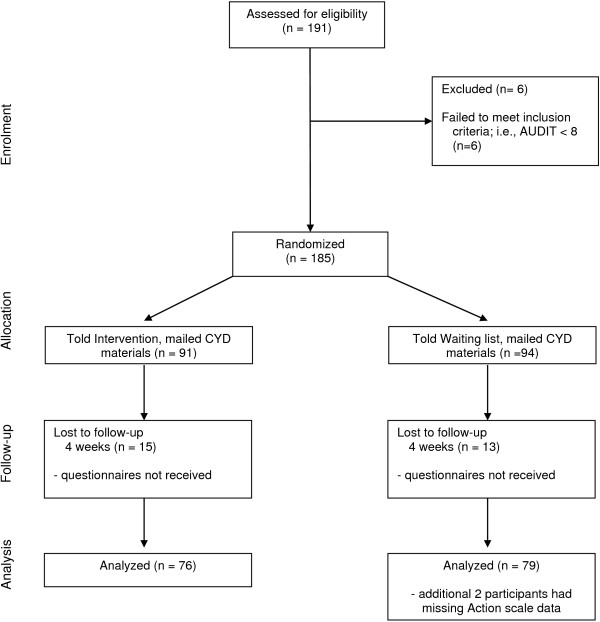
BACKGROUND: Employing waiting list control designs in psychological and behavioral intervention research may artificially inflate intervention effect estimates. This exploratory randomized controlled trial tested this proposition in a study employing a brief intervention for problem drinkers, one domain of research in which waiting list control designs are used. METHODS: All participants (N = 185) were provided with brief personalized feedback intervention materials after being randomly allocated either to be told that they were in the intervention condition and that this was the intervention or to be told that they were in the waiting list control condition and that they would receive access to the intervention in four weeks with this information provided in the meantime. RESULTS: A total of 157 participants (85%) were followed-up after 4 weeks. Between-group differences were found in one of four outcomes (proportion within safe drinking guidelines). An interaction was identified between experimental manipulation and stage of change at study entry such that participant change was arrested among those more ready to change and told they were on the waiting list. CONCLUSIONS: Trials with waiting list control conditions may overestimate treatment effects, though the extent of any such bias appears likely to vary between study populations. Arguably they should only be used where this threat to valid inference has been carefully assessed.
Overview
The claims and statistics of this paper haven’t been checked yet.
Run the check — free, no account needed. It reads the open-access text and checks the sources it cites.
Integrity signals
Registry
Cites
Statistics
Figures
Verification
Claims the paper makes
The claims and statistics of this paper haven’t been checked yet.
Run the check — free, no account needed. It reads the open-access text and checks the sources it cites.
Claims other papers make about this one
Each is checked against this paper’s own text: does it say what the citing paper says it does?
The cited source says what the claim attributes to it.
In the citing paper
“The literature reports growing concerns over the use of waitlist style control groups in psychotherapy research, as the outcomes of the interventions may be over-estimated with this type of control.64”
From Workplace interventions to improve well-being and reduce burnout for nurses, physicians and allied healthcare professionals: a systematic review. (2023) · cites this paper as [64]
The cited source says what the claim attributes to it.
In the citing paper
“Intervention outcomes should also be interpreted with caution because of the potential for overestimation of effect sizes when a waitlist comparison group is used in behavior change research [106].”
From Evaluation of an App-Delivered Psychological Flexibility Skill Training Intervention for Medical Student Burnout and Well-being: Randomized Controlled Trial (2023) · cites this paper as [106]
The cited source says what the claim attributes to it.
In the citing paper
“previous research suggests that waitlist participants’ expectations of receiving support at a later time could hinder the self-driven behavior change that they might otherwise have made during the same period [106].”
From Evaluation of an App-Delivered Psychological Flexibility Skill Training Intervention for Medical Student Burnout and Well-being: Randomized Controlled Trial (2023) · cites this paper as [106]
The cited source says what the claim attributes to it.
In the citing paper
“it has been noted that such designs may overestimate intervention effects [84].”
Self-check
Percentages, sums and reported differences re-computed from the paper’s own numbers.
The self-check needs the paper’s full text.
Citations
Cites
SAUNDERS, J. B., AASLAND, O. G., BABOR, T. F., DE LA FUENTE, J. R., & GRANT, M. (1993) · Addiction · doi:10.1111/j.1360-0443.1993.tb02093.x · Cited by 13,597 · cited 1×
“The outcome variables were: number of drinks in a typical recent week, largest number of drinks on one occasion, and the AUDIT-C [28], the consumption subscale of the Alcohol Use Disorders Identification Test AUDIT, [29,30], which includes three items (frequency of drinking, number of drinks per drinking day, and freq…”
(1979) · Medical Entomology and Zoology · Cited by 11,252
Quasi-experimentation: Design and analysis issues for field settings
Shrout, P. E. (1980) · Evaluation and Program Planning · doi:10.1016/0149-7189(80)90063-4 · Cited by 6,091
(2001) · Cited by 5,455
(1991) · Medical Entomology and Zoology · Cited by 4,438
Framework for design and evaluation of complex interventions to improve health
Campbell, M. (2000) · BMJ · doi:10.1136/bmj.321.7262.694 · Cited by 3,474
ROLLNICK, S., HEATHER, N., GOLD, R., & HALL, W. (1992) · British Journal of Addiction · doi:10.1111/j.1360-0443.1992.tb02720.x · Cited by 818
Dawson, D. A., Grant, B. F., Stinson, F. S., & Zhou, Y. (2005) · Alcoholism Clinical and Experimental Research · doi:10.1097/01.alc.0000164374.32229.a2 · Cited by 704
Mohr, D. C., Spring, B., Freedland, K. E., Beckner, V., Arean, P., Hollon, S. D., Ockene, J., & Kaplan, R. (2009) · Psychotherapy and Psychosomatics · doi:10.1159/000228248 · Cited by 565
Motivational Interviewing: Preparing People to Change Addictive Behavior
Rotgers, F. (1993) · Journal of Studies on Alcohol · doi:10.15288/jsa.1993.54.507a · Cited by 398
Research works printed but not linked: 1
- McCambridge J, Kypri K, Elbourne D: In randomisation we trust? Possible problems in experimenting with people in behavioural intervention trials. J Clin Epidemiol. -in press
Cited by
Sorted by citations
Items 201–300 of 321
Bisconti, N., Odier, M., Becker, M. A., & Bullock, K. D. (2024) · JMIR Mental Health · doi:10.2196/52369 · Cited by 4
“Research on WC design shows highly variable effects, which depend on the characteristics of sample being studied [40].”
BackgroundConigrave, J. H., Lee, K. S., Dobbins, T., Wilson, S., Padarian, J., Ivers, R. G., Morley, K. C., Haber, P., Vnuk, J., Marshall, K. S., et al. (2024) · BMC Health Services Research · doi:10.1186/s12913-024-11214-6 · Cited by 4
“Experimental research suggests that being on a waiting list to receive support can be taxing when one feels ready to change [36].”
BackgroundResearch participation effects and where to find them: a systematic review of studies on alcohol
Gunnarsson, K. U., Collier, E. S., & Bendtsen, M. (2025) · Journal of Clinical Epidemiology · doi:10.1016/j.jclinepi.2025.111668 · Cited by 4
Majumdar, V., Snigdha, A., Manjunath, N. K., Nagarathna, R., Mavathur, R. N., Singh, A., Kalpana, S., & Nagendra, H. R. (2021) · BMJ Open · doi:10.1136/bmjopen-2021-051209 · Cited by 4
Hamamura, T., Suganuma, S., Takano, A., Matsumoto, T., & Shimoyama, H. (2021) · Addictive Behaviors Reports · doi:10.1016/j.abrep.2021.100400 · Cited by 4
Ketelhut, S., Wehlan, E., Bayer, G., & Ketelhut, R. G. (2022) · International Journal of Environmental Research and Public Health · doi:10.3390/ijerph19169836 · Cited by 4
“Observer-rating scales are more sensitive to change than self-rating scales [66].”
BackgroundForbes, Z. N. M., & Miller, K. (2023) · Review Journal of Autism and Developmental Disorders · doi:10.1007/s40489-023-00398-y · Cited by 5
“This may be explained by waitlist group participants having lowered expectations that they are ‘waiting’ for treatment and therefore will not see improvement until they receive this treatment (Cunningham et al., 2013).”
Bertz, J. W., Smith, K. E., Panlilio, L. V., Stull, S. W., Reamer, D., Murville, M.-L., Sullivan, M., Holtyn, A. F., Toegel, F., Epstein, D. H., et al. (2021) · Drug and Alcohol Dependence Reports · doi:10.1016/j.dadr.2021.100011 · Cited by 5
Wright, H., Martin, F., Clyne, W., Clark, C. C. T., McGillion, M. H., Matouskova, G., & Turner, A. (2020) · JMIR Research Protocols · doi:10.2196/24264 · Cited by 5
“There is some evidence that wait-list controls for studies of psychological interventions may overestimate intervention effects relative to other forms of control group [47].”
BackgroundKristensen, M. B., Wessel, I., Beck, A. M., Dieperink, K. B., Mikkelsen, T. B., Møller, J. K., & Zwisler, A. (2020) · Nutrition Journal · doi:10.1186/s12937-020-00539-7 · Cited by 4
Pellegrini, L., Laws, K. R., Albert, U., Reid, J. E., & Fineberg, N. A. (2020) · Expert Review of Pharmacoeconomics & Outcomes Research · doi:10.1080/14737167.2020.1829480 · Cited by 4
Tse, C. S., Singh, S., & Sandborn, W. J. (2022) · Inflammatory Bowel Diseases · doi:10.1093/ibd/izab153 · Cited by 3
Chan, K., Marsack‐Topolewski, C. N., Ratnayake, M., Kaplan, D. B., Voet, K. A., Riemenschneider, M., & Graves, J. (2024) · Journal of Gerontological Social Work · doi:10.1080/01634372.2024.2373290 · Cited by 3
“Waitlist controlled designs may overestimate treatment effects due to difference in readiness to change and duration of the intervention (Cunningham et al., 2013).”
Seery, C., Rushiti, F., Krasniqi, S. P., Çarkaxhiu, S. I., Xhemaili, V. D., Limani, D. A., Prapashtica, Q., Turjaka, V., Zekaj, N., Salihu, M., et al. (2024) · Clinical Psychology & Psychotherapy · doi:10.1002/cpp.3039 · Cited by 3
Lao, U., Zhu, H., Liang, F., Bai, E. W., Yin, P., Huang, X., Girdler, S. J., Bölte, S., & Zou, X. (2024) · BMJ Open · doi:10.1136/bmjopen-2023-081827 · Cited by 3
MacLellan, A., Fairchild, G. F., & Button, K. S. (2026) · JMIR Mental Health · doi:10.2196/91564 · Cited by 2
“[17,40,41], with effect sizes ranging from f =0.23 [39] to f =0.30 [17].”
InfluentialMorrison, F. P., Fullam, R. S., Thomson, K., Meyer, D., & Daffern, M. (2022) · International Journal of Offender Therapy and Comparative Criminology · doi:10.1177/0306624x221086581 · Cited by 3
“Athough many studies trialing novel treatments utilize a waitlist or placebo control group, these can artificially inflate the efficacy of the experimental group (Baskin et al., 2003; Cunningham et al., 2013).”
BackgroundJolley, S., Lord, J., Plant, D., Wood, E. A., Bracegirdle, K., Browning, S., Carter, B., & James, K. (2023) · Trials · doi:10.1186/s13063-023-07267-3 · Cited by 5
Feder, A., Kowalchyk, M. L., Brinkman, H. R., Cahn, L., Aaronson, C. J., Böttche, M., Presseau, C., Fred-Torres, S., Markowitz, J. C., Litz, B. T., et al. (2024) · Psychiatry Research · doi:10.1016/j.psychres.2024.115885 · Cited by 3
Thompson, L. C., & Wilson, P. (2024) · Children · doi:10.3390/children11050510 · Cited by 3
“This made long-term follow-up, essential in a definitive trial, of little value, and it is possible that natural improvement among those mothers allocated to the waiting-list condition was curtailed until they joined a group [36].”
Background6-Week student wellness program improves psychological wellbeing of students
Gerdes, A. C., & Gordon, N. S. (2024) · Journal of American College Health · doi:10.1080/07448481.2024.2351431 · Cited by 3
Plathner, M., & Wolf, L. (2025) · Journal of Bodywork and Movement Therapies · doi:10.1016/j.jbmt.2025.01.041 · Cited by 3
Edikpa, E. C., IGABARI, Q. E., Ede, M. O., Amoke, C. V., Manafa, I. F., Nweze, C. A., Okoro, I. D., & Okereke, I. E. (2025) · Psychological Reports · doi:10.1177/00332941251323243 · Cited by 3
Klaassen, A. D., Jorritsma, W., Willigenburg, N. W., Gerritsma, C. L., ten Have, B. L. E. F., Moojen, D. J. F., Gademan, M. G. J., Groenwold, R. H. H., & Poolman, R. W. (2025) · Acta Orthopaedica · doi:10.2340/17453674.2025.43332 · Cited by 3
“Literature suggests that patients awaiting an intervention might report less improvement than expected in a conservative cohort [ 17 ].”
Hancock, S., Thayabaranathan, T., Stolwyk, R. J., Cameron, J., Immink, M. A., Hillier, S., Kilkenny, M. F., Brodtmann, A. G., Carey, L. M., Olaiya, M. T., et al. (2025) · Mindfulness · doi:10.1007/s12671-025-02579-8 · Cited by 3
“In this trial, the attention control was used to control for common mechanisms for change (known as common factors) such as participation, socialisation, and participant’s expectations of benefit (Cunningham et al., 2013).”
Simmet, A., Teut, M., Schleicher, R., Bschaden, A., & Stroebele‐Benschop, N. (2020) · BMC Public Health · doi:10.1186/s12889-020-09232-0 · Cited by 3
Kariyawasam, D., Soukup, T., Parsons, J., Sevdalis, N., Lopez, M. B., Forde, R., Ismail, K., Jones, M., Ford‐Adams, M., Yemane, N., et al. (2022) · BMJ Open · doi:10.1136/bmjopen-2022-062971 · Cited by 4
İnce, B., & Yücel, B. (2022) · Current Psychology · doi:10.1007/s12144-022-03909-y · Cited by 4
“Since clinical trials with a wait-list control condition only were criticised for possible overestimation of treat-ment effects (Cunningham et al., 2013), a further strength was comparing the efficacy of the program with an active intervention and wait-list control.”
BackgroundCare ally-assisted massage for Veterans with chronic neck pain: TOMCATT results
Munk, N., Daggy, J., Slaven, J. E., Evans, E., Foote, T., Laws, B., Matthias, M. S., & Bair, M. J. (2024) · Contemporary Clinical Trials · doi:10.1016/j.cct.2024.107561 · Cited by 3
Stokholm, J. R., Vinberg, M., Faurholt‐Jepsen, M., & Kessing, L. V. (2024) · Trials · doi:10.1186/s13063-024-08172-z · Cited by 5
“The trial is designed as a two-arm, parallel-group, superiority, randomized trial with a balanced randomization 1:1 to group-based psychoeducation versus a waiting list [38].”
Mindfulness for men with pregnant partners: An integrative literature review (Part one)
Jones, D., Ebert, L. M., & Hazelton, M. (2017) · British Journal of Midwifery · doi:10.12968/bjom.2017.25.11.707 · Cited by 3
Psychotherapy for PTSD and stress disorders
Sikkema, K. J., & Coleman, J. N. (2019) · Elsevier eBooks · doi:10.1016/b978-0-12-814932-4.00009-4 · Cited by 3
Vaikuttavuustutkimus: Satunnaistettu vertailukoe tulee suunnitella huolella
Hinkka‐Yli‐Salomäki, S. (2021) · Kasvun tuki -aikakauslehti · doi:10.61259/kt.128200 · Cited by 3
Rubel, J. A., Väth, T., Hanraths, S., Pruessner, L., Timm, C., Hartmann, S. F., Barnow, S., & Lalk, C. (2023) · doi:10.31234/osf.io/kbhvy · Cited by 3
Hamed, A. M., Moralejo, D., & Durante, Á. (2025) · Creative Nursing · doi:10.1177/10784535241307932 · Cited by 4
“For example, when using a waitlist as a control group, participants can be informed that they will eventually receive the treatment but must await completion of the treatment by participants in the treatment group (Cunningham et al., 2013).”
Randomized Controlled Trial of Acoustic Neuromodulation to Enhance Well-Being in Healthcare Workers
Tegeler, C. L., Clary, H. M. M., Shaltout, H. A., Russell, G. B., Danhauer, S. C., & Tegeler, C. H. (2025) · Global Advances in Integrative Medicine and Health · doi:10.1177/27536130251388984 · Cited by 3
A randomized controlled trial study of a life review art intervention for older adults living alone
Tsai, P., Chou, W.-H., & Liao, S.-Y. (2025) · Frontiers in Psychology · doi:10.3389/fpsyg.2025.1669119 · Cited by 4
“This arrangement preserved psychosocial support for the control group while minimizing the risks of contamination and attrition due to unequal benefit, with delayed intervention offered when necessary to address ethical and retention considerations (Cunningham et al., 2013).”
Moghaddam, N. G., Dawson, D. L., Evangelou, N., Turton, J. C., Hawton, A., Law, G. R., Roche, B. T., Rowan, E., Burge, R., Frost, A. C., et al. (2022) · Pilot and Feasibility Studies · doi:10.1186/s40814-022-01152-7 · Cited by 2
Doren, N. V., & Roeser, R. W. (2024) · ECNU Review of Education · doi:10.1177/20965311241265122 · Cited by 2
Gunnarsson, K. U., Henriksson, M., McCambridge, J., & Bendtsen, M. (2024) · Drug and Alcohol Dependence · doi:10.1016/j.drugalcdep.2024.112409 · Cited by 2
Self-citationTakács, J. (2019) · Testnevelés Sport Tudomány · doi:10.21846/tst.2019.1-2.2 · Cited by 2
“Finally, it is important to note that the waiting-list control condition may overestimate treatment effects, although the extent of any such bias is likely to vary among study populations (Cunningham et al., 2013).”
BackgroundCavonius‐Rintahaka, D., Roos, M., Gillberg, C., Billstedt, E., & Aho, A. L. (2021) · Advances in Neurodevelopmental Disorders · doi:10.1007/s41252-021-00230-w · Cited by 2
Why can’t patients last the wait?
Guitar, N. A. (2017) · University of Western Ontario Medical Journal · doi:10.5206/uwomj.v86i2.2015 · Cited by 2
McCambridge, J. (2014) · Addiction · doi:10.1111/add.12588 · Cited by 2
Self-citationZaks, I., Dekel, R., Shoval‐Zuckerman, Y., & Horesh, D. (2023) · Contemporary Clinical Trials · doi:10.1016/j.cct.2023.107280 · Cited by 1
Hyperbaric Oxygen Post Established Stroke
Harrison, D. W., Brasher, P. M. A., Eng, J. J., Harris, D. R., Hoens, A. M., Khazei, A., Yao, J. K., & Abu‐Laban, R. B. (2024) · Cureus · doi:10.7759/cureus.63395 · Cited by 1
“There were significant limitations with the trial: it used a waitlist control, which can lead to overestimates of treatment effects [9,10], and the validity of the primary outcome, NIHSS, is uncertain in chronic stroke [11].”
MethodCrawford, J., Collier, E. S., Gunnarsson, K. U., Shorter, G. W., McCambridge, J., Lundgren, O., & Bendtsen, M. (2025) · BMJ Open · doi:10.1136/bmjopen-2025-100532 · Cited by 1
Self-citationCunha, O. S., Silva, T. P. E., Almeida, T. C., Gonçalves, R. A., Sousa, M., & Caridade, S. (2026) · International Journal of Offender Therapy and Comparative Criminology · doi:10.1177/0306624x251415371 · Cited by 1
Safeguarding Gaps in the PATHWAYS Trial: Insights from GnRH Analogue Use in Gynecology
Jorgensen, S. C. J. (2026) · Journal of Sex & Marital Therapy · doi:10.1080/0092623x.2026.2641107 · Cited by 1
“…GnRHa’s physiologic effects are largely limited to hormone and menstrual suppression, any short-term improvement in subjective psychological measures in a waitlist-controlled trial are likely to be strongly shaped by expectancy and nocebo effects (Cunningham et al., 2013; Huneke et al., 2025).”
Wardęszkiewicz, J., Holas, P., & Andersson, G. (2026) · Mindfulness · doi:10.1007/s12671-026-02778-x · Cited by 4
Studer, S., Kleinstäuber, M., von Lersner, U., & Weise, C. (2024) · Trials · doi:10.1186/s13063-023-07878-w · Cited by 1
“A waitlist con-trol group carries the risk of overestimating effects [69].”
BackgroundNew evidence for flexible psilocybin dosing in patients with treatment-resistant depression
Aaronson, S. T., & Kozak, Z. (2024) · Med · doi:10.1016/j.medj.2024.01.014 · Cited by 1
Borsutzky, S., Wilke, A.-S., Gehlenborg, J., & Moritz, S. (2025) · Frontiers in Psychiatry · doi:10.3389/fpsyt.2025.1528128 · Cited by 1
“While previous research suggests that waitlist control groups typically in fl ate effect sizes in favor of the experimental intervention (51, 52), this unlikely applies to our study, as the WCG also demonstrated notable improvements.”
Ugwoke, R. O., Ugwoke, O. V., Onyeanu, E. O., & Ajayi, T. A. (2022) · Frontiers in Psychology · doi:10.3389/fpsyg.2022.948978 · Cited by 1
“, 2013; Kinser and Robins, 2013; Schimelpfening, 2021), it has been observed that the use of this type of group could result in the overestimation of treatment effects (Grossman et al., 2007; Cunningham et al., 2013).”
BackgroundWardęszkiewicz, J., Holas, P., & Andersson, G. (2025) · Research Square · doi:10.21203/rs.3.rs-7166236/v1 · Cited by 1
Knee osteoarthritis and aquatic cycling
Rewald (2018) · Research Publications (Maastricht University) · doi:10.26481/dis.20180711sr
Dante, A., Cerra, C. L., Caponnetto, V., Franconi, I., Gaxhja, E., Petrucci, C., & Lancia, L. (2018) · Advances in intelligent systems and computing · doi:10.1007/978-3-319-98872-6_31
Martins, D. S. (2020) · Digital Library of Theses and Dissertations (Universidade de São Paulo) · doi:10.11606/d.47.2020.tde-02092020-174154
Syafitri, D. U., Laksmiwati, A. A., & Aziz, A. A. (2021) · Intuisi : Jurnal Psikologi Ilmiah · doi:10.15294/intuisi.v13i1.26388
“…mana subjek yang berada di kelompok WL nantinya akan diberikan perlakuan yang sama (perlakuan tertunda) setelah perlakuan pada kelompok eksperimen selesai, sembari peneliti tetap mendapatkan data evaluasi (pretes, postes, observasi, dll) dari subjek di kelompok tersebut (Cunningham et al., 2013).”
Lippke, S., Ratz, T., Keller, F. M., Juljugin, D., Peters, M., Pischke, C. R., & Voelcker‐Rehage, C. (2022) · doi:10.2196/preprints.36515
Sidani, S., & Braden, C. J. (2021) · Wiley eBooks · doi:10.1002/9781119610113.ch14
Mindfulness for men with pregnant partners: An integrative literature review (Part two)
Jones, D., Ebert, L. M., & Hazelton, M. (2017) · British Journal of Midwifery · doi:10.12968/bjom.2017.25.12.783
Wasilewski, M. B., Nonoyama, M. L., Dale, C., Mckim, D. A., ROAD, J. D., Leasa, D. J., Goldstein, R. S., & Rose, L. (2018) · doi:10.2196/preprints.11827
Sharma, N., Kumar, P., Kaur, S., & Sharma, N. (2023) · Sports Health A Multidisciplinary Approach · doi:10.1177/19417381231175478
Studer, S., Kleinstäuber, M., von Lersner, U., & Weise, C. (2023) · Research Square · doi:10.21203/rs.3.rs-3142516/v1
Coco, L., & Gallun, F. J. (2023) · Elsevier eBooks · doi:10.1016/b978-0-323-91259-4.00035-7
Schell, C., Godinho, A., & Cunningham, J. A. (2023) · Substance Use & Misuse · doi:10.1080/10826084.2023.2259453
“While there are advantages to this design (Cunningham et al., 2013), in this case, the two interventions may have been too similar to have a differential effect on QOL, especially as there is research showing that an individual’s QOL may improve by participating in treat-ment without necessarily…”
BackgroundMethodSelf-citationLao, U., Zhu, H., Liang, F., Bai, E. W., Yin, P., Huang, X., Girdler, S. J., Bölte, S., & Zou, X. (2023) · medRxiv · doi:10.1101/2023.10.30.23296686
“These differences also affect collaboration among various social service providers, including healthcare, schools, and communities [33, 34, 35].”
BackgroundPotthoff, J., & Schienle, A. (2023) · European Journal of Investigation in Health Psychology and Education · doi:10.3390/ejihpe13110179
“We chose an active control group (instead of a waiting-list group) to avoid overestimation of treatment effects [21].”
MethodVelalagan, R., Wu, W. T., John, J. R., Lin, P., & Eapen, V. (2026) · BMC Psychiatry · doi:10.1186/s12888-026-08579-9
Schweinhart, A. M., Goins, R. T., & Anderson, E. (2025) · Innovation in Aging · doi:10.1093/geroni/igaf041
“As such, we used a waitlist-controlled design, which is inherently less rigorous than an RCT and research suggests that behavioral health interventions using this approach may inflate intervention effect (Cunningham et al., 2013).”
Botchway-Commey, E. N., Burton, C., Pace, C. C., Ehrenreich, J. T., Kennedy, S. M., Williams, J. S., Poulakis, Z., DPsychClin, A. M., Anderson, V. A., & Crowe, L. M. (2025) · BMC Psychology · doi:10.1186/s40359-025-03052-w
“Although the waitlist control group method is said to sometimes cause people to stall in their personal efforts to change behaviour [59] and overestimate treat-ment effects, our short waitlist period (i.e., 8 weeks) and regular contact with this group during the waitlist period are expected to…”
Asriati, R., & Oriza, I. I. D. (2025) · Konselor · doi:10.24036/02025142127-0-86
“A wait-list control means that participants who want help will still receive the intervention later, while allowing researchers to analyze the results from the main intervention group (Cunningham et al., 2013).”
Curtis, K., Clarke, H. A., Mina, D. S., Bechsgaard, G., Weinrib, A., Jones, J. S., Au, D., & Katz, J. D. (2025) · OBM Integrative and Complementary Medicine · doi:10.21926/obm.icm.2503041
Lee, J., & Kim, J. (2025) · American Journal of Health Promotion · doi:10.1177/08901171251391600 · Cited by 1
“48 Second, the characteristics of the study population and facility may have introduced bias.”
Lauckner, C., Adatorwovor, R., Taylor, E. W., Sesenu, F., Tanner, T., Whitmire, A., Marconi, V. C., Kershaw, T., & Hansen, N. B. (2025) · Addiction Science & Clinical Practice · doi:10.1186/s13722-025-00631-5
“While waitlist-control groups have noted disadvantages, such as inflated effect sizes [36, 37], they are common in alcohol reduction interventions [38–40] and in this case represented an approach that balanced scientific rigor with equity and principles of beneficence.”
Laing, J., McKinnon, A. I., Creswell, C., Ehlers, A., & Wild, J. (2025) · Trials · doi:10.1186/s13063-025-09341-4
“Some research suggests that participants assigned to wait conditions avoid attempting behaviour change on their own and, as such, demonstrate limited improvement [73].”
Bendtsen, M., Åsberg, K., & McCambridge, J. (2022) · Figshare · doi:10.6084/m9.figshare.19777956
Self-citationJensen, M., Hüttenrauch, E., Schmidt, J., Andersson, G., Chavanon, M.-L., & Weise, C. (2020) · Figshare · doi:10.6084/m9.figshare.12257978
Jensen, M., Hüttenrauch, E., Schmidt, J., Andersson, G., Chavanon, M.-L., & Weise, C. (2020) · Figshare · doi:10.6084/m9.figshare.12257963
Kristensen, M. B., Wessel, I., Beck, A. M., Dieperink, K. B., Mikkelsen, T. B., Møller, J.-J. K., & Zwisler, A.-D. (2020) · Figshare · doi:10.6084/m9.figshare.11999325
Craig, S. L., Eaton, A. D., Leung, V. W. Y., Iacono, G., Pang, N., Dillon, F. R., Austin, A., Pascoe, R. V., & Dobinson, C. (2021) · Figshare · doi:10.6084/m9.figshare.14746329
Jensen, M., Hüttenrauch, E., Schmidt, J., Andersson, G., Chavanon, M.-L., & Weise, C. (2020) · Figshare · doi:10.6084/m9.figshare.12257987
Kristensen, M. B., Wessel, I., Beck, A. M., Dieperink, K. B., Mikkelsen, T. B., Møller, J.-J. K., & Zwisler, A.-D. (2020) · Figshare · doi:10.6084/m9.figshare.11999340
Bendtsen, M., Åsberg, K., & McCambridge, J. (2022) · Figshare · doi:10.6084/m9.figshare.19777953
Self-citationJensen, M., Hüttenrauch, E., Schmidt, J., Andersson, G., Chavanon, M.-L., & Weise, C. (2020) · Figshare · doi:10.6084/m9.figshare.12257969
Schormann, A. L. A., Pillny, M., Haß, K., & Lincoln, T. M. (2023) · Figshare · doi:10.6084/m9.figshare.22735638
Collier, E. S., Blomqvist, J., Crawford, J., McCambridge, J., & Bendtsen, M. (2023) · Figshare · doi:10.6084/m9.figshare.24454950
Self-citationBendtsen, M., Åsberg, K., & McCambridge, J. (2022) · Figshare · doi:10.6084/m9.figshare.19777950
Self-citationJensen, M., Hüttenrauch, E., Schmidt, J., Andersson, G., Chavanon, M.-L., & Weise, C. (2020) · Figshare · doi:10.6084/m9.figshare.12257993
Bendtsen, M., Åsberg, K., & McCambridge, J. (2022) · Figshare · doi:10.6084/m9.figshare.19777959
Self-citationKristensen, M. B., Wessel, I., Beck, A. M., Dieperink, K. B., Mikkelsen, T. B., Møller, J.-J. K., & Zwisler, A.-D. (2020) · Figshare · doi:10.6084/m9.figshare.11999352
Jensen, M., Hüttenrauch, E., Schmidt, J., Andersson, G., Chavanon, M.-L., & Weise, C. (2020) · Figshare · doi:10.6084/m9.figshare.12257984
Bendtsen, M., Åsberg, K., & McCambridge, J. (2022) · Figshare · doi:10.6084/m9.figshare.19777944
Self-citationMoghaddam, N., Dawson, D. L., Nikos, E., Turton, J. C., Hawton, A., Law, G. R., Roche, B., Rowan, E., Burge, R., Frost, A. C., et al. (2022) · Figshare · doi:10.6084/m9.figshare.20887251
Kristensen, M. B., Wessel, I., Beck, A. M., Dieperink, K. B., Mikkelsen, T. B., Møller, J.-J. K., & Zwisler, A.-D. (2020) · Figshare · doi:10.6084/m9.figshare.11999331
Metadata
- Authors
- Cunningham, J. A., Kypri, K., & McCambridge, J.
- Affiliations
- Australian National University (AU)
- University of Newcastle Australia (AU)
- London School of Hygiene & Tropical Medicine (GB)
- Corresponding author
- Cunningham, John A
- Venue
- BMC Medical Research Methodology
- Published
- 2013-12
- Volume
- 13
- Issue
- 1
- Pages
- 150-150
- ISSN
- 1471-2288 (ISSN-L)
- PMC
- PMC4029562
- OpenAlex
- W2132268984
- Cited by
- 321
- References
- 40
- Citations by year
- 2026: 18 · 2025: 29 · 2024: 35 · 2023: 41 · 2022: 42 · 2021: 37 · 2020: 33 · 2019: 28 · 2018: 15 · 2017: 17 · 2016: 11 · 2015: 5 · 2014: 10
- FWCI
- 7.62
- Type
- journal article
- Language
- en
- Open access
- gold
- doi.org
- Licence
- Locations
- BMC Medical Research Methodology (publishedVersion, cc-by)
- Europe PMC (PubMed Central) (publishedVersion, cc-by)
- PubMed Central (publishedVersion, cc-by)
- PubMed (publishedVersion)
- LSHTM Research Online (London School of Hygiene and Tropical Medicine) (acceptedVersion)
- Figshare (submittedVersion, cc-by)
- ANU Open Research (Australian National University) (submittedVersion, cc-by)
- NOVA (University of Newcastle Australia) (submittedVersion)
- Funders
- Wellcome Trust (WT086516MA)
- Medical Research Council
- Topics
- Physical Sciences › Mathematics › Statistics and Probability › Statistical Methods in Clinical Trials
- Health Sciences › Medicine › Epidemiology › Substance Abuse Treatment and Outcomes
- Social Sciences › Decision Sciences › Statistics, Probability and Uncertainty › Meta-analysis and systematic reviews
- Keywords
- overestimation of treatment effects, brief intervention, problem drinking, personalized feedback, stages of change, alcohol consumption, drinking guidelines
- MeSH terms
- Adult, Alcohol Drinking, Behavior Therapy, Female, Humans, Male, Middle Aged, Research Design, Waiting Lists, Bias, Alcohol-Related Disorders
About these checks
Registry, retraction, Cites and statistics results are computed, not judged, with one exception: a printed reference that no index lists is read once by a model before it counts as a citation error. Claims are extracted by a model and kept only when their quote appears verbatim in the text; each cited source is then checked, with a model’s help, for whether it says what the claim relies on. Those verdicts can be wrong — read the claim’s quote and the cited source before relying on one.
Statistics and arithmetic are recomputed, not judged.
Confidence bands are shown only for fields calibrated on our annotated test set. None is calibrated yet, so no band is shown.
What counts as a claim ›How we measure confidence ›How we check this ›
Are you an author, or do you see a problem with this page? Request a review
