

The DOI matches its Crossref record; 41 of the 41 references it cites were found in a registry or an index.
Exploratory randomized controlled trial evaluating the impact of a waiting list control design
Open accessAbstract
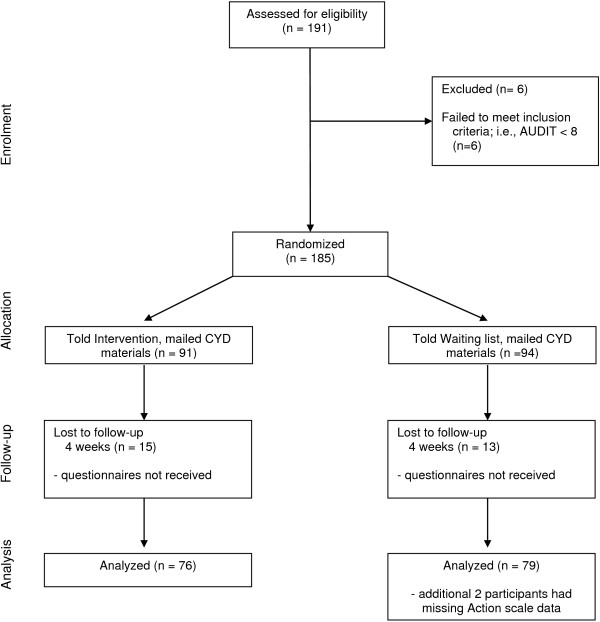
BACKGROUND: Employing waiting list control designs in psychological and behavioral intervention research may artificially inflate intervention effect estimates. This exploratory randomized controlled trial tested this proposition in a study employing a brief intervention for problem drinkers, one domain of research in which waiting list control designs are used. METHODS: All participants (N = 185) were provided with brief personalized feedback intervention materials after being randomly allocated either to be told that they were in the intervention condition and that this was the intervention or to be told that they were in the waiting list control condition and that they would receive access to the intervention in four weeks with this information provided in the meantime. RESULTS: A total of 157 participants (85%) were followed-up after 4 weeks. Between-group differences were found in one of four outcomes (proportion within safe drinking guidelines). An interaction was identified between experimental manipulation and stage of change at study entry such that participant change was arrested among those more ready to change and told they were on the waiting list. CONCLUSIONS: Trials with waiting list control conditions may overestimate treatment effects, though the extent of any such bias appears likely to vary between study populations. Arguably they should only be used where this threat to valid inference has been carefully assessed.
Overview
The claims and statistics of this paper haven’t been checked yet.
Run the check — free, no account needed. It reads the open-access text and checks the sources it cites.
Integrity signals
Registry
Cites
Statistics
Figures
Verification
Claims the paper makes
The claims and statistics of this paper haven’t been checked yet.
Run the check — free, no account needed. It reads the open-access text and checks the sources it cites.
Claims other papers make about this one
Each is checked against this paper’s own text: does it say what the citing paper says it does?
The cited source says what the claim attributes to it.
In the citing paper
“The literature reports growing concerns over the use of waitlist style control groups in psychotherapy research, as the outcomes of the interventions may be over-estimated with this type of control.64”
From Workplace interventions to improve well-being and reduce burnout for nurses, physicians and allied healthcare professionals: a systematic review. (2023) · cites this paper as [64]
The cited source says what the claim attributes to it.
In the citing paper
“Intervention outcomes should also be interpreted with caution because of the potential for overestimation of effect sizes when a waitlist comparison group is used in behavior change research [106].”
From Evaluation of an App-Delivered Psychological Flexibility Skill Training Intervention for Medical Student Burnout and Well-being: Randomized Controlled Trial (2023) · cites this paper as [106]
The cited source says what the claim attributes to it.
In the citing paper
“previous research suggests that waitlist participants’ expectations of receiving support at a later time could hinder the self-driven behavior change that they might otherwise have made during the same period [106].”
From Evaluation of an App-Delivered Psychological Flexibility Skill Training Intervention for Medical Student Burnout and Well-being: Randomized Controlled Trial (2023) · cites this paper as [106]
The cited source says what the claim attributes to it.
In the citing paper
“it has been noted that such designs may overestimate intervention effects [84].”
Self-check
Percentages, sums and reported differences re-computed from the paper’s own numbers.
The self-check needs the paper’s full text.
Citations
Cites
SAUNDERS, J. B., AASLAND, O. G., BABOR, T. F., DE LA FUENTE, J. R., & GRANT, M. (1993) · Addiction · doi:10.1111/j.1360-0443.1993.tb02093.x · Cited by 13,597 · cited 1×
“The outcome variables were: number of drinks in a typical recent week, largest number of drinks on one occasion, and the AUDIT-C [28], the consumption subscale of the Alcohol Use Disorders Identification Test AUDIT, [29,30], which includes three items (frequency of drinking, number of drinks per drinking day, and freq…”
(1979) · Medical Entomology and Zoology · Cited by 11,252
Quasi-experimentation: Design and analysis issues for field settings
Shrout, P. E. (1980) · Evaluation and Program Planning · doi:10.1016/0149-7189(80)90063-4 · Cited by 6,091
(2001) · Cited by 5,455
(1991) · Medical Entomology and Zoology · Cited by 4,438
Framework for design and evaluation of complex interventions to improve health
Campbell, M. (2000) · BMJ · doi:10.1136/bmj.321.7262.694 · Cited by 3,474
ROLLNICK, S., HEATHER, N., GOLD, R., & HALL, W. (1992) · British Journal of Addiction · doi:10.1111/j.1360-0443.1992.tb02720.x · Cited by 818
Dawson, D. A., Grant, B. F., Stinson, F. S., & Zhou, Y. (2005) · Alcoholism Clinical and Experimental Research · doi:10.1097/01.alc.0000164374.32229.a2 · Cited by 704
Mohr, D. C., Spring, B., Freedland, K. E., Beckner, V., Arean, P., Hollon, S. D., Ockene, J., & Kaplan, R. (2009) · Psychotherapy and Psychosomatics · doi:10.1159/000228248 · Cited by 565
Motivational Interviewing: Preparing People to Change Addictive Behavior
Rotgers, F. (1993) · Journal of Studies on Alcohol · doi:10.15288/jsa.1993.54.507a · Cited by 398
Research works printed but not linked: 1
- McCambridge J, Kypri K, Elbourne D: In randomisation we trust? Possible problems in experimenting with people in behavioural intervention trials. J Clin Epidemiol. -in press
Cited by
Sorted by citations
Items 101–200 of 321
Spahrkäs, S. S., Looijmans, A., Sanderman, R., & Hagedoorn, M. (2020) · JMIR Research Protocols · doi:10.2196/15969 · Cited by 20
Siew, L. E. D., Teo, N. R., Ang, W. H. D., & Lau, Y. (2023) · Journal of Cancer Survivorship · doi:10.1007/s11764-022-01244-6 · Cited by 19
Blanco, L. R., Duru, O. K., & Mangione, C. M. (2019) · Journal of Family and Economic Issues · doi:10.1007/s10834-019-09657-9 · Cited by 20
“First, given that our study was designed as an RCT with a control group wait-list, so that everyone benefits from the intervention, this is likely to result in an overestimation of the treatment effects (see Cunningham et al. 2013). Nevertheless, given our desire to conduct the RCT using a community-based approach, it…”
Rajan, G., Wachtler, C., Lee, S., Wändell, P. E., Philips, B., Wahlström, L., Svedin, C. G., & Carlsson, A. C. (2020) · Journal of Interpersonal Violence · doi:10.1177/0886260520965973 · Cited by 20
“We used a waiting list design with a very short follow-up period, both factors that can exaggerate the efficacy of the intervention (Cunningham et al., 2013).”
MethodThe Radical Openness Group: A controlled trial with 3-month follow-up.
Keogh, K. M., Booth, R., Baird, K., Gibson, J., & Davenport, J. R. (2016) · Practice Innovations · doi:10.1037/pri0000023 · Cited by 20
Kaldo, V., Bothelius, K., Blom, K., Lindhé, M., Larsson, M., Karimi, K., Melder, S., Bondestam, V., Ulfsparre, C., Sternbrink, K., et al. (2019) · Journal of Sleep Research · doi:10.1111/jsr.12881 · Cited by 18
van Zwieten, A., Caldwell, P. H. Y., Howard, K., Tong, A., Craig, J. C., Alexander, S. I., Howell, M., Teixeira-Pinto, A. M., Hawley, C. M., Jesudason, S., et al. (2019) · BMC Nephrology · doi:10.1186/s12882-019-1325-y · Cited by 18
Schubert, K., Lohse, J., Kalder, M., Ziller, V., & Weise, C. (2022) · Trials · doi:10.1186/s13063-022-06204-0 · Cited by 17
“Depressive mood is assessed using the Patient Health Questionnaire-9 (PHQ-9) [57], a 9- item depression subscale from the Patient Health Questionnaire which has reliable sensitivity to change.”
MethodAn adaptive method for assigning clinical trials wait-times for controls
Sima, A. P., Stromberg, K. A., & Kreutzer, J. S. (2021) · Contemporary Clinical Trials Communications · doi:10.1016/j.conctc.2021.100727 · Cited by 17
Transfer effects of abacus training on cognition
Lu, Y., Li, M.-Y., Cui, Z.-Q., Wang, L., Hu, Y., & Zhou, X.-L. (2021) · Current Psychology · doi:10.1007/s12144-021-01968-1 · Cited by 11
Wolff, J., Wuelfing, P., König, A., Ehrl, B., Damsch, J., Smollich, M., Baumann, F. T., Harbeck, N., & Wuerstlein, R. (2023) · Breast Care · doi:10.1159/000531495 · Cited by 17
“Nevertheless, as the control group data also changed, this seems not to be the case [29].”
Backgroundvan den Bogaard, D., Soenens, B., BRENNING, K. M., Flamant, N., & Vansteenkiste, M. (2024) · Journal of Happiness Studies · doi:10.1007/s10902-024-00761-8 · Cited by 19
“Although waiting lists eventually enable the provision of care and therefore have ethical advantages (Cunningham et al., 2013), they may overestimate intervention effects as participants in the waiting list condition may compliantly ‘wait’ to change (Miller & Rollnick, 2002).”
Cunningham, J. A., Godinho, A., & Bertholet, N. (2019) · BMC Medical Research Methodology · doi:10.1186/s12874-019-0770-4 · Cited by 16
Self-citationReactions to being allocated to a waiting list control group in a digital alcohol intervention trial
Gunnarsson, K. U., McCambridge, J., & Bendtsen, M. (2022) · Patient Education and Counseling · doi:10.1016/j.pec.2022.11.014 · Cited by 17
Self-citationde Oliveira, A. M., Radanovic, M., de Mello, P. C. H., Buchain, P. C., Vizzotto, A. D. B., Harder, J., Stella, F., Gitlin, L. N., Piersol, C. V., Valiengo, L. D. C. L., et al. (2021) · Journal of Alzheimer s Disease · doi:10.3233/jad-210142 · Cited by 15
“Another positive aspect to be considered is that our CG was not a “waiting group” (i.e., a group waiting for the intervention in the near future) which is known to introduce bias in comparability between groups [54].”
The impact of Covid-19 on access to psychological services
Purrington, J., & Beail, N. (2021) · Advances in Mental Health and Intellectual Disabilities · doi:10.1108/amhid-03-2021-0017 · Cited by 16
Pilot randomized controlled trial of an online intervention for problem gamblers
Cunningham, J. A., Godinho, A., & Hodgins, D. C. (2019) · Addictive Behaviors Reports · doi:10.1016/j.abrep.2019.100175 · Cited by 16
“Finally, Hodgins et al. have translated a paper and pencil self-help intervention into an online format (Diskin & Hodgins, 2009; Hodgins, Currie, Currie, & Fick, 2009; Hodgins, Currie, & el-Guebaly, 2001; Hodgins, Fick, Murray, & Cunningham, 2013).”
Self-citationImproving Self-Control Through Financial Counseling: A Randomized Controlled Trial
Tumataroa, S., & O’Hare, D. (2019) · Journal of Financial Counseling and Planning · doi:10.1891/1052-3073.30.2.304 · Cited by 16
Garland, S. N., Savard, J., Dalton, K., Walsh, N. A., Seal, M., Rash, J. A., Browne, S., Urquhart, R., Thoms, J., Gadag, V. G., et al. (2021) · Contemporary Clinical Trials · doi:10.1016/j.cct.2021.106322 · Cited by 17
Jung, M. S., Kim, M., Sohn, E. H., & Lee, J. (2023) · Cancer Nursing · doi:10.1097/ncc.0000000000001286 · Cited by 15
Super, A., Yarker, J., Lewis, R., Keightley, S., Summers, D., & Munir, F. (2024) · International Journal of Environmental Research and Public Health · doi:10.3390/ijerph21101346 · Cited by 19
“Although it has been argued that trials with a waitlist control may overestimate the effects of the treatment condition [107], this can vary depending on study populations.”
BackgroundJongen, P. J., van Mastrigt, G. A. P. G., Heerings, M. A. P., Visser, L. H., Ruimschotel, R. P., Hussaarts, A., Duyverman, L., Valkenburg-Vissers, J., Cornelissen, J., Bos, M., et al. (2019) · PLoS ONE · doi:10.1371/journal.pone.0223482 · Cited by 14
“Thus, an exploratory RCT evaluating the impact of a waitlist control design, reported that in persons with problem drinking–a chronic health condition–the outcomes had improved by 25–35% after four weeks in the waitlist group [20].”
BackgroundBaumgartner, C., Bilevicius, E., Khazaal, Y., Achab, S., Schaaf, S., Wenger, A., Haug, S., Keough, M. T., Hodgins, D. C., & Schaub, M. P. (2019) · BMJ Open · doi:10.1136/bmjopen-2019-032110 · Cited by 16
Schorno, N., Gut, V., Conzelmann, A., & Schmid, J. (2022) · Journal of Sport and Exercise Psychology · doi:10.1123/jsep.2021-0018 · Cited by 16
“Fifth, the fact that the MICG received counseling as a “thank you for participating” after the follow-up assessment (t3) might have led to an overestimation of the effects of intervention (Cunningham et al., 2013).”
BackgroundUzodinma, U. E., Onyishi, C. N., Ngwoke, A. N., Ugwu, J. I., Okorie, C. O., Amujiri, B. A., Ani, C., Ngwu, C. N., Nwankwo, F. M., Okoli, C., et al. (2022) · Science Progress · doi:10.1177/00368504221100907 · Cited by 14
“Secondly, it gives others on the waiting list a chance to get the intervention to address their condition at a later period.(47) Thus a waitlist control trial design is promising for finding out the effectiveness of a psychotherapeutic intervention through effective comparison and providing therapeutic opportunities f…”
BackgroundMethodKayser, J., Wang, X., Wu, Z., Dimoji, A., & Xiang, X. (2023) · JMIR Research Protocols · doi:10.2196/44210 · Cited by 14
“For limitations, this study uses a small sample size and a waitlist control design, which may lead to an overestimation of treatment effects [62].”
MethodKristensen, M. B., Wessel, I., Beck, A. M., Dieperink, K. B., Mikkelsen, T. B., Møller, J. K., & Zwisler, A. (2020) · Nutrients · doi:10.3390/nu12072117 · Cited by 14
“Since concerns have been raised that wait-list control groups may overestimate intervention e ff ect in randomized controlled trials [64], and the number of statistical tests in the present trial poses a risk of type 1 errors, no firm conclusions on the intervention e ff ect on secondary outcomes can…”
Grebosz‐Haring, K., Thun‐Hohenstein, L., Schuchter-Wiegand, A. K., Bathke, A. C., & Clift, S. M. (2023) · Annals of the New York Academy of Sciences · doi:10.1111/nyas.15006 · Cited by 13
Effects of study design and allocation on self-reported alcohol consumption: randomized trial
Kypri, K., Wilson, A., Attia, J., Sheeran, P., & McCambridge, J. (2015) · Trials · doi:10.1186/s13063-015-0642-0 · Cited by 13
“In relation to hypothesis 2, we have undertaken a similar experimental study by post rather than online, evaluating the possible impact of communication of randomization to either intervention or a waiting list control condition, again while delivering the same content to both groups [5].”
BackgroundMethodInfluentialSelf-citationJensen, M., Hüttenrauch, E., Schmidt, J., Andersson, G., Chavanon, M., & Weise, C. (2020) · Trials · doi:10.1186/s13063-020-04309-y · Cited by 13
Silva, H. D. J., de Miranda, J. P., Silva, W. T., Fonseca, L. S., Xavier, D. M., Oliveira, M. X., & Oliveira, V. C. (2025) · Journal of physiotherapy · doi:10.1016/j.jphys.2025.03.003 · Cited by 16
Deluca, P., Coulton, S., Alam, M. F., Boniface, S., Donoghue, K., Gilvarry, E. A., Kaner, E., Lynch, E. M., Maconochie, I. K., McArdle, P., et al. (2022) · Addiction · doi:10.1111/add.15884 · Cited by 12
“However, previous research with young people has shown that alcohol screening can reduce drinking [40].”
BackgroundSchönfeld, S., Rathmer, I., Michaelsen, M. M., Hoetger, C., Onescheit, M., Lange, S., Werdecker, L., & Esch, T. (2022) · JMIR Research Protocols · doi:10.2196/37195 · Cited by 15
“The study design was chosen as the primary aim of the study is to evaluate the intervention relative to no intervention, and WCGs are an ethical option to provide the intervention quickly to all participants [50].”
BackgroundBendtsen, M. (2022) · Journal of Medical Internet Research · doi:10.2196/40730 · Cited by 12
“It leads to subjecting more than necessary participants to unnecessary effects from study procedures [6], potentially harmful or noneffective interventions and control conditions [7-9], or ending a trial with ambiguous findings when recruiting more participants could deliver less uncertain evidence [10].”
BackgroundBendtsen, M., Åsberg, K., & McCambridge, J. (2023) · Drug and Alcohol Dependence · doi:10.1016/j.drugalcdep.2023.110957 · Cited by 12
Self-citationZainal, N. H., Tan, H. H., Hong, R. Y. S., & Newman, M. G. (2024) · Journal of Anxiety Disorders · doi:10.1016/j.janxdis.2024.102858 · Cited by 15
Parent-Child Interaction Therapy
Briegel, W. (2016) · Zeitschrift für Kinder- und Jugendpsychiatrie und Psychotherapie · doi:10.1024/1422-4917/a000453 · Cited by 12
Assessing potential of psilocybin for depressive disorders
Kozak, Z., Johnson, M. W., & Aaronson, S. T. (2023) · Expert Opinion on Investigational Drugs · doi:10.1080/13543784.2023.2273493 · Cited by 11
“For example, while a waitlist control design may help address issues of expectancy, it has also been shown to over-estimate treatment effects [55].”
BackgroundElkarif, T., Orkibi, H., & Keisari, S. (2024) · The Journal of Positive Psychology · doi:10.1080/17439760.2024.2427581 · Cited by 13
“The waiting period for this group may have influenced their questionnaire responses (Cunningham et al., 2013).”
Rasmussen, M. U., Amris, K., Rydahl‐Hansen, S., Danneskiold‐Samsøe, B., Mortensen, E. L., Christensen, R., & Sjölund, B. H. (2016) · Disability and Rehabilitation · doi:10.1080/09638288.2016.1211179 · Cited by 11
“The risk of overestimating intervention effects was considered, as waiting list controls in general tend to not improve, compared to patients allocated to active control groups (placebo).[41] However, the control group in our study did on average improve in pain self-efficacy during the six-month period.”
BackgroundPeersmann, S. H. M., van Straten, A., Kaspers, G. J. L., Thano, A., van den Bergh, E., Grootenhuis, M. A., & van Litsenburg, R. R. L. (2021) · Trials · doi:10.1186/s13063-021-05263-z · Cited by 11
“At last, the waiting-list control is a non-active control group which might inflate treatment effects [77].”
BackgroundBourne, J. E., Leary, S. D., Page, A. S., Searle, A., England, C. Y., Thompson, D., Andrews, R. C., Foster, C. E., & Cooper, A. R. (2023) · Pilot and Feasibility Studies · doi:10.1186/s40814-023-01283-5 · Cited by 12
“While the use of waitlist controls in trials has been debated [56, 57], the inability to blind participants in physical activity interventions and their positive impact on retention means they should be used in future e-cycling interventions.”
BackgroundØstergaard, T., Lundgren, T., Rosendahl, I. K., Zettle, R. D., Jonassen, R., Harmer, C. J., Stiles, T. C., Landrø, N. I., & Haaland, V. Ø. (2019) · Frontiers in Psychology · doi:10.3389/fpsyg.2019.01995 · Cited by 11
“Also, we did not include a waiting list control group that have been found to overestimate treatment effects (Cunningham et al., 2013).”
BackgroundFrick, A., Thinnes, I., & Stangier, U. (2020) · Trials · doi:10.1186/s13063-019-3815-4 · Cited by 14
Zuccolo, P. F., Brunoni, A. R., Borja, T., Matijasevich, A., Polanczyk, G. V., & Fatori, D. (2024) · Psychotherapy and Psychosomatics · doi:10.1159/000541311 · Cited by 11
“The choice of control group is known to impact the effect sizes of interventions tested using an RCT framework [46].”
Schormann, A. L. A., Pillny, M., Haß, K., & Lincoln, T. M. (2023) · Pilot and Feasibility Studies · doi:10.1186/s40814-023-01284-4 · Cited by 11
Saur, S., Weisel, K. K., Lang, C., Fuhrmann, L. M., Steins‐Loeber, S., Enewoldsen, N., Reichl, D., Zink, M., Jakobi, F., Rudolph, M., et al. (2022) · Internet Interventions · doi:10.1016/j.invent.2022.100517 · Cited by 11
“This design has sometimes been criticized for overestimating the effects of the active condition (Cunningham et al., 2013).”
BackgroundSpringfield, S., Buscemi, J., Fitzgibbon, M., Stolley, M. R., Zenk, S. N., Schiffer, L. A., Sampson, J., Jones, Q., Murdock, T., Davis, I. F., et al. (2015) · Contemporary Clinical Trials · doi:10.1016/j.cct.2015.06.006 · Cited by 10
“In developing the intervention, we addressed support for diet and physical activity changes [55], individual/community barriers, and strategies to enhance motivation [56] and regular physical activity [55,56].”
BackgroundCunningham, J. A., Hendershot, C. S., KAY‐LAMBKIN, F. J., Neighbors, C., Griffiths, K. M., Bennett, K., Bennett, A., Godinho, A., & Schell, C. (2018) · BMJ Open · doi:10.1136/bmjopen-2018-022412 · Cited by 11
“This recruitment method allows for a double blind design and the inclusion of a usual care control group whose members are unaware that others receive a drinking intervention.(28) To determine eligibility, all potential participants, 18 years and older, will undergo an assessment of current depression and of whether t…”
Self-citationNapoli, V., Berchiolli, R. N., Carboncini, M. C., Sartucci, F., Marconi, M., Bocci, T., Perrone, O., Mannoni, N., Congestrì, C., Benedetti, R., et al. (2019) · Annals of Vascular Surgery · doi:10.1016/j.avsg.2019.05.018 · Cited by 10
Placebo, usual care and wait-list interventions for all mental health disorders
Faltinsen, E., Todorovac, A., Hróbjartsson, A., Gluud, C., Kongerslev, M. T., Simonsen, E., & Storebø, O. J. (2019) · Cochrane Database of Systematic Reviews · doi:10.1002/14651858.mr000050 · Cited by 9
Harvey, A. G., Agnew, E. R., Hache, R. E., Spencer, J. M., Diaz, M., Patino, E. O., Milner, A., Dong, L., Kilbourne, A. M., Buysse, D. J., et al. (2025) · Implementation Science · doi:10.1186/s13012-025-01440-9 · Cited by 12
“Also, we acknowledge that the UC-DT design may inflate the effect size differences [87] and that corrections for multiple secondary outcomes were not conducted.”
Juniar, D., van Ballegooijen, W., Kleygrewe, G., van Schaik, A., Passchier, J., & Riper, H. M. (2025) · Frontiers in Digital Health · doi:10.3389/fdgth.2025.1603389 · Cited by 20
“This was done in light of previous studies (42–45) indicating that different control conditions can influence effect size estimates.”
van Dalen, M., Pasmans, S. G. M. A., Aendekerk, M.-L., Mathijssen, I. M. J., Koudstaal, M. J., Timman, R., Williamson, H., Hillegers, M. H. J., Utens, E. M. W. J., & Okkerse, J. M. E. (2021) · BMJ Open · doi:10.1136/bmjopen-2020-041449 · Cited by 10
Stegner, A. J., Almassi, N. E., Dougherty, R. J., Ellingson, L. D., Gretzon, N. P., Lindheimer, J. B., Ninneman, J. V., Riper, S. M. V., O’Connor, P. J., & Cook, D. B. (2021) · Life Sciences · doi:10.1016/j.lfs.2021.119810 · Cited by 9
Lippke, S., Ratz, T., Keller, F. M., Juljugin, D., Peters, M., Pischke, C. R., & Voelcker‐Rehage, C. (2022) · JMIR Aging · doi:10.2196/36515 · Cited by 9
“Cunningham et al [78] found that wait-list groups interrupt efforts to change and pointed to the importance of activities toward changing different psychological preconditions and developmental possibilities.”
BackgroundA pragmatic randomised controlled trial of healing therapy in a gastroenterology outpatient setting
Lee, R. T., Kingstone, T., Roberts, L. M., Edwards, S., Soundy, A., Shah, P. R., Haque, S. M., & Singh, S. (2016) · European Journal of Integrative Medicine · doi:10.1016/j.eujim.2016.11.017 · Cited by 9
“It has been indicated in the context of trials used in psychological and behavioural research that patients on the waiting control trial list: “appear to improve less (or not at all) than would be expected for people who are concerned about their behaviour and who are taking steps to change” [52] and it is also theref…”
BackgroundCan a couples’ intervention reduce unmet needs and caregiver burden after brain injury?
Graham, K. M., Kreutzer, J. S., Marwitz, J. H., Sima, A. P., & Hsu, N. H. (2019) · Rehabilitation Psychology · doi:10.1037/rep0000300 · Cited by 9
Støre, S. J., Tillfors, M., Wästlund, E., Angelhoff, C., Andersson, G., & Norell‐Clarke, A. (2021) · Contemporary Clinical Trials · doi:10.1016/j.cct.2021.106588 · Cited by 9
Effectiveness of Non-Pharmacological Interventions for Irritable Bowel Syndrome: A Systematic Review
Amsallem, F., Sanchez, S., Armoiry, X., & Mion, F. (2021) · Evidence-based Complementary and Alternative Medicine · doi:10.1155/2021/4404185 · Cited by 14
“*e improvement of clinical trials requires the consideration of patient expectations as an important factor in the therapeutic outcome [54, 55].”
BackgroundWasilewski, M. B., Nonoyama, M. L., Dale, C., Mckim, D. A., ROAD, J. D., Leasa, D. J., Goldstein, R. S., & Rose, L. (2018) · JMIR Research Protocols · doi:10.2196/11827 · Cited by 9
“A waitlist control group was chosen as it is believed to be a cost-effective and ethical alternative to no-treatment control groups when primarily studying psychological and behavioral interventions such as the one in this study [31].”
Ugarte, C. A., Cruzat‐Mandich, C., Quiñones, Á., Díaz-Tendero, D., Gallegos, M., Gil, A. A., & Cepeda‐Benito, A. (2023) · Frontiers in Psychology · doi:10.3389/fpsyg.2023.1101120 · Cited by 7
Bevilacqua, L., Fox‐Smith, L., Lampard, O., Rojas, N. K., Zavitsanou, G., Meiser‐Stedman, R., & Beazley, P. I. (2024) · Clinical Child Psychology and Psychiatry · doi:10.1177/13591045241259070 · Cited by 9
“This is important because comparing an intervention to a waitlist control may potentially in fl ate effect estimates in intervention studies (Cunningham et al., 2013; Hart et al., 2008).”
Wilson, M. V., BRAITHWAITE, F., Arnold, J. B., Crouch, S. M., Moore, E., Heil, A. M., Cooper, K., & Stanton, T. R. (2024) · Pain · doi:10.1097/j.pain.0000000000003293 · Cited by 8
Menon, S., Katona, C., & Glover, N. (2024) · Mental Health Science · doi:10.1002/mhs2.85 · Cited by 11
Luttinen, J., Watroba, A., Niemelä, M., Miettunen, J., & Ruotsalainen, H. (2025) · Journal of Affective Disorders · doi:10.1016/j.jad.2025.02.002 · Cited by 13
Reducing the stickiness of negative memory retrieval through positive memory training in adolescents
Belmans, E., Vuyst, H.-J. D., Takano, K., & Raes, F. (2023) · Journal of Behavior Therapy and Experimental Psychiatry · doi:10.1016/j.jbtep.2023.101881 · Cited by 8
Lonergan, M. H., Saumier, D., Pigeon, S., Etienne, P. E., & Brunet, A. (2022) · Journal of Affective Disorders · doi:10.1016/j.jad.2022.08.082 · Cited by 12
Cunha, O. S., Silva, T. P. E., Almeida, T. C., Caridade, S., & Gonçalves, R. A. (2023) · Journal of Experimental Criminology · doi:10.1007/s11292-023-09569-7 · Cited by 8
“Although WLCC has ethical advantages because it allows for the provision of care to participants who are seeking help, this type of design may overestimate the intervention effects (Cunningham et al., 2013).”
InfluentialKey Considerations for Designing Clinical Studies to Evaluate Digital Health Solutions
Bolinger, E., & Tyl, B. (2024) · Journal of Medical Internet Research · doi:10.2196/54518 · Cited by 7
“The traditional “waitlist” design used in medical device evaluation may also be appropriate but can inflate effect sizes by decreasing behavioral activation in the control arm (in essence, inducing the opposite of the Hawthorne effect) [22,23].”
MethodAguilar‐Latorre, A., Oliván‐Blázquez, B., Algorta, G. P., Serrano-Ripoll, M. J., Olszewski, L. E., & Lanuza, A. T. (2023) · Journal of Affective Disorders · doi:10.1016/j.jad.2023.04.007 · Cited by 9
Mun, C. J., Speed, T. J., Finan, P. H., Wideman, T. H., Quartana, P. J., & Smith, M. T. (2023) · International Journal of Behavioral Medicine · doi:10.1007/s12529-023-10184-z · Cited by 7
“Although the previous proof of concept study found significant CBT-I effects on IL-6 outcomes with an even smaller sample [11], this may have been due to the use of a waitlist-control design which tends to overestimate treatment effects when compared to placebo-controlled studies [36, 37].”
Can REBT Reduce Academic Stress and Increase Adjustment in Rural Students?
Omeke, F. C., Ede, M. O., Chukwu, C. L., Aroh, P. N., Onyeanusi, O. C., Ozor, T. O., Okoro, I. D., Maduakolam, J. N., Agu, F. A., & Aba, S. I. (2024) · Journal of Rational-Emotive & Cognitive-Behavior Therapy · doi:10.1007/s10942-024-00539-0 · Cited by 8
“The comparison group was placed on the waitlist because it gives the active experimental group a control group to compare against to see if the treatment had an impact (Cunningham et al., 2013).”
Kyranou, M., & Karanikola, M. N. K. (2025) · Healthcare · doi:10.3390/healthcare13030274 · Cited by 11
Hansen, S. M., Stubberud, J., Hjertstedt, M., & Kirmess, M. (2019) · BMJ Open · doi:10.1136/bmjopen-2019-029392 · Cited by 7
“The use of a WL design has been criticised for overestimating treatment effects.(49) 50 In our study, the WL-group will have contact with health personnel every 12th week during the waiting period (ie, assessment points) in addition to other possible treatment.”
Longitudinal Analysis of Mortality for Older Adults Receiving or Waiting for Aging Network Services
Gum, A. M., Green, O., Schonfeld, L. I., Conner, K. O., Rigg, K. K., Wagoner, F., Melling, K. A., & Parkinson, K. (2019) · Journal of the American Geriatrics Society · doi:10.1111/jgs.16232 · Cited by 7
“It is also possible that being placed on a waiting list is harmful, as indicated by randomized studies and a meta-analysis comparing wait-list control conditions to active interventions and other types of control conditions.(23,24) Researchers have speculated that waiting for services (or research interventions) may c…”
BackgroundBendtsen, M., Gunnarsson, K. U., & McCambridge, J. (2021) · BMJ Open · doi:10.1136/bmjopen-2021-049810 · Cited by 7
“The two primary outcomes have been selected to be similar to the outcomes used in the exploratory trial on which this trial has been modelled 30 while at the same time being part of the proposed core outcome set for brief alcohol interventions.”
Self-citationBoedt, T., Willaert, N., Fong, S. L., Dancet, E. A. F., Spiessens, C., Raes, F., Matthys, C., & der Gucht, K. V. (2022) · BMJ Open · doi:10.1136/bmjopen-2021-050088 · Cited by 7
Renal denervation in patients who do not respond to cardiac resynchronization therapy
Pietilä-Effati, P. M., Höglund, M., Käräjämäki, A. J., Höglund, F., Nabb, A.-M., Matila, E., & Koistinen, M. J. (2022) · Scandinavian Cardiovascular Journal · doi:10.1080/14017431.2022.2060526 · Cited by 7
“Patients were randomized 1:1 according to wait list comparison [15,16].”
MethodBasharpoor, S., Zakibakhsh Mohammadi, N., Heidari, F., Azarkolah, A., Vicario, C. M., & Salehinejad, M. A. (2022) · Journal of Affective Disorders · doi:10.1016/j.jad.2022.09.089 · Cited by 7
Zainal, N. H., Tan, H. H., Hong, R. Y. S., & Newman, M. G. (2024) · JMIR Mental Health · doi:10.2196/53712 · Cited by 7
“…approach was strategically designed to address potential credibility and expectancy effects, minimize the likelihood of regression to the mean, and mitigate the possibility of inflated effect sizes that could occur with a no-treatment or waitlist control group [59] (Multimedia Appendix 1).”
Brega, A. G., STOTZ, S. A., MOORE, K. R., McNulty, M. C., & Jiang, L. (2024) · Journal of the Academy of Nutrition and Dietetics · doi:10.1016/j.jand.2024.05.004 · Cited by 6
Online self-compassion training vs. expressive writing: A randomized controlled trial
Linford, L. B., & Warren, J. S. (2024) · Journal of Positive Psychology · doi:10.1080/17439760.2024.2362431 · Cited by 6
“A weakness of implementing a waitlist control group is that it can artificially inflate the estimated outcome effect (Cunningham et al., 2013).”
Fostering resilient recovery: An intervention for disaster-affected teachers in Indonesia
Parrott, E., Lomeli-Rodriguez, M., Rahman, A., Direzkia, Y., Bernardino, A., Burgess, R. A., & Joffé, H. (2024) · SSM - Mental Health · doi:10.1016/j.ssmmh.2024.100355 · Cited by 14
MacKinnon, A., Silang, K., Watts, D., Kaur, J., Freeman, M., Dewsnap, K., Keys, E., Madsen, J. W., Giesbrecht, G. F., Williamson, T. S., et al. (2024) · Journal of Clinical Sleep Medicine · doi:10.5664/jcsm.11396 · Cited by 6
Online psychosocial intervention for persons with spinal cord injury: A meta-analysis
Blackport, D., Shao, R., Ahrens, J., Sequeira, K., Teasell, R. W., Hadjistavropoulos, H. D., Loh, E., & Mehta, S. (2021) · Journal of Spinal Cord Medicine · doi:10.1080/10790268.2021.2009675 · Cited by 7
Vivas-Fernández, M., López, L. J. G., Piqueras, J. A., Muela-Martínez, J. A., Canals, J., Fernández, L. E., Jiménez-Vázquez, D., Díaz-Castela, M. D. M., Morales‐Hidalgo, P., Rivera, M., et al. (2023) · Child and Adolescent Psychiatry and Mental Health · doi:10.1186/s13034-022-00550-2 · Cited by 7
“The use of waitlist control conditions (WLCs) in RCTs may also overestimate treatment effects and thus artificially inflate the effect sizes of prevention programs [1, 25, 33, 69].”
BackgroundRetractedAdams, C., & Stickley, T. (2019) · Nordic Journal of Arts Culture and Health · doi:10.18261/issn.2535-7913-2019-01-05 · Cited by 7
Nixon, L., Slattery, B. W., Cassese, A., & ten Hoor, G. A. (2023) · International Journal of Applied Positive Psychology · doi:10.1007/s41042-023-00114-5 · Cited by 7
“Further, the inclusion of a waitlist control group had ethical advantages because it allowed for the provision of care (if delayed) to participants during a difficult period (Cunningham et al., 2013).”
Lee, S.-A., & Park, J. (2025) · npj Digital Medicine · doi:10.1038/s41746-025-02120-0 · Cited by 5
“Previous research has shown that waitlist comparatorsoftenyieldin fl atedandmorevariableeffectsthanusualcareor active comparators in behavioral trials, underscoring their heterogeneity-inducing nature 36 .”
Gityamwi, N., Armes, J., Harris, J., Ream, E., Green, R., Ahankari, A. S., Callwood, A., Ip, A., Cockle‐Hearne, J., Grosvenor, W., et al. (2025) · PLOS Digital Health · doi:10.1371/journal.pdig.0000806 · Cited by 6
“This is particularly true in studies where participants are aware of their group allocation as they are likely to consciously not show/inform any changes until they start the intervention [156].”
MacLellan, A., Fairchild, G., & Button, K. (2025) · Cognitive Therapy and Research · doi:10.1007/s10608-025-10636-8 · Cited by 4
Lo, H. H. M., Zhang, J., & Choi, C. W. (2019) · Research on Social Work Practice · doi:10.1177/1049731519870273 · Cited by 5
Mohammed, M., Bella-Awusah, T., Adedokun, B., Lagunju, I., & Ani, C. (2023) · International Journal of Mental Health · doi:10.1080/00207411.2023.2253397 · Cited by 6
“Finally, the use of a waitlist control group is known to increase the apparent effect of interventions (Cunningham et al., 2013).”
Rewind for Posttraumatic Stress Disorder: A Randomised Controlled Trial
Wright, L. A., Barawi, K., Kitchiner, N., Kitney, D., Lewis, C., Roberts, A., Roberts, N. P., Simon, N. A., Ariti, C. A., Nussey, I., et al. (2023) · Depression and Anxiety · doi:10.1155/2023/6279649 · Cited by 7
“These fi ndings are re fl ected in some other PTSD trials [31] but contrast to other waitlist controlled trials where participants do not improve and sometimes deteriorate, possibly expecting change only after receiving the intervention [32].”
ResultPlacebo and the law of identification
Bierman, S., Weil, A., & Dahmer, S. (2024) · Frontiers in Psychiatry · doi:10.3389/fpsyt.2024.1474558 · Cited by 4
Yavuz, M., & Akça, M. (2025) · Current Psychology · doi:10.1007/s12144-024-07260-2 · Cited by 4
“For instance, the waitlist group also showed increases in most variables, which may indicate a testing effect, consistent with findings in the literature on wait-listed participants in intervention studies (Freedland et al., 2011 ; Cunningham et al., 2013 ).”
Psychotherapy research in the deaf community: pilot clinical trial lessons learned
Anderson, M. L., Wilkins, A. M., Hostovsky, S., Pici-D’Ottavio, E., Aldalur, A., McGinnis, F., & Meza, K. A. (2025) · The Journal of Deaf Studies and Deaf Education · doi:10.1093/jdsade/enaf007 · Cited by 4
Forestier, R. J., Debiais, F., Michel, N., Schueller, R., & Juhel, C. (2025) · International Journal of Biometeorology · doi:10.1007/s00484-025-02927-2 · Cited by 4
“Furthermore, the control group was a waiting list group, which may have a negative impact on outcome measures by leading to an overestimation of the intervention effects (Cunningham et al. 2013).”
Collier, E. S., Blomqvist, J., Crawford, J., McCambridge, J., & Bendtsen, M. (2023) · Substance Abuse Treatment Prevention and Policy · doi:10.1186/s13011-023-00569-4 · Cited by 4
“This was deemed of interest as the implications of waiting-list designs are not yet fully understood [12, 16] although it has been suggested that individuals with increased readiness to change may be particularly negatively impacted by being put on a waiting list for support tool access [17].”
BackgroundSelf-citation
Metadata
- Authors
- Cunningham, J. A., Kypri, K., & McCambridge, J.
- Affiliations
- Australian National University (AU)
- University of Newcastle Australia (AU)
- London School of Hygiene & Tropical Medicine (GB)
- Corresponding author
- Cunningham, John A
- Venue
- BMC Medical Research Methodology
- Published
- 2013-12
- Volume
- 13
- Issue
- 1
- Pages
- 150-150
- ISSN
- 1471-2288 (ISSN-L)
- PMC
- PMC4029562
- OpenAlex
- W2132268984
- Cited by
- 321
- References
- 40
- Citations by year
- 2026: 18 · 2025: 29 · 2024: 35 · 2023: 41 · 2022: 42 · 2021: 37 · 2020: 33 · 2019: 28 · 2018: 15 · 2017: 17 · 2016: 11 · 2015: 5 · 2014: 10
- FWCI
- 7.62
- Type
- journal article
- Language
- en
- Open access
- gold
- doi.org
- Licence
- Locations
- BMC Medical Research Methodology (publishedVersion, cc-by)
- Europe PMC (PubMed Central) (publishedVersion, cc-by)
- PubMed Central (publishedVersion, cc-by)
- PubMed (publishedVersion)
- LSHTM Research Online (London School of Hygiene and Tropical Medicine) (acceptedVersion)
- Figshare (submittedVersion, cc-by)
- ANU Open Research (Australian National University) (submittedVersion, cc-by)
- NOVA (University of Newcastle Australia) (submittedVersion)
- Funders
- Wellcome Trust (WT086516MA)
- Medical Research Council
- Topics
- Physical Sciences › Mathematics › Statistics and Probability › Statistical Methods in Clinical Trials
- Health Sciences › Medicine › Epidemiology › Substance Abuse Treatment and Outcomes
- Social Sciences › Decision Sciences › Statistics, Probability and Uncertainty › Meta-analysis and systematic reviews
- Keywords
- overestimation of treatment effects, brief intervention, problem drinking, personalized feedback, stages of change, alcohol consumption, drinking guidelines
- MeSH terms
- Adult, Alcohol Drinking, Behavior Therapy, Female, Humans, Male, Middle Aged, Research Design, Waiting Lists, Bias, Alcohol-Related Disorders
About these checks
Registry, retraction, Cites and statistics results are computed, not judged, with one exception: a printed reference that no index lists is read once by a model before it counts as a citation error. Claims are extracted by a model and kept only when their quote appears verbatim in the text; each cited source is then checked, with a model’s help, for whether it says what the claim relies on. Those verdicts can be wrong — read the claim’s quote and the cited source before relying on one.
Statistics and arithmetic are recomputed, not judged.
Confidence bands are shown only for fields calibrated on our annotated test set. None is calibrated yet, so no band is shown.
What counts as a claim ›How we measure confidence ›How we check this ›
Are you an author, or do you see a problem with this page? Request a review
