

Risk of bias of randomized controlled trials published in orthopaedic journals
Open accessThe DOI matches its Crossref record; 46 of the 48 references it cites were found in a registry or an index.
Abstract
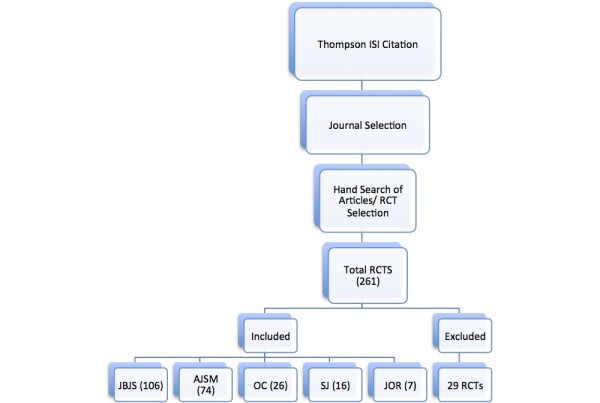
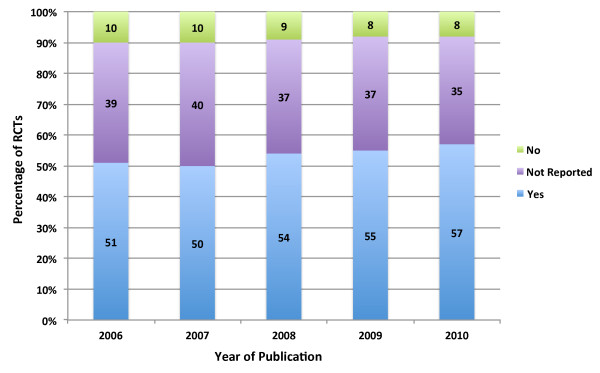
BACKGROUND: The purpose of this study was to assess the quality of methodology in orthopaedics-related randomized controlled trials (RCTs) published from January 2006 to December 2010 in the top orthopaedic journals based on impact scores from the Thompson ISI citation reports (2010). METHODS: Journals included American Journal of Sports Medicine; Journal of Orthopaedic Research; Journal of Bone and Joint Surgery, American; Spine Journal; and Osteoarthritis and Cartilage. Each RCT was assessed on ten criteria (randomization method, allocation sequence concealment, participant blinding, outcome assessor blinding, outcome measurement, interventionist training, withdrawals, intent to treat analyses, clustering, and baseline characteristics) as having empirical evidence for biasing treatment effect estimates when not performed properly. RESULTS: A total of 232 RCTs met our inclusion criteria. The proportion of RCTs in published journals fell from 6% in 2006 to 4% in 2010. Forty-nine percent of the criteria were fulfilled across these journals, with 42% of the criteria not being amendable to assessment due to inadequate reporting. The results of our regression revealed that a more recent publication year was significantly associated with more fulfilled criteria (β = 0.171; CI = -0.00 to 0.342; p = 0.051). CONCLUSION: In summary, very few studies met all ten criteria. Thus, many of these studies likely have biased estimates of treatment effects. In addition, these journals had poor reporting of important methodological aspects.
Overview
The claims and statistics of this paper haven’t been checked yet.
Free: it reads the open-access text and checks the first 5 claims that cite a source we can check. Create a free account to check every claim.
Integrity signals
Registry
Cites
Statistics
Figures
Verification
Claims the paper makes
The claims and statistics of this paper haven’t been checked yet.
Free: it reads the open-access text and checks the first 5 claims that cite a source we can check. Create a free account to check every claim.
Claims other papers make about this one
Each is checked against this paper’s own text: does it say what the citing paper says it does?
The source backs part of the claim, not all of it — or backs it for a different population, condition or comparison.
In the citing paper
“only 1% of studies in high-impact orthopedic journals reported all ten criteria needed for risk of bias assessment (13).”
From The devil is in the details: Reporting and transparent research practices in sports medicine and orthopedic clinical trials (2021) · cites this paper as [13]
Experimental — accuracy not yet measuredThe source backs part of the claim, not all of it — or backs it for a different population, condition or comparison.
In the citing paper
“In 42% of papers, risk of bias could not be assessed due to incomplete reporting (13).”
From The devil is in the details: Reporting and transparent research practices in sports medicine and orthopedic clinical trials (2021) · cites this paper as [13]
Experimental — accuracy not yet measuredIn the citing paper
“among randomized controlled trials published in the top five orthopedics journals, 60% failed to address the blinding status of the participants and 58% did not specify the number of participants included in the final analysis (13).”
From The devil is in the details: Reporting and transparent research practices in sports medicine and orthopedic clinical trials (2021) · cites this paper as [13]
Self-check
Percentages, sums and reported differences re-computed from the paper’s own numbers.
The self-check needs the paper’s full text.
Citations
Cites
von Elm, E., Altman, D. G., Egger, M., Pocock, S. J., Gøtzsche, P. C., Vandenbroucke, J. P., & Initiative, F. T. S. (2007) · PLoS Medicine · doi:10.1371/journal.pmed.0040296 · Cited by 23,020 · cited 1×
“For example, the most recent of these investigations of reporting quality [19] applied the Consolidated Standards of Reporting Trials (CONSORT) statement [20] to a sample of RCTs, the Strengthening the Reporting of Observational Studies in Epidemiology (STROBE) statement [21] to a sample of case–control, cohort and cr…”
Methodvon Elm, E., Altman, D. G., Egger, M., Pocock, S. J., Gøtzsche, P. C., & Vandenbroucke, J. P. (2007) · The Lancet · doi:10.1016/s0140-6736(07)61602-x · Cited by 21,320
Assessing the quality of reports of randomized clinical trials: Is blinding necessary?
Jadad, A. R., Moore, R. A., Carroll, D., Jenkinson, C., Reynolds, D. J. M., Gavaghan, D. J., & McQuay, H. J. (1996) · Controlled Clinical Trials · doi:10.1016/0197-2456(95)00134-4 · Cited by 17,582 · cited 2×
“Carefully planned and well-executed RCTs give us the best estimates of treatment effect and can thus guide clinical decision making [2,3], although trials that lack methodological rigor cause over- or underestimation of treatment effect sizes due to bias [4-6].”
BackgroundCONSORT 2010 Statement: updated guidelines for reporting parallel group randomised trials
the CONSORT Group, Schulz, K. F., Altman, D. G., & Moher, D. (2010) · BMC Medicine · doi:10.1186/1741-7015-8-18 · Cited by 13,371
Moher, D., Hopewell, S., Schulz, K. F., Montori, V., Gotzsche, P. C., Devereaux, P. J., Elbourne, D., Egger, M., & Altman, D. G. (2010) · BMJ · doi:10.1136/bmj.c869 · Cited by 8,883
Evidence-Based Medicine: How to Practice and Teach EBM
Sackett, D. L. (2000) · Cited by 5,950
Schulz (1995) · doi:10.1001/jama.1995.03520290060030 · Cited by 5,634 · cited 3×
“We can only extrapolate for the extensive literature that has shown this to be true for RCTs in other clinical areas [3,4,23-34].”
BackgroundMethodMoher, D., Schulz, K. F., & Altman, D. G. (2001) · The Lancet · doi:10.1016/s0140-6736(00)04337-3 · Cited by 5,373
The Revised CONSORT Statement for Reporting Randomized Trials: Explanation and Elaboration
Altman, D. G., Schulz, K. F., Moher, D., Egger, M., Davidoff, F., Elbourne, D., Gøtzsche, P. C., Lang, T., & for the CONSORT Group (2001) · Annals of Internal Medicine · doi:10.7326/0003-4819-134-8-200104170-00012 · Cited by 3,835 · cited 2×
“Background Randomized controlled trials (RCTs) provide strong evidence for efficacy of healthcare interventions [1].”
BackgroundCONSORT 2010 statement: updated guidelines for reporting parallel group randomized trials
Schulz, K. F., Altman, D. G., Moher, D., & for the CONSORT Group* (2010) · Annals of Internal Medicine · doi:10.7326/0003-4819-152-11-201006010-00232 · Cited by 3,824
Improving the Quality of Reporting of Randomized Controlled Trials: The CONSORT Statement
Begg, C. (1996) · JAMA · doi:10.1001/jama.1996.03540080059030 · Cited by 3,127
von Elm, E., Altman, D. G., Egger, M., Pocock, S. J., Gøtzsche, P. C., & Vandenbroucke, J. P. (2007) · Preventive Medicine · doi:10.1016/j.ypmed.2007.08.012 · Cited by 2,698
Moher, D. (2001) · JAMA · doi:10.1001/jama.285.15.1987 · Cited by 2,545 · cited 1×
“Hence, efforts have been undertaken toward improving the design and reporting of RCTs [1,6-11].”
BackgroundKjaergard, L. L., Villumsen, J., & Gluud, C. (2001) · Annals of Internal Medicine · doi:10.7326/0003-4819-135-11-200112040-00010 · Cited by 2,283 · cited 2×
“We can only extrapolate for the extensive literature that has shown this to be true for RCTs in other clinical areas [3,4,23-34].”
BackgroundMethodThe Hazards of Scoring the Quality of Clinical Trials for Meta-analysis
Jüni, P. (1999) · JAMA · doi:10.1001/jama.282.11.1054 · Cited by 1,981 · cited 2×
“We can only extrapolate for the extensive literature that has shown this to be true for RCTs in other clinical areas [3,4,23-34].”
BackgroundMethodNo surgical innovation without evaluation: the IDEAL recommendations
McCulloch, P., Altman, D. G., Campbell, W. B., Flum, D. R., Glasziou, P., Marshall, J. C., & Nicholl, J. (2009) · The Lancet · doi:10.1016/s0140-6736(09)61116-8 · Cited by 1,820
Better Reporting of Harms in Randomized Trials: An Extension of the CONSORT Statement
Ioannidis, J. P. A., Evans, S. J. W., Gøtzsche, P. C., O'Neill, R. T., Altman, D. G., Schulz, K., Moher, D., & for the CONSORT Group* (2004) · Annals of Internal Medicine · doi:10.7326/0003-4819-141-10-200411160-00009 · Cited by 1,593
Moher, D., Jones, A., Lepage, L., & for the CONSORT Group (2001) · JAMA · doi:10.1001/jama.285.15.1992 · Cited by 1,027
Evidence-based Medicine: How to Practice and Teach EBM
Satya-Murti, S. (1997) · JAMA: The Journal of the American Medical Association · doi:10.1001/jama.1997.03550020100049 · Cited by 975 · cited 3×
“We can only extrapolate for the extensive literature that has shown this to be true for RCTs in other clinical areas [3,4,23-34].”
BackgroundMethodComparison of Evidence of Treatment Effects in Randomized and Nonrandomized Studies
Ioannidis, J. P. A. (2001) · JAMA · doi:10.1001/jama.286.7.821 · Cited by 919 · cited 2×
“We can only extrapolate for the extensive literature that has shown this to be true for RCTs in other clinical areas [3,4,23-34].”
BackgroundMethodPlint, A. C., Moher, D., Morrison, A., Schulz, K., Altman, D. G., Hill, C., & Gaboury, I. (2006) · Medical Journal of Australia · doi:10.5694/j.1326-5377.2006.tb00557.x · Cited by 872
Bias in treatment assignment in controlled clinical trials
Chalmers, T. C., Celano, P., Sacks, H. S., & Smith, H. (1983) · New England Journal of Medicine · doi:10.1056/nejm198312013092204 · Cited by 864 · cited 2×
“We can only extrapolate for the extensive literature that has shown this to be true for RCTs in other clinical areas [3,4,23-34].”
BackgroundMethodKunz, R., & Oxman, A. D. (1998) · BMJ · doi:10.1136/bmj.317.7167.1185 · Cited by 770 · cited 2×
“We can only extrapolate for the extensive literature that has shown this to be true for RCTs in other clinical areas [3,4,23-34].”
BackgroundMethodThe Intention-to-Treat Principle: How to Assess the True Effect of Choosing a Medical Treatment
Detry, M. A., & Lewis, R. J. (2014) · JAMA · doi:10.1001/jama.2014.7523 · Cited by 634
(2001) · Europe PMC (PubMed Central) · Cited by 442
Assessing the Quality of Randomized Controlled Trials:Current Issues and Future Directions
Moher, D., Jadad, A. R., & Tugwell, P. (1996) · International Journal of Technology Assessment in Health Care · doi:10.1017/s0266462300009570 · Cited by 436 · cited 1×
“Carefully planned and well-executed RCTs give us the best estimates of treatment effect and can thus guide clinical decision making [2,3], although trials that lack methodological rigor cause over- or underestimation of treatment effect sizes due to bias [4-6].”
BackgroundQuality of Reporting of Randomized Trials as a Measure of Methodologic Quality
Huwiler-Müntener, K. (2002) · JAMA · doi:10.1001/jama.287.21.2801 · Cited by 397
Systematic Reviews: Critical Links in the Great Chain of Evidence
Mulrow, C. D., Cook, D. J., & Davidoff, F. (1997) · Annals of Internal Medicine · doi:10.7326/0003-4819-126-5-199703010-00008 · Cited by 260 · cited 1×
“Carefully planned and well-executed RCTs give us the best estimates of treatment effect and can thus guide clinical decision making [2,3], although trials that lack methodological rigor cause over- or underestimation of treatment effect sizes due to bias [4-6].”
BackgroundBHANDARI, M., RICHARDS, R. R., SPRAGUE, S., & SCHEMITSCH, E. H. (2002) · The Journal of Bone and Joint Surgery-American Volume · doi:10.2106/00004623-200203000-00009 · Cited by 243
Neglected topics in chronic pain treatment outcome studies: determination of success
Turk, D. C., Rudy, T. E., & Sorkin, B. A. (1993) · Pain · doi:10.1016/0304-3959(93)90049-u · Cited by 242
Turk, D. C., & Rudy, T. E. (1990) · Pain · doi:10.1016/0304-3959(90)90046-g · Cited by 190
Systematic reviews : synthesis of best evidence for health care decisions
Mulrow, C. D., & Cook, D. J. (1998) · American College of Physicians eBooks · Cited by 172
Standards of Reporting of Randomized Controlled Trials in General Surgery: Can We Do Better?
Balasubramanian, S. P., Wiener, M., Alshameeri, Z., Tiruvoipati, R., Elbourne, D., & Reed, M. W. (2006) · Annals of Surgery · doi:10.1097/01.sla.0000217640.11224.05 · Cited by 161 · cited 1×
“This trend of poor reporting has been seen in other fields as well, including internal medicine [17] and general surgery [22].”
BackgroundGarbage in, Garbage out: Data issues in supertree construction
Bininda-Emonds, O. R. P., Jones, K. E., Price, S. A., Cardillo, M., Grenyer, R., & Purvis, A. (2004) · Computational Biology · doi:10.1007/978-1-4020-2330-9_13 · Cited by 159
Poolman, R. W., Struijs, P. A., Krips, R., Sierevelt, I. N., Lutz, K. H., & Bhandari, M. (2006) · BMC Medical Research Methodology · doi:10.1186/1471-2288-6-44 · Cited by 99
Systematic Reviews: Synthesis of Best Evidence for Health Care Decisions
Bundrick, J. B. (1998) · Mayo Clinic Proceedings · doi:10.4065/73.12.1229-a · Cited by 93
Chan, S., & Bhandari, M. (2007) · The Journal of Bone & Joint Surgery · doi:10.2106/jbjs.f.01591 · Cited by 85 · cited 2×
“Beyond methodological deficits in these trials some evidence suggests, similar to our findings, that RCTs in orthopaedic surgery fail to report much important information [16,18].”
BackgroundResultHerman, A., Botser, I. B., Tenenbaum, S., & Chechick, A. (2009) · The Journal of Bone and Joint Surgery-American Volume · doi:10.2106/jbjs.h.01481 · Cited by 74 · cited 3×
“Furthermore, Herman and colleagues [14] found that only 35% of the RCTs in eight leading”
BackgroundResultKaranicolas, P. J., Bhandari, M., Taromi, B., Akl, E. A., Bassler, D., Alonso‐Coello, P., Comas, D. R., Bryant, D., Smith, S. E., Walter, S. D., et al. (2008) · Journal of Bone and Joint Surgery · doi:10.2106/jbjs.g.00963 · Cited by 72 · cited 2×
“Also, Karanicolas and colleagues [15] found that less than 10% of 171 included orthopaedic trauma RCTs had blinded outcome assessors.”
BackgroundA systematic survey of the quality of research reporting in general orthopaedic journals
Parsons, N. R., Hiskens, R., Price, C. L., Achten, J., & Costa, M. L. (2011) · The Journal of Bone and Joint Surgery. British volume · doi:10.1302/0301-620x.93b9.27193 · Cited by 55
A Quality Assessment of Randomized Clinical Trials in Pediatric Orthopaedics
Dulai, S. K., Slobogean, B., Beauchamp, R. D., & Mulpuri, K. (2007) · Journal of Pediatric Orthopaedics · doi:10.1097/bpo.0b013e3180621f3e · Cited by 45 · cited 4×
“[12] reported that despite increasing numbers of RCTs, only 19% of pediatric orthopaedic trials evaluated met the standard for methodological acceptability.”
BackgroundInfluentialMontané, E., Vallano, A., Vidal, X., Aguilera, C., & Laporte, J.-R. (2010) · BMC Clinical Pharmacology · doi:10.1186/1472-6904-10-2 · Cited by 37 · cited 1×
“Beyond methodological deficits in these trials some evidence suggests, similar to our findings, that RCTs in orthopaedic surgery fail to report much important information [16,18].”
ResultIMPACT OF QUALITY ITEMS ON STUDY OUTCOME
Verhagen, A., de Bie, R. D., Lenssen, A., de Vet, H. D., Kessels, A., Boers, M., & van den Brandt, P. A. (2000) · International Journal of Technology Assessment in Health Care · doi:10.1017/s0266462300103174 · Cited by 27 · cited 2×
“We can only extrapolate for the extensive literature that has shown this to be true for RCTs in other clinical areas [3,4,23-34].”
BackgroundMethodRandomised trials comparing chemotherapy regimens for advanced non-small cell lung cancer
Ioannidis, J. P. A., Polycarpou, A., Ntais, C., & Pavlidis, N. A. (2003) · European Journal of Cancer · doi:10.1016/s0959-8049(03)00571-9 · Cited by 26 · cited 2×
“We can only extrapolate for the extensive literature that has shown this to be true for RCTs in other clinical areas [3,4,23-34].”
BackgroundMethodDesign, quality, and bias in randomized controlled trials of systemic lupus erythematosus.
Karassa, F. B., Tatsioni, A., & Ioannidis, J. P. A. (2003) · PubMed · Cited by 26
Mākelä, M. (1998) · STM:n Hallinnonalan avoin julkaisuarkisto (Julkari) · Cited by 21
Research works printed but not linked: 1
- 24. Juni P, Tallon D, Egger M. “Garbage in – garbage out?” Assessment of the quality of controlled trials in meta-analyses published in leading journals. Oxford: Centre for Statistics in Medicine; 2000. p. 19. (Proceedings of the 3rd symposium on systematic reviews: beyond the basics. St. Catherine’s College).
Cited by
Use of the Journal Impact Factor in academic review, promotion, and tenure evaluations
McKiernan, E. C., Schimanski, L. A., Muñoz Nieves, C., Matthias, L., Niles, M. T., & Alperin, J. P. (2019) · eLife · doi:10.7554/elife.47338 · Cited by 347
“Chess & Gagnier (2013) analyzed clinical trial studies for ten312 different indicators of quality, including randomization and blinding, and found that less than 1% of313 studies met all ten quality criteria, while the JIF of the journals did not significantly predict whether314 a larger number of…”
Surgical management of degenerative meniscus lesions: the 2016 ESSKA meniscus consensus
Beaufils, P., Becker, R., Kopf, S., Englund, M., Verdonk, R., Ollivier, M., & Seil, R. (2017) · Knee Surgery, Sports Traumatology, Arthroscopy · doi:10.1007/s00167-016-4407-4 · Cited by 343
Muscogiuri, G., El Ghoch, M., Colao, A., Hassapidou, M., Yumuk, V., Busetto, L., & Obesity Management Task Force (OMTF) of the European Association for the Study of Obesity (EASO) (2021) · Obesity Facts · doi:10.1159/000515381 · Cited by 289
Khan, M., Evaniew, N., Gichuru, M., Habib, A., Ayeni, O. R., Bedi, A., Walsh, M., Devereaux, P. J., & Bhandari, M. (2017) · The American Journal of Sports Medicine · doi:10.1177/0363546516674469 · Cited by 171
“Primary intervention Surgical 18 (38) Shoulder 6 (13) Knee 12 (25) Hip 0 (0) Anesthetic 19 (40) Nonoperative 11 (23) Outcome assessed Imaging 12 (25) Perioperative comfort 10 (21) Clinical assessment 13 (27) Adverse events 13 (27) Year of publication 2005 5 (10) 2006 2 (4) 2007 5 (10) 2008 3 (6) 2009 2 (4) 2010 5 (10)…”
Heterogeneity of the definition of elderly age in current orthopaedic research
Sabharwal, S., Wilson, H., Reilly, P., & Gupte, C. M. (2015) · SpringerPlus · doi:10.1186/s40064-015-1307-x · Cited by 160
Metadata
- Authors
- Chess, L. E., & Gagnier, J.
- Affiliations
- Wayne State University (US)
- University of Michigan (US)
- Corresponding author
- Chess, Laura E
- ORCID
- Gagnier, Joel
- Venue
- BMC Medical Research Methodology
- Published
- 2013-06-09
- Volume
- 13
- Issue
- 1
- Pages
- 76-76
- ISSN
- 1471-2288 (ISSN-L)
- PMC
- PMC3724580
- OpenAlex
- W2009249600
- Cited by
- 83
- References
- 48
- Citations by year
- 2026: 2 · 2024: 3 · 2023: 4 · 2022: 8 · 2021: 6 · 2020: 5 · 2019: 12 · 2018: 9 · 2017: 13 · 2016: 6 · 2015: 12 · 2014: 3
- FWCI
- 7.72
- Type
- journal article
- Language
- en
- Open access
- gold
- doi.org
- Licence
- cc-by
- creativecommons.org/licenses/by/2.0 (tdm)
- Locations
- BMC Medical Research Methodology (publishedVersion, cc-by)
- Europe PMC (PubMed Central) (publishedVersion, cc-by)
- PubMed Central (publishedVersion, cc-by)
- PubMed (publishedVersion)
- Topics
- Social Sciences › Decision Sciences › Statistics, Probability and Uncertainty › Meta-analysis and systematic reviews
- Physical Sciences › Mathematics › Statistics and Probability › Statistical Methods in Clinical Trials
- Social Sciences › Library and Information Sciences › Academic Publishing and Open Access
- Keywords
- risk of bias, randomized controlled trials, orthopaedic research, methodological quality, reporting quality, blinding, randomization methods, intention-to-treat analysis, publication year trends, orthopaedic journals
- MeSH terms
- Female, Humans, Male, Orthopedics, Publishing, Research Design, Bias, Randomized Controlled Trials as Topic, Journal Impact Factor
About these checks
Registry, retraction, Cites and statistics results are computed, not judged, with one exception: a printed reference that no index lists is read once by a model before it counts as a citation error. Claims are extracted by a model and kept only when their quote appears verbatim in the text; each cited source is then checked, with a model’s help, for whether it says what the claim relies on. Those verdicts can be wrong — read the claim’s quote and the cited source before relying on one.
Statistics and arithmetic are recomputed, not judged.
Confidence bands are shown only for fields calibrated on our annotated test set. None is calibrated yet, so no band is shown.
What counts as a claim ›How we measure confidence ›How we check this ›
Are you an author, or do you see a problem with this page? Request a review
Data sources
Bibliographic data: Semantic Scholar, OpenAlex, Crossref.
Contains information from the Semantic Scholar Academic Graph Datasets, made available under the ODC Attribution License (ODC-BY 1.0).
Semantic Scholar’s data is described in: Kinney, R., et al. (2023). The Semantic Scholar Open Data Platform. arXiv:2301.10140.
