

Methods for the thematic synthesis of qualitative research in systematic reviews
Open accessThe DOI matches its Crossref record; 60 of the 64 references it cites were found in a registry or an index; 3 of the 48 sources its claims cite were checked for support.
Abstract
BACKGROUND: There is a growing recognition of the value of synthesising qualitative research in the evidence base in order to facilitate effective and appropriate health care. In response to this, methods for undertaking these syntheses are currently being developed. Thematic analysis is a method that is often used to analyse data in primary qualitative research. This paper reports on the use of this type of analysis in systematic reviews to bring together and integrate the findings of multiple qualitative studies. METHODS: We describe thematic synthesis, outline several steps for its conduct and illustrate the process and outcome of this approach using a completed review of health promotion research. Thematic synthesis has three stages: the coding of text 'line-by-line'; the development of 'descriptive themes'; and the generation of 'analytical themes'. While the development of descriptive themes remains 'close' to the primary studies, the analytical themes represent a stage of interpretation whereby the reviewers 'go beyond' the primary studies and generate new interpretive constructs, explanations or hypotheses. The use of computer software can facilitate this method of synthesis; detailed guidance is given on how this can be achieved. RESULTS: We used thematic synthesis to combine the studies of children's views and identified key themes to explore in the intervention studies. Most interventions were based in school and often combined learning about health benefits with 'hands-on' experience. The studies of children's views suggested that fruit and vegetables should be treated in different ways, and that messages should not focus on health warnings. Interventions that were in line with these suggestions tended to be more effective. Thematic synthesis enabled us to stay 'close' to the results of the primary studies, synthesising them in a transparent way, and facilitating the explicit production of new concepts and hypotheses. CONCLUSION: We compare thematic synthesis to other methods for the synthesis of qualitative research, discussing issues of context and rigour. Thematic synthesis is presented as a tried and tested method that preserves an explicit and transparent link between conclusions and the text of primary studies; as such it preserves principles that have traditionally been important to systematic reviewing.
Overview
CoChat Summary
TL;DR
This paper describes thematic synthesis, a three-stage method for integrating qualitative findings in systematic reviews: line-by-line coding, descriptive themes, and analytical themes. It illustrates the method with a review of children’s views on healthy eating and argues it preserves transparency while enabling new interpretive constructs.
Key findings
- Thematic synthesis has three overlapping stages: free line-by-line coding, development of descriptive themes, and generation of analytical themes; descriptive themes remain close to primary studies, while analytical themes go beyond them.
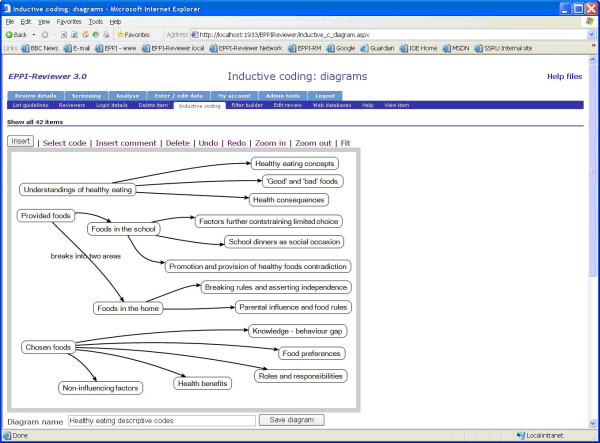
- In the example review, eight relevant qualitative studies yielded 36 initial codes, 12 descriptive themes, six analytical themes, and ten intervention recommendations.
- Six main issues emerged from children’s views: children do not see it as their role to be interested in health; future-health messages are not personally relevant or credible; fruit, vegetables and confectionery have different meanings; children seek food choices; eating is valued as a social occasion; and children see contradictions between promoted theory and adult practice.
- Most interventions were school-based and combined health-benefit learning with hands-on experience; interventions aligned with children’s views tended to be more effective, while multi-component physical activity plus healthy eating interventions worked less well than healthy-eating-only ones.
Methods
- Methodological paper describing thematic synthesis, illustrated with a completed systematic review of barriers to and facilitators of healthy eating among children aged four to 10 years.
- Searching involved extensive grey literature, author contact, and manual journal screening; quality was assessed using 12 criteria covering reporting, validity/reliability strategies, and appropriateness for children’s perspectives.
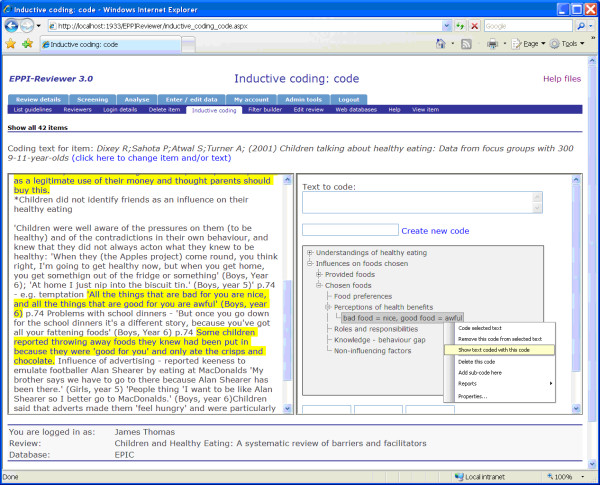
- Findings text labelled results/findings was entered verbatim into NVivo/EPPI-Reviewer; three reviewers independently coded line-by-line, grouped codes into descriptive themes, then generated analytical themes through group discussion and review questions.
Limitations
- Stated: contextual information in primary reports was very restricted, making it difficult to use context fully; there is little consensus on assessing qualitative quality and no accepted or empirically tested methods for excluding studies on quality, so all studies were included regardless of quality.
- Stated: the analytical-theme stage depends on reviewers’ judgement and insights and is potentially controversial; sensitivity analysis was done after synthesis by examining relative contributions of studies, finding poorer-quality studies contributed comparatively little and contained few unique themes.
- Evident: the method is illustrated with a single example review rather than compared empirically with other synthesis methods; the paper does not report a formal validation or inter-rater reliability for the synthesis.
Model-written summary. Check it against the paper before relying on it.
Integrity signals
Registry
Cites
Statistics
Figures
Verification
Claims the paper makes
3 Valid · 1 Not valid · 20 Not checked · 63 Own results and interpretations
A result the paper reports from its own data — it cites no other source for it, so there is none to check. The quote shows it is in the paper.
In the paper
“we found that there was very little difference in the methods we had to use to find qualitative studies compared to the methods we use when searching for studies for inclusion in a meta-analysis.”
§ Methods for the thematic synthesis of qualitative research in systematic reviews > Methods > Searching
plain- Asserted: passes — The authors put it forward as true.
- Checkable: passes — It can be checked against evidence.
- Load-bearing: unclear — It is unclear whether the paper’s conclusions depend on it.
- Based: passes — The paper gives a reason why it holds.
A result the paper states — it cites no source for it, so there is none to check. The quote shows it is in the paper.
In the paper
“Interventions that were in line with these suggestions tended to be more effective.”
§ Methods for the thematic synthesis of qualitative research in systematic reviews > Abstract > Results
hedgedstates an association- Asserted: passes — The authors put it forward as true.
- Checkable: passes — It can be checked against evidence.
- Load-bearing: passes — The paper’s conclusions depend on it.
- Based: passes — The paper gives a reason why it holds.
A result the paper states — it cites no source for it, so there is none to check. The quote shows it is in the paper.
In the paper
“In our review, it was not possible to rely on simple electronic searches of databases.”
§ Methods for the thematic synthesis of qualitative research in systematic reviews > Methods > Searching
plain- Asserted: passes — The authors put it forward as true.
- Checkable: passes — It can be checked against evidence.
- Load-bearing: unclear — It is unclear whether the paper’s conclusions depend on it.
- Based: passes — The paper gives a reason why it holds.
A result the paper reports from its own data — it cites no other source for it, so there is none to check. The quote shows it is in the paper.
In the paper
“In the event, we did not find any themes that belonged to a specific group, but another outcome of this process was a realisation that the contextual information given in the reports of studies was very restricted indeed.”
§ Methods for the thematic synthesis of qualitative research in systematic reviews > Discussion > Context and rigour in thematic synthesis
plain- Asserted: passes — The authors put it forward as true.
- Checkable: passes — It can be checked against evidence.
- Load-bearing: unclear — It is unclear whether the paper’s conclusions depend on it.
- Based: passes — The paper gives a reason why it holds.
A result the paper states — it cites no source for it, so there is none to check. The quote shows it is in the paper.
In the paper
“Interventions targeted at people with particular risk factors worked better than others, and multi-component interventions that combined the promotion of physical activity with healthy eating did not work as well as those that only concentrated on healthy eating.”
§ Methods for the thematic synthesis of qualitative research in systematic reviews > Results
plainstates a cause- Asserted: passes — The authors put it forward as true.
- Checkable: passes — It can be checked against evidence.
- Load-bearing: passes — The paper’s conclusions depend on it.
- Based: passes — The paper gives a reason why it holds.
25 more claims
Create a free account to see all 87 claims and to verify the 9 references still open.
- It may state two separate claims as one. 26
- Probably not a substantial claim. 45
Claims other papers make about this one
Each is checked against this paper’s own text: does it say what the citing paper says it does?
The source backs part of the claim, not all of it — or backs it for a different population, condition or comparison.
In the citing paper
“A thematic synthesis approach was used to integrate findings from studies with diverse methodological designs, following three key stages (Thomas & Harden, 2008).”
From Mind the gap: a systematic review of barriers, facilitators, and experiences of care transitions for people living with dementia and their informal caregivers. (2026) · cites this paper as Thomas & Harden, 2008
Experimental — accuracy not yet measuredThe source backs part of the claim, not all of it — or backs it for a different population, condition or comparison.
In the citing paper
“The thematic coding frame in Table 2 was applied to all included studies and reviewed for consistency of interpretation. This process, known as “axial coding,” ensured coded themes remained connected to and understood within the context of the source studies [13].”
From Patient-Perceived Factors Influencing Physical Activity Sensor Use in Stroke Prevention and Rehabilitation: Systematic Review of Qualitative Studies Using Thematic Synthesis (2026) · cites this paper as [13]
Experimental — accuracy not yet measuredThe source backs part of the claim, not all of it — or backs it for a different population, condition or comparison.
In the citing paper
“These data will be analysed following a three-step process. First, study data will be coded line by line by the first reviewer and checked by a second reviewer with a coding frame developed from codes derived from the data.”
From Effectiveness and acceptability of cognitive-behavioural therapy based interventions for maternal peripartum depression: A systematic review, meta-analysis and thematic synthesis protocol (2019) · cites this paper as [104]
Experimental — accuracy not yet measuredThe cited source says what the claim attributes to it.
In the citing paper
“The data coding, extraction and synthesis process was an iterative process, aligned with the thematic synthesis process outlined by Thomas 2008.”
From Health workers' perceptions and experiences of using mHealth technologies to deliver primary healthcare services: a qualitative evidence synthesis (2020) · cites this paper as Thomas 2008
The cited source says what the claim attributes to it.
In the citing paper
“To ensure the scientific reliability and trustworthiness of the findings, the qualitative analysis followed a thematic synthesis approach [25].”
From Sustainable Value Creation in Nonprofit Organizations: Processes, Determinants, and Strategic Dimensions (2026) · cites this paper as [25]
31 more claims about this paper
Create a free account to see every claim other papers make about this one.
Citations
Cites
Using thematic analysis in psychology
Braun, V., & Clarke, V. (2006) · Qualitative Research in Psychology · doi:10.1191/1478088706qp063oa · Cited by 194,414
(1997) · Cited by 4,204
Systematic reviews in the social sciences: a practical guide
(2006) · Choice Reviews Online · doi:10.5860/choice.43-5664 · Cited by 4,089
The Handbook of Research Synthesis.
Howel, D., Cooper, H., & Hedges, L. V. (1995) · Biometrics · doi:10.2307/2533295 · Cited by 3,642
Systematic Reviews in the Social Sciences: A Practical Guide
Petticrew, M., & Roberts, H. (2006) · doi:10.1002/9780470754887 · Cited by 3,586
Assessing the quality of controlled clinical trials
Jüni, P., Altman, D. G., & Egger, M. (2001) · BMJ · doi:10.1136/bmj.323.7303.42 · Cited by 3,309
Noblit, G., & Hare, R. (1988) · doi:10.4135/9781412985000 · Cited by 2,723
Qualitative Research: Rigour and qualitative research
Mays, N., & Pope, C. (1995) · BMJ · doi:10.1136/bmj.311.6997.109 · Cited by 2,715
Systematic Reviews in Health Care : Meta-Analysis in Context
Egger, M., Smith, G. D., & Altman, D. G. (2000) · Cited by 2,417
Dixon-Woods, M., Cavers, D., Agarwal, S., Annandale, E., Arthur, A., Harvey, J., Hsu, R., Katbamna, S., Olsen, R., Smith, L., et al. (2006) · BMC Medical Research Methodology · doi:10.1186/1471-2288-6-35 · Cited by 2,289
Research works printed but not linked: 9
- EPPI-Centre EPPI-Centre Methods for Conducting Systematic Reviews 2006 London: EPPI-Centre, Social Science Research Unit, Institute of Education, University of London
- Higgins J Green S (Eds) Cochrane Handbook for Systematic Reviews of Interventions 426 2006 Updated September 2006. Accessed 24th January 2007
- Sandelowski M Barroso J Handbook for Synthesising Qualitative Research 2007 New York: Springer
- Oakley A Experiments in Knowing: Gender and methods in the social sciences 2000 Cambridge: Polity Press
- Shepherd J Harden A Rees R Brunton G Oliver S Oakley A Young People and Healthy Eating: A systematic review of barriers and facilitators 2001 London: EPPI-Centre, Social Science Research Unit, Institute of Education, University of London
- Popay J Moving Beyond Effectiveness in Evidence Synthesis 2006 London: National Institute for Health and Clinical Excellence
- Boyatzis RE Transforming Qualitative Information 1998 Sage: Cleveland
- Medical Sociology Group Criteria for the evaluation of qualitative research papers Med Sociol News 1996 22 68 71
- Thomas J Brunton J EPPI-Reviewer 30: Analysis and management of data for research synthesis EPPI-Centre software 2006 London: EPPI-Centre, Social Science Research Unit, Institute of Education
Cited by
Items 8,101–8,200 of 9,166
Alba-Lopez, L., Satterfield, N., & Seo, D. (2026) · Qualitative Research Journal · doi:10.1108/qrj-08-2025-0249
Hayo, L., & Hasegawa, H. (2026) · Journal of Agriculture and Food Research · doi:10.1016/j.jafr.2026.102731 · Cited by 2
Meta-Sentez: Nitel Araştırmaların Bütüncül Sentezi İçin Bir Yöntem
ERGUN, A. D. (2026) · Elektronik Sosyal Bilimler Dergisi · doi:10.17755/esosder.1657490 · Cited by 1
Nacaroğlu, O. (2026) · Erzincan Üniversitesi Eğitim Fakültesi Dergisi · doi:10.17556/erziefd.1682972 · Cited by 1
Ikigai Play: Towards an Ikigai Paradigm of Healthy and Active Ageing in Europe
Giesteira, B., Souza, T., de Sousa, A. P., Rodrigues, L., & Maior, G. V. (2026) · IGI Global eBooks · doi:10.4018/979-8-3373-3531-5.ch008
Aspects hindering hearing conservation programme effectiveness: a narrative review
Rikhotso, O., Morodi, T. J., & Masekameni, M. D. (2025) · Occupational Health Southern Africa · doi:10.62380/ohsa.2025.31.4.3
Berry, D., Skrocki, A., Howell, E., & Pilgreen, D. G. (2026) · Behavioral Sciences · doi:10.3390/bs16020246 · Cited by 2
Wu, L., Mei, Z., Tao, C., Sun, H., Zhang, S., Jin, S., Li, W., Chen, J., Liu, X., Gu, M., et al. (2026) · Research in Nursing & Health · doi:10.1002/nur.70055
Jaan, S. A., Ali, A., Edelman, N. L., & Ford, E. M. (2026) · Journal of Patient Safety and Risk Management · doi:10.1177/25160435261421362
Jing, J., Li, M., Wang, X., Wang, D., Bi, S., Zhu, Q., Rui, Y., & Yuan, L. (2026) · Supportive Care in Cancer · doi:10.1007/s00520-026-10321-w
Getenet, S. T., Adeniji, S. M., Muir, T., Baker, P., & Fielding-Wells, J. (2026) · Educational Studies in Mathematics · doi:10.1007/s10649-026-10480-x · Cited by 2
Well-being of health workers providing maternal and newborn care: A qualitative evidence synthesis
Hazfiarini, A., Corona, M. V., Minckas, N., Homer, C., Turner, T., Zahroh, R. I., Afulani, P. A., Cometto, G., McDonald, S., Warren, C., et al. (2026) · PLOS Global Public Health · doi:10.1371/journal.pgph.0005522 · Cited by 1
Halk Sağlığı Usul ve Üslubu Beşinci Kitap - Tanzim
Turaman, C. (2026) · Akademisyen Kitabevi eBooks · doi:10.37609/akya.4065
Ani, J. I., & Katende-Kyenda, L. N. (2026) · Social and Health Sciences · doi:10.25159/2957-3645/19997 · Cited by 1
Aminu, K., Jayasinghe, Y. A., Adegbile, O. E., Olorunlana, A., Nwebo, R. A., Nnannah, P. C., Salami, A. A., Adisa, A. O., Eze, U. A., & Kanmodi, K. K. (2026) · Health Science Reports · doi:10.1002/hsr2.71750 · Cited by 1
Vicarious learning in SME internationalization: A systematic review and thematic synthesis
Perera, S. R., Sinha, P. N., Gilbert‐Saad, A., et al. (2026) · Journal of Management & Organization · doi:10.1017/jmo.2026.10087
Baldus, C., Simon-Kutscher, K., Kunze, S., Ulrich, S., Bröning, S., Naeve, C., Arnaud, N., Laurenz, L. J., Harbs, J., & Thomasius, R. (2026) · Journal of Child and Family Studies · doi:10.1007/s10826-026-03267-4 · Cited by 1
Examining an electroacupuncture protocol for sciatica: scoping review and case study vignettes
Scott, R. S., Lorenc, A., & Charlesworth, K. (2026) · European Journal of Integrative Medicine · doi:10.1016/j.eujim.2026.102632
Aliaga-Castellanos, S., Martinez-Granero, S., Fernández‐Férez, A., Granero‐Molina, J., Antequera-Raynal, L. H., Granero‐Heredia, G., & Jiménez‐Lasserrotte, M. D. M. (2026) · Healthcare · doi:10.3390/healthcare14040483
Cobb-Clark, M.-A., & Nguyen, H. T. M. (2026) · Teachers and Teaching · doi:10.1080/13540602.2026.2630394 · Cited by 1
El impacto de la formación técnico-profesional y su influencia en la inserción laboral
Morillo, J. I. G. (2025) · Actas Iberoamericanas en Ciencias Sociales · doi:10.69821/aicis.v3i3.160
Participar no siempre es incluir: poder, reconocimiento e implementación de metodologías activas
Alvarado, G. A. Z. (2026) · Pedagogical Constellation · doi:10.69821/constellations.v5i1.151
Bo, Y. (2026) · Research Connections · doi:10.1093/rescon/vmag006 · Cited by 4
Flores, D. R., Ochoa, W. O., & Mogrovejo, I. M. (2026) · Revista Multidisciplinaria Investigación Contemporánea · doi:10.58995/redlic.rmic.v4.n2.a190
Sanadi, R., Elangovan, A. R., Kuppusamy, C., Arasappa, R., & Chandra, P. S. (2026) · Archives of Women s Mental Health · doi:10.1007/s00737-025-01669-9 · Cited by 1
Islam, M. T., Odunyemi, A., Bruce, M., & Alam, K. (2026) · Health & Social Care in the Community · doi:10.1155/hsc/8871771 · Cited by 1
Theis, S., Cartwright, L. A., Fortin, M., Ruppert, J. L. W., & Gonzalez, A. (2026) · Environmental Management · doi:10.1007/s00267-026-02390-8
Immersive sensemaking for binary reverse engineering: a survey and synthesis
Brown, D., Mulder, E., & Mulder, S. (2026) · Frontiers in Virtual Reality · doi:10.3389/frvir.2026.1613269 · Cited by 1
Impacts of climate change on agricultural productivity: a scoping review
Sugiyanto, & Nugroho, A. C. (2026) · IOP Conference Series Earth and Environmental Science · doi:10.1088/1755-1315/1586/1/012038 · Cited by 1
Smart Cities and Mental Health: A Thematic Review of Environmental, Digital, and Social Determinants
Sualp, K., Beltran, S. J., & Plonsky, G. (2026) · Community Mental Health Journal · doi:10.1007/s10597-026-01592-y
SMEs and Supply Chains: A Systematic Review of CSR Adoption and Scalability ModelsPreprint
Ndemena, P. (2026) · Research Square · doi:10.21203/rs.3.rs-8916003/v1
de Jong, R., van der Voort, A., Aben, W., & de Jonge, M. V. (2026) · European Child & Adolescent Psychiatry · doi:10.1007/s00787-025-02951-y · Cited by 1
Strategi Guru dalam Memilih Model Pembelajaran bagi Siswa Slow Learner di Sekolah Dasar Inklusif
Pratama, M. R., & Prasetyo, S. (2026) · Didaktika Jurnal Kependidikan · doi:10.58230/27454312.3735 · Cited by 1
O’Connor, L., Ahern, J., Hume, S., Bracken, L., Donson, F., & Rogers, E. M. (2026) · Children and Youth Services Review · doi:10.1016/j.childyouth.2026.108846 · Cited by 1
Alinda, K., Kaawaase, T. K., & Nkundabanyanga, S. K. (2026) · IIMBG Journal of Sustainable Business and Innovation · doi:10.1108/ijsbi-05-2025-0020 · Cited by 2
Awuni, P. M. A., Mbinta, J. F., & Zobazie, C. B. (2026) · Bulletin of the National Research Centre/Bulletin of the National Research Center · doi:10.1186/s42269-026-01401-2
Ma, G., Yao, S., Shen, H., Dong, Y., Chen, L., Song, H., Fang, Y., & Shen, X. (2026) · Frontiers in Rehabilitation Sciences · doi:10.3389/fresc.2026.1694213 · Cited by 1
Thomson, G., Ceballos-Rasgado, M., Harris, C., & Schroeder, D. (2026) · Wellcome Open Research · doi:10.12688/wellcomeopenres.24827.3 · Cited by 1
Mir, R., Poduval, S., Sheringham, J., & Hamilton, F. L. (2026) · JMIR Research Protocols · doi:10.2196/71383 · Cited by 1
Analyses of the Development and Challenges of Parkour Coaches’ Education in Europe
Kolar, E., Pišot, R., Veličković, S., et al. (2026) · Annales Kinesiologiae · doi:10.35469/ak.2025.527
Chen, R. (2025) · The Scientific Notes of the Pedagogical Department · doi:10.26565/2074-8167-2025-56-08
Abdelghani, A. A. A., Mohammed, M. A., & Ahmed, H. A. M. (2026) · Eco-Tourism and Sustainable Development · doi:10.63385/etsd.v2i1.354
Lotito, F., Maffeo, M., & Fiorini, J. (2026) · Journal of Pediatric Nursing · doi:10.1016/j.pedn.2026.02.025 · Cited by 3
Nature-Based Learning in Malaysian Early Childhood Education: A Systematic Literature Review
Sauli, S. S., Isa, F. M., Kosnin, A. M., et al. (2026) · International Journal of Early Childhood · doi:10.1007/s13158-026-00499-9
Fitriyah, I. J., Muqoyyidin, A. W., Erlangga, S. Y., & Himmah, R. (2026) · Psychological Science and Education · doi:10.17759/pse.2026310105
Blackwell-Green, G., Cooper, M., & Singh, N. V. (2026) · BMC Family Practice · doi:10.1186/s12875-026-03201-z · Cited by 1
Alvarado, G. A. Z. (2026) · Revista Multidisciplinaria Voces de América y el Caribe · doi:10.69821/remuvac.v3i1.286 · Cited by 1
Seppey, M., Bodryzlova, Y., Mac-Seing, M., et al. (2026) · Sexuality Research and Social Policy · doi:10.1007/s13178-026-01294-w
Saputra, M. H., & Permana, K. (2026) · Jurnal Simki Economic · doi:10.29407/jse.v9i1.1415 · Cited by 6
Parsanejad, M., & Kuhbanani, A. Z. (2026) · Information Technology & Tourism · doi:10.21203/rs.3.rs-8874905/v1
RESILIENCE OF SOCIAL WORKERS' PROFESSIONAL IDENTITY: INTERNATIONAL LESSONS AND UKRAINIAN CHALLENGES
СТОЛЯРИК, О., & Semigina, T. (2025) · Bulletin of Taras Shevchenko National University of Kyiv Social work · doi:10.17721/2616-7786.2025/11-1/8 · Cited by 3
Sabauri, K., & Zurabashvili, D. (2026) · World Science · doi:10.31435/ws.1(91).2026.4304
Beeston, E., Chitrakar, A., Acheampong, K., Gray, L. J., Singh, S., Moss, E. L., & Darko, N. (2026) · BMC Health Services Research · doi:10.1186/s12913-026-14263-1 · Cited by 2
A systematic review and meta-synthesis of ethics of teaching in nursing education
Chaimo, K., & Thanasilp, S. (2026) · Nursing Ethics · doi:10.1177/09697330261418157 · Cited by 1
Disclosure experiences in LGBTQ+ healthcare staff: a systematic review and meta-synthesis
Prakkash, R., Manning, L., Bécares, L., Hatch, S. L., Akande, I., & Dorrington, S. (2026) · BMJ Open · doi:10.1136/bmjopen-2025-100412 · Cited by 1
Deng, Y., Butler, J., & Oram, S. (2026) · BJPsych Bulletin · doi:10.1192/bjb.2026.10222 · Cited by 1
Participation, empowerment and self-organization in community-based tourism
Wu, H., & Zhang, C. (2026) · Tourism Geographies · doi:10.1080/14616688.2026.2635581
Soundy, A. (2026) · Lifespan development and mental health. · doi:10.70322/ldmh.2026.10003 · Cited by 4
Elmi, A., Palmer, Y., Gracey, F., & Shepherd, A. (2026) · Neuropsychological Rehabilitation · doi:10.1080/09602011.2026.2620570 · Cited by 1
Perspectives of military-affiliated women on lethal means safety: A systematic review
Litschi, M. A., Lafferty, M., Riegelman, A., Lancaster, S. L., & Linkh, D. J. (2026) · PLoS ONE · doi:10.1371/journal.pone.0344104
Hassan, M., Jani, Y., Valle, K., Okoye, N., Kazemeini, S., Yusem-Cartens, L., Rutkowski, C., & Frasier, K. M. (2026) · Journal of Biosciences and Medicines · doi:10.4236/jbm.2026.143012
Integrating Constructivist, Assessment, and Cultural Dimensions in EFL Writing Pedagogy
Patty, J. (2025) · ELITE Journal of English Language and Literature · doi:10.33772/kpwenx61
Sanfaçon-Verret, A., Neashish, E., Moar, B.-T., Taler, V., & Monetta, L. (2026) · Global Public Health · doi:10.1080/17441692.2026.2640763
Wakim, A. F., Utazi, K. S., Ekechukwu, N. E., & Kalu, M. E. (2026) · PLoS ONE · doi:10.1371/journal.pone.0343744
McGovern, W., Smart, D., Alderson, H., Barron, C., Cooling, V., Frost, H., Kaner, E., Hackett, S., & McGovern, R. (2026) · BMC Public Health · doi:10.1186/s12889-026-26838-y
New media encourages environmental participation in the digital era
Zulfikar, M., Sarwoprasojo, S., Hapsari, D. R., et al. (2026) · Priviet Social Sciences Journal · doi:10.55942/pssj.v6i2.1162
Circular and Bio Economy Barriers and Drivers in Worker Cooperatives
Albanese, M., Guerreschi, A., & Lomuscio, M. (2026) · International Review of Applied Economics · doi:10.1080/02692171.2026.2634171
Sinkala, H., Kabaso, O., Kanyamuna, V., Simui, F., & Muleya, G. (2026) · African Journal of Empirical Research · doi:10.51867/ajernet.7.1.77
Kakoko, D., Akyoo, W. O., Sabas, D., & Mnyanyi, C. (2026) · Discover Education · doi:10.1007/s44217-026-01212-7
Méndez-Cañón, M., Ornellas, A., & Creus, A. (2025) · Education in the Knowledge Society (EKS) · doi:10.14201/eks.31350
The role of internal audit in public procurement governance: a systematic literature review
Saleh, R., Winarningsih, S., Suharman, H., & Setiawan, M. N. (2026) · Cogent Business & Management · doi:10.1080/23311975.2026.2640253 · Cited by 5
Zheng, B., He, Q., & Lin, C. (2026) · Medical Teacher · doi:10.1080/0142159x.2026.2630980
Saikali, M., Baysari, M. T., Lichtner, V., Pelayo, S., Carland, J. E., & Marcilly, R. (2026) · International Journal of Medical Informatics · doi:10.1016/j.ijmedinf.2026.106369
Kaelin, V., Quaaden, K., Lindgren, H., Granlund, M., & Imms, C. (2026) · Developmental Medicine & Child Neurology · doi:10.1111/dmcn.70228
Zainuddin, M. Z., Tamburaka, S., & Dali, N. (2025) · Ilomata International Journal of Tax and Accounting · doi:10.61194/ijtc.v6i4.2188
Obstetric violence from the perspective of healthcare personnel: a qualitative systematic review
Guzmán-Guevara, F. M., Manjarres-Posada, N. I., & Vega-Fregoso, G. (2026) · Frontiers in Global Women s Health · doi:10.3389/fgwh.2026.1773729
Bolaji, P., Babalola, A. E., & Fletcher, S. (2026) · Research Square · doi:10.21203/rs.3.rs-7687461/v1
Rol del coordinador y acompañamiento pedagógico mediado por tecnología: una revisión narrativa
Camilo, A. S. C., & Estrada, A. F. (2026) · Pedagogical Constellation · doi:10.69821/constellations.v5i1.152
Culturally responsive assessment: Promoting equity and inclusion in refugee education
Kole, J. K. T. (2026) · Social Sciences & Humanities Open · doi:10.1016/j.ssaho.2026.102677
Al-Obaidy, M. H., & Abdulah, Z. (2025) · Journal of Health Innovation and Environmental Education. · doi:10.37251/jhiee.v2i2.2687
Çiçek, E., & Özoğlu, M. (2026) · Journal of Professional Nursing · doi:10.1016/j.profnurs.2026.03.003
Muzondo, P. J., Matowanyika, K., & Chipangamate, N. S. (2026) · Transportation Research Interdisciplinary Perspectives · doi:10.1016/j.trip.2026.101929
Tomás, J., Sousa, H. J., Araújo, D., Field, A., Ribeiro, J., & Sarmento, H. (2026) · International Journal of Performance Analysis in Sport · doi:10.1080/24748668.2026.2645328 · Cited by 2
M'membe, F., Ntayi, J. M., & Nyahunda, L. (2026) · African Journal of Empirical Research · doi:10.51867/ajernet.7.1.103
M'membe, F., Ntayi, J. M., & Nyahunda, L. (2026) · African Journal of Empirical Research · doi:10.51867/ajernet.7.1.105
Luo, W., Feng, T., Zhang, T., Chen, X., Lu, X., Li, Y., Hou, C., & Gao, J. (2026) · Public Health · doi:10.1016/j.puhe.2026.106252 · Cited by 1
Tradition meets transformation: the rise of women’s football in the Kingdom of Saudi Arabia
Reeves, M. J., Alkilani, L. F., & Blundell, M. (2026) · Managing Sport and Leisure · doi:10.1080/23750472.2026.2644941
Oladipupo, T., Bayo, E., & Alawiye, P. O. (2025) · International Journal of Scientific Research and Modern Technology. · doi:10.38124/ijsrmt.v4i10.1314
Belluzzo, M., Giaquinto, V., Esposito, C., Borrelli, G., Alfieri, E., & Amodeo, A. L. (2026) · Sport Education and Society · doi:10.1080/13573322.2026.2645399 · Cited by 1
Hatmi, K. A. (2026) · SSRN Electronic Journal · doi:10.2139/ssrn.6439404
Sheng, W., Yang, X., & Zhang, Q. (2026) · BMC Geriatrics · doi:10.1186/s12877-026-07348-3 · Cited by 2
Krisnamurthi, B., Utami, A. D., Abdullah, I., & Aulia, M. R. (2026) · SSRN Electronic Journal · doi:10.2139/ssrn.6437512 · Cited by 1
Alonzo-Godoy, M., Agut, M. P. M., & Monzó-Martínez, A. (2026) · Education Sciences · doi:10.3390/educsci16030480 · Cited by 4
The experiences of adults with end-stage renal disease who dialyse at home: a systematic review
Blake, A. (2026) · British Journal of Nursing · doi:10.12968/bjon.2025.0534
Gobiet, E., Tripathi, K., Vleminck, A. D., den Block, L. V., & Pivodic, L. (2026) · Social Science & Medicine · doi:10.1016/j.socscimed.2026.119220
Han, N.-K., & Kim, J. G. (2026) · Journal of Nursing Management · doi:10.1155/jonm/9182331
Şenyapar, H. N. D. (2026) · Health & Social Work · doi:10.1093/hsw/hlag011
Lin, S., Zheng, J., Huang, X., & Ye, R. (2026) · BMC Pediatrics · doi:10.1186/s12887-026-06757-y
Fármacos en el ambiente: aproximaciones para su estudio a través de una revisión de alcance
Prieto, D. M. Q., Orozco-Díaz, J. G., Toro, J., & Ballesteros-Cabrera, M. D. P. (2025) · Gestión y Ambiente · doi:10.15446/ga.v28n1.120427 · Cited by 1
Wang, W., Zhang, Z., Chen, X., & Lee, C. (2026) · Social Science & Medicine · doi:10.1016/j.socscimed.2026.119228
Metadata
- Authors
- Thomas, J., & Harden, A.
- Affiliations
- University of London (GB)
- Corresponding author
- Thomas, James
- Venue
- BMC Medical Research Methodology
- Published
- 2008-07-10
- Volume
- 8
- Issue
- 1
- Pages
- 45-45
- ISSN
- 1471-2288 (ISSN-L)
- PMC
- PMC2478656
- OpenAlex
- W2109305774
- Cited by
- 9,312
- References
- 64
- Citations by year
- 2026: 1606 · 2025: 1253 · 2024: 1082 · 2023: 899 · 2022: 903 · 2021: 852 · 2020: 606 · 2019: 472 · 2018: 404 · 2017: 318 · 2016: 275 · 2015: 179 · 2014: 141 · 2013: 122 · 2012: 91
- FWCI
- 38.28
- Type
- journal article
- Language
- en
- Open access
- gold
- doi.org
- Licence
- cc-by
- creativecommons.org/licenses/by/2.0 (tdm)
- Locations
- BMC Medical Research Methodology (publishedVersion, cc-by)
- PubMed Central (publishedVersion, cc-by)
- PubMed (publishedVersion)
- UEL Research Repository (University of East London) (acceptedVersion)
- City Research Online (City University London) (acceptedVersion)
- IOE EPrints (submittedVersion)
- UEL Research Repository (University of East London) (submittedVersion, cc-by-nd)
- DOAJ (DOAJ: Directory of Open Access Journals) (submittedVersion, cc-by-sa)
- UCL Discovery (University College London) (submittedVersion)
- Funders
- National Institute for Health and Care Research
- Economic and Social Research Council (RES-576-25-5008)
- Topics
- Social Sciences › Education › Qualitative Research Methods and Applications
- Social Sciences › Decision Sciences › Statistics, Probability and Uncertainty › Meta-analysis and systematic reviews
- Social Sciences › Sociology and Political Science › Delphi Technique in Research
- Keywords
- thematic synthesis, thematic analysis, health promotion interventions, children's perspectives, school-based intervention, fruit and vegetable intake, health messaging
- MeSH terms
- Humans, Methods, Review Literature as Topic, Statistics as Topic, Qualitative Research
About these checks
Registry, retraction, Cites and statistics results are computed, not judged, with one exception: a printed reference that no index lists is read once by a model before it counts as a citation error. Claims are extracted by a model and kept only when their quote appears verbatim in the text; each cited source is then checked, with a model’s help, for whether it says what the claim relies on. Those verdicts can be wrong — read the claim’s quote and the cited source before relying on one.
The claim verdicts this report counts are experimental: their accuracy is not yet measured.
A language model drew the claims from the paper on 2026-10-04, under version 3 of the claim definition (model deepseek-v4.1-flash, prompt extract-v3).
A second model labelled each claim on 2026-10-04 (model jev-1.13-20260917, definition revision gold-guideline-v0.2).
Statistics and arithmetic are recomputed, not judged.
Confidence bands are shown only for fields calibrated on our annotated test set. None is calibrated yet, so no band is shown.
What counts as a claim ›How we measure confidence ›How we check this ›
Are you an author, or do you see a problem with this page? Request a review
Data sources
Bibliographic data: Semantic Scholar, OpenAlex, Crossref.
Contains information from the Semantic Scholar Academic Graph Datasets, made available under the ODC Attribution License (ODC-BY 1.0).
Semantic Scholar’s data is described in: Kinney, R., et al. (2023). The Semantic Scholar Open Data Platform. arXiv:2301.10140.
