

The DOI matches its Crossref record; 39 of the 39 references it cites were found in a registry or an index.
Rapid appraisal of barriers to the diagnosis and management of patients with dementia in primary care: a systematic review
Open accessAbstract
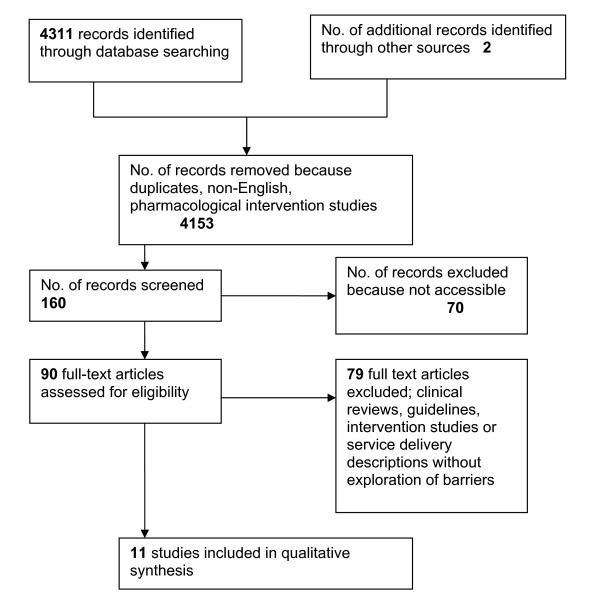
BACKGROUND: The diagnosis of dementia in primary care is perceived as a problem across countries and systems, resulting in delayed recognition and adverse outcomes for patients and their carers. Improving its early detection is an area identified for development in the English National Dementia Strategy 2009; there are thought to be multiple benefits to the patient, family, and resources by doing this. The aim of this review was to carry out a rapid appraisal in order to inform the implementation of this policy. METHOD: Publications in English up to August 2009 relating to barriers to the recognition of dementia, were identified by a broad search strategy, using electronic databases MEDLINE, EMBASE, and psycINFO. Exclusion criteria included non-English language, studies about pharmacological interventions or screening instruments, and settings without primary care. RESULTS: Eleven empirical studies were found: 3 quantitative, 6 qualitative, and 2 with mixed methodologies. The main themes from the qualitative studies were found to be lack of support, time constraints, financial constraints, stigma, diagnostic uncertainty, and disclosing the diagnosis. Quantitative studies yielded diverse results about knowledge, service support, time constraints, and confidence. The factors identified in qualitative and quantitative studies were grouped into 3 categories: patient factors, GP factors and system characteristics. CONCLUSION: Much can still be done in the way of service development and provision, GP training and education, and the eradication of stigma attached to dementia, to improve the early detection and management of dementia. Implementation of dementia strategies should include attention to all three categories of barriers. Further research should focus on their interaction, using different methods from studies to date.
Overview
The claims and statistics of this paper haven’t been checked yet.
Run the check — free, no account needed. It reads the open-access text and checks the sources it cites.
Integrity signals
Registry
Cites
Statistics
Figures
Verification
Claims the paper makes
The claims and statistics of this paper haven’t been checked yet.
Run the check — free, no account needed. It reads the open-access text and checks the sources it cites.
Claims other papers make about this one
Each is checked against this paper’s own text: does it say what the citing paper says it does?
The cited source says what the claim attributes to it.
In the citing paper
“Personal style, defined as the perceived fit between the intervention and the preferred style of clinical practice, such as clinicians’ communication style [78, 79], personality [54] and philosophical opposition to the intervention [69, 76], were presented exclusively as barriers.”
From Achieving change in primary care—causes of the evidence to practice gap: systematic reviews of reviews (2015) · cites this paper as [79]
The check wasn’t confident either way, so it gives no verdict — never disputed.
In the citing paper
“Perceptions of barriers may be socially constructed, and addressing them may not necessarily improve implementation [79].”
From Achieving change in primary care—causes of the evidence to practice gap: systematic reviews of reviews (2015) · cites this paper as [79]
Experimental — accuracy not yet measured
Self-check
Percentages, sums and reported differences re-computed from the paper’s own numbers.
The self-check needs the paper’s full text.
Citations
Cites
Preferred Reporting Items for Systematic Reviews and Meta-Analyses: the PRISMA statement
Moher, D., Liberati, A., Tetzlaff, J., Altman, D. G., & for the PRISMA Group (2009) · BMJ · doi:10.1136/bmj.b2535 · Cited by 83,823
Preferred reporting items for systematic reviews and meta-analyses: the PRISMA Statement.
(2009) · PubMed Central · Cited by 44,859
Dixon-Woods, M., Cavers, D., Agarwal, S., Annandale, E., Arthur, A., Harvey, J., Hsu, R., Katbamna, S., Olsen, R., Smith, L., et al. (2006) · BMC Medical Research Methodology · doi:10.1186/1471-2288-6-35 · Cited by 2,289
Living Well with Dementia: A National Dementia Strategy
(2009) · PsycEXTRA Dataset · doi:10.1037/e608082011-001 · Cited by 1,119
Rogers, S. L., & Friedhoff, L. T. (1996) · Dementia and Geriatric Cognitive Disorders · doi:10.1159/000106895 · Cited by 743
Evidence based policy: proceed with careCommentary: research must be taken seriously
Black, N. A., & Donald, A. (2001) · BMJ · doi:10.1136/bmj.323.7307.275 · Cited by 588 · cited 1×
“Influencing policy development and implementation is now an issue for researchers in all those countries with government-driven dementia strategies, and as Black has pointed out [25], timing is important: "Windows of opportunity to make change open up only rarely and briefly, when policy makers' values happen to coinc…”
BackgroundNon-communicable diseases must have greater priority, says WHO
Zarocostas, J. (2009) · British medical journal · doi:10.1136/bmj.b2857 · Cited by 391
Turner, S., Iliffe, S., Downs, M., Wilcock, J., Bryans, M., Levin, E., Keady, J., & O'Carroll, R. (2004) · Age and Ageing · doi:10.1093/ageing/afh140 · Cited by 375 · cited 7×
“The response rates of the studies ranged from 28% (n = 127) [30] to 67% (n = 153) [16].”
BackgroundResultInfluentialSelf-citationDiagnosing Dementia: Perspectives of Primary Care Physicians
Boise, L., Camicioli, R. M., Morgan, D. L., Rose, J. H., & Congleton, L. (1999) · The Gerontologist · doi:10.1093/geront/39.4.457 · Cited by 329 · cited 1×
“Despite this, early detection of dementia is difficult to achieve in primary care across different health care systems [16-18] with diagnosis taking between 18 to 30 months, and in the extreme, up to 4 years [19].”
BackgroundPractice constraints, behavioral problems, and dementia care: primary care physicians' perspectives
Hinton, L., Franz, C. E., Reddy, G., Flores, Y., Kravitz, R. L., & Barker, J. C. (2007) · Journal of General Internal Medicine · doi:10.1007/s11606-007-0317-y · Cited by 268 · cited 5×
“Inadequate financial remuneration (especially in countries where PCPs are paid according to services they provide) was proposed by PCPs as a barrier in the qualitative research [33,28,31,34], and was confirmed in one quantitative study (46% of PCPs in Turner et al [30]).”
BackgroundResultInfluential
Research works printed but not linked: 5
- Alzheimer's Disease International: Global Alzheimer's Disease Charter. 2009, (accessed 12/04/10), [ http://www.globalcharter.org/charter.php ]
- Levin E, Sinclair I, Gorbach P: Families Confusion, & Old Age. 1989, Aldershot: Gower
- The Audit Commission: Forget me not: developing mental health services for older people in England. 2000, London, The Audit Commission
- National Audit Office: Improving services and support for people with dementia. 2007, London: TSO
- Public Accounts Committee: Sixth report of session 2007-8: Improving services and support for people with dementia. 2008, London: TSO
Cited by
Sorted by citations
Items 201–275 of 275
Rullier, L., Meillon, C., Bergua, V., Pimouguet, C., Harmand, M. G., Helmer, C., Pérès, K., Dartigues, J., & Amieva, H. (2018) · International Psychogeriatrics · doi:10.1017/s1041610218001497 · Cited by 3
“Reasons for poor case recognition rates are unclear and probably multifactorial (Bradford et al., 2009; Helmer et al., 2008; Koch and Iliffe, 2010).”
BackgroundExperiencias luego del diagnóstico de demencia: aportes desde la perspectiva de los pacientes
Jean Gajardo, J., Rubén Alvarado, M., & Andrea Slachevsky, C. (2021) · Revista chilena de neuro-psiquiatría · doi:10.4067/s0717-92272021000300185 · Cited by 2
Belisario, J. S. M., Tudor, K. I., Sumalinog, A. R. N., Middleton, L. T., & Car, J. (2013) · Cochrane Database of Systematic Reviews · doi:10.1002/14651858.cd010580 · Cited by 3
A Cost-Benefit Analysis of a Group Memory Intervention for Healthy Older Adults with Memory Concerns
Baker, S., Vandermorris, S., Verhoeff, N. P. L. G., & Troyer, A. K. (2022) · Canadian Journal on Aging / La Revue canadienne du vieillissement · doi:10.1017/s0714980821000726 · Cited by 4
Paladino, J., Granados, H. C., Eruchalu, J. A. C., Davila, C., Gomez, L. A. R., Sideman, A. B., Dohan, D. P., Lindenberger, E. C., Dow, L. A., Vranceanu, A., et al. (2025) · Journal of Geriatric Psychiatry and Neurology · doi:10.1177/08919887251388036 · Cited by 2
General practitioners’ perspectives on blood biomarkers for Alzheimer's disease
Claessen, T., Visser, F. C., Munster, B. C. V., van der Flier, W. M., Jiménez‐Mausbach, M., van Harten, A. C., Teunissen, C. E., & Visser, L. N. C. (2025) · Alzheimer s & Dementia Diagnosis Assessment & Disease Monitoring · doi:10.1002/dad2.70186 · Cited by 2
Yang, J., Ding, H., Amini, S., Hao, B., Karjadi, C., Au, R., & Paschalidis, I. C. (2026) · Alzheimer s Research & Therapy · doi:10.1186/s13195-026-02006-7 · Cited by 2
Madden, E. F., Qeadan, F., Hettema, J., Tingey, B., Greenwald, M. K., Frabis, F., Vincent, M., & Page, K. (2026) · Journal of Substance Use and Addiction Treatment · doi:10.1016/j.josat.2026.210026 · Cited by 2
Centring the Human Subject: Catalyzing Change in Ethics and Dementia Research
Puurveen, G., Mann, J., & Cox, S. (2023) · Philosophy and medicine · doi:10.1007/978-3-031-12692-5_5 · Cited by 2
REFLEXÕES ACERCA DOS CUIDADOS PALIATIVOS EM PACIENTES COM ALZHEIMER: UMA REVISÃO INTEGRATIVA
Christian, B. M. D. Á., Silva, C. D. J., Giassi, J. M. D. O. J., Lima, P. O., & Souza, M. C. D. S. (2023) · Revista Destaques Acadêmicos · doi:10.22410/issn.2176-3070.v15i3a2023.3433 · Cited by 2
Gengeswaran, N., Brandwood, A., Anderson, N. N., Ramlakhan, J. U., & Gagliardi, A. R. (2024) · Dementia · doi:10.1177/14713012241244982 · Cited by 2
Linden, I., Perry, M., Wolfs, C. A. G., Schers, H., Dirksen, C. D., & Ponds, R. (2024) · Patient Education and Counseling · doi:10.1016/j.pec.2024.108446 · Cited by 2
Angomas, E., Blinka, M. D., Kelly, E., Oniha, O., McGuire, M., Colburn, J. L., Gallo, J. J., Wolff, J. L., Boyd, C. M., Samus, Q. M., et al. (2025) · Journal of General Internal Medicine · doi:10.1007/s11606-025-09493-8 · Cited by 2
Kornder, N., Lindner, N., Ehm, M., Rachor, F., Shan, C. W., Bösner, S., & van der Wardt, V. (2025) · BMC Family Practice · doi:10.1186/s12875-025-02952-5 · Cited by 2
“The emotional and ethical complexities surrounding dementia diagnosis continue to shape GP practices [31–33].”
Knowledge and Attitude of Health Care Providers for Korean National Health Examination
Kang, S. Y., Lee, J. A., & Kim, Y. S. (2017) · Daehan imsang geon-gang jeungjin hakoeji/Daehan imsang geon'gang jeungjin haghoeji · doi:10.15384/kjhp.2017.17.4.252 · Cited by 2
Fronza, G. P., & Dissanayaka, N. N. (2020) · International Psychogeriatrics · doi:10.1017/s1041610220000071 · Cited by 2
“Limited knowledge about dementia and low sense of self-efficacy could potentially hinder the diagnostic process (Imre et al., 2019; Koch and Iliffe, 2010).”
BackgroundExploring Memory Care Clinics in Minnesota: A Qualitative Analysis
Birkeland, R. W., McCarron, H. R., Nkimberg, M., & Gaugler, J. E. (2021) · Journal of Geriatric Psychiatry and Neurology · doi:10.1177/08919887211044752 · Cited by 2
Kjennetegn ved sykehjemsbeboere med langtkommen demens og smerter
Rostad, H. M., Grov, E. K., Utne, I., & Halvorsrud, L. (2019) · Sykepleien Forskning · doi:10.4220/sykepleienf.2019.79184 · Cited by 7
Letrilliart, L. (2020) · NPG. Neurologie, psychiatrie, gériatrie/NPG · doi:10.1016/s1627-4830(20)30198-7 · Cited by 1
Maruta, N., & Shevchenko-Bitensky, K. V. (2019) · Experimental and Clinical Medicine · doi:10.35339/ekm.2019.85.04.07 · Cited by 2
Wilkins, J., Neira, C., Su, L., & Initiative, A. D. N. (2025) · Brain and Behavior · doi:10.1002/brb3.70893 · Cited by 1
“…in Alzheimer’s disease (AD), which is the most common cause of dementia, can be particularly relevant considering its prevalence and clinical significance (about 75% of patients with AD experience severely impaired insight) (Wedderburn et al. 2008; Koch and Iliffe 2010; van Vliet et al. 2012).”
Lai, Y.-L., Chang, E.-Y., Liu, Y., Hsu, J., & Hsu, H. (2025) · Asia-Pacific Signal and Information Processing Association Annual Summit and Conference (APSIPA ASC) · doi:10.1109/apsipaasc65261.2025.11249167 · Cited by 1
“However, early diagnosis remains difficult due to patients’ limited self-awareness, the reluctance of many older adults to seek medical attention, and constraints in healthcare accessibility [2].”
Sayed, A., Zhu, J., Thoma, F. W., Cohen, A. D., Reis, S., López, O. L., Sultan, I., McKennan, C. G., Mulukutla, S. R., Pascoal, T. A., et al. (2025) · Journal of Alzheimer s Disease · doi:10.1177/13872877251409341 · Cited by 1
Stern, C., Valenzuela, C., Whitehorn, A., Pollock, D., Minooee, S., Gohil, D. A., Zhu, Z., Kirkpatrick, P., Loureiro, R. L., Davies, E., et al. (2026) · JBI Evidence Synthesis · doi:10.11124/jbies-25-00265 · Cited by 3
Aminzadeh, F., Molnar, F., & Ayotte, D. (2012) · Cited by 1
Kim, J., & Lee, H. (2024) · Aging Medicine · doi:10.1002/agm2.12380 · Cited by 1
Maruta, N., & Shevchenko-Bitensky, K. V. (2020) · Bulletin of Problems Biology and Medicine · doi:10.29254/2077-4214-2019-4-2-154-144-149 · Cited by 1
Représentations des médecins généralistes à propos du diagnostic des troubles cognitifs
Sanlaville-Boisson, C., Généraliste, A. L. M., Colin, C., Salmon, P. K., & Letrilliart, L. (2021) · Soins Gérontologie · doi:10.1016/j.sger.2021.05.009 · Cited by 1
An Improved Framework of Healthcare Supports System for the Treatment of Dementia Cases
Ntuen, A. U., Efiong, J. E., Eme, O., & Uche-Nwachi, E. O. (2021) · International Journal of Information Engineering and Electronic Business · doi:10.5815/ijieeb.2021.06.04 · Cited by 1
“This argument agrees with the publication of [16] where they emphasize that various kinds of dementia have diverse possible causes.”
BackgroundLetrilliart, L., Pouchain, D., Reste, J. Y. L., & Renard, V. (2015) · La Presse Médicale · doi:10.1016/j.lpm.2015.02.003 · Cited by 1
Services for People with Mild Dementia
Jones, R. W. (2013) · Wiley eBooks · doi:10.1002/9781118378663.ch5
Approche structurée en pratique familiale pour les patients ayant des problèmes de mémoire
Lee, L. S., Weston, W. W., Heckman, G. A., Gagnon, M., Lee, F. J., & Sloka, S. (2013) · Europe PMC (PubMed Central)
Phase II Evaluation of a Gerontology Nurse Specialist in Primary Healthcare.
King, A. I. I., Boyd, M. L., Raphael, D. L., Foster, S., Dagley, E., & Calverley, R. (2014) · ResearchSpace (University of Auckland)
Noel, M. D. (2014) · Knowledge Commons (Lakehead University)
A comparative study of dementia-related service provision and configuration in Canada
Tam‐Tham, H. (2013) · Libraries and Cultural Resources (University of Calgary) · doi:10.11575/prism/24670
C URRENT OPINION Improving access to dementia services for people from minority ethnic groups
Mukadam, N., Cooper, C., & Livingston, G. (2013)
Voluntary Cognitive Impairment Screening in Primary Care
Stell, C. (2016)
Peixoto, U. M. R., Vieira, A. M. D. C. T., Rosa, A. P., Faria, U. A., Oliveira, S., do Minho, U., Costa, A. S., Rocha, S., & Machado, Á. S. (2018) · Revista Portuguesa de Clínica Geral · doi:10.32385/rpmgf.v34i1.12358
Gitlin, L. N., & Hodgson, N. A. (2018) · Elsevier eBooks · doi:10.1016/b978-0-12-811928-0.00023-5
Implementation of complex interventions in UK General Practice
Lau, W. K. R. (2018) · UCL Discovery (University College London)
Assessing the Penetrance of Dementia Services
Rozsa, M., & Flicker, L. A. (2019) · Healthcare · doi:10.3390/healthcare7030081
“It is not a disease, only memory loss”
Koehn, S. D. (2020) · Elsevier eBooks · doi:10.1016/b978-0-12-817566-8.00002-4
Maximizing the Mini-Cog: Cognitive Decline Caused by Carotid Artery Stenosis
Streiter, S., Gaziano, J. M., & Orkaby, A. R. (2020) · Archives of Clinical and Medical Case Reports · doi:10.26502/acmcr.96550217
“Barriers to early diagnosis include subtle presentation of disease, lack of provider confidence in making a diagnosis, and stigmatization of dementia [2].”
BackgroundWilliams, A. J., Cottingham, M. E., & Patel, E. (2020) · The Clinical Neuropsychologist · doi:10.1080/13854046.2020.1822445
“…diagnose, and manage neurocognitive disorders is often complicated by short appointment times (<15minutes), limited training in geriatric medicine, and incomplete or inaccurate information about cognitive screening measures in medical journals (e.g., Hinton et al., 2007; Koch & Iliffe, 2010).”
Background„Hogyan tovább, demensgondozás?” : Kihívások és lehetőségek a demenciával élők szociális ellátásában
Fülöp, S. (2022) · Máltai Tanulmányok · doi:10.56699/mt.2022.4.10 · Cited by 3
Keegan, A., Strahley, A. E., Taylor, S. P., Wilson, T. M., Shah, M. D., Williamson, J. D., & Palakshappa, J. A. (2023) · Critical Care Explorations · doi:10.1097/cce.0000000000000920
Associating Impaired Insight and Brain Atrophy Rates in Alzheimer's DiseasePreprint
Wilkins, J., Muñoz‐Neira, C., & Su, L. (2024) · SSRN Electronic Journal · doi:10.2139/ssrn.4876055
Development of Alzheimer’s Disease Risk Score for Future Primary Care: A White-Box ApproachPreprint
Wiranto, Y., Setiawan, D., Watts, A. S., Ashourvan, A., & Initiative, T. A. D. N. (2024) · medRxiv · doi:10.1101/2024.08.02.24311399
The need for early diagnosis—Clinical, societal and health economic drivers
van Maurik, I. S., & van der Flier, W. M. (2025) · Elsevier eBooks · doi:10.1016/b978-0-12-822240-9.00014-4
Development of a dementia literacy scale among community-dwelling older adults
Aihara, Y. (2025) · Geriatric Nursing · doi:10.1016/j.gerinurse.2025.03.032
Janes, M., Buckell, A., Jones, B. A., Park, M. S., & Badham, S. P. (2025) · Dementia · doi:10.1177/14713012251345928
“Avoidance of professional help-seeking in the early stages of dementia is problematic as the literature suggests that both people with dementia and those who care for them bene fi t most from early diagnosis (Koch et al., 2010).”
Healthcare workers’ attitudes regarding the assessment of dementia in the elderly
Živanović, S., Pavlović, J., Hadživuković, N., Perkhofer, S., & Podgorica, N. (2025) · BMC Health Services Research · doi:10.1186/s12913-025-12958-5 · Cited by 1
Tseng, O. L.-I., Kim, G., Ho, W. Y., Lee, E. J., Chang, H., Lacaille, D. V., Newton, C., Vàsàrhelyi, K., Poureslami, I. M., Liow, E., et al. (2025) · The Annals of Family Medicine · doi:10.1370/afm.240118
Lu, Y., Liu, C., Fawkes, S. A., Wang, Z., & Yu, D. (2022) · Figshare · doi:10.6084/m9.figshare.19753251
Lu, Y., Liu, C., Fawkes, S. A., Wang, Z., & Yu, D. (2022) · Figshare · doi:10.6084/m9.figshare.19753248
Lu, Y., Liu, C., Fawkes, S. A., Wang, Z., & Yu, D. (2022) · Figshare · doi:10.6084/m9.figshare.19753245
Lu, Y., Liu, C., Fawkes, S. A., Wang, Z., & Yu, D. (2022) · Figshare · doi:10.6084/m9.figshare.20047190
Lu, Y., Liu, C., Fawkes, S. A., Wang, Z., & Yu, D. (2022) · Figshare · doi:10.6084/m9.figshare.20047187
Lu, Y., Liu, C., Fawkes, S. A., Wang, Z., & Yu, D. (2022) · Figshare · doi:10.6084/m9.figshare.20047193
Sideman, A. B., Nguyen, H. Q., Langer-Gould, A. M., Lee, E. A., Soo Borson, B., Shen, E., Tsoy, E., Macias, M. M., Goode, C. A., Rankin, K., et al. (2024) · Figshare · doi:10.6084/m9.figshare.26758276
Lu, Y., Liu, C., Fawkes, S. A., Wang, Z., & Yu, D. (2022) · Figshare · doi:10.6084/m9.figshare.20047184
Acoustic Analysis of Primary Care Patient-provider Conversations to Screen for Cognitive ImpairmentPreprint
Colonel, J. T., Becker, J., Chan, L., Faherty, C., Vleck, T. T. V., Curtis, L. M., Wisnivesky, J. P., Federman, A. D., & Lin, B. (2025) · medRxiv · doi:10.64898/2025.12.27.25343088
Machine Learning Applications for Brain Disorders: Towards Inclusivity and Equity
Wong‐Lin, K., McClean, P. L., & Tropea, D. (2026) · Springer eBooks · doi:10.1007/978-981-95-2070-1_9
Subramaniam, M., Ning, K., Asharani, P. V., Abdin, E., Jeyagurunathan, A., Chua, B. Y., Tan, B. C. W., Magadi, H., Yao, F., Ng, L. L., et al. (2026) · Scientific Reports · doi:10.1038/s41598-026-45491-4
Wiranto, Y., Setiawan, D., Watts, A. S., Ashourvan, A., & Initiative, T. A. D. N. (2026) · Frontiers in Aging Neuroscience · doi:10.3389/fnagi.2026.1759273
“However, many PCPs may not feel confident in delivering a conclusive diagnosis, resulting in delays in obtaining appropriate care (Bradford et al., 2009; Koch et al., 2010).”
Hegerath‐Segler, F., Giehl, C., Vollmar, H. C., & Otte, I. C. (2026) · BMC Family Practice · doi:10.1186/s12875-026-03305-6
“A potential reason for this delay may be the fact that GPs and patients avoid discussing the sensitive subject of dementia [4–6], for example due to fear of stigmatisation.”
Acoustic Analysis of Primary Care Patient–Clinician Conversations to Screen for Cognitive Impairment
Colonel, J. T., Becker, J., Chan, L., Faherty, C., Hackett, K., Carnavali, F., Vleck, T. T. V., Curtis, L., Wisnivesky, J., Federman, A., et al. (2026) · JAMA Neurology · doi:10.1001/jamaneurol.2026.1868 · Cited by 1
Heil, T. C., Gorissen, M., Thissen, S., & Perry, M. (2026) · Aging & Mental Health · doi:10.1080/13607863.2026.2676645
Taniguchi, S., Son, D., Inoue, K., Imaoka, S., Nakai, T., Otsuka, Y., Taniguchi, S., Hamada, T., & Sunami, N. (2026) · Journal of General and Family Medicine · doi:10.1002/jgf2.70154
Juanamasta, I. G., Polsook, R., Ahmed, B. H., Aungsuroch, Y., Dewi, N. M. R. C., Suparta, I. G. G., & Efendi, F. (2026) · International Journal of Environmental Research and Public Health · doi:10.3390/ijerph23081031
“Timely engagement with primary care enables earlier diagnosis, which in turn permits earlier pharmacological and non-pharmacological intervention, advance care planning, and access to support services [5].”
InfluentialSummanwar, D., Lee, L., Willis, D. R., Miled, Z. B., Baucco, C., Webber, E. C., Perkins, A. J., Powell, A. Y., & Fowler, N. R. (2026) · BMJ Open · doi:10.1136/bmjopen-2026-116755
Is wisdom a predictor of quality of life in people with experience of dementia?
Mirani, S., Williams, T., Tang, S., Harden, B., & Orrell, M. W. (2026) · International Psychogeriatrics · doi:10.1016/j.inpsyc.2026.100279
Noble, N., Bryant, J., McGhie, A., Ries, N. M., CLOUGH, A. R., Naden, P., Silberberg, P., Davis, R., & Freund, M. (2026) · Dementia · doi:10.1177/14713012261501208
Metadata
- Authors
- the EVIDEM-ED project, Koch, T., & Iliffe, S.
- Affiliations
- The Royal Free Hospital (GB)
- Corresponding author
- Koch, Tamar
- ORCID
- Iliffe, Steve
- Venue
- BMC Family Practice
- Published
- 2010-07-01
- Volume
- 11
- Issue
- 1
- Pages
- 52-52
- ISSN
- 1471-2296 (ISSN-L)
- PMC
- PMC2909966
- OpenAlex
- W2049017668
- Cited by
- 275
- References
- 39
- Citations by year
- 2026: 15 · 2025: 19 · 2024: 15 · 2023: 12 · 2022: 25 · 2021: 15 · 2020: 26 · 2019: 24 · 2018: 23 · 2017: 8 · 2016: 11 · 2015: 19 · 2014: 15 · 2013: 23 · 2012: 15
- FWCI
- 2.18
- Type
- journal article
- Language
- en
- Open access
- gold
- doi.org
- Licence
- Locations
- BMC Family Practice (publishedVersion, cc-by)
- PubMed Central (publishedVersion, cc-by)
- PubMed (publishedVersion)
- DOAJ (DOAJ: Directory of Open Access Journals) (submittedVersion, cc-by-sa)
- Funders
- National Institute for Health and Care Research (RP-PG-0606-1005)
- Topics
- Health Sciences › Medicine › Psychiatry and Mental health › Dementia and Cognitive Impairment Research
- Health Sciences › Medicine › Family Practice › Primary Care and Health Outcomes
- Health Sciences › Health Professions › General Health Professions › Patient-Provider Communication in Healthcare
- Keywords
- dementia, barriers to diagnosis, early detection, primary care, general practitioners, dementia stigma, diagnostic uncertainty, diagnosis disclosure, general practice training, time constraints, financial constraints, National Dementia Strategy, dementia management
- MeSH terms
- Attitude of Health Personnel, Dementia, Humans, Primary Health Care, Disease Management, Early Diagnosis
About these checks
Registry, retraction, Cites and statistics results are computed, not judged, with one exception: a printed reference that no index lists is read once by a model before it counts as a citation error. Claims are extracted by a model and kept only when their quote appears verbatim in the text; each cited source is then checked, with a model’s help, for whether it says what the claim relies on. Those verdicts can be wrong — read the claim’s quote and the cited source before relying on one.
Statistics and arithmetic are recomputed, not judged.
Confidence bands are shown only for fields calibrated on our annotated test set. None is calibrated yet, so no band is shown.
What counts as a claim ›How we measure confidence ›How we check this ›
Are you an author, or do you see a problem with this page? Request a review
