

Reduction of missed appointments at an urban primary care clinic: a randomised controlled study
Open accessThe DOI matches its Crossref record; 34 of the 34 references it cites were found in a registry or an index.
Abstract
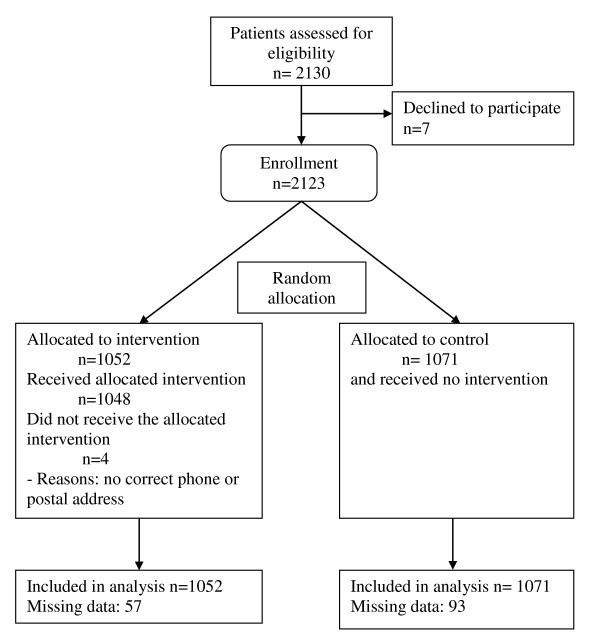
BACKGROUND: Missed appointments are known to interfere with appropriate care and to misspend medical and administrative resources. The aim of this study was to test the effectiveness of a sequential intervention reminding patients of their upcoming appointment and to identify the profile of patients missing their appointments. METHODS: We conducted a randomised controlled study in an urban primary care clinic at the Geneva University Hospitals serving a majority of vulnerable patients. All patients booked in a primary care or HIV clinic at the Geneva University Hospitals were sent a reminder 48 hrs prior to their appointment according to the following sequential intervention: 1. Phone call (fixed or mobile) reminder; 2. If no phone response: a Short Message Service (SMS) reminder; 3. If no available mobile phone number: a postal reminder. The rate of missed appointment, the cost of the intervention, and the profile of patients missing their appointment were recorded. RESULTS: 2123 patients were included: 1052 in the intervention group, 1071 in the control group. Only 61.7% patients had a mobile phone recorded at the clinic. The sequential intervention significantly reduced the rate of missed appointments: 11.4% (n = 122) in the control group and 7.8% (n = 82) in the intervention group (p < 0.005), and allowed to reallocate 28% of cancelled appointments. It also proved to be cost effective in providing a total net benefit of 1846. - EUR/3 months. A satisfaction survey conducted with 241 patients showed that 93% of them were not bothered by the reminders and 78% considered them to be useful. By multivariate analysis, the following characteristics were significant predictors of missed appointments: younger age (OR per additional decade 0.82; CI 0.71-0.94), male gender (OR 1.72; CI 1.18-2.50), follow-up appointment >1 year (OR 2.2; CI: 1.15-4.2), substance abuse (2.09, CI 1.21-3.61), and being an asylum seeker (OR 2.73: CI 1.22-6.09). CONCLUSION: A practical reminder system can significantly increase patient attendance at medical outpatient clinics. An intervention focused on specific patient characteristics could further increase the effectiveness of appointment reminders.
Overview
The claims and statistics of this paper haven’t been checked yet.
Free: it reads the open-access text and checks the first 5 claims that cite a source we can check. Create a free account to check every claim.
Integrity signals
Registry
Cites
Statistics
Figures
Verification
Claims the paper makes
The claims and statistics of this paper haven’t been checked yet.
Free: it reads the open-access text and checks the first 5 claims that cite a source we can check. Create a free account to check every claim.
Claims other papers make about this one
Each is checked against this paper’s own text: does it say what the citing paper says it does?
The cited source doesn’t support the claim as written.
In the citing paper
“Overall, the sequential reminders reduced the rate of missed appointments by 11.4%.”
From The Empirical Foundations of Telemedicine Interventions in Primary Care (2016) · cites this paper as [96]
Checked by a reasoning model — may be wrong.
Experimental — accuracy not yet measuredThe source backs part of the claim, not all of it — or backs it for a different population, condition or comparison.
In the citing paper
“Twelve percent of the patients had no phone.”
From The Empirical Foundations of Telemedicine Interventions in Primary Care (2016) · cites this paper as [96]
Experimental — accuracy not yet measuredThe cited source says what the claim attributes to it.
In the citing paper
“This reduction was statistically significant for primary care and smoking cessation appointments but not significant for human immunodeficiency virus and diet consultations.”
From The Empirical Foundations of Telemedicine Interventions in Primary Care (2016) · cites this paper as [96]
The cited source says what the claim attributes to it.
In the citing paper
“Among patients in the intervention group, 51% received a reminder on their mobile phones, 19% on fixed phone, 18% by SMS, and 10% by post.”
From The Empirical Foundations of Telemedicine Interventions in Primary Care (2016) · cites this paper as [96]
The cited source says what the claim attributes to it.
In the citing paper
“''The net financial benefit of the intervention was estimated to be e1,850 over 3 months.oncecosts linked to the intervention were deducted.''”
From The Empirical Foundations of Telemedicine Interventions in Primary Care (2016) · cites this paper as [96]
1 more claim about this paper
Create a free account to see every claim other papers make about this one.
Self-check
Percentages, sums and reported differences re-computed from the paper’s own numbers.
The self-check needs the paper’s full text.
Citations
Cites
Missed Visits and Mortality among Patients Establishing Initial Outpatient HIV Treatment
Mugavero, M. J., Lin, H., Willig, J. H., Westfall, A. O., Ulett, K. B., Routman, J. S., Abroms, S., Raper, J. L., Saag, M. S., & Allison, J. J. (2009) · Clinical Infectious Diseases · doi:10.1086/595705 · Cited by 481 · cited 1×
“Previous studies showed that overall attendance rates appear to be rather low in such populations: up to 30% of HIV infected patients scheduled for a clinic appointment never turned up for an initial evaluation [20,21] and 35% of scheduled medical appointments were not honoured in an other setting [22].”
BackgroundGardner, L. I., Metsch, L. R., Anderson-Mahoney, P., Loughlin, A. M., Rio, C. D., Strathdee, S., Sansom, S. L., Siegal, H. A., Greenberg, A. E., & Holmberg, S. D. (2005) · AIDS · doi:10.1097/01.aids.0000161772.51900.eb · Cited by 467 · cited 1×
“Previous studies showed that overall attendance rates appear to be rather low in such populations: up to 30% of HIV infected patients scheduled for a clinic appointment never turned up for an initial evaluation [20,21] and 35% of scheduled medical appointments were not honoured in an other setting [22].”
BackgroundDobkin, P. L., Civita, M. D., Paraherakis, A., & Gill, K. (2002) · Addiction · doi:10.1046/j.1360-0443.2002.00083.x · Cited by 378 · cited 1×
“Optimal attendance can reach 66 to 83% of patients enrolled in nicotine cessation program [23-25].”
BackgroundThe use of text messaging to improve attendance in primary care: a randomized controlled trial
Leong, K. C., Chen, W. S., Leong, K. W., Mastura, I., Mimi, O., Sheikh, M. A., Zailinawati, A. H., Ng, C. J., Phua, K. L., & Teng, C. L. (2006) · Family Practice · doi:10.1093/fampra/cml044 · Cited by 291 · cited 3×
“More recently, randomised controlled studies comparing SMS, phone calls and no intervention showed that SMS and phone reminders were equally effective in reducing the rate of missed appointments, SMS being more cost-effective [15,16].”
BackgroundResultGeorge, A., & Rubin, G. (2003) · Family Practice · doi:10.1093/fampra/20.2.178 · Cited by 246 · cited 1×
“Prevalence of missed appointments ranges from 5 to 55% and varies between countries, health care systems and clinical settings [3-6].”
BackgroundChen, Z.-W., Fang, L.-Z., Chen, L.-Y., & Dai, H.-L. (2008) · Journal of Zhejiang University SCIENCE B · doi:10.1631/jzus.b071464 · Cited by 231 · cited 1×
“Finally, the economic evaluation, which, proved to be economically efficient, similarly to other randomised studies testing text messaging and/or mobile phone reminders only, [2,11,16,34] was limited.”
ResultSharp, D. J., & Hamilton, W. (2001) · BMJ · doi:10.1136/bmj.323.7321.1081 · Cited by 216 · cited 2×
“Missed appointments were significantly associated with younger age, being an asylum seeker, having substance abuse problems, having a follow-up appointment after more than a year These findings are in accordance with prior studies: factors influencing missed appointments usually include patient related factors such yo…”
BackgroundResultKoshy, E., Car, J., & Majeed, A. (2008) · BMC Ophthalmology · doi:10.1186/1471-2415-8-9 · Cited by 201 · cited 2×
“Finally, the economic evaluation, which, proved to be economically efficient, similarly to other randomised studies testing text messaging and/or mobile phone reminders only, [2,11,16,34] was limited.”
BackgroundResultNeal, R. D., Hussain-Gambles, M., Allgar, V. L., Lawlor, D. A., & Dempsey, O. (2005) · BMC Family Practice · doi:10.1186/1471-2296-6-47 · Cited by 200
Predictors of outpatient medical appointment attendance among persons with HIV
Catz, S. L., Mcclure, J. B., Jones, G. N., & Brantley, P. J. (1999) · AIDS Care · doi:10.1080/09540129947983 · Cited by 192 · cited 1×
“Previous studies showed that overall attendance rates appear to be rather low in such populations: up to 30% of HIV infected patients scheduled for a clinic appointment never turned up for an initial evaluation [20,21] and 35% of scheduled medical appointments were not honoured in an other setting [22].”
Background
Research works printed but not linked: 1
- Atun AR Mohan A Uses and benefits of SMS in Healthcare Delivery 2005 Imperial College London, Centre for Health Management
Cited by
Items 101–150 of 150
Ayer, R., Poudel, K. C., Kikuchi, K., Ghimire, M., Shibanuma, A., & Jimba, M. (2021) · AIDS and Behavior · doi:10.1007/s10461-020-03122-7 · Cited by 10
The walk-in clinic model improves access to psychiatry in primary care
Kroll, D. S., Chakravartti, A., Gasparrini, K., Latham, C., Davidson, P., Byron-Burke, M., & Gitlin, D. F. (2016) · Journal of Psychosomatic Research · doi:10.1016/j.jpsychores.2016.08.003 · Cited by 7
Spanning Generations—Appointment Reminder Preferences Among Patients With Rheumatic Diseases
Gauthier, C., Lindwall, E., Davis, W., & Quinet, R. (2012) · JCR Journal of Clinical Rheumatology · doi:10.1097/rhu.0b013e3182676b6b · Cited by 8
“One study that we reviewed showed effectiveness of a sequential reminder system involving phone, SMS, and postal reminders.(6) The institution of an appointment reminder system using several different modalities and tailored to patient age may be a promising approach.”
BackgroundEvaluation of an ambulatory care pathway for patients with nitrous oxide-induced myeloneuropathy
Zaloum, S. A., Paris, A., Mair, D. C., Gutteridge, C., Ayling, R. M., Onen, B., Walton, J., Workman, A., Villanueva, N., & Noyce, A. J. (2024) · BMJ Neurology Open · doi:10.1136/bmjno-2024-000737 · Cited by 7
The use of digital solutions in alleviating the burden of IAPT’s waiting times
Jayaraajan, K., Sivananthan, A., Koomson, A., Ahmad, A., Haque, M., & Hussain, M. (2022) · International Journal of Risk & Safety in Medicine · doi:10.3233/jrs-227033 · Cited by 5
“Although IAPT offers a simple text reminder, the app uses staggered and engaging reminders as research shows that this yields better attendance [7].”
MethodRatmansky, M., Hai, N., Schlossberg, T., Mimouni-Bloch, A., & Schweiger, A. (2017) · Israel Journal of Health Policy Research · doi:10.1186/s13584-017-0132-9 · Cited by 6
Predictors of Patient Retention at a Student-Run Free Clinic
Hess, M. C., Chung, S. K., Baños, J. H., Cockrum, R. H., Wagoner, N. V., & Hoesley, C. J. (2018) · Journal of Student-Run Clinics · doi:10.59586/jsrc.v4i1.70 · Cited by 5
“13,15,17 If a patient cancelled at least once or no-showed to at least one visit in the first six months after the initial visit, she/he was significantly less likely to be retained in care.”
BackgroundPrasetyo, Y. A., Preechawong, S., & Yunibhand, J. (2015) · Journal of Health Research · Cited by 5
Promoting Sexual Health With SMS Texting Technology
Blackburn, L., & Blatnik, A. (2013) · Nursing for Women s Health · doi:10.1111/1751-486x.12074 · Cited by 6
Santos, J., Camplain, C., Pollitt, A. M., & Baldwin, J. A. (2023) · Journal of Evaluation in Clinical Practice · doi:10.1111/jep.13939 · Cited by 5
Addressing the causes of ‘missingness’ in healthcare: a co-designed suite of interventions
Lindsay, C., Baruffati, D., Mackenzie, M., Ellis, D. A., Major, M., O’Donnell, C. A., Simpson, S. A., Williamson, A. E., & Wong, G. (2026) · BMC Medicine · doi:10.1186/s12916-026-05031-3 · Cited by 4
Overbooking for physical examination considering late cancellation and set-resource relationship
Ho, T., Kung, L.-C., Huang, H.-Y., Lai, J.-F., & Chiu, H. (2021) · BMC Health Services Research · doi:10.1186/s12913-021-07148-y · Cited by 4
Chohlas-Wood, A., Coots, M., Nudell, J., Nyarko, J., Brunskill, E., Rogers, T., & Goel, S. (2025) · Science Advances · doi:10.1126/sciadv.adx7483 · Cited by 4
Omokanye, S. A., Adeleke, I. T., Adekanye, A. O., Adewale, F. B., Nwachukwu, C., & Adebisi, A. A. (2021) · International Journal of Biological and Pharmaceutical Sciences Archive · doi:10.30574/ijbpsa.2021.1.2.0035 · Cited by 4
“The after effect of missed appointment include; disruption of daily work planning of both physicians and administrative staff [8,20], interference with adequate medical care [21], time lost and decreased efficiency on the part of physicians [18] and prolonged waiting time [7].”
BackgroundImproving physical health in people with severe mental illness
Hardy, S. (2020) · Practice Nursing · doi:10.12968/pnur.2020.31.11.456 · Cited by 3
Machine Learning Approaches for Type 2 Diabetes Prediction and Care ManagementPreprint
Lim, A., Singh, A. P., Chiam, J., Eckert, C., Kumar, V., Ahmad, M. A., & Teredesai, A. M. (2021) · arXiv (Cornell University) · doi:10.48550/arxiv.2104.07820 · Cited by 4
Levine, D. M., Kakani, P., & Mehrotra, A. (2021) · npj Digital Medicine · doi:10.1038/s41746-021-00389-5 · Cited by 2
Digiusto, E., Friend, R., Batey, R. G., & Mattick, R. P. (2013) · Clinical Psychologist · doi:10.1111/cp.12007 · Cited by 2
Alfa, M. A., Zezi, A. U., Gyang, S. S., Yusuf, H., & Aliyu, I. M. (2016) · Journal of Applied Pharmaceutical Science · doi:10.7324/japs.2016.60926 · Cited by 2
“It has also been successfully used to schedule hospital appointments (Perron et al., 2011).”
Methodde Tomás, J. F. Á., Justel, F. B., & do Rosario, R. B. (2013) · FMC - Formación Médica Continuada en Atención Primaria · doi:10.1016/s1134-2072(13)70673-x · Cited by 2
Text Messaging Appointment Reminders to Reduce No-Shows: A Pilot Study
Stephenson, C. M. (2016) · UKnowledge (University of Kentucky) · Cited by 2
Pesquisa operativa para adequação das agendas num serviço de Atenção Primária
Ana, A. M. S. (2017) · Revista Brasileira de Medicina de Família e Comunidade · doi:10.5712/rbmfc12(39)1459 · Cited by 3
Garcia, P. J., Pérez‐Lu, J. E., Curioso, W. H., Cárcamo, C., & Beuermann, D. W. (2021) · Health Systems and Policy Research · doi:10.36648/2254-9137.21.s1.001 · Cited by 3
Vasyukova, N. O., Lukina, Y. V., Zvonareva, O., Петровна, В. В., Николаевна, Т. С., Дмитриева, Н. А., Lerman, O. V., Zagrebelny, A. V., Budaeva, I. V., Nekoshnova, E. S., et al. (2019) · CARDIOVASCULAR THERAPY AND PREVENTION · doi:10.15829/1728-8800-2019-6-107-112 · Cited by 1
Alakaam, A. A. H., Lemacks, J. L., & Parker, A. (2018) · Journal of Epidemiological Research · doi:10.5430/jer.v4n2p35 · Cited by 1
“8%.[18] Other intervention procedures explored the use of three different interventions: multiple phone calls and texting, patient education on the importance of attending clinic appointments, and the systematic updating of patient contact information each visit.”
BackgroundResultAppointment planning and scheduling in primary care
Hoseini, B. (2017) · Cited by 1
Bernardi, H., Albiero, J. F. G., & Helena, E. T. D. S. (2021) · Revista de Gestão em Sistemas de Saúde · doi:10.5585/rgss.v10i2.17198 · Cited by 2
Jaffer, A. (2015) · ScholarWorks (Walden University) · Cited by 1
Potgieter, J.-H. (2014) · University of the Witwatersrand, Johannesburg Institutional Repository on DSpace (University of the Witwatersrand, Johannesburg)
"Bruk av telemedisinske hjelpemidler for å redusere andel ikke-møtte til poliklinisk konsultasjon."
Kostopoulos, A. B., Comstedt, C. M., Rizvi, S. A. M., Wulff, J., Myhre, J.-I., & Thorsheim, G. E. (2011) · NORA - Norwegian Open Research Archives
Myogenous Orofacial Pain Disorders: A Retrospective Study
Gomez-Marroquin, E., Abe, Y., Padilla, M., Enciso, R., & Clark, G. T. (2020) · Journal of Anesthesiology and Pain Therapy · doi:10.29245/2768-5365/2020/3.1107
Missed Appointments by Hypertension Patients in Transitional Care: Race and Insurance Correlates
Appel, H. B., Ai, A. L., & Tingir, S. (2020) · Journal of Public Health Issues and Practices · doi:10.33790/jphip1100157
“Extant literature indicates approximately 50% of all patients miss appointments in community settings and general medical practices in the United States, and between 5-55% worldwide [2].”
BackgroundVarma, D. S., Hart, M. W., McIntyre, D. S., Kwiatkowski, E. K., & Cottler, L. B. (2018) · doi:10.2196/preprints.11011
Li, S., Ng, S. Y. M., & Lee, V. H.-F. (2022) · SSRN Electronic Journal · doi:10.2139/ssrn.4190315
Švab, I., Klemenc–Ketiš, Z., & Homar, V. (2024) · doi:10.18690/um.mf.1.2024
Tackling No-show Imbalance problems for Healthcare Appointment datasets
Wang, X., & Liu, X. (2024) · IEEE International Conference on Big Data (BigData) · doi:10.1109/bigdata62323.2024.10826019
Patient–Provider Concordance Reduces Missed Appointments in Texas Primary Care Safety-Net Clinics
Adepoju, O. E., & Dang, P. (2025) · Journal of Racial and Ethnic Health Disparities · doi:10.1007/s40615-025-02411-y
Werner, K., Alsuhaibani, S., Alsukait, R. F., Alshehri, R., Herbst, C. H., Alhajji, M., & Lin, T. K. (2023) · Figshare · doi:10.6084/m9.figshare.24425654
Overbury, R. S., Huynh, K., Bohnsack, J. F., Frech, T., & Hersh, A. O. (2021) · Figshare · doi:10.6084/m9.figshare.17110664
Werner, K., Alsuhaibani, S., Alsukait, R. F., Alshehri, R., Herbst, C. H., Alhajji, M., & Lin, T. K. (2024) · Figshare · doi:10.6084/m9.figshare.24425809
Overbury, R. S., Huynh, K., Bohnsack, J. F., Frech, T., & Hersh, A. O. (2021) · Figshare · doi:10.6084/m9.figshare.17110667
Werner, K., Alsuhaibani, S., Alsukait, R. F., Alshehri, R., Herbst, C. H., Alhajji, M., & Lin, T. K. (2024) · Figshare · doi:10.6084/m9.figshare.26630599
Barriers to Accessing Urogynecologic Care in a Federally Qualified Health Center
Brioso, X., Borneman, R., Yanes, L. I., Madein, A., Davenport, A. P., & Ringel, N. E. (2025) · Urogynecology · doi:10.1097/spv.0000000000001782
Macleod, C., Logue, C., Kumbier, K. E., Shaw, M. A., Henneman, J., Kehne, A., Jarzebowski, M., Powell, V. D., Sussman, J. B., Bohnert, A. S. B., et al. (2026) · Drug and Alcohol Dependence · doi:10.1016/j.drugalcdep.2026.113080
Racial and Socioeconomic Differences in Real-World Use of Biologic Therapy for Asthma
Littlejohn, M., Zuckerman, A. D., Gargurevich, N., Choi, L., LUBWAMA, R. N., Stanford, R. H., Campbell, C., Núñez, M., Petruski‐Ivleva, N., Tardy, A.-L., et al. (2026) · Journal of Asthma and Allergy · doi:10.2147/jaa.s587574
Rousaki, A., Jones, D. J., Dowding, D., & Gasteiger, N. (2026) · Journal of the American Medical Informatics Association · doi:10.1093/jamia/ocag112 · Cited by 1
Yadav, S., Khaliq, M. A. U., & Khan, S. (2026) · International Journal of Community Medicine and Public Health · doi:10.18203/2394-6040.ijcmph20262291
Need Assessment of Self-Management Information of People Living with HIV/AIDS
Noveyani, A. E., & Kinanthi, C. A. (2026) · Malaysian Journal of Medicine and Health Sciences · doi:10.47836/mjmhs.22.s7.13
Ernesti, Z., Lugina, E., Mwita, C. J., Tupa, F., Noah, H., Ngowi, J. R., Wood, C., Mwaiselage, J., & Lidenge, S. J. (2026) · ecancermedicalscience · doi:10.3332/ecancer.2026.2232
Lammers, K., Ekkers, W. D. J., Rommes, M., & Blanken, P. (2026) · European Addiction Research · doi:10.1159/ear/acrag009
Metadata
- Authors
- Junod Perron, N., Dominicé Dao, M., Kossovsky, M. P., Miserez, V., Chuard, C., Calmy, A., & Gaspoz, J.-M.
- Affiliations
- University Hospital of Geneva (CH)
- Venue
- BMC Family Practice
- Published
- 2010-10-25
- Volume
- 11
- Issue
- 1
- Pages
- 79-79
- ISSN
- 1471-2296 (ISSN-L)
- PMC
- PMC2984453
- OpenAlex
- W1993680757
- Semantic Scholar
- 644cf7e24e42eb7cc98b3f1f8c8d5536f311d311
- Cited by
- 150
- References
- 34
- Citations by year
- 2026: 6 · 2025: 4 · 2024: 5 · 2023: 11 · 2022: 5 · 2021: 12 · 2020: 15 · 2019: 9 · 2018: 13 · 2017: 10 · 2016: 14 · 2015: 11 · 2014: 11 · 2013: 15 · 2012: 6
- FWCI
- 11.41
- Type
- journal article
- Language
- en
- Open access
- gold
- doi.org
- Licence
- cc-by
- creativecommons.org/licenses/by/2.0 (tdm)
- Locations
- BMC Family Practice (publishedVersion, cc-by)
- PubMed Central (publishedVersion, cc-by)
- PubMed (publishedVersion)
- Archive ouverte UNIGE (University of Geneva) (acceptedVersion, other-oa)
- DOAJ (DOAJ: Directory of Open Access Journals) (submittedVersion)
- Archive ouverte UNIGE (University of Geneva) (submittedVersion, cc-by)
- Funders
- Hôpitaux Universitaires de Genève
- Topics
- Social Sciences › Decision Sciences › Management Science and Operations Research › Healthcare Operations and Scheduling Optimization
- Health Sciences › Medicine › Emergency Medicine › Emergency and Acute Care Studies
- Health Sciences › Medicine › Family Practice › Primary Care and Health Outcomes
- Keywords
- missed appointments, appointment reminders, patient attendance, primary care, SMS reminders, phone call reminders, vulnerable patients, HIV clinics, cost-effectiveness, patient satisfaction, substance abuse, asylum seekers, follow-up visits
- MeSH terms
- Adult, Appointments and Schedules, Female, Hospitals, University, Humans, Male, Middle Aged, Postal Service, Primary Health Care, Switzerland, Telephone, Reminder Systems, Patient Satisfaction, Efficiency, Organizational, Urban Health Services, Cell Phone
About these checks
Registry, retraction, Cites and statistics results are computed, not judged, with one exception: a printed reference that no index lists is read once by a model before it counts as a citation error. Claims are extracted by a model and kept only when their quote appears verbatim in the text; each cited source is then checked, with a model’s help, for whether it says what the claim relies on. Those verdicts can be wrong — read the claim’s quote and the cited source before relying on one.
Statistics and arithmetic are recomputed, not judged.
Confidence bands are shown only for fields calibrated on our annotated test set. None is calibrated yet, so no band is shown.
What counts as a claim ›How we measure confidence ›How we check this ›
Are you an author, or do you see a problem with this page? Request a review
Data sources
Bibliographic data: Semantic Scholar, OpenAlex, Crossref.
Contains information from the Semantic Scholar Academic Graph Datasets, made available under the ODC Attribution License (ODC-BY 1.0).
Semantic Scholar’s data is described in: Kinney, R., et al. (2023). The Semantic Scholar Open Data Platform. arXiv:2301.10140.
