

The DOI matches its Crossref record; 56 of the 56 references it cites were found in a registry or an index.
Ulcerative colitis and irritable bowel patients exhibit distinct abnormalities of the gut microbiota
Open accessAbstract
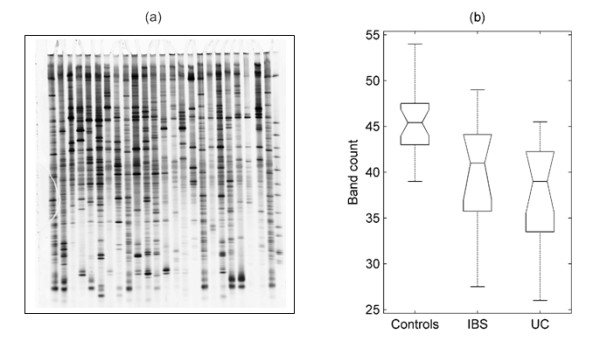
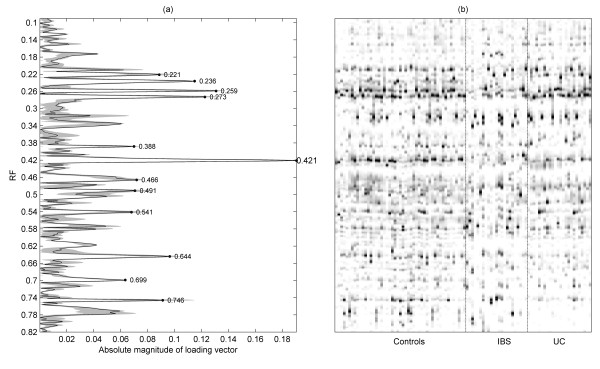
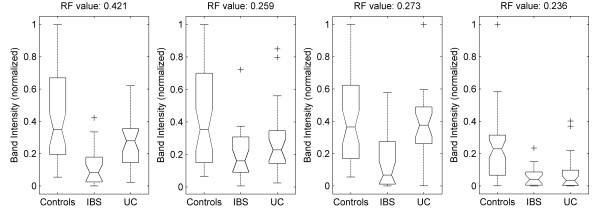
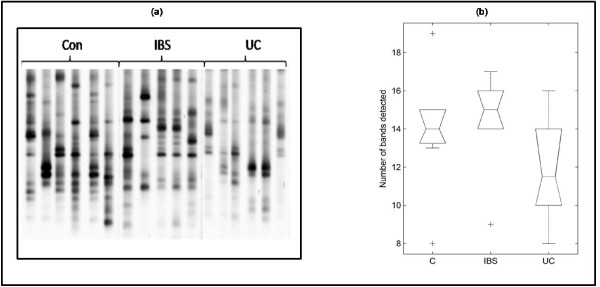
Background: Previous studies suggest a link between gut microbiota and the development of ulcerative colitis (UC) and irritable bowel syndrome (IBS). Our aim was to investigate any quantitative differences in faecal bacterial compositions in UC and IBS patients compared to healthy controls, and to identify individual bacterial species that contribute to these differences. Methods: Faecal microbiota of 13 UC patients, 11 IBS patients and 22 healthy volunteers were analysed by PCR-Denaturing Gradient Gel Electrophoresis (DGGE) using universal and Bacteroides specific primers. The data obtained were normalized using in-house developed statistical method and interrogated by multivariate approaches. The differentiated bands were excised and identified by sequencing the V3 region of the 16S rRNA genes. Results: Band profiles revealed that number of predominant faecal bacteria were significantly different between UC, IBS and control group (p < 10-4). By assessing the mean band numbers in UC (37 ± 5) and IBS (39 ± 6), compared to the controls (45 ± 3), a significant decrease in bacterial species is suggested (p = 0.01). There were no significant differences between IBS and UC. Biodiversity of the bacterial species was significantly lower in UC (μ = 2.94, σ = 0.29) and IBS patients (μ = 2.90, σ = 0.38) than controls (μ = 3.25, σ = 0.16; p = 0.01). Moreover, similarity indices revealed greater biological variability of predominant bacteria in UC and IBS compared to the controls (median Dice coefficients 76.1% (IQR 70.9 - 83.1), 73.8% (IQR 67.0 - 77.5) and 82.9% (IQR 79.1 - 86.7) respectively). DNA sequencing of discriminating bands suggest that the presence of Bacteroides vulgatus, B. ovatus, B. uniformis, and Parabacteroides sp. in healthy volunteers distinguishes them from IBS and UC patients. DGGE profiles of Bacteroides species revealed a decrease of Bacteroides community in UC relative to IBS and controls. Conclusion: Molecular profiling of faecal bacteria revealed abnormalities of intestinal microbiota in UC and IBS patients, while different patterns of Bacteroides species loss in particular, were associated with UC and IBS.
Overview
The claims and statistics of this paper haven’t been checked yet.
Run the check — free, no account needed. It reads the open-access text and checks the sources it cites.
Integrity signals
Registry
Cites
Statistics
Figures
Verification
Claims the paper makes
The claims and statistics of this paper haven’t been checked yet.
Run the check — free, no account needed. It reads the open-access text and checks the sources it cites.
Claims other papers make about this one
Each is checked against this paper’s own text: does it say what the citing paper says it does?
In the citing paper
“We also found higher relative abundances of the genera Bacteroides and Prevotella in mice with less developed mucus, bacteria that have been found to be increased also in other colitis models or patients with IBD 39, 43.”
From The composition of the gut microbiota shapes the colon mucus barrier (2015) · cites this paper as [43]
Self-check
Percentages, sums and reported differences re-computed from the paper’s own numbers.
The self-check needs the paper’s full text.
Citations
Cites
A Mathematical Theory of Communication
Shannon, C. E. (1948) · The MIT Press eBooks · doi:10.1002/j.1538-7305.1948.tb00917.x · Cited by 50,387
The Mathematical Theory of Communication
Shannon, C. E., Weaver, W., & Wiener, N. (1950) · Physics Today · doi:10.1063/1.3067010 · Cited by 9,885
Diversity of the Human Intestinal Microbial Flora
Eckburg, P. B., Bik, E. M., Bernstein, C. N., Purdom, E., Dethlefsen, L., Sargent, M., Gill, S. R., Nelson, K. E., & Relman, D. A. (2005) · Science · doi:10.1126/science.1110591 · Cited by 7,913
Frank, D. N., St. Amand, A. L., Feldman, R. A., Boedeker, E. C., Harpaz, N., & Pace, N. R. (2007) · Proceedings of the National Academy of Sciences · doi:10.1073/pnas.0706625104 · Cited by 4,611
Sokol, H., Pigneur, B., Watterlot, L., Lakhdari, O., Bermúdez-Humarán, L. G., Gratadoux, J.-J., Blugeon, S., Bridonneau, C., Furet, J.-P., Corthier, G., et al. (2008) · Proceedings of the National Academy of Sciences · doi:10.1073/pnas.0804812105 · Cited by 4,413
Mathematical Theory of Communication
Dubitzky, W., Olaf Wolkenhauer, A., Cho, K.-H., & Yokota, H. (2013) · Springer eBooks · doi:10.1007/978-1-4419-9863-7_100015 · Cited by 3,291
Coated Oral 5-Aminosalicylic Acid Therapy for Mildly to Moderately Active Ulcerative Colitis
Schroeder, K. W., Tremaine, W. J., & Ilstrup, D. M. (1987) · New England Journal of Medicine · doi:10.1056/nejm198712243172603 · Cited by 3,037
Reduced diversity of faecal microbiota in Crohn’s disease revealed by a metagenomic approach
Manichanh, C., Rigottier-Gois, L., Bonnaud, E., Gloux, K., Pelletier, E., Frangeul, L., Nalin, R., Jarrin, C., Chardon, P., Marteau, P., et al. (2006) · Gut · doi:10.1136/gut.2005.073817 · Cited by 2,277
Inflammatory bowel disease: Etiology and pathogenesis
Fiocchi, C. (1998) · Gastroenterology · doi:10.1016/s0016-5085(98)70381-6 · Cited by 2,059
Microbial Influences in Inflammatory Bowel Diseases
Sartor, R. B. (2008) · Gastroenterology · doi:10.1053/j.gastro.2007.11.059 · Cited by 1,927
Cited by
Sorted by citations
Cryan, J. F., O'Riordan, K. J., Cowan, C. S. M., Sandhu, K. V., Bastiaanssen, T. F. S., Boehme, M., Codagnone, M. G., Cussotto, S., Fulling, C., Golubeva, A. V., et al. (2019) · Physiological Reviews · doi:10.1152/physrev.00018.2018 · Cited by 5,286
Manichanh, C., Borruel, N., Casellas, F., & Guarner, F. (2012) · Nature Reviews Gastroenterology & Hepatology · doi:10.1038/nrgastro.2012.152 · Cited by 1,160
Intestinal microbiota in functional bowel disorders: a Rome foundation report
Simrén, M., Barbara, G., Flint, H. J., Spiegel, B. M. R., Spiller, R. C., Vanner, S., Verdu, E. F., Whorwell, P. J., & Zoetendal, E. G. (2013) · Gut · doi:10.1136/gutjnl-2012-302167 · Cited by 939
An irritable bowel syndrome subtype defined by species-specific alterations in faecal microbiota
Jeffery, I. B., O'Toole, P. W., Öhman, L., Claesson, M. J., Deane, J., Quigley, E. M. M., & Simrén, M. (2012) · Gut · doi:10.1136/gutjnl-2011-301501 · Cited by 835
Dewulf, E. M., Cani, P. D., Claus, S. P., Fuentes, S., Puylaert, P. G., Neyrinck, A. M., Bindels, L. B., de Vos, W. M., Gibson, G. R., Thissen, J.-P., et al. (2013) · Gut · doi:10.1136/gutjnl-2012-303304 · Cited by 825
Metadata
- Authors
- Noor, S. O., Ridgway, K., Scovell, L., Kemsley, E. K., Lund, E. K., Jamieson, C., Johnson, I. T., & Narbad, A.
- Affiliations
- Norwich Research Park (GB)
- Norfolk and Norwich University Hospital (GB)
- Corresponding author
- Narbad, Arjan
- Venue
- BMC Gastroenterology
- Published
- 2010-11-12
- Volume
- 10
- Issue
- 1
- Pages
- 134-134
- ISSN
- 1471-230X (ISSN-L)
- PMC
- PMC3002299
- OpenAlex
- W2086580205
- Cited by
- 227
- References
- 56
- Citations by year
- 2026: 4 · 2025: 7 · 2024: 12 · 2023: 15 · 2022: 10 · 2021: 12 · 2020: 17 · 2019: 22 · 2018: 16 · 2017: 6 · 2016: 15 · 2015: 27 · 2014: 23 · 2013: 15 · 2012: 15
- FWCI
- 5.35
- Type
- journal article
- Language
- en
- Open access
- gold
- doi.org
- Locations
- BMC Gastroenterology (publishedVersion, cc-by)
- Europe PMC (PubMed Central) (publishedVersion, cc-by)
- PubMed Central (publishedVersion, cc-by)
- PubMed (publishedVersion)
- DOAJ (DOAJ: Directory of Open Access Journals) (submittedVersion)
- UEA Digital Repository (University of East Anglia) (submittedVersion)
- Funders
- Biotechnology and Biological Sciences Research Council
- Topics
- Life Sciences › Biochemistry, Genetics and Molecular Biology › Molecular Biology › Gut microbiota and health
- Health Sciences › Medicine › Gastroenterology › Inflammatory Bowel Disease
- Health Sciences › Medicine › Gastroenterology › Gastrointestinal motility and disorders
- Keywords
- ulcerative colitis, irritable bowel syndrome, gut microbiota, Bacteroides, Bacteroides vulgatus, Bacteroides ovatus, Bacteroides uniformis, Parabacteroides, bacterial diversity, 16S rRNA gene sequencing, PCR-DGGE, inflammatory bowel disease, dysbiosis
- MeSH terms
- Adult, Bacteroides, Colitis, Ulcerative, Feces, Female, Humans, Male, Middle Aged, Multivariate Analysis, Case-Control Studies, Polymerase Chain Reaction, Gastrointestinal Tract, Irritable Bowel Syndrome, Young Adult, Denaturing Gradient Gel Electrophoresis, Molecular Typing
About these checks
Registry, retraction, Cites and statistics results are computed, not judged, with one exception: a printed reference that no index lists is read once by a model before it counts as a citation error. Claims are extracted by a model and kept only when their quote appears verbatim in the text; each cited source is then checked, with a model’s help, for whether it says what the claim relies on. Those verdicts can be wrong — read the claim’s quote and the cited source before relying on one.
Statistics and arithmetic are recomputed, not judged.
Confidence bands are shown only for fields calibrated on our annotated test set. None is calibrated yet, so no band is shown.
What counts as a claim ›How we measure confidence ›How we check this ›
Are you an author, or do you see a problem with this page? Request a review
