

Stromal regulatory T-cells are associated with a favourable prognosis in gastric cancer of the cardia
Open accessThe DOI matches its Crossref record; 31 of the 31 references it cites were found in a registry or an index.
Abstract
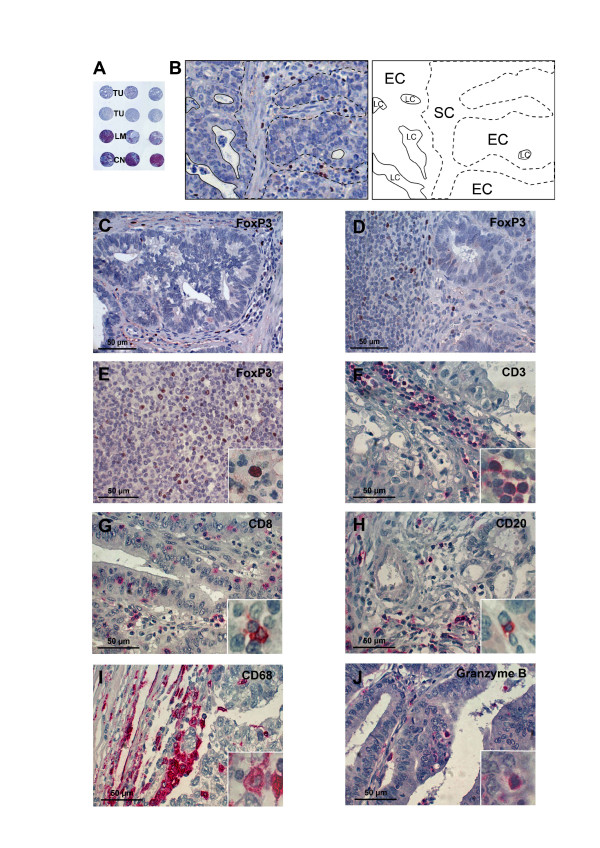
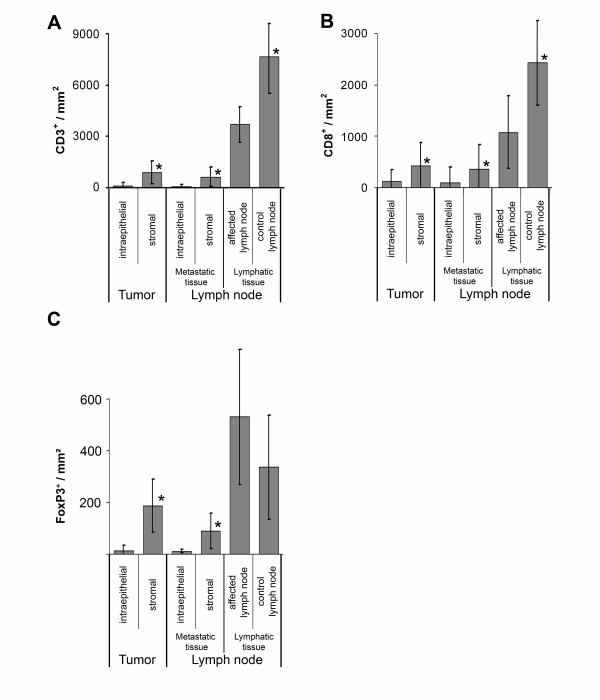
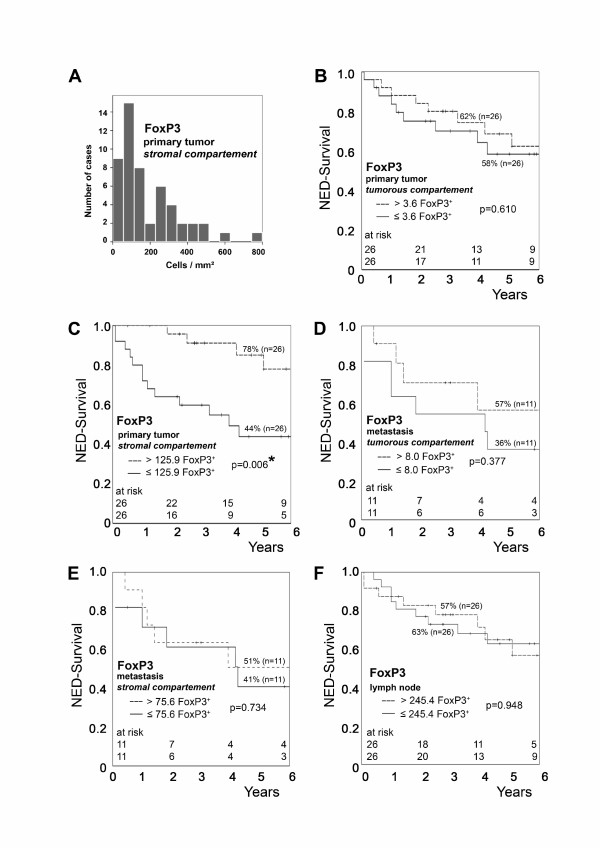
Background: Recent evidence suggests that CD4+CD25+FoxP3+ regulatory T-cells (Treg) may be responsible for the failure of host anti-tumour immunity by suppressing cytotoxic T- cells. We assessed the prognostic significance of tumour infiltrating lymphocytes (TIL) in intestinal-type gastric cardiac cancer. Methods: Tumour infiltrating lymphocyte (TIL) subsets and tumour infiltrating macrophages (TIM) were investigated in 52 cases using tissue microarrays. The interrelationship between the cell populations (CD3+, CD8+, CD20+, CD68+, GranzymeB+, FoxP3+) in different compartments and NED-survival was investigated (median follow-up time: 61 months). Results: Intraepithelial infiltration with TIL and TIM including Treg was generally low and not related to NED-survival. However, patients with large numbers of FoxP3+ Treg in the tumour stroma (>125.9 FoxP3+TILs/mm 2) had a median survival time of 58 months while those with low FoxP3+ TIL counts (<125.9 FoxP3+TILs/mm 2) had a median survival time of 32 months (p = 0.006). Patients with high versus low stromal CD68+/FoxP3+ cell ratios in primary tumour displayed median survivals of 32 and 55 months, respectively (p = 0.008). Conclusion: Our results suggest that inflammatory processes within the tumour stroma of gastric intestinal-type adenocarcinomas located at the gastric cardia may affect outcome in two ways. Tumour-infiltrating macrophages are likely to promote carcinogenesis while large numbers of Treg are associated with improved outcome probably by inhibiting local inflammatory processes promoting carcinogenesis. Thus, inhibition of Treg may not be a feasible treatment option in gastric adenocarcinoma.
Overview
The claims and statistics of this paper haven’t been checked yet.
Free: it reads the open-access text and checks the first 5 claims that cite a source we can check. Create a free account to check every claim.
Integrity signals
Registry
Cites
Statistics
Figures
Verification
Claims the paper makes
The claims and statistics of this paper haven’t been checked yet.
Free: it reads the open-access text and checks the first 5 claims that cite a source we can check. Create a free account to check every claim.
Claims other papers make about this one
Each is checked against this paper’s own text: does it say what the citing paper says it does?
The cited source says what the claim attributes to it.
In the citing paper
“Studies on various types of malignant tumors, such as CRC, HNSCC, and gastric cancer (GC), have shown a positive correlation between Tregs infiltration and prolonged survival of cancer patients [16, 18, 20, 34, 35].”
From Potential anti-tumor effects of regulatory T cells in the tumor microenvironment: a review (2024) · cites this paper as [34]
Self-check
Percentages, sums and reported differences re-computed from the paper’s own numbers.
The self-check needs the paper’s full text.
Citations
Cites
Nonparametric Estimation from Incomplete Observations
Kaplan, E. L., & Meier, P. (1992) · Springer Series in Statistics · doi:10.1007/978-1-4612-4380-9_25 · Cited by 45,181
Nonparametric Estimation from Incomplete Observations
Kaplan, E. L., & Meier, P. (1958) · Journal of the American Statistical Association · doi:10.1080/01621459.1958.10501452 · Cited by 39,158
Curiel, T. J., Coukos, G., Zou, L., Alvarez, X., Cheng, P., Mottram, P., Evdemon-Hogan, M., Conejo-Garcia, J. R., Zhang, L., Burow, M., et al. (2004) · Nature Medicine · doi:10.1038/nm1093 · Cited by 5,151 · cited 3×
“In ovarian carcinoma both intratumoural CD3 and CD8 TIL were associated with improved survival [7,8] while Treg were identified as a significant negative prognostic factor [9].”
BackgroundResultIntratumoral T Cells, Recurrence, and Survival in Epithelial Ovarian Cancer
Zhang, L., Conejo-Garcia, J. R., Katsaros, D., Gimotty, P. A., Massobrio, M., Regnani, G., Makrigiannakis, A., Gray, H., Schlienger, K., Liebman, M. N., et al. (2003) · New England Journal of Medicine · doi:10.1056/nejmoa020177 · Cited by 3,397 · cited 2×
“In ovarian carcinoma both intratumoural CD3 and CD8 TIL were associated with improved survival [7,8] while Treg were identified as a significant negative prognostic factor [9].”
BackgroundResultSato, E., Olson, S. H., Ahn, J., Bundy, B., Nishikawa, H., Qian, F., Jungbluth, A. A., Frosina, D., Gnjatic, S., Ambrosone, C., et al. (2005) · Proceedings of the National Academy of Sciences · doi:10.1073/pnas.0509182102 · Cited by 2,372
Regulatory T Cells in Autoimmmunity
Shevach, E. M. (2000) · Annual Review of Immunology · doi:10.1146/annurev.immunol.18.1.423 · Cited by 1,236
Salama, P., Phillips, M., Grieu, F., Morris, M., Zeps, N., Joseph, D., Platell, C., & Iacopetta, B. (2009) · Journal of Clinical Oncology · doi:10.1200/jco.2008.18.7229 · Cited by 991
Bland, J. M., & Altman, D. G. (2004) · BMJ · doi:10.1136/bmj.328.7447.1073 · Cited by 928
Inflammation, atrophy, and gastric cancer
Fox, J. G., & Wang, T. C. (2007) · Journal of Clinical Investigation · doi:10.1172/jci30111 · Cited by 772
Balkwill, F., & Coussens, L. M. (2004) · Nature · doi:10.1038/431405a · Cited by 627
Cited by
Items 101–169 of 169
Kim, H., Heo, Y. J., Cho, Y. A., Kang, S. Y., Ahn, S., & Kim, K. (2021) · Clinical & Translational Oncology · doi:10.1007/s12094-021-02714-6 · Cited by 21
Role of LAP+CD4+T cells in the tumor microenvironment of colorectal cancer
Zhong, W., Jiang, Z., Zhang, L., Huang, J., Wang, S.-J., Liao, C., Cai, B., Chen, L.-S., Zhang, S., Guo, Y., et al. (2017) · World Journal of Gastroenterology · doi:10.3748/wjg.v23.i3.455 · Cited by 19
Lee, B., Hutchinson, R. A., Wong, H., Tie, J., Putoczki, T. L., Tran, B., Gibbs, P., & Christie, M. (2017) · Seminars in Cancer Biology · doi:10.1016/j.semcancer.2017.12.009 · Cited by 18
T-regulatory lymphocytes in peripheral blood of gastric and colorectal cancer patients
Szczepanik, A., Siedlar, M., Sierzega, M., Goroszeniuk, D., Bukowska-Strakova, K., Czupryna, A., & Kulig, J. (2011) · World Journal of Gastroenterology · doi:10.3748/wjg.v17.i3.343 · Cited by 16
Microbiota in digestive cancers: our new partner?
Lopez, A., Hansmannel, F., Kökten, T., Bronowicki, J., Melhem, H., Sokol, H., & Peyrin‐Biroulet, L. (2017) · Carcinogenesis · doi:10.1093/carcin/bgx087 · Cited by 16
Liu, H., Li, Z., Han, X., Li, Z., Zhao, Y., Liu, F., Zhu, Z., Lv, Y., Liu, Z., & Zhang, N. (2022) · Critical Reviews in Oncology/Hematology · doi:10.1016/j.critrevonc.2022.103893 · Cited by 16
Regulatory T cells in liver metastases: emerging and divergent roles in tumour progression
Wu, G., Yang, T., Gholami, S., DePeralta, D. K., Weiss, M. J., Deng, M., Wang, P., & Huang, H. (2025) · eGastroenterology · doi:10.1136/egastro-2025-100257 · Cited by 15
Rocha, S., Basto, A. P., Ijsselsteijn, M. E., Teles, S. P., Azevedo, M. M., Gonçalves, G., Gullo, I., Almeida, G. M., Maqueda, J. J., Oliveira, M. I., et al. (2021) · Cancers · doi:10.3390/cancers13030421 · Cited by 14
Can Tissue-Based Immune Markers be Used for Studying the Natural History of Cancer?
Koshiol, J. E., & Lin, S. (2012) · Annals of Epidemiology · doi:10.1016/j.annepidem.2012.03.001 · Cited by 14
T Cell Density and Location Can Influence the Prognosis of Ovarian Cancer
Al‐Attar, A., Shehata, M., Durrant, L. G., Moseley, P. M., Deen, S., & Chan, S. Y. T. (2009) · Pathology & Oncology Research · doi:10.1007/s12253-009-9230-5 · Cited by 14
Immune Suppression in Tumors as a Surmountable Obstacle to Clinical Efficacy of Cancer Vaccines
Wieërs, G., Demotte, N., Godelaine, D., & van der Bruggen, P. (2011) · Cancers · doi:10.3390/cancers3032904 · Cited by 13
Won, K. Y., Kim, H. K., Kim, G. Y., Song, M. J., & Lim, S. (2020) · Pathology - Research and Practice · doi:10.1016/j.prp.2020.153003 · Cited by 12
Understanding and Targeting Human Cancer Regulatory T Cells to Improve Therapy
Kolb, H. R., Borcherding, N. C., & Zhang, W. (2021) · Advances in experimental medicine and biology · doi:10.1007/978-981-15-6407-9_12 · Cited by 12
Song, M. J., Park, S., & Won, K. Y. (2020) · Pathology - Research and Practice · doi:10.1016/j.prp.2020.152927 · Cited by 12
Tumour-infiltrating lymphocytes in cancer: implications for the diagnostic pathologist
Simonson, W. T. N., & Allison, K. H. (2010) · Diagnostic histopathology · doi:10.1016/j.mpdhp.2010.10.006 · Cited by 12
Khalil, R. G., Mohammed, D. A., Hamdalla, H. M., & Ahmed, O. M. (2024) · Cytokine · doi:10.1016/j.cyto.2024.156834 · Cited by 12
The Interface of Cancer, Their Microenvironment and Nanotechnology
Roque, N. R., Matias, D., Bal鏰-Silva, J., Ferrer, V. P., Pessoa, L. S., & Spohr, T. C. L. D. S. E. (2022) · ONCOLOGIE · doi:10.32604/oncologie.2022.024035 · Cited by 11
Muhammad, F. A., Shareef, A., Jyothi, S. R., Kumar, S., Chauhan, A. S., Gautam, A., Джамшедовна, А. М., Sameer, H. N., Yaseen, A., Athab, Z. H., et al. (2025) · Immunological Investigations · doi:10.1080/08820139.2025.2529970 · Cited by 10
Heo, Y. J., Lee, T., Byeon, S., Kim, E. J., Shin, H. C., Kim, B., Kang, S. Y., Ha, S. Y., & Kim, K. (2020) · The Journal of Pathology Clinical Research · doi:10.1002/cjp2.179 · Cited by 10
Perrot‐Applanat, M., Pimpie, C., Vacher, S., Bièche, I., Pocard, M. D., & Baud, V. (2022) · Biomedicines · doi:10.3390/biomedicines10020240 · Cited by 10
Göbel, H. H., Büttner-Herold, M. J., Fuhrich, N., Aigner, T. G., Grabenbauer, G. G., & Distel, L. V. (2020) · Radiotherapy and Oncology · doi:10.1016/j.radonc.2020.02.003 · Cited by 10
Self-citationPoureau, P.-G., & Metges, J. (2021) · ONCOLOGIE · doi:10.32604/oncologie.2021.15525 · Cited by 9
Wang, L., Zhou, D., Ren, H., & Chen, Y. (2018) · Oncology Letters · doi:10.3892/ol.2018.8361 · Cited by 9
Zhang, Z., Liu, C., Liang, T., Yu, C., Qin, Z., Zhou, X., Xue, J., Zeng, H., Lu, Z., Xu, G., et al. (2020) · Medicine · doi:10.1097/md.0000000000023251 · Cited by 8
Han, J., Yin, H., He, T., He, J., Jiang, Z., Chen, Q., Xu, Z., Xie, Y., Xu, Y., Wang, H., et al. (2025) · Advanced Science · doi:10.1002/advs.202500806 · Cited by 8
Immunohistochemical analysis of FoxP3+ regulatory T cells in lower lip squamous cell carcinomas
FILHO, F. A. P. D. C., de Aguiar, M. C. F., de Souza, L. B., Pinto, L. P., Godoy, G. P., Alves, P. M., & Nonaka, C. F. W. (2016) · Brazilian Oral Research · doi:10.1590/1807-3107bor-2016.vol30.0130 · Cited by 8
Johnson, M. J., Sumstad, D., Folsom, T. D., Slipek, N. J., DeFeo, A. P., Growe, M., Kadidlo, D. M., Thyagarajan, B., Starr, T. K., Lou, E., et al. (2025) · Cytotherapy · doi:10.1016/j.jcyt.2025.06.007 · Cited by 7
Singh, P., SOUZA, P. D., Scott, K. F., Hall, B. M., Verma, N. D., Becker, T. M., Toh, J. W. T., Sajinovic, M., & Spring, K. J. (2019) · Translational Medicine Communications · doi:10.1186/s41231-019-0032-9 · Cited by 6
Liu, X., Guo, Y., Huang, C., Xu, D., Zhu, C., Xu, J., Zhang, Z., Shen, Y., Zhao, W., & Zhao, G. (2020) · PubMed Central · Cited by 6
Exploring BIRC family genes as prognostic biomarkers and therapeutic targets in prostate cancer
Yu, X., Liu, Y., Mo, Z.-M., Luo, R.-J., & Chen, W.-K. (2025) · Discover Oncology · doi:10.1007/s12672-025-02002-7 · Cited by 6
Mucosal Macrophages in Defense and Regulation
Smythies, L. E., Denning, T. L., & Smith, P. D. (2015) · Elsevier eBooks · doi:10.1016/b978-0-12-415847-4.00026-4 · Cited by 4
Lee, K. H., Kim, E. Y., Park, Y. L., Do, S., Chae, S. W., & Park, C. H. (2017) · Tumor Biology · doi:10.1177/1010428317710575 · Cited by 4
Evaluation of Inflammatory Cells (Tumor Infiltrating Lymphocytes) in Solid Tumors
Dundr, P., Němejcová, K., Bártů, M., Matěj, R., Rohan, Z., & Tichá, I. (2017) · Klinicka onkologie · doi:10.14735/amko20173s10 · Cited by 4
Kalamohan, K., Rathinam, D., Panneerpandian, P., & Ganesan, K. (2017) · Cancer Immunology and Immunotherapy · doi:10.1007/s00262-017-1998-7 · Cited by 3
Han, S., & Ju, M. H. (2024) · Journal of Immunology Research · doi:10.1155/2024/4468145 · Cited by 3
Multifaceted function of B cells in tumorigenesis
Kang, N., Duan, Q., Min, X., Li, T., Li, Y., Gao, J., & Liu, W. (2025) · Frontiers of Medicine · doi:10.1007/s11684-025-1127-5 · Cited by 3
PD1 and PD-L1 Immune Checkpoint Inhibitors in Gastrointestinal Cancer
Pectasides, E., & McDermott, D. F. (2017) · Springer eBooks · doi:10.1007/978-3-319-43063-8_6 · Cited by 2
Wang, G., Huangfu, L., Gao, X.-Y., Gan, X., Xing, X., & Ji, J. (2022) · Frontiers in Oncology · doi:10.3389/fonc.2022.887244 · Cited by 2
T Cell and Antigen-Presenting Cell Subsets in the Tumor Microenvironment
Wilke, C. M., Wei, S., Wang, L., Kryczek, I., Fang, J., Wang, G., & Zou, W. (2012) · Springer eBooks · doi:10.1007/978-1-4614-4732-0_2 · Cited by 2
Mei, W., Liu, S., Wei, M., Xin, S., & Liu, X. (2025) · CytoJournal · doi:10.25259/cytojournal_44_2025 · Cited by 2
Folsom, T. D., Moriarity, B. S., Starr, T. K., Lou, E., & Webber, B. R. (2023) · Elsevier eBooks · doi:10.1016/b978-0-12-822620-9.00005-7 · Cited by 1
Prediction of gastric cancer prognosis in the next-generation sequencing era
Cai, H., Hou, X., Ding, Y., Fu, Z., Wang, L., & Du, Y. (2019) · Traditional Medicine and Modern Medicine · doi:10.1142/s2575900019300029 · Cited by 1
Montalli, V. Â. M., Passador‐Santos, F., Soares, A. B., Martinez, E. F., Rodrigues, D. B. R., de Araújo, V. C., & Napimoga, M. H. (2018) · InterAmerican Journal of Medicine and Health · doi:10.31005/iajmh.v1i1.25 · Cited by 1
The Immunosuppressive Role of Edn3/Ednrb Signaling in the Melanoma Microenvironment
de Freitas, J. T. (2019) · FIU - Digital Commons (Florida International University) · doi:10.25148/etd.fidc007654
Cytokine fusion proteins for solid tumor therapy: mechanistic insights and clinical advances
Wang, Y., Zheng, J., Li, Z., Qu, J., Ren, Y., Cai, Z., Li, Y., Sun, W., Jiang, N., Cai, C., et al. (2026) · Journal of Hematology & Oncology · doi:10.1186/s13045-026-01842-2
The role of POPX2 in the regulation of hippo pathway
Muhammad, B. R. (2018) · doi:10.32657/10220/46579
Halvorsen, E. C. (2018) · cIRcle (University of British Columbia) · doi:10.14288/1.0364674
Immune Targets in Colorectal Cancer
Dariya, B., & Nagaraju, G. P. (2020) · Diagnostics and therapeutic advances in GI malignancies · doi:10.1007/978-981-15-6487-1_12
Foxp3+ Treg cells in gastric cancer: recent progress
巫晓龙, & 夏冬 (2015) · 中国普通外科杂志 · doi:10.3978/pw.v24i10.4140
Tumormikroenvironment in Neuroendokrinen Tumoren (NET) des gastroenteropankreatischen Systems
Skupin, J. (2013) · eDiss (Georg-August-Universität Göttingen) · doi:10.53846/goediss-4201
L'IL-2 et l'IL-15 façonnent le développement thymique des lymphocytes T régulateurs
Apert, C. (2019) · theses.fr (ABES) · doi:10.70675/a73c4691z51bfz4cb1zb586zcec2c4a9c4ff
Rôle des lymphocytes T CD4+ régulateurs dans la suppression des réponses immunitaires anti-tumorales
Pommier, A. (2012) · theses.fr (ABES) · doi:10.70675/ee403b42z6244z4834z866dz96644b13ba11
The role of immune tolerance in tumor escape to immunosurveillance
Miranda, S. (2017) · Portuguese National Funding Agency for Science, Research and Technology (RCAAP Project by FCT) · doi:10.34626/9abf-m193
Wang, L., Cao, Y., Ren, Y., Zhang, Y., & Wang, L. (2026) · Cancer Medicine · doi:10.1002/cam4.71897
Wand, M.-T. (2020) · OPUS FAU (Kooperativer Bibliotheksverbund Berlin-Brandenburg (KOBV), on behalf of the Universitätsbibliothek Erlangen-Nürnberg)
Dutta, S. (2013) · Enlighten: Theses (The University of Glasgow)
Der Einfluss von Entzündungszellen auf die Prognose von Patienten mit Kardiakarzinomen des Magens
Schindler, A. (2012) · OPUS Repository (Kooperativer Bibliotheksverbund Berlin-Brandenburg)
Modern concepts of factors for gastric cancer progression
Senchukova, M. A., & Ryabov, А. B. (2016) · P A Herzen Journal of Oncology · doi:10.17116/onkolog20165182-87
HATOGAI, K. (2017) · Institutional Repositories DataBase (IRDB) · doi:10.20776/103747
Tahira, U. Q., Ara, J., Edib, F., Ahmed, S., Rahman, S., Gupta, S. D., & Begum, S. (2026) · Journal of Chittagong Medical College Teachers Association · doi:10.3329/jcmcta.v36i2.86918
Reuter, L. V. (2014) · mediaTUM (Technical University of Munich)
Biglycan Overexpression Predicts Poor Prognosis of Gastric CancerPreprint
Huang, X., Chen, H., Song, W.-M., Wang, Y.-Y., Zhou, M., Zhao, H., Li, N., Zheng, B., Gong, Q., Liu, K.-B., et al. (2021) · Research Square · doi:10.21203/rs.3.rs-419860/v1
Brunner, M. (2010) · OPUS FAU (Kooperativer Bibliotheksverbund Berlin-Brandenburg (KOBV), on behalf of the Universitätsbibliothek Erlangen-Nürnberg)
Immunologische Phänomene lokaler Strahlentherapie
Sage, E. K., Geinitz, H., & München, T. U. (2017) · mediaTUM (Technical University of Munich)
Wang, G.-J., Huangfu, L.-T., Gao, X.-Y., Gan, X.-J., Xing, X.-F., & Ji, J.-F. (2022) · doi:10.3389/fonc.2022.887244.s001
Metadata
- Authors
- Haas, M., Dimmler, A., Hohenberger, W., Grabenbauer, G. G., Niedobitek, G., & Distel, L. V.
- Affiliations
- Friedrich-Alexander-Universität Erlangen-Nürnberg (DE)
- Corresponding author
- Niedobitek, Gerald
- Venue
- BMC Gastroenterology
- Published
- 2009-09-04
- Volume
- 9
- Issue
- 1
- Pages
- 65-65
- ISSN
- 1471-230X (ISSN-L)
- PMC
- PMC2749861
- OpenAlex
- W1996965524
- Semantic Scholar
- 0c267c401f5afaa7e9cb33182856689ba39c1344
- Cited by
- 154
- References
- 31
- Citations by year
- 2026: 1 · 2025: 7 · 2024: 6 · 2023: 2 · 2022: 8 · 2021: 9 · 2020: 12 · 2019: 9 · 2018: 12 · 2017: 16 · 2016: 16 · 2015: 11 · 2014: 7 · 2013: 9 · 2012: 13
- FWCI
- 8.16
- Type
- journal article
- Language
- en
- Open access
- gold
- doi.org
- Licence
- Locations
- BMC Gastroenterology (publishedVersion, cc-by)
- PubMed Central (publishedVersion, cc-by)
- PubMed (publishedVersion)
- DOAJ (DOAJ: Directory of Open Access Journals) (submittedVersion)
- Topics
- Health Sciences › Medicine › Oncology › Gastric Cancer Management and Outcomes
- Life Sciences › Immunology and Microbiology › Immunology › T-cell and B-cell Immunology
- Life Sciences › Immunology and Microbiology › Immunology › Immune cells in cancer
- Keywords
- regulatory T cells, Foxp3, gastric cardia cancer, tumor stroma, tumor-infiltrating lymphocytes, tumour-infiltrating macrophages, CD68, prognostic factors, survival, intestinal-type gastric adenocarcinoma, antitumor immunity, tumor microenvironment
- MeSH terms
- Adenocarcinoma, Aged, Cardia, Humans, Lymph Nodes, Lymphatic Metastasis, Lymphocytes, Macrophages, Middle Aged, Prognosis, Retrospective Studies, Stomach Neoplasms, Multivariate Analysis, Stromal Cells, T-Lymphocytes, Regulatory, Forkhead Transcription Factors, Kaplan-Meier Estimate
About these checks
Registry, retraction, Cites and statistics results are computed, not judged, with one exception: a printed reference that no index lists is read once by a model before it counts as a citation error. Claims are extracted by a model and kept only when their quote appears verbatim in the text; each cited source is then checked, with a model’s help, for whether it says what the claim relies on. Those verdicts can be wrong — read the claim’s quote and the cited source before relying on one.
Statistics and arithmetic are recomputed, not judged.
Confidence bands are shown only for fields calibrated on our annotated test set. None is calibrated yet, so no band is shown.
What counts as a claim ›How we measure confidence ›How we check this ›
Are you an author, or do you see a problem with this page? Request a review
Data sources
Bibliographic data: Semantic Scholar, OpenAlex, Crossref.
Contains information from the Semantic Scholar Academic Graph Datasets, made available under the ODC Attribution License (ODC-BY 1.0).
Semantic Scholar’s data is described in: Kinney, R., et al. (2023). The Semantic Scholar Open Data Platform. arXiv:2301.10140.
