

Deferiprone targets aconitase: Implication for Friedreich's ataxia treatment
Open accessThe DOI matches its Crossref record; 17 of the 17 references it cites were found in a registry or an index.
Abstract
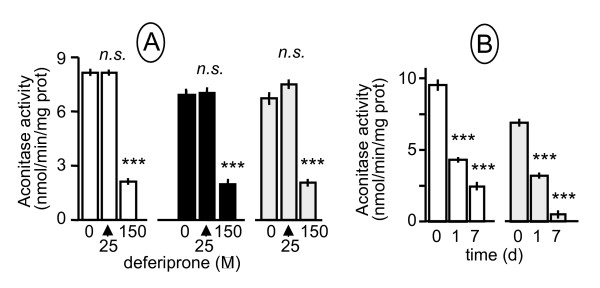
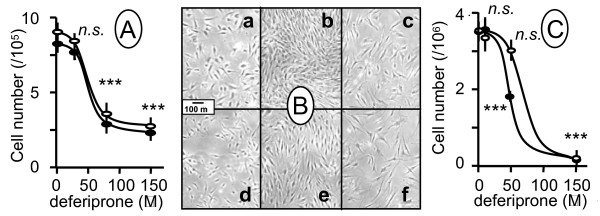
Background: Friedreich ataxia is a neurological disease originating from an iron-sulfur cluster enzyme deficiency due to impaired iron handling in the mitochondrion, aconitase being particularly affected. As a mean to counteract disease progression, it has been suggested to chelate free mitochondrial iron. Recent years have witnessed a renewed interest in this strategy because of availability of deferiprone, a chelator preferentially targeting mitochondrial iron. Method: Control and Friedreich's ataxia patient cultured skin fibroblasts, frataxin-depleted neuroblastoma-derived cells (SK-N-AS) were studied for their response to iron chelation, with a particular attention paid to iron-sensitive aconitase activity. Results: We found that a direct consequence of chelating mitochondrial free iron in various cell systems is a concentration and time dependent loss of aconitase activity. Impairing aconitase activity was shown to precede decreased cell proliferation. Conclusion: We conclude that, if chelating excessive mitochondrial iron may be beneficial at some stage of the disease, great attention should be paid to not fully deplete mitochondrial iron store in order to avoid undesirable consequences.
Overview
The claims and statistics of this paper haven’t been checked yet.
Free: it reads the open-access text and checks the first 5 claims that cite a source we can check. Create a free account to check every claim.
Integrity signals
Registry
Cites
Statistics
Figures
Verification
Claims the paper makes
The claims and statistics of this paper haven’t been checked yet.
Free: it reads the open-access text and checks the first 5 claims that cite a source we can check. Create a free account to check every claim.
Claims other papers make about this one
Each is checked against this paper’s own text: does it say what the citing paper says it does?
In the citing paper
“appropriate iron chelation may have therapeutic benefits”
Self-check
Percentages, sums and reported differences re-computed from the paper’s own numbers.
The self-check needs the paper’s full text.
Citations
Cites
Friedreich's Ataxia: Autosomal Recessive Disease Caused by an Intronic GAA Triplet Repeat Expansion
Campuzano, V., Montermini, L., Moltò, M. D., Pianese, L., Cossée, M., Cavalcanti, F., Monros, E., Rodius, F., Duclos, F., Monticelli, A., et al. (1996) · Science · doi:10.1126/science.271.5254.1423 · Cited by 2,786 · cited 1×
“It originates from a triplet expansion in the first intron of the gene coding for frataxin and the resulting impaired transcription causes depletion of this mitochondrial protein [1].”
BackgroundHentze, M. W., & Kühn, L. C. (1996) · Proceedings of the National Academy of Sciences · doi:10.1073/pnas.93.16.8175 · Cited by 1,292 · cited 1×
“Indeed, while the activity of the mitochondrial enzyme is determinant for the metabolic flux through the tricarboxylic acid in the mitochondria [4], the cytosolic counterpart of the aconitase is known to tightly regulate the overall iron metabolism of mammal cells [5].”
BackgroundAconitase and mitochondrial iron–sulphur protein deficiency in Friedreich ataxia
Rötig, A., de Lonlay, P., Chretien, D., Foury, F., Koenig, M., Sidi, D., Munnich, A., & Rustin, P. (1997) · Nature Genetics · doi:10.1038/ng1097-215 · Cited by 991 · cited 2×
“In keeping with this, aco-nitase was found severely affected in Friedreich ataxia and its residual activity might be a crucial issue to determine the course of the disease [3].”
BackgroundMethodInfluentialSelf-citationSelective iron chelation in Friedreich ataxia: biologic and clinical implications
Boddaert, N., Le Quan Sang, K. H., Rötig, A., Leroy-Willig, A., Gallet, S., Brunelle, F., Sidi, D., Thalabard, J.-C., Munnich, A., & Cabantchik, Z. I. (2007) · Blood · doi:10.1182/blood-2006-12-065433 · Cited by 409 · cited 1×
“Recently the interest in using an iron chelation approach was renewed due to the availability of deferiprone, a chelator specifically targeting mitochondrial iron [12,13].”
BackgroundWong, A. (1999) · Human Molecular Genetics · doi:10.1093/hmg/8.3.425 · Cited by 374 · cited 1×
“Conflicting results have been reported concerning mitochondrial iron content of FRDA patient's fibroblasts which may or not accumulate iron [16].”
BackgroundDi Prospero, N. A., Baker, A., Jeffries, N., & Fischbeck, K. H. (2007) · The Lancet Neurology · doi:10.1016/s1474-4422(07)70220-x · Cited by 300 · cited 1×
“However, while antioxidants were readily trialled with some promising results [10], iron-chelator therapy could not be initially assessed because desferrioxamine, the only chelator in widespread clinical use at that time, did not target mitochondrial iron [11].”
BackgroundGlickstein, H., Ben El, R., Shvartsman, M., & Cabantchik, Z. I. (2005) · Blood · doi:10.1182/blood-2005-02-0460 · Cited by 249 · cited 2×
“Recently the interest in using an iron chelation approach was renewed due to the availability of deferiprone, a chelator specifically targeting mitochondrial iron [12,13].”
BackgroundResultDisabled early recruitment of antioxidant defenses in Friedreich's ataxia
Chantrel-Groussard, K. (2001) · Human Molecular Genetics · doi:10.1093/hmg/10.19.2061 · Cited by 189 · cited 1×
“Beside the impaired ISC assembly, an increased susceptibility to oxidative insult [7] and a late mitochondrial iron accumulation [8] have been reported as a result of frataxin depletion.”
BackgroundSelf-citationMetabolic regulation of citrate and iron by aconitases: role of iron–sulfur cluster biogenesis
Tong, W.-H., & Rouault, T. A. (2007) · BioMetals · doi:10.1007/s10534-006-9047-6 · Cited by 160 · cited 2×
“Not surprisingly in view of the critical role of theses enzymes in cell metabolism [14], we observed that the severe loss of aconitase activity was concomitant with a major impairment of cell growth of con-trol and patient's fibroblasts (Fig.”
BackgroundCharacterization of Iron-Sulfur Protein Assembly in Isolated Mitochondria
Mühlenhoff, U., Richhardt, N., Gerber, J., & Lill, R. (2002) · Journal of Biological Chemistry · doi:10.1074/jbc.m204675200 · Cited by 122 · cited 1×
“As such, it also potently impairs aconitase activity, presumably through reduced synthesis of the iron-sulfur cluster machinery which makes use of available iron in the mitochondrial matrix with the help of frataxin [15].”
BackgroundRichardson, D. R., Mouralian, C., Ponka, P., & Becker, E. (2001) · Biochimica et Biophysica Acta (BBA) - Molecular Basis of Disease · doi:10.1016/s0925-4439(01)00041-2 · Cited by 91 · cited 1×
“However, while anti-oxidants were readily trialled with some promising results [10], iron-chelator therapy could not be initially assessed because desferrioxamine, the only chelator in widespread clinical use at that time, did not target mitochondrial iron [11].”
BackgroundTurakhia, S., Venkatakrishnan, C. D., Dunsmore, K., Wong, H., Kuppusamy, P., Zweier, J. L., & Ilangovan, G. (2007) · American Journal of Physiology-Heart and Circulatory Physiology · doi:10.1152/ajpheart.00328.2007 · Cited by 69 · cited 1×
“Accordingly, loss of aconitase activity has been previously shown to trigger cell death of cardiac fibroblasts [6].”
BackgroundIron Dysregulation in Friedreich Ataxia
Wilson, R. B. (2006) · Seminars in Pediatric Neurology · doi:10.1016/j.spen.2006.08.005 · Cited by 62 · cited 1×
“The actual consensus states that frataxin function, through the handling of mitochondrial iron, is intimately related with the synthesis of iron-sulfur clusters (ISC) subsequently distributed to the various cell compartments [2].”
BackgroundRibonucleotide Reductase: Evidence for Specific Association with HeLa-Cell Mitochondria
Young, P., Leeds, J. M., Slabaugh, M. B., & Mathews, C. K. (1994) · Biochemical and Biophysical Research Communications · doi:10.1006/bbrc.1994.2146 · Cited by 41 · cited 1×
“the mitochondrial ribonucleotide reductase [18].”
UGT1A6 genotype‐related pharmacokinetics of deferiprone (L1) in healthy volunteers
Limenta, L. M. G., Jirasomprasert, T., Tankanitlert, J., Svasti, S., Wilairat, P., Chantharaksri, U., Fucharoen, S., & Morales, N. P. (2008) · British Journal of Clinical Pharmacology · doi:10.1111/j.1365-2125.2008.03103.x · Cited by 37
The use of antioxidants in Friedreich?s ataxia treatment
Rustin, P. (2003) · Expert Opinion on Investigational Drugs · doi:10.1517/13543784.12.4.569 · Cited by 26 · cited 1×
“Therefore, both antioxidant- and mitochondrial iron chelator-based therapies have been initially considered [9].”
BackgroundSelf-citationWaldvogel (1999) · doi:10.1002/1531-8249(199907)46:1
Research works printed but not linked: 1
- Tzagoloff A Siekevitz P Mitochondria Cellular Organelles 1982 New York, Plenum Press 1 342
Cited by
Kell, D. B. (2010) · Archives of Toxicology · doi:10.1007/s00204-010-0577-x · Cited by 361
“As would be expected, appropriate iron chelation may have therapeutic benefits (Boddaert et al. 2007; Campanella et al. 2009; Goncalves et al. 2008; Kakhlon et al. 2010; Lim et al. 2008; Marmolino and Acquaviva 2009; Santos et al. 2010; Schulz et al. 2009; Sohn et al. 2008).”
BackgroundScott, L. E., & Orvig, C. (2009) · Chemical Reviews · doi:10.1021/cr9000176 · Cited by 332
Importance of Iron Chelation in Free Radical-Induced Oxidative Stress and Human Disease
Jomova, K., & Valko, M. (2011) · Current Pharmaceutical Design · doi:10.2174/138161211798072463 · Cited by 271
Impaired Nuclear Nrf2 Translocation Undermines the Oxidative Stress Response in Friedreich Ataxia
Paupe, V., Dassa, E. P., Goncalves, S., Auchère, F., Lönn, M., Holmgren, A., & Rustin, P. (2009) · PLoS ONE · doi:10.1371/journal.pone.0004253 · Cited by 218
“Unfortunately, use of iron chelators does not provide a clue to test for oxygen-associated iron toxicity [42].”
Self-citationFriedreich Ataxia: Molecular Mechanisms, Redox Considerations, and Therapeutic Opportunities
Santos, R., Lefevre, S., Sliwa, D., Seguin, A., Camadro, J.-M., & Lesuisse, E. (2010) · Antioxidants & Redox Signaling · doi:10.1089/ars.2009.3015 · Cited by 192
“(129) found that treatment of patient fibroblasts with 150 mM deferiprone abolished aconitase activity and inhibited cellular growth.”
Metadata
- Authors
- Goncalves, S., Paupe, V., Dassa, E. P., & Rustin, P.
- Affiliations
- Inserm (FR)
- Corresponding author
- Rustin, Pierre
- ORCID
- Rustin, Pierre
- Venue
- BMC Neurology
- Published
- 2008-06-16
- Volume
- 8
- Issue
- 1
- Pages
- 20-20
- ISSN
- 1471-2377 (ISSN-L)
- PMC
- PMC2440763
- OpenAlex
- W2080445232
- Cited by
- 66
- References
- 17
- Citations by year
- 2025: 2 · 2024: 1 · 2023: 5 · 2022: 3 · 2020: 5 · 2019: 5 · 2018: 3 · 2017: 5 · 2016: 1 · 2015: 2 · 2014: 3 · 2013: 6 · 2012: 2
- FWCI
- 5.03
- Type
- journal article
- Language
- en
- Open access
- gold
- doi.org
- Licence
- Locations
- BMC Neurology (publishedVersion, cc-by)
- PubMed Central (publishedVersion, cc-by)
- PubMed (publishedVersion)
- HAL (submittedVersion, other-oa)
- DOAJ (DOAJ: Directory of Open Access Journals) (submittedVersion)
- Funders
- Friedreich's Ataxia Research Alliance
- Fund for Astrophysical Research
- Topics
- Life Sciences › Neuroscience › Neurology › Neurological diseases and metabolism
- Life Sciences › Neuroscience › Cellular and Molecular Neuroscience › Genetic Neurodegenerative Diseases
- Life Sciences › Biochemistry, Genetics and Molecular Biology › Molecular Biology › Mitochondrial Function and Pathology
- Keywords
- Friedreich's ataxia, deferiprone, aconitase, iron chelation, mitochondrial iron, frataxin, cell proliferation, neurodegeneration
- MeSH terms
- Deferiprone, Aconitate Hydratase, Cells, Cultured, Cytosol, Fibroblasts, Friedreich Ataxia, Humans, Iron, Iron Chelating Agents, Mitochondria, Pyridones, Cell Proliferation
About these checks
Registry, retraction, Cites and statistics results are computed, not judged, with one exception: a printed reference that no index lists is read once by a model before it counts as a citation error. Claims are extracted by a model and kept only when their quote appears verbatim in the text; each cited source is then checked, with a model’s help, for whether it says what the claim relies on. Those verdicts can be wrong — read the claim’s quote and the cited source before relying on one.
Statistics and arithmetic are recomputed, not judged.
Confidence bands are shown only for fields calibrated on our annotated test set. None is calibrated yet, so no band is shown.
What counts as a claim ›How we measure confidence ›How we check this ›
Are you an author, or do you see a problem with this page? Request a review
Data sources
Bibliographic data: Semantic Scholar, OpenAlex, Crossref.
Contains information from the Semantic Scholar Academic Graph Datasets, made available under the ODC Attribution License (ODC-BY 1.0).
Semantic Scholar’s data is described in: Kinney, R., et al. (2023). The Semantic Scholar Open Data Platform. arXiv:2301.10140.
