

The DOI matches its Crossref record; 35 of the 35 references it cites were found in a registry or an index.
Epidemiology and trends for Caesarean section births in New South Wales, Australia: A population-based study
Open accessAbstract
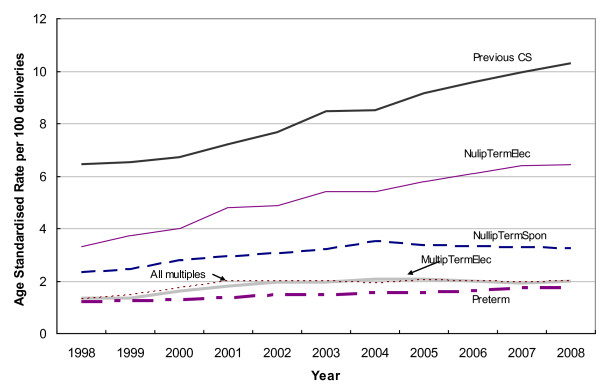
Background: Caesarean section (CS) rates around the world have been increasing and in Australia have reached 30% of all births. Robson's Ten-Group Classification System (10-group classification) provides a clinically relevant classification of CS rates that provides a useful basis for international comparisons and trend analyses. This study aimed to investigate trends in CS rates in New South Wales (NSW), including trends in the components of the 10-group classification. Methods: We undertook a cross-sectional study using data from the Midwives Data Collection, a state-wide surveillance system that monitors patterns of pregnancy care, services and pregnancy outcomes in New South Wales, Australia. The study population included all women giving birth between 1 st January 1998 and 31st December 2008. Descriptive statistics are presented including age-standardised CS rates, annual percentage change as well as regression analyses. Results: From 1998 to 2008 the CS rate in NSW increased from 19.1 to 29.5 per 100 births. There was a significant average annual increase in primary 4.3% (95%CI 3.0-5.7%) and repeat 4.8% (95% CI 3.9-5.7%) CS rates from 1998 to 2008. After adjusting for maternal and pregnancy factors, the increase in CS delivery over time was maintained. When examining CS rates classified according to the 10-group classification, the greatest contributors to the overall CS rate and the largest annual increases occurred among nulliparae at term having elective CS and multipara having elective repeat CS. Conclusions: Given that the increased CS rate cannot be explained by known and collected maternal or pregnancy characteristics, the increase may be related to differences in clinical decision making or maternal request. Future efforts to reduce the overall CS rate should be focussed on reducing the primary CS rate.
Overview
The claims and statistics of this paper haven’t been checked yet.
Run the check — free, no account needed. It reads the open-access text and checks the sources it cites.
Integrity signals
Registry
Cites
Statistics
Figures
Verification
Claims the paper makes
The claims and statistics of this paper haven’t been checked yet.
Run the check — free, no account needed. It reads the open-access text and checks the sources it cites.
Claims other papers make about this one
Each is checked against this paper’s own text: does it say what the citing paper says it does?
In the citing paper
“growth that cannot be explained by increases in obstetric risk factors, including those associated with delayed and multiple infant pregnancy and maternal obesity3–6”
From The relation between cesarean birth and child cognitive development (2017) · cites this paper as [6]
Self-check
Percentages, sums and reported differences re-computed from the paper’s own numbers.
The self-check needs the paper’s full text.
Citations
Cites
Health at a glance: OECD indicators
Anyim, J. T., & Covenant University, T. (2010) · Choice Reviews Online · doi:10.5860/choice.47-4774 · Cited by 1,261
Lumbiganon, P., Laopaiboon, M., Gülmezoglu, A. M., Souza, J. P., Taneepanichskul, S., Pang, R., Attygalle, D. E., Shrestha, N., Mori, R., Hinh, N. D., et al. (2010) · The Lancet · doi:10.1016/s0140-6736(09)61870-5 · Cited by 1,089 · cited 1×
“3) [33] but lower than that reported in the USA (31.”
ResultRisk of Uterine Rupture during Labor among Women with a Prior Cesarean Delivery
Lydon‐Rochelle, M. T., Holt, V. L., Easterling, T. R., & Martin, D. P. (2001) · New England Journal of Medicine · doi:10.1056/nejm200107053450101 · Cited by 929
Australia's mothers and babies 2001
Laws, P. J., & Sullivan, E. A. (1995) · Cited by 883
Monitoring emergency obstetric care : a handbook
Disability (2009) · Cited by 710
Classification of caesarean sections
Robson, M. S. (2001) · Fetal and Maternal Medicine Review · doi:10.1017/s0965539501000122 · Cited by 611
Cesarean Birth in the United States: Epidemiology, Trends, and Outcomes
MacDorman, M. F., Menacker, F., & Declercq, E. R. (2008) · Clinics in Perinatology · doi:10.1016/j.clp.2008.03.007 · Cited by 468 · cited 4×
“This is in contrast to the USA where increases appear to be similar across all gestational age categories [4].”
BackgroundResultInfluentialPoobalan, A. S., Aucott, L. S., Gurung, T., Smith, W. C., & Bhattacharya, S. (2008) · Obesity Reviews · doi:10.1111/j.1467-789x.2008.00537.x · Cited by 384 · cited 1×
“Previous research has highlighted potential reasons for the increasing CS rate including maternal request [14,15] and associated ethical and litigious issues, [15-17] obesity [18,19] and increasing maternal age [20-22].”
BackgroundSmith, G. C. S. (2002) · JAMA · doi:10.1001/jama.287.20.2684 · Cited by 348 · cited 1×
“The decision to perform a primary CS has important implications for maternal morbidity in the current pregnancy and mode of delivery and maternal morbidity in subsequent pregnancies [11-13].”
BackgroundDeclercq, E., Menacker, F., & MacDorman, M. (2005) · BMJ · doi:10.1136/bmj.38279.705336.0b · Cited by 325 · cited 1×
“Such research has demonstrated that primary CS rates appear to be unrelated to the medical risk profile of mothers, and change in a similar pattern to the overall CS rates [23].”
Background
Research works printed but not linked: 2
- British Columbia Perinatal Health Program: British Columbia Perinatal Database Registry Annual Report. 2007, Vancouver BC
- Australian Bureau of Statistics: 3235.0 - Population by Age and Sex, Regions of Australia, 2007. 2008, Canberra
Cited by
Sorted by citations
Vogel, J. P., Betrán, A. P., Vindevoghel, N., Souza, J. P., Torloni, M. R., Zhang, J., Tunçalp, Ö., Mori, R., Morisaki, N., Ortiz‐Panozo, E., et al. (2015) · The Lancet Global Health · doi:10.1016/s2214-109x(15)70094-x · Cited by 1,038
Betrán, A. P., Vindevoghel, N., Souza, J. P., Gülmezoglu, A. M., & Torloni, M. R. (2014) · PLoS ONE · doi:10.1371/journal.pone.0097769 · Cited by 392
“Multiple definitions were used for what is considered a ‘‘birth’’ and therefore which pregnant women can be included in the classification [13,21,23,27,33,41,45,54,59] (see Table 5).”
BackgroundMethodMethods of achieving and maintaining an appropriate caesarean section rate
Robson, M. S., Hartigan, L., & Murphy, M. (2012) · Best Practice & Research Clinical Obstetrics & Gynaecology · doi:10.1016/j.bpobgyn.2012.09.004 · Cited by 246
Drivers of maternity care in high-income countries: can health systems support woman-centred care?
Shaw, D., Guise, J., Shah, N. T., Gemzell‐Danielsson, K., Joseph, K. S., Levy, B. S., Wong, F., Woodd, S., & Main, E. K. (2016) · The Lancet · doi:10.1016/s0140-6736(16)31527-6 · Cited by 237
The relation between cesarean birth and child cognitive development
Polidano, C., Zhu, A., & Bornstein, J. C. (2017) · Scientific Reports · doi:10.1038/s41598-017-10831-y · Cited by 119
Tracy, S., Welsh, A. W., Hall, B., Hartz, D. L., Lainchbury, A., Bisits, A., White, J., & Tracy, M. B. (2014) · BMC Pregnancy and Childbirth · doi:10.1186/1471-2393-14-46 · Cited by 97
Bhatia, M., Banerjee, K., Dixit, P., & Dwivedi, L. K. (2020) · JAMA Network Open · doi:10.1001/jamanetworkopen.2020.15022 · Cited by 91
Kushnir, J., Friedman, A., Ehrenfeld, M., & Kushnir, T. (2012) · Birth · doi:10.1111/j.1523-536x.2012.00532.x · Cited by 84
Analysis of Cesarean Section Rate - According to Robson’s 10-group Classification
Kazmi, T., Saiseema, V. S., & Khan, S. (2012) · Oman Medical Journal · doi:10.5001/omj.2012.102 · Cited by 70
Unexplained variation in hospital caesarean section rates
Lee, Y. Y., Roberts, C. L., Patterson, J. A., Simpson, J. M., Nicholl, M., Morris, J. M., & Ford, J. B. (2013) · The Medical Journal of Australia · doi:10.5694/mja13.10279 · Cited by 69
Self-citationTura, A. K., Pijpers, O. M., de Man, M., Cleveringa, M., KOOPMANS, I. K., Gure, T., & Stekelenburg, J. (2018) · BMJ Open · doi:10.1136/bmjopen-2017-020520 · Cited by 68
D'Souza, R. D. (2012) · Best Practice & Research Clinical Obstetrics & Gynaecology · doi:10.1016/j.bpobgyn.2012.09.006 · Cited by 66
Management of pain associated with the insertion of intrauterine contraceptives
Gemzell‐Danielsson, K., Mansour, D., Fiala, C., Kaunitz, A. M., & Bahamondes, L. G. (2013) · Human Reproduction Update · doi:10.1093/humupd/dmt022 · Cited by 64
“The proportion of Caesarean section births has also increased (Bailit et al., 2004; Villar et al., 2006; Barber et al., 2011; Stavrou et al., 2011), and women who have only ever had a Caesarean section are often viewed as nulliparous with respect to IUC placement.”
BackgroundPathways to a rising caesarean section rate: a population-based cohort study
Roberts, C. L., Algert, C. S., Ford, J. B., Todd, A. L., & Morris, J. M. (2012) · BMJ Open · doi:10.1136/bmjopen-2012-001725 · Cited by 64
“5% in Cohort 2, table 1) and makes a continued and stable contribution to caesarean section rates.(6) 31 Decreasing breech presentation as a means of reducing caesarean section rates should not be overlooked, as external cephalic version is evidence-based and likely to be achievable with training and education for bot…”
Self-citationZeitlin, J. A., Durox, M., Macfarlane, A., Alexander, S., Heller, G., Loghi, M., Nijhuis, J. G., Ólafsdóttir, H. S., Mierzejewska, E., Gissler, M., et al. (2020) · BJOG An International Journal of Obstetrics & Gynaecology · doi:10.1111/1471-0528.16634 · Cited by 64
Caesarean section at full cervical dilatation
Davis, G., Fleming, T., Ford, K., Mouawad, M. R., & Ludlow, J. (2015) · Australian and New Zealand Journal of Obstetrics and Gynaecology · doi:10.1111/ajo.12374 · Cited by 61
Role of public and private funding in the rising caesarean section rate: a cohort study
Einarsdóttir, K., Haggar, F. A., Pereira, G. F., Leonard, H., de Klerk, N. H., Stanley, F. J., & Stock, S. J. (2013) · BMJ Open · doi:10.1136/bmjopen-2013-002789 · Cited by 55
Belachew, J., Cnattingius, S., Mulic‐Lutvica, A., Eurenius, K., Axelssön, O., & Wikström, A. (2013) · BJOG An International Journal of Obstetrics & Gynaecology · doi:10.1111/1471-0528.12444 · Cited by 51
Cesarean delivery: Trend in indications over three decades within a major city hospital network
Morton, R., Burton, A. E., Kumar, P., Hyett, J. A., Phipps, H., McGeechan, K., & de Vries, B. S. (2020) · Acta Obstetricia Et Gynecologica Scandinavica · doi:10.1111/aogs.13816 · Cited by 49
A comprehensive hepatitis C virus risk factors meta‐analysis (1989–2013); Do they differ in Egypt?
El‐Ghitany, E. M., Wahab, M. M. A., El-Wahab, E. W. A., Hassouna, S., & Farghaly, A. G. (2014) · Liver International · doi:10.1111/liv.12617 · Cited by 48
Perinatal consequences of a category 1 caesarean section at term
Grace, L., Greer, R. M., & Kumar, S. (2015) · BMJ Open · doi:10.1136/bmjopen-2014-007248 · Cited by 48
Tarimo, C. S., Mahande, M. J., & Obure, J. (2020) · BMC Pregnancy and Childbirth · doi:10.1186/s12884-020-02861-8 · Cited by 49
Horta, B. L., Gigante, D. P., Lima, R. C., Barros, F. C., & Victora, C. G. (2013) · PLoS ONE · doi:10.1371/journal.pone.0074301 · Cited by 45
Misrecognition of need: Women's experiences of and explanations for undergoing cesarean delivery
Tully, K. P., & Ball, H. L. (2013) · Social Science & Medicine · doi:10.1016/j.socscimed.2013.02.039 · Cited by 54
“…of primary cesarean section is consistently higher (Betrán et al., 2007; Declercq et al., 2011; Menacker & Hamilton, 2010) than the 10-15% calculated as appropriate (WHO, 2009), suggesting factors other than clinical indications influence the deliveries (Bragg et al., 2010; Stavrou et al., 2011).”
Nassar, N., Schiff, M., & Roberts, C. L. (2013) · PLoS ONE · doi:10.1371/journal.pone.0056238 · Cited by 44
“[11,24,25] The changing pattern towards fewer births commencing spontaneously and increased use of caesarean section has in itself potential adverse health consequences for both mothers and infants.”
BackgroundSelf-citationEinarsdóttir, K., Kemp, A., Haggar, F. A., Moorin, R. E., Gunnell, A. S., Preen, D. B., Stanley, F. J., & Holman, C. D. J. (2012) · PLoS ONE · doi:10.1371/journal.pone.0041436 · Cited by 43
“However, it appears clear from other studies that increases in maternal or foetal risk indicating the need for operative delivery are not a major factor [39,40].”
ResultTrends in Cesarean Delivery: Rate and Indications
Mittal, S., Pardeshi, S., Mayadeo, N., & Mane, J. (2014) · The Journal of Obstetrics and Gynecology of India · doi:10.1007/s13224-013-0491-2 · Cited by 42
Doan, E., GIBBONS, K. S., & Tudehope, D. (2014) · Australian and New Zealand Journal of Obstetrics and Gynaecology · doi:10.1111/ajo.12220 · Cited by 42
Abdel‐Aleem, H., Aboelnasr, M. F., Jayousi, T. M., & Habib, F. (2014) · Cochrane Database of Systematic Reviews · doi:10.1002/14651858.cd010322.pub2 · Cited by 41
Maged, A. M., Deeb, W. S., Elbaradie, S. M. Y., Elzayat, A. R., Metwally, A. A., Hamed, M. A., & Shaker, A. A. (2018) · Taiwanese Journal of Obstetrics and Gynecology · doi:10.1016/j.tjog.2018.04.004 · Cited by 45
Black, M. E., Entwistle, V. A., Bhattacharya, S., & Gillies, K. (2016) · BMJ Open · doi:10.1136/bmjopen-2015-008881 · Cited by 38
Analysis of Cesarean Sections using Robson’s Ten Group Classification System
Parveen, R., Khakwani, M., Naz, A., & Bhatti, R. (2021) · Pakistan Journal of Medical Sciences · doi:10.12669/pjms.37.2.3823 · Cited by 38
The Association between Cesarean Delivery on Maternal Request and Method of Newborn Feeding in China
Liu, X., Zhang, J., Liu, Y., Li, Y., & Li, Z. (2012) · PLoS ONE · doi:10.1371/journal.pone.0037336 · Cited by 38
“The increasing trend of CDMR was also observed in other countries [27,28].”
BackgroundCesarean section rates in Lithuania using Robson Ten Group Classification System
Barčaitė, E., Kemeklienė, G., Railaitė, D. R., Bartusevičius, A., Maleckienė, L., & Nadišauskienė, R. J. (2015) · Medicina · doi:10.1016/j.medici.2015.09.001 · Cited by 37
“Recent research showed that the overall CS rate and its variation in 97%–99% depend on the CS rates in Group 1 and 2 [16,21,22].”
BackgroundSpatial and temporal trends of cesarean deliveries in Uganda: 2012–2016
Atuheire, E. B., Opio, D. N., Kadobera, D., Ario, A. R., Matovu, J. K. B., Harris, J. R., Bulage, L., Nakiganda, B., Tumwesigye, N. M., Zhu, B., et al. (2019) · BMC Pregnancy and Childbirth · doi:10.1186/s12884-019-2279-6 · Cited by 35
Wang, L., Xu, X., Baker, P. N., Tong, C., Zhang, L., Qi, H., & Zhao, Y. (2016) · International Journal of Environmental Research and Public Health · doi:10.3390/ijerph13070686 · Cited by 34
“8%) CS rates from 1998 to 2008 in Australia [12].”
BackgroundFoureur, M. J., Turkmani, S., Clack, D., Davis, D. L., Mollart, L. J., Leiser, B., & Homer, C. (2016) · Women and Birth · doi:10.1016/j.wombi.2016.05.011 · Cited by 32
Decision-Making Process for Choosing an Elective Cesarean Delivery Among Primiparas in Taiwan
Huang, S.-Y., Sheu, S., Tai, C., Chiang, C.-P., & Chien, L. (2012) · Maternal and Child Health Journal · doi:10.1007/s10995-012-1062-3 · Cited by 30
Tegueté, I., Traoré, Y., Sissoko, A., Y., M., Thera, A., Dolo, T., Mounkoro, N., Traoré, M., & Dolo, A. (2012) · InTech eBooks · doi:10.5772/47914 · Cited by 29
Christensen, L. F., & Overgaard, C. (2017) · BMC Pregnancy and Childbirth · doi:10.1186/s12884-016-1208-1 · Cited by 28
Kant, A., & Mendiratta, S. (2018) · International Journal of Reproduction Contraception Obstetrics and Gynecology · doi:10.18203/2320-1770.ijrcog20184528 · Cited by 26
Johansson, M., Hildingsson, I., & Fenwick, J. (2014) · Women and Birth · doi:10.1016/j.wombi.2014.03.003 · Cited by 25
Trends in cesarean section rates at a large East African referral hospital from 2005-2010
Worjoloh, A., Manongi, R. N., Oneko, O., Hoyo, C., Daltveit, A. K., & Westreich, D. J. (2012) · Open Journal of Obstetrics and Gynecology · doi:10.4236/ojog.2012.23053 · Cited by 25
“The frequency of CS at KCMC does not mirror the rise in CS seen across many other countries [20,21], nor does it reflect the low prevalence of CS in Tanzania and other SSA countries [3,11,22].”
BackgroundXie, M., Lao, T. T.-H., Du, M., Sun, Q., Qu, Z., Ma, J., Song, X., Wang, M.-F., Xu, D., & Ma, R. (2019) · Journal of obstetrics and gynaecology research · doi:10.1111/jog.14048 · Cited by 23
Al-Kadri, H. M., Tamim, H., & Al-Anazi, S. (2015) · International Journal of Women s Health · doi:10.2147/ijwh.s85215 · Cited by 25
“A Chinese publication reported that CS delivery rate rose dramatically from 3.4% to 39.3% between the years 1988 and 2008.19 A similar rise in CS rate was observed in developed countries such as USA20 and Australia.21 Despite the significant increase in CS delivery rate in the studied institution, most of the studied…”
ResultInfluentialDoes a Caesarean section increase the time to a second live birth? A register-based cohort study
O’Neill, S. M., Khashan, A. S., Henriksen, T. B., Kenny, L. C., Kearney, P. M., Mortensen, P. B., Greene, R. A., & Agerbo, E. (2014) · Human Reproduction · doi:10.1093/humrep/deu217 · Cited by 25
“…College Cork, Cork, Ireland 3Department of Obstetrics and Gynaecology, University College Cork, Cork, Ireland 4Perinatal Epidemiology Research Unit, Department of Paediatrics, Aarhus University Hospital, Skejby DK – 8200 Aarhus N, Denmark 5Department of Epidemiology and Public Health,…”
BackgroundHomer, C., Besley, K., Bell, J., Davis, D. L., Adams, J., Porteous, A., & Foureur, M. J. (2013) · BMC Pregnancy and Childbirth · doi:10.1186/1471-2393-13-140 · Cited by 24
“One of the greatest contributors to the overall CS rate is a woman having an elective repeat CS (ERCS) [1].”
BackgroundInfluentialDunn, L., Flenady, V., & Kumar, S. (2016) · Journal of Translational Medicine · doi:10.1186/s12967-016-0769-0 · Cited by 23
“Current global caesarean section rates are far in excess of the WHO target rate, exceeding 25 % in the United States [41–43], the United Kingdom [44] and Australia [45].”
BackgroundAbduljabbar, H. S., Bahkali, N. M., AlBasri, S. F., Hachim, E. A., Shoudary, I. H., Dause, W. R., Mira, M. Y., & Khojah, M. (2016) · Saudi Medical Journal · doi:10.15537/smj.2016.7.13259 · Cited by 22
Li, W.-Y., Liabsuetrakul, T., & Stray‐Pedersen, B. (2014) · BMC Pregnancy and Childbirth · doi:10.1186/1471-2393-14-12 · Cited by 21
“Background The rate of cesarean delivery (CD) has been increasing worldwide, and is now higher than the upper limit of 15% recommended by the World Health Organization (WHO) [1-4].”
BackgroundInfluentialRay, A., & Jose, S. (2017) · International Journal of Reproduction Contraception Obstetrics and Gynecology · doi:10.18203/2320-1770.ijrcog20170066 · Cited by 20
Zaigham, M., Hellström-Westas, L. K., Domellöf, M., & Andersson, O. (2020) · BMC Pregnancy and Childbirth · doi:10.1186/s12884-020-03253-8 · Cited by 20
Comparative analysis of current diagnostic criteria for gestational diabetes mellitus
Boyadzhieva, M. V., Atanasova, I., Zacharieva, S., Tankova, T. I., & Dimitrova, V. (2012) · Obstetric Medicine · doi:10.1258/om.2011.110073 · Cited by 19
Secular trends in caesarean section rates over 20 years in a regional obstetric unit in Hong Kong
Chung, W., Kong, C., & To, W. W. K. (2017) · Hong Kong Medical Journal · doi:10.12809/hkmj176217 · Cited by 17
Hanson, C., Betrán, A. P., Opondo, C., Mkumbo, E., Manzi, F., Mbaruku, G. M., & Schellenberg, J. (2018) · BJOG An International Journal of Obstetrics & Gynaecology · doi:10.1111/1471-0528.15534 · Cited by 17
“Population-based studies from high income countries report levels of 50% and above.(40,41) We also report very low CS rates in small babies.”
BackgroundWhy are caesarean section rates so high in facilities in Mali and Benin?
Schantz, C., Ravit, M., TRAORE, B. A., Aboubakar, M., Goyet, S., de Loenzien, M., & Dumont, A. (2018) · Sexual & Reproductive Healthcare · doi:10.1016/j.srhc.2018.01.001 · Cited by 15
Nippita, T. A. C., Khambalia, A., Seeho, S. K. M., Trevena, J. A., Ja, P., Ford, J. B., Morris, J. M., & Roberts, C. (2015) · BJOG An International Journal of Obstetrics & Gynaecology · doi:10.1111/1471-0528.13478 · Cited by 15
Self-citationBirthing outcomes from an Australian HypnoBirthing programme
Phillips-Moore, J. (2012) · British Journal of Midwifery · doi:10.12968/bjom.2012.20.8.558 · Cited by 15
Pregnancy outcome in women with epilepsy in Western China: A prospective hospital based study
He, S., Zhu, H., Qiu, X., Zhu, X., Peng, A., Duan, J., & Chen, L. (2017) · Epilepsy & Behavior · doi:10.1016/j.yebeh.2017.05.034 · Cited by 15
Frequency Rate and Indications of Cesarean Sections at Prince Zaid Bin Al Hussein Hospital - Jordan
Omar, A. A. A., & Anza, S. H. A. (2012) · Cited by 14
Lotfi, F., Lohivash, S., Kavosi, Z., Owjimehr, S., & Bayati, M. (2021) · BMC Research Notes · doi:10.1186/s13104-021-05677-7 · Cited by 12
“In a study carried out in Turkey, two-third of pregnant women preferred to give birth through elective CS, and about 50% of them believed that choosing the type of delivery was the right of any woman [20].”
BackgroundRada, M. P., Ciortea, R., Măluţan, A. M., Prundeanu, I., Doumouchtsis, S. K., Bucuri, C. E., Blaga, L. D., & Mihu, D. (2022) · Journal of Perinatal Medicine · doi:10.1515/jpm-2021-0572 · Cited by 12
Cesarean Section Rate Analysis in University Hospital Tuzla - According to Robson's Classification
Fatušić, J., Hudić, I., Fatušić, Z., ZildzicMoralic, A., & Zivkovic, A. (2016) · Medical Archives · doi:10.5455/medarh.2016.70.213-216 · Cited by 12
Homer, C., Davis, D. L., Mollart, L. J., Turkmani, S., Smith, R., Bullard, M., Leiser, B., & Foureur, M. J. (2021) · Women and Birth · doi:10.1016/j.wombi.2021.05.010 · Cited by 13
Chen, J. S., Ford, J. B., Ampt, A. J., Simpson, J. M., & Roberts, C. L. (2013) · Paediatric and Perinatal Epidemiology · doi:10.1111/ppe.12039 · Cited by 11
Self-citationTrends and predictors of cesarean birth in Singapore, 2005‐2014: A population‐based cohort study
Chi, C., Pang, D., Aris, I. M., Teo, W. T., Li, S. W., Biswas, A., Yong, E., Chong, Y. S., Tan, K. B., & Kramer, M. S. (2018) · Birth · doi:10.1111/birt.12341 · Cited by 12
Malla, R. V., Hamal, C., Neupane, B., & Khatri, R. A. (2018) · Medical Journal of Shree Birendra Hospital · doi:10.3126/mjsbh.v17i2.20290 · Cited by 11
Rising cesarean deliveries in India: medical compulsions or convenience of the affluent?
Kumar, R., & Lakhtakia, S. (2020) · Health Care For Women International · doi:10.1080/07399332.2020.1798963 · Cited by 11
“Notwithstanding evidence against cesarean sections, the increasing cesarean sections are becoming a cause of concern in developed as well as developing countries (Betr an et al. 2016; Solanke, 2018; Stavrou et al., 2011: Roberts & Nippita, 2015; WHO, 2015).”
BackgroundSingh, D., & Kaur, L. (2017) · Journal of Clinical Ultrasound · doi:10.1002/jcu.22485 · Cited by 11
“There has been a rising trend in the incidence of cesarean section in recent times.(1) The rate of repeat cesarean section in the United States is 91%.”
BackgroundEthnicity and risk of caesarean section in a term, nulliparous N ew Z ealand obstetric cohort
Anderson, N. H., Sadler, L. C., Stewart, A. W., Fyfe, E. M., & McCowan, L. M. E. (2013) · Australian and New Zealand Journal of Obstetrics and Gynaecology · doi:10.1111/ajo.12036 · Cited by 10
Predictors of cesarean delivery in women undergoing labor induction with a Foley balloon
Delaney, S. S., Shaffer, B. L., Cheng, Y. W., Vargas, J., Sparks, T. N., Paul, K. J., & Caughey, A. B. (2014) · The Journal of Maternal-Fetal & Neonatal Medicine · doi:10.3109/14767058.2014.944154 · Cited by 10
“…attempts at vaginal births after previous cesarean, more pregnancies with multiple gestations, higher proportion of women with medical complications of pregnancy, the rise in obesity, cesarean delivery (CD) by maternal request, medical-legal pressures and increased rates of labor induction [1–3].”
Prosser, S. J., Miller, Y. D., Thompson, R., & Redshaw, M. (2014) · BMC Pregnancy and Childbirth · doi:10.1186/1471-2393-14-149 · Cited by 10
“Unlike many previous studies that have used routinely collected data (such as hospital records or birth registrations) to examine rates of caesarean section [14,18,23], our findings are based on data reported by women and thus hinge on the reliability of this information.”
BackgroundResultPatterson, J. A., Francis, S., & Ford, J. B. (2016) · Maternal and Child Health Journal · doi:10.1007/s10995-016-1992-2 · Cited by 9
Self-citationQualitative website analysis of information on birth after caesarean section
Peddie, V. L., Whitelaw, N., Cumming, G., Bhattacharya, S., & Black, M. E. (2015) · BMC Pregnancy and Childbirth · doi:10.1186/s12884-015-0614-0 · Cited by 8
Biró, M. A., Knight, M., Wallace, E. M., Papacostas, K., & East, C. E. (2013) · Australian and New Zealand Journal of Obstetrics and Gynaecology · doi:10.1111/ajo.12147 · Cited by 8
Ziller, V., Taskan, S., Sechet, I., & Kostev, K. (2016) · Geburtshilfe und Frauenheilkunde · doi:10.1055/s-0036-1593189 · Cited by 8
Thompson, F., Dempsey, K., & Mishra, G. D. (2016) · BJOG An International Journal of Obstetrics & Gynaecology · doi:10.1111/1471-0528.13881 · Cited by 7
Murugesan, K., & Rengaraj, S. (2021) · International Journal of Advanced Medical and Health Research · doi:10.4103/ijamr.ijamr_152_21 · Cited by 7
A Study and Analysis of Cesarean Sections by Robson\'s Ten Group Classification System
Nimbkar, A. R., Panchbudhe, S. A., & Deshmukh, P. (2022) · Journal of South Asian Federation of Obstetrics and Gynaecology · doi:10.5005/jp-journals-10006-2084 · Cited by 7
Bonvicini, L., Candela, S., Evangelista, A., Bertani, D., Casoli, M., Lusvardi, A., Messori, A., & Rossi, P. G. (2014) · BMC Pregnancy and Childbirth · doi:10.1186/1471-2393-14-72 · Cited by 7
“This classification has been shown to be useful for monitoring CS rates and their components, allowing risk stratification [18-22].”
MethodMaso, G., Piccoli, M., Montico, M., Monasta, L., Ronfani, L., Parolin, S., Gigli, C., Domini, D., Fiscella, C., Casarsa, S., et al. (2013) · BioMed Research International · doi:10.1155/2013/786563 · Cited by 7
“Details on management of induction of labour were not available, but this finding might be useful to audit in each center marginal indications of induction, implementing an effective management to reduce unnecessary interventions [11, 12, 14].”
BackgroundReducing caesarean section rates – No easy task
Roberts, C. L., Algert, C. S., Todd, A. L., & Morris, J. M. (2013) · Australian and New Zealand Journal of Obstetrics and Gynaecology · doi:10.1111/ajo.12065 · Cited by 7
Self-citationHarpham, M. E., Nassar, N., Leung, S., Lainchbury, A., & Shand, A. (2018) · The Journal of Maternal-Fetal & Neonatal Medicine · doi:10.1080/14767058.2018.1519537 · Cited by 7
Self-citationKhumalo, M., Leonard, T., Scribante, J., & Perrie, H. (2022) · International Journal of Women s Health · doi:10.2147/ijwh.s382518 · Cited by 6
Owen, K. B., Ibiebele, I., Simpson, J. M., Morton, R. L., Morris, J. M., & Torvaldsen, S. (2021) · Australian Health Review · doi:10.1071/ah20237 · Cited by 6
Self-citationHeera Shenoy, T., Shenoy, S. T., Anaswara, T., & Remash, K. (2019) · International Journal of Reproduction Contraception Obstetrics and Gynecology · doi:10.18203/2320-1770.ijrcog20191956 · Cited by 6
“Therefore, induction of labour protocols needs to strictly adhered in order to reduce the burden of unnecessary surgical interventions.(26) In addition, encouraging vaginal birth after CS (VBAC) and deconstructing the stigma of “once a caesarean, always a caesarean has to be emphasised.”
BackgroundMekonnen, A. B., Teale, G. R., Vasilevski, V., & Sweet, L. P. (2025) · Acta Obstetricia Et Gynecologica Scandinavica · doi:10.1111/aogs.15054 · Cited by 7
Análisis de la vía del parto en los diferentes escenarios asistenciales en Uruguay
Briozzo, L., Tomasso, G., & Colistro, V. (2019) · Revista Médica del Uruguay · doi:10.29193/rmu.35.2.1 · Cited by 8
“Stavrou E, Ford J, Shand A, Morris J, Roberts C. Epidemiology and trends for caesarean section births in New South Wales, Australia: a population-based study.”
BackgroundLabor and Delivery Outcomes in Australian Mothers after Kidney Transplantation
Tangirala, N., Hewawasam, E., Davies, C. E., Poprzeczny, A. J., Sullivan, E., McDonald, S. P., & Jesudason, S. (2024) · Journal of the American Society of Nephrology · doi:10.1681/asn.0000000559 · Cited by 4
Einarsdóttir, K., Ball, S. J., Pereira, G. F., Griffin, C., Jacoby, P., de Klerk, N. H., Leonard, H., & Stanley, F. J. (2015) · Paediatric and Perinatal Epidemiology · doi:10.1111/ppe.12202 · Cited by 4
Identifying better systems design in Australian maternity care: a Boundary Critique analysis
Donnellan-Fernandez, R. E., Newman, L., Reiger, K. M., & Tracy, S. (2013) · Health Systems · doi:10.1057/hs.2013.7 · Cited by 4
“…breastfeeding rates and associated increases in allergies, asthma, childhood obesity and diabetes, as well as high rates of perinatal depression (Donnellan-Fernandez, 2011b; Lynch, 2011; Stavrou et al, 2011; AIHW National Perinatal Epidemiology and Statistics Unit and AIHW, 2013; Hyde et al, 2012).”
BackgroundPractice of the Caesarean Section in Four Maternities in Benin Using Robson Classification
Hounkpatin, B. I. B., Aboubakar, M., Dangbemey, P., Tognifode, V., Schantz, C., Dumont, A., & René-Perrin, R.-X. (2020) · Open Journal of Obstetrics and Gynecology · doi:10.4236/ojog.2020.101006 · Cited by 4
“The same trend was found in a study in Switzerland [22] over a period of 11 years and by WHO in two multi-country surveys on maternal and neonatal health published in 2008 and 2011 [4].”
BackgroundResultInfluentialBrown, H. K., Hill, J., & Natale, R. (2014) · Journal of Obstetrics and Gynaecology Canada · doi:10.1016/s1701-2163(15)30537-5 · Cited by 4
Ghaedmohammadi, Z., Anaraki, A. N., Khajeian, A., Khajehian, M. M., & Ostovar, A. (2015) · Eastern Mediterranean Health Journal · doi:10.26719/2015.21.4.266 · Cited by 4
Is current rising trends of cesarean section –justified ?
Preetkamal, Kaur, H., & Nagpal, M. (2017) · International Journal of Reproduction Contraception Obstetrics and Gynecology · doi:10.18203/2320-1770.ijrcog20170547 · Cited by 4
Fatima, S. S., Zeb, L., Shafqat, T., & Qazi, Q. (2022) · American Journal of Health Medicine and Nursing Practice · doi:10.47672/ajhmn.1001 · Cited by 3
Effect of Delivery Modes on Hearing Screening Results
Kepekçi, A. H. (2019) · Global Journal of Otolaryngology · doi:10.19080/gjo.2019.20.556045 · Cited by 3
A prospective comparative study of cesarean section in multiparous and primiparous women
SURESH, D. Y. A., & Suresh, Y. (2017) · International Journal of Pharma and Bio Sciences · doi:10.22376/ijpbs.2017.8.3.b890-895 · Cited by 2
Ouattara, A., Kiemtoré, S., Ouédraogo, I., Sawadogo, Y. A., Millogo, T., Bikienga, M., Kouanda, S., & Ouédraogo, C. M. R. (2021) · Open Journal of Obstetrics and Gynecology · doi:10.4236/ojog.2021.112021 · Cited by 2
Factors Associated with Caesarean Section Among Women Delivered at Kirehe District Hospital
Habiyakare, C., & Rutayisire, E. (2022) · Journal of Public Health International · doi:10.14302/issn.2641-4538.jphi-22-4325 · Cited by 2
Metadata
- Authors
- Stavrou, E. P., Ford, J. B., Shand, A. W., Morris, J. M., & Roberts, C. L.
- Affiliations
- The University of Sydney (AU)
- Corresponding author
- Ford, Jane B
- Venue
- BMC Pregnancy and Childbirth
- Published
- 2011-01-20
- Volume
- 11
- Issue
- 1
- Pages
- 8-8
- ISSN
- 1471-2393 (ISSN-L)
- PMC
- PMC3037931
- OpenAlex
- W2085744854
- Cited by
- 137
- References
- 35
- Citations by year
- 2026: 3 · 2025: 1 · 2024: 3 · 2023: 1 · 2022: 8 · 2021: 8 · 2020: 11 · 2019: 9 · 2018: 9 · 2017: 15 · 2016: 13 · 2015: 10 · 2014: 13 · 2013: 18 · 2012: 15
- FWCI
- 18.95
- Type
- journal article
- Language
- en
- Open access
- gold
- doi.org
- Licence
- Locations
- BMC Pregnancy and Childbirth (publishedVersion, cc-by)
- PubMed Central (publishedVersion, cc-by)
- PubMed (publishedVersion)
- DOAJ (DOAJ: Directory of Open Access Journals) (submittedVersion)
- Funders
- National Health and Medical Research Council (573122)
- Topics
- Health Sciences › Medicine › Obstetrics and Gynecology › Maternal and Perinatal Health Interventions
- Health Sciences › Medicine › Anesthesiology and Pain Medicine › Anesthesia and Pain Management
- Health Sciences › Medicine › Public Health, Environmental and Occupational Health › Reproductive Health and Contraception
- Keywords
- cesarean section rate, primary cesarean section, repeat cesarean section, elective cesarean section, nulliparous women, multiparous women, term pregnancy, clinical decision-making, New South Wales
- MeSH terms
- Adolescent, Adult, Cesarean Section, Child, Cross-Sectional Studies, Female, Humans, Maternal Age, Middle Aged, New South Wales, Parity, Pregnancy, Regression Analysis, Elective Surgical Procedures, Cesarean Section, Repeat, Young Adult
About these checks
Registry, retraction, Cites and statistics results are computed, not judged, with one exception: a printed reference that no index lists is read once by a model before it counts as a citation error. Claims are extracted by a model and kept only when their quote appears verbatim in the text; each cited source is then checked, with a model’s help, for whether it says what the claim relies on. Those verdicts can be wrong — read the claim’s quote and the cited source before relying on one.
Statistics and arithmetic are recomputed, not judged.
Confidence bands are shown only for fields calibrated on our annotated test set. None is calibrated yet, so no band is shown.
What counts as a claim ›How we measure confidence ›How we check this ›
Are you an author, or do you see a problem with this page? Request a review
