

The DOI matches its Crossref record; 35 of the 35 references it cites were found in a registry or an index.
Epidemiology and trends for Caesarean section births in New South Wales, Australia: A population-based study
Open accessAbstract
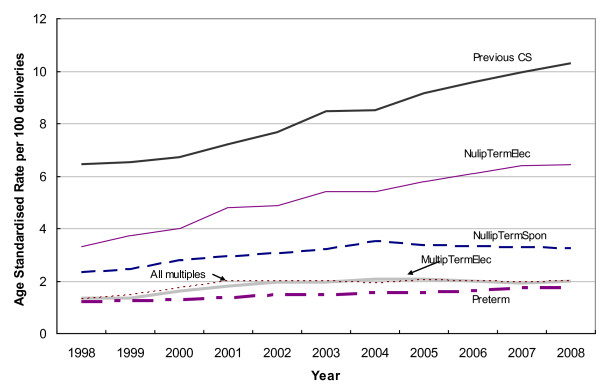
Background: Caesarean section (CS) rates around the world have been increasing and in Australia have reached 30% of all births. Robson's Ten-Group Classification System (10-group classification) provides a clinically relevant classification of CS rates that provides a useful basis for international comparisons and trend analyses. This study aimed to investigate trends in CS rates in New South Wales (NSW), including trends in the components of the 10-group classification. Methods: We undertook a cross-sectional study using data from the Midwives Data Collection, a state-wide surveillance system that monitors patterns of pregnancy care, services and pregnancy outcomes in New South Wales, Australia. The study population included all women giving birth between 1 st January 1998 and 31st December 2008. Descriptive statistics are presented including age-standardised CS rates, annual percentage change as well as regression analyses. Results: From 1998 to 2008 the CS rate in NSW increased from 19.1 to 29.5 per 100 births. There was a significant average annual increase in primary 4.3% (95%CI 3.0-5.7%) and repeat 4.8% (95% CI 3.9-5.7%) CS rates from 1998 to 2008. After adjusting for maternal and pregnancy factors, the increase in CS delivery over time was maintained. When examining CS rates classified according to the 10-group classification, the greatest contributors to the overall CS rate and the largest annual increases occurred among nulliparae at term having elective CS and multipara having elective repeat CS. Conclusions: Given that the increased CS rate cannot be explained by known and collected maternal or pregnancy characteristics, the increase may be related to differences in clinical decision making or maternal request. Future efforts to reduce the overall CS rate should be focussed on reducing the primary CS rate.
Overview
The claims and statistics of this paper haven’t been checked yet.
Run the check — free, no account needed. It reads the open-access text and checks the sources it cites.
Integrity signals
Registry
Cites
Statistics
Figures
Verification
Claims the paper makes
The claims and statistics of this paper haven’t been checked yet.
Run the check — free, no account needed. It reads the open-access text and checks the sources it cites.
Claims other papers make about this one
Each is checked against this paper’s own text: does it say what the citing paper says it does?
In the citing paper
“growth that cannot be explained by increases in obstetric risk factors, including those associated with delayed and multiple infant pregnancy and maternal obesity3–6”
From The relation between cesarean birth and child cognitive development (2017) · cites this paper as [6]
Self-check
Percentages, sums and reported differences re-computed from the paper’s own numbers.
The self-check needs the paper’s full text.
Citations
Cites
Health at a glance: OECD indicators
Anyim, J. T., & Covenant University, T. (2010) · Choice Reviews Online · doi:10.5860/choice.47-4774 · Cited by 1,261
Lumbiganon, P., Laopaiboon, M., Gülmezoglu, A. M., Souza, J. P., Taneepanichskul, S., Pang, R., Attygalle, D. E., Shrestha, N., Mori, R., Hinh, N. D., et al. (2010) · The Lancet · doi:10.1016/s0140-6736(09)61870-5 · Cited by 1,089 · cited 1×
“3) [33] but lower than that reported in the USA (31.”
ResultRisk of Uterine Rupture during Labor among Women with a Prior Cesarean Delivery
Lydon‐Rochelle, M. T., Holt, V. L., Easterling, T. R., & Martin, D. P. (2001) · New England Journal of Medicine · doi:10.1056/nejm200107053450101 · Cited by 929
Australia's mothers and babies 2001
Laws, P. J., & Sullivan, E. A. (1995) · Cited by 883
Monitoring emergency obstetric care : a handbook
Disability (2009) · Cited by 710
Classification of caesarean sections
Robson, M. S. (2001) · Fetal and Maternal Medicine Review · doi:10.1017/s0965539501000122 · Cited by 611
Cesarean Birth in the United States: Epidemiology, Trends, and Outcomes
MacDorman, M. F., Menacker, F., & Declercq, E. R. (2008) · Clinics in Perinatology · doi:10.1016/j.clp.2008.03.007 · Cited by 468 · cited 4×
“This is in contrast to the USA where increases appear to be similar across all gestational age categories [4].”
BackgroundResultInfluentialPoobalan, A. S., Aucott, L. S., Gurung, T., Smith, W. C., & Bhattacharya, S. (2008) · Obesity Reviews · doi:10.1111/j.1467-789x.2008.00537.x · Cited by 384 · cited 1×
“Previous research has highlighted potential reasons for the increasing CS rate including maternal request [14,15] and associated ethical and litigious issues, [15-17] obesity [18,19] and increasing maternal age [20-22].”
BackgroundSmith, G. C. S. (2002) · JAMA · doi:10.1001/jama.287.20.2684 · Cited by 348 · cited 1×
“The decision to perform a primary CS has important implications for maternal morbidity in the current pregnancy and mode of delivery and maternal morbidity in subsequent pregnancies [11-13].”
BackgroundDeclercq, E., Menacker, F., & MacDorman, M. (2005) · BMJ · doi:10.1136/bmj.38279.705336.0b · Cited by 325 · cited 1×
“Such research has demonstrated that primary CS rates appear to be unrelated to the medical risk profile of mothers, and change in a similar pattern to the overall CS rates [23].”
Background
Research works printed but not linked: 2
- British Columbia Perinatal Health Program: British Columbia Perinatal Database Registry Annual Report. 2007, Vancouver BC
- Australian Bureau of Statistics: 3235.0 - Population by Age and Sex, Regions of Australia, 2007. 2008, Canberra
Cited by
Sorted by citations
Items 101–137 of 137
Prevalence and determinants of cesarean section in a rural tertiary care hospital of Bangladesh
Begum, F., Akter, S., Jahan, A., Hoque, L. F., & Aktar, M. N. (2024) · International Journal of Reproduction Contraception Obstetrics and Gynecology · doi:10.18203/2320-1770.ijrcog20241053 · Cited by 2
Childbirth in Pleasure and Ecstasy: A Fountain of Hormones and Chemicals
Khajehei, M., & Doherty, M. (2012) · eSpace (Curtin University) · Cited by 2
Caesarean section rates in large medical schemes in South Africa: An explorative descriptive study
Willie, M. M. (2012) · Cited by 2
Karna, J., & Malhotra, V. M. (2017) · International Journal of Community Medicine and Public Health · doi:10.18203/2394-6040.ijcmph20173365 · Cited by 2
Noonan, S. H. J., & Larkin, T. (2022) · Australian Journal of Rural Health · doi:10.1111/ajr.12959 · Cited by 2
Analysis of caesarean sections at a tertiary care centre according to Robson’s criteria
Mohapatra, I., Samantaray, S. R., Vivekanand, A., Manjula, A., & Priyanka, B. (2020) · International Journal of Reproduction Contraception Obstetrics and Gynecology · doi:10.18203/2320-1770.ijrcog20203339 · Cited by 2
“The similar CS rates have also been published by RCOG 18 and Stavrou EP et al.(19) The high caesarean section rate in Group 10 was mainly to improve the fetal outcome.”
ResultHosseini, S. A., Piroozi, B., Amerzade, M., Ghasri, H., Farshadi, S. A., Safari, H., & Moradi, S. (2017) · Journal of Obstetrics Gynecology and Cancer Research · doi:10.5812/jogcr.11209 · Cited by 1
“However, the cesarean section rate is dramatically increasing around the world (2-4).”
BackgroundSingh, A., & Sadiqunnisa (2019) · International Journal of Reproduction Contraception Obstetrics and Gynecology · doi:10.18203/2320-1770.ijrcog20191974 · Cited by 1
“When compared with other studies internationally, almost all studies conveyed comparable results in groups 6-10.(11,15) The study results showed that one third (46%) of the total CS rate was contributed by Group 5 (1308 repeat CS out of 1334 laboring women with previous 1 CS), which is slightly higher than other studi…”
ResultPatnaik, N. (2020) · International Journal of Clinical Obstetrics and Gynaecology · doi:10.33545/gynae.2020.v4.i3b.577 · Cited by 1
Jadav, P. A., Dabhi, P. M., & Rathod, D. A. (2021) · International Journal of Reproduction Contraception Obstetrics and Gynecology · doi:10.18203/2320-1770.ijrcog20213863 · Cited by 1
Accademic Performance of Cesarean Birth Child
Sahid, M. H. (2021) · Annals of Physiotherapy & Occupational Therapy · doi:10.23880/aphot-16000205 · Cited by 1
Santhi, V. V., Gogineni, S., Sunita, C., & Panchumarthi, M. (2023) · International Journal of Reproduction Contraception Obstetrics and Gynecology · doi:10.18203/2320-1770.ijrcog20230676 · Cited by 1
Indwelling bladder catheterization as part of postoperative care for caesarean section
Abdel‐Aleem, H., Aboelnasr, M. F., Jayousi, T. M., & Habib, F. (2013) · Cochrane Database of Systematic Reviews · doi:10.1002/14651858.cd010322 · Cited by 1
Barbosa, D. C. M. (2017) · doi:10.11606/t.17.2017.tde-29032017-102707 · Cited by 1
Pereira, F., Leonard, H., & Stanley, F. J. (2013)
DESARROLLO DE CRITERIOS PARA INDICACIÓN DE CESÁREA SEGÚN EL MÉTODO DE PERTINENCIA RAND/UCLA
Azurín, J. C., Flores, J. B., Becerra-Gonzales, V. G., Carbajal-Urteaga, P., Caro-Vargas, M., Castillo-Cáceda, S. A., & Castro-Tamayo, R. (2013) · Ciencia e Investigación Medico Estudiantil Latinoamericana · doi:10.23961/cimel.2013.182.406
Kolip, P., & Schmidt-Semisch, H. (2013)
Hospital Profiling of the Cesarean Delivery Procedure for the State of Georgia, 2012
Giles, D. (2016) · ScholarWorks (Walden University)
Tanveer, Q., Fatima, A., & Sana, U. M. (2016) · The Professional Medical Journal · doi:10.17957/tpmj/16.3553
Prajwal, S., Ps, R., Sujoy, M., & Mukhopadhyay, I. (2017) · IOSR Journal of Dental and Medical Sciences · doi:10.9790/0853-1603134953
CHANGING TRENDS IN CAESAREAN DELIVERY - A CLINICAL STUDY
Shetty, A. (2016) · Journal of Evidence Based Medicine and Healthcare · doi:10.18410/jebmh/2016/974
Analyzing the Clinical and Economic Impact of Cesarean Delivery on Maternal and Infant Outcomes
Kwakyepeprah, M. (2017) · uO Research (University of Ottawa) · doi:10.20381/ruor-20724
Roy, P., Jeyaseelan, L., & Ruby, J. (2017) · Journal of South Asian Federation of Obstetrics and Gynaecology · doi:10.5005/jp-journals-10006-1520
Are cesarean delivery rates and indications changing?
Mane, J. D. (2019) · International Journal of Reproduction Contraception Obstetrics and Gynecology · doi:10.18203/2320-1770.ijrcog20190018
Retained Placenta and Postpartum Haemorrhage
Belachew, J. (2015) · KTH Publication Database DiVA (KTH Royal Institute of Technology)
CHANGING TRENDS IN THE INDICATIONS OF CAESAREAN OVER A DECADE AT TERTIARY CARE HOSPITAL
Ponnada, G. K., Sucharitha, B., Komala, C., Sravanthi, B. S., & Devi, D. H. (2019) · Journal of Evidence Based Medicine and Healthcare · doi:10.18410/jebmh/2019/164
Cesarian Births in Brazil: Clinical Indication or Convenience?
Alcântara, L. L. D. M., Almeida, N. K. D. O., & de Almeida, R. M. V. R. (2019) · World Congress on Medical Physics and Biomedical Engineering, September 7 - 12, 2009, Munich, Germany · doi:10.1007/978-981-13-2517-5_100
A Success Story of Complicated Antipartum Hemorrage and Placenta Previa in ICU Setting
Ashraf, S. (2020) · American Journal of Biomedical Science & Research · doi:10.34297/ajbsr.2020.11.001639
“Other causes of a placenta previa may include fibroids, large placental area with twins, late fertilization, internal scarring from previous c-sections, smoking and in-vitro fertilization [6].”
BackgroundHosseini, S. A., Piroozi, B., Amerzade, M., Ghasri, H., Farshadi, S. A., Safari, H., & Moradi, S. (2017) · Journal of Obstetrics Gynecology and Cancer Research · doi:10.5812/ogcr.11209
Sah, D. K., Purbey, H. N., & Jha, R. (2022) · Scholars International Journal of Obstetrics and Gynecology · doi:10.36348/sijog.2022.v05i07.003
Ambike, A., Deokar, V., Santpur, U., & Ambike, D. A. (2022) · GLOBAL JOURNAL FOR RESEARCH ANALYSIS · doi:10.36106/gjra/1000204
Kulkarni, K. K., Kumar, M., Nagar, S., & Dhillon, A. (2024) · Journal of Obstetric and Gynaecological Practices POGS · doi:10.5005/jogyp-11012-0030
Begum, T., Barzi, F., Fatima, Y., Anuradha, S., & Mamun, A. A. (2026) · European Journal of Obstetrics & Gynecology and Reproductive Biology · doi:10.1016/j.ejogrb.2026.115017
Chiesa, M. (2018) · theses.fr (ABES) · doi:10.70675/6ef32b4fzb74az4b06zb8edz92268c28d542
Visconti, M., Pascucci, E., Monari, F., & Facchinetti, F. (2026) · Springer eBooks · doi:10.1007/978-3-032-05381-7_69
Estudo da incidência de cesáreas de acordo com a Classificação de Robson em uma maternidade pública
Silva, L. F., de Almeida, C. P. S., Batista, D. D. F., & Mariani, C. (2020) · Femina · doi:10.61622/0100-7254482202005
Vidal, À., Levy, J., Schwarzt, A. K., & von Wolff, M. (2026) · Frontiers in Endocrinology · doi:10.3389/fendo.2026.1639111
“A potential association between mode of delivery and subfer-tility has important social, clinical, and public health implications (9, 10), particularly given that the global prevalence of infertility is estimated to range from 12.6% to 17.5% (11).”
Influential
Metadata
- Authors
- Stavrou, E. P., Ford, J. B., Shand, A. W., Morris, J. M., & Roberts, C. L.
- Affiliations
- The University of Sydney (AU)
- Corresponding author
- Ford, Jane B
- Venue
- BMC Pregnancy and Childbirth
- Published
- 2011-01-20
- Volume
- 11
- Issue
- 1
- Pages
- 8-8
- ISSN
- 1471-2393 (ISSN-L)
- PMC
- PMC3037931
- OpenAlex
- W2085744854
- Cited by
- 137
- References
- 35
- Citations by year
- 2026: 3 · 2025: 1 · 2024: 3 · 2023: 1 · 2022: 8 · 2021: 8 · 2020: 11 · 2019: 9 · 2018: 9 · 2017: 15 · 2016: 13 · 2015: 10 · 2014: 13 · 2013: 18 · 2012: 15
- FWCI
- 18.95
- Type
- journal article
- Language
- en
- Open access
- gold
- doi.org
- Licence
- Locations
- BMC Pregnancy and Childbirth (publishedVersion, cc-by)
- PubMed Central (publishedVersion, cc-by)
- PubMed (publishedVersion)
- DOAJ (DOAJ: Directory of Open Access Journals) (submittedVersion)
- Funders
- National Health and Medical Research Council (573122)
- Topics
- Health Sciences › Medicine › Obstetrics and Gynecology › Maternal and Perinatal Health Interventions
- Health Sciences › Medicine › Anesthesiology and Pain Medicine › Anesthesia and Pain Management
- Health Sciences › Medicine › Public Health, Environmental and Occupational Health › Reproductive Health and Contraception
- Keywords
- cesarean section rate, primary cesarean section, repeat cesarean section, elective cesarean section, nulliparous women, multiparous women, term pregnancy, clinical decision-making, New South Wales
- MeSH terms
- Adolescent, Adult, Cesarean Section, Child, Cross-Sectional Studies, Female, Humans, Maternal Age, Middle Aged, New South Wales, Parity, Pregnancy, Regression Analysis, Elective Surgical Procedures, Cesarean Section, Repeat, Young Adult
About these checks
Registry, retraction, Cites and statistics results are computed, not judged, with one exception: a printed reference that no index lists is read once by a model before it counts as a citation error. Claims are extracted by a model and kept only when their quote appears verbatim in the text; each cited source is then checked, with a model’s help, for whether it says what the claim relies on. Those verdicts can be wrong — read the claim’s quote and the cited source before relying on one.
Statistics and arithmetic are recomputed, not judged.
Confidence bands are shown only for fields calibrated on our annotated test set. None is calibrated yet, so no band is shown.
What counts as a claim ›How we measure confidence ›How we check this ›
Are you an author, or do you see a problem with this page? Request a review
