

Secular trends in pregnancy weight gain in German women and their influences on foetal outcome: a hospital-based study
Open accessThe DOI matches its Crossref record; 45 of the 45 references it cites were found in a registry or an index.
Abstract
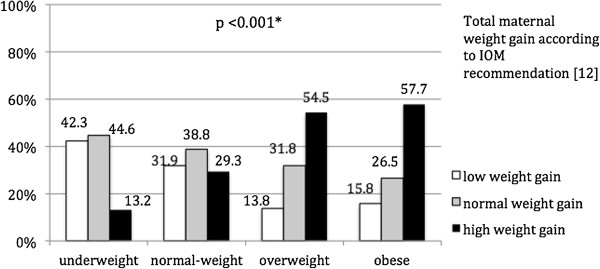
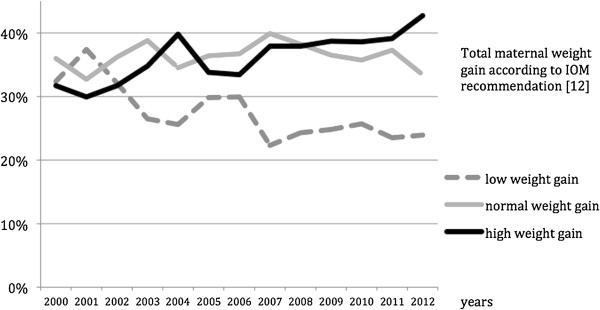
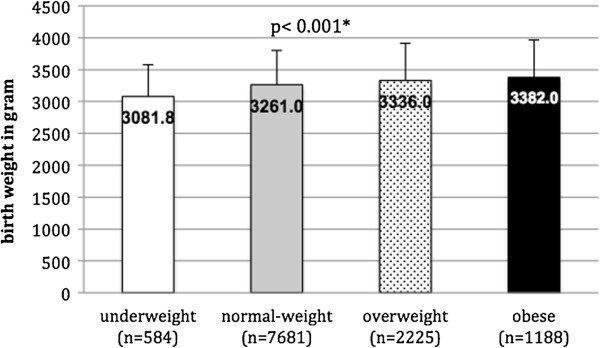
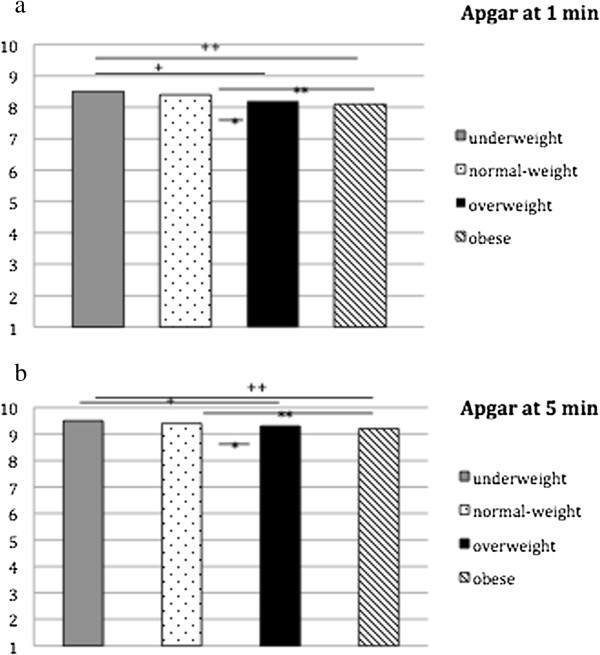
BACKGROUND: Increasing rates of overweight have been reported. In Germany, women of childbearing age are especially affected. Those women are at increased risks of several peri- and postnatal complications. The purpose of this study was to carry out Germany's first study in terms of secular trends of overweight and weight gain during pregnancy related to foetal clinical outcomes (birth weight, Apgar score and umbilical blood pH). METHODS: A database maintained by a large regional university hospital in Cologne, Germany was used to evaluate clinical routine data from 1996 to 2012. 11771 women (23.5 ± 5.4 years; 18-48 years), who gave birth to a live singleton child (>2000 gram) were included. Recommended weight gain during pregnancy was based on IOM guidelines: Total weight gain range for underweight (initial BMI < 18.5 kg/m2) is 12.5-18 kg/ 28-40 lbs respectively, for normal-weight (initial BMI 18.5 -24.9 kg/m2) is 11.5-16 kg/ 25-35 lbs respectively, for overweight (initial BMI 25.0-29.9 kg/m2) is 7-11.5 kg/ 15-25 lbs respectively and for obese (initial BMI ≥ 30.0 kg/m2) is 5-9 kg/ 11-20 lbs respectively.A one-way variance analysis was employed to test for differences in particular factors in various groups. Multiple linear regression analysis was used to model impact factors. RESULTS: Over the second analysed period (2005-2012), the number of women with high weight gain increased from 33.8% to 42.9% (p <0.001). 54.5% overweight and 57.7% obese women were affected (p <0.001). Women with high weight gain were 54.5% significantly more likely to give birth to an infant ≥ 4000 grams than women with normal (31.7%) or low weight gain (13.8%, p < 0.001). Women with normal weight gain had significantly better foetal outcomes in terms of the Apgar score at 5 min and umbilical cord blood pH. CONCLUSION: These data confirm an increase in maternal weight gain before and during pregnancy. An excessive weight gain is accompanied by macrosomia, lower Apgar scores and pH-value. Women should therefore be advised about the risks of obesity before and during pregnancy as well as excessive maternal weight gain during pregnancy.
Overview
The claims and statistics of this paper haven’t been checked yet.
Free: it reads the open-access text and checks the first 5 claims that cite a source we can check. Create a free account to check every claim.
Integrity signals
Registry
Cites
Statistics
Figures
Verification
Claims the paper makes
The claims and statistics of this paper haven’t been checked yet.
Free: it reads the open-access text and checks the first 5 claims that cite a source we can check. Create a free account to check every claim.
Claims other papers make about this one
Each is checked against this paper’s own text: does it say what the citing paper says it does?
The cited source says what the claim attributes to it.
In the citing paper
“high rates of excessive GWG (EGWG) and pre-pregnancy overweight/obesity were reported in Europe (36% and 29%, respectively) and USA (44% and 59.5%, respectively) [15, 16], while these figures were lower in China (27.6% and 6.1%, respectively) [17, 18].”
Self-check
Percentages, sums and reported differences re-computed from the paper’s own numbers.
The self-check needs the paper’s full text.
Citations
Cites
Bundesgesundheitsblatt - Gesundheitsforschung - Gesundheitsschutz
(2013) · Bundesgesundheitsblatt - Gesundheitsforschung - Gesundheitsschutz · doi:10.1007/103.1437-1588 · Cited by 11,796
Weight Gain During Pregnancy: Reexamining the Guidelines
Rasmussen, K. M., & Yaktine, A. L. (2009) · Cited by 4,493
Maternal Morbid Obesity and the Risk of Adverse Pregnancy Outcome
Cedergren, M. I. (2004) · Obstetrics & Gynecology · doi:10.1097/01.aog.0000107291.46159.00 · Cited by 1,248 · cited 2×
“Discussion Excess weight and obesity during pregnancy result in major adverse effects on both mother and child later in life [19,28,29].”
BackgroundHealth at a glance: OECD indicators
(2010) · Choice Reviews Online · doi:10.5860/choice.47-4774 · Cited by 1,236
The Continuing Value of the Apgar Score for the Assessment of Newborn Infants
Casey, B. M., McIntire, D. D., & Leveno, K. J. (2001) · New England Journal of Medicine · doi:10.1056/nejm200102153440701 · Cited by 826
Pregnancy complications and outcomes among overweight and obese nulliparous women
(2001) · American Journal of Public Health · doi:10.2105/ajph.91.3.436 · Cited by 757 · cited 1×
“obese women when compared to normal-weight women [4].”
BackgroundInterpregnancy weight change and risk of adverse pregnancy outcomes: a population-based study
Villamor, E., & Cnattingius, S. (2006) · The Lancet · doi:10.1016/s0140-6736(06)69473-7 · Cited by 756
Nohr, E. A., Vaeth, M., Baker, J. L., Sørensen, T. I., Olsen, J., & Rasmussen, K. M. (2008) · The American Journal of Clinical Nutrition · doi:10.1093/ajcn/87.6.1750 · Cited by 649 · cited 1×
“Discussion Excess weight and obesity during pregnancy result in major adverse effects on both mother and child later in life [19,28,29].”
BackgroundLashen, H. (2004) · Human Reproduction · doi:10.1093/humrep/deh277 · Cited by 577
Mensink, G. B. M., Schienkiewitz, A., Haftenberger, M., Lampert, T., Ziese, T., & Scheidt-Nave, C. (2013) · Bundesgesundheitsblatt - Gesundheitsforschung - Gesundheitsschutz · doi:10.1007/s00103-012-1656-3 · Cited by 576
Cited by
Martínez‐Hortelano, J. A., Cavero‐Redondo, I., Álvarez‐Bueno, C., Garrido‐Miguel, M., Soriano‐Cano, A., & Martínez‐Vizcaíno, V. (2020) · BMC Pregnancy and Childbirth · doi:10.1186/s12884-020-03335-7 · Cited by 167
“The year of recruitment showed that GWG is rising in all regions, according to previous studies in all regions [5, 6].”
BackgroundMethodResultInfluentialSimko, M., Totka, A., Vondrova, D., Samohyl, M., Jurkovicova, J., Trnka, M., Cibulkova, A., Stofko, J., & Argalasova, L. (2019) · International Journal of Environmental Research and Public Health · doi:10.3390/ijerph16101751 · Cited by 112
Kunath, J., Günther, J., Rauh, K., Hoffmann, J., Stecher, L., Rosenfeld, E., Kick, L., Ulm, K., & Hauner, H. (2019) · BMC Medicine · doi:10.1186/s12916-018-1235-z · Cited by 108
Simko, M., Totka, A., Vondrova, D., Samohyl, M., Jurkovicova, J., Trnka, M., Cibulkova, A., Stofko, J., & Argalasova, L. (2019) · doi:10.20944/preprints201904.0130.v1 · Cited by 112
Ke, J.-F., Liu, S., Ge, R.-L., Ma, L., & Li, M.-F. (2023) · BMC Pregnancy and Childbirth · doi:10.1186/s12884-023-05657-8 · Cited by 50
“5%, respectively) [15, 16], while these figures were lower in China (27.”
BackgroundYang, S., Zhou, A., Xiong, C., Yang, R., Bassig, B. A., Hu, R., Zhang, Y., Yao, C., Zhang, Y., Qiu, L., et al. (2015) · Paediatric and Perinatal Epidemiology · doi:10.1111/ppe.12213 · Cited by 48
Hung, T.-H., Chen, S.-F., Hsu, J.-J., & Hsieh, T.-T. (2015) · Taiwanese Journal of Obstetrics and Gynecology · doi:10.1016/j.tjog.2015.06.010 · Cited by 43
Bauer, C., Gräf, C., Platschek, A.-M., Strüder, H. K., & Ferrari, N. (2017) · Journal of Physical Activity and Health · doi:10.1123/jpah.2016-0563 · Cited by 53
Self-citationHoffmann, J., Günther, J., Geyer, K., Stecher, L., Rauh, K., Kunath, J., Meyer, D. M., Sitzberger, C., Spies, M., Rosenfeld, E., et al. (2019) · BMC Pregnancy and Childbirth · doi:10.1186/s12884-019-2553-7 · Cited by 48
“In Germany, more than 40% of pregnant women exceed the recommended IOM thresholds [16].”
BackgroundMărginean, C., Mărginean, C. O., Bănescu, C. V., Meliţ, L. E., Tripon, F., & Iancu, M. (2016) · Medicine · doi:10.1097/md.0000000000004098 · Cited by 33
“[53] In the study of Farah et al, [1] by the use of a multivariate analysis, the evaluated factors influenced GWG in 5% and the study of Ferrari et al [25] using a linear regression showed that GWG has a great impact on BW, having a total outcome variance of 8.4%.”
BackgroundMethodInfluentialTarvonen, M. J., Hovi, P., Sainio, S., Vuorela, P., Andersson, S., & Teramo, K. A. (2021) · Acta Diabetologica · doi:10.1007/s00592-021-01756-0 · Cited by 33
Mărginean, C. O., Mărginean, C., Bănescu, C. V., Meliţ, L. E., Tripon, F., & Iancu, M. (2019) · Pediatric Research · doi:10.1038/s41390-019-0347-2 · Cited by 22
Wen, J., Lv, A., Aihemaitijiang, S., Li, H., Zhou, Y., & Liu, J. (2024) · Nutrition Reviews · doi:10.1093/nutrit/nuae027 · Cited by 17
Paternal factors to the offspring birth weight: the 829 birth cohort study.
Fan, C., Huang, T., Cui, F., Gao, M., Song, L., & Wang, S. (2015) · PubMed Central · Cited by 19
MC4R and ENPP1 gene polymorphisms and their implication in maternal and neonatal risk for obesity
Mărginean, C., Mărginean, C. O., Mihaela, I., Meliţ, L. E., Tripon, F., & Bănescu, C. V. (2019) · Scientific Reports · doi:10.1038/s41598-019-47402-2 · Cited by 12
Ferrari, N., Schmitz, L., Schmidt, N., Mahabir, E., de Vondel, P. V., Merz, W. M., Lehmacher, W., Stock, S., Brockmeier, K., Ensenauer, R. E., et al. (2020) · BMC Sports Science Medicine and Rehabilitation · doi:10.1186/s13102-020-00198-5 · Cited by 12
“When obese women become pregnant they are at increased risk of several perinatal and postpartum complications such as excessive weight gain, gestational diabetes, preeclampsia, pregnancy-induced hypertension or fetal macrosomia [5, 6].”
BackgroundSelf-citationGestational weight gain and offspring’s cognitive skills: a systematic review and meta-analysis
Martínez‐Hortelano, J. A., Álvarez‐Bueno, C., Cavero‐Redondo, I., Herráiz-Adillo, Á., Berlanga‐Macías, C., & Martínez‐Vizcaíno, V. (2020) · BMC Pediatrics · doi:10.1186/s12887-020-02429-7 · Cited by 13
Noever, K., Schubert, J., Reuschel, E., Timmesfeld, N., & Arabin, B. (2020) · Geburtshilfe und Frauenheilkunde · doi:10.1055/a-1110-0859 · Cited by 11
Mărginean, C., Mărginean, C. O., Bănescu, C. V., Meliţ, L. E., Tripon, F., & Iancu, M. (2019) · Medicine · doi:10.1097/md.0000000000016414 · Cited by 7
Martínez‐Hortelano, J. A., Berlanga‐Macías, C., Pozuelo‐Carrascosa, D. P., Sanabria‐Martínez, G., Poyatos‐León, R., & Martínez‐Vizcaíno, V. (2019) · Medicine · doi:10.1097/md.0000000000015470 · Cited by 7
“Approximately 30% of women of reproductive age are overweight or obese.([1,2]) prepregnancy body mass index (BMI) has been associated with adverse perinatal outcomes, such as gestational diabetes, hypertensive disorders, higher cesarean section rates, postpartum hemorrhage, low birth weight, macrosomia, death, and sti…”
Barzen, C., Vogel, M., Kieß, W., & Poulain, T. (2024) · Archives of Gynecology and Obstetrics · doi:10.1007/s00404-024-07487-1 · Cited by 5
“Similar to obesity prevalence, the number of women who experience excessive GWG is rising [12].”
BackgroundHow much weight are women gaining during pregnancy? An Italian cohort study
Romano, M., Lacaria, E., Battini, L., Aragona, M., Bianchi, C., Penno, G., Prato, S. D., & Bertolotto, A. (2015) · Gynecological Endocrinology · doi:10.3109/09513590.2015.1062867 · Cited by 5
“4%) [16] and comparable to that found by others [17].”
ResultKörperliche Aktivität in der Schwangerschaft: Präventives Potenzial
Ferrari, N., & Graf, C. (2016) · Der Gynäkologe · doi:10.1007/s00129-016-3851-z · Cited by 5
Self-citationFerrari, N., Schmidt, N., Schmidt, L., Merz, W. M., Brockmeier, K., Dötsch, J., Bae‐Gartz, I., Mahabir, E., & Joisten, C. (2023) · Biomedicines · doi:10.3390/biomedicines11020447 · Cited by 5
“These changes are notably more pronounced and are associated with a threefold higher risk for gestational diabetes mellitus (GDM) in pregnant women with overweight/obesity than in those with normal weight [9,10].”
BackgroundSelf-citationStoffwechsel und Ernährung in der Schwangerschaft
Hauner, H. (2022) · Monatsschrift Kinderheilkunde · doi:10.1007/s00112-021-01383-7 · Cited by 2
Formoso, G., Bianchi, C., Burlina, S., Manicardi, E., Sculli, M. A., Resi, V., & Sciacca, L. (2022) · Acta Diabetologica · doi:10.1007/s00592-022-01950-8 · Cited by 2
Tang, Y., Islam, N., Luo, R., Wen, S. W., & Guo, Y. (2023) · BMJ Open · doi:10.1136/bmjopen-2023-080757 · Cited by 2
Nuamah, M. A., Adu‐Bonsaffoh, K., Asah‐Opoku, K., Atuahene, M. D., Korankye, E., Torto, M., Kitcher, S., Yawson, A. E., Asare‐Anane, H., & Samba, A. (2022) · Postgraduate Medical Journal of Ghana · doi:10.60014/pmjg.v9i2.234 · Cited by 2
Feng, Z., Wu, X., Tong, X., He, Z., Yang, C., Shen, W., Ding, Y., Liu, J., Meng, Q., Zhang, A., et al. (2025) · Frontiers in Pediatrics · doi:10.3389/fped.2024.1412975 · Cited by 4
What Adversely Affects the Unborn—Psychotropic Drugs or Maternal Morbidity?
Koren, G. (2015) · The Journal of Clinical Psychiatry · doi:10.4088/jcp.14com09439 · Cited by 1
Zhang, J., Wu, X., & Song, Q. (2022) · Disease Markers · doi:10.1155/2022/9073043 · Cited by 2
Kunath, J., Günther, J., Kick, L., Rauh, K., Rosenfeld, E., & Hauner, H. (2017) · Hebamme · doi:10.1055/s-0042-118620 · Cited by 4
Roldan-Reoyo, O. (2015) · UPM Digital Archive (Technical University of Madrid) · doi:10.20868/upm.thesis.37219 · Cited by 3
Körperliche Aktivität bei Gestationsdiabetes: Bedeutung für Prävention und Therapie
Ferrari, N., & Joisten, C. (2020) · Der Diabetologe · doi:10.1007/s11428-020-00706-8
Self-citationRoldan-Reoyo, O., Mackintosh, K. A., McNarry, M. A., Jones, S., Emery, S. J., Uzun, O., & Lewis, M. J. (2022) · medRxiv · doi:10.1101/2022.04.27.22274359
Schrameyer, L., Wittler, L., Schmidt, L., Wessely, S., Flothkötter, M., Eiser, S., Reiß, K., Paul, M., Ferrari, N., & Joisten, C. (2022) · Prävention und Gesundheitsförderung · doi:10.1007/s11553-022-00998-2
Self-citationAdipositas und Schwangerschaft – Rolle der körperlichen Aktivität
Ferrari, N., & Joisten, C. (2023) · Adipositas - Ursachen Folgeerkrankungen Therapie · doi:10.1055/a-1973-8808
“[12] Ferrari N, Mallmann P, Brockmeier K et al.”
BackgroundSelf-citationSreelakshmy, K., & Shahnas, M. (2024) · Indian Journal of Obstetrics and Gynecology Research · doi:10.18231/j.ijogr.2024.012
Martínez‐Hortelano, J. A., Cavero-Redondo, I., Álvarez-Bueno, C., Garrido‐Miguel, M., Soriano‐Cano, A., & Martínez-Vizcaíno, V. (2020) · Figshare · doi:10.6084/m9.figshare.13151974
Martínez‐Hortelano, J. A., Álvarez-Bueno, C., Cavero-Redondo, I., Herráiz-Adillo, Á., Berlanga‐Macías, C., & Martínez-Vizcaíno, V. (2020) · Figshare · doi:10.6084/m9.figshare.13294451
Martínez‐Hortelano, J. A., Álvarez-Bueno, C., Cavero-Redondo, I., Herráiz-Adillo, Á., Berlanga‐Macías, C., & Martínez-Vizcaíno, V. (2020) · Figshare · doi:10.6084/m9.figshare.13294448
Martínez‐Hortelano, J. A., Álvarez-Bueno, C., Cavero-Redondo, I., Herráiz-Adillo, Á., Berlanga‐Macías, C., & Martínez-Vizcaíno, V. (2020) · Figshare · doi:10.6084/m9.figshare.13294454
Martínez‐Hortelano, J. A., Álvarez-Bueno, C., Cavero-Redondo, I., Herráiz-Adillo, Á., Berlanga‐Macías, C., & Martínez-Vizcaíno, V. (2020) · Figshare · doi:10.6084/m9.figshare.13294445
Metadata
- Authors
- Ferrari, N., Mallmann, P., Brockmeier, K., Strüder, H. K., & Graf, C.
- Affiliations
- University Hospital Cologne (DE)
- German Sport University Cologne (DE)
- Corresponding author
- Ferrari, Nina
- Venue
- BMC Pregnancy and Childbirth
- Published
- 2014-07-15
- Volume
- 14
- Issue
- 1
- Pages
- 228-228
- ISSN
- 1471-2393 (ISSN-L)
- PMC
- PMC4223617
- OpenAlex
- W2091783321
- Semantic Scholar
- ba49ad84f1d60908d8d44b1c9903d51cb08f8e98
- Cited by
- 43
- References
- 45
- Citations by year
- 2025: 1 · 2024: 3 · 2023: 5 · 2022: 6 · 2021: 1 · 2020: 10 · 2019: 7 · 2017: 2 · 2016: 2 · 2015: 6
- FWCI
- 3.54
- Type
- journal article
- Language
- en
- Open access
- gold
- doi.org
- Licence
- Locations
- BMC Pregnancy and Childbirth (publishedVersion, cc-by)
- Europe PMC (PubMed Central) (publishedVersion, cc-by)
- PubMed Central (publishedVersion, cc-by)
- PubMed (publishedVersion)
- Kölner Universitäts PublikationsServer (Universität zu Köln) (publishedVersion)
- Funders
- Universitätsklinikum Köln
- Topics
- Health Sciences › Medicine › Obstetrics and Gynecology › Gestational Diabetes Research and Management
- Health Sciences › Medicine › Pediatrics, Perinatology and Child Health › Maternal and Neonatal Healthcare
- Health Sciences › Medicine › Public Health, Environmental and Occupational Health › Obesity, Physical Activity, Diet
- Keywords
- weight gain, secular trends, maternal overweight, maternal obesity, fetal outcomes, birth weight, Apgar score, umbilical cord pH, IOM weight gain guidelines, German women
- MeSH terms
- Adolescent, Adult, Apgar Score, Birth Weight, Female, Fetal Blood, Fetal Macrosomia, Germany, Humans, Hydrogen-Ion Concentration, Infant, Newborn, Middle Aged, Obesity, Pregnancy, Weight Gain, Young Adult
About these checks
Registry, retraction, Cites and statistics results are computed, not judged, with one exception: a printed reference that no index lists is read once by a model before it counts as a citation error. Claims are extracted by a model and kept only when their quote appears verbatim in the text; each cited source is then checked, with a model’s help, for whether it says what the claim relies on. Those verdicts can be wrong — read the claim’s quote and the cited source before relying on one.
Statistics and arithmetic are recomputed, not judged.
Confidence bands are shown only for fields calibrated on our annotated test set. None is calibrated yet, so no band is shown.
What counts as a claim ›How we measure confidence ›How we check this ›
Are you an author, or do you see a problem with this page? Request a review
Data sources
Bibliographic data: Semantic Scholar, OpenAlex, Crossref.
Contains information from the Semantic Scholar Academic Graph Datasets, made available under the ODC Attribution License (ODC-BY 1.0).
Semantic Scholar’s data is described in: Kinney, R., et al. (2023). The Semantic Scholar Open Data Platform. arXiv:2301.10140.
