

Secular trends in pregnancy weight gain in German women and their influences on foetal outcome: a hospital-based study
Open accessThe DOI matches its Crossref record; 45 of the 45 references it cites were found in a registry or an index.
Abstract
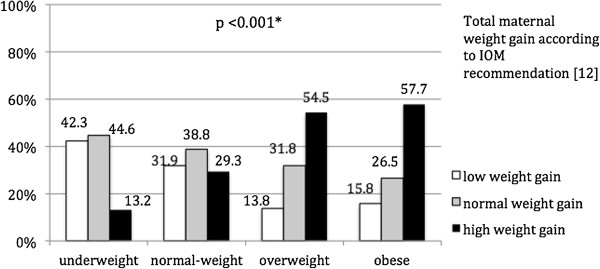
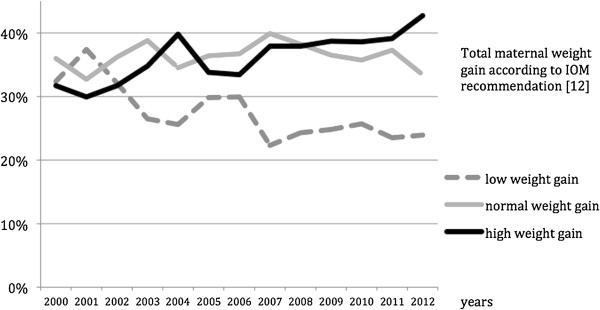
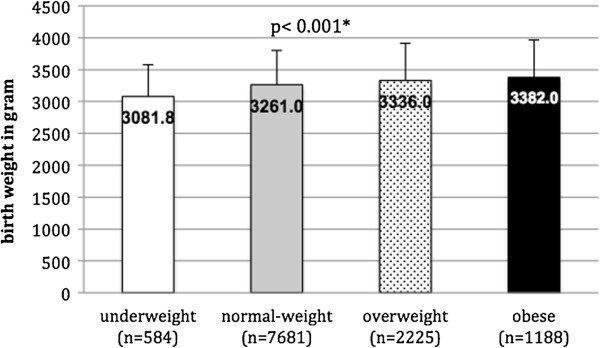
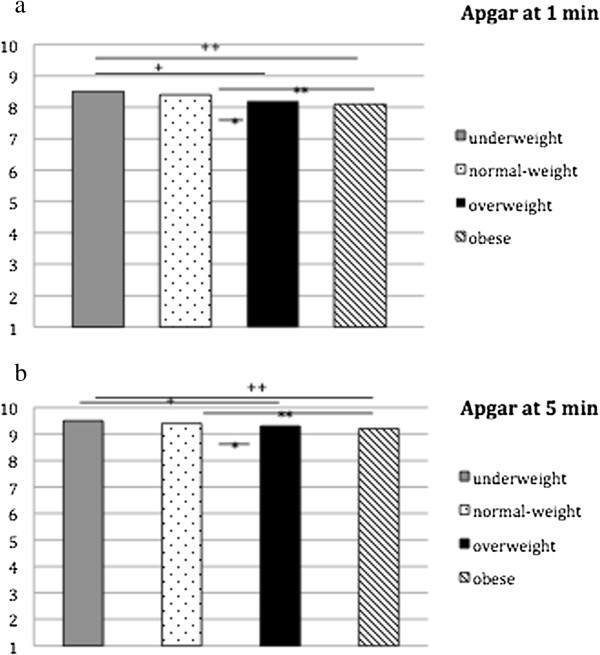
BACKGROUND: Increasing rates of overweight have been reported. In Germany, women of childbearing age are especially affected. Those women are at increased risks of several peri- and postnatal complications. The purpose of this study was to carry out Germany's first study in terms of secular trends of overweight and weight gain during pregnancy related to foetal clinical outcomes (birth weight, Apgar score and umbilical blood pH). METHODS: A database maintained by a large regional university hospital in Cologne, Germany was used to evaluate clinical routine data from 1996 to 2012. 11771 women (23.5 ± 5.4 years; 18-48 years), who gave birth to a live singleton child (>2000 gram) were included. Recommended weight gain during pregnancy was based on IOM guidelines: Total weight gain range for underweight (initial BMI < 18.5 kg/m2) is 12.5-18 kg/ 28-40 lbs respectively, for normal-weight (initial BMI 18.5 -24.9 kg/m2) is 11.5-16 kg/ 25-35 lbs respectively, for overweight (initial BMI 25.0-29.9 kg/m2) is 7-11.5 kg/ 15-25 lbs respectively and for obese (initial BMI ≥ 30.0 kg/m2) is 5-9 kg/ 11-20 lbs respectively.A one-way variance analysis was employed to test for differences in particular factors in various groups. Multiple linear regression analysis was used to model impact factors. RESULTS: Over the second analysed period (2005-2012), the number of women with high weight gain increased from 33.8% to 42.9% (p <0.001). 54.5% overweight and 57.7% obese women were affected (p <0.001). Women with high weight gain were 54.5% significantly more likely to give birth to an infant ≥ 4000 grams than women with normal (31.7%) or low weight gain (13.8%, p < 0.001). Women with normal weight gain had significantly better foetal outcomes in terms of the Apgar score at 5 min and umbilical cord blood pH. CONCLUSION: These data confirm an increase in maternal weight gain before and during pregnancy. An excessive weight gain is accompanied by macrosomia, lower Apgar scores and pH-value. Women should therefore be advised about the risks of obesity before and during pregnancy as well as excessive maternal weight gain during pregnancy.
Overview
The claims and statistics of this paper haven’t been checked yet.
Free: it reads the open-access text and checks the first 5 claims that cite a source we can check. Create a free account to check every claim.
Integrity signals
Registry
Cites
Statistics
Figures
Verification
Claims the paper makes
The claims and statistics of this paper haven’t been checked yet.
Free: it reads the open-access text and checks the first 5 claims that cite a source we can check. Create a free account to check every claim.
Claims other papers make about this one
Each is checked against this paper’s own text: does it say what the citing paper says it does?
The cited source says what the claim attributes to it.
In the citing paper
“high rates of excessive GWG (EGWG) and pre-pregnancy overweight/obesity were reported in Europe (36% and 29%, respectively) and USA (44% and 59.5%, respectively) [15, 16], while these figures were lower in China (27.6% and 6.1%, respectively) [17, 18].”
Self-check
Percentages, sums and reported differences re-computed from the paper’s own numbers.
The self-check needs the paper’s full text.
Citations
Cites
Bundesgesundheitsblatt - Gesundheitsforschung - Gesundheitsschutz
(2013) · Bundesgesundheitsblatt - Gesundheitsforschung - Gesundheitsschutz · doi:10.1007/103.1437-1588 · Cited by 11,796
Weight Gain During Pregnancy: Reexamining the Guidelines
Rasmussen, K. M., & Yaktine, A. L. (2009) · Cited by 4,493
Maternal Morbid Obesity and the Risk of Adverse Pregnancy Outcome
Cedergren, M. I. (2004) · Obstetrics & Gynecology · doi:10.1097/01.aog.0000107291.46159.00 · Cited by 1,248 · cited 2×
“Discussion Excess weight and obesity during pregnancy result in major adverse effects on both mother and child later in life [19,28,29].”
BackgroundHealth at a glance: OECD indicators
(2010) · Choice Reviews Online · doi:10.5860/choice.47-4774 · Cited by 1,236
The Continuing Value of the Apgar Score for the Assessment of Newborn Infants
Casey, B. M., McIntire, D. D., & Leveno, K. J. (2001) · New England Journal of Medicine · doi:10.1056/nejm200102153440701 · Cited by 826
Pregnancy complications and outcomes among overweight and obese nulliparous women
(2001) · American Journal of Public Health · doi:10.2105/ajph.91.3.436 · Cited by 757 · cited 1×
“obese women when compared to normal-weight women [4].”
BackgroundInterpregnancy weight change and risk of adverse pregnancy outcomes: a population-based study
Villamor, E., & Cnattingius, S. (2006) · The Lancet · doi:10.1016/s0140-6736(06)69473-7 · Cited by 756
Nohr, E. A., Vaeth, M., Baker, J. L., Sørensen, T. I., Olsen, J., & Rasmussen, K. M. (2008) · The American Journal of Clinical Nutrition · doi:10.1093/ajcn/87.6.1750 · Cited by 649 · cited 1×
“Discussion Excess weight and obesity during pregnancy result in major adverse effects on both mother and child later in life [19,28,29].”
BackgroundLashen, H. (2004) · Human Reproduction · doi:10.1093/humrep/deh277 · Cited by 577
Mensink, G. B. M., Schienkiewitz, A., Haftenberger, M., Lampert, T., Ziese, T., & Scheidt-Nave, C. (2013) · Bundesgesundheitsblatt - Gesundheitsforschung - Gesundheitsschutz · doi:10.1007/s00103-012-1656-3 · Cited by 576
Perinatal risk factors for childhood obesity and metabolic dysregulation
Catalano, P. M., Farrell, K., Thomas, A., Huston-Presley, L., Mencin, P., de Mouzon, S. H., & Amini, S. B. (2009) · The American Journal of Clinical Nutrition · doi:10.3945/ajcn.2008.27416 · Cited by 553
Increased fetal adiposity: a very sensitive marker of abnormal in utero development
Catalano, P. M., Thomas, A., Huston-Presley, L., & Amini, S. B. (2003) · American Journal of Obstetrics and Gynecology · doi:10.1016/s0002-9378(03)00828-7 · Cited by 519 · cited 1×
“Adverse effects on foetal and neonatal parameters, described in terms of the Apgar score, are also more likely [16-21].”
BackgroundEffect of Prepregnancy Maternal Overweight and Obesity on Pregnancy Outcome
Ovesen, P., Rasmussen, S., & Kesmodel, U. (2011) · Obstetrics & Gynecology · doi:10.1097/aog.0b013e3182245d49 · Cited by 491 · cited 1×
“Many findings to date have described possible long-term effects [30,31] but there are relatively few studies into such short-term effects as congenital malformations and mortality.”
BackgroundFraser, A., Tilling, K., Macdonald-Wallis, C., Sattar, N., Brion, M.-J., Benfield, L., Ness, A., Deanfield, J., Hingorani, A., Nelson, S. M., et al. (2010) · Circulation · doi:10.1161/circulationaha.109.906081 · Cited by 486 · cited 3×
“Excessive weight gain during pregnancy is associated with multiple maternal and neonatal complications like gestational hypertension, macrosomia, birth complications, caesarean delivery, stillbirth, low Apgar score at 5 minutes, hypoglycaemia or cardiovascular risk factors [7-11].”
BackgroundMalin, G. L., Morris, R. K., & Khan, K. S. (2010) · BMJ · doi:10.1136/bmj.c1471 · Cited by 461 · cited 3×
“In addition, low Apgar scores and lower umbilical cord blood pH are associated with neonatal mortality and morbidity, spasticity and long term outcomes like cerebral palsy [27,35,36].”
BackgroundMethodObesity, insulin resistance, and pregnancy outcome
Catalano, P. M. (2010) · Reproduction · doi:10.1530/rep-10-0088 · Cited by 447
American Academy of Pediatrics, Committee on Fetus and Newborn, American College of Obstetricians and Gynecologists, & Committee on Obstetric Practice (2006) · Pediatrics · doi:10.1542/peds.2006-0325 · Cited by 371
The effect of gestational weight gain by body mass index on maternal and neonatal outcomes
Crane, J. M. G., White, J., Murphy, P., Burrage, L., & Hutchens, D. (2009) · Journal of Obstetrics and Gynaecology Canada · doi:10.1016/s1701-2163(16)34050-6 · Cited by 363 · cited 1×
“Excessive weight gain during pregnancy is associated with multiple maternal and neonatal complications like gestational hypertension, macrosomia, birth complications, caesarean delivery, stillbirth, low Apgar score at 5 minutes, hypoglycaemia or cardiovascular risk factors [7-11].”
BackgroundNeonatal mortality rate: Relationship to birth weight and gestational age
Lubchenco, L. O., Searls, D. T., & Brazie, J. V. (1972) · The Journal of Pediatrics · doi:10.1016/s0022-3476(72)80114-8 · Cited by 305
Overweight and obesity in Germany
Mensink, G., Schienkiewitz, A., Haftenberger, M., Lampert, T., Ziese, T., & Scheidt‐Nave, C. (2013) · PubMed · doi:10.25646/1440 · Cited by 297
Chu, S. Y., Callaghan, W. M., Bish, C. L., & D'Angelo, D. (2009) · American Journal of Obstetrics and Gynecology · doi:10.1016/j.ajog.2008.09.879 · Cited by 292 · cited 2×
“It is particularly noticeable that overweight and obese women gain much more weight during pregnancy than normal-weight women [5,6].”
BackgroundPredictors of Obesity in Childhood, Adolescence, and Adulthood in a Birth Cohort
Rooney, B. L., Mathiason, M. A., & Schauberger, C. W. (2011) · Maternal and Child Health Journal · doi:10.1007/s10995-010-0689-1 · Cited by 268 · cited 1×
“Macrosomic new-borns are more likely than other infants to be obese in childhood, adolescents and early adulthood [33] and are at risk of cardiovascular and metabolic risk factors later in life [15,34].”
BackgroundGestational Weight Gain and Adverse Neonatal Outcome among Term Infants
Stotland, N. E., Cheng, Y. W., Hopkins, L. M., & Caughey, A. B. (2006) · Obstetrics & Gynecology · doi:10.1097/01.aog.0000228960.16678.bd · Cited by 250 · cited 4×
“[9] also provided evidence that underlined a relationship between excessive weight gain, large size for gestational age, lower Apgar scores (<7) at five minutes, and lower umbilical cord blood pH.”
BackgroundMethodInfluentialDiagnosis of birth asphyxia on the basis of fetal pH, Apgar score, and newborn cerebral dysfunction
Gilstrap, L. C., Leveno, K. J., Burris, J., Lynne Williams, M., & Little, B. B. (1989) · American Journal of Obstetrics and Gynecology · doi:10.1016/0002-9378(89)90410-9 · Cited by 244 · cited 2×
“Therefore, the measurement of umbilical cord blood pH has been adopted as an addition to the Apgar score for assessing the condition of the new-borns [24].”
MethodMoster, D., Lie, R. T., Irgens, L. M., Bjerkedal, T., & Markestad, T. (2001) · The Journal of Pediatrics · doi:10.1067/mpd.2001.114694 · Cited by 239
Evaluation of Gestational Weight Gain Guidelines for Women With Normal Prepregnancy Body Mass Index
DeVader, S. R., Neeley, H. L., Myles, T. D., & Leet, T. L. (2007) · Obstetrics & Gynecology · doi:10.1097/01.aog.0000284451.37882.85 · Cited by 234
Obesity, gestational weight gain and preterm birth: a study within the Danish National Birth Cohort
Nohr, E. A., Bech, B. H., Vaeth, M., Rasmussen, K. M., Henriksen, T. B., & Olsen, J. (2007) · Paediatric and Perinatal Epidemiology · doi:10.1111/j.1365-3016.2007.00762.x · Cited by 205
The Apgar score revisited: Influence of gestational age
Catlin, E. A., Carpenter, M. W., Brann, B. S., Mayfield, S. R., Shaul, P. W., Goldstein, M., & Oh, W. (1986) · The Journal of Pediatrics · doi:10.1016/s0022-3476(86)80715-6 · Cited by 199 · cited 1×
“In addition, the Apgar score at one and five minutes after birth are directly related to gestational age [38].”
BackgroundPostpartum weight change: how much of the weight gained in pregnancy will be lost after delivery?
Greene, G. W., Smiciklas‐Wright, H., Scholl, T. O., & Karp, R. J. (1988) · PubMed · Cited by 157
Hedderson, M. M., Weiss, N. S., Sacks, D. A., Pettitt, D. J., Selby, J. V., Quesenberry, C. P., & Ferrara, A. (2006) · Obstetrics & Gynecology · doi:10.1097/01.aog.0000242568.75785.68 · Cited by 148 · cited 1×
“Excessive weight gain during pregnancy is associated with multiple maternal and neonatal complications like gestational hypertension, macrosomia, birth complications, caesarean delivery, stillbirth, low Apgar score at 5 minutes, hypoglycaemia or cardiovascular risk factors [7-11].”
BackgroundHigher infant body fat with excessive gestational weight gain in overweight women
Hull, H. R., Thornton, J. C., Ji, Y., Paley, C., Rosenn, B., Mathews, P., Navder, K., Yu, A., Dorsey, K., & Gallagher, D. (2011) · American Journal of Obstetrics and Gynecology · doi:10.1016/j.ajog.2011.04.004 · Cited by 136 · cited 1×
“In addition, studies have found excessive maternal weight gain [12] in overweight women to be associated with a higher percentage of fat mass in their children compared to children of normal-weight women [13].”
BackgroundNeonatal Macrosomia Is an Independent Risk Factor for Adult Metabolic Syndrome
Hermann, G. M., Dallas, L. M., Haskell, S. E., & Roghair, R. D. (2010) · Neonatology · doi:10.1159/000285629 · Cited by 119 · cited 1×
“Macrosomic new-borns are more likely than other infants to be obese in childhood, adolescents and early adulthood [33] and are at risk of cardiovascular and metabolic risk factors later in life [15,34].”
BackgroundErste Ergebnisse aus der „Studie zur Gesundheit Erwachsener in Deutschland“ (DEGS)
Kurth, B. (2013) · Publication server of the Robert Koch Institute (Robert Kock Institute) · doi:10.1007/s00103-011-1504-5 · Cited by 88 · cited 1×
“Background Findings from the largest nationally and internationally representative studies have shown that the number of overweight and obese adults is increasing [1-3].”
Erste Ergebnisse aus der - Studie zur Gesundheit Erwachsener in Deutschland? (DEGS)
(2012) · Bundesgesundheitsblatt - Gesundheitsforschung - Gesundheitsschutz · doi:10.1007/s00103-012-1504-5 · Cited by 88
Newborn assessment and long-term adverse outcome: A systematic review
van de Riet, J. E., Vandenbussche, F. P. H. A., le Cessie, S., & Keirse, M. J. N. C. (1999) · American Journal of Obstetrics and Gynecology · doi:10.1016/s0002-9378(99)70676-9 · Cited by 85 · cited 1×
“In addition, low Apgar scores and lower umbilical cord blood pH are associated with neonatal mortality and morbidity, spasticity and long term outcomes like cerebral palsy [27,35,36].”
BackgroundGestational weight gain: influences on the long-term health of the child
Poston, L. (2012) · Current Opinion in Clinical Nutrition & Metabolic Care · doi:10.1097/mco.0b013e3283527cf2 · Cited by 83 · cited 1×
“Many findings to date have described possible long-term effects [30,31] but there are relatively few studies into such short-term effects as congenital malformations and mortality.”
BackgroundACOG Committee Opinion No. 333: The Apgar Score
(2006) · Obstetrics & Gynecology · doi:10.1097/00006250-200605000-00051 · Cited by 74
Maternal obesity and neonatal Apgar scores
Chen, M., Mcniff, C., Madan, J. C., Goodman, E., Davis, J. M., & Dammann, O. (2009) · The Journal of Maternal-Fetal & Neonatal Medicine · doi:10.3109/14767050903168440 · Cited by 71
Maternal obesity in pregnancy.
Calandra, C., Abell, D. A., & Beischer, N. A. (1981) · PubMed · Cited by 66
Weight gain during pregnancy: adherence to Health Canada's guidelines.
Lowell, H., & Miller, D. C. (2010) · PubMed · Cited by 64
Gestational Age–Dependent Reference Values for pH in Umbilical Cord Arterial Blood at Term
Kitlinski, M. L., Källén, K., Marsál, K., & Olofsson, P. (2003) · Obstetrics & Gynecology · doi:10.1097/00006250-200308000-00023 · Cited by 56 · cited 2×
“Nevertheless, Kitlinski et al. 2003 [39] found that within the interval of 37–41 weeks no association between gestational age and a low Apgar score was demonstrated, but a statistically significant positive association between a gestational age of 41 3/7 weeks or more and Apgar score less than 7 at…”
BackgroundImpact of obesity on incision-to-delivery interval and neonatal outcomes at cesarean delivery
Conner, S. N., Tuuli, M. G., Longman, R. E., Odibo, A. O., Macones, G. A., & Cahill, A. G. (2013) · American Journal of Obstetrics and Gynecology · doi:10.1016/j.ajog.2013.05.054 · Cited by 50 · cited 1×
“A lower Apgar score is associated with lower levels of umbilical cord pH, especially in morbidly obese women (BMI >50 kg/m(2)) [25].”
BackgroundGesundheit von Erwachsenen in Deutschland (DEGS1 2008-2012)
Kamtsiuris, P., Dölle, R., & Robert Koch-Institut, A. F. E. U. G. (2015) · Publication server of the Robert Koch Institute (Robert Kock Institute) · doi:10.7797/16-200812-1-1-1 · Cited by 38
The Adverse Impact of Maternal Obesity on Intrapartum and Perinatal Outcomes
Vinayagam, D., & Chandraharan, E. (2012) · ISRN Obstetrics and Gynecology · doi:10.5402/2012/939762 · Cited by 36 · cited 1×
“Adverse effects on foetal and neonatal parameters, described in terms of the Apgar score, are also more likely [16-21].”
BackgroundCould maternal pre-pregnancy body mass index affect Apgar score?
Sekhavat, L., & Fallah, R. (2012) · Archives of Gynecology and Obstetrics · doi:10.1007/s00404-012-2503-3 · Cited by 15 · cited 1×
“The children of overweight or obese women, for instance, more commonly achieve lower Apgar scores at five minutes than the children of normal-weight mothers [22,23].”
Background
Cited by
Martínez‐Hortelano, J. A., Cavero‐Redondo, I., Álvarez‐Bueno, C., Garrido‐Miguel, M., Soriano‐Cano, A., & Martínez‐Vizcaíno, V. (2020) · BMC Pregnancy and Childbirth · doi:10.1186/s12884-020-03335-7 · Cited by 167
“The year of recruitment showed that GWG is rising in all regions, according to previous studies in all regions [5, 6].”
BackgroundMethodResultInfluentialSimko, M., Totka, A., Vondrova, D., Samohyl, M., Jurkovicova, J., Trnka, M., Cibulkova, A., Stofko, J., & Argalasova, L. (2019) · International Journal of Environmental Research and Public Health · doi:10.3390/ijerph16101751 · Cited by 112
Kunath, J., Günther, J., Rauh, K., Hoffmann, J., Stecher, L., Rosenfeld, E., Kick, L., Ulm, K., & Hauner, H. (2019) · BMC Medicine · doi:10.1186/s12916-018-1235-z · Cited by 108
Simko, M., Totka, A., Vondrova, D., Samohyl, M., Jurkovicova, J., Trnka, M., Cibulkova, A., Stofko, J., & Argalasova, L. (2019) · doi:10.20944/preprints201904.0130.v1 · Cited by 112
Ke, J.-F., Liu, S., Ge, R.-L., Ma, L., & Li, M.-F. (2023) · BMC Pregnancy and Childbirth · doi:10.1186/s12884-023-05657-8 · Cited by 50
“5%, respectively) [15, 16], while these figures were lower in China (27.”
Background
Metadata
- Authors
- Ferrari, N., Mallmann, P., Brockmeier, K., Strüder, H. K., & Graf, C.
- Affiliations
- University Hospital Cologne (DE)
- German Sport University Cologne (DE)
- Corresponding author
- Ferrari, Nina
- Venue
- BMC Pregnancy and Childbirth
- Published
- 2014-07-15
- Volume
- 14
- Issue
- 1
- Pages
- 228-228
- ISSN
- 1471-2393 (ISSN-L)
- PMC
- PMC4223617
- OpenAlex
- W2091783321
- Semantic Scholar
- ba49ad84f1d60908d8d44b1c9903d51cb08f8e98
- Cited by
- 43
- References
- 45
- Citations by year
- 2025: 1 · 2024: 3 · 2023: 5 · 2022: 6 · 2021: 1 · 2020: 10 · 2019: 7 · 2017: 2 · 2016: 2 · 2015: 6
- FWCI
- 3.54
- Type
- journal article
- Language
- en
- Open access
- gold
- doi.org
- Licence
- Locations
- BMC Pregnancy and Childbirth (publishedVersion, cc-by)
- Europe PMC (PubMed Central) (publishedVersion, cc-by)
- PubMed Central (publishedVersion, cc-by)
- PubMed (publishedVersion)
- Kölner Universitäts PublikationsServer (Universität zu Köln) (publishedVersion)
- Funders
- Universitätsklinikum Köln
- Topics
- Health Sciences › Medicine › Obstetrics and Gynecology › Gestational Diabetes Research and Management
- Health Sciences › Medicine › Pediatrics, Perinatology and Child Health › Maternal and Neonatal Healthcare
- Health Sciences › Medicine › Public Health, Environmental and Occupational Health › Obesity, Physical Activity, Diet
- Keywords
- weight gain, secular trends, maternal overweight, maternal obesity, fetal outcomes, birth weight, Apgar score, umbilical cord pH, IOM weight gain guidelines, German women
- MeSH terms
- Adolescent, Adult, Apgar Score, Birth Weight, Female, Fetal Blood, Fetal Macrosomia, Germany, Humans, Hydrogen-Ion Concentration, Infant, Newborn, Middle Aged, Obesity, Pregnancy, Weight Gain, Young Adult
About these checks
Registry, retraction, Cites and statistics results are computed, not judged, with one exception: a printed reference that no index lists is read once by a model before it counts as a citation error. Claims are extracted by a model and kept only when their quote appears verbatim in the text; each cited source is then checked, with a model’s help, for whether it says what the claim relies on. Those verdicts can be wrong — read the claim’s quote and the cited source before relying on one.
Statistics and arithmetic are recomputed, not judged.
Confidence bands are shown only for fields calibrated on our annotated test set. None is calibrated yet, so no band is shown.
What counts as a claim ›How we measure confidence ›How we check this ›
Are you an author, or do you see a problem with this page? Request a review
Data sources
Bibliographic data: Semantic Scholar, OpenAlex, Crossref.
Contains information from the Semantic Scholar Academic Graph Datasets, made available under the ODC Attribution License (ODC-BY 1.0).
Semantic Scholar’s data is described in: Kinney, R., et al. (2023). The Semantic Scholar Open Data Platform. arXiv:2301.10140.
