

Combined mutations of ASXL1, CBL, FLT3, IDH1, IDH2, JAK2, KRAS, NPM1, NRAS, RUNX1, TET2 and WT1 genes in myelodysplastic syndromes and acute myeloid leukemias
Open accessThe DOI matches its Crossref record; 41 of the 41 references it cites were found in a registry or an index.
Abstract
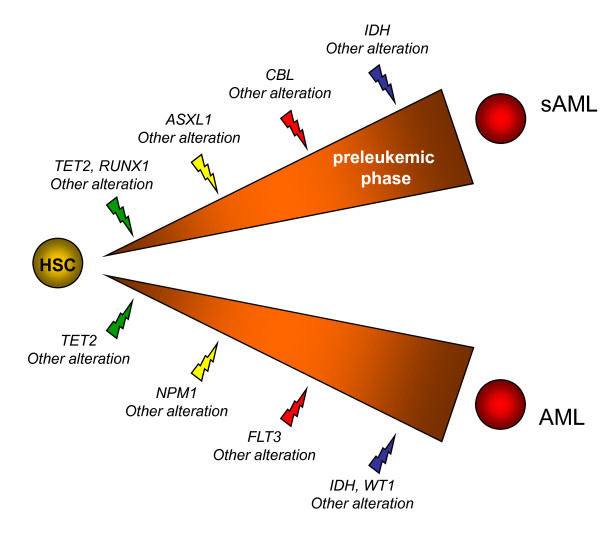
Background: Gene mutation is an important mechanism of myeloid leukemogenesis. However, the number and combination of gene mutated in myeloid malignancies is still a matter of investigation. Methods: We searched for mutations in the ASXL1, CBL, FLT3, IDH1, IDH2, JAK2, KRAS, NPM1, NRAS, RUNX1, TET2 and WT1 genes in 65 myelodysplastic syndromes (MDSs) and 64 acute myeloid leukemias (AMLs) without balanced translocation or complex karyotype. Results: Mutations in ASXL1 and CBL were frequent in refractory anemia with excess of blasts. Mutations in TET2 occurred with similar frequency in MDSs and AMLs and associated equally with either ASXL1 or NPM1 mutations. Mutations of RUNX1 were mutually exclusive with TET2 and combined with ASXL1 but not with NPM1. Mutations in FLT3 (mutation and internal tandem duplication), IDH1, IDH2, NPM1 and WT1 occurred primarily in AMLs. Conclusion: Only 14% MDSs but half AMLs had at least two mutations in the genes studied. Based on the observed combinations and exclusions we classified the 12 genes into four classes and propose a highly speculative model that at least a mutation in one of each class is necessary for developing AML with simple or normal karyotype.
Overview
The claims and statistics of this paper haven’t been checked yet.
Free: it reads the open-access text and checks the first 5 claims that cite a source we can check. Create a free account to check every claim.
Integrity signals
Registry
Cites
Statistics
Figures
Verification
Claims the paper makes
The claims and statistics of this paper haven’t been checked yet.
Free: it reads the open-access text and checks the first 5 claims that cite a source we can check. Create a free account to check every claim.
Claims other papers make about this one
Each is checked against this paper’s own text: does it say what the citing paper says it does?
In the citing paper
“Mutations in some chromatin modifying enzyme genes (e.g., ASXL1, EZH2) increase in frequency from MDS to AML (55–57).”
From CpG methylation patterns and decitabine treatment response in acute myeloid leukemia cells and normal hematopoietic precursors (2012) · cites this paper as [55]
Self-check
Percentages, sums and reported differences re-computed from the paper’s own numbers.
The self-check needs the paper’s full text.
Citations
Cites
Vardiman, J. W., Thiele, J., Arber, D. A., Brunning, R. D., Borowitz, M. J., Porwit, A., Harris, N. L., Le Beau, M. M., Hellström-Lindberg, E., Tefferi, A., et al. (2009) · Blood · doi:10.1182/blood-2009-03-209262 · Cited by 4,424 · cited 1×
“They included 65 cases of MDS (Additional file 1Table S1), comprising, according to the WHO criteria [17], 5 refractory anemia (RA), 13 refractory anemia with ring sideroblasts (RARS) (including one with myelofibrosis), 7 refractory cytopenia with multilineage dysplasia (RCMD), 16 refractory anemia with excess of blas…”
MethodCancer-associated IDH1 mutations produce 2-hydroxyglutarate
Dang, L., White, D. W., Gross, S., Bennett, B. D., Bittinger, M. A., Driggers, E. M., Fantin, V. R., Jang, H. G., Jin, S., Keenan, M. C., et al. (2009) · Nature · doi:10.1038/nature08617 · Cited by 4,154
Recurring mutations found by sequencing an acute myeloid leukemia genome
Mardis, E. R., Ding, L., Dooling, D. J., Larson, D. E., McLellan, M. D., Chen, K., Koboldt, D. C., Fulton, R. S., Delehaunty, K. D., McGrath, S. D., et al. (2009) · New England Journal of Medicine · doi:10.1056/nejmoa0903840 · Cited by 2,219 · cited 14×
“DNA sequencing of exon-coding sequences of ASXL1, CBL, FLT3, IDH1, IDH2, JAK2, KRAS, NPM1, NRAS, RUNX1, TET2 and WT1 was done as follows.”
BackgroundInfluentialWard, P. S., Patel, J., Wise, D. R., Abdel-Wahab, O., Bennett, B. D., Coller, H. A., Cross, J. R., Fantin, V. R., Hedvat, C. V., Perl, A. E., et al. (2010) · Cancer Cell · doi:10.1016/j.ccr.2010.01.020 · Cited by 2,020
Mutation in TET2 in Myeloid Cancers
Delhommeau, F., Dupont, S., Valle, V. D., James, C., Trannoy, S., Massé, A., Kosmider, O., Le Couedic, J.-P., Robert, F., Alberdi, A., et al. (2009) · New England Journal of Medicine · doi:10.1056/nejmoa0810069 · Cited by 1,776 · cited 15×
“DNA sequencing of exon-coding sequences of ASXL1, CBL, FLT3, IDH1, IDH2, JAK2, KRAS, NPM1, NRAS, RUNX1, TET2 and WT1 was done as follows.”
BackgroundInfluentialGreenberg, P. L., Attar, E. C., Bennett, J. M., Bloomfield, C. D., Borate, U., Castro, C. M. D., Deeg, H. J., Frankfurt, O., Gaensler, K. M. L., Garcia-Manero, G., et al. (2013) · Journal of the National Comprehensive Cancer Network · doi:10.6004/jnccn.2013.0104 · Cited by 1,639
Inactivating mutations of the histone methyltransferase gene EZH2 in myeloid disorders
Ernst, T., Chase, A. J., Score, J., Hidalgo-Curtis, C. E., Bryant, C., Jones, A. V., Waghorn, K., Zoi, K., Ross, F. M., Reiter, A., et al. (2010) · Nature Genetics · doi:10.1038/ng.621 · Cited by 1,139
Grisendi, S., Mecucci, C., Falini, B., & Pandolfi, P. P. (2006) · Nature Reviews Cancer · doi:10.1038/nrc1885 · Cited by 850 · cited 1×
“NPM1 overexpression leads to increased cell growth [38].”
BackgroundSomatic mutations of the histone H3K27 demethylase gene UTX in human cancer
van Haaften, G., Dalgliesh, G. L., Davies, H., Chen, L., Bignell, G., Greenman, C., Edkins, S., Hardy, C., O'Meara, S., Teague, J., et al. (2009) · Nature Genetics · doi:10.1038/ng.349 · Cited by 784 · cited 3×
“32. van Haaften G, Dalgliesh GL, Davies H, Chen L, Bignell G, Greenman C, Edkins S, Hardy C, O’Meara S, Teague J, Butler A, Hinton J, Latimer C, Andrews J, Barthorpe S, Beare D, Buck G, Campbell PJ, Cole J, Forbes S, Jia M, Jones D, Kok CY, Leroy C, Lin ML, McBride DJ, Maddison M, Maquire S, McLay K, Menzies A, Mirone…”
BackgroundSomatic mutations of the histone methyltransferase gene EZH2 in myelodysplastic syndromes
Nikoloski, G., Langemeijer, S. M. C., Kuiper, R. P., Knops, R., Massop, M., Tönnissen, E. R. L. T. M., van der Heijden, A., Scheele, T. N., Vandenberghe, P., de Witte, T., et al. (2010) · Nature Genetics · doi:10.1038/ng.620 · Cited by 755 · cited 1×
“Indeed, our study did not include several target genes, such as CBFB [30], CDKN1A/B, CEBPA, ETV6, KIT, NF1, NFIA [31], P53, RB1 and UTX [32]; it did not include either a search for the recently discovered mutations of the EZH2 gene [33,34].”
Background
Cited by
Clinical Effect of Point Mutations in Myelodysplastic Syndromes
Bejar, R., Stevenson, K., Abdel-Wahab, O., Galili, N., Nilsson, B., Garcia-Manero, G., Kantarjian, H., Raza, A., Levine, R. L., Neuberg, D., et al. (2011) · New England Journal of Medicine · doi:10.1056/nejmoa1013343 · Cited by 1,627
Crystal Structure of TET2-DNA Complex: Insight into TET-Mediated 5mC Oxidation
Hu, L., Li, Z., Cheng, J., Rao, Q., Gong, W., Liu, M., Shi, Y. G., Zhu, J., Wang, P., & Xu, Y. (2013) · Cell · doi:10.1016/j.cell.2013.11.020 · Cited by 450
Gaidzik, V. I., Bullinger, L., Schlenk, R. F., Zimmermann, A. S., Röck, J., Paschka, P., Corbacioglu, A., Krauter, J., Schlegelberger, B., Ganser, A., et al. (2011) · Journal of Clinical Oncology · doi:10.1200/jco.2010.30.7926 · Cited by 456
Dynamics of clonal evolution in myelodysplastic syndromes
Makishima, H., Yoshizato, T., Yoshida, K., Sekeres, M. A., Radivoyevitch, T., Suzuki, H., Przychodzen, B., Nagata, Y., Meggendorfer, M., Sanada, M., et al. (2017) · Nature Genetics · doi:10.1038/ng.3742 · Cited by 422
WT1 Recruits TET2 to Regulate Its Target Gene Expression and Suppress Leukemia Cell Proliferation
Wang, Y., Xiao, M., Chen, X., Chen, L., Xu, Y., Lv, L., Wang, P., Yang, H., Ma, S., Lin, H., et al. (2015) · Molecular Cell · doi:10.1016/j.molcel.2014.12.023 · Cited by 304
“In addition to IDH1, IDH2 and TET2, wilm’s tumor gene, WT1, is also frequently mutated in AML (2013; Fernandez-Mercado et al., 2012; Liang et al., 2013; Patel et al., 2012; Rocquain et al., 2010; Welch et al., 2012).”
InfluentialGelsi-Boyer, V., Brecqueville, M., Devillier, R., Murati, A., Mozziconacci, M.-J., & Birnbaum, D. (2012) · Journal of Hematology & Oncology · doi:10.1186/1756-8722-5-12 · Cited by 278
“With the exception of NPM1 and FLT3, it seems that ASXL1 mutations coincide with mutations in many known genes including EZH2 [18], IDH1/2, RUNX1 and TET2 [21,22].”
BackgroundInfluentialSelf-citationIm, A. P., Sehgal, A. R., Carroll, M. P., Smith, B. D., Tefferi, A., Johnson, D. E., & Boyiadzis, M. (2014) · Leukemia · doi:10.1038/leu.2014.124 · Cited by 267
Prognostic Significance of ASXL1 Mutations in Patients With Myelodysplastic Syndromes
Thol, F., Friesen, I., Damm, F., Yun, H., Weissinger, E. M., Krauter, J., Wagner, K., Chaturvedi, A., Sharma, A., Wichmann, M., et al. (2011) · Journal of Clinical Oncology · doi:10.1200/jco.2010.33.4938 · Cited by 277
Mutant nucleophosmin and cooperating pathways drive leukemia initiation and progression in mice
Vassiliou, G. S., Cooper, J. L., Rad, R., Li, J., Rice, S., Uren, A., Rad, L., Ellis, P., Andrews, R., Banerjee, R., et al. (2011) · Nature Genetics · doi:10.1038/ng.796 · Cited by 233
“Observations from whole genome sequencing studies are generating data in support of such a model in this and other subgroups of AML E u r op e P M C F und e r s A u t ho r M a nu s c r i p t s E u r op e P M C F und e r s A u t ho r M a nu s c r i p t s with a normal karyotype 10 , 28 .”
Gelsi‐Boyer, V., Trouplin, V., Roquain, J., Adélaïde, J., Carbuccia, N., Esterni, B., Finetti, P., Murati, A., Arnoulet, C., Zerazhi, H., et al. (2010) · British Journal of Haematology · doi:10.1111/j.1365-2141.2010.08381.x · Cited by 222
Self-citationSchnittger, S., Eder, C., Jeromin, S., Alpermann, T., Fasan, A., Grossmann, V, Kohlmann, A., Illig, T., Klopp, N., Wichmann, H.-E., et al. (2013) · Leukemia · doi:10.1038/leu.2012.262 · Cited by 211
Gaidzik, V. I., Paschka, P., Späth, D., Habdank, M., Köhne, C.-H., Germing, U., von Lilienfeld-Toal, M., Held, G., Horst, H.-A., Haase, D., et al. (2012) · Journal of Clinical Oncology · doi:10.1200/jco.2011.39.2886 · Cited by 185
Myelodysplastic syndromes are induced by histone methylation–altering ASXL1 mutations
Inoue, D., Kitaura, J., Togami, K., Nishimura, K., Enomoto, Y., Uchida, T., Kagiyama, Y., Kawabata, K. C., Nakahara, F., Izawa, K., et al. (2013) · Journal of Clinical Investigation · doi:10.1172/jci70739 · Cited by 172
“In this model, co-transduction of ASXL1-MT, but not ASXL1-WT, with N-Ras-G12V significantly shortened latency when compared with mice transplanted with BM cells transduced with N-Ras-G12V alone (Figure 6A and data not shown) and increased the number of immature blast cells (35% vs. 15%), indicating that the combinatio…”
InfluentialBrecqueville, M., Rey, J., Bertucci, F., Coppin, E., Finetti, P., Carbuccia, N., Cervera, N., Gelsi‐Boyer, V., Arnoulet, C., Gisserot, O., et al. (2012) · Genes, Chromosomes and Cancer · doi:10.1002/gcc.21960 · Cited by 158
“ASXL1 mutations are associated with secondary AML (Carbuccia et al., 2010; Rocquain et al., 2010).”
BackgroundSelf-citationDella Gatta, G., Palomero, T., Perez-Garcia, A., Ambesi-Impiombato, A., Bansal, M., Carpenter, Z. W., De Keersmaecker, K., Sole, X., Xu, L., Paietta, E., et al. (2012) · Nature Medicine · doi:10.1038/nm.2610 · Cited by 150
The role of ASXL1 in hematopoiesis and myeloid malignancies
Asada, S., Fujino, T., Goyama, S., & Kitamura, T. (2019) · Cellular and Molecular Life Sciences · doi:10.1007/s00018-019-03084-7 · Cited by 152
Ohgami, R. S., Ma, L., Merker, J. D., Gotlib, J. R., Schrijver, I., Zehnder, J. L., & Arber, D. A. (2015) · Modern Pathology · doi:10.1038/modpathol.2014.160 · Cited by 141
Myeloid malignancies: mutations, models and management
Murati, A., Brecqueville, M., Devillier, R., Mozziconacci, M.-J., Gelsi-Boyer, V., & Birnbaum, D. (2012) · BMC Cancer · doi:10.1186/1471-2407-12-304 · Cited by 139
“For example, in MDSs, it is highly conceivable that the current prognostic index used for the evaluation of the disease (IPSS), which already Initial step Second step Third step Fourth step ER (TET2) TF (RUNX1) Signaling (RAS) Signaling (FLT3) Signaling (CBL) Signaling (JAK2) ER (IDH1) ER (BCORL1) Miscellaneous (Tri 8…”
BackgroundInfluentialSelf-citationThe Role of IDH Mutations in Acute Myeloid Leukemia
Bravo, G. M., & Dinardo, C. D. (2018) · Future Oncology · doi:10.2217/fon-2017-0523 · Cited by 142
IDH1 and IDH2 mutations in myelodysplastic syndromes and role in disease progression
DiNardo, C. D., Jabbour, E., Ravandi, F., Takahashi, K., Daver, N., Routbort, M., Patel, K. P., Brandt, M., Pierce, S., Kantarjian, H., et al. (2016) · Leukemia · doi:10.1038/leu.2015.211 · Cited by 112
CRL4VprBP E3 Ligase Promotes Monoubiquitylation and Chromatin Binding of TET Dioxygenases
Nakagawa, T., Lv, L., Nakagawa, M., Yu, Y., Yu, C., D’Alessio, A. C., Nakayama, K., Fan, H.-Y., Chen, X., & Xiong, Y. (2015) · Molecular Cell · doi:10.1016/j.molcel.2014.12.002 · Cited by 107
“Intriguingly, we found mutations of only two lysine residues in TET2: K1117 (Gelsi-Boyer et al., 2009; Rocquain et al., 2010) and K1299 (Delhommeau et al., 2009; Jankowska et al., 2009; Kosmider et al., 2009).”
InfluentialBaştürk, O., Tan, M. C. B., Bhanot, U. K., Allen, P. J., Adsay, V. N., Scott, S. N., Shah, R. H., Berger, M. F., Askan, G., Dikoglu, E., et al. (2016) · Modern Pathology · doi:10.1038/modpathol.2016.98 · Cited by 113
How we treat higher-risk myelodysplastic syndromes
Sekeres, M. A., & Cutler, C. S. (2013) · Blood · doi:10.1182/blood-2013-08-496935 · Cited by 110
Lin, J., Yao, D., Qian, J., Chen, Q., Qian, W., Li, Y., Yang, J. C., Wang, C., Chai, H., Qian, Z. Y., et al. (2011) · Annals of Hematology · doi:10.1007/s00277-011-1352-7 · Cited by 99
Chen, T.-C., Hou, H.-A., Chou, W.-C., Tang, J.-L., Kuo, Y.-Y., Chen, C.-Y., Tseng, M.-H., Huang, C.-F., Lai, Y.-J., Chiang, Y.-C., et al. (2014) · Blood Cancer Journal · doi:10.1038/bcj.2013.74 · Cited by 96
D-2-hydroxyglutarate produced by mutant IDH2 causes cardiomyopathy and neurodegeneration in mice
Akbay, E. A., Moslehi, J., Christensen, C. L., Saha, S., Tchaicha, J. H., Ramkissoon, S. H., Stewart, K. M., Carretero, J., Kikuchi, E., Zhang, H., et al. (2014) · Genes & Development · doi:10.1101/gad.231233.113 · Cited by 87
“…nearly all IDH mutations in human tumors are invariably concurrent with additional genetic alterations (such as inactivation of TP53 or P14ARF) or deletion of 1p/19q in glioma patients (Ichimura et al. 2009) and with NRAS, ASXL1, or FLT3 mutations in leukemia patients (Rocquain et al. 2010).”
BackgroundNegrotto, S., Ng, K. P., Jankowska, A. M., Bodo, J., Gopalan, B., Guinta, K., Mulloy, J. C., Hsi, E., Maciejewski, J., & Saunthararajah, Y. (2012) · Leukemia · doi:10.1038/leu.2011.207 · Cited by 90
Kar, S. A., Jankowska, A., Makishima, H., Visconte, V., Jerez, A., Sugimoto, Y., Muramatsu, H., Traina, F., Afable, M. G., Guinta, K. M., et al. (2012) · Haematologica · doi:10.3324/haematol.2012.064048 · Cited by 88
“The goals of this study were to include newly discovered spliceosomal mutations(4,6,7,23,24) in the context of previously known molecular lesions to enrich the previous catalogue of somatic mutations characterizing CMML, as demonstrated through screens by our group(2) and others.(3,25) In addition to the inclusion of…”
BackgroundRUNX1 is required for oncogenic Myb and Myc enhancer activity in T-cell acute lymphoblastic leukemia
Choi, A., Illendula, A., Pulikkan, J. A., Roderick, J. E., Tesell, J., Yu, J., Hermance, N. M., Zhu, L. J., Castilla, L. H., Bushweller, J. H., et al. (2017) · Blood · doi:10.1182/blood-2017-03-775536 · Cited by 93
TET2 promoter methylation in low-grade diffuse gliomas lacking IDH1/2 mutations: Figure 1
Kim, Y.-H., Pierscianek, D., Mittelbronn, M., Vital, A., Mariani, L., Hasselblatt, M., & Ohgaki, H. (2011) · Journal of Clinical Pathology · doi:10.1136/jclinpath-2011-200133 · Cited by 74
Posttranslational modifications of RUNX1 as potential anticancer targets
Goyama, S., Huang, G., Kurokawa, M., & Mulloy, J. C. (2014) · Oncogene · doi:10.1038/onc.2014.305 · Cited by 77
Ten Eleven Translocation Enzymes and 5-Hydroxymethylation in Mammalian Development and Cancer
Kinney, S. R. M., & Pradhan, S. (2012) · Advances in experimental medicine and biology · doi:10.1007/978-1-4419-9967-2_3 · Cited by 77
AML with Myelodysplasia-Related Changes: Development, Challenges, and Treatment Advances
Koenig, K. L., Sahasrabudhe, K. D., Sigmund, A. M., & Bhatnagar, B. (2020) · Genes · doi:10.3390/genes11080845 · Cited by 77
Fernández‐Mercado, M., Yip, B. H., Pellagatti, A., Davies, C. H., Larráyoz, M. J., Kondo, T., Pérez, C., Killick, S. B., McDonald, E.-J., Odero, M. D., et al. (2012) · PLoS ONE · doi:10.1371/journal.pone.0042334 · Cited by 72
“[2,3,4,5,6,7,8,9,10,11,12,13,14,15,16,17] The characterisation of cases by the presence or absence of mutations in these selected genes should allow a molecular dissection of cases of CNAML into different biological and prognostic groups, as well as achieving the long sought after goal of molecular monitoring of CN-AM…”
BackgroundKikuchi, S., Kobune, M., Iyama, S., Sato, T., Murase, K., Kawano, Y., Takada, K., Ono, K., Kaneko, Y., Miyanishi, K., et al. (2012) · Free Radical Biology and Medicine · doi:10.1016/j.freeradbiomed.2012.06.006 · Cited by 56
Jin, J., Hu, C., Yu, M., Chen, F., Ye, L., Yin, X., Zhuang, Z., & Tong, H. (2014) · PLoS ONE · doi:10.1371/journal.pone.0100206 · Cited by 56
Regulation of hematopoietic stem cell fate by the ubiquitin proteasome system
Moran-Crusio, K., Reavie, L. B., & Aifantis, I. (2012) · Trends in Immunology · doi:10.1016/j.it.2012.01.009 · Cited by 58
Regulation of stem cell function by protein ubiquitylation
Strikoudis, A., Guillamot, M., & Aifantis, I. (2014) · EMBO Reports · doi:10.1002/embr.201338373 · Cited by 62
“Interestingly, CBL is mutated in 5–15% of human myeloid proliferative disorders [85–89].”
Saunthararajah, Y., Triozzi, P., Rini, B., Singh, A., Radivoyevitch, T., Sekeres, M., Advani, A., Tiu, R., Reu, F., Kalaycio, M., et al. (2012) · Seminars in Oncology · doi:10.1053/j.seminoncol.2011.11.011 · Cited by 53
Liu, W.-J., Tan, X., Luo, X., Guo, B.-P., Wei, Z.-J., Ke, Q., He, S., & Cen, H. (2014) · Leukemia & lymphoma/Leukemia and lymphoma · doi:10.3109/10428194.2014.893308 · Cited by 56
The classification of MDS: From FAB to WHO and beyond
Vardiman, J. W. (2012) · Leukemia Research · doi:10.1016/j.leukres.2012.08.008 · Cited by 51
Clonal leukemic evolution in myelodysplastic syndromes with TET2 and IDH1/2 mutations
Lin, T., Nagata, Y., Kao, H., Sanada, M., Okuno, Y., Huang, C. F., Liang, D.-C., Kuo, M. ‐., Lai, C., Lee, E. H., et al. (2013) · Haematologica · doi:10.3324/haematol.2013.091249 · Cited by 54
“9 4q-CNN-LOH, A1512Efs*59 Ho 10 Frameshift 48,XY,+8,+9[5] +8”
BackgroundResultInfluentialZhou, T., Kinney, M. C., Scott, L. M., Zinkel, S. S., & Rebel, V. I. (2015) · Blood · doi:10.1182/blood-2015-01-624239 · Cited by 55
Shiba, N., Hasegawa, D., Park, H., Murata, C., Sato‐Otsubo, A., Ogawa, C., Manabe, A., Arakawa, H., Ogawa, S., & Hayashi, Y. (2011) · Blood · doi:10.1182/blood-2011-02-333435 · Cited by 53
“25 Marked associations between chromosome translocation and gene mutations have been reported: KIT mutation in core binding leukemia, t(8;21)/AML1-ETO and inv(16)(p13q22)/ CBF -MYH11, FLT3-ITD in leukemia with t(15;17)/PMLRAR , or with t(6;9)/DEK-CAN.”
BackgroundEpigenetic regulators and their impact on therapy in acute myeloid leukemia
Pastore, F., & Levine, R. L. (2016) · Haematologica · doi:10.3324/haematol.2015.140822 · Cited by 51
“ASXL1 mutations have been shown to co-occur with RUNX1 mutations and are inversely correlated with mutations of NPM1, DNMT3A, FLT3-ITD and FLT3-TKD.(79,81) ASXL1 mutations are associated with an unfavorable overall survival rate (median overall survival 15.”
BackgroundInfluentialHájková, H., Marková, J., Haškovec, C., Šárová, I., Fuchs, O., Kostečka, A., Cetkovský, P., Michalova, K., & Schwarz, J. (2012) · Leukemia Research · doi:10.1016/j.leukres.2012.05.012 · Cited by 60
“[4] Rocquain J, Carbuccia N, Trouplin V, Raynaud S, Murati A, Nezri M, et al.”
BackgroundPrognostic significance of serum ferritin level at diagnosis in myelodysplastic syndrome
Kikuchi, S., Kobune, M., Iyama, S., Sato, T., Murase, K., Kawano, Y., Takada, K., Ono, K., Hayashi, T., Miyanishi, K., et al. (2012) · International Journal of Hematology · doi:10.1007/s12185-012-1048-3 · Cited by 53
“bility [18, 22–25], which could contribute to leukemic transformation in patients with MDS [26, 27].”
Landscape of Tumor Suppressor Mutations in Acute Myeloid Leukemia
Panuzzo, C., Signorino, E., Calabrese, C., Ali, M. S., Petiti, J., Bracco, E., & Cilloni, D. (2020) · Journal of Clinical Medicine · doi:10.3390/jcm9030802 · Cited by 47
“The incidence of ASXL1 mutations increases significantly with age and correlates with t (8;21), trisomy 8 (+8) and del(7q)/− 7 chromosomal aberrations [95,96].”
BackgroundNPM1-Mutated Myeloid Neoplasms with <20% Blasts: A Really Distinct Clinico-Pathologic Entity?
Forghieri, F., Nasillo, V., Paolini, A., Bettelli, F., Pioli, V., Giusti, D., Gilioli, A., Colasante, C., Acquaviva, G., Riva, G., et al. (2020) · International Journal of Molecular Sciences · doi:10.3390/ijms21238975 · Cited by 43
“, 2010 [54] Multicenter, retrospective 129 ˆ NA NA NGS/PCR 0/65 0/65 -”
Jiang, Y., Eveillard, J., Couturier, M., Soubise, B., Chen, J., Gao, S., Basinko, A., Morel, F., Douet‐Guilbert, N., & Troadec, M. (2021) · Cancers · doi:10.3390/cancers13030481 · Cited by 47
“Mutation rates are equally identified among the other major reported mutated genes of MDS, ASXL1, RUNX1, DNMT3A, TP53 (with a frequency of more than or close to 10% each), and in EZH2 and KRAS/NRAS (with a mutation frequency of about 5%).”
InfluentialMolecular Targeted Therapy and Immunotherapy for Myelodysplastic Syndrome
Lee, P., Yim, R., Yung, Y., Chu, H.-T., Yip, P.-K., & Gill, H. (2021) · International Journal of Molecular Sciences · doi:10.3390/ijms221910232 · Cited by 44
A novel class dependent feature selection method for cancer biomarker discovery
Zhou, W., & Dickerson, J. A. (2014) · Computers in Biology and Medicine · doi:10.1016/j.compbiomed.2014.01.014 · Cited by 39
The Role of Ten-Eleven Translocation Proteins in Inflammation
Gerecke, C., Rodrigues, C. E., Homann, T., & Kleuser, B. (2022) · Frontiers in Immunology · doi:10.3389/fimmu.2022.861351 · Cited by 39
“Furthermore, four genes that play a role in the citric acid cycle, namely IDH1, IDH2, SDH (succinate dehydrogenase) and FH (fumarate hydratase), are frequently mutated in leukemias and various types of solid cancers (38, 68, 69).”
BackgroundActivating CBL mutations are associated with a distinct MDS/MPN phenotype
Schwaab, J., Ernst, T., Erben, P., Rinke, J., Schnittger, S., Ströbel, P., Metzgeroth, G., Mossner, M., Haferlach, T., Cross, N. C. P., et al. (2012) · Annals of Hematology · doi:10.1007/s00277-012-1521-3 · Cited by 35
Greenberg, P. L. (2013) · Journal of the National Comprehensive Cancer Network · doi:10.6004/jnccn.2013.0105 · Cited by 38
Epigenetic alterations and microRNAs: New players in the pathogenesis of myelodysplastic syndromes
Vasilatou, D., Papageorgiou, S. G., Dimitriadis, G., & Pappa, V. (2013) · Epigenetics · doi:10.4161/epi.24897 · Cited by 41
Mutations in epigenetic regulators in myelodysplastic syndromes
Nikoloski, G., van der Reijden, B. A., & Jansen, J. H. (2012) · International Journal of Hematology · doi:10.1007/s12185-011-0996-3 · Cited by 41
Bravo, G. M., Lee, E., Merchán, B., Kantarjian, H. M., & Garcia‐Manero, G. (2014) · British Journal of Haematology · doi:10.1111/bjh.12957 · Cited by 36
“…in this gene is the third most frequently mutated in MDS, occurring in about 11–21% of MDS patients (Gelsi-Boyer et al, 2009; Boultwood et al, 2010; Rocquain et al, 2010; Thol et al, 2011b) and in about 10–15% of patients with myeloproliferative neoplasm (MPN) syndromes (Gelsi-Boyer et al, 2009;…”
BackgroundKoszarska, M., Bors, A., Feczko, A., Meggyesi, N., Bátai, Á., Csomor, J., Ádám, E., Kozma, A., Orbán, T. I., Lovas, N., et al. (2012) · Leukemia & lymphoma/Leukemia and lymphoma · doi:10.3109/10428194.2012.736981 · Cited by 32
Targeting RUNX1 in acute myeloid leukemia: preclinical innovations and therapeutic implications
Gonzales, F., Barthélémy, A., Peyrouze, P., Fenwarth, L., Preudhomme, C., Duployez, N., & Cheok, M. H.-C. (2021) · Expert Opinion on Therapeutic Targets · doi:10.1080/14728222.2021.1915991 · Cited by 43
Lin, Y., Zheng, Y., Wang, Z., & Wang, S. (2016) · Hematology · doi:10.1080/10245332.2015.1106815 · Cited by 32
Becker, H., Maharry, K. S., Mrózek, K., Volinia, S., Eisfeld, A.-K., Radmacher, M. D., Kohlschmidt, J., Metzeler, K. H., Schwind, S., Whitman, S. P., et al. (2014) · Leukemia · doi:10.1038/leu.2014.114 · Cited by 30
“20 (mutated vs wild-type) Mutated 6 (8) 1 (3) 5 (13) Single mutated 4 1 3 Double mutated 2 0 2 Wild-type 74 (92) 39 (97) 35 (87)”
InfluentialPark, S. H., Lee, H., Kim, I., Kang, J.-E., Lee, E. Y., Kim, H., Kim, Y., Won, J.-H., Bang, S., Kim, H., et al. (2015) · Annals of Laboratory Medicine · doi:10.3343/alm.2015.35.3.288 · Cited by 29
“However, both EZH2 and CBL mutations were reported to occur very rarely and offer no prognostic impact for AML [9-11]; in addition, WT1 mutation was reported to occur only rarely in AML [12].”
BackgroundPrognostic role of TET2 deficiency in myelodysplastic syndromes: A meta-analysis
Lin, Y., Lin, Z., Cheng, K., Fang, Z., Li, Z., Luo, Y., & Xu, B. (2017) · Oncotarget · doi:10.18632/oncotarget.17177 · Cited by 29
“The results were similar to those of studies [13, 14, 17, 19].”
ResultConcomitant germ‐line RUNX 1 and acquired ASXL 1 mutations in a T‐cell acute lymphoblastic leukemia
Prébet, T., Carbuccia, N., Raslová, H., Favier, R., Rey, J., Arnoulet, C., Vey, N., Vainchenker, W., Birnbaum, D., & Mozziconacci, J. (2013) · European Journal Of Haematology · doi:10.1111/ejh.12147 · Cited by 28
“We searched for CBL and ASXL1 gene mutations in the same samples by using Sanger sequencing as described (8).”
MethodSelf-citationThe AML–MDS interface—leukemic transformation in myelodysplastic syndromes
Porwit‐MacDonald, A., & Saft, L. (2011) · Journal of Hematopathology · doi:10.1007/s12308-011-0088-6 · Cited by 36
“Mutations in FLT3, IDH1, IDH2, NPM1, and WT1 were found mainly in AML patients [47].”
BackgroundMolecular Biology of Myelodysplastic Syndromes
Shih, A. H., & Levine, R. L. (2011) · Seminars in Oncology · doi:10.1053/j.seminoncol.2011.04.013 · Cited by 31
Kao, H., Sanada, M., Liang, D., Lai, C., Lee, E., Kuo, M., Lin, T., Shih, Y., Wu, J., Huang, C., et al. (2011) · Neoplasia · doi:10.1593/neo.111192 · Cited by 28
“Two studies had examined paired MDS and sAML samples; however, only one case each were included in their studies [14,15].”
ResultMolecular and genetic features of myelodysplastic syndromes
Greenberg, P. L. (2011) · International Journal of Laboratory Hematology · doi:10.1111/j.1751-553x.2011.01390.x · Cited by 31
“Rocquain et al. (2010), 12.”
BackgroundRare mutations in DNMT3A in myeloproliferative neoplasms and myelodysplastic syndromes
Brecqueville, M., Cervera, N., Gelsi‐Boyer, V., Murati, A., Adélaïde, J., Chaffanet, M., Rey, J., Vey, N., Mozziconacci, J., & Birnbaum, D. (2011) · Blood Cancer Journal · doi:10.1038/bcj.2011.15 · Cited by 31
Self-citationForghieri, F., Paolini, A., Morselli, M., Bigliardi, S., Bonacorsi, G., Leonardi, G., Coluccio, V., Maccaferri, M., Fantuzzi, V., Faglioni, L., et al. (2015) · Leukemia & lymphoma/Leukemia and lymphoma · doi:10.3109/10428194.2015.1026900 · Cited by 27
Shin, S.-Y., Lee, S., Kim, H., Cho, E., Kim, J., Park, S., Jung, C. W., & Kim, S. (2016) · Oncotarget · doi:10.18632/oncotarget.10240 · Cited by 29
“From a literature review, we selected 19 genes significantly mutated in AML [5, 12, 15, 16]]; they included FLT3-ITD, FLT3-TKD, DNMT3A, NPM1, TET2, RUNX1, CEBPA, WT1, IDH1, IDH2, NRAS, ASXL1, SETD2, PTPN11, TP53, KIT, JAK2, KRAS, BRAF and CBL (Supplementary Table S7).”
BackgroundThe molecular basis of myeloid malignancies
Kitamura, T., Inoue, D., Okochi, N., Kato, N., Komeno, Y., Yang, L. U., Enomoto, Y., Doki, N., UCHIDA, T., Kagiyama, Y., et al. (2014) · Proceedings of the Japan Academy Series B · doi:10.2183/pjab.90.389 · Cited by 33
Update on cytogenetic and molecular changes in myelodysplastic syndromes
Schlegelberger, B., Göhring, G., Thol, F. R., & Heuser, M. (2012) · Leukemia & lymphoma/Leukemia and lymphoma · doi:10.3109/10428194.2011.618235 · Cited by 29
TET2 expression level and 5-hydroxymethylcytosine are decreased in refractory cytopenia of childhood
Coutinho, D. F., Monte-Mór, B. D. C. R., Vianna, D. T., Rouxinol, S. T., Batalha, A. B. W., Bueno, A. P. S., de Azevedo, A. M. B., Fernandez, T. D. S., Pombo‐de‐Oliveira, M. S., Gutiyama, L. M., et al. (2015) · Leukemia Research · doi:10.1016/j.leukres.2015.07.005 · Cited by 25
Faulk, K. E., Gore, L., & Cooper, T. M. (2014) · Pediatric Drugs · doi:10.1007/s40272-014-0067-3 · Cited by 26
Aranaz, P., Hurtado, C., Erquiaga, I., Miguéliz, I., Ormazabal, C., Cristóbal, I., García‐Delgado, M., Novo, F. J., & Vizmanos, J. L. (2012) · Haematologica · doi:10.3324/haematol.2011.052605 · Cited by 23
Waisbren, J., Dinner, S. N., Altman, J. K., Frankfurt, O., Helenowski, I., Gao, J., McMahon, B. J., & Stein, B. L. (2016) · International Journal of Hematology · doi:10.1007/s12185-016-2081-4 · Cited by 23
“Next generation sequencing may uncover additional mutations in these patients, for example RUNX1 mutation carriers have been shown to present with thrombocytopenia and an increased risk of MDS/AML, and GATA2 mutants present with rapid onset MDS and often have a poor prognosis [24, 25].”
BackgroundOdenike, O. M., Thirman, M. J., Artz, A. S., Godley, L. A., Larson, R. A., & Stock, W. (2011) · Seminars in Oncology · doi:10.1053/j.seminoncol.2011.01.010 · Cited by 27
Epigenetic regulation by ASXL1 in myeloid malignancies
Yang, F., & Agosto-Peña, J. (2023) · International Journal of Hematology · doi:10.1007/s12185-023-03586-y · Cited by 23
“Integrated genomic approach identified potential cooperating events in AML [112, 113], as Asxl1 mutations frequently co-occur with mutations leading to hyperactivation of Ras in myeloid malignancies such as RAS, PTPN11, and NF1 mutations [4, 7, 114, 115].”
BackgroundRisk factors affect accurate prognosis in ASXL1-mutated acute myeloid leukemia
Fan, Y., Liao, L., Liu, Y., Wu, Z., Wang, C., Jiang, Z., Wang, S., & Liu, Y. (2021) · Cancer Cell International · doi:10.1186/s12935-021-02233-y · Cited by 21
Myelodysplasia Syndrome, Clonal Hematopoiesis and Cardiovascular Disease
Veiga, C. B., Lawrence, E., Murphy, A. J., Herold, M. J., & Dragoljevic, D. (2021) · Cancers · doi:10.3390/cancers13081968 · Cited by 21
“Importantly, ASXL1 is mutated in patients with entire spectrum of myeloid malignancies including 21% of MDS and 25% AML patients [87,88].”
BackgroundChopra, M., & Bohlander, S. K. (2014) · Cancer Genetics · doi:10.1016/j.cancergen.2014.10.005 · Cited by 20
Otrock, Z. K., Tiu, R. V., Maciejewski, J. P., & Sekeres, M. A. (2013) · Expert Review of Hematology · doi:10.1586/ehm.12.67 · Cited by 19
Gelsi‐Boyer, V., Cervera, N., Bertucci, F., Brecqueville, M., Finetti, P., Murati, A., Arnoulet, C., Mozziconacci, J., Mills, K., Cross, N. C. P., et al. (2012) · Haematologica · doi:10.3324/haematol.2012.071506 · Cited by 17
“(aCGH) and sequencing of candidate genes.(7,8) According to the French-American-British (FAB)(6) and WHO(3) classifications, the”
BackgroundSelf-citationOncogenic Signaling by Leukemia-Associated Mutant Cbl Proteins
Band, H. (2013) · Biochemistry & Analytical Biochemistry · doi:10.4172/2161-1009.s6-001 · Cited by 18
“Beginning with initial reports in 2007, a large number of studies have now established that mutations clustered in the linker helical region and RING finger domain of Cbl (and rarely Cbl-b) are the features of myeloid leukemias, predominantly in the category of myelodysplastic/myeloproliferative disorders (MDS/MPD) [3…”
BackgroundLiberante, F. G., Pouryahya, T., McMullin, M., Zhang, S., & Mills, K. (2015) · Oncotarget · doi:10.18632/oncotarget.6773 · Cited by 16
“Moreover, WT1, CDK6 and FLT3, well-established drivers of leukemogenesis, [25–27] also form part of the increasing component.”
BackgroundCasitas B-cell lymphoma mutation in childhood T-cell acute lymphoblastic leukemia
Saito, Y., Aoki, Y., Muramatsu, H., Makishima, H., Maciejewski, J. P., Imaizumi, M., Rikiishi, T., Sasahara, Y., Kure, S., Niihori, T., et al. (2012) · Leukemia Research · doi:10.1016/j.leukres.2012.04.018 · Cited by 15
“C381R mutation that was identified in one T-ALL patient has also been identified in a JMML patient and a single patient with MDS [5, 23].”
BackgroundInfluentialASXL1 mutations are frequent in de novo AML with trisomy 8 and confer an unfavorable prognosis
Zong, X., Yao, H., Wen, L., Ma, L., Wang, Q., Yang, Z., Zhang, T., Chen, S., & Depei, W. (2016) · Leukemia & lymphoma/Leukemia and lymphoma · doi:10.1080/10428194.2016.1179296 · Cited by 16
Akram, A. M., Chaudhary, A., Kausar, H., Althobaiti, F., Abbas, A. S., Hussain, Z., Fatima, N., Zafar, E., Asif, D., Afzal, U., et al. (2021) · Saudi Journal of Biological Sciences · doi:10.1016/j.sjbs.2021.04.089 · Cited by 14
“PCR thermal cycler was used for KRAS and NRAS gene amplification according to the protocol given by (Rocquain et al., 2010).”
MethodSantamaría, C., Ramos, F., Puig, N., Barragán, E., de Paz, R., Pedro, C., Insunza, A., Tormo, M., del Cañizo, C., Díez‐Campelo, M., et al. (2012) · Annals of Hematology · doi:10.1007/s00277-012-1538-7 · Cited by 14
“did not find correlation between TET2 status and IPSS subtypes in MDS [16].”
BackgroundWertheim, G. B. W., Hexner, E. O., & Bagg, A. (2012) · Molecular Diagnosis & Therapy · doi:10.1007/s40291-012-0009-0 · Cited by 18
Zhou, L., An, J., Hou, C. J., Ding, Z., Qiu, H., Tang, X., Sun, A., Chen, S., Xu, Y., Liu, T., et al. (2021) · Hematology · doi:10.1080/16078454.2021.1905356 · Cited by 14
Ismael, O., Shimada, A., Elmahdi, S., Elshazley, M., Muramatsu, H., Hama, A., Takahashi, Y., Yamada, M., Yamashita, Y. I., Horide, K., et al. (2013) · International Journal of Hematology · doi:10.1007/s12185-013-1495-5 · Cited by 14
“A subset of recurrent genetic alterations has been found in AML with potential clinical implications [8–12]; therefore, these genetic mutations are expected to hold prognostic importance for AML patients.”
BackgroundMutations in epigenetic modifiers in acute myeloid leukemia and their clinical utility
Hou, H., & Tien, H. (2016) · Expert Review of Hematology · doi:10.1586/17474086.2016.1144469 · Cited by 14
Ren, Y., Lang, W., Mei, C., Luo, Y., Ye, L., Wang, L., Zhou, X., Xu, G., Ma, L., Jin, J., et al. (2022) · Hematological Oncology · doi:10.1002/hon.3099 · Cited by 12
Wertheim, G. B. W., & Bagg, A. (2011) · Expert Review of Molecular Diagnostics · doi:10.1586/erm.11.19 · Cited by 15
CRISPR/Cas9-mediated ASXL1 mutations in U937 cells disrupt myeloid differentiation
Wu, Z., Zhao, X., Banaszak, L. G., Gutierrez‐Rodrigues, F., Keyvanfar, K., Gao, S., Raffo, D. Q., Kajigaya, S., & Young, N. S. (2018) · International Journal of Oncology · doi:10.3892/ijo.2018.4290 · Cited by 12
“ASXL1 associates with the deubiquitinating enzyme BRCA1-associated protein 1 to promote gene expression through the removal of H2A lysine 119 ubiquitination induced by polycomb repressive complex (PRC)1 (15).”
IDH1 p.R132 mutations may not be actively involved in the carcinogenesis of hepatocellular carcinoma
Yao, Y. (2014) · Medical Science Monitor · doi:10.12659/msm.889891 · Cited by 12
“0% 68 [3, 6, 29, 64, 190-253]”
Emerging pharmacotherapies for elderly acute myeloid leukemia patients
Thomas, X., Elhamri, M., & Heiblig, M. (2020) · Expert Review of Hematology · doi:10.1080/17474086.2020.1758058 · Cited by 11
Metadata
- Authors
- Rocquain, J., Carbuccia, N., Trouplin, V., Raynaud, S., Murati, A., Nezri, M., Tadrist, Z., Olschwang, S., Vey, N., Birnbaum, D., Gelsi-Boyer, V., & Mozziconacci, M.-J.
- Affiliations
- Inserm (FR)
- Aix-Marseille Université (FR)
- Venue
- BMC Cancer
- Published
- 2010-08-02
- Volume
- 10
- Issue
- 1
- Pages
- 401-401
- ISSN
- 1471-2407 (ISSN-L)
- PMC
- PMC2923633
- OpenAlex
- W2159355068
- Cited by
- 171
- References
- 41
- Citations by year
- 2026: 1 · 2025: 2 · 2024: 2 · 2023: 4 · 2022: 5 · 2021: 12 · 2020: 4 · 2019: 3 · 2018: 6 · 2017: 7 · 2016: 12 · 2015: 13 · 2014: 23 · 2013: 19 · 2012: 30
- FWCI
- 15.41
- Type
- journal article
- Language
- en
- Open access
- gold
- doi.org
- Licence
- Locations
- BMC Cancer (publishedVersion, cc-by)
- PubMed Central (publishedVersion, cc-by)
- PubMed (publishedVersion)
- DOAJ (DOAJ: Directory of Open Access Journals) (submittedVersion)
- Funders
- Institut National de la Santé et de la Recherche Médicale
- Fondation de France
- Topics
- Health Sciences › Medicine › Hematology › Acute Myeloid Leukemia Research
- Life Sciences › Biochemistry, Genetics and Molecular Biology › Molecular Biology › Retinoids in leukemia and cellular processes
- Life Sciences › Biochemistry, Genetics and Molecular Biology › Molecular Biology › Chromatin Remodeling and Cancer
- Keywords
- myelodysplastic syndrome, acute myeloid leukemia, ASXL1, CBL, FLT3, IDH1, IDH2, JAK2, KRAS, NPM1, NRAS, RUNX1, TET2, WT1, refractory anemia with excess blasts, internal tandem duplication
- MeSH terms
- Nucleophosmin, Aged, Aged, 80 and over, DNA-Binding Proteins, DNA, Neoplasm, Female, Humans, Isocitrate Dehydrogenase, Male, Middle Aged, Mutation, Myelodysplastic Syndromes, Neoplasm Proteins, Nuclear Proteins, Prognosis, Proto-Oncogene Proteins, Genes, ras, Repressor Proteins, Leukemia, Myeloid, Acute, Polymerase Chain Reaction, Proto-Oncogene Proteins p21(ras), ras Proteins, WT1 Proteins, Dioxygenases, Core Binding Factor Alpha 2 Subunit, Proto-Oncogene Proteins c-cbl, fms-Like Tyrosine Kinase 3, Janus Kinase 2
About these checks
Registry, retraction, Cites and statistics results are computed, not judged, with one exception: a printed reference that no index lists is read once by a model before it counts as a citation error. Claims are extracted by a model and kept only when their quote appears verbatim in the text; each cited source is then checked, with a model’s help, for whether it says what the claim relies on. Those verdicts can be wrong — read the claim’s quote and the cited source before relying on one.
Statistics and arithmetic are recomputed, not judged.
Confidence bands are shown only for fields calibrated on our annotated test set. None is calibrated yet, so no band is shown.
What counts as a claim ›How we measure confidence ›How we check this ›
Are you an author, or do you see a problem with this page? Request a review
Data sources
Bibliographic data: Semantic Scholar, OpenAlex, Crossref.
Contains information from the Semantic Scholar Academic Graph Datasets, made available under the ODC Attribution License (ODC-BY 1.0).
Semantic Scholar’s data is described in: Kinney, R., et al. (2023). The Semantic Scholar Open Data Platform. arXiv:2301.10140.
