

Perceived barriers and facilitators to mental health help-seeking in young people: a systematic review
Open accessThe DOI matches its Crossref record; 50 of the 51 references it cites were found in a registry or an index, and 1 are not checked yet.
Abstract
BACKGROUND: Adolescents and young adults frequently experience mental disorders, yet tend not to seek help. This systematic review aims to summarise reported barriers and facilitators of help-seeking in young people using both qualitative research from surveys, focus groups, and interviews and quantitative data from published surveys. It extends previous reviews through its systematic research methodology and by the inclusion of published studies describing what young people themselves perceive are the barriers and facilitators to help-seeking for common mental health problems. METHODS: Twenty two published studies of perceived barriers or facilitators in adolescents or young adults were identified through searches of PubMed, PsycInfo, and the Cochrane database. A thematic analysis was undertaken on the results reported in the qualitative literature and quantitative literature. RESULTS: Fifteen qualitative and seven quantitative studies were identified. Young people perceived stigma and embarrassment, problems recognising symptoms (poor mental health literacy), and a preference for self-reliance as the most important barriers to help-seeking. Facilitators were comparatively under-researched. However, there was evidence that young people perceived positive past experiences, and social support and encouragement from others as aids to the help-seeking process. CONCLUSIONS: Strategies for improving help-seeking by adolescents and young adults should focus on improving mental health literacy, reducing stigma, and taking into account the desire of young people for self-reliance.
Overview
The claims and statistics of this paper haven’t been checked yet.
Free: it reads the open-access text and checks the first 5 claims that cite a source we can check. Create a free account to check every claim.
Integrity signals
Registry
Cites
Statistics
Figures
Verification
Claims the paper makes
The claims and statistics of this paper haven’t been checked yet.
Free: it reads the open-access text and checks the first 5 claims that cite a source we can check. Create a free account to check every claim.
Claims other papers make about this one
Each is checked against this paper’s own text: does it say what the citing paper says it does?
The cited source doesn’t support the claim as written.
In the citing paper
“A previous systematic review demonstrated that a low level of MHL is the main barrier to seeking assistance [11].”
From Mental health literacy intervention on help-seeking in athletes: a systematic review (2020) · cites this paper as [11]
Checked by a reasoning model — may be wrong.
Experimental — accuracy not yet measuredThe source backs part of the claim, not all of it — or backs it for a different population, condition or comparison.
In the citing paper
“Despite this, the extant literature has extensively examined many barriers and facilitators impacting young people seeking help and has increased understanding on a range of personal, social, cultural, and service factors (Doan et al. 2020; Gulliver et al. 2010; Goodwin et al. 2016; Michelmore and Hindley 2012; Nam et al. 2010; Radez et al. 2021; Roth ì and Leavey 2006; Rowe et al. 2014).”
From "You Have the Choice of Whether You're Going to Get Help or Attempt Suicide": Exploring the Process and Impact of Mental Health Help-Seeking with Young People (16–25 Years) (2025) · cites this paper as Gulliver et al. 2010
Experimental — accuracy not yet measuredThe source backs part of the claim, not all of it — or backs it for a different population, condition or comparison.
In the citing paper
“In addition to the issue of low levels of MHL, high levels of stigma are recognised as another barrier influencing help-seeking in elite sport [11].”
From Mental health literacy intervention on help-seeking in athletes: a systematic review (2020) · cites this paper as [11]
Experimental — accuracy not yet measuredThe source backs part of the claim, not all of it — or backs it for a different population, condition or comparison.
In the citing paper
“In addition, existing face-to-face services pose significant barriers for young people [10-16] largely due to access, availability, and high costs of these services [17], as well as the reluctance of young people to seek professional help due to stigma and embarrassment [18-20].”
From Do online mental health services improve help-seeking for young people? A systematic review (2014) · cites this paper as [13]
Experimental — accuracy not yet measuredThe source backs part of the claim, not all of it — or backs it for a different population, condition or comparison.
In the citing paper
“Meeting these needs is challenging, as men (particularly younger men) tend not to seek professional help for distress (Gulliver, Griffiths, & Christensen, 2010;Oliver et al., 2005;Rickwood, Deane, & Wilson, 2007).”
From e-TC: Development and pilot testing of a web-based intervention to reduce anxiety and depression in survivors of testicular cancer (2017) · cites this paper as Gulliver, Griffiths, & Christensen, 2010
Experimental — accuracy not yet measured
19 more claims about this paper
Create a free account to see every claim other papers make about this one.
Self-check
Percentages, sums and reported differences re-computed from the paper’s own numbers.
The self-check needs the paper’s full text.
Citations
Cites
Preferred Reporting Items for Systematic Reviews and Meta-Analyses: the PRISMA statement
Moher, D., Liberati, A., Tetzlaff, J., Altman, D. G., & for the PRISMA Group (2009) · BMJ · doi:10.1136/bmj.b2535 · Cited by 83,823
Preferred reporting items for systematic reviews and meta-analyses: the PRISMA Statement.
(2009) · PubMed Central · Cited by 44,859
Kessler, R. C., Chiu, W. T., Demler, O., & Walters, E. E. (2005) · Archives of General Psychiatry · doi:10.1001/archpsyc.62.6.617 · Cited by 12,052
(2021) · Handbook of Research Methods for Marketing Management · doi:10.4337/9781788976954.00014 · Cited by 4,009
Young People’s Help-Seeking for Mental Health Problems
Rickwood, D., Deane, F. P., Wilson, C. J., & Ciarrochi, J. (2005) · Australian e-Journal for the Advancement of Mental Health · doi:10.5172/jamh.4.3.218 · Cited by 1,619
When and how do young people seek professional help for mental health problems?
Rickwood, D. J., Deane, F. P., & Wilson, C. J. (2007) · Medical Journal of Australia · doi:10.5694/j.1326-5377.2007.tb01334.x · Cited by 1,195
Help-Seeking and Access to Mental Health Care in a University Student Population
Eisenberg, D., Golberstein, E., & Gollust, S. E. (2007) · Medical Care · doi:10.1097/mlr.0b013e31803bb4c1 · Cited by 1,131 · cited 1×
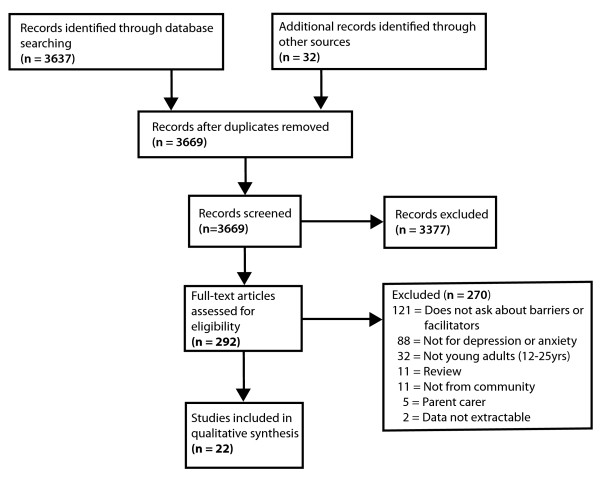
“This process resulted in a total of 22 relevant studies [20-41] for inclusion into the review.”
Background(2006) · Why Science Matters · doi:10.1002/9780470773994.ch8 · Cited by 1,014
Sawyer, M. G., Arney, F. M., Baghurst, P. A., Clark, J. J., Graetz, B. W., Kosky, R. J., Nurcombe, B., Patton, G. C., Prior, M. R., Raphael, B., et al. (2001) · Australian & New Zealand Journal of Psychiatry · doi:10.1046/j.1440-1614.2001.00964.x · Cited by 826
International Journal of Adolescent Medicine and Health
(2011) · International Journal of Adolescent Medicine and Health · doi:10.1515/ijamh · Cited by 686
Improving mental health literacy as a strategy to facilitate early intervention for mental disorders
Kelly, C. M., Jorm, A. F., & Wright, A. (2007) · Medical Journal of Australia · doi:10.5694/j.1326-5377.2007.tb01332.x · Cited by 598
Social-psychological factors affecting help-seeking for emotional problems
Rickwood, D. J., & Braithwaite, V. A. (1994) · Social Science & Medicine · doi:10.1016/0277-9536(94)90099-x · Cited by 583
Chew‐Graham, C. A., Rogers, A., & Yassin, N. (2003) · Medical Education · doi:10.1046/j.1365-2923.2003.01627.x · Cited by 580
Wrigley, S., Jackson, H., Judd, F., & Komiti, A. (2005) · Australian & New Zealand Journal of Psychiatry · doi:10.1080/j.1440-1614.2005.01612.x · Cited by 299
Biddle, L., Donovan, J., Sharp, D., & Gunnell, D. (2007) · Sociology of Health & Illness · doi:10.1111/j.1467-9566.2007.01030.x · Cited by 261 · cited 2×
“One study [21] of young people with mental distress reported that participants were aware of their distress, but continuously altered the meaning they attached to this distress, and in particular whether or not it was “normal” in order to accommodate higher levels of distress and avoid seeking help.”
BackgroundPrevalence of common mental disorders in general practice attendees across Europe
King, M., Nazareth, I., Levy, G., Walker, C., Morris, R., Weich, S., Bellón-Saameño, J. Á., Moreno, B., Švab, I., Rotar, D., et al. (2008) · British Journal of Psychiatry · doi:10.1192/bjp.bp.107.039966 · Cited by 258
Essau, C. A. (2005) · Depression and Anxiety · doi:10.1002/da.20115 · Cited by 249
Handsearching versus electronic searching to identify reports of randomized trials
Hopewell, S., Clarke, M. J., Lefebvre, C., & Scherer, R. W. (2007) · Cochrane Database of Systematic Reviews · doi:10.1002/14651858.mr000001.pub2 · Cited by 247
Zachrisson, H. D., Rödje, K., & Mykletun, A. (2006) · BMC Public Health · doi:10.1186/1471-2458-6-34 · Cited by 230 · cited 1×
“Similarly, a large study of over 11,000 Norwegian adolescents in school aged 15 to 16 years found that only 34% of those with high levels of depression and anxiety symptoms had sought professional help in the previous year [8].”
BackgroundHelp-Seeking for Psychiatric Disorders
Bland, R. C., Newman, S. C., & Orn, H. (1997) · The Canadian Journal of Psychiatry · doi:10.1177/070674379704200904 · Cited by 227 · cited 1×
“help for a mental illness [9], with only 35% of those surveyed with a common mental disorder seeking help during the previous year [4].”
BackgroundAdolescent Opinions About Reducing Help-Seeking Barriers and Increasing Appropriate Help Engagement
Wilson, C. J., & Deane, F. P. (2001) · Journal of Educational and Psychological Consultation · doi:10.1207/s1532768xjepc1204_03 · Cited by 215
Adolescents' Willingness to Seek Psychological Help: Promoting and Preventing Factors
Sheffield, J. K., Fiorenza, E., & Sofronoff, K. (2004) · Journal of Youth and Adolescence · doi:10.1023/b:joyo.0000048064.31128.c6 · Cited by 209
Where to seek help for a mental disorder?
Jorm, A. F., Wright, A., & Morgan, A. J. (2007) · Medical Journal of Australia · doi:10.5694/j.1326-5377.2007.tb01415.x · Cited by 206
Measuring Barriers to Help-Seeking Behavior in Adolescents
Kuhl, J., Jarkon-Horlick, L., & Morrissey, R. F. (1997) · Journal of Youth and Adolescence · doi:10.1023/a:1022367807715 · Cited by 200
Help-Seeking Behaviors and Depression among African American Adolescent Boys
Lindsey, M. A., Korr, W. S., Broitman, M., Bone, L., Green, A., & Leaf, P. J. (2006) · Social Work · doi:10.1093/sw/51.1.49 · Cited by 196
Unmet Need for Treatment of Major Depression in the United States
Mojtabai, R. (2009) · Psychiatric Services · doi:10.1176/ps.2009.60.3.297 · Cited by 193
Barriers to Help Seeking for Mental Disorders in a Rural Impoverished Population
Fox, J. C., Blank, M. B., Rovnyak, V. G., & Barnett, R. Y. (2001) · Community Mental Health Journal · doi:10.1023/a:1017580013197 · Cited by 179
What Teens Want: Barriers to Seeking Care for Depression
Wisdom, J. P., Clarke, G. N., & Green, C. A. (2006) · Administration and Policy in Mental Health and Mental Health Services Research · doi:10.1007/s10488-006-0036-4 · Cited by 179
Demographic Differences in Adolescents' Health Concerns and Perceptions of Helping Agents
Dubow, E. F., Lovko Jr., K. R., & Kausch, D. F. (1990) · Journal of Clinical Child Psychology · doi:10.1207/s15374424jccp1901_6 · Cited by 174
Ciarrochi, J., Wilson, C. J., Deane, F. P., & Rickwood, D. (2003) · Counselling Psychology Quarterly · doi:10.1080/0951507031000152632 · Cited by 147
A grounded theory study of help-seeking behaviors among White male high school students.
Timlin-Scalera, R. M., Ponterotto, J. G., Blumberg, F. C., & Jackson, M. A. (2003) · Journal of Counseling Psychology · doi:10.1037/0022-0167.50.3.339 · Cited by 137
Understanding barriers to mental health service utilization for adolescents in rural Australia
Aisbett, D., Boyd, C., Francis, K., Newnham, K., & newnham, K. (2007) · Rural and Remote Health · doi:10.22605/rrh624 · Cited by 132
Young people, social support and help-seeking
Barker, Olukoya, & Aggleton (2005) · International Journal of Adolescent Medicine and Health · doi:10.1515/ijamh.2005.17.4.315 · Cited by 123
Attitudes of Older Korean Americans Toward Mental Health Services
Jang, Y., Kim, G., Hansen, L., & Chiriboga, D. A. (2007) · Journal of the American Geriatrics Society · doi:10.1111/j.1532-5415.2007.01125.x · Cited by 111
Young adults' perceptions of GPs as a help source for mental distress: a qualitative study.
Biddle, L., Donovan, J., Gunnell, D., & Sharp, D. (2006) · PubMed Central · Cited by 109
Barriers to seeking treatment for major depression
Blumenthal*, R., & Endicott, J. (1996) · Depression and Anxiety · doi:10.1002/(sici)1520-6394(1996)4:6<273::aid-da3>3.0.co;2-d · Cited by 106
Boyd, C., Francis, K., Aisbett, D., Newnham, K., Sewell, J., Dawes, G., & Nurse, S. (2007) · Australian Journal of Rural Health · doi:10.1111/j.1440-1584.2007.00884.x · Cited by 104 · cited 2×
“It is of interest that all three studies focusing on rural populations [20,23,28] mentioned a high rate of barriers related to stigma, which is consistent with a previous finding that perceived stigma may affect help-seeking more in rural than urban residing adults [43].”
BackgroundResultDepressive symptoms and help-seeking intentions in young people
Wilson, C. J., Rickwood, D., & Deane, F. P. (2007) · Clinical Psychologist · doi:10.1080/13284200701870954 · Cited by 103 · cited 1×
“This process resulted in a total of 22 relevant studies [20-41] for inclusion into the review.”
BackgroundWho Influence Men to Go to Therapy? Reports from Men Attending Psychological Services
Cusack, J., Deane, F. P., Wilson, C. J., & Ciarrochi, J. (2004) · International Journal for the Advancement of Counselling · doi:10.1023/b:adco.0000035530.44111.a8 · Cited by 99 · cited 1×
“Conversely, facilitators have been proposed to include prior treatment, higher education, and greater mental disorder episode length [13], and the influence of intimate partners and general practitioners [14].”
BackgroundBrimstone, R., Thistlethwaite, J. E., & Quirk, F. (2007) · Medical Education · doi:10.1111/j.1365-2929.2006.02649.x · Cited by 91
Searching the right database. A comparison of four databases for psychiatry journals
Mcdonald, S., Taylor, L., & Adams, C. (1999) · Health Libraries Review · doi:10.1046/j.1365-2532.1999.00222.x · Cited by 86
Barriers to Help-seeking in Young People: Community Beliefs About Youth Suicide
Gilchrist, H., & Sullivan, G. (2006) · Australian Social Work · doi:10.1080/03124070500449796 · Cited by 65 · cited 1×
“This process resulted in a total of 22 relevant studies [20-41] for inclusion into the review.”
BackgroundLindsey, C. R., & Kalafat, J. (1998) · Journal of Educational and Psychological Consultation · doi:10.1207/s1532768xjepc0903_1 · Cited by 62
Wilson, C. J., Deane, F. P., Marshall, K. L., & Dalley, A. (2008) · Journal of Youth and Adolescence · doi:10.1007/s10964-007-9225-z · Cited by 61 · cited 2×
“Other top rated barriers from the quantitative studies were believing that no one could help [26], not liking to disclose personal matters to a stranger [37], and not feeling comfortable talking to a general practitioner whom the young person did not know [38].”
BackgroundBoey, K. W. (1999) · International Journal of Social Psychiatry · doi:10.1177/002076409904500203 · Cited by 57
Student Perceptions That Inhibit the Initiation of Counseling.
West, J. (1991) · The School counselor · Cited by 55
Rural Adolescents' Attitudes to Seeking Help for Mental Health Problems
Francis, K., Boyd, C. P., Aisbett, D., Newnham, K., & Newnham, K. (2006) · FedUni ResearchOnline (Federation University Australia) · Cited by 48
Barriers to Help Seeking Among 12th Graders
Helms, J. L. (2003) · Journal of Educational and Psychological Consultation · doi:10.1207/s1532768xjepc1401_02 · Cited by 29
Adolescents' preference towards self-help: implications for service development
Farrand, P. A., Perry, J., Lee, C., & Parker, M. (2006) · Primary Care and Community Psychiatry · doi:10.1185/135525706x121129 · Cited by 27
Unmet Need for Treatment of Major Depression in the United States
Mojtabai, R. (2009) · Psychiatric Services · doi:10.1176/appi.ps.60.3.297 · Cited by 25
Raphael, B. (2000) · PsycEXTRA Dataset · doi:10.1037/e677312010-001 · Cited by 23
Research works printed but not linked: 1
- Australian Bureau of Statistics Australian Bureau of Statistics. Canberra 2004-05 National Health Survey: Summary of Results 2006
Cited by
Clement, S., Schauman, O., Graham, T., Maggioni, F., Evans-Lacko, S., Bezborodovs, N., Morgan, C., Rüsch, N., Brown, J. S. L., & Thornicroft, G. (2015) · Psychological Medicine · doi:10.1017/s0033291714000129 · Cited by 3,152
Mental health literacy: empowering the community to take action for better mental health
Jorm, A. F. (2012) · American Psychologist · doi:10.1037/a0025957 · Cited by 1,783
Evidence for effective interventions to reduce mental-health-related stigma and discrimination
Thornicroft, G., Mehta, N., Clement, S., Evans-Lacko, S., Doherty, M., Rose, D., Koschorke, M., Shidhaye, R., O'Reilly, C., & Henderson, C. (2016) · The Lancet · doi:10.1016/s0140-6736(15)00298-6 · Cited by 1,338
Radez, J., Reardon, T., Creswell, C., Lawrence, P. J., Evdoka-Burton, G., & Waite, P. (2021) · European Child & Adolescent Psychiatry · doi:10.1007/s00787-019-01469-4 · Cited by 1,119
Firth, J., Torous, J., Nicholas, J., Carney, R., Pratap, A., Rosenbaum, S., & Sarris, J. (2017) · World Psychiatry · doi:10.1002/wps.20472 · Cited by 1,097
Metadata
- Authors
- Gulliver, A., Griffiths, K. M., & Christensen, H.
- Affiliations
- Australian National University (AU)
- Corresponding author
- Gulliver, Amelia
- Venue
- BMC Psychiatry
- Published
- 2010-12
- Volume
- 10
- Issue
- 1
- Pages
- 113-113
- ISSN
- 1471-244X (ISSN-L)
- PMC
- PMC3022639
- OpenAlex
- W2107750653
- Semantic Scholar
- f95edcc0bd6116b085c3f189a000be87dd3d6115
- Cited by
- 3,292
- References
- 51
- Citations by year
- 2026: 301 · 2025: 323 · 2024: 301 · 2023: 299 · 2022: 306 · 2021: 318 · 2020: 363 · 2019: 238 · 2018: 221 · 2017: 170 · 2016: 147 · 2015: 111 · 2014: 90 · 2013: 48 · 2012: 42
- FWCI
- 4.00
- Type
- journal article
- Language
- en
- Open access
- gold
- doi.org
- Licence
- cc-by
- creativecommons.org/licenses/by/2.0 (tdm)
- Locations
- BMC Psychiatry (publishedVersion, cc-by)
- Europe PMC (PubMed Central) (publishedVersion, cc-by)
- PubMed Central (publishedVersion, cc-by)
- PubMed (publishedVersion)
- DOAJ (DOAJ: Directory of Open Access Journals) (submittedVersion)
- ANU Open Research (Australian National University) (submittedVersion, cc-by)
- Funders
- Australian National University
- Australian Institute of Sport
- National Health and Medical Research Council (525413, 525411)
- Topics
- Health Sciences › Medicine › Psychiatry and Mental health › Mental Health Treatment and Access
- Social Sciences › Psychology › Clinical Psychology › Suicide and Self-Harm Studies
- Social Sciences › Psychology › Clinical Psychology › Psychology and Mental Health
- Keywords
- help-seeking, mental health help-seeking, adolescents, young adults, perceived barriers, perceived facilitators, mental health literacy, stigma, self-reliance, social support, common mental disorders
- MeSH terms
- Adolescent, Adult, Mental Disorders, Data Collection, Female, Health Services Accessibility, Humans, Male, Mental Health Services, Patient Acceptance of Health Care, Qualitative Research, Young Adult
About these checks
Registry, retraction, Cites and statistics results are computed, not judged, with one exception: a printed reference that no index lists is read once by a model before it counts as a citation error. Claims are extracted by a model and kept only when their quote appears verbatim in the text; each cited source is then checked, with a model’s help, for whether it says what the claim relies on. Those verdicts can be wrong — read the claim’s quote and the cited source before relying on one.
Statistics and arithmetic are recomputed, not judged.
Confidence bands are shown only for fields calibrated on our annotated test set. None is calibrated yet, so no band is shown.
What counts as a claim ›How we measure confidence ›How we check this ›
Are you an author, or do you see a problem with this page? Request a review
Data sources
Bibliographic data: Semantic Scholar, OpenAlex, Crossref.
Contains information from the Semantic Scholar Academic Graph Datasets, made available under the ODC Attribution License (ODC-BY 1.0).
Semantic Scholar’s data is described in: Kinney, R., et al. (2023). The Semantic Scholar Open Data Platform. arXiv:2301.10140.
