

Internet-versus group-administered cognitive behaviour therapy for panic disorder in a psychiatric setting: a randomised trial
Open accessThe DOI matches its Crossref record; 42 of the 43 references it cites were found in a registry or an index.
Abstract
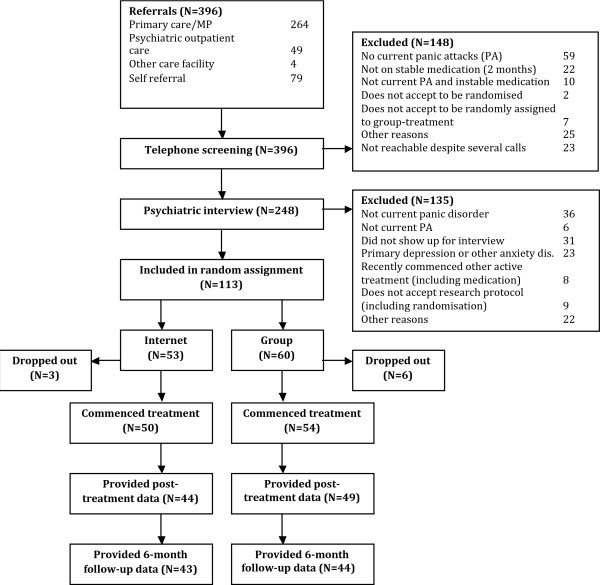
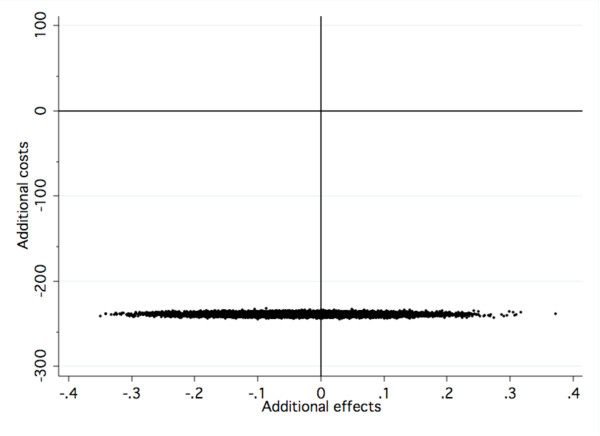
BACKGROUND: Internet administered cognitive behaviour therapy (CBT) is a promising new way to deliver psychological treatment, but its effectiveness in regular care settings and in relation to more traditional CBT group treatment has not yet been determined. The primary aim of this study was to compare the effectiveness of Internet-and group administered CBT for panic disorder (with or without agoraphobia) in a randomised trial within a regular psychiatric care setting. The second aim of the study was to establish the cost-effectiveness of these interventions. METHODS: Patients referred for treatment by their physician, or self-referred, were telephone-screened by a psychiatric nurse. Patients fulfilling screening criteria underwent an in-person structured clinical interview carried out by a psychiatrist. A total of 113 consecutive patients were then randomly assigned to 10 weeks of either guided Internet delivered CBT (n = 53) or group CBT (n = 60). After treatment, and at a 6-month follow-up, patients were again assessed by the psychiatrist, blind to treatment condition. RESULTS: Immediately after randomization 9 patients dropped out, leaving 104 patients who started treatment. Patients in both treatment conditions showed significant improvement on the main outcome measure, the Panic Disorder Severity Scale (PDSS) after treatment. For the Internet treatment the within-group effect size (pre-post) on the PDSS was Cohen's d = 1.73, and for the group treatment it was d = 1.63. Between group effect sizes were low and treatment effects were maintained at 6-months follow-up. We found no statistically significant differences between the two treatment conditions using a mixed models approach to account for missing data. Group CBT utilised considerably more therapist time than did Internet CBT. Defining effect as proportion of PDSS responders, the cost-effectiveness analysis concerning therapist time showed that Internet treatment had superior cost-effectiveness ratios in relation to group treatment both at post-treatment and follow-up. CONCLUSIONS: This study provides support for the effectiveness of Internet CBT in a psychiatric setting for patients with panic disorder, and suggests that it is equally effective as the more widely used group administered CBT in reducing panic-and agoraphobic symptoms, as well as being more cost effective with respect to therapist time. TRIAL REGISTRATION: ClinicalTrials.gov NCT00845260.
Overview
The claims and statistics of this paper haven’t been checked yet.
Free: it reads the open-access text and checks the first 5 claims that cite a source we can check. Create a free account to check every claim.
Integrity signals
Registry
Cites
Statistics
Figures

Verification
Claims the paper makes
The claims and statistics of this paper haven’t been checked yet.
Free: it reads the open-access text and checks the first 5 claims that cite a source we can check. Create a free account to check every claim.
Claims other papers make about this one
Each is checked against this paper’s own text: does it say what the citing paper says it does?
The source backs part of the claim, not all of it — or backs it for a different population, condition or comparison.
In the citing paper
“an increasing number of controlled studies indicate that for common psychiatric disorders ICBT is as effective as face-to-face delivered treatment [11-13]”
From Acceptability, effectiveness, and cost-effectiveness of internet-based exposure treatment for irritable bowel syndrome in a clinical sample: A randomized controlled trial (2011) · cites this paper as [12]
Experimental — accuracy not yet measuredThe cited source says what the claim attributes to it.
In the citing paper
“there are an increasing number of studies showing that internet-delivered CBT can be equally effective as face-to-face CBT in conditions such as panic disorder [16], depressive symptoms [17], tinnitus [18]”
From The promise and pitfalls of the internet for cognitive behavioral therapy (2010) · cites this paper as [16]
In the citing paper
“We used the effect sizes based on intent-to-treat analysis when available (in 51 comparisons); otherwise, we used complete-sample analysis results (in 2 comparisons [51,52]).”
From Internet-Delivered Cognitive Behavioral Therapy for Anxiety Disorders in Open Community Versus Clinical Service Recruitment: Meta-Analysis (2019) · cites this paper as [51]
In the citing paper
“This dropout seems to reflect the reality of trials conducted in routine mental health care, as comparable rates were found in earlier clinical trials comparing iCBT with ftfCBT [65, 74–77]; it could not be prevented by our e-mail and telephone reminders.”
Self-check
Percentages, sums and reported differences re-computed from the paper’s own numbers.
The self-check needs the paper’s full text.
Citations
Cites
(1998) · The Journal of Clinical Psychiatry · Cited by 19,139
A new depression scale designed to be sensitive to change
Montgomery, S. A., & Åsberg, M. (1979) · British Journal of Psychiatry · doi:10.1192/bjp.134.4.382 · Cited by 13,962 · cited 2×
“Other outcomes measures used were the Clinical Global Impression Scale (CGI) [25], the Montgomery Åsberg Depression Rating Scale (MADRS) [26], the Anxiety Sensitivity Index (ASI) [27], and the Sheehan Disability Scale (SDS) [28].”
MethodMethods for the Economic Evaluation of Health Care Programmes
Drummond, M. E., Sculpher, M. J., Torrance, G. W., O’Brien, B. J., & Stoddart, G. L. (2005) · doi:10.1093/oso/9780198529446.001.0001 · Cited by 13,648
(1998) · PubMed · Cited by 10,216
The mini international neuropsychiatric interview
Lecrubier, Y., Sheehan, D., Hergueta, T., & Weiller, E. (1998) · European Psychiatry · doi:10.1016/s0924-9338(99)80239-9 · Cited by 5,872
Anxiety, sensitivity, anxiety frequency, and the prediction of fearfulness
Reiss, S., Peterson, R. A., Gursky, D. M., & McNally, R. J. (1986) · Behaviour Research and Therapy · doi:10.1016/0005-7967(86)90143-9 · Cited by 3,169 · cited 2×
“Other outcomes measures used were the Clinical Global Impression Scale (CGI) [25], the Montgomery Åsberg Depression Rating Scale (MADRS) [26], the Anxiety Sensitivity Index (ASI) [27], and the Sheehan Disability Scale (SDS) [28].”
MethodBoutron, I., Moher, D., Altman, D. G., Schulz, K. F., Ravaud, P., & for the CONSORT Group* (2008) · Annals of Internal Medicine · doi:10.7326/0003-4819-148-4-200802190-00008 · Cited by 2,292 · cited 1×
“Statistical analysis and rationale for comparisons We were informed by the adapted CONSORT checklist [32], but also analysed our data according to a mixed models approach.”
MethodThe Great Psychotherapy Debate: Models Methods and Findings
Horvath, A. O. (2002) · Psychotherapy Research · doi:10.1093/ptr/12.1.108 · Cited by 1,705
Internet-based cognitive behaviour therapy for symptoms of depression and anxiety: A meta-analysis
SPEK, V., CUIJPERS, P., NYKLÍČEK, I., RIPER, H., KEYZER, J., & POP, V. (2007) · Psychological Medicine · doi:10.1017/s0033291706008944 · Cited by 1,586 · cited 1×
“The literature [37] strongly suggests that guidance/therapist contact during treatment is needed, as non-guided Internet treatments generally show smaller or nonexistent treatment effects and much larger attrition.”
BackgroundGueorguieva, R., & Krystal, J. H. (2004) · Archives of General Psychiatry · doi:10.1001/archpsyc.61.3.310 · Cited by 1,529 · cited 2×
“As a second way to analyze the data, and to account for missing data we used a mixed effects models approach [30] because in the analysis of longitudinal data repeated observations for the same individual are correlated.”
Method
Research works printed but not linked: 1
- American Psychiatric Association: Diagnostic and Statistical Manual of Mental Disorders-4th edition (DSM-IV). text revision edition edition. 2000, Washington DC: American Psychiatric Press, 4
Cited by
Carlbring, P., Andersson, G., Cuijpers, P., Riper, H., & Hedman-Lagerlöf, E. (2018) · Cognitive Behaviour Therapy · doi:10.1080/16506073.2017.1401115 · Cited by 1,232
“The pooled between-group effect size in the three studies targeting panic disorder (Bergström et al., 2010; Carlbring et al., 2005; Kiropoulos et al., 2008) was g = .05 (95% CI, −.20 to .30), in line with the notion of equivalent effects.”
BackgroundResultInfluentialSelf-citationAndersson, G., Cuijpers, P., Carlbring, P., Riper, H., & Hedman, E. (2014) · World Psychiatry · doi:10.1002/wps.20151 · Cited by 1,077
“In the three studies targeting panic disorder (26-28), the effect size was 0.”
BackgroundSelf-citationKatzman, M. A., Bleau, P., Blier, P., Chokka, P., Kjernisted, K., Van Ameringen, M., & the Canadian Anxiety Guidelines Initiative Group on behalf of the Anxiety Disorders Association of Canada/Association Canadienne des troubles anxieux and McGill University (2014) · BMC Psychiatry · doi:10.1186/1471-244x-14-s1-s1 · Cited by 1,090
“videoconferencing [75,159-161], and internet-based CBT (ICBT) [75,79,162-169] have been shown to be more”
MethodAndrews, G., Basu, A., Cuijpers, P., Craske, M. G., McEvoy, P., English, C. L., & Newby, J. M. (2018) · Journal of Anxiety Disorders · doi:10.1016/j.janxdis.2018.01.001 · Cited by 922
Hedman, E., Ljótsson, B., & Lindefors, N. (2012) · Expert Review of Pharmacoeconomics & Outcomes Research · doi:10.1586/erp.12.67 · Cited by 672
Self-citation
Metadata
- Authors
- Bergström, J., Andersson, G., Ljótsson, B., Rück, C., Andréewitch, S., Karlsson, A., Carlbring, P., Andersson, E., & Lindefors, N.
- Affiliations
- Karolinska Institutet (SE)
- Linköping University (SE)
- Umeå University (SE)
- Corresponding author
- Bergström, Jan
- Venue
- BMC Psychiatry
- Published
- 2010-07-02
- Volume
- 10
- Issue
- 1
- Pages
- 54-54
- ISSN
- 1471-244X (ISSN-L)
- PMC
- PMC2910662
- OpenAlex
- W2046682955
- Semantic Scholar
- 744755a1dc5e773ea6e3309280d1dc42e1ad89e1
- Cited by
- 202
- References
- 43
- Citations by year
- 2026: 2 · 2025: 6 · 2024: 4 · 2023: 16 · 2022: 10 · 2021: 19 · 2020: 9 · 2019: 11 · 2018: 13 · 2017: 6 · 2016: 15 · 2015: 14 · 2014: 19 · 2013: 23 · 2012: 17
- FWCI
- 27.67
- Type
- journal article
- Language
- en
- Open access
- gold
- doi.org
- Licence
- cc-by
- creativecommons.org/licenses/by/2.0 (tdm)
- Locations
- BMC Psychiatry (publishedVersion, cc-by)
- PubMed Central (publishedVersion, cc-by)
- PubMed (publishedVersion)
- KTH Publication Database DiVA (KTH Royal Institute of Technology) (submittedVersion, other-oa)
- Publications (Mid Sweden University) (submittedVersion, other-oa)
- DOAJ (DOAJ: Directory of Open Access Journals) (submittedVersion)
- Funders
- Stockholms Läns Landsting
- Topics
- Social Sciences › Psychology › Applied Psychology › Digital Mental Health Interventions
- Social Sciences › Psychology › Experimental and Cognitive Psychology › Anxiety, Depression, Psychometrics, Treatment, Cognitive Processes
- Social Sciences › Psychology › Clinical Psychology › Psychological Treatments and Assessments
- Keywords
- internet-based cognitive behavioral therapy, group cognitive behavioral therapy, panic disorder, agoraphobia, cost-effectiveness, treatment effectiveness, psychiatric nursing, Panic Disorder Severity Scale
- MeSH terms
- Adult, Agoraphobia, Cost-Benefit Analysis, Double-Blind Method, Female, Follow-Up Studies, Humans, Male, Psychiatric Department, Hospital, Psychiatric Status Rating Scales, Psychotherapy, Group, Self Care, Cognitive Behavioral Therapy, Panic Disorder, Treatment Outcome, Health Care Costs, Outcome Assessment, Health Care, Internet, Diagnostic and Statistical Manual of Mental Disorders
About these checks
Registry, retraction, Cites and statistics results are computed, not judged, with one exception: a printed reference that no index lists is read once by a model before it counts as a citation error. Claims are extracted by a model and kept only when their quote appears verbatim in the text; each cited source is then checked, with a model’s help, for whether it says what the claim relies on. Those verdicts can be wrong — read the claim’s quote and the cited source before relying on one.
Statistics and arithmetic are recomputed, not judged.
Confidence bands are shown only for fields calibrated on our annotated test set. None is calibrated yet, so no band is shown.
What counts as a claim ›How we measure confidence ›How we check this ›
Are you an author, or do you see a problem with this page? Request a review
How to cite
Cite CoChat for the checks on this page, and the paper for its own findings.
- This page
- CoChat. (2026). Citation check: Internet-versus group-administered cognitive behaviour therapy for panic disorder in a psychiatric setting: a randomised trial. https://app.cochat.ai/papers/10.1186/1471-244x-10-54
- The paper
- Bergström, J., Andersson, G., Ljótsson, B., Rück, C., Andréewitch, S., Karlsson, A., Carlbring, P., Andersson, E., & Lindefors, N. (2010). Internet-versus group-administered cognitive behaviour therapy for panic disorder in a psychiatric setting: a randomised trial. BMC Psychiatry. https://doi.org/10.1186/1471-244x-10-54
Data sources
Bibliographic data: Semantic Scholar, OpenAlex, Crossref.
Contains information from the Semantic Scholar Academic Graph Datasets, made available under the ODC Attribution License (ODC-BY 1.0).
Semantic Scholar’s data is described in: Kinney, R., et al. (2023). The Semantic Scholar Open Data Platform. arXiv:2301.10140.
