

The course of untreated anxiety and depression, and determinants of poor one-year outcome: a one-year cohort study
Open accessThe DOI matches its Crossref record; 32 of the 34 references it cites were found in a registry or an index.
Abstract
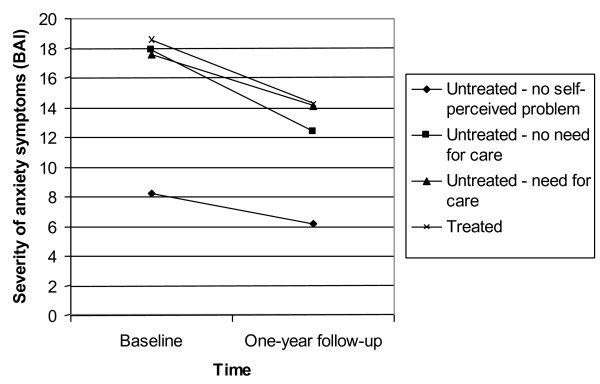
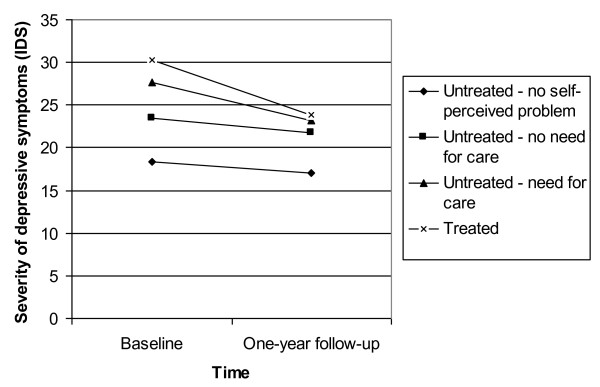
Background: Little is known about the course and outcome of untreated anxiety and depression in patients with and without a self-perceived need for care. The aim of the present study was to examine the one-year course of untreated anxiety and depression, and to determine predictors of a poor outcome. Method: Baseline and one-year follow-up data were used of 594 primary care patients with current anxiety or depressive disorders at baseline (established by the Composite Interview Diagnostic Instrument (CIDI)), from the Netherlands Study of Depression and Anxiety (NESDA). Receipt of and need for care were assessed by the Perceived Need for Care Questionnaire (PNCQ). Results: In depression, treated and untreated patients with a perceived treatment need showed more rapid symptom decline but greater symptom severity at follow-up than untreated patients without a self-perceived mental problem or treatment need. A lower education level, lower income, unemployment, loneliness, less social support, perceived need for care, number of somatic disorders, a comorbid anxiety and depressive disorder and symptom severity at baseline predicted a poorer outcome in both anxiety and depression. When all variables were considered at the same time, only baseline symptom severity appeared to predict a poorer outcome in anxiety. In depression, a poorer outcome was also predicted by more loneliness and a comorbid anxiety and depressive disorder. Conclusion: In clinical practice, special attention should be paid to exploring the need for care among possible risk groups (e.g. low social economic status, low social support), and support them in making an informed decision on whether or not to seek treatment.
Overview
The claims and statistics of this paper haven’t been checked yet.
Free: it reads the open-access text and checks the first 5 claims that cite a source we can check. Create a free account to check every claim.
Integrity signals
Registry
Cites
Statistics
Figures
Verification
Claims the paper makes
The claims and statistics of this paper haven’t been checked yet.
Free: it reads the open-access text and checks the first 5 claims that cite a source we can check. Create a free account to check every claim.
Claims other papers make about this one
Each is checked against this paper’s own text: does it say what the citing paper says it does?
The source backs part of the claim, not all of it — or backs it for a different population, condition or comparison.
In the citing paper
“Studies on structural social support, social network size, and mental health disorders have shown that less social contact and loneliness can cause more severe depressive symptoms. 338”
From Major depressive disorder: hypothesis, mechanism, prevention and treatment (2024) · cites this paper as [338]
Experimental — accuracy not yet measuredThe source backs part of the claim, not all of it — or backs it for a different population, condition or comparison.
In the citing paper
“They found that loneliness at baseline predicted depression and anxiety severity and remission from depression [25, 66].”
From Associations between loneliness and perceived social support and outcomes of mental health problems: a systematic review (2018) · cites this paper as [66]
Experimental — accuracy not yet measuredIn the citing paper
“Beljouw et al. [66] analysed data from primary care patients with current anxiety or depressive disorders, and found that greater loneliness at baseline was predictive of more severe depressive (beta = 0.89) or anxiety symptoms (beta = 0.40) at 1-year follow-up.”
From Associations between loneliness and perceived social support and outcomes of mental health problems: a systematic review (2018) · cites this paper as [66]
Self-check
Percentages, sums and reported differences re-computed from the paper’s own numbers.
The self-check needs the paper’s full text.
Citations
Cites
An inventory for measuring clinical anxiety: Psychometric properties.
Beck, A. T., Epstein, N., Brown, G., & Steer, R. A. (1988) · Journal of Consulting and Clinical Psychology · doi:10.1037/0022-006x.56.6.893 · Cited by 14,407
Revisiting the Behavioral Model and Access to Medical Care: Does it Matter?
Andersen, R. M. (1995) · Journal of Health and Social Behavior · doi:10.2307/2137284 · Cited by 9,831 · cited 1×
“Independent variables All determinants used in this paper were addressed at T0. Determinants of a poor clinical outcome Determinants of outcome are classified according to Andersen’s behavioral model [22, 23 ], and include: 1) predisposing factors such as socio-demographic characteristics; 2) factors that enable the u…”
MethodScreening for serious mental illness in the general population
Kessler, R. C., Barker, P. R., Colpe, L. J., Epstein, J. F., Gfroerer, J. C., Hiripi, E., Howes, M. J., Normand, S.-L. T., Manderscheid, R. W., Walters, E. E., et al. (2003) · Archives of General Psychiatry · doi:10.1001/archpsyc.60.2.184 · Cited by 5,692
Societal and Individual Determinants of Medical Care Utilization in the United States
ANDERSEN, R., & NEWMAN, J. F. (2005) · The Milbank Quarterly · doi:10.1111/j.1468-0009.2005.00428.x · Cited by 3,611 · cited 1×
“Determinants of a poor clinical outcome Determinants of outcome are classified according to Andersen’s behavioral model [22,23], and include: 1) predisposing factors such as socio-demographic characteristics; 2) factors that enable the use of services such as income; and 3) factors that determine the need for care.”
MethodSocietal and Individual Determinants of Medical Care Utilization in the United States
Andersen, R., & Newman, J. F. (1973) · The Milbank Memorial Fund Quarterly. Health and Society · doi:10.2307/3349613 · Cited by 2,838
The Inventory of Depressive Symptomatology (IDS): Psychometric properties
Rush, A. J., Gullion, C. M., Basco, M. R., Jarrett, R. B., & Trivedi, M. H. (1996) · Psychological Medicine · doi:10.1017/s0033291700035558 · Cited by 2,177 · cited 1×
“The dependent variables used in this study are severity of depression and anxiety at baseline and one-year follow-up, measured by the 30-item Inventory of Depressive Symptomatology (Self-Report; IDS-SR) [20] and the 21-item Beck Anxiety Inventory (BAI) [21], respectively.”
MethodWang, P. S., Aguilar-Gaxiola, S., Alonso, J., Angermeyer, M. C., Borges, G., Bromet, E. J., Bruffaerts, R., de Girolamo, G., de Graaf, R., Gureje, O., et al. (2007) · The Lancet · doi:10.1016/s0140-6736(07)61414-7 · Cited by 1,655 · cited 1×
“However, many mental disorders remain untreated [1-8].”
The Development of a Rasch-Type Loneliness Scale
de Jong-Gierveld, J., & Kamphuls, F. (1985) · Applied Psychological Measurement · doi:10.1177/014662168500900307 · Cited by 1,291 · cited 1×
“The De Jong-Gierveld Loneliness Scale [24] measures the amount of loneliness a respondent experiences by citing 11 statements such as ‘I often feel rejected’, which can be rated on a 3-point Likert scale.”
BackgroundThe Netherlands Study of Depression and Anxiety (NESDA): rationale, objectives and methods
Penninx, B. W. J. H., Beekman, A. T. F., Smit, J. H., Zitman, F. G., Nolen, W. A., Spinhoven, P., Cuijpers, P., De Jong, P. J., Van Marwijk, H. W. J., Assendelft, W. J. J., et al. (2008) · International Journal of Methods in Psychiatric Research · doi:10.1002/mpr.256 · Cited by 927 · cited 1×
“Procedures of NESDA are described in detail elsewhere [17].”
MethodSelf-citation
Research works printed but not linked: 3
- 3. van Beljouw et al. BMC Psychiatry 2010, 10:86 http://www.biomedcentral.com/1471-244X/10/86
- 15. Kessler RC, Berglund PA, Bruce ML, Koch R, Laska EM, Leaf PJ, et al: The prevalence and correlates of untreated serious mental illness. Health Serv Res 2001, 36:987-1007.
- 20. World Health Organization: Composite Interview Diagnostic Instrument (CIDI). World Health Organization 1990.
Cited by
Items 101–150 of 150
Holt-Gosselin, B., Keller, A. S., Chesnut, M., Ling, R., Grisanzio, K. A., & Williams, L. M. (2021) · Journal of Affective Disorders · doi:10.1016/j.jad.2021.08.039 · Cited by 2
Carlier, I. V. E., van der Elst, L. V., de Jong, K., & van Vliet, I. M. (2023) · The Journal of Nervous and Mental Disease · doi:10.1097/nmd.0000000000001667 · Cited by 2
Ueberholz, R. Y., Glassman, H., Mallik, A., & Russo, F. (2025) · BMJ Open · doi:10.1136/bmjopen-2024-094784 · Cited by 2
Depression in the context of physical illness
Gastelum, E. D., Muskin, P. R., & Shapiro, P. A. (2013) · Cambridge University Press eBooks · doi:10.1017/cbo9781139175869.013 · Cited by 2
Gudjonsson, S. O., Sveinbjarnardóttir, E. K., & Arnardóttir, R. H. (2020) · Nordic Journal of Psychiatry · doi:10.1080/08039488.2020.1733659 · Cited by 2
“anxiety symptoms are not treated adequately [8].”
Penedo, J. M. G., Krieger, T., Koditek, M. C., & Holtforth, M. G. (2020) · Journal of Behavior Therapy and Experimental Psychiatry · doi:10.1016/j.jbtep.2020.101576 · Cited by 2
Dokuka, S., Сивак, Е., & Smirnov, I. (2022) · Lecture notes in computer science · doi:10.1007/978-3-030-97240-0_4 · Cited by 2
Mental Health-Seeking Behaviors for Hispanic Individuals in the United States
Aluisy, A. (2024) · Digital Commons - University of South Florida (University of South Florida) · Cited by 2
Li, Z., Huang, J., Chen, X., Yao, L., Zhao, X., Liu, C., Zhang, H., Song, Z., & Wang, J.-H. (2025) · Social Cognitive and Affective Neuroscience · doi:10.1093/scan/nsaf054 · Cited by 1
Flehr, A., Dowrick, C. F., Kaylor‐Hughes, C., & Gunn, J. M. (2025) · The Lancet Primary Care · doi:10.1016/j.lanprc.2025.100042 · Cited by 1
Landrian, A. S., Liu, P., Suthar, H., Corletto, G., Adler, K. F., & Henwood, B. F. (2026) · Discover Public Health · doi:10.1186/s12982-026-01857-7 · Cited by 1
Zhu, Z., Lin, X., Chen, Z., Li, H., & Lin, R. (2026) · JMIR Aging · doi:10.2196/79253 · Cited by 1
“Older adults face additional barriers, including limited service accessibility, transportation difficulties, stigma, and reduced awareness of help-seeking pathways, further increasing the risk of untreated or poorly managed depression [28-31].”
operaMIDAZOLAMO TABLEČIŲ IR SKYSTOS FORMOS SEDACIJOS POVEIKIO VAIKŲ ELGSENAI PALYGINIMAS
Kalibatienė, L., & Macas, A. (2014) · Sveikatos mokslai · doi:10.5200/sm-hs.2014.032 · Cited by 1
Forschung in der Psychotherapie
Helle, M. (2019) · Basiswissen Psychologie · doi:10.1007/978-3-662-58712-6_6 · Cited by 1
Recovery and the mental health system
Hare-Duke, L., Ng, F., & Slade, M. (2022) · Oxford University Press eBooks · doi:10.1093/med/9780198861478.003.0057 · Cited by 1
COVİD-19 Döneminde Doğum Sonrası Depresyon Riski Değerlendirmesi: Kesitsel bir çalışma
Malas, E. M. (2024) · DergiPark · Cited by 1
Stefanidou, T., Li, S., Lagan, K., Evlat, G., Gray, H., Harju‐Seppänen, J., Jarvis, A., O’Sullivan, M., Talwar, S., Lewis, G., et al. (2026) · BMC Medicine · doi:10.1186/s12916-026-05252-6 · Cited by 1
“Findings related to anxiety were limited and inconsistent. van Beljouw et al. [52] found no significant association between baseline loneliness and anxiety symptoms at one-year follow-up after adjustment (β = −0.02, SE = 0.10).”
InfluentialPersonalised modelling of geographic movements in depression
Palmius, N. (2018) · Oxford University Research Archive (ORA) (University of Oxford) · Cited by 1
Adaptation and evaluation of an intervention to reduce loneliness amongst adults with depression
Hare-Duke, L. (2020) · Nottingham ePrints (University of Nottingham) · Cited by 1
Johansson, O. (2023) · Lund University Publications (Lund University) · Cited by 1
Salimuddin, S. (2023) · oURspace (University of Regina) · doi:10.82465/4148 · Cited by 1
Predicting the future: Clinical outcome prediction with machine learning in neuropsychiatry
Zhutovsky, P. (2021) · UvA-DARE (University of Amsterdam) · Cited by 1
Stay-at-home-fathers Navigating Depression: A Consensual Qualitative Research Study
Caperton, W. (2015) · e-Publications@Marquette (Marquette University)
McGrath, P. J., & Roose, S. P. (2013) · Cambridge University Press eBooks · doi:10.1017/cbo9781139175869.004
Socio-Cultural Determinants of Mental Health Service Utilization Among Latinos in the United States
Barreras, J. L. (2019) · eScholarship (California Digital Library)
Things change: The early identification of patients with an unfavourable prognosis
de Boer, S. B. B. (2020) · Leiden Repository (Leiden University)
Determinants of adverse health outcomes in late-life depression: the role of vitamin D and frailty
van den Berg, K. S. (2021) · University of Groningen research database (University of Groningen / Centre for Information Technology) · doi:10.33612/diss.192839589
Wormgoor, M. E. A., Indahl, A., & Egeland, J. (2022) · PLoS ONE · doi:10.1371/journal.pone.0273216
“The present findings of higher baseline anxiety in CSP, rendering the impact of CSP on symptom remission as insignificant, is complementary to previous research reporting negative prognostic value of baseline anxiety on pain outcome [76, 83, 85].”
ResultGerbi, G. B., & Miles-Richardson, S. (2022) · Archives of Public Health Practice and Policy · doi:10.33425/2834-4227.1003
Biopsychosocial perspective of small fiber neuropathy
Damci, A. (2025) · Research Publications (Maastricht University) · doi:10.26481/dis.20250408ad
Predicting Anxiety Severity with Digital Ecological Momentary Assessment of Stress, Sleep, and Mood
Raposa, M. E., Brooks, A., Miclette, M., & Holley, D. (2025) · Journal of Technology in Behavioral Science · doi:10.1007/s41347-025-00566-3
Gort, E. M. (2013) · Utrecht University Repository (Utrecht University)
Stefanidou, T., Wang, J., Morant, N. J., Lloyd‐Evans, B., & Johnson, S. (2021) · Figshare · doi:10.6084/m9.figshare.14175845
Stefanidou, T., Wang, J., Morant, N. J., Lloyd‐Evans, B., & Johnson, S. (2021) · Figshare · doi:10.6084/m9.figshare.14175839
Stefanidou, T., Wang, J., Morant, N. J., Lloyd‐Evans, B., & Johnson, S. (2021) · Figshare · doi:10.6084/m9.figshare.14175842
Fl, B., & Amw, S. (2012) · Rivm Repository (Netherlands National Institute for Public Health and the Environment)
Geipel, M. S., Hamann, J., & München, T. U. (2024)
Gerhards, S. K. (2024) · Qucosa (Saxon State and University Library Dresden)
Medeiros, B. V. (2012) · DSpace (Federal University of Santa Catarina)
Binet, É. (2023) · Corpus Université Laval (Université Laval)
Kuczynski, A. M. (2023) · ResearchWorks at the University of Washington (University of Washington)
Impact of delayed elective urological surgery: A prospective observational study
Simunovic, I., Zurl, H., Altziebler, J. V., Leitsmann, C., Scheipner, L., Mischinger, J., MANGGE, A., Pohl, K. K., Frank, A., Weiss, A., et al. (2026) · BJUI Compass · doi:10.1002/bco2.70197
“21 While extensive psychosocial distress was reported in patients with cancer facing surgery delays during the COVID-19 pandemic, 19 our findings show that patients with benign conditions were also psychologically impacted.”
Jahn, S. (2024) · Qucosa (Saxon State and University Library Dresden)
Brockmann, A.-L., Pfeiffer, L., Batra, A., & Fuhr, K. (2026) · Behavioral Sciences · doi:10.3390/bs16091584
“…outcomes when receiving CBT instead of HT, other studies found that a higher level predicted a better treatment outcome (Hirschfeld et al., 1998; van Beljouw et al., 2010) and is considered to be a protective factor regarding mental health conditions such as depression and anxiety (Bjelland et…”
Balaraman, A., & Bauer, A. G. (2026) · Journal of Psychoactive Drugs · doi:10.1080/02791072.2026.2673848
ระยะเวลาการเข้าถึงบริการของผู้ที่มีอาการทางจิตเวชในประเทศไทยจากการสำรวจระบาดวิทยาสุขภาพจิตแห่งชาติ
Vanichrudee, N., Supanya, S., Kwansanit, P., Tantirangsi, N., & Kittirattanapaiboon, P. (2020) · Journal of Mental Health of Thailand - วารสารสุขภาพจิต แห่งประเทศไทย
Metadata
- Authors
- van Beljouw, I. M., Verhaak, P. F., Cuijpers, P., van Marwijk, H. W., & Penninx, B. W.
- Affiliations
- Netherlands Institute for Health Services Research (NL)
- Vrije Universiteit Amsterdam (NL)
- University Medical Center Groningen (NL)
- Corresponding author
- Verhaak, Peter FM
- Venue
- BMC Psychiatry
- Published
- 2010-10-20
- Volume
- 10
- Issue
- 1
- Pages
- 86-86
- ISSN
- 1471-244X (ISSN-L)
- PMC
- PMC2974663
- OpenAlex
- W2156611669
- Cited by
- 128
- References
- 32
- Citations by year
- 2026: 6 · 2025: 8 · 2024: 5 · 2023: 9 · 2022: 9 · 2021: 20 · 2020: 7 · 2019: 11 · 2018: 10 · 2017: 7 · 2016: 5 · 2015: 11 · 2014: 3 · 2013: 7 · 2012: 7
- FWCI
- 7.40
- Type
- journal article
- Language
- en
- Open access
- gold
- doi.org
- Licence
- Locations
- BMC Psychiatry (publishedVersion, cc-by)
- PubMed Central (publishedVersion, cc-by)
- PubMed (publishedVersion)
- VU Research Portal (publishedVersion, other-oa)
- Pure Amsterdam UMC (acceptedVersion, other-oa)
- Amsterdam UMC (VU Amsterdam) - Institutional Repository (acceptedVersion, other-oa)
- Data Archiving and Networked Services (DANS) (submittedVersion)
- Data Archiving and Networked Services (DANS) (submittedVersion, other-oa)
- Leiden Repository (Leiden University) (submittedVersion)
- Digital Academic REpository of VU University Amsterdam (Vrije Universiteit Amsterdam) (submittedVersion)
- DOAJ (DOAJ: Directory of Open Access Journals) (submittedVersion)
- Research Explorer (The University of Manchester) (submittedVersion)
- University of Groningen research database (University of Groningen / Centre for Information Technology) (submittedVersion, cc-by)
- Funders
- Universiteit Leiden (10‐000‐1002)
- ZonMw (10‐000‐1002)
- Vrije Universiteit Amsterdam
- Fonds Psychische Gezondheid
- GGZ inGeest
- Rivierduinen
- GGZ Friesland
- GGZ Drenthe
- Nederlands Instituut voor Onderzoek van de Gezondheidszorg (10-000-1002)
- Leids Universitair Medisch Centrum
- Universitair Medisch Centrum Groningen
- Topics
- Health Sciences › Medicine › Psychiatry and Mental health › Mental Health Treatment and Access
- Social Sciences › Psychology › Experimental and Cognitive Psychology › Anxiety, Depression, Psychometrics, Treatment, Cognitive Processes
- Health Sciences › Medicine › Pharmacology (medical) › Treatment of Major Depression
- Keywords
- untreated depression, treatment outcome prediction, perceived need for care, primary care patients, loneliness, social support, comorbidities, symptom severity, socioeconomic status, treatment seeking, NESDA
- MeSH terms
- Adolescent, Adult, Aged, Anxiety Disorders, Attitude to Health, Depressive Disorder, Female, Follow-Up Studies, Humans, Male, Middle Aged, Netherlands, Patient Acceptance of Health Care, Primary Health Care, Prognosis, Psychiatric Status Rating Scales, Surveys and Questionnaires, Severity of Illness Index, Cohort Studies, Multicenter Studies as Topic, Comorbidity, Outcome Assessment, Health Care, Withholding Treatment
About these checks
Registry, retraction, Cites and statistics results are computed, not judged, with one exception: a printed reference that no index lists is read once by a model before it counts as a citation error. Claims are extracted by a model and kept only when their quote appears verbatim in the text; each cited source is then checked, with a model’s help, for whether it says what the claim relies on. Those verdicts can be wrong — read the claim’s quote and the cited source before relying on one.
Statistics and arithmetic are recomputed, not judged.
Confidence bands are shown only for fields calibrated on our annotated test set. None is calibrated yet, so no band is shown.
What counts as a claim ›How we measure confidence ›How we check this ›
Are you an author, or do you see a problem with this page? Request a review
Data sources
Bibliographic data: Semantic Scholar, OpenAlex, Crossref.
Contains information from the Semantic Scholar Academic Graph Datasets, made available under the ODC Attribution License (ODC-BY 1.0).
Semantic Scholar’s data is described in: Kinney, R., et al. (2023). The Semantic Scholar Open Data Platform. arXiv:2301.10140.
