

The DOI matches its Crossref record; 64 of the 64 references it cites were found in a registry or an index.
A randomized controlled pilot study of a brief web-based mindfulness training
Open accessAbstract
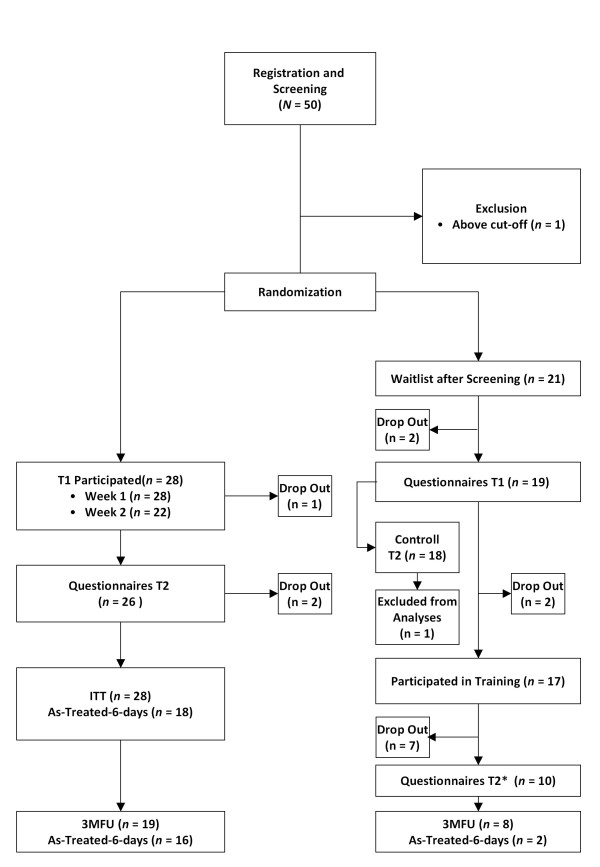
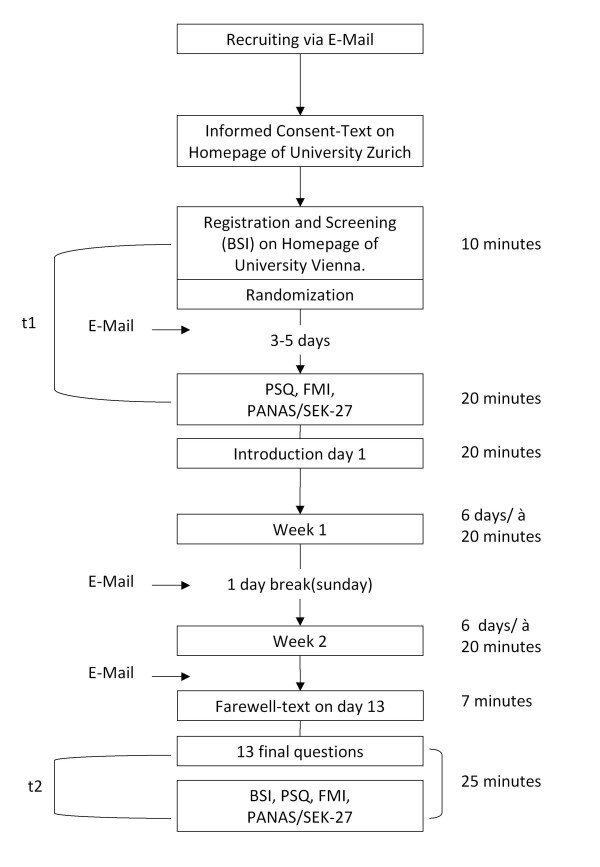
BACKGROUND: Mindfulness has been shown to be effective in treating various medical and mental problems. Especially its incorporation in cognitive-behavioural interventions has improved long-term outcomes of those treatments. It has also been shown, that brief mindfulness-based trainings are effective in reducing distress. There have been few web-based interventions incorporating mindfulness techniques in their manual and it remains unclear whether a brief web-based mindfulness intervention is feasible. METHODS: Out of 50 adults (different distress levels; exclusion criteria: <18 years, indication of psychotic or suicidal ideation in screening) who were recruited via e-mail and screened online, 49 were randomized into an immediate 2-weeks-treatment group (N=28) or a waitlist-control group (N=21), starting with a 2-week delay. Distress (BSI), perceived stress (PSQ), mindfulness (FMI), as well as mood and emotion regulation (PANAS/SEK-27) were measured at pre-, post- and 3-month follow-up (3MFU). Intention-to-treat analyses using MI for missing data and per-protocol analyses (≥50% attendance) were performed. RESULTS: 26 participants of the treatment group completed post-measures. Most measures under ITT-analysis revealed no significant improvement for the treatment group, but trends with medium effect sizes for PSQ (d=0.46) and PANASneg (d=0.50) and a small, non-significant effect for FMI (d=0.29). Per-protocol analyses for persons who participated over 50% of the time revealed significant treatment effects for PSQ (d=0.72) and PANASneg (d=0.77). Comparing higher distressed participants with lower distressed participants, highly distressed participants seemed to profit more of the training in terms of distress reduction (GSI, d=0.85). Real change (RCI) occurred for PSQ in the treatment condition (OR=9). Results also suggest that participants continued to benefit from the training at 3MFU. CONCLUSION: This study of a brief web-based mindfulness training indicates that mindfulness can be taught online and may improve distress, perceived stress and negative affect for regular users. Although there were no significant improvements, but trends, for most measures under ITT, feasibility of such a program was demonstrated and also that persons continued to use techniques of the training in daily life. TRIAL REGISTRATION: German Clinical Trials Register (DRKS): DRKS00003209.
Overview
The claims and statistics of this paper haven’t been checked yet.
Run the check — free, no account needed. It reads the open-access text and checks the sources it cites.
Integrity signals
Registry
Cites
Statistics
Figures
Verification
Claims the paper makes
The claims and statistics of this paper haven’t been checked yet.
Run the check — free, no account needed. It reads the open-access text and checks the sources it cites.
Claims other papers make about this one
Each is checked against this paper’s own text: does it say what the citing paper says it does?
The cited source says what the claim attributes to it.
In the citing paper
“For PANAS score, previous trials indicate that mindfulness intervention might improve positive affect (Bossi et al. 2022) and negative affect (Glück & Maercker 2011).”
From Changes in Mental Health and EEG Biomarkers of Undergraduates Under Different Patterns of Mindfulness (2024) · cites this paper as Glück & Maercker 2011
The cited source says what the claim attributes to it.
In the citing paper
“While emerging evidence supports the feasibility of online self-help mindfulness training in non-clinical populations (Glück and Maercker, 2011; Krusche et al., 2012), there is a severe lack of research to support such interventions for those with clinical levels of depression and anxiety.”
From Online mindfulness-enhanced cognitive behavioural therapy for anxiety and depression: Outcomes of a pilot trial (2018) · cites this paper as Glück and Maercker, 2011
Self-check
Percentages, sums and reported differences re-computed from the paper’s own numbers.
The self-check needs the paper’s full text.
Citations
Cites
Baron, R. M., & Kenny, D. A. (1986) · Journal of Personality and Social Psychology · doi:10.1037/0022-3514.51.6.1173 · Cited by 91,532
Faul, F., Erdfelder, E., Lang, A.-G., & Buchner, A. (2007) · Behavior Research Methods · doi:10.3758/bf03193146 · Cited by 65,971
The benefits of being present: Mindfulness and its role in psychological well-being
Brown, K. W., & Ryan, R. M. (2003) · Journal of Personality and Social Psychology · doi:10.1037/0022-3514.84.4.822 · Cited by 13,448
Mindfulness-based interventions in context: Past, present, and future
Kabat-Zinn, J. (2003) · Clinical Psychology: Science and Practice · doi:10.1093/clipsy.bpg016 · Cited by 8,615
Mindfulness-based interventions in context: Past, present, and future.
Kabat-Zinn, J. (2003) · Clinical Psychology: Science and Practice · doi:10.1093/clipsy/bpg016 · Cited by 8,612
Jacobson, N. S., & Truax, P. (1991) · Journal of Consulting and Clinical Psychology · doi:10.1037/0022-006x.59.1.12 · Cited by 7,770
Using Self-Report Assessment Methods to Explore Facets of Mindfulness
Baer, R. A., Smith, G. T., Hopkins, J., Krietemeyer, J., & Toney, L. (2006) · Assessment · doi:10.1177/1073191105283504 · Cited by 7,511 · cited 4×
“These correlations have also been reported in other studies [29,52-54].”
BackgroundMethodResultInfluential(2008) · Medical Entomology and Zoology · Cited by 7,477
Mindfulness: A proposed operational definition.
Bishop, S. R., Lau, M., Shapiro, S., Carlson, L., Anderson, N. D., Carmody, J., Segal, Z. V., Abbey, S., Speca, M., Velting, D., et al. (2004) · Clinical Psychology: Science and Practice · doi:10.1093/clipsy.bph077 · Cited by 7,234
Mindfulness training as a clinical intervention: a conceptual and empirical review
Baer, R. A. (2003) · Clinical Psychology: Science and Practice · doi:10.1093/clipsy.bpg015 · Cited by 4,577
Research works printed but not linked: 2
- Franke GH: BSI. Brief Symptom Inventory - Deutsche Version. Manual. 2000, Göttingen: Beltz Test GmbH
- Hanh NT: The Miracle of Mindfulness: An Introduction to the Practice of Meditation. 1999, Boston, MA: Beacon Press
Cited by
Sorted by citations
Items 101–166 of 166
Pickett, S. M., Kozak, A. T., Lanni, D. J., Warnke, A. S., Gaillard, P., & Jarrett, N. L. (2022) · Journal of American College Health · doi:10.1080/07448481.2022.2066979 · Cited by 15
Positive and Negative Affect Schedule (PANAS)
Roemer, A., & Medvedev, O. N. (2023) · Springer eBooks · doi:10.1007/978-3-030-77644-2_86-1 · Cited by 12
Positive Technology for Helping People Cope with Stress
Villani, D., Cipresso, P., Gaggioli, A., & Riva, G. (2016) · Advances in psychology, mental health, and behavioral studies (APMHBS) book series · doi:10.4018/978-1-4666-9986-1.ch014 · Cited by 13
Jose, P. E., & Geiserman, A. (2023) · Current Psychology · doi:10.1007/s12144-023-04999-y · Cited by 11
Myers, N. D., Dietz, S., Prilleltensky, I., Prilleltensky, O., McMahon, A., Rubenstein, C. L., & Lee, S. (2018) · Games for Health Journal · doi:10.1089/g4h.2017.0132 · Cited by 11
TANGAEON: Tangible Interaction to Support People in a Mindfulness Practice
Vianello, A., Chittaro, L., & Matassa, A. (2018) · International Journal of Human-Computer Interaction · doi:10.1080/10447318.2018.1509540 · Cited by 12
Hepner, K. A., Bloom, E. L., Newberry, S. J., Sousa, J., Osilla, K. C., Booth, M. S., Bialas, A., & Rutter, C. M. (2022) · Rand health quarterly · doi:10.7249/rhq-10-01-09 · Cited by 11
Martin, K.-J., Golijani-Moghaddam, N., & dasNair, R. (2018) · International Journal of Therapy and Rehabilitation · doi:10.12968/ijtr.2018.25.2.82 · Cited by 10
Lippmann, M., Laudel, H., Heinzle, M., & Narciss, S. (2019) · Journal of Medical Internet Research · doi:10.2196/12497 · Cited by 10
Türkoğlu, N., & Kavuran, E. (2024) · Mindfulness · doi:10.1007/s12671-024-02336-3 · Cited by 12
Web Based Interventions in Psychiatry: An Overview
Mehta, V. S., & Parakh, M. (2015) · International Journal of Mental Health & Psychiatry · doi:10.4172/2471-4372.1000108 · Cited by 10
The Effectiveness of Internet-Based Mindfulness Interventions for Physical and Mental Illnesses
Krolikowski, A. (2013) · International Journal of Cyber Behavior Psychology and Learning · doi:10.4018/ijcbpl.2013100106 · Cited by 12
Nymberg, P., Hansson, E. E., Stenman, E., Calling, S., Sundquist, K., Sundquist, J., & Zöller, B. (2018) · Trials · doi:10.1186/s13063-018-2932-9 · Cited by 9
Lucas‐Thompson, R. G., Rayburn, S. R., Seiter, N. S., Broderick, P. C., Smyth, J. M., Coatsworth, J. D., & Henry, K. L. (2020) · Frontiers in Public Health · doi:10.3389/fpubh.2020.579556 · Cited by 9
Servant, D., Leterme, A.-C., Barasino, O., Rougegrez, L., Duhamel, A., & Vaiva, G. (2017) · JMIR Research Protocols · doi:10.2196/resprot.7976 · Cited by 8
Hammerdahl, E., Hilt, L. M., Draheim, A. A., Fox, G., & Breister, E. (2025) · Mindfulness · doi:10.1007/s12671-024-02499-z · Cited by 9
Johansson, B., & Bjuhr, H. (2016) · International Journal of Social Science Studies · doi:10.11114/ijsss.v4i3.1389 · Cited by 8
McBee, L. (2014) · Elsevier eBooks · doi:10.1016/b978-0-12-416031-6.00011-6 · Cited by 7
Loiacono, E. T., Fulwiler, C., Cohanim, R., & Davis, M. (2018) · AIS Transactions on Human-Computer Interaction · doi:10.17705/1thci.00109 · Cited by 8
Mindfulness Meditation for Posttraumatic Stress Disorder
Wahbeh, H. (2014) · Wiley eBooks · doi:10.1002/9781118294895.ch39 · Cited by 7
Beurskens, J., Waal, G. H., & Wanten, G. (2021) · Clinical Nutrition ESPEN · doi:10.1016/j.clnesp.2020.12.026 · Cited by 6
Immersive VR as a Promising Technology for Computer-Supported Mindfulness
De Paolis, L. T., Arpaia, P., D’Errico, G., Gatto, C., Moccaldi, N., & Nuccetelli, F. (2021) · Lecture notes in computer science · doi:10.1007/978-3-030-87595-4_12 · Cited by 5
Zhu, T., Zhang, L., Weng, W., Gan, R., Sun, L., Wei, Y., Zhu, Y., Yu, H., Xue, J., & Chen, S. (2025) · Journal of Medical Internet Research · doi:10.2196/55583 · Cited by 5
Alqahtani, F., & Orji, R. (2025) · Human Behavior and Emerging Technologies · doi:10.1155/hbe2/8111089 · Cited by 14
The Mindful AFL Player: Engagement, Mobile Apps, and Well-Being
Mitchell, J., & Hassed, C. S. (2016) · Cambridge University Press eBooks · doi:10.1017/cbo9781139871310.013 · Cited by 6
Programas de ordenador basados en mindfulness . Una revisión de la literatura médica
López-Montoyo, A., Modrego‐Alarcón, M., Morillo, H., García‐Campayo, J., & Quero, S. (2016) · Mindfulness & Compassion · doi:10.1016/j.mincom.2016.09.003 · Cited by 5
Nymberg, P., Calling, S., Stenman, E., Palmér, K., Hansson, E. E., Sundquist, K., Sundquist, J., & Zöller, B. (2021) · Pilot and Feasibility Studies · doi:10.1186/s40814-021-00810-6 · Cited by 4
Luo, M., Gan, Q., Huang, Z., Jiang, Y., Li, K., Wu, M., Yang, D., Shao, H., Chen, Y., Fu, Y., et al. (2024) · Brain Topography · doi:10.1007/s10548-023-01026-y · Cited by 3
“For PANAS score, previous trials indicate that mindfulness intervention might improve positive affect (Bossi et al. 2022) and negative affect (Glück & Maercker 2011).”
Coninck, S. D., & Emmers, E. (2023) · Frontiers in Digital Health · doi:10.3389/fdgth.2023.1216268 · Cited by 5
Self-Help Mindfulness-Based Cognitive Therapy
Jones, F. W., Strauss, C., & Cavanagh, K. (2016) · Springer eBooks · doi:10.1007/978-3-319-29866-5_10 · Cited by 3
Video Conferencing for Mindfulness Programs: Benefits, Experiences, and Recommendations
Meissner, T. (2017) · International Journal of Whole Person Care · doi:10.26443/ijwpc.v4i2.126 · Cited by 3
Positive Technology for Helping People Cope with Stress
Villani, D., Cipresso, P., Gaggioli, A., & Riva, G. (2020) · IGI Global eBooks · doi:10.4018/978-1-7998-3432-8.ch038 · Cited by 2
Pal, A., Mukhopadhyay, P., & Pal, N. D. (2024) · Journal of the Association of Physicians of India · doi:10.59556/japi.72.0767 · Cited by 2
Positive and Negative Affect Schedule (PANAS)
Roemer, A., & Medvedev, O. N. (2025) · Springer eBooks · doi:10.1007/978-3-031-47219-0_86 · Cited by 2
Arredondo, M., Sabaté, M., Botella, L., Villar, P. H., & Acosta, L. M. (2016) · Revista de Psicoterapia · doi:10.33898/rdp.v27i103.110 · Cited by 2
Papenfuss, I., Lommen, M. J. J., & Ostafin, B. D. (2025) · Journal of Experimental Psychopathology · doi:10.1177/20438087251347677 · Cited by 1
Simundic, A., Petrovic, J., Khoury, B., Geoffroy, M., & Heath, N. L. (2025) · Psychological Reports · doi:10.1177/00332941251383508 · Cited by 1
Johansson, B., & Bjuhr, H. (2018) · Archives of Psychology · doi:10.31296/aop.v2i5.61 · Cited by 1
Chui, R. C. F., Siu, N. Y.-F., Tsui, W.-M., & Wong, C. Y.-T. (2020) · Educational communications and technology yearbook · doi:10.1007/978-981-15-8167-0_14 · Cited by 1
Yan, K., Ikani, N., Yusainy, C., Witteman, C. L. M., & Spijker, J. (2025) · Trials · doi:10.1186/s13063-025-08858-y · Cited by 2
Cavalcante, V. N., Cavalcanti, A. C. D., Pereira, J. D. M. V., Figueiredo, L. D. S., & Mesquita, E. T. (2021) · International Journal of Cardiovascular Sciences · doi:10.36660/ijcs.20200135 · Cited by 5
Noone, C. (2016) · Arrow@dit (Dublin Institute of Technology) · doi:10.13025/17145 · Cited by 1
Zernicke, K. A. (2015) · Libraries and Cultural Resources (University of Calgary) · doi:10.11575/prism/27180
Santachita, A., & Aragón, M. L. V. (2015) · Revista de la Asociación Española de Neuropsiquiatría · doi:10.4321/s0211-57352015000300007 · Cited by 8
Vacca, R., & Hoadley, C. P. (2016) · Lecture notes in computer science · doi:10.1007/978-3-319-40250-5_38
Professional E-Therapy in a Low Budget Setting
Karlsson, J.-O., & Johanson, B. (2016) · KTH Publication Database DiVA (KTH Royal Institute of Technology)
Hanson, M. D. (2017) · Minds at UW (University of Wisconsin)
Johnson, E. (2019) · SMU Scholar (Southern Methodist University)
Mind Your Purpose: Intervening on Mindfulness to Promote Daily Levels of Purpose
Young, R. (2014) · Carleton University's Institutional Repository (MacOdrum Library, Carleton University) · doi:10.22215/etd/2014-10283
Effects of technology-based mindfulness training on wellbeing and stress
Schauer, T., & Diefenbach, S. (2021) · Internal Medicine Review · doi:10.18103/imr.v7i1.901
Online mindfulness-based stress reduction for lesbian women: A feasibility studyPreprint
Jabson, J. M., & Patterson, J. G. (2017) · doi:10.2196/preprints.9334
Atas do IX Simpósio Nacional de Investigação em Psicologia
Lopes, D., & Garrido, M. V. (2017) · Psicologia · doi:10.17575/rpsicol.v31i2.1348 · Cited by 1
Sparacio, A., IJzerman, H., Ropovik, I., Filippo, G., Spiessens, C., Uchino, B. N., Landvatter, J., Tacana, T., Diller, S. J., Derrick, J. L., et al. (2023) · doi:10.31234/osf.io/krbn3
Nymberg, P., Calling, S., Stenman, E., Palmér, K., Hansson, E. E., Sundquist, K., Sundquist, J., & Zöller, B. (2021) · Figshare · doi:10.6084/m9.figshare.14234724
Nymberg, P., Calling, S., Stenman, E., Palmér, K., Hansson, E. E., Sundquist, K., Sundquist, J., & Zöller, B. (2021) · Figshare · doi:10.6084/m9.figshare.14234712
Nymberg, P., Calling, S., Stenman, E., Palmér, K., Hansson, E. E., Sundquist, K., Sundquist, J., & Zöller, B. (2021) · Figshare · doi:10.6084/m9.figshare.14234709
Nymberg, P., Calling, S., Stenman, E., Palmér, K., Hansson, E. E., Sundquist, K., Sundquist, J., & Zöller, B. (2021) · Figshare · doi:10.6084/m9.figshare.14234706
Nymberg, P., Calling, S., Stenman, E., Palmér, K., Hansson, E. E., Sundquist, K., Sundquist, J., & Zöller, B. (2021) · Figshare · doi:10.6084/m9.figshare.14234721
Nymberg, P., Calling, S., Stenman, E., Palmér, K., Hansson, E. E., Sundquist, K., Sundquist, J., & Zöller, B. (2021) · Figshare · doi:10.6084/m9.figshare.14234718
A meta-scientific approach to understanding stress regulation
Sparacio, A. (2023) · theses.fr (ABES) · doi:10.70675/757862f2z87a4z4ec7zabc9z5a275e01261b
Dinesh, T. K., Shetty, A., & Kini, R. S. (2025) · Economic Research-Ekonomska Istraživanja · doi:10.32728/er-ei.38.2.3 · Cited by 1
Older Informal Carers’ Experiences Using a Digital Mindfulness-Based Intervention
Wilson, M., & Doyle, J. (2026) · Lecture notes in computer science · doi:10.1007/978-3-032-30421-6_25
대학 운동선수의 평가염려 완벽주의와 마음챙김이 경쟁반추에 미치는 영향*
윤, 성., & 허, 정. (2026) · 한국체육학회지 · doi:10.23949/kjpe.2026.5.65.3.19
Mind, Body, and Well-being in Adults: Exploring the Efficacy of a Brief Meditation Intervention
Marmara, J., Hosking, W., & McLean, S. A. (2026) · Mindfulness · doi:10.1007/s12671-026-02981-w
A meta-scientific approach to understanding stress regulation
Sparacio, A. (2023) · Cronfa (Swansea University) · doi:10.23889/suthesis.63454
Metadata
- Authors
- Glück, T. M., & Maercker, A.
- Affiliations
- University of Vienna (AT)
- Corresponding author
- Glück, Tobias M
- ORCID
- Glück, Tobias M
- Venue
- BMC Psychiatry
- Published
- 2011-11-08
- Volume
- 11
- Issue
- 1
- Pages
- 175-175
- ISSN
- 1471-244X (ISSN-L)
- PMC
- PMC3250944
- OpenAlex
- W1991358662
- Cited by
- 168
- References
- 60
- Citations by year
- 2026: 3 · 2025: 8 · 2024: 5 · 2023: 9 · 2022: 5 · 2021: 19 · 2020: 14 · 2019: 11 · 2018: 17 · 2017: 19 · 2016: 28 · 2015: 9 · 2014: 10 · 2013: 10 · 2012: 1
- FWCI
- 7.24
- Type
- journal article
- Language
- en
- Open access
- gold
- doi.org
- Licence
- Locations
- BMC Psychiatry (publishedVersion, cc-by)
- Europe PMC (PubMed Central) (publishedVersion, cc-by)
- PubMed Central (publishedVersion, cc-by)
- PubMed (publishedVersion)
- Zurich Open Repository and Archive (University of Zurich) (acceptedVersion, cc-by)
- Phaidra (Universität Wien) (submittedVersion, cc-by-nc-nd)
- DOAJ (DOAJ: Directory of Open Access Journals) (submittedVersion)
- Zurich Open Repository and Archive (University of Zurich) (submittedVersion, cc-by)
- Zurich Open Repository and Archive (University of Zurich)
- Funders
- Universität Wien
- Topics
- Social Sciences › Psychology › Clinical Psychology › Mindfulness and Compassion Interventions
- Social Sciences › Psychology › Applied Psychology › Digital Mental Health Interventions
- Social Sciences › Psychology › Social Psychology › Psychological Well-being and Life Satisfaction
- Keywords
- mindfulness training, online intervention, brief intervention, psychological distress, perceived stress, negative affect, emotion regulation, feasibility, online therapy
- MeSH terms
- Adult, Aged, Behavior Therapy, Female, Follow-Up Studies, Humans, Male, Middle Aged, Pilot Projects, Psychotherapy, Brief, Stress, Psychological, Treatment Outcome, Internet
About these checks
Registry, retraction, Cites and statistics results are computed, not judged, with one exception: a printed reference that no index lists is read once by a model before it counts as a citation error. Claims are extracted by a model and kept only when their quote appears verbatim in the text; each cited source is then checked, with a model’s help, for whether it says what the claim relies on. Those verdicts can be wrong — read the claim’s quote and the cited source before relying on one.
Statistics and arithmetic are recomputed, not judged.
Confidence bands are shown only for fields calibrated on our annotated test set. None is calibrated yet, so no band is shown.
What counts as a claim ›How we measure confidence ›How we check this ›
Are you an author, or do you see a problem with this page? Request a review
