

The DOI matches its Crossref record; 64 of the 64 references it cites were found in a registry or an index.
A randomized controlled pilot study of a brief web-based mindfulness training
Open accessAbstract
BACKGROUND: Mindfulness has been shown to be effective in treating various medical and mental problems. Especially its incorporation in cognitive-behavioural interventions has improved long-term outcomes of those treatments. It has also been shown, that brief mindfulness-based trainings are effective in reducing distress. There have been few web-based interventions incorporating mindfulness techniques in their manual and it remains unclear whether a brief web-based mindfulness intervention is feasible. METHODS: Out of 50 adults (different distress levels; exclusion criteria: <18 years, indication of psychotic or suicidal ideation in screening) who were recruited via e-mail and screened online, 49 were randomized into an immediate 2-weeks-treatment group (N=28) or a waitlist-control group (N=21), starting with a 2-week delay. Distress (BSI), perceived stress (PSQ), mindfulness (FMI), as well as mood and emotion regulation (PANAS/SEK-27) were measured at pre-, post- and 3-month follow-up (3MFU). Intention-to-treat analyses using MI for missing data and per-protocol analyses (≥50% attendance) were performed. RESULTS: 26 participants of the treatment group completed post-measures. Most measures under ITT-analysis revealed no significant improvement for the treatment group, but trends with medium effect sizes for PSQ (d=0.46) and PANASneg (d=0.50) and a small, non-significant effect for FMI (d=0.29). Per-protocol analyses for persons who participated over 50% of the time revealed significant treatment effects for PSQ (d=0.72) and PANASneg (d=0.77). Comparing higher distressed participants with lower distressed participants, highly distressed participants seemed to profit more of the training in terms of distress reduction (GSI, d=0.85). Real change (RCI) occurred for PSQ in the treatment condition (OR=9). Results also suggest that participants continued to benefit from the training at 3MFU. CONCLUSION: This study of a brief web-based mindfulness training indicates that mindfulness can be taught online and may improve distress, perceived stress and negative affect for regular users. Although there were no significant improvements, but trends, for most measures under ITT, feasibility of such a program was demonstrated and also that persons continued to use techniques of the training in daily life. TRIAL REGISTRATION: German Clinical Trials Register (DRKS): DRKS00003209.
Overview
The claims and statistics of this paper haven’t been checked yet.
Run the check — free, no account needed. It reads the open-access text and checks the sources it cites.
Integrity signals
Registry
Cites
Statistics
Figures
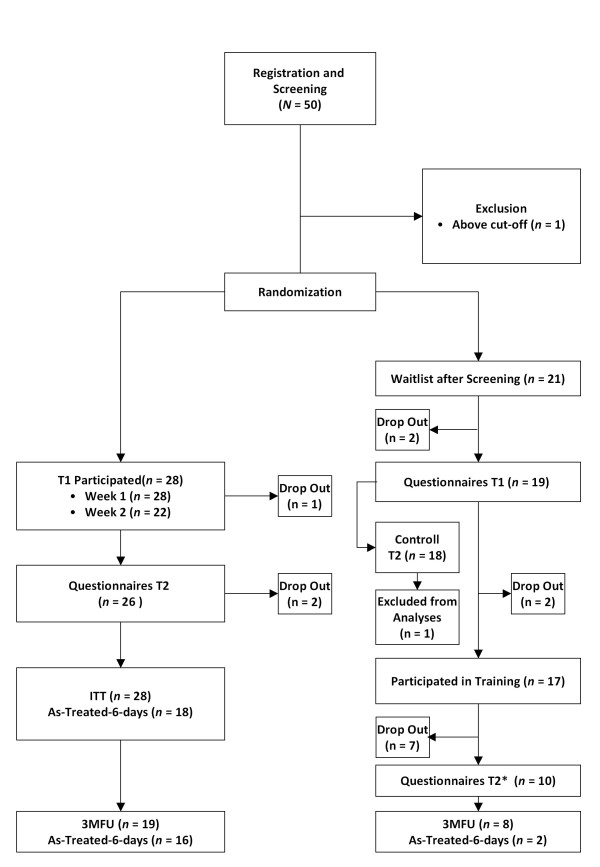
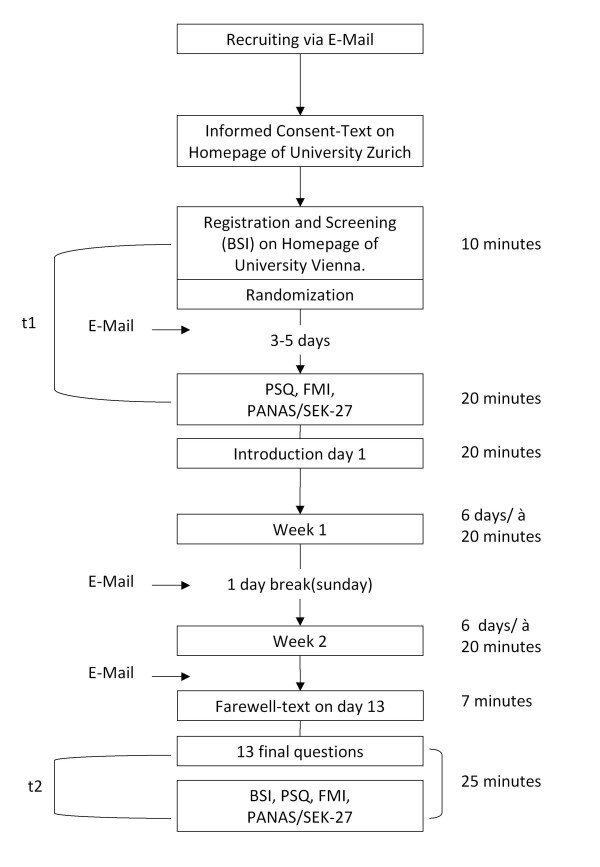
Verification
Claims the paper makes
The claims and statistics of this paper haven’t been checked yet.
Run the check — free, no account needed. It reads the open-access text and checks the sources it cites.
Claims other papers make about this one
Each is checked against this paper’s own text: does it say what the citing paper says it does?
The cited source says what the claim attributes to it.
In the citing paper
“For PANAS score, previous trials indicate that mindfulness intervention might improve positive affect (Bossi et al. 2022) and negative affect (Glück & Maercker 2011).”
From Changes in Mental Health and EEG Biomarkers of Undergraduates Under Different Patterns of Mindfulness (2024) · cites this paper as Glück & Maercker 2011
The cited source says what the claim attributes to it.
In the citing paper
“While emerging evidence supports the feasibility of online self-help mindfulness training in non-clinical populations (Glück and Maercker, 2011; Krusche et al., 2012), there is a severe lack of research to support such interventions for those with clinical levels of depression and anxiety.”
From Online mindfulness-enhanced cognitive behavioural therapy for anxiety and depression: Outcomes of a pilot trial (2018) · cites this paper as Glück and Maercker, 2011
Self-check
Percentages, sums and reported differences re-computed from the paper’s own numbers.
The self-check needs the paper’s full text.
Citations
Cites
Baron, R. M., & Kenny, D. A. (1986) · Journal of Personality and Social Psychology · doi:10.1037/0022-3514.51.6.1173 · Cited by 91,532
Faul, F., Erdfelder, E., Lang, A.-G., & Buchner, A. (2007) · Behavior Research Methods · doi:10.3758/bf03193146 · Cited by 65,971
The benefits of being present: Mindfulness and its role in psychological well-being
Brown, K. W., & Ryan, R. M. (2003) · Journal of Personality and Social Psychology · doi:10.1037/0022-3514.84.4.822 · Cited by 13,448
Mindfulness-based interventions in context: Past, present, and future
Kabat-Zinn, J. (2003) · Clinical Psychology: Science and Practice · doi:10.1093/clipsy.bpg016 · Cited by 8,615
Mindfulness-based interventions in context: Past, present, and future.
Kabat-Zinn, J. (2003) · Clinical Psychology: Science and Practice · doi:10.1093/clipsy/bpg016 · Cited by 8,612
Jacobson, N. S., & Truax, P. (1991) · Journal of Consulting and Clinical Psychology · doi:10.1037/0022-006x.59.1.12 · Cited by 7,770
Using Self-Report Assessment Methods to Explore Facets of Mindfulness
Baer, R. A., Smith, G. T., Hopkins, J., Krietemeyer, J., & Toney, L. (2006) · Assessment · doi:10.1177/1073191105283504 · Cited by 7,511 · cited 4×
“These correlations have also been reported in other studies [29,52-54].”
BackgroundMethodResultInfluential(2008) · Medical Entomology and Zoology · Cited by 7,477
Mindfulness: A proposed operational definition.
Bishop, S. R., Lau, M., Shapiro, S., Carlson, L., Anderson, N. D., Carmody, J., Segal, Z. V., Abbey, S., Speca, M., Velting, D., et al. (2004) · Clinical Psychology: Science and Practice · doi:10.1093/clipsy.bph077 · Cited by 7,234
Mindfulness training as a clinical intervention: a conceptual and empirical review
Baer, R. A. (2003) · Clinical Psychology: Science and Practice · doi:10.1093/clipsy.bpg015 · Cited by 4,577
Mindfulness training as a clinical intervention: A conceptual and empirical review.
Baer, R. A. (2003) · Clinical Psychology: Science and Practice · doi:10.1093/clipsy/bpg015 · Cited by 4,576
Schafer, J. L. (1999) · Statistical Methods in Medical Research · doi:10.1177/096228029900800102 · Cited by 3,949
The effect of mindfulness based therapy on anxiety and depression: A meta analytic review
Hofmann, S. G., Sawyer, A. T., Witt, A. A., & Oh, D. (2010) · Journal of Consulting and Clinical Psychology · doi:10.1037/a0018555 · Cited by 3,846
Prevention of relapse/recurrence in major depression by mindfulness-based cognitive therapy.
Teasdale, J. D., Segal, Z. V., Williams, J. M. G., Ridgeway, V. A., Soulsby, J. M., & Lau, M. A. (2000) · Journal of Consulting and Clinical Psychology · doi:10.1037/0022-006x.68.4.615 · Cited by 3,236
Crawford, J. R., & Henry, J. D. (2004) · British Journal of Clinical Psychology · doi:10.1348/0144665031752934 · Cited by 2,957 · cited 1×
“The first part (EMO-CHECK) contains the 20 items of the Positive Affect Schedule Negative Affect Schedule (PANAS) [31] assessing two dimensions of negative affect and positive affect (further denoted as PANAS and PANAS).”
BackgroundBaer, R. A., Smith, G. T., Lykins, E., Button, D., Krietemeyer, J., Sauer, S., Walsh, E., Duggan, D., & Williams, J. M. G. (2008) · Assessment · doi:10.1177/1073191107313003 · Cited by 2,930
Alterations in brain and immune function produced by mindfulness meditation
Davidson, R. J., Kabat-Zinn, J., Schumacher, J., Rosenkranz, M., Muller, D., Santorelli, S. F., Urbanowski, F., Harrington, A., Bonus, K., & Sheridan, J. F. (2003) · Psychosomatic Medicine · doi:10.1097/01.psy.0000077505.67574.e3 · Cited by 2,925 · cited 1×
“This also corresponds with study results on neurobiological changes related to mindfulness exercise [46].”
ResultHayes, S. C. (2004) · Behavior Therapy · doi:10.1016/s0005-7894(04)80013-3 · Cited by 2,493
(1993) · Medical Entomology and Zoology · Cited by 2,491
Assessment of Mindfulness by Self-Report: The Kentucky Inventory of Mindfulness Skills
Baer, R. A., Smith, G. T., & Allen, K. B. (2004) · Assessment · doi:10.1177/1073191104268029 · Cited by 2,298
Robertson, I. H., Manly, T., Andrade, J., Baddeley, B., & Yiend, J. (1997) · Neuropsychologia · doi:10.1016/s0028-3932(97)00015-8 · Cited by 2,189
Carmody, J., & Baer, R. A. (2008) · Journal of Behavioral Medicine · doi:10.1007/s10865-007-9130-7 · Cited by 1,823
Meta-analysis of experiments with matched groups or repeated measures designs
Dunlap, W. P., Cortina, J. M., Vaslow, J. B., & Burke, M. J. (1996) · Psychological Methods · doi:10.1037/1082-989x.1.2.170 · Cited by 1,693 · cited 1×
“’s formula [36] Glück and Maercker BMC Psychiatry 2011, 11:175”
BackgroundShort-term meditation training improves attention and self-regulation
Tang, Y.-Y., Ma, Y., Wang, J., Fan, Y., Feng, S., Lu, Q., Yu, Q., Sui, D., Rothbart, M. K., Fan, M., et al. (2007) · Proceedings of the National Academy of Sciences · doi:10.1073/pnas.0707678104 · Cited by 1,597
Internet-based cognitive behaviour therapy for symptoms of depression and anxiety: A meta-analysis
SPEK, V., CUIJPERS, P., NYKLÍČEK, I., RIPER, H., KEYZER, J., & POP, V. (2007) · Psychological Medicine · doi:10.1017/s0033291706008944 · Cited by 1,586
Internet-Based and Other Computerized Psychological Treatments for Adult Depression: A Meta-Analysis
Andersson, G., & Cuijpers, P. (2009) · Cognitive Behaviour Therapy · doi:10.1080/16506070903318960 · Cited by 1,368
Mindfulness-based stress reduction for health care professionals: results from a randomized trial
Shapiro, S. L., Astin, J. A., Bishop, S. R., & Cordova, M. (2005) · International Journal of Stress Management · doi:10.1037/1072-5245.12.2.164 · Cited by 1,323
Jain, S., Shapiro, S. L., Swanick, S., Roesch, S. C., Mills, P. J., Bell, I., & Schwartz, G. E. R. (2007) · Annals of Behavioral Medicine · doi:10.1207/s15324796abm3301_2 · Cited by 1,300
Barak, A., Hen, L., Boniel-Nissim, M., & Shapira, N. (2008) · Journal of Technology in Human Services · doi:10.1080/15228830802094429 · Cited by 1,283
Lieberman, M. D., Eisenberger, N. I., Crockett, M. J., Tom, S. M., Pfeifer, J. H., & Way, B. M. (2007) · Psychological Science · doi:10.1111/j.1467-9280.2007.01916.x · Cited by 1,150
The Assessment of Present-Moment Awareness and Acceptance: The Philadelphia Mindfulness Scale
Cardaciotto, L., Herbert, J. D., Forman, E. M., Moitra, E., & Farrow, V. (2008) · Assessment · doi:10.1177/1073191107311467 · Cited by 940
Schafer, J. L. (1999) · Statistical Methods in Medical Research · doi:10.1191/096228099671525676 · Cited by 920
Jacobson, N. S., Roberts, L. J., Berns, S. B., & McGlinchey, J. B. (1999) · Journal of Consulting and Clinical Psychology · doi:10.1037//0022-006x.67.3.300 · Cited by 853
Jacobson, N. S., Roberts, L. J., Berns, S. B., & McGlinchey, J. B. (1999) · Journal of Consulting and Clinical Psychology · doi:10.1037/0022-006x.67.3.300 · Cited by 853
Neural correlates of dispositional mindfulness during affect labeling
Creswell, J. D., Way, B. M., Eisenberger, N. I., & Lieberman, M. D. (2007) · Psychosomatic Medicine · doi:10.1097/psy.0b013e3180f6171f · Cited by 835
Multiple Imputation for Interval Estimation From Simple Random Samples With Ignorable Nonresponse
Rubin, D. B., & Nathaniel Schenker, A. (1986) · Journal of the American Statistical Association · doi:10.1080/01621459.1986.10478280 · Cited by 768
What Do We Really Know About Mindfulness-Based Stress Reduction?
Bishop, S. R. (2002) · Psychosomatic Medicine · doi:10.1097/00006842-200201000-00010 · Cited by 748
Perils and promise in defining and measuring mindfulness: Observations from experience.
Brown, K. W., & Ryan, R. M. (2004) · Clinical Psychology: Science and Practice · doi:10.1093/clipsy.bph078 · Cited by 585
Carmody, J., & Baer, R. A. (2009) · Journal of Clinical Psychology · doi:10.1002/jclp.20555 · Cited by 568 · cited 2×
“Although there has been no evidence that shorter mindfulness trainings are less effective in reducing distress [13], it seems possible that subjective changes in distress were noticed only by those with higher initial levels of GSI.”
BackgroundFliege, H., Rose, M., Arck, P., Walter, O. B., Kocalevent, R.-D., Weber, C., & Klapp, B. F. (2005) · Psychosomatic Medicine · doi:10.1097/01.psy.0000151491.80178.78 · Cited by 496
Are patient expectations still relevant for psychotherapy process and outcome
Greenberg, R. P., Constantino, M. J., & Bruce, N. (2006) · Clinical Psychology Review · doi:10.1016/j.cpr.2005.03.002 · Cited by 477
Health Status Measures: Strategies and Analytic Methods for Assessing Change Scores
Stratford, P. W., Binkley, J. M., & Riddle, D. L. (1996) · Physical Therapy · doi:10.1093/ptj/76.10.1109 · Cited by 434
The effects of brief mindfulness meditation training on experimentally induced pain
Zeidan, F., Gordon, N. S., Merchant, J., & Goolkasian, P. (2010) · The Journal of Pain · doi:10.1016/j.jpain.2009.07.015 · Cited by 364
Meyer, B., Berger, T., Caspar, F., Beevers, C. G., Andersson, G., & Weiss, M. (2009) · Journal of Medical Internet Research · doi:10.2196/jmir.1151 · Cited by 363 · cited 5×
“With its incorporation into cognitive behavioural manuals, mindfulness is now also used in some webbased interventions as component in cognitive-behavioural treatment programmes for a variety of conditions [16-20].”
BackgroundMethodResultInfluentialDefining an agenda for future research on the clinical application of mindfulness practice
Dimidjian, S., & Linehan, M. M. (2003) · Clinical Psychology: Science and Practice · doi:10.1093/clipsy.bpg019 · Cited by 334
Ljótsson, B., Falk, L., Vesterlund, A. W., Hedman, E., Lindfors, P., Rück, C., Hursti, T., Andréewitch, S., Jansson, L., Lindefors, N., et al. (2010) · Behaviour Research and Therapy · doi:10.1016/j.brat.2010.03.003 · Cited by 270
Berking, M., & Znoj, H. (2008) · Zeitschrift für Psychiatrie Psychologie und Psychotherapie · doi:10.1024/1661-4747.56.2.141 · Cited by 268
On the Bias of Various Estimators of the Logit and Its Variance with Application to Quantal Bioassay
Gart, J. J., & Zweifel, J. R. (1967) · Biometrika · doi:10.1093/biomet/54.1-2.181 · Cited by 267
Kingston, J., Chadwick, P., Meron, D., & Skinner, T. C. (2007) · Journal of Psychosomatic Research · doi:10.1016/j.jpsychores.2006.10.007 · Cited by 218 · cited 1×
“Most mindfulness trainings require participants to invest substantial amounts of time and discipline such as Mindfulness Based Stress Reduction (MBSR) [4]; however, short mindfulness-trainings lasting from a couple of days up to 4 weeks have also been reported effective in terms of mindfulness and distress reduction […”
BackgroundMethodological issues in research on web-based behavioral interventions
Danaher, B. G., & Seeley, J. R. (2009) · Annals of Behavioral Medicine · doi:10.1007/s12160-009-9129-0 · Cited by 193
Distance delivery of mindfulness-based cognitive therapy for depression: Project UPLIFT
Thompson, N. J., Walker, E. R., Obolensky, N., Winning, A., Barmon, C., DiIorio, C., & Compton, M. T. (2010) · Epilepsy & Behavior · doi:10.1016/j.yebeh.2010.07.031 · Cited by 185 · cited 1×
“With its incorporation into cognitive behavioural manuals, mindfulness is now also used in some webbased interventions as component in cognitive-behavioural treatment programmes for a variety of conditions [16-20].”
MethodA Pilot Study Comparing the Effects of Mindfulness-Based and Cognitive-Behavioral Stress Reduction
Smith, B. W., Shelley, B. M., Dalen, J., Wiggins, K., Tooley, E., & Bernard, J. (2008) · The Journal of Alternative and Complementary Medicine · doi:10.1089/acm.2007.0641 · Cited by 162
Hessel, A., Schumacher, J., Geyer, M. A., & Brähler, E. (2001) · Diagnostica · doi:10.1026//0012-1924.47.1.27 · Cited by 145
Multiple Imputation for Interval Estimation From Simple Random Samples With Ignorable Nonresponse
Rubin, D. B., & Schenker, N. (1986) · Journal of the American Statistical Association · doi:10.2307/2289225 · Cited by 140
On Logit Confidence Intervals for the Odds Ratio with Small Samples
Agresti, A. (1999) · Biometrics · doi:10.1111/j.0006-341x.1999.00597.x · Cited by 115
Ljótsson, B., Hedman, E., Lindfors, P., Hursti, T., Lindefors, N., Andersson, G., & Rück, C. (2011) · Behaviour Research and Therapy · doi:10.1016/j.brat.2010.10.006 · Cited by 113
Internet‐based cognitive behavioral therapy for tinnitus
Andersson, G., & Kaldo, V. (2004) · Journal of Clinical Psychology · doi:10.1002/jclp.10243 · Cited by 103
Intent-to-Treat Analysis versus As-Treated Analysis
Ellenberg, J. H. (1996) · Drug Information Journal · doi:10.1177/009286159603000229 · Cited by 88
Eisen, K. P., Allen, G. J., Bollash, M., & Pescatello, L. S. (2008) · Computers in Human Behavior · doi:10.1016/j.chb.2007.02.003 · Cited by 81
An Estimate of the Odds Ratio That Always Exists
Parzen, M. I., Lipsitz, S. R., Ibrahim, J. G., & Klar, N. S. (2002) · Journal of Computational and Graphical Statistics · doi:10.1198/106186002760180590 · Cited by 57
(1983) · Drug Information Journal · doi:10.1177/009286158301700210 · Cited by 42
Harnett, P. H., Whittingham, K., Puhakka, E., Hodges, J., Spry, C., & Dob, R. (2010) · Mindfulness · doi:10.1007/s12671-010-0024-3 · Cited by 36
Preschl, B., Wagner, B., Forstmeier, S., & Maercker, A. R. A. (2011) · Zurich Open Repository and Archive (University of Zurich) · doi:10.5167/uzh-67320 · Cited by 31
Self-citationOn the Bias of Various Estimators of the Logit and Its Variance with Application to Quantal Bioassay
Gart, J. J., & Zweifel, J. R. (1967) · Biometrika · doi:10.2307/2333861 · Cited by 28
Research works printed but not linked: 2
- Franke GH: BSI. Brief Symptom Inventory - Deutsche Version. Manual. 2000, Göttingen: Beltz Test GmbH
- Hanh NT: The Miracle of Mindfulness: An Introduction to the Practice of Meditation. 1999, Boston, MA: Beacon Press
Cited by
Sorted by citations
Spijkerman, M. P. J., Pots, W. T. M., & Bohlmeijer, E. T. (2016) · Clinical Psychology Review · doi:10.1016/j.cpr.2016.03.009 · Cited by 975
“The total sample size ranged from 49 in a pilot study (Glück & Maercker, 2011) to 551 in a largescale trial (Morledge et al., 2013).”
BackgroundAlbertson, E. R., Neff, K. D., & Shackleford, K. E. (2014) · Mindfulness · doi:10.1007/s12671-014-0277-3 · Cited by 618
A systematic review and meta-analysis of psychological interventions to improve mental wellbeing
van Agteren, J., Iasiello, M., Lo, L., Bartholomaeus, J., Kopsaftis, Z., Carey, M., & Kyrios, M. (2021) · Nature Human Behaviour · doi:10.1038/s41562-021-01093-w · Cited by 510
Mindfulness on-the-go: Effects of a mindfulness meditation app on work stress and well-being
Bostock, S., Crosswell, A. D., Prather, A. A., & Steptoe, A. (2019) · Journal of Occupational Health Psychology · doi:10.1037/ocp0000118 · Cited by 465
Heber, E., Ebert, D. D., Lehr, D., Cuijpers, P., Berking, M., Nobis, S., & Riper, H. (2017) · Journal of Medical Internet Research · doi:10.2196/jmir.5774 · Cited by 408
Metadata
- Authors
- Glück, T. M., & Maercker, A.
- Affiliations
- University of Vienna (AT)
- Corresponding author
- Glück, Tobias M
- ORCID
- Glück, Tobias M
- Venue
- BMC Psychiatry
- Published
- 2011-11-08
- Volume
- 11
- Issue
- 1
- Pages
- 175-175
- ISSN
- 1471-244X (ISSN-L)
- PMC
- PMC3250944
- OpenAlex
- W1991358662
- Cited by
- 168
- References
- 60
- Citations by year
- 2026: 3 · 2025: 8 · 2024: 5 · 2023: 9 · 2022: 5 · 2021: 19 · 2020: 14 · 2019: 11 · 2018: 17 · 2017: 19 · 2016: 28 · 2015: 9 · 2014: 10 · 2013: 10 · 2012: 1
- FWCI
- 7.24
- Type
- journal article
- Language
- en
- Open access
- gold
- doi.org
- Licence
- Locations
- BMC Psychiatry (publishedVersion, cc-by)
- Europe PMC (PubMed Central) (publishedVersion, cc-by)
- PubMed Central (publishedVersion, cc-by)
- PubMed (publishedVersion)
- Zurich Open Repository and Archive (University of Zurich) (acceptedVersion, cc-by)
- Phaidra (Universität Wien) (submittedVersion, cc-by-nc-nd)
- DOAJ (DOAJ: Directory of Open Access Journals) (submittedVersion)
- Zurich Open Repository and Archive (University of Zurich) (submittedVersion, cc-by)
- Zurich Open Repository and Archive (University of Zurich)
- Funders
- Universität Wien
- Topics
- Social Sciences › Psychology › Clinical Psychology › Mindfulness and Compassion Interventions
- Social Sciences › Psychology › Applied Psychology › Digital Mental Health Interventions
- Social Sciences › Psychology › Social Psychology › Psychological Well-being and Life Satisfaction
- Keywords
- mindfulness training, online intervention, brief intervention, psychological distress, perceived stress, negative affect, emotion regulation, feasibility, online therapy
- MeSH terms
- Adult, Aged, Behavior Therapy, Female, Follow-Up Studies, Humans, Male, Middle Aged, Pilot Projects, Psychotherapy, Brief, Stress, Psychological, Treatment Outcome, Internet
About these checks
Registry, retraction, Cites and statistics results are computed, not judged, with one exception: a printed reference that no index lists is read once by a model before it counts as a citation error. Claims are extracted by a model and kept only when their quote appears verbatim in the text; each cited source is then checked, with a model’s help, for whether it says what the claim relies on. Those verdicts can be wrong — read the claim’s quote and the cited source before relying on one.
Statistics and arithmetic are recomputed, not judged.
Confidence bands are shown only for fields calibrated on our annotated test set. None is calibrated yet, so no band is shown.
What counts as a claim ›How we measure confidence ›How we check this ›
Are you an author, or do you see a problem with this page? Request a review
