

Preventing relapse in recurrent depression using mindfulness-based cognitive therapy, antidepressant medication or the combination: trial design and protocol of the MOMENT study
Open accessThe DOI matches its Crossref record; 61 of the 63 references it cites were found in a registry or an index.
Abstract
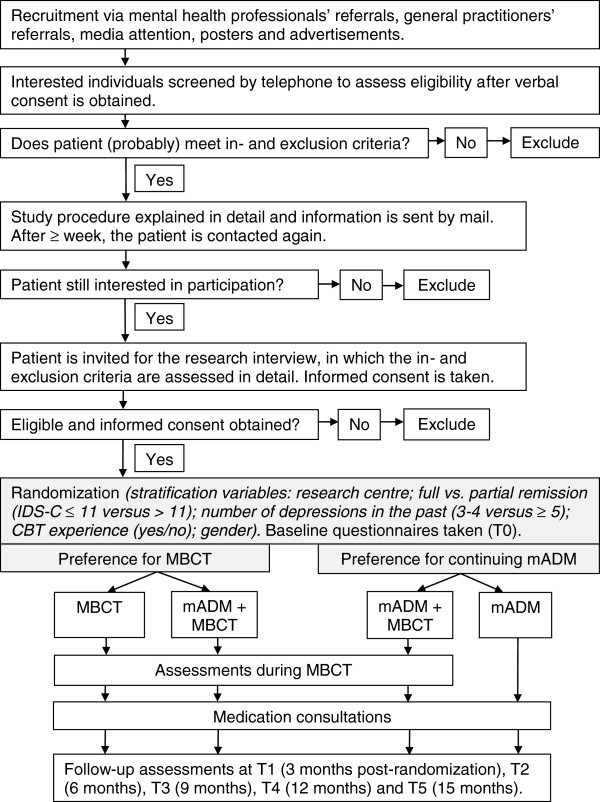
BACKGROUND: Depression is a common psychiatric disorder characterized by a high rate of relapse and recurrence. The most commonly used strategy to prevent relapse/recurrence is maintenance treatment with antidepressant medication (mADM). Recently, it has been shown that Mindfulness-Based Cognitive Therapy (MBCT) is at least as effective as mADM in reducing the relapse/recurrence risk. However, it is not yet known whether combination treatment of MBCT and mADM is more effective than either of these treatments alone. Given the fact that most patients have a preference for either mADM or for MBCT, the aim of the present study is to answer the following questions. First, what is the effectiveness of MBCT in addition to mADM? Second, how large is the risk of relapse/recurrence in patients withdrawing from mADM after participating in MBCT, compared to those who continue to use mADM after MBCT? METHODS/DESIGN: Two parallel-group, multi-center randomized controlled trials are conducted. Adult patients with a history of depression (3 or more episodes), currently either in full or partial remission and currently treated with mADM (6 months or longer) are recruited. In the first trial, we compare mADM on its own with mADM plus MBCT. In the second trial, we compare MBCT on its own, including tapering of mADM, with mADM plus MBCT. Follow-up assessments are administered at 3-month intervals for 15 months. Primary outcome is relapse/recurrence. Secondary outcomes are time to, duration and severity of relapse/recurrence, quality of life, personality, several process variables, and incremental cost-effectiveness ratio. DISCUSSION: Taking into account patient preferences, this study will provide information about a) the clinical and cost-effectiveness of mADM only compared with mADM plus MBCT, in patients with a preference for mADM, and b) the clinical and cost-effectiveness of withdrawing from mADM after MBCT, compared with mADM plus MBCT, in patients with a preference for MBCT. TRIAL REGISTRATION: ClinicalTrials.gov: NCT00928980.
Overview
The claims and statistics of this paper haven’t been checked yet.
Free: it reads the open-access text and checks the first 5 claims that cite a source we can check. Create a free account to check every claim.
Integrity signals
Registry
Cites
Statistics
Figures
Verification
Claims the paper makes
The claims and statistics of this paper haven’t been checked yet.
Free: it reads the open-access text and checks the first 5 claims that cite a source we can check. Create a free account to check every claim.
Claims other papers make about this one
Each is checked against this paper’s own text: does it say what the citing paper says it does?
The source backs part of the claim, not all of it — or backs it for a different population, condition or comparison.
In the citing paper
“It may therefore be useful to reassure HPs that the risk of relapse may be minimised if discontinuation is accompanied by appropriate psychological support (although there is still a need for further work on providing support for patients who are discontinuing antidepressants).34 38 39”
From Helping people discontinue long-term antidepressants: views of health professionals in UK primary care (2019) · cites this paper as [39]
Experimental — accuracy not yet measuredThe cited source says what the claim attributes to it.
In the citing paper
“For the sample size calculation we refer to the published protocol (Huijbers et al., 2012).A total of 96 participants (48 per group) was needed to demonstrate a difference of 25%, with a power of 0.80 and alpha of 0.05.”
From Adding mindfulness-based cognitive therapy to maintenance antidepressant medication for prevention of relapse/recurrence in major depressive disorder: Randomised controlled trial (2015) · cites this paper as Huijbers et al., 2012
Self-check
Percentages, sums and reported differences re-computed from the paper’s own numbers.
The self-check needs the paper’s full text.
Citations
Cites
Diagnostic and Statistical Manual of Mental Disorders
Williams, J. B. W., & First, M. (2013) · Encyclopedia of Social Work · doi:10.1093/acrefore/9780199975839.013.104 · Cited by 109,519
Preacher, K. J., & Hayes, A. F. (2008) · Behavior Research Methods · doi:10.3758/brm.40.3.879 · Cited by 34,117 · cited 2×
“In this subsample, we will test the mediating effect of adherence to MBCT, rumination, cognitive reactivity, mindfulness skills, and self-compassion, on depressive relapse/recurrence and depression severity as outcomes, using a multiple mediation model following the approach suggested by Preacher and Hayes [57].”
Diagnostic and Statistical Manual of Mental Disorders.
Widiger, T. A. (2000) · Encyclopedia of Psychology, Vol. 3. · doi:10.1037/10518-009 · Cited by 19,744
(1998) · The Journal of Clinical Psychiatry · Cited by 19,139
EuroQol: a new facility for the measurement of health-related quality of life
(1990) · Health Policy · doi:10.1016/0168-8510(90)90421-9 · Cited by 15,736
Depression and quality of life in older persons: A review
Sivertsen, H., Bjørkløf, G. H., Engedal, K., Selbæk, G., & Helvik, A.-S. (2015) · Dementia and Geriatric Cognitive Disorders · doi:10.1159/000437299 · Cited by 14,152
The benefits of being present: Mindfulness and its role in psychological well-being
Brown, K. W., & Ryan, R. M. (2003) · Journal of Personality and Social Psychology · doi:10.1037/0022-3514.84.4.822 · Cited by 13,448 · cited 1×
“The Mindful Attention Awareness Scale (MAAS [49]) is administered before each MBCT session to assess mindful attention in daily life.”
(1998) · PubMed · Cited by 10,216
Cognitive Therapy for Depression: (675542012-001)
(2012) · PsycEXTRA Dataset · doi:10.1037/e675542012-001 · Cited by 9,663
Development of the World Health Organization WHOQOL-BREF Quality of Life Assessment
THE WHOQOL GROUP (1998) · Psychological Medicine · doi:10.1017/s0033291798006667 · Cited by 7,933
Research works printed but not linked: 6
- National Institute for Clinical Excellence Depression: management of depression in primary and secondary care 2004 London: National Institute for Health and Clinical Excellence NICE guidance
- First MB Gibbon M Spitzer RL Williams JBW User Guide for the Structured Clinical Interview for DSM-IV Axis 1 Disorders 1996 Washington, DC: American Psychiatric Association
- Akkerhuis GW Vertaling IDS 1997 Utrecht: H.C. Rümke Groep
- Moleman P Praktische psychofarmacologie 2009 Houten: Prelum
- Costa PT McCrae RR Revised NEO Personality Inventory (NEO-PI-R) and the Five Factor Inventory (NEO-FFI): Professional Manual 1992 Odessa, Florida: Psychological Assessment Resources Inc
- Oostenbrink JB Bouwmans CAM Koopmanschap MA Rutten FFH Handleiding voor kostenonderzoek. Methoden en standaard kostprijzen voor economische evaluaties in de gezondheidszorg. Geactualiseerde versie 2004 Diemen: College voor zorgverzekeringen 2004
Cited by
Kuyken, W., Warren, F. C., Taylor, R. S., Whalley, B., Crane, C., Bondolfi, G., Hayes, R., Huijbers, M., Ma, H., Schweizer, S., et al. (2016) · JAMA Psychiatry · doi:10.1001/jamapsychiatry.2016.0076 · Cited by 821
Self-citationBockting, C. L., Hollon, S. D., Jarrett, R. B., Kuyken, W., & Dobson, K. (2015) · Clinical Psychology Review · doi:10.1016/j.cpr.2015.02.003 · Cited by 295
Self-citationCrane, R. S., Eames, C., Kuyken, W., Hastings, R. P., Williams, J. M. G., Bartley, T., Evans, A., Silverton, S., Soulsby, J. G., & Surawy, C. (2013) · Assessment · doi:10.1177/1073191113490790 · Cited by 255
“Such research is in progress as part of a large MBCT trial in the Netherlands (Huijbers et al., 2012).”
BackgroundMethodSelf-citationPsychological therapies for treatment-resistant depression in adults
Ijaz, S., Davies, P., Williams, C. J., Kessler, D., Lewis, G., & Wiles, N. (2018) · Cochrane Database of Systematic Reviews · doi:10.1002/14651858.cd010558.pub2 · Cited by 155
Sundquist, J., Lilja, Å., Palmér, K., Memon, A. A., Wang, X., Johansson, L. M., & Sundquist, K. (2015) · British Journal of Psychiatry · doi:10.1192/bjp.bp.114.150243 · Cited by 123
Abuse and misuse of antidepressants
Sullivan, M., & Evans, E. (2014) · Substance Abuse and Rehabilitation · doi:10.2147/sar.s37917 · Cited by 91
“151 For patients with substance use disorders co-occurring with depression, integrated treatment delivered in a group setting has been found to be more effective than treatment as usual.”
Kuyken, W., Hayes, R., Barrett, B., Byng, R., Dalgleish, T., Kessler, D., Lewis, G., Watkins, E., Morant, N., Taylor, R. S., et al. (2015) · Health Technology Assessment · doi:10.3310/hta19730 · Cited by 82
Self-citationManaging antidepressant discontinuation: a systematic review
Maund, E., Stuart, B., Moore, M., Dowrick, C., Geraghty, A. W. A., Dawson, S., & Kendrick, T. (2019) · The Annals of Family Medicine · doi:10.1370/afm.2336 · Cited by 82
van Ravesteijn, H., Lucassen, P., Bor, H., van Weel, C., & Speckens, A. (2013) · Psychotherapy and Psychosomatics · doi:10.1159/000348588 · Cited by 65
Self-citationHuijbers, M. J., Spinhoven, P., Spijker, J., Ruhé, H. G., van Schaik, D. J. F., van Oppen, P., Nolen, W. A., Ormel, J., Kuyken, W., van der Wilt, G. J., et al. (2016) · British Journal of Psychiatry · doi:10.1192/bjp.bp.115.168971 · Cited by 58
Self-citationSpinhoven, P., Huijbers, M. J., Ormel, J., & Speckens, A. E. M. (2017) · Journal of Affective Disorders · doi:10.1016/j.jad.2017.02.011 · Cited by 55
“…study, which investigated the effectiveness of MBCT, maintenance antidepressant medication (mADM) and the combination of both to prevent relapse/ recurrence in patients with recurrent depression in remission (for study details and outcomes of both RCTs see Huijbers et al. (2012, 2015, 2016)).”
BackgroundSelf-citationHuijbers, M. J., Crane, R. S., Kuyken, W., Heijke, L., van den Hout, I., Donders, A. R. T., & Speckens, A. E. M. (2017) · Mindfulness · doi:10.1007/s12671-016-0672-z · Cited by 54
“The IDS-C was administered by independent, trained research assistants (Huijbers et al. 2012).”
MethodSelf-citationDisciplined Improvisation: Characteristics of Inquiry in Mindfulness-Based Teaching
Crane, R. S., Stanley, S., Rooney, M., Bartley, T., Cooper, L., & Mardula, J. (2015) · Mindfulness · doi:10.1007/s12671-014-0361-8 · Cited by 44
“Trials are increasingly including analysis of mediator variables in their design (Huijbers et al. 2012; Kuyken et al. 2010b; Williams et al. 2010), so it is likely that studies of mechanisms of action will increase over the next few years and that this will feed the knowledge base on MB teaching.”
Backgroundvan Ravesteijn, H., Grutters, J., olde Hartman, T., Lucassen, P., Bor, H., van Weel, C., van der Wilt, G. J., & Speckens, A. (2013) · Journal of Psychosomatic Research · doi:10.1016/j.jpsychores.2013.01.001 · Cited by 45
“In line with the original Mindfulness-Based Stress Reduction format [20], we incorporated a silent day to give participants the opportunity to deepen their mindfulness practice [21].”
MethodSelf-citationMonnart, A., Vanderhasselt, M., Schröder, E., Campanella, S., Fontaine, P., & Kornreich, C. (2019) · Frontiers in Psychiatry · doi:10.3389/fpsyt.2019.00730 · Cited by 47
Huijbers, M. J., Spinhoven, P., Spijker, J., Ruhé, H. G., van Schaik, D. J. F., van Oppen, P., Nolen, W. A., Ormel, J., Kuyken, W., van der Wilt, G. J., et al. (2015) · Journal of Affective Disorders · doi:10.1016/j.jad.2015.08.023 · Cited by 43
“Huijbers et al. / Journal of Affective Disorders 187 (2015) 54–61 55”
BackgroundMethodSelf-citationSundquist, J., Palmér, K., Johansson, L. M., & Sundquist, K. (2017) · European Psychiatry · doi:10.1016/j.eurpsy.2017.01.328 · Cited by 40
“mindfulness-based cognitive therapy (MBCT), have been increasingly used during the past decade for a range of conditions (5-8).”
BackgroundShapero, B. G., Greenberg, J., Mischoulon, D., Pedrelli, P., Meade, K., & Lazar, S. W. (2018) · Mindfulness · doi:10.1007/s12671-018-0889-0 · Cited by 43
“MBCT is an evidence-based group intervention that combines components of cognitive behavioral therapy (CBT) with mindfulness meditation (Huijbers et al. 2012; Segal et al. 2012; Van der Velden et al. 2015).”
BackgroundDoes mindfulness based cognitive therapy prevent relapse of depression?
Kuyken, W., Crane, R., & Dalgleish, T. (2012) · BMJ · doi:10.1136/bmj.e7194 · Cited by 34
Self-citationMocking, R. J. T., Figueroa, C. A., Rive, M. M., Geugies, H., Servaas, M. N., Assies, J., Koeter, M. W. J., Vaz, F. M., Wichers, M., van Straalen, J. P., et al. (2016) · BMJ Open · doi:10.1136/bmjopen-2015-009510 · Cited by 31
Self-citationBowers, H. M., Williams, S. J., Geraghty, A. W. A., Maund, E., O’brien, W., Leydon, G., May, C. R., & Kendrick, T. (2019) · BMJ Open · doi:10.1136/bmjopen-2018-027837 · Cited by 31
Molecular serum signature of treatment resistant depression
Ruland, T., Chan, M. K., Stocki, P., Grosse, L., Rothermundt, M., Cooper, J. D., Arolt, V., & Bahn, S. (2016) · Psychopharmacology · doi:10.1007/s00213-016-4348-0 · Cited by 27
Sundquist, J., Palmér, K., Memon, A. A., Wang, X., Johansson, L. M., & Sundquist, K. (2018) · Early Intervention in Psychiatry · doi:10.1111/eip.12715 · Cited by 29
“In this study, we used MGT developed for Swedish primary healthcare using manuals and standardized techniques adapted and modified from MBSR/MBCT. MGT (in Swedish: Här and Nu = here and now) has been used in Sweden for teaching more than 1500 mindfulness instructors since 2005.”
Influentialde Klerk‐Sluis, J. M., Huijbers, M. J., Löcke, S., Spijker, J., Spinhoven, P., Speckens, A. E. M., & Ruhé, H. G. (2021) · Depression and Anxiety · doi:10.1002/da.23220 · Cited by 24
“For further detail see the MOMENT study protocol (Huijbers et al., 2012).”
BackgroundMethodSelf-citationEffect of a Brief Meditation Intervention on Gambling Cravings and Rates of Delay Discounting
Shead, N. W., Champod, A. S., & MacDonald, A. (2019) · International Journal of Mental Health and Addiction · doi:10.1007/s11469-019-00133-x · Cited by 21
“…and secular 1259 International Journal of Mental Health and Addiction (2020) 18:1247–1263 conceptualization of mindfulness that was also used by other researchers to target various psychological symptoms (Hendrickson and Rasmussen 2013; Hoge et al. 2014; Huijbers et al. 2012; Michalak et al. 2011).”
BackgroundMindfulness facets and Big Five personality facets in persons with recurrent depression in remission
Spinhoven, P., Huijbers, M. J., Zheng, Y., Ormel, J., & Speckens, A. E. M. (2017) · Personality and Individual Differences · doi:10.1016/j.paid.2017.01.045 · Cited by 20
“…as the ‘MOMENT’ study, which investigated the effectiveness of MBCT,mADMand the combination of both to prevent relapse/recurrence in patientswith recurrent depression in remission (for study details and outcomes of both RCTs see Huijbers et al., 2012; Huijbers et al., 2015; Huijbers et al., 2016).”
BackgroundSelf-citationHuijbers, M. J., Spinhoven, P., van Schaik, A., Nolen, W. A., & Speckens, A. E. M. (2016) · Journal of Affective Disorders · doi:10.1016/j.jad.2016.01.041 · Cited by 20
“Huijbers et al. / Journal of Affective Disorders 195 (2016) 32–39 33”
BackgroundMethodSelf-citationMatthews, J., Huberty, J., Leiferman, J. A., McClain, D. B., & Larkey, L. (2016) · Journal of Evidence-Based Complementary & Alternative Medicine · doi:10.1177/2156587216641829 · Cited by 20
“Mindfulness also cultivates self-compassion, which has been reported to be a beneficial factor that is protective against depression and relapse/recurrence.(81) More research is needed, especially randomized controlled trials, to determine the efficacy of mindfulness interventions for depression and the pathways by wh…”
BackgroundGreenberg, J., Shapero, B. G., Mischoulon, D., & Lazar, S. W. (2017) · European Archives of Psychiatry and Clinical Neuroscience · doi:10.1007/s00406-016-0746-x · Cited by 17
Schuling, R., Huijbers, M. J., van Ravesteijn, H., Donders, R., Kuyken, W., & Speckens, A. E. M. (2016) · Contemporary Clinical Trials · doi:10.1016/j.cct.2016.07.014 · Cited by 21
Self-citationter Avest, M. J., Dusseldorp, E., Huijbers, M. J., van Aalderen, J. R., Cladder-Micus, M. B., Spinhoven, P., Greven, C. U., & Speckens, A. E. M. (2019) · Behaviour Research and Therapy · doi:10.1016/j.brat.2019.103467 · Cited by 18
Self-citationHuijbers, M. J., Wentink, C., Simons, E. M. F., Spijker, J., & Speckens, A. E. M. (2020) · BMJ Open · doi:10.1136/bmjopen-2020-039053 · Cited by 17
Self-citationThe impact of well-being on self-confidence: The mediating role of soft skills among adolescents
Silitonga, L. L., Maruli, S., & Simanjuntak, H. (2025) · Cognitive Development · doi:10.1016/j.cogdev.2025.101567 · Cited by 15
ter Avest, M. J., Greven, C. U., Huijbers, M. J., Wilderjans, T. F., Speckens, A. E. M., & Spinhoven, P. (2020) · Cognitive Therapy and Research · doi:10.1007/s10608-020-10108-1 · Cited by 15
Self-citationMindfulness-Based Cognitive Therapy
Eisendrath, S. J. (2016) · Springer eBooks · doi:10.1007/978-3-319-29866-5 · Cited by 23
Batmaz, S., Kaymak, S. U., Koçbıyık, S., & Türkçapar, M. H. (2015) · International Journal of Cognitive Therapy · doi:10.1521/ijct.2015.8.1.61 · Cited by 12
Zou, Z., Huang, J., Yang, Q., Zhang, Y., Xu, B., Wang, P., & Chen, G. (2022) · Evidence-based Complementary and Alternative Medicine · doi:10.1155/2022/1442578 · Cited by 8
“+e recurrence risk has been shown to increase with 16% after each successive episode [6, 7].”
BackgroundRaiskila, T., Sequeiros, S. B., Kiuttu, J., Kauhanen, M.-L., Läksy, K., Vainiemi, K., Tuulio‐Henriksson, A., Hakko, H. H., Joukamaa, M. I., & Veijola, J. M. (2013) · Depression Research and Treatment · doi:10.1155/2013/926562 · Cited by 6
“Depression is a common psychiatric disorder characterized by high rates of relapse and recurrence [1].”
Backgroundter Avest, M. J., Greven, C. U., Huijbers, M. J., Wilderjans, T. F., Speckens, A. E. M., & Spinhoven, P. (2020) · Mindfulness · doi:10.1007/s12671-020-01453-z · Cited by 6
“The current study used data from the MOMENT study which consists of two related multicenter RCTs.”
BackgroundInfluentialSelf-citationIs a Combination of Pharmacotherapy and Psychotherapy Superior to Each Alone?
Choi, K., & Kim, Y. (2017) · Springer eBooks · doi:10.1007/978-981-10-6577-4_21 · Cited by 4
(2014) · Journal of Depression & Anxiety · doi:10.4172/2167-1044.1000161 · Cited by 3
Himle, A. E., Havik, O. E., & Thimm, J. C. (2020) · Nordic Psychology · doi:10.1080/19012276.2020.1727359 · Cited by 4
Bockting, C. (2015) · Utrecht University Repository (Utrecht University) · Cited by 2
Facilitating Self-As-Context: A Treatment Component Study
Williams, N. F. (2015) · VTechWorks (Virginia Tech) · Cited by 2
Reichenberg, L. W., & Seligman, L. (2016) · Wiley eBooks · doi:10.1002/9781394259465.ch5 · Cited by 1
van Aalderen, J. R. (2016) · Radboud Repository (Radboud University) · Cited by 2
Batmaz, S., Kaymak, S. U., Kocbiyik, S., & Türkçapar, M. H. (2014) · European Psychiatry · doi:10.1016/s0924-9338(14)78328-2
اللا, م. ا. ع. ا. ع. (2019) · مجلة الإرشاد النفسی · doi:10.21608/cpc.2019.109623
Metcalf, C. (2019) · CU Scholar (University of Colorado Boulder) · Cited by 2
Metadata
- Authors
- Huijbers, M. J., Spijker, J., Donders, A. R. T., van Schaik, D. J., van Oppen, P., Ruhé, H. G., Blom, M. B. J., Nolen, W. A., Ormel, J., van der Wilt, G. J., Kuyken, W., Spinhoven, P., & Speckens, A. E. M.
- Affiliations
- Radboud University Nijmegen (NL)
- Pro Persona (NL)
- Amsterdam UMC Location University of Amsterdam (NL)
- Parnassia Groep (NL)
- University Medical Center Groningen (NL)
- University of Exeter (GB)
- Leiden University (NL)
- Corresponding author
- Huijbers, Marloes J
- ORCID
- Venue
- BMC Psychiatry
- Published
- 2012-08-27
- Volume
- 12
- Issue
- 1
- Pages
- 125-125
- ISSN
- 1471-244X (ISSN-L)
- PMC
- PMC3469366
- OpenAlex
- W2145168537
- Cited by
- 53
- References
- 63
- Citations by year
- 2025: 1 · 2024: 1 · 2022: 1 · 2021: 1 · 2020: 4 · 2019: 7 · 2018: 3 · 2017: 6 · 2016: 11 · 2015: 6 · 2014: 6 · 2013: 5 · 2012: 1
- FWCI
- 6.55
- Type
- journal article
- Language
- en
- Open access
- gold
- doi.org
- Licence
- Locations
- BMC Psychiatry (publishedVersion, cc-by)
- Europe PMC (PubMed Central) (publishedVersion, cc-by)
- PubMed Central (publishedVersion, cc-by)
- PubMed (publishedVersion)
- University of Groningen research database (University of Groningen / Centre for Information Technology) (publishedVersion, cc-by)
- Pure Amsterdam UMC (acceptedVersion, other-oa)
- Radboud Repository (Radboud University) (submittedVersion)
- Data Archiving and Networked Services (DANS) (submittedVersion)
- Leiden Repository (Leiden University) (submittedVersion)
- Digital Academic REpository of VU University Amsterdam (Vrije Universiteit Amsterdam) (submittedVersion)
- DOAJ (DOAJ: Directory of Open Access Journals) (submittedVersion)
- Radboud Repository (Radboud University) (submittedVersion, other-oa)
- University of Groningen research database (University of Groningen / Centre for Information Technology) (submittedVersion, other-oa)
- Data Archiving and Networked Services (DANS) (submittedVersion, other-oa)
- Funders
- ZonMw (170992903)
- Topics
- Social Sciences › Psychology › Clinical Psychology › Mindfulness and Compassion Interventions
- Health Sciences › Medicine › Pharmacology (medical) › Treatment of Major Depression
- Social Sciences › Psychology › Experimental and Cognitive Psychology › Anxiety, Depression, Psychometrics, Treatment, Cognitive Processes
- Keywords
- recurrent depression, relapse prevention, mindfulness-based cognitive therapy, combination therapy, antidepressant tapering, relapse and recurrence, cost-effectiveness, patient preferences, quality of life
- MeSH terms
- Adult, Antidepressive Agents, Clinical Protocols, Combined Modality Therapy, Cost-Benefit Analysis, Depressive Disorder, Humans, Research, Cognitive Behavioral Therapy, Treatment Outcome, Patient Selection, Secondary Prevention
About these checks
Registry, retraction, Cites and statistics results are computed, not judged, with one exception: a printed reference that no index lists is read once by a model before it counts as a citation error. Claims are extracted by a model and kept only when their quote appears verbatim in the text; each cited source is then checked, with a model’s help, for whether it says what the claim relies on. Those verdicts can be wrong — read the claim’s quote and the cited source before relying on one.
Statistics and arithmetic are recomputed, not judged.
Confidence bands are shown only for fields calibrated on our annotated test set. None is calibrated yet, so no band is shown.
What counts as a claim ›How we measure confidence ›How we check this ›
Are you an author, or do you see a problem with this page? Request a review
Data sources
Bibliographic data: Semantic Scholar, OpenAlex, Crossref.
Contains information from the Semantic Scholar Academic Graph Datasets, made available under the ODC Attribution License (ODC-BY 1.0).
Semantic Scholar’s data is described in: Kinney, R., et al. (2023). The Semantic Scholar Open Data Platform. arXiv:2301.10140.
