

The development and psychometric properties of a new scale to measure mental illness related stigma by health care providers: The opening minds scale for Health Care Providers (OMS-HC)
Open accessThe DOI matches its Crossref record; 60 of the 60 references it cites were found in a registry or an index.
Abstract
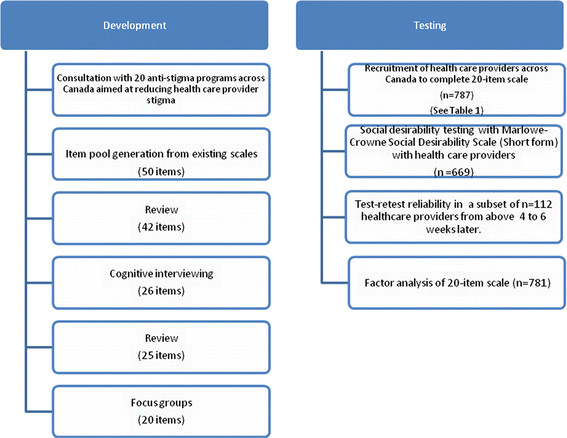
BACKGROUND: Research on the attitudes of health care providers towards people with mental illness has repeatedly shown that they may be stigmatizing. Many scales used to measure attitudes towards people with mental illness that exist today are not adequate because they do not have items that relate specifically to the role of the health care provider. METHODS: We developed and tested a new scale called the Opening Minds Scale for Health Care Providers (OMS-HC). After item-pool generation, stakeholder consultations and content validation, focus groups were held with 64 health care providers/trainees and six people with lived experience of mental illness to develop the scale. The OMS-HC was then tested with 787 health care providers/trainees across Canada to determine its psychometric properties. RESULTS: The initial testing OMS-HC scale showed good internal consistency, Cronbach's alpha = 0.82 and satisfactory test-retest reliability, intraclass correlation = 0.66 (95% CI 0.54 to 0.75). The OMC-HC was only weakly correlated with social desirability, indicating that the social desirability bias was not likely to be a major determinant of OMS-HC scores. A factor analysis favoured a two-factor structure which accounted for 45% of the variance using 12 of the 20 items tested. CONCLUSIONS: The OMS-HC provides a good starting point for further validation as well as a tool that could be used in the evaluation of programs aimed at reducing mental illness related stigma by health care providers. The OMS-HC incorporates various dimensions of stigma with a modest number of items that can be used with busy health care providers.
Overview
The claims and statistics of this paper haven’t been checked yet.
Free: it reads the open-access text and checks the first 5 claims that cite a source we can check. Create a free account to check every claim.
Integrity signals
Registry
Cites
Statistics
Figures
Verification
Claims the paper makes
The claims and statistics of this paper haven’t been checked yet.
Free: it reads the open-access text and checks the first 5 claims that cite a source we can check. Create a free account to check every claim.
Claims other papers make about this one
Each is checked against this paper’s own text: does it say what the citing paper says it does?
The cited source says what the claim attributes to it.
In the citing paper
“Stigmatising attitudes towards people with mental health problems were primarily assessed with Social Distance Scales based on Link et al[26] and Personal Stigma Scales based on Griffiths et al [27]. Other validated stigma scales included the Attitudes to Mental Illness Scale,[28] Opening Minds Scale for Healthcare Providers[29] and the Personal Attributes scale [30].”
From Systematic review and meta-analysis of Mental Health First Aid training: Effects on knowledge, stigma, and helping behaviour (2018) · cites this paper as [29]
Self-check
Percentages, sums and reported differences re-computed from the paper’s own numbers.
The self-check needs the paper’s full text.
Citations
Cites
Stigma: Notes on the Management of Spoiled Identity
(1969) · Postgraduate Medical Journal · doi:10.1136/pgmj.45.527.642 · Cited by 14,231
Foundations of Clinical Research: Applications to Practice,
(2002) · Survey of Ophthalmology · doi:10.1016/s0039-6257(02)00362-4 · Cited by 9,489
Link, B. G., & Phelan, J. C. (2001) · Annual Review of Sociology · doi:10.1146/annurev.soc.27.1.363 · Cited by 8,848
Kendall, M. G. (1957) · Biometrika · doi:10.2307/2333282 · Cited by 6,383
Starting at the beginning: an introduction to coefficient alpha and internal consistency
Streiner, D. L. (2003) · Journal of Personality Assessment · doi:10.1207/s15327752jpa8001_18 · Cited by 3,794 · cited 1×
“70 was considered acceptable [52].”
How stigma interferes with mental health care.
Corrigan, P. (2004) · American Psychologist · doi:10.1037/0003-066x.59.7.614 · Cited by 3,648 · cited 3×
“Recovery is a process which occurs when people with mental illness discover, or rediscover, their strengths and abilities for pursuing personal goals and develop a sense of identity that allows them to grow beyond their mental illness [3,4].”
BackgroundBevan, J. M., & Kendall, M. G. (1971) · The Statistician · doi:10.2307/2986801 · Cited by 2,436
Netemeyer, R., Bearden, W., & Sharma, S. (2003) · Sage eBooks · doi:10.4135/9781412985772 · Cited by 2,118
(2003) · Cited by 2,093
Excess mortality of mental disorder
Harris, C., & Barraclough, B. (1998) · British Journal of Psychiatry · doi:10.1192/bjp.173.1.11 · Cited by 1,881 · cited 1×
“For example, it has been reported that people with mental illness have poorer physical health in part because medical professionals wrongly associate the physical symptoms experienced by the person with mental illness to the mental illness itself [27-30].”
Background
Cited by
Items 101–200 of 262
Adams, E. T., Nyblade, L. C., Madson, G., Wallhagen, M. I., Smith, S. L., Stelmach, R. D., & Francis, H. W. (2024) · Ear and Hearing · doi:10.1097/aud.0000000000001541 · Cited by 12
“…development of training programs that prompt HCPs to self-assess and manage stigma, which have shown promise for elevating HCP awareness of mental health stigma (Kassam et al. 2012; Sukhera et al. 2020) and reducing HIV stigma in health facilities (Ekstrand et al. 2020; Siraprapasiri et al. 2020).”
Paradigms Lost, Paradigms Found: Lessons Learned in the Fight Against the Stigma of Mental Illness
Stuart, H. L., & Sartorius, N. (2022) · Oxford University Press eBooks · doi:10.1093/med/9780197555804.001.0001 · Cited by 16
Estigma hacia personas con enfermedad mental en estudiantes y profesores de terapia ocupacional,
Jean Gajardo, J., Espinosa, F., Rodrigo Goycolea, M., Oyarzún, M., Espinosa, I. M., Valdebenito, A., & Pezoa, C. (2022) · Cadernos Brasileiros de Terapia Ocupacional · doi:10.1590/2526-8910.ctoao24103145 · Cited by 11
Zavorotnyy, M., Klatte, S., Yang, Y., Liu, W., Wagner, U., & Kircher, T. T. J. (2023) · Frontiers in Psychiatry · doi:10.3389/fpsyt.2023.1306403 · Cited by 11
“Similarly to baseline ratings in the SCM domains, we observed a comparatively low baseline stigma expression measured with the OMS-HC, a tool to test stigmatization among medical providers (41).”
MethodJean Gajardo, J., Francisca Espinosa, T., Espinosa, I. M., Rodrigo Goycolea, M., Valdebenito, A., Oyarzún, M., & Pezoa, C. (2021) · Revista chilena de neuro-psiquiatría · doi:10.4067/s0717-92272021000200091 · Cited by 11
“En este contexto se desarrolló el cuestionario Opening Minds Scale for Healthcare Practitioners (OMSHC), para evaluar el estigma hacia personas con enfermedades mentales en profesionales de la salud (9,10).”
BackgroundNeikrug, A. B., Stehli, A., Xiong, G. L., Suo, S., Le-Bucklin, K.-V. T., Cant, W., & McCarron, R. M. (2022) · Journal of Continuing Education in the Health Professions · doi:10.1097/ceh.0000000000000432 · Cited by 10
“These measures (ie, OMS-HC and PSES) have been previously used inmedical provider populations, and their measurement validity has been reported.(29,32,33) For the purpose of evaluating and considering fellows’ satisfaction with current psychiatric knowledge, the confidence to treat various psychiatric illnesses, and s…”
MethodVielma-Aguilera, A., Bustos, C., Saldivia, S., & Grandón, P. (2021) · Current Psychology · doi:10.1007/s12144-021-01911-4 · Cited by 10
Neary, S., Ruggeri, M., Roman, C., Kamauf, R., Chilton, J., & Martin, A. (2022) · The Journal of Physician Assistant Education · doi:10.1097/jpa.0000000000000410 · Cited by 11
Mental Stigma Among Al-Ahsa Population in Saudi Arabia
Alamer, M., Alsaad, A. J., Al-Ghareeb, M., Almomatten, A. M., Alaethan, M., & Alameer, M. (2021) · Cureus · doi:10.7759/cureus.19710 · Cited by 11
Bazzari, A. H., & Bazzari, F. H. (2023) · Behavioral Sciences · doi:10.3390/bs13110884 · Cited by 9
“However, 5 questions require reverse scoring, which in the original 20-item version of the OMS-HC questionnaire [27] were labeled as items: 3, 8, 9, 10, and 19.”
BackgroundKitay, B. M., Walde, T., Robertson, D., Cohen, T., Duvivier, R. J., & Martin, A. (2020) · Journal of the American Psychiatric Nurses Association · doi:10.1177/1078390320945778 · Cited by 10
“Many students in the health professions in the United States and abroad harbor negative attitudes toward ECT (Abbas et al., 2007; Aki et al., 2013; Clothier et al., 2001; Walter et al., 2002), including nursing students (Kavanagh & McLoughlin, 2009; Sharma et al., 2017).”
BackgroundDepression-related stigma among primary care providers
Kluemper, A., Heath, L. J., Loeb, D. F., Kroehl, M., & Trinkley, K. E. (2021) · Mental Health Clinician · doi:10.9740/mhc.2021.05.175 · Cited by 9
“6 As such, provider stigma can negatively impact patient care 6 whether intentional or not.”
InfluentialWang, D. S., Smith, S., & Locke, C. R. (2014) · Advances in Social Work · doi:10.18060/16477 · Cited by 8
Manley, A. E., Perry, R. E., Moran, P., Dawson, S., Biddle, L., & Savović, J. (2026) · BMJ Open · doi:10.1136/bmjopen-2025-111351 · Cited by 10
Engaging Nursing Students in Mental Health Concepts Through Multiple Teaching Modalities
Carr, K. L., Rhodes, K., Klamm, M. M., & McElwain, S. D. (2023) · Journal of Nursing Education · doi:10.3928/01484834-20230315-01 · Cited by 8
Moreira, M. B. P., Pereira, H. P., Torres, I. N., Marina, S., & Ricou, M. (2024) · Frontiers in Psychology · doi:10.3389/fpsyg.2024.1359483 · Cited by 8
Noonan, M., Brown, M., Gibbons, M., Tuohy, T., Johnson, K., Bradshaw, C., Tighe, S. M., Atkinson, S., Murphy, L., MOHAMAD, M. R., et al. (2024) · Midwifery · doi:10.1016/j.midw.2024.104089 · Cited by 9
Rehl, D., Mangapora, M., Love, M., Love, C., Shaw, K., McCarthy, J., & Beverly, E. A. (2024) · Journal of Osteopathic Medicine · doi:10.1515/jom-2023-0188 · Cited by 8
Lasalvia, A., Pillan, S., Marzocco, G., Ambrosini, A., Veltro, F., Pozzan, T., D’Astore, C., Cristofalo, D., Ruggeri, M., & Bonetto, C. (2023) · Epidemiology and Psychiatric Sciences · doi:10.1017/s2045796023000689 · Cited by 8
Michels, C., Schneider, T. L., Tetreault, K., Payne, J. M., Zubke, K., & Salisbury‐Afshar, E. (2024) · Western Journal of Emergency Medicine · doi:10.5811/westjem.18020 · Cited by 8
“10 15 We sought to evaluate nurse attitudes, beliefs, barriers, and facilitators to naloxone distribution in an academic ED in the Midwest.”
BackgroundThe stigma of mental health professionals towards users with a mental disorder.
Valverde-Bolivar, E., García-Arenas, J. J., Pelegrin, I. L., Pérez-Gómez, L., Muñoz, M., & Simonelli‐Muñoz, A. J. (2022) · Actas Españolas de Psiquiatría · Cited by 16
Clair, V., Rossa-Roccor, V., Mutiso, V., Rieder, S., Musau, A., Frank, E., & Ndetei, D. M. (2022) · International Journal of Mental Health and Addiction · doi:10.1007/s11469-022-00914-x · Cited by 7
“, 2012), such as providing contact with people suffering from mental illnesses, which appears to be successful in reducing stigma, including among health workers (Kassam et al., 2012; Patten et al., 2012; Penn & Couture, 2002).”
BackgroundChallenges for healthcare providers in treating women with psychiatric disorders during pregnancy.
Einarson, A. (2012) · PubMed · Cited by 7
Vaghee, S., Salarhaji, A., Lotfabadi, M. K., & Vaghei, N. (2017) · Iranian Journal of Psychiatry and Behavioral Sciences · doi:10.5812/ijpbs.9672 · Cited by 8
“Papish A, Kassam A, Modgill G, Vaz G, Zanussi L, Patten S. Reducing the stigma of mental illness in undergraduate medical education: a randomized controlled trial.”
MethodInfluentialKim, W., Bae, J. N., Lim, J., Lee, M. H., Hahm, B., & Yi, H. G. (2017) · Psycho-Oncology · doi:10.1002/pon.4546 · Cited by 7
Diefenderfer, L. A., Iuppa, C. A., Kriz, C. R., & Nelson, L. A. (2020) · Mental Health Clinician · doi:10.9740/mhc.2020.01.005 · Cited by 7
“Total scores range from 20 to 100, with 100 being the most stigmatizing.(24) All students were secluded from their preceptor for approximately 20 minutes to complete the survey and to maintain blinding from the preceptor regarding participation.”
BackgroundInfluentialValidation of the Persistent Somatic Symptom Stigma Scale for Healthcare Professionals
McGhie-Fraser, B., Ballering, A., Lucassen, P. L., McLoughlin, C., Brouwers, E. P. M., Stone, J., Hartman, T. O., & van Dulmen, S. (2024) · Journal of Clinical Epidemiology · doi:10.1016/j.jclinepi.2024.111505 · Cited by 8
Stigma as a Mental Health Policy Controversy: Positions, Options, and Strategies for Change
Pescosolido, B. A. (2019) · Springer eBooks · doi:10.1007/978-3-030-11908-9_19 · Cited by 6
Hsia, S. L., Brooks, J., Yao, E., Gruenberg, K., & Finley, P. R. (2022) · Currents in Pharmacy Teaching and Learning · doi:10.1016/j.cptl.2022.09.022 · Cited by 7
McLaughlin, J. E., Kennedy, L., Garris, S., Harris, S. C., Hillman, A. D., Pinelli, N. R., & Rhoney, D. H. (2017) · Currents in Pharmacy Teaching and Learning · doi:10.1016/j.cptl.2017.06.005 · Cited by 6
Zarbah, A., Alalfard, H. A., Alamri, H. S., Edrees, N. A., Alshahrani, N. S., & Alshehri, A. F. (2023) · Journal of Family and Community Medicine · doi:10.4103/jfcm.jfcm_222_22 · Cited by 6
“The results of this is that patients with mental disorders are given less care because of their disorders and physical symptoms leading to feelings of not being welcome to the healthcare facilities.[11] The stigma associated with mental disorders places a heavy burden on a person with mental condition and their relati…”
BackgroundFernandes, R. H. H., Sanches, M., Bobbili, S. J., de Godoy, S., de Sousa, Á. F. L., González-Ângulo, P., Vedana, K. G. G., & Ventura, C. A. A. (2024) · Healthcare · doi:10.3390/healthcare12222265 · Cited by 5
“To explore the dimensional structure of the MICA-4, an exploratory factor analysis (EFA) was performed using Mplus 8.2 [54].”
InfluentialErcan, F., Karakaş, M., Gürhan, N., DEMİRCAN, Ü., & Haydar Mehmet, K. A. Y. A. (2021) · Journal of Clinical Psychiatry · doi:10.5505/kpd.2021.82653 · Cited by 6
“The Lancet Psychiatry 2015; 2(10):863-864.”
InfluentialLiew, J. R., Jie, C., Tucker, J. R., & Streyffeler, L. (2022) · Medical Education Online · doi:10.1080/10872981.2022.2151069 · Cited by 5
“In the domain of beliefs, we used: 1) the Opening Minds Scale for Health Care Providers (OMS-HC) [24,25], a 7-item subscale measuring attitudes of health-care providers toward persons with mental illness (Cronbach’s α Cohort 1 = 0.”
MethodInfluentialExemplification in news narratives: stigmatizing and securitizing effects
Sellnow‐Richmond, D. D., Lukacovic, M. N., & Sellnow-Richmond, S. A. (2024) · Frontiers in Communication · doi:10.3389/fcomm.2024.1316677 · Cited by 6
Sutton, R., & French, P. (2019) · The Journal of Mental Health Training Education and Practice · doi:10.1108/jmhtep-04-2018-0027 · Cited by 5
Videla, C. P., Sapag, J. C., Klabunde, R., Velasco, P. R., Anríquez, S., Aracena, M., Mascayano, F., Bravo, P., Sena, B. F., Escalona, A. J., et al. (2022) · Transcultural Psychiatry · doi:10.1177/13634615221100377 · Cited by 5
“However, the Spanish versions of the Opening Minds Scale for Healthcare Providers (OMSHC; Kassam et al., 2012), Mental Illness: Clinician’s Attitudes (MICA; Gabbidon et al.”
BackgroundMethodInfluentialLindsay, B. L., Dobson, K. S., Krupa, T. M., Knaak, S. J., & Szeto, A. C. H. (2024) · Discover Psychology · doi:10.1007/s44202-024-00249-9 · Cited by 4
“The Opening Minds Stigma Scale for Health Care Providers (OMS-HC) [13, 14], also developed as part of the OM initiative to assesses stigma, was adapted to the sample.”
Roberts, M., Moxham, L. J., Yousiph, T., Robson, G., Lewer, K., Jay, E., Drury, P., Cordina, J., Villeneuve‐Smith, S., & Patterson, C. (2025) · Nurse Education Today · doi:10.1016/j.nedt.2025.106660 · Cited by 4
Cid, A., Patten, A., Beazely, M. A., Grindrod, K., Yessis, J. L., & Chang, F. (2022) · Pharmacy · doi:10.3390/pharmacy10010024 · Cited by 4
“Social desirability bias was tested with the OMS-HC scale and was weakly correlated with the stigma scale [54].”
MethodWitte, T. H., & Oldenburg, B. (2024) · Journal of Drug Education · doi:10.1177/00472379241278326 · Cited by 4
“The Opening Minds Scale for Healthcare Providers (OMS-HC) is a psychometrically sound, self-report questionnaire originally created as a 12-item or 20-item scale to assess attitudes and behavioral intentions of health care providers (HCPs) towards people with mental illness (Kassam et al., 2012).”
Lasalvia, A., Vallan, M. D., Bodini, L., & Bonetto, C. (2024) · Psychiatry Research · doi:10.1016/j.psychres.2024.116291 · Cited by 4
Harris, S. C., Yates, D., Patel, M., & Patel, K. (2017) · Mental Health Clinician · doi:10.9740/mhc.2017.09.187 · Cited by 4
“The OMS is a validated instrument that measures the attitudes of health care providers toward people with mental illness using a 5-point Likert agreement scale ranging from strongly disagree (1) to strongly agree (5) (total range 10 to 50).(18) The SDS, based on the work of Link et al,(19) is a widely used validated i…”
MethodAssessment of the Opening Minds Scale for use with nursing students
Happell, B., Platania‐Phung, C., Scholz, B., Bocking, J., Horgan, A. M., Manning, F., Doody, R., Hals, E., Granerud, A., van der Vaart, K. J., et al. (2019) · Perspectives In Psychiatric Care · doi:10.1111/ppc.12393 · Cited by 4
Mental illness attitudes in medical education: Assessing the stigma in medical students
Márquez-Cervantes, E., Haydé, D., & Costilla-Esquivel, A. (2023) · Salud Mental · doi:10.17711/sm.0185-3325.2023.014 · Cited by 4
“In our subjects, the MICA-2 scale had a Cronbach’s alpha coefficient of 69 (rounded), which is considered acceptable and similar to the previously re-ported (Kassam et al., 2012).”
InfluentialRamos, H. N. V., Mora-Ríos, J., Rey, G. N., & Mondragón, L. (2023) · PeerJ · doi:10.7717/peerj.16375 · Cited by 4
“The Opening Minds Stigma Scale for Health Care Providers (OMS-HC) was developed to assess the attitudes of healthcare providers toward mental illness ( Kassam et al., 2012 ).”
InfluentialHunt, A., Carpenter, T., Brar, G., Katiyar, T., Al-Shawaf, L., Gillett, G., Chaudhary, N., Boyle, D., Butler, M., Das, A., et al. (2026) · The British Journal of Psychiatry · doi:10.1192/bjp.2026.10615 · Cited by 4
Hillman, A. D., Kennedy, L., Garris, S., McLaughlin, J. E., & Rhoney, D. H. (2015) · Mental Health Clinician · doi:10.9740/mhc.2015.07.162 · Cited by 3
Davidson, D., & Lymburner, J. A. (2017) · Canadian Psychology/Psychologie canadienne · doi:10.1037/cap0000107 · Cited by 3
Patient-reported assessment of compassion in Spanish: a systematic review
Soto-Rubio, A. L., Picazo, C., Gil‐Juliá, B., Andreu‐Vaillo, Y., Pérez‐Marín, M., & Sinclair, S. (2024) · Frontiers in Medicine · doi:10.3389/fmed.2024.1352694 · Cited by 3
Barbo, G., Leidl, D. M., Montreuil, M., Li, H., Richter, S. M., & Petrucka, P. M. (2025) · PLoS ONE · doi:10.1371/journal.pone.0333434 · Cited by 3
“OMS-HC has been chosen since it has been developed and tested on Canadian healthcare providers to examine anti-stigma interventions [34].”
O'Donnell, A. J., Kaner, E., Hanratty, B., Gilvarry, E. A., Wigham, S., & Jackson, K. (2025) · PLoS ONE · doi:10.1371/journal.pone.0334524 · Cited by 3
“Additionally, research consistently finds that people with mental ill-health and/or problematic substance use may sometimes experience stigma and negative views from health care providers [81–83].”
Sastre‐Rus, M., Montes‐Hidalgo, J., Lluch-Canut, M. T., García‐Lorenzo, A., & Tomás‐Sábado, J. (2018) · Revista de Enfermería y Salud Mental · doi:10.5538/2385-703x.2018.10.5 · Cited by 5
Turjoman, M. A., Alqhtani, A., Altuwaylie, T. M., Alshehri, K. S., & Almalki, A. (2020) · International Journal of Medicine in Developing Countries · doi:10.24911/ijmdc.51-1600273094 · Cited by 3
Student Paramedic Stigma towards People with Mental Illness: An International Study
Simpson, P., Agho, K., Nugteren, B. V., Rasku, T., Thompson, S., & Thyer, L. (2020) · Australasian Journal of Paramedicine · doi:10.33151/ajp.17.832 · Cited by 4
“Instrument Data were collected using the Opening Minds Scale for Health Providers (OMS-HC) (40).”
BackgroundMethodWEATHERSTONE, S. J., & Dodd, L. (2022) · European Journal of Mental Health · doi:10.5708/ejmh.17.2022.3.1 · Cited by 3
“Follow-up tests revealed that women expressed a significantly lower level of stigma for ratings on the ISMI survey (p = .005) and the MICAv4 survey (p = .020), whereas the OMS-HC survey was not significant (p = .546).”
BackgroundInfluentialCultural adaptation of the opening minds scale for health care providers(OMS-HC) for Brazil
Carrara, B. S., Ventura, C. A. A., & de Godoy, S. (2022) · Acta Scientiarum Health Sciences · doi:10.4025/actascihealthsci.v45i1.54524 · Cited by 3
Ngo, V. K., Vu, T. T., Levine, D., Punter, M. A., Beane, S. J., Weiss, M., Wyka, K., Florez-Arango, J. F., & Zhou, X. (2024) · BMC Public Health · doi:10.1186/s12889-024-20026-6 · Cited by 4
“Providers will also be asked about their emotional distress using the PHQ-4 [37], mental health stigma with the Opening Minds Scale for Health Care Providers (OMS-HC-15) [58, 59], self-care activities (PCSC-21) [60] as well as burnout using the Maslach Burnout Inventory (MBI-9) [61].”
MethodStuart, H. L., & Sartorius, N. (2022) · Oxford University Press eBooks · doi:10.1093/med/9780197555804.003.0001 · Cited by 2
Ang, J. S., Khoe, H. C. H., Huang, J., Tay, G. W. N., & Ho, C. S. H. (2025) · BMC Emergency Medicine · doi:10.1186/s12873-025-01290-0 · Cited by 4
Factors Influencing Stigma Toward Mental Disorders Among Healthcare Workers: An Observational Study
Fantuzzi, C., Bagozzi, D., Accardo, R., D’Ambrosi, G., & Sanson, G. (2025) · Perspectives In Psychiatric Care · doi:10.1155/ppc/3591255 · Cited by 2
Abdusalyamova, A., Nurkatov, Y., Yessimov, N., & Alibekova, R. (2026) · Cambridge Prisms Global Mental Health · doi:10.1017/gmh.2026.10211 · Cited by 2
Tran, A. R., Patel, S. A., Loera, L. J., Smith, T. L., & Catanzano, S. (2024) · Mental Health Clinician · doi:10.9740/mhc.2024.02.073 · Cited by 2
Adapting the Opening Minds Stigma Scale for Healthcare Providers to Measure Opioid-Related Stigma
Cid, A., Patten, A., Beazely, M. A., & Grindrod, K. (2024) · Pharmacy · doi:10.3390/pharmacy12040105 · Cited by 2
“Additionally, future research on anti-stigma interventions should incorporate additional measures for external validity, such as those that measure knowledge and intended behaviour [18].”
BackgroundMethodInfluentialBhat, D., Sharma, Y., Sridevi, P., Surti, S. B., Sarmah, J., Ranjit, M., Bal, M., & Babu, B. V. (2024) · Journal of Racial and Ethnic Health Disparities · doi:10.1007/s40615-024-02228-1 · Cited by 2
“It contributes to health inequalities, low rates of seeking help, lack of access to care and under-treatment, and negatively impacts wellbeing [13].”
Dennis, S. J., Folger, L. F., Hein, K. E., & Mullins‐Sweatt, S. N. (2025) · Personality and Mental Health · doi:10.1002/pmh.70024 · Cited by 3
Huang, M.-L. (2025) · Annals of Pharmacy Education Safety and Public Health Advocacy · doi:10.51847/xanb8pckq4 · Cited by 2
Kordlou, F., Kabir, K., Bahador, H., & nayeri, T. D. (2015) · Alborz University Medical Journal · doi:10.18869/acadpub.aums.4.4.248 · Cited by 2
Changing the Stigma of the Homeless in Nursing Students
O’Hara, L. L. S. (2019) · Cited by 2
Saúde mental e atenção primária à saúde: agentes comunitários de saúde e a redução do estigma
Carrara, B. S. (2023) · Digital Library of Theses and Dissertations (Universidade de São Paulo) · doi:10.11606/t.22.2023.tde-09082023-164135 · Cited by 3
Mange sykepleiere deler egenerfaringer med pasienter
Unhjem, J. V. (2022) · Sykepleien Forskning · doi:10.4220/sykepleiens.2022.90324 · Cited by 1
Kheyrollahi, R., Farghadani, A., Janbozorgi, M., & Mohammadi, F. S. (2023) · Shenakht Journal of Psychology and Psychiatry · doi:10.32598/shenakht.10.3.17 · Cited by 1
Assessment of emergency department physician perspectives on people with functional seizures
Moore, M., Watson, M. M., & Strom, L. A. (2025) · Epilepsy & Behavior · doi:10.1016/j.yebeh.2025.110494 · Cited by 1
Tucker, S., Woo, H., Henry, M. C., & Lee, I. (2026) · British Journal of Guidance and Counselling · doi:10.1080/03069885.2025.2480288 · Cited by 1
Impact of Recovery College Online Courses Across Learner Types: A Multilevel Analysis
Lefay, G., Samson-Daoust, E., Rapisarda, F., & Briand, C. (2026) · Health & Social Care in the Community · doi:10.1155/hsc/1319353 · Cited by 1
Ručević, S., & Pribisalić, D. (2021) · Annual of Social Work · doi:10.3935/ljsr.v27i3.404 · Cited by 2
Employment Inequity and Workplace Stigma
Stuart, H. L., & Sartorius, N. (2022) · Oxford University Press eBooks · doi:10.1093/med/9780197555804.003.0009 · Cited by 1
Stuart, H. L., & Sartorius, N. (2022) · Oxford University Press eBooks · doi:10.1093/med/9780197555804.003.0012 · Cited by 1
Stuart, H. L., & Sartorius, N. (2022) · Oxford University Press eBooks · doi:10.1093/med/9780197555804.003.0013 · Cited by 1
Using Technology to Fight Stigma
Stuart, H. L., & Sartorius, N. (2022) · Oxford University Press eBooks · doi:10.1093/med/9780197555804.003.0010 · Cited by 1
Prabawati, C. Y., Priyantini, D., Reliani, R., Winata, S. G., & Rofiqi, E. (2023) · Advances in health sciences research/Advances in Health Sciences Research · doi:10.2991/978-94-6463-202-6_10 · Cited by 1
Khenti, A., Bobbili, S. J., Lentinello, E., Sapag, J. C., van der Maas, M., Sanches, M., Agic, B., Hamilton, H. A., Patten, S. B., Stuart, H. L., et al. (2023) · International Journal of Mental Health and Addiction · doi:10.1007/s11469-023-01136-5 · Cited by 1
“The following instruments were selected for inclusion in the staff survey: A) Opening Minds Survey for Health Care Providers (Kassam et al., 2012)”
Self-citationMental health literacy among primary care providers in Hungary: a vignette-based survey
Swisher, V. S., Őri, D., Rihmer, Z., & Wernigg, R. (2025) · Annals of General Psychiatry · doi:10.1186/s12991-024-00539-5 · Cited by 2
Wolgast, M., Tham, K. F., Straht, M., & Levinsson, H. (2025) · International Journal of Social Psychiatry · doi:10.1177/00207640251383193 · Cited by 1
“The OMS-HC is a self-assessment instrument consisting of 20 questions, developed by Kassam et al. (2012).”
Morais, C. D. A. (2014) · RIUnB Institutional Repository (University of Brasília) · doi:10.26512/2014.12.t.18266 · Cited by 2
Wei, Y. (2017) · DalSpace (Dalhousie University) · Cited by 7
Truitt, G. (2019) · Digital Archive @ GSU · doi:10.57709/15899022 · Cited by 1
Impacts of Mental Health First Aid on Mental Health Literacy and Stigma
Hwang, J. (2020) · CUNY Academic Works (City University of New York) · Cited by 1
Zuaboni, G., Elmer, T., Rabenschlag, F., Heumann, K., Jaeger, S., Kozel, B., Mahlke, C., Schori, D., Theodoridou, A., Jaeger, M., et al. (2021) · Research Square · doi:10.21203/rs.3.rs-134092/v1 · Cited by 1
Kassam, A., Antepim, B., & Sukhera, J. I. (2023) · medRxiv · doi:10.1101/2023.05.16.23290047 · Cited by 1
Self-citationDeveloping and validating a scale to measure the enacted and felt stigma of gambling
Donaldson, P., Best, T., Langham, E., Browne, M., & Oorloff, A. (2015) · Acquire (CQUniversity) · Cited by 1
Alonso, L. D. S. (2015) · Biblos-e Archivo (Universidad Autónoma de Madrid) · Cited by 5
Suza, D. E. (2013) · PSU Knowledge Bank (Prince of Songkla University)
A Mixed Methods Approach to Challenging Stigma at a Faculty of Education
Atkins, M.-A. (2016) · Scholarship@Western (Western University)
Krone, M. (2016) · Digital USD (University of San Diego) · doi:10.22371/05.2016.013 · Cited by 3
“Much of the mental health literature regarding stigma refers to Corrigan’s (2004) model of stigma (Ascherman, Vogel & Wade, 2009; Britt, Wright, & Moore, 2012; Cummings, Lucas, & Druss, 2013; Downs & Eisenberg, 2012; Kassam et al., 2012; Mestdagh & Hansen, 2014; Quinn et al., 2014).”
BackgroundContinuing Education Model for Nurses Regarding Substance Use Disorder
Perry, N., & Chertok, I. R. A. (2018) · Journal of Health Education Research & Development · doi:10.4172/2380-5439.1000272
“Healthcare providers may be poorly trained and ill-informed about mental illness, including substance use disorder, which may result in a lack of perceived competency [4].”
BackgroundPetgrave, D. K. (2018) · Digital Commons - East Tennessee State University (East Tennessee State University)
Metadata
- Authors
- Kassam, A., Papish, A., Modgill, G., & Patten, S.
- Affiliations
- University of Calgary (CA)
- Mental Health Commission of Canada (CA)
- Corresponding author
- Kassam, Aliya
- Venue
- BMC Psychiatry
- Published
- 2012-06-13
- Volume
- 12
- Issue
- 1
- Pages
- 62-62
- ISSN
- 1471-244X (ISSN-L)
- PMC
- PMC3681304
- OpenAlex
- W2133451493
- Cited by
- 233
- References
- 60
- Citations by year
- 2026: 10 · 2025: 17 · 2024: 25 · 2023: 17 · 2022: 42 · 2021: 18 · 2020: 17 · 2019: 21 · 2018: 9 · 2017: 22 · 2016: 7 · 2015: 12 · 2014: 7 · 2013: 6 · 2012: 3
- FWCI
- 13.51
- Type
- journal article
- Language
- en
- Open access
- gold
- doi.org
- Licence
- Locations
- BMC Psychiatry (publishedVersion, cc-by)
- Europe PMC (PubMed Central) (publishedVersion, cc-by)
- PubMed Central (publishedVersion, cc-by)
- PubMed (publishedVersion)
- DOAJ (DOAJ: Directory of Open Access Journals) (submittedVersion)
- Funders
- Mental Health Commission
- Alberta Innovates
- Health Canada
- Topics
- Health Sciences › Medicine › Psychiatry and Mental health › Mental Health Treatment and Access
- Health Sciences › Nursing › Research and Theory › Health Education and Validation
- Social Sciences › Decision Sciences › Management Science and Operations Research › Psychometric Methodologies and Testing
- Keywords
- mental health stigma, scale development, psychometric properties, clinician attitudes, stigma reduction interventions, factor structure, social desirability bias, content validation
- MeSH terms
- Adolescent, Adult, Aged, Attitude of Health Personnel, Mental Disorders, Female, Health Personnel, Humans, Male, Middle Aged, Psychometrics, Stereotyping, Reproducibility of Results, Social Stigma
About these checks
Registry, retraction, Cites and statistics results are computed, not judged, with one exception: a printed reference that no index lists is read once by a model before it counts as a citation error. Claims are extracted by a model and kept only when their quote appears verbatim in the text; each cited source is then checked, with a model’s help, for whether it says what the claim relies on. Those verdicts can be wrong — read the claim’s quote and the cited source before relying on one.
Statistics and arithmetic are recomputed, not judged.
Confidence bands are shown only for fields calibrated on our annotated test set. None is calibrated yet, so no band is shown.
What counts as a claim ›How we measure confidence ›How we check this ›
Are you an author, or do you see a problem with this page? Request a review
Data sources
Bibliographic data: Semantic Scholar, OpenAlex, Crossref.
Contains information from the Semantic Scholar Academic Graph Datasets, made available under the ODC Attribution License (ODC-BY 1.0).
Semantic Scholar’s data is described in: Kinney, R., et al. (2023). The Semantic Scholar Open Data Platform. arXiv:2301.10140.
