

The development and psychometric properties of a new scale to measure mental illness related stigma by health care providers: The opening minds scale for Health Care Providers (OMS-HC)
Open accessThe DOI matches its Crossref record; 60 of the 60 references it cites were found in a registry or an index.
Abstract
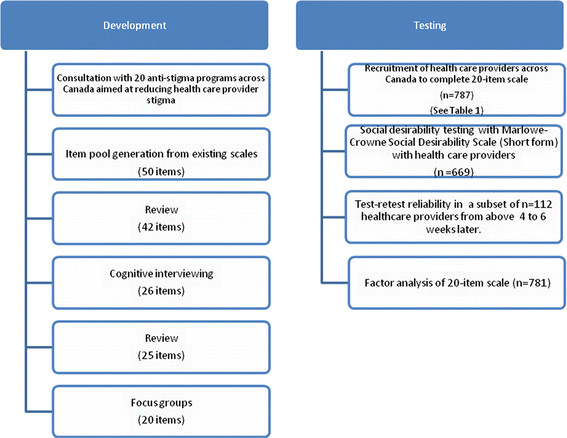
BACKGROUND: Research on the attitudes of health care providers towards people with mental illness has repeatedly shown that they may be stigmatizing. Many scales used to measure attitudes towards people with mental illness that exist today are not adequate because they do not have items that relate specifically to the role of the health care provider. METHODS: We developed and tested a new scale called the Opening Minds Scale for Health Care Providers (OMS-HC). After item-pool generation, stakeholder consultations and content validation, focus groups were held with 64 health care providers/trainees and six people with lived experience of mental illness to develop the scale. The OMS-HC was then tested with 787 health care providers/trainees across Canada to determine its psychometric properties. RESULTS: The initial testing OMS-HC scale showed good internal consistency, Cronbach's alpha = 0.82 and satisfactory test-retest reliability, intraclass correlation = 0.66 (95% CI 0.54 to 0.75). The OMC-HC was only weakly correlated with social desirability, indicating that the social desirability bias was not likely to be a major determinant of OMS-HC scores. A factor analysis favoured a two-factor structure which accounted for 45% of the variance using 12 of the 20 items tested. CONCLUSIONS: The OMS-HC provides a good starting point for further validation as well as a tool that could be used in the evaluation of programs aimed at reducing mental illness related stigma by health care providers. The OMS-HC incorporates various dimensions of stigma with a modest number of items that can be used with busy health care providers.
Overview
The claims and statistics of this paper haven’t been checked yet.
Free: it reads the open-access text and checks the first 5 claims that cite a source we can check. Create a free account to check every claim.
Integrity signals
Registry
Cites
Statistics
Figures
Verification
Claims the paper makes
The claims and statistics of this paper haven’t been checked yet.
Free: it reads the open-access text and checks the first 5 claims that cite a source we can check. Create a free account to check every claim.
Claims other papers make about this one
Each is checked against this paper’s own text: does it say what the citing paper says it does?
The cited source says what the claim attributes to it.
In the citing paper
“Stigmatising attitudes towards people with mental health problems were primarily assessed with Social Distance Scales based on Link et al[26] and Personal Stigma Scales based on Griffiths et al [27]. Other validated stigma scales included the Attitudes to Mental Illness Scale,[28] Opening Minds Scale for Healthcare Providers[29] and the Personal Attributes scale [30].”
From Systematic review and meta-analysis of Mental Health First Aid training: Effects on knowledge, stigma, and helping behaviour (2018) · cites this paper as [29]
Self-check
Percentages, sums and reported differences re-computed from the paper’s own numbers.
The self-check needs the paper’s full text.
Citations
Cites
Stigma: Notes on the Management of Spoiled Identity
(1969) · Postgraduate Medical Journal · doi:10.1136/pgmj.45.527.642 · Cited by 14,231
Foundations of Clinical Research: Applications to Practice,
(2002) · Survey of Ophthalmology · doi:10.1016/s0039-6257(02)00362-4 · Cited by 9,489
Link, B. G., & Phelan, J. C. (2001) · Annual Review of Sociology · doi:10.1146/annurev.soc.27.1.363 · Cited by 8,848
Kendall, M. G. (1957) · Biometrika · doi:10.2307/2333282 · Cited by 6,383
Starting at the beginning: an introduction to coefficient alpha and internal consistency
Streiner, D. L. (2003) · Journal of Personality Assessment · doi:10.1207/s15327752jpa8001_18 · Cited by 3,794 · cited 1×
“70 was considered acceptable [52].”
How stigma interferes with mental health care.
Corrigan, P. (2004) · American Psychologist · doi:10.1037/0003-066x.59.7.614 · Cited by 3,648 · cited 3×
“Recovery is a process which occurs when people with mental illness discover, or rediscover, their strengths and abilities for pursuing personal goals and develop a sense of identity that allows them to grow beyond their mental illness [3,4].”
BackgroundBevan, J. M., & Kendall, M. G. (1971) · The Statistician · doi:10.2307/2986801 · Cited by 2,436
Netemeyer, R., Bearden, W., & Sharma, S. (2003) · Sage eBooks · doi:10.4135/9781412985772 · Cited by 2,118
(2003) · Cited by 2,093
Excess mortality of mental disorder
Harris, C., & Barraclough, B. (1998) · British Journal of Psychiatry · doi:10.1192/bjp.173.1.11 · Cited by 1,881 · cited 1×
“For example, it has been reported that people with mental illness have poorer physical health in part because medical professionals wrongly associate the physical symptoms experienced by the person with mental illness to the mental illness itself [27-30].”
Background
Cited by
Mental health literacy measures evaluating knowledge, attitudes and help-seeking: a scoping review
Wei, Y., McGrath, P. J., Hayden, J., & Kutcher, S. (2015) · BMC Psychiatry · doi:10.1186/s12888-015-0681-9 · Cited by 500
“Opening Minds Scale for Health Care Providers (OMS-HC) Kassam et al., 2012 [97] αa = .78; .79; .82 CS; FA; CT; R A r it a = -.13-.57; ICCb = .66 (p < .001) 37.”
Morgan, A. J., Ross, A., & Reavley, N. J. (2018) · PLOS ONE · doi:10.1371/journal.pone.0197102 · Cited by 461
“Other validated stigma scales included the Attitudes to Mental Illness Scale,[28] Opening Minds Scale for Healthcare Providers[29] and the Personal Attributes scale [30].”
MethodFox, A. B., Earnshaw, V. A., Taverna, E. C., & Vogt, D. (2018) · Stigma and Health · doi:10.1037/sah0000104 · Cited by 400
Knaak, S., Modgill, G., & Patten, S. B. (2014) · The Canadian Journal of Psychiatry · doi:10.1177/070674371405901s06 · Cited by 247
Self-citationModgill, G., Patten, S. B., Knaak, S., Kassam, A., & Szeto, A. C. (2014) · BMC Psychiatry · doi:10.1186/1471-244x-14-120 · Cited by 208
“In earlier phases of development of the scale [16], consultations with international experts in the field of stigma related to mental health had indicated that social distance was an important part of the stigma construct.”
BackgroundMethodSelf-citationPapish, A., Kassam, A., Modgill, G., Vaz, G., Zanussi, L., & Patten, S. (2013) · BMC Medical Education · doi:10.1186/1472-6920-13-141 · Cited by 157
“Data were collected on-line using the Opening Minds Scale for Health Care Providers (OMS-HC; Additional file 1), a validated twenty item scale [48].”
MethodSelf-citationPatten, S. B., Remillard, A., Phillips, L., Modgill, G., Szeto, A. C., Kassam, A., & Gardner, D. M. (2012) · BMC Medical Education · doi:10.1186/1472-6920-12-120 · Cited by 164
“Although OMS-HC ratings have been shown to be distinct from social desirability ratings [20], it is always possible that attitude scales are influenced by social desirability bias.”
BackgroundMethodSelf-citationTheoretical and Practical Considerations for Combating Mental Illness Stigma in Health Care
Ungar, T., Knaak, S., & Szeto, A. C. (2016) · Community Mental Health Journal · doi:10.1007/s10597-015-9910-4 · Cited by 133
“Using a validated measure, the Opening Minds Stigma Scale for Healthcare Providers (OMS-HC) (Kassam et al. 2012; Modgill et al. 2014), this research found the highest stigma ratings among surgeons, followed closely by anesthetists and emergency rural physicians.”
BackgroundMethodStigma and bipolar disorder: A review of the literature
Hawke, L. D., Parikh, S. V., & Michalak, E. E. (2013) · Journal of Affective Disorders · doi:10.1016/j.jad.2013.05.030 · Cited by 145
Opening Minds in Canada: Targeting Change
Stuart, H., Chen, S.-P., Christie, R., Dobson, K., Kirsh, B., Knaak, S., Koller, M., Krupa, T., Lauria-Horner, B., Luong, D., et al. (2014) · The Canadian Journal of Psychiatry · doi:10.1177/070674371405901s05 · Cited by 113
Self-citationChang, S. S. H., Ong, H. L., Seow, E., Chua, B. Y., Abdin, E., Samari, E., Teh, W. L., Chong, S. A., & Subramaniam, M. (2017) · BMJ Open · doi:10.1136/bmjopen-2017-018099 · Cited by 120
Sandhu, H. S., Arora, A. K., Brasch, J. S., & Streiner, D. L. (2018) · The Canadian Journal of Psychiatry · doi:10.1177/0706743718792193 · Cited by 121
“The OMS-HC measures explicit stigmatizing attitudes of health care professionals regarding mental illness.(9,21,22) The shortened 12-item OMS-HC was used to offset response burden and increase feasibility of use by busy populations.”
BackgroundMethodResultInfluentialKnaak, S., Szeto, A. C., Fitch, K., Modgill, G., & Patten, S. (2015) · Borderline Personality Disorder and Emotion Dysregulation · doi:10.1186/s40479-015-0030-0 · Cited by 83
“It should also be noted that previous research on the OMS-HC [25] did not find scores correlating strongly with social desirability.”
MethodResultSelf-citationHappell, B., Platania‐Phung, C., Scholz, B., Bocking, J., Horgan, A. M., Manning, F., Doody, R., Hals, E., Granerud, A., Lahti, M., et al. (2018) · International Journal of Mental Health Nursing · doi:10.1111/inm.12551 · Cited by 95
“evaluation of Canadian antistigma programmes targeting healthcare practitioners, including nurses (Kassam et al. 2012).”
BackgroundMethodWei, Y., McGrath, P. J., Hayden, J. A., & Kutcher, S. (2017) · Epidemiology and Psychiatric Sciences · doi:10.1017/s2045796017000178 · Cited by 100
Foster, K., Withers, E., Blanco, T., Lupson, C., Steele, M. C., Giandinoto, J., & Furness, T. (2019) · International Journal of Mental Health Nursing · doi:10.1111/inm.12634 · Cited by 91
Moll, S. E., Patten, S., Stuart, H., MacDermid, J. C., & Kirsh, B. (2018) · The Canadian Journal of Psychiatry · doi:10.1177/0706743718766051 · Cited by 72
Self-citationCarrara, B. S., Fernandes, R. H. H., Bobbili, S. J., & Ventura, C. A. A. (2021) · International Journal of Social Psychiatry · doi:10.1177/0020764020985891 · Cited by 82
“…are typically responsible for mental illness prevention and early identification, the dissemination of general mental health information, as well as treatment and therefore have the potential to reduce mental illness-related stigma towards people with lived experience (Kassam et al., 2012).”
InfluentialMental Health Literacy in Healthcare Students: An Expansion of the Mental Health Literacy Scale
Chao, H.-J., Lien, Y., Kao, Y., Tasi, I.-C., Lin, H.-S., & Lin, H.-S. (2020) · International Journal of Environmental Research and Public Health · doi:10.3390/ijerph17030948 · Cited by 87
“This item pool referenced items from the following sources: the Mental Health Promoting Knowledge Measure [41], the MHL Scale [36], the Mental Health Literacy Measure [37], the Mental Health Knowledge Questionnaire [42], the Community Attitude Towards the Mentally Ill Scale (Chinese version) [43], the Endorsed and Ant…”
MethodInfluentialWong, J. C. M., Chua, J. Y. X., Chan, P. Y., & Shorey, S. (2024) · Journal of Advanced Nursing · doi:10.1111/jan.16127 · Cited by 84
Happell, B., Platania‐Phung, C., Bocking, J., Scholz, B., Horgan, A. M., Manning, F., Doody, R., Hals, E., Granerud, A., Lahti, M., et al. (2018) · Issues in Mental Health Nursing · doi:10.1080/01612840.2018.1489921 · Cited by 84
“The current research utilises the 20 item version for health care providers (Kassam et al., 2012).”
MethodDickens, G. L., Lamont, E., & Gray, S. (2016) · Journal of Clinical Nursing · doi:10.1111/jocn.13202 · Cited by 91
Explicit and Implicit Attitudes of Canadian Psychiatrists toward People with Mental Illness
Dabby, L., Tranulis, C., & Kirmayer, L. J. (2015) · The Canadian Journal of Psychiatry · doi:10.1177/070674371506001006 · Cited by 84
Stigma in health professionals towards people with mental illness: An integrative review
Carrara, B. S., Ventura, C. A. A., Bobbili, S. J., Jacobina, O. M. P., Khenti, A., & Mendes, I. A. C. (2019) · Archives of Psychiatric Nursing · doi:10.1016/j.apnu.2019.01.006 · Cited by 80
Wong, E. C., Collins, R. L., Cerully, J., Yu, J. W., & Seelam, R. (2017) · Social Psychiatry and Psychiatric Epidemiology · doi:10.1007/s00127-017-1459-9 · Cited by 71
Khenti, A., Bobbili, S. J., & Sapag, J. C. (2019) · Journal of Community Health · doi:10.1007/s10900-019-00706-w · Cited by 69
Giannetti, V. J., Caley, C. F., Kamal, K. M., Covvey, J. R., McKee, J. R., Wells, B. G., Najarian, D. M., Dunn, T. J., & Vadagam, P. (2018) · International Journal of Clinical Pharmacy · doi:10.1007/s11096-018-0619-7 · Cited by 70
Ashton, L. J., Gordon, S., & Reeves, R. A. (2017) · Community Mental Health Journal · doi:10.1007/s10597-017-0189-5 · Cited by 66
“2010) and the Opening Minds Scale for Health Care Providers (OMSHC) (Kassam et al. 2012) in relation to the target groups of healthcare students and providers.”
BackgroundTóth, M. D., Ihionvien, S., Leduc, C., Aust, B., Amann, B. L., Cresswell‐Smith, J., Reich, H., Cully, G., Sanches, S. A., Fanaj, N., et al. (2023) · BMJ Open · doi:10.1136/bmjopen-2022-067126 · Cited by 75
McKenzie, K., Gregory, J., & Hogg, L. I. (2021) · Journal of Personality Disorders · doi:10.1521/pedi_2021_35_528 · Cited by 68
Praharso, N. F., Pols, H., & Tiliopoulos, N. (2020) · Asian Journal of Psychiatry · doi:10.1016/j.ajp.2020.102168 · Cited by 69
Impact of a Mental Illness Stigma Awareness Intervention on Pharmacy Student Attitudes and Knowledge
Bamgbade, B. A., Ford, K. H., & Barner, J. C. (2016) · American Journal of Pharmaceutical Education · doi:10.5688/ajpe80580 · Cited by 61
Martin, A., Chilton, J. A., Gothelf, D., & Amsalem, D. (2020) · Journal of Medical Education and Curricular Development · doi:10.1177/2382120519889352 · Cited by 60
Mental Health Practice and Attitudes of Family Physicians Can Be Changed!
MacCarthy, D., Weinerman, R., Kallstrom, L., Kadlec, H., Hollander, M. J., & Patten, S. B. (2013) · The Permanente Journal · doi:10.7812/tpp/13-033 · Cited by 52
Self-citationHanisch, S., Birner, U., Oberhauser, C., Nowak, D., & Sabariego, C. (2017) · JMIR Mental Health · doi:10.2196/mental.7600 · Cited by 53
“We assessed attitudes in the workplace toward coworkers who may have a mental illness using the 23-item Opening Minds Scale for Workplace Attitudes (OMS-WA), an adapted version of the Opening Minds Scale for Health Care Providers (OMS-HC) [41].”
MethodDickens, G. L., Hallett, N., & Lamont, E. (2015) · International Journal of Nursing Studies · doi:10.1016/j.ijnurstu.2015.10.019 · Cited by 55
“…disorder e.g., “Treating consumers with borderline personality disorder can be rewarding”) +d Fa - Opening Minds Scale for Healthcare Providers (OMS-HC) (Kassam et al., 2012; Modgill et al., 2014) Attitudes and behavioural intentions towards mental illness and persons with a mental illness.”
BackgroundInfluentialThe contribution of shame to post‐psychotic trauma
Turner, M. H., Bernard, M., Birchwood, M., Jackson, C., & Jones, C. (2013) · British Journal of Clinical Psychology · doi:10.1111/bjc.12007 · Cited by 40
Sherwood, D. A. (2018) · Currents in Pharmacy Teaching and Learning · doi:10.1016/j.cptl.2018.11.001 · Cited by 47
Ng, Y. P., Rashid, A., & O'Brien, F. M. (2017) · PLoS ONE · doi:10.1371/journal.pone.0187861 · Cited by 52
Sastre‐Rus, M., García‐Lorenzo, A., Lluch‐Canut, T., Tomás‐Sábado, J., & Zabaleta‐del‐Olmo, E. (2019) · Journal of Advanced Nursing · doi:10.1111/jan.13960 · Cited by 54
Moll, S. E., Zanhour, M., Patten, S. B., Stuart, H. L., & MacDermid, J. C. (2017) · Journal of Occupational Rehabilitation · doi:10.1007/s10926-017-9695-0 · Cited by 45
Self-citationBannatyne, A. J., Jones, C., Craig, B. M., Jones, D., & Forrest, K. (2023) · Frontiers in Medicine · doi:10.3389/fmed.2023.1204274 · Cited by 41
“(43) Canada Determine whether a novel intervention could reduce medical students’ stigmatizing attitudes toward individuals with mental illness Quasi experimental (no control) 2nd year medical students (N = 49) (n = 49) 90-min large group presentation which incorporated stand-up comedy and scenes from Cracking Up (awa…”
MethodInfluentialSaif, F. A., Shakhoori, H. A., Nooh, S., & Jahrami, H. (2019) · PLoS ONE · doi:10.1371/journal.pone.0225738 · Cited by 41
“The 15-item OMS-HC helped us set a baseline score of stigma attitudes of health care providers in our population and paved the way for future important interventions and follow-up studies [4, 43].”
BackgroundEconomou, M. P., Peppou, L. Ε., Kontoangelos, K. A., Palli, A., Tsaliagkou, I., Legaki, E.-M., Gournellis, R., & Papageorgiou, C. (2019) · Community Mental Health Journal · doi:10.1007/s10597-019-00521-6 · Cited by 43
“A future study should include such a measure, for example such as the Opening Minds Scale for Health Care Providers (Kassam et al.”
BackgroundMethodInfluentialEiroá‐Orosa, F. J., Lomascolo, M., & Tosas, A. (2021) · International Journal of Environmental Research and Public Health · doi:10.3390/ijerph18031214 · Cited by 40
“The Opening Minds Stigma Scale for Health Care Providers (OMS-HC; [27,35]), is a 15-item scale that measures stigma levels and has been specially designed for use in primary care.”
MethodInfluentialMartin, A., Krause, R., Chilton, J. A., Jacobs, A., & Amsalem, D. (2019) · Journal of Psychiatric and Mental Health Nursing · doi:10.1111/jpm.12580 · Cited by 40
Frick, A., Osae, L., Ngo, S., Anksorus, H. N., Williams, C. R., Rodgers, P. T., & Harris, S. C. (2021) · Currents in Pharmacy Teaching and Learning · doi:10.1016/j.cptl.2021.01.027 · Cited by 39
Martin, A., Chilton, J. A., Paasche, C., Nabatkhorian, N., Gortler, H., Cohenmehr, E., Weller, I., Amsalem, D., & Neary, S. L. (2020) · Journal of Medical Education and Curricular Development · doi:10.1177/2382120520968072 · Cited by 39
“9) fell within the “moderately depressed” range (15-19);11 the mean score for anxiety (17.”
BackgroundKlein, P., Fairweather‐Schmidt, A. K., & Lawn, S. (2022) · Systematic Reviews · doi:10.1186/s13643-022-01960-1 · Cited by 41
Mittal, D., Owen, R. R., Ounpraseuth, S., Chekuri, L., Drummond, K. L., Jennings, M. B., Smith, J. L., Sullivan, J. G., & Corrigan, P. W. (2019) · Psychiatry Research · doi:10.1016/j.psychres.2019.112641 · Cited by 37
Horta, H., & Santos, J. M. (2016) · Scientometrics · doi:10.1007/s11192-016-2012-4 · Cited by 37
“At this stage, the questions were discussed informally with researchers and academics to obtain their feedback, which was used to refine the structure and content of the questions (see Kassam et al. 2012).”
Destrebecq, A. L. L., Ferrara, P., Frattini, L. F., Pittella, F., Rossano, G., Striano, G., Terzoni, S., & Gambini, O. (2017) · Community Mental Health Journal · doi:10.1007/s10597-017-0149-0 · Cited by 43
Validation of the Opening Minds Scale and patterns of stigma in Chilean primary health care
Sapag, J. C., Klabunde, R., Villarroel, L. A., Velasco, P. R., Huenchulaf, C. Á., Parra, C., Bobbili, S. J., Mascayano, F., Bustamante, I. V., Alvarado, R., et al. (2019) · PLoS ONE · doi:10.1371/journal.pone.0221825 · Cited by 39
Moll, S., Patten, S. B., Stuart, H., Kirsh, B., & MacDermid, J. C. (2015) · BMC Medical Education · doi:10.1186/s12909-015-0363-9 · Cited by 32
“66), with limited impact of social desirability [38].”
Self-citationUsing contact-based education to destigmatize opioid use disorder among medical students
Mort, S. C., Díaz, S., & Beverly, E. A. (2020) · Teaching and Learning in Medicine · doi:10.1080/10401334.2020.1820869 · Cited by 32
Soundy, A., Hemmings, L., Gardiner, L., Rosewilliam, S., Heneghan, N. R., Cronin, K., & Reid, K. (2021) · Patient Education and Counseling · doi:10.1016/j.pec.2021.01.022 · Cited by 33
Building Beautiful Minds: Teaching Through Movies to Tackle Stigma in Psychology Students in the UAE
Petkari, E. (2017) · Academic Psychiatry · doi:10.1007/s40596-017-0723-3 · Cited by 31
“The Mann-Whitney U test was used to examine the changes in the OMS-HC subscales score and the differences in each item from T1 to T2.”
MethodOverview of schizophrenia research and treatment in Pakistan
Nawaz, R., Gul, S., Amin, R., Huma, T., & Mughairbi, F. A. (2020) · Heliyon · doi:10.1016/j.heliyon.2020.e05545 · Cited by 20
“Clinicians in high-income countries also offer convenient and non-stigmatizing access to health care for patients affected with SCZ-related disorders [84].”
BackgroundExamining the Application of the Opening Minds Survey in the Community Health Centre Setting
van der Maas, M., Stuart, H. L., Patten, S. B., Lentinello, E., Bobbili, S. J., Mann, R. E., Hamilton, H. A., Sapag, J. C., Corrigan, P. W., & Khenti, A. (2017) · The Canadian Journal of Psychiatry · doi:10.1177/0706743717719079 · Cited by 26
Self-citationBamgbade, B. A., Barner, J. C., & Ford, K. H. (2016) · Community Mental Health Journal · doi:10.1007/s10597-016-0075-6 · Cited by 28
Chew, Q. H., Ang, L. P. A., Tan, L. L., Chan, H. N., Ong, S. H., Cheng, A., Lai, Y. M., Tan, M. Y., Tor, P. C., Gwee, K. P., et al. (2019) · BMJ Open · doi:10.1136/bmjopen-2019-030619 · Cited by 25
“Stigmatising attitudes in residents were measured with the Opening Minds Stigma Scale for Healthcare Providers (OMS-HC).(26) It consists of 20 items on a five-point Likert scale, ranging from 0 (strongly disagree) to 4 (strongly agree).”
MethodDonaldson, P., Langham, E., Best, T., & Browne, M. (2015) · Journal of Gambling Issues · doi:10.4309/jgi.2015.31.8 · Cited by 25
Movahedi, S., Shariat, S. V., & Shalbafan, M. (2022) · Frontiers in Psychiatry · doi:10.3389/fpsyt.2022.961538 · Cited by 21
Sastre‐Rus, M., Tomás‐Sábado, J., Juliá‐Sanchis, R., Roldán-Merino, J. F., Llobet, M. P., & Lluch‐Canut, T. (2020) · Journal of Clinical Nursing · doi:10.1111/jocn.15467 · Cited by 22
Initial Validation of the Mental Health Provider Stigma Inventory
Kennedy, S. C., Abell, N., & Mennicke, A. M. (2014) · Research on Social Work Practice · doi:10.1177/1049731514563577 · Cited by 21
“Additionally, the inclusion of participants who provide mental health counseling services both formally (e.g., social workers and psychologists) and informally (e.g., nurses) allows for analysis of the scale’s utility beyond one specific discipline (Kassam et al., 2012).”
BackgroundMethodInfluentialGupta, S., Kumar, A., Kathiresan, P., Pakhre, A., Pal, A., & Singh, V. (2024) · Indian Journal of Psychiatry · doi:10.4103/indianjpsychiatry.indianjpsychiatry_412_23 · Cited by 23
“Opening Minds Scale for Health care Providers (OMS-HC) [68] • It is a self-report questionnaire and assesses attitudes and behavioral intentions toward PWMI.”
Briand, C., Giguère, C., de Medeiros, J. M., Vallée, C., Luconi, F., Vachon, B., Drolet, M.-J., Monthuy‐Blanc, J., Mahroug, A., & Hakin, R. (2024) · International Journal of Mental Health Systems · doi:10.1186/s13033-024-00637-7 · Cited by 20
“…- short form (WEMWBS) [44], the Generalized Anxiety Disorder-7 (GAD-7) [45], the Connor-Davidson Resilience Scale (CD-RISC-10) [46], the Mental Health Self-Management Questionnaire (MHSQ) [47], the Consumer Constructed Scale to Measure Empowerment [48, 49], the Opening Minds Scale (OMS) [50, 51].”
MethodScoping Review of Questionnaires on Stigma of Mental Illness in Persian
Rezvanifar, F., Shariat, S. V., Amini, H., Rasoulian, M., & Shalbafan, M. (2020) · Iranian Journal of Psychiatry and Clinical Psychology · doi:10.32598/ijpcp.26.2.2619.1 · Cited by 21
Őri, D., Rózsa, S., Szocsics, P., Simon, L., Purebl, G., & Győrffy, Z. (2020) · BMC Psychiatry · doi:10.1186/s12888-020-02902-8 · Cited by 21
Őri, D., Szocsics, P., Molnár, T. F., Ralovich, F. V., Huszár, Z., Bene, Á., Rózsa, S., Győrffy, Z., & Purebl, G. (2022) · PLoS ONE · doi:10.1371/journal.pone.0269802 · Cited by 21
“The original 20-item version of the scale [27] was shortened to 15 items by Modgill [15] to gain a more stable factor solution.”
MethodGu, L., Xu, D., & Yu, M. (2021) · Nurse Education Today · doi:10.1016/j.nedt.2021.104973 · Cited by 21
Fujii, T., Hanya, M., Murotani, K., & Kamei, H. (2021) · BMC Psychiatry · doi:10.1186/s12888-021-03208-z · Cited by 20
“scenarios that community pharmacists may face when dealing with patients diagnosed with schizophrenia; therefore, conventional scales [20] that are designed for general healthcare professionals may be insufficient to address stigma among community pharmacists.”
BackgroundTei‐Tominaga, M., Asakura, T., & Asakura, K. (2013) · International Journal of Mental Health Nursing · doi:10.1111/inm.12052 · Cited by 23
Attwood, J., Wilkinson‐Tough, M., Lambe, S., & Draper, E. (2019) · Journal of Personality Disorders · doi:10.1521/pedi_2019_33_458 · Cited by 19
Tong, Y., Wang, Z., Sun, Y., & Li, S. (2020) · Frontiers in Psychiatry · doi:10.3389/fpsyt.2020.00337 · Cited by 19
Őri, D., Szocsics, P., Molnár, T. F., Motlová, L. B., Kazakova, O., Mörkl, S., Wallies, M., Abdulhakim, M., Boivin, S., Bruna, K., et al. (2023) · Frontiers in Public Health · doi:10.3389/fpubh.2023.1168929 · Cited by 18
“Finally, the changes resulted in a reduction to 20 items (4).”
BackgroundWands, L., Pfeiffer, K. M., & Pelkmans, J. L. (2022) · Nurse Education in Practice · doi:10.1016/j.nepr.2022.103370 · Cited by 16
Vorstenbosch, E., Masoliver-Gallach, R., & Escuder-Romeva, G. (2022) · BMJ Open · doi:10.1136/bmjopen-2022-061160 · Cited by 18
Genetic counselors’ attitudes toward and practice related to psychiatric genetic counseling
Booke, S., Austin, J., Calderwood, L., & Campion, M. W. (2019) · Journal of Genetic Counseling · doi:10.1002/jgc4.1176 · Cited by 16
Khenti, A., Mann, R., Sapag, J. C., Bobbili, S. J., Lentinello, E., van der Maas, M., Agic, B., Hamilton, H. A., Stuart, H. L., Patten, S. B., et al. (2017) · BMJ Open · doi:10.1136/bmjopen-2017-017044 · Cited by 18
“The SD for the OMS-HC, calculated based on our pilot study, is consistent with previous research.(44) In the pilot study, the association between pre-measures and post-measures was r=0.”
BackgroundMethodSelf-citationTay, G. W. N., Tong, M. M., Yap, J. Y. G., Mak, H. K., Goh, Y. S., & Ho, C. S. H. (2025) · Medical Education Online · doi:10.1080/10872981.2025.2542809 · Cited by 17
“It has also demonstrated a strong correlation with other established measures of stigma and attitudes towards mental health [65]; furthermore, a clear factor structure aligned with the theoretical framework of stigma was revealed during the validation of the questionnaire [67].”
InfluentialZuaboni, G., Elmer, T., Rabenschlag, F., Heumann, K., Jaeger, S., Kozel, B., Mahlke, C., Theodoridou, A., Jaeger, M., & Rüsch, N. (2021) · BMC Psychology · doi:10.1186/s40359-021-00592-9 · Cited by 17
Minty, Y., Moosa, M. Y. H., & Jeenah, F. Y. (2021) · South African Journal of Psychiatry · doi:10.4102/sajpsychiatry.v27i0.1592 · Cited by 18
Vallières-Noël, M.-M., Garçon, S., Rosmus, C., Goulnik, F., & Lavoie‐Tremblay, M. (2015) · Archives of Psychiatric Nursing · doi:10.1016/j.apnu.2015.08.008 · Cited by 16
“Furthermore, the nurses' perception of patients with an MH disorder directly influences their behavior and care, which has a significant effect on the patients' recovery (Foster, 2009; Kassam et al., 2012; Ross & Goldner, 2009; van der Kluit, Goossens, & de Leeuw, 2013).”
BackgroundMorris, E. M., Inglis, A. J., Friedman, J. M., & Austin, J. (2013) · Genetics in Medicine · doi:10.1038/gim.2013.31 · Cited by 17
Poirier, T. I., Stamper-Carr, C., & Newman, K. (2017) · Currents in Pharmacy Teaching and Learning · doi:10.1016/j.cptl.2017.05.004 · Cited by 15
Eiroá‐Orosa, F. J., & Limiñana-Bravo, L. (2019) · International Journal of Environmental Research and Public Health · doi:10.3390/ijerph16020244 · Cited by 16
“OMS-HC: Opening Minds Stigma Scale for Health Care Providers Primary care professionals Professional stigma [24]”
BackgroundSzeto, A. C. H., Dobson, K. S., Luong, D., Krupa, T. M., & Kirsh, B. H. (2019) · The Canadian Journal of Psychiatry · doi:10.1177/0706743719842557 · Cited by 18
Kassam, A., Antepim, B., & Sukhera, J. I. (2024) · Perspectives on Medical Education · doi:10.5334/pme.1152 · Cited by 14
“For example, accrediting bodies may want to consider how medical schools address stigma and normalize self-disclosure by preceptors and learners alike, which can be an active ingredient in learner self-disclosure [3, 16, 30].”
BackgroundSelf-citationEstigma na doença mental: estudo observacional
Familiar, I. F. E. M. G. E., Oliveira, A. R., Azevedo, S. M., & Familiar, I. F. E. M. G. E. (2014) · Revista Portuguesa de Clínica Geral · doi:10.32385/rpmgf.v30i4.11347 · Cited by 14
Janssens, K. M. E., van Weeghel, J., Henderson, C., Joosen, M. C. W., & Brouwers, E. P. M. (2020) · Trials · doi:10.1186/s13063-020-04376-1 · Cited by 13
Pickett, J., Haas, M. R., Fix, M., Tabatabai, R. R., Carrick, A. I., Robertson, J., Barnes, A. V., Ondeyka, A., Brown, M. J., Edwards, A. R., et al. (2019) · AEM Education and Training · doi:10.1002/aet2.10377 · Cited by 13
“Finally, residents’ attitudes toward individuals with mental illness was assessed using the Attitude Subscale of the Opening Minds Scale for Health Care Providers (i.e., Kassam et al.16) an instrument that measures providers’ attitudes toward people with mental illness.”
BackgroundNewton‐Howes, G., Senior, J., Beaglehole, B., Purdie, G., & Gordon, S. (2021) · Australian & New Zealand Journal of Psychiatry · doi:10.1177/0004867420987886 · Cited by 13
“In the control cohort, the fact that significant decreases in stigma were found as measured by the OMS-15 but not the OMS-HC-20 in fifth year probably reflects the former being more sensitive to change.”
BackgroundMethodInfluentialLinz, S. J., Emmons, R. A., Jerome-D’Emilia, B., Solomon, P., Wunnenberg, M., Durham, J. S., & Koehler, R. (2022) · Archives of Psychiatric Nursing · doi:10.1016/j.apnu.2022.04.006 · Cited by 14
Knaak, S. J., Szeto, A. C. H., Kassam, A., Hamer, A., Modgill, G., & Patten, S. B. (2017) · Journal of Mental Health and Addiction Nursing · doi:10.22374/jmhan.v1i1.19 · Cited by 15
Self-citationSapag, J. C., Traub, C., Velasco, P. R., Arratia, T., Alvarado, R., Aracena, M., Poblete, F., Villarroel, L. A., Bravo, P., Huenchulaf, C. Á., et al. (2022) · Frontiers in Psychiatry · doi:10.3389/fpsyt.2022.1083042 · Cited by 13
“Two elements were considered: (1) a minimum sample size of 105 and (2) an estimation of the intracluster correlation coefficient (ICC) for the study outcome (OMS-HC scale) (83).”
BackgroundInfluentialCarrara, B. S., Sanches, M., Bobbili, S. J., de Godoy, S., de Sousa, Á. F. L., de Souza, J., & Ventura, C. A. A. (2023) · Healthcare · doi:10.3390/healthcare11071049 · Cited by 12
“OMS-HC is a widely used self-report questionnaire that assesses several dimensions of health care professionals’ stigmatizing attitude towards their patients with mental health problems [25].”
BackgroundMethodInfluentialMoxham, L. J., Roberts, M., Yousiph, T., Jay, E., Lewer, K., Robson, G., Drury, P., Cordina, J., Villeneuve‐Smith, S., & Patterson, C. (2024) · International Journal of Mental Health Nursing · doi:10.1111/inm.13429 · Cited by 11
“The OMS-HC (Kassam et al. 2012) is a 15-item psychometric scale developed to index mental illness-related stigma among healthcare providers.”
InfluentialHamed, W. E., Babegi, A. S., Elamin, H. A. M., Kamel, N. A., Escolano-Castillo, A. M., Dailah, H. G., & El-Etreby, R. R. (2025) · BMC Nursing · doi:10.1186/s12912-025-02926-z · Cited by 13
Emergency Nurses’ Care of Psychiatric Patients
Hennen, R., & Phillips, K. E. (2023) · Journal of the American Psychiatric Nurses Association · doi:10.1177/10783903231153418 · Cited by 11
“Higher scores equate to more stigma (Kassam et al., 2012).”
Background
Metadata
- Authors
- Kassam, A., Papish, A., Modgill, G., & Patten, S.
- Affiliations
- University of Calgary (CA)
- Mental Health Commission of Canada (CA)
- Corresponding author
- Kassam, Aliya
- Venue
- BMC Psychiatry
- Published
- 2012-06-13
- Volume
- 12
- Issue
- 1
- Pages
- 62-62
- ISSN
- 1471-244X (ISSN-L)
- PMC
- PMC3681304
- OpenAlex
- W2133451493
- Cited by
- 233
- References
- 60
- Citations by year
- 2026: 10 · 2025: 17 · 2024: 25 · 2023: 17 · 2022: 42 · 2021: 18 · 2020: 17 · 2019: 21 · 2018: 9 · 2017: 22 · 2016: 7 · 2015: 12 · 2014: 7 · 2013: 6 · 2012: 3
- FWCI
- 13.51
- Type
- journal article
- Language
- en
- Open access
- gold
- doi.org
- Licence
- Locations
- BMC Psychiatry (publishedVersion, cc-by)
- Europe PMC (PubMed Central) (publishedVersion, cc-by)
- PubMed Central (publishedVersion, cc-by)
- PubMed (publishedVersion)
- DOAJ (DOAJ: Directory of Open Access Journals) (submittedVersion)
- Funders
- Mental Health Commission
- Alberta Innovates
- Health Canada
- Topics
- Health Sciences › Medicine › Psychiatry and Mental health › Mental Health Treatment and Access
- Health Sciences › Nursing › Research and Theory › Health Education and Validation
- Social Sciences › Decision Sciences › Management Science and Operations Research › Psychometric Methodologies and Testing
- Keywords
- mental health stigma, scale development, psychometric properties, clinician attitudes, stigma reduction interventions, factor structure, social desirability bias, content validation
- MeSH terms
- Adolescent, Adult, Aged, Attitude of Health Personnel, Mental Disorders, Female, Health Personnel, Humans, Male, Middle Aged, Psychometrics, Stereotyping, Reproducibility of Results, Social Stigma
About these checks
Registry, retraction, Cites and statistics results are computed, not judged, with one exception: a printed reference that no index lists is read once by a model before it counts as a citation error. Claims are extracted by a model and kept only when their quote appears verbatim in the text; each cited source is then checked, with a model’s help, for whether it says what the claim relies on. Those verdicts can be wrong — read the claim’s quote and the cited source before relying on one.
Statistics and arithmetic are recomputed, not judged.
Confidence bands are shown only for fields calibrated on our annotated test set. None is calibrated yet, so no band is shown.
What counts as a claim ›How we measure confidence ›How we check this ›
Are you an author, or do you see a problem with this page? Request a review
Data sources
Bibliographic data: Semantic Scholar, OpenAlex, Crossref.
Contains information from the Semantic Scholar Academic Graph Datasets, made available under the ODC Attribution License (ODC-BY 1.0).
Semantic Scholar’s data is described in: Kinney, R., et al. (2023). The Semantic Scholar Open Data Platform. arXiv:2301.10140.
