

The development and psychometric properties of a new scale to measure mental illness related stigma by health care providers: The opening minds scale for Health Care Providers (OMS-HC)
Open accessThe DOI matches its Crossref record; 60 of the 60 references it cites were found in a registry or an index.
Abstract
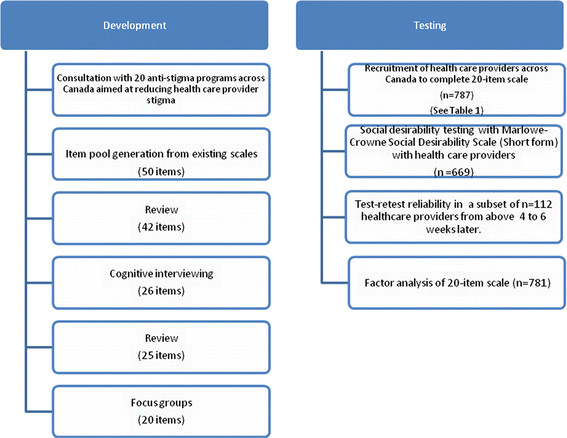
BACKGROUND: Research on the attitudes of health care providers towards people with mental illness has repeatedly shown that they may be stigmatizing. Many scales used to measure attitudes towards people with mental illness that exist today are not adequate because they do not have items that relate specifically to the role of the health care provider. METHODS: We developed and tested a new scale called the Opening Minds Scale for Health Care Providers (OMS-HC). After item-pool generation, stakeholder consultations and content validation, focus groups were held with 64 health care providers/trainees and six people with lived experience of mental illness to develop the scale. The OMS-HC was then tested with 787 health care providers/trainees across Canada to determine its psychometric properties. RESULTS: The initial testing OMS-HC scale showed good internal consistency, Cronbach's alpha = 0.82 and satisfactory test-retest reliability, intraclass correlation = 0.66 (95% CI 0.54 to 0.75). The OMC-HC was only weakly correlated with social desirability, indicating that the social desirability bias was not likely to be a major determinant of OMS-HC scores. A factor analysis favoured a two-factor structure which accounted for 45% of the variance using 12 of the 20 items tested. CONCLUSIONS: The OMS-HC provides a good starting point for further validation as well as a tool that could be used in the evaluation of programs aimed at reducing mental illness related stigma by health care providers. The OMS-HC incorporates various dimensions of stigma with a modest number of items that can be used with busy health care providers.
Overview
The claims and statistics of this paper haven’t been checked yet.
Free: it reads the open-access text and checks the first 5 claims that cite a source we can check. Create a free account to check every claim.
Integrity signals
Registry
Cites
Statistics
Figures
Verification
Claims the paper makes
The claims and statistics of this paper haven’t been checked yet.
Free: it reads the open-access text and checks the first 5 claims that cite a source we can check. Create a free account to check every claim.
Claims other papers make about this one
Each is checked against this paper’s own text: does it say what the citing paper says it does?
The cited source says what the claim attributes to it.
In the citing paper
“Stigmatising attitudes towards people with mental health problems were primarily assessed with Social Distance Scales based on Link et al[26] and Personal Stigma Scales based on Griffiths et al [27]. Other validated stigma scales included the Attitudes to Mental Illness Scale,[28] Opening Minds Scale for Healthcare Providers[29] and the Personal Attributes scale [30].”
From Systematic review and meta-analysis of Mental Health First Aid training: Effects on knowledge, stigma, and helping behaviour (2018) · cites this paper as [29]
Self-check
Percentages, sums and reported differences re-computed from the paper’s own numbers.
The self-check needs the paper’s full text.
Citations
Cites
Stigma: Notes on the Management of Spoiled Identity
(1969) · Postgraduate Medical Journal · doi:10.1136/pgmj.45.527.642 · Cited by 14,231
Foundations of Clinical Research: Applications to Practice,
(2002) · Survey of Ophthalmology · doi:10.1016/s0039-6257(02)00362-4 · Cited by 9,489
Link, B. G., & Phelan, J. C. (2001) · Annual Review of Sociology · doi:10.1146/annurev.soc.27.1.363 · Cited by 8,848
Kendall, M. G. (1957) · Biometrika · doi:10.2307/2333282 · Cited by 6,383
Starting at the beginning: an introduction to coefficient alpha and internal consistency
Streiner, D. L. (2003) · Journal of Personality Assessment · doi:10.1207/s15327752jpa8001_18 · Cited by 3,794 · cited 1×
“70 was considered acceptable [52].”
How stigma interferes with mental health care.
Corrigan, P. (2004) · American Psychologist · doi:10.1037/0003-066x.59.7.614 · Cited by 3,648 · cited 3×
“Recovery is a process which occurs when people with mental illness discover, or rediscover, their strengths and abilities for pursuing personal goals and develop a sense of identity that allows them to grow beyond their mental illness [3,4].”
BackgroundBevan, J. M., & Kendall, M. G. (1971) · The Statistician · doi:10.2307/2986801 · Cited by 2,436
Netemeyer, R., Bearden, W., & Sharma, S. (2003) · Sage eBooks · doi:10.4135/9781412985772 · Cited by 2,118
(2003) · Cited by 2,093
Excess mortality of mental disorder
Harris, C., & Barraclough, B. (1998) · British Journal of Psychiatry · doi:10.1192/bjp.173.1.11 · Cited by 1,881 · cited 1×
“For example, it has been reported that people with mental illness have poorer physical health in part because medical professionals wrongly associate the physical symptoms experienced by the person with mental illness to the mental illness itself [27-30].”
BackgroundThe paradox of self-stigma and mental illness.
Corrigan, P. W., & Watson, A. C. (2002) · Clinical Psychology: Science and Practice · doi:10.1093/clipsy.9.1.35 · Cited by 1,872 · cited 1×
“; licensee BioMed Central Commons Attribution License (http://creativec reproduction in any medium, provided the or Studies have varied in the dimensions of stigma examined, but the most common ones are: ‘perceived stigma’, which refers to one’s belief that others perceive an individual as socially unacceptable [4-7]…”
BackgroundAn Attribution Model of Public Discrimination Towards Persons with Mental Illness
Corrigan, P., Markowitz, F. E., Watson, A., Rowan, D., & Kubiak, M. A. (2003) · Journal of Health and Social Behavior · doi:10.2307/1519806 · Cited by 1,407 · cited 3×
“This has been described in the literature where some refuse to be diminished by stigma and becoming more active participants of change in health care [7].”
BackgroundThe Social Rejection of Former Mental Patients: Understanding Why Labels Matter
Link, B. G., Cullen, F. T., Frank, J., & Wozniak, J. F. (1987) · American Journal of Sociology · doi:10.1086/228672 · Cited by 1,265
de Vet, H. C., Terwee, C. B., Ostelo, R. W., Beckerman, H., Knol, D. L., & Bouter, L. M. (2006) · Health and Quality of Life Outcomes · doi:10.1186/1477-7525-4-54 · Cited by 829
Illness Management and Recovery: A Review of the Research
Mueser, K. T., Corrigan, P. W., Hilton, D. W., Tanzman, B., Schaub, A., Gingerich, S., Essock, S. M., Tarrier, N., Morey, B., Vogel-Scibilia, S., et al. (2002) · Psychiatric Services · doi:10.1176/appi.ps.53.10.1272 · Cited by 679
Shunned: Discrimination against people with mental illness
Thornicroft, G. (2003) · doi:10.1093/med/9780198570981.001.0001 · Cited by 643
Felt versus enacted stigma: A concept revisited
Jacoby, A. (1994) · Social Science & Medicine · doi:10.1016/0277-9536(94)90396-4 · Cited by 601
Help-seeking behaviour in men and women with common mental health problems: cross-sectional study
Oliver, M. I., Pearson, N., Coe, N., & Gunnell, D. (2005) · British Journal of Psychiatry · doi:10.1192/bjp.186.4.297 · Cited by 558 · cited 1×
“Mental illness related stigma can lead to low rates of seeking help, lack of access to care, under-treatment [1], and social marginalization [2].”
BackgroundChallenging Two Mental Illness Stigmas: Personal Responsibility and Dangerousness
Corrigan, P. W., Rowan, D., Green, A., Lundin, R., River, P., Uphoff-Wasowski, K., White, K., & Kubiak, M. A. (2002) · Schizophrenia Bulletin · doi:10.1093/oxfordjournals.schbul.a006939 · Cited by 551 · cited 1×
“In the literature, it has been shown that attitudes towards people with mental illness can be measured using stereotypes such as: ‘people with mental illness are dangerous,’ and ‘people with mental illness do not recover’ [23,24] as well as a desire for social distance because of the aforementioned stereotypes [7].”
BackgroundMental Disorders and Use of Cardiovascular Procedures After Myocardial Infarction
Druss, B. G. (2000) · JAMA · doi:10.1001/jama.283.4.506 · Cited by 534 · cited 1×
“For example, people with mental illness are “substantially less likely to undergo coronary re-vascularisation procedures” compared to people without mental illness [32].”
BackgroundOn the stigma of mental illness: Practical strategies for research and social change.
(2005) · American Psychological Association eBooks · doi:10.1037/10887-000 · Cited by 527
‘Diagnostic overshadowing’: worse physical health care for people with mental illness
Jones, S., Howard, L., & Thornicroft, G. (2008) · Acta Psychiatrica Scandinavica · doi:10.1111/j.1600-0447.2008.01211.x · Cited by 475 · cited 3×
“For example, it has been reported that people with mental illness have poorer physical health in part because medical professionals wrongly associate the physical symptoms experienced by the person with mental illness to the mental illness itself [27-30].”
BackgroundDevelopment and psychometric properties of the Mental Health Knowledge Schedule
Evans-Lacko, S., Little, K., Meltzer, H., Rose, D., Rhydderch, D., Henderson, C., & Thornicroft, G. (2010) · The Canadian Journal of Psychiatry · doi:10.1177/070674371005500707 · Cited by 402 · cited 1×
“Other areas of future research could incorporate additional instruments for external validity such as those that measure knowledge [54] intended behaviour [55] or behavior such as Objective Structured Clinical Exams (OSCEs) used in teaching health care providers to determine the relationship between the tri-partite mo…”
BackgroundMortality and medical comorbidity among psychiatric patients: a review
(1996) · Psychiatric Services · doi:10.1176/ps.47.12.1356 · Cited by 393
Evans-Lacko, S., Rose, D., Little, K., Flach, C., Rhydderch, D., Henderson, C., & Thornicroft, G. (2011) · Epidemiology and Psychiatric Sciences · doi:10.1017/s2045796011000308 · Cited by 363 · cited 1×
“Other areas of future research could incorporate additional instruments for external validity such as those that measure knowledge [54] intended behaviour [55] or behavior such as Objective Structured Clinical Exams (OSCEs) used in teaching health care providers to determine the relationship between the tri-partite mo…”
BackgroundContact with the Mentally Ill and Perceptions of How Dangerous They Are
Link, B. G., & Cullen, F. T. (1986) · Journal of Health and Social Behavior · doi:10.2307/2136945 · Cited by 330 · cited 2×
“Other dimensions of stigma that have been examined include social distance, which refers to one’s desire to maintain distance from people with mental illness [5,9], ‘dangerousness”, which refers to one’s belief that the individual is dangerous [6], recovery, which refers to one’s belief that people with mental illness…”
BackgroundHow Adolescents Perceive the Stigma of Mental Illness and Alcohol Abuse
Corrigan, P. W., Lurie, B. D., Goldman, H. H., Slopen, N., Medasani, K., & Phelan, S. (2005) · Psychiatric Services · doi:10.1176/appi.ps.56.5.544 · Cited by 311
Do mental health professionals stigmatize their patients?
Lauber, C., Nordt, C., Braunschweig, C., & Rössler, W. (2006) · Acta Psychiatrica Scandinavica · doi:10.1111/j.1600-0447.2005.00718.x · Cited by 290 · cited 2×
“This has been a problem and continues to be a problem in primary care, mental health services and within the education of health care providers [37-42].”
BackgroundThe stigma of psychiatric treatment and help-seeking intentions for depression
Schomerus, G., Matschinger, H., & Angermeyer, M. C. (2009) · European Archives of Psychiatry and Clinical Neuroscience · doi:10.1007/s00406-009-0870-y · Cited by 289 · cited 1×
“For example, perceived stigma has been found to be unrelated to help seeking in some studies [13,14].”
ResultEvaluating and researching the effectiveness of educational interventions
Hutchinson, L. (1999) · BMJ · doi:10.1136/bmj.318.7193.1267 · Cited by 264 · cited 2×
“Because evidence-based educational interventions are given priority, evaluation drives undergraduate, post graduate and continuing education curriculum development [44].”
BackgroundReducing stigma and discrimination: candidate interventions
Thornicroft, G., Brohan, E., Kassam, A., & Lewis-Holmes, E. (2008) · International Journal of Mental Health Systems · doi:10.1186/1752-4458-2-3 · Cited by 257 · cited 1×
“Mental illness related stigma can lead to low rates of seeking help, lack of access to care, under-treatment [1], and social marginalization [2].”
BackgroundSelf-citationShunned: Discrimination Against People Mental Illness
Nelson, S. H. (2007) · The Journal of Clinical Psychiatry · doi:10.4088/jcp.v68n1223b · Cited by 252
Hodges, B., Inch, C., & Silver, I. (2001) · American Journal of Psychiatry · doi:10.1176/appi.ajp.158.10.1579 · Cited by 235 · cited 3×
“People with mental illness may also feel unwelcome in certain medical settings because of staff attitudes [36-42].”
BackgroundEvidence-based practice: attitudes, knowledge and behaviour among allied health care professionals
Heiwe, S., Kajermo, K. N., Tyni-Lenne, R., Guidetti, S., Samuelsson, M., Andersson, I.-L., & Wengstrom, Y. (2011) · International Journal for Quality in Health Care · doi:10.1093/intqhc/mzq083 · Cited by 227
What about psychiatrists' attitude to mentally ill people?
Lauber, C., Anthony, M., Ajdacic-Gross, V., & Rössler, W. (2004) · European Psychiatry · doi:10.1016/j.eurpsy.2004.06.019 · Cited by 209
Mental Disorders and Access to Medical Care in the United States
Druss, B. G., & Rosenheck, R. A. (1998) · American Journal of Psychiatry · doi:10.1176/ajp.155.12.1775 · Cited by 209 · cited 1×
“Furthermore, people with mental illness may have less access to medical care [34,35] such as obtaining a primary care physician [34,35] as there is a need for community mental health centres to address barriers to primary medical care [36].”
BackgroundEvaluating educational interventions
Wilkes, M., & Bligh, J. (1999) · BMJ · doi:10.1136/bmj.318.7193.1269 · Cited by 207 · cited 1×
“aspx) Evaluation describes and explains the practice of participants to determine their effectiveness [43,44].”
BackgroundAt Issue: Stop the Stigma: Call Mental Illness a Brain Disease
Corrigan, P. W., & Watson, A. C. (2004) · Schizophrenia Bulletin · doi:10.1093/oxfordjournals.schbul.a007095 · Cited by 203 · cited 3×
“Finally, disclosing that one has a mental illness, because of the dimensions described above, can lead to self stigma and may also be an indicator of mental illness related stigma [24,25].”
BackgroundKassam, A., Glozier, N., Leese, M., Henderson, C., & Thornicroft, G. (2010) · Acta Psychiatrica Scandinavica · doi:10.1111/j.1600-0447.2010.01562.x · Cited by 190 · cited 2×
“with mental illness, a large gap was shown in the area of surveys used to measure the attitudes of health care providers [26].”
BackgroundSelf-citationAccess to Medical Care Among Persons With Psychotic and Major Affective Disorders
Bradford, D. W., Kim, M. M., Braxton, L. E., Marx, C. E., Butterfield, M., & Elbogen, E. B. (2008) · Psychiatric Services · doi:10.1176/appi.ps.59.8.847 · Cited by 182 · cited 1×
“Furthermore, people with mental illness may have less access to medical care [34,35] such as obtaining a primary care physician [34,35] as there is a need for community mental health centres to address barriers to primary medical care [36].”
BackgroundPhysical health care of patients with schizophrenia in primary care: a comparative study
Roberts, L., Roalfe, A., Wilson, S., & Lester, H. (2006) · Family Practice · doi:10.1093/fampra/cml054 · Cited by 181 · cited 2×
“Furthermore, people with schizophrenia were significantly less likely to receive important basic health checks such as blood pressure and cholesterol measurement [31].”
BackgroundOn the stigma of mental illness
Cumming, J., & Cumming, E. (1965) · Community Mental Health Journal · doi:10.1007/bf01435202 · Cited by 171
The Medical Condition Regard Scale: Measuring Reactions to Diagnoses
Christison, G. W., Haviland, M. G., & Riggs, M. L. (2002) · Academic Medicine · doi:10.1097/00001888-200203000-00017 · Cited by 169 · cited 2×
“The Medical Condition Regard Scale is a non-condition-specific scale developed from the literature on physicians' responses to patients they like and dislike, stigma definitions, and discussions with primary care faculty.”
MethodJohnston, J. M., Leung, G. M., Fielding, R., Tin, K. Y. K., & Ho, L. (2003) · Medical Education · doi:10.1046/j.1365-2923.2003.01678.x · Cited by 162 · cited 1×
“The knowledge, attitudes and behaviour framework allows clear intervention targets and units of measurement [17,18].”
BackgroundNo hope without compassion: the importance of compassion in recovery-focused mental health services
Spandler, H., & Stickley, T. (2011) · Journal of Mental Health · doi:10.3109/09638237.2011.583949 · Cited by 136 · cited 1×
“While some may consider that compassion and social responsibility may be paternalistic and stigmatizing towards people with mental illness [11], these dimensions can be seen as important indicators of non-stigmatizing attitudes and are acknowledged widely as significant competencies of health care providers [4,12].”
BackgroundReducing mental illness stigma and discrimination — everybody's business
Hocking, B. (2003) · Medical Journal of Australia · doi:10.5694/j.1326-5377.2003.tb05306.x · Cited by 115 · cited 4×
“Finally, disclosing that one has a mental illness, because of the dimensions described above, can lead to self stigma and may also be an indicator of mental illness related stigma [24,25].”
BackgroundResultInfluentialROWE, J. (2012) · Journal of Psychiatric and Mental Health Nursing · doi:10.1111/j.1365-2850.2011.01756.x · Cited by 115
Emotional reactions to people with mental illness
Angermeyer, M. C., Holzinger, A., & Matschinger, H. (2010) · Epidemiologia e Psichiatria Sociale · doi:10.1017/s1121189x00001573 · Cited by 108 · cited 2×
“compassion towards people with mental illness are also dimensions of stigma [10].”
BackgroundVoltmer, E., Kieschke, U., Schwappach, D. L., Wirsching, M., & Spahn, C. (2008) · BMC Medical Education · doi:10.1186/1472-6920-8-46 · Cited by 104 · cited 1×
“As health care providers are not immune to mental illness themselves, this is an important dimension of stigma to measure in relation to health care provider well being [53].”
BackgroundPerceived Stigma and Help-Seeking Behavior: Longitudinal Evidence From the Healthy Minds Study
Golberstein, E., Eisenberg, D., & Gollust, S. (2009) · Psychiatric Services · doi:10.1176/appi.ps.60.9.1254 · Cited by 95 · cited 1×
“For example, perceived stigma has been found to be unrelated to help seeking in some studies [13,14].”
ResultSullivan, G., Han, X., Moore, S., & Kotrla, K. (2006) · Psychiatric Services · doi:10.1176/appi.ps.57.8.1126 · Cited by 91 · cited 1×
“Similarly, people with co-morbid mental illness and diabetes are less likely to be admitted to hospital for diabetic complications than those with no mental illness [33].”
BackgroundAttitudes of psychiatrists toward patients with schizophrenia
Üçok, A., Polat, A., Sartorius, N., Erkoç, Ş., & Ataklı, C. (2003) · Psychiatry and Clinical Neurosciences · doi:10.1111/j.1440-1819.2004.01198.x · Cited by 90 · cited 2×
“This has been a problem and continues to be a problem in primary care, mental health services and within the education of health care providers [37-42].”
BackgroundProfessional Attitudes Toward the Chronic Mentally Ill
Mirabi, M., Weinman, M. L., Magnetti, S. M., & Keppler, K. N. (1985) · Psychiatric Services · doi:10.1176/ps.36.4.404 · Cited by 86 · cited 3×
“This has been a problem and continues to be a problem in primary care, mental health services and within the education of health care providers [37-42].”
BackgroundCotard's syndrome and delayed diagnosis in Kashmir, India
Wani, Z. A., Khan, A. W., Baba, A. A., Khan, H. A., Wani, Q.-U., & Taploo, R. (2008) · International Journal of Mental Health Systems · doi:10.1186/1752-4458-2-1 · Cited by 63
Campanelli, P., Martin, E. A., & Rothgeb, J. M. (1991) · Journal of the Royal Statistical Society Series D (The Statistician) · doi:10.2307/2348278 · Cited by 49 · cited 2×
“Questions were asked around what the volunteer felt each item on the questionnaire was referring to, whether they felt pressured to respond to the item in a certain manner (positively or negatively) and whether the item made sense and was measuring attitudes of health care providers towards people with mental illness…”
BackgroundMethodTorre, G. L., Semyonov, L., Mannocci, A., & Boccia, A. (2011) · Scandinavian Journal of Public Health · doi:10.1177/1403494811424612 · Cited by 19 · cited 1×
“The knowledge, attitudes and behaviour framework is also one that is widely used in health promotion [21,22].”
BackgroundÜçok, A. (2008) · Wiley eBooks · doi:10.1002/9780470997642.ch9 · Cited by 16
Hoke, M. M., & Robbins, L. K. (2011) · Nursing Clinics of North America · doi:10.1016/j.cnur.2011.02.004 · Cited by 15
Selected guidance system components related to instruction
Nelson, D. E., & Jones, G. B. (1970) · Psychology in the Schools · doi:10.1002/1520-6807(197004)7:2<198::aid-pits2310070218>3.0.co;2-d · cited 1×
“Other dimensions of stigma that have been examined include social distance, which refers to one’s desire to maintain distance from people with mental illness [5,9], ‘dangerousness”, which refers to one’s belief that the individual is dangerous [6], recovery, which refers to one’s belief that people with mental illness…”
BackgroundDevelopment of reliable and valid short forms of the Marlowe - Crowne Social Desirability Scale
Reynolds, W. M. (1982) · Journal of Clinical Psychology · doi:10.1002/1097-4679(198201)38:1<119::aid-jclp2270380118>3.0.co;2-i · cited 2×
“The researcher (AK) looked for consensus in qualitative responses around the term “mental illness” the definition of mental illness, the definition of recovery, social desirability bias and the relevance of the items to health care providers [47].”
Background
Cited by
Mental health literacy measures evaluating knowledge, attitudes and help-seeking: a scoping review
Wei, Y., McGrath, P. J., Hayden, J., & Kutcher, S. (2015) · BMC Psychiatry · doi:10.1186/s12888-015-0681-9 · Cited by 500
“Opening Minds Scale for Health Care Providers (OMS-HC) Kassam et al., 2012 [97] αa = .78; .79; .82 CS; FA; CT; R A r it a = -.13-.57; ICCb = .66 (p < .001) 37.”
Morgan, A. J., Ross, A., & Reavley, N. J. (2018) · PLOS ONE · doi:10.1371/journal.pone.0197102 · Cited by 461
“Other validated stigma scales included the Attitudes to Mental Illness Scale,[28] Opening Minds Scale for Healthcare Providers[29] and the Personal Attributes scale [30].”
MethodFox, A. B., Earnshaw, V. A., Taverna, E. C., & Vogt, D. (2018) · Stigma and Health · doi:10.1037/sah0000104 · Cited by 400
Knaak, S., Modgill, G., & Patten, S. B. (2014) · The Canadian Journal of Psychiatry · doi:10.1177/070674371405901s06 · Cited by 247
Self-citationModgill, G., Patten, S. B., Knaak, S., Kassam, A., & Szeto, A. C. (2014) · BMC Psychiatry · doi:10.1186/1471-244x-14-120 · Cited by 208
“In earlier phases of development of the scale [16], consultations with international experts in the field of stigma related to mental health had indicated that social distance was an important part of the stigma construct.”
BackgroundMethodSelf-citation
Metadata
- Authors
- Kassam, A., Papish, A., Modgill, G., & Patten, S.
- Affiliations
- University of Calgary (CA)
- Mental Health Commission of Canada (CA)
- Corresponding author
- Kassam, Aliya
- Venue
- BMC Psychiatry
- Published
- 2012-06-13
- Volume
- 12
- Issue
- 1
- Pages
- 62-62
- ISSN
- 1471-244X (ISSN-L)
- PMC
- PMC3681304
- OpenAlex
- W2133451493
- Cited by
- 233
- References
- 60
- Citations by year
- 2026: 10 · 2025: 17 · 2024: 25 · 2023: 17 · 2022: 42 · 2021: 18 · 2020: 17 · 2019: 21 · 2018: 9 · 2017: 22 · 2016: 7 · 2015: 12 · 2014: 7 · 2013: 6 · 2012: 3
- FWCI
- 13.51
- Type
- journal article
- Language
- en
- Open access
- gold
- doi.org
- Licence
- Locations
- BMC Psychiatry (publishedVersion, cc-by)
- Europe PMC (PubMed Central) (publishedVersion, cc-by)
- PubMed Central (publishedVersion, cc-by)
- PubMed (publishedVersion)
- DOAJ (DOAJ: Directory of Open Access Journals) (submittedVersion)
- Funders
- Mental Health Commission
- Alberta Innovates
- Health Canada
- Topics
- Health Sciences › Medicine › Psychiatry and Mental health › Mental Health Treatment and Access
- Health Sciences › Nursing › Research and Theory › Health Education and Validation
- Social Sciences › Decision Sciences › Management Science and Operations Research › Psychometric Methodologies and Testing
- Keywords
- mental health stigma, scale development, psychometric properties, clinician attitudes, stigma reduction interventions, factor structure, social desirability bias, content validation
- MeSH terms
- Adolescent, Adult, Aged, Attitude of Health Personnel, Mental Disorders, Female, Health Personnel, Humans, Male, Middle Aged, Psychometrics, Stereotyping, Reproducibility of Results, Social Stigma
About these checks
Registry, retraction, Cites and statistics results are computed, not judged, with one exception: a printed reference that no index lists is read once by a model before it counts as a citation error. Claims are extracted by a model and kept only when their quote appears verbatim in the text; each cited source is then checked, with a model’s help, for whether it says what the claim relies on. Those verdicts can be wrong — read the claim’s quote and the cited source before relying on one.
Statistics and arithmetic are recomputed, not judged.
Confidence bands are shown only for fields calibrated on our annotated test set. None is calibrated yet, so no band is shown.
What counts as a claim ›How we measure confidence ›How we check this ›
Are you an author, or do you see a problem with this page? Request a review
Data sources
Bibliographic data: Semantic Scholar, OpenAlex, Crossref.
Contains information from the Semantic Scholar Academic Graph Datasets, made available under the ODC Attribution License (ODC-BY 1.0).
Semantic Scholar’s data is described in: Kinney, R., et al. (2023). The Semantic Scholar Open Data Platform. arXiv:2301.10140.
