

A systematic review of help-seeking interventions for depression, anxiety and general psychological distress
Open accessThe DOI matches its Crossref record; 58 of the 59 references it cites were found in a registry or an index; 64 of the 177 sources its claims cite were checked for support.
Abstract
BACKGROUND: Depression and anxiety are treatable disorders, yet many people do not seek professional help. Interventions designed to improve help-seeking attitudes and increase help-seeking intentions and behaviour have been evaluated in recent times. However, there have been no systematic reviews of the efficacy or effectiveness of these interventions in promoting help-seeking. Therefore, this paper reports a systematic review of published randomised controlled trials targeting help-seeking attitudes, intentions or behaviours for depression, anxiety, and general psychological distress. METHODS: Studies were identified through searches of PubMed, PsycInfo, and the Cochrane database in November 2011. Studies were included if they included a randomised controlled trial of at least one intervention targeting help-seeking for depression or anxiety or general psychological distress, and contained extractable data on help-seeking attitudes or intentions or behaviour. Studies were excluded if they focused on problems or conditions other than the target (e.g., substance use, eating disorder). RESULTS: Six published studies of randomised controlled trials investigating eight different interventions for help-seeking were identified. The majority of trials targeted young adults. Mental health literacy content was effective (d = .12 to .53) in improving help-seeking attitudes in the majority of studies at post-intervention, but had no effect on help-seeking behaviour (d = -.01, .02). The…
Overview
CoChat Summary
## TL;DR
This systematic review found 6 randomized controlled trials of help-seeking interventions for depression, anxiety, and general psychological distress, covering 8 intervention conditions. Mental health literacy interventions improved help-seeking attitudes (effect sizes d = .12 to .53), but there was no evidence that they improved help-seeking behavior.
## Key findings
- The review identified 6 published studies of randomized controlled trials, published between 2004 and 2009, with sample sizes from 80 to 525 and participant ages ranging from 17 to 79 years.
- In all 6 trials, at least one intervention improved at least one help-seeking outcome at post-test; for the 5 studies that measured attitudes, willingness, or beliefs, at least one intervention improved help-seeking attitudes, with effect sizes from d = .12 to .53.
- Help-seeking behavior was harder to change: only 1 of 3 studies measuring behavior found a significant post-test effect, with a small effect size of d = .24; the review reports no significant intervention effect in the only study measuring intentions.
- Mental health literacy was the most common content type (6 of 8 interventions) and was associated with better attitudes in 5 studies, but none of the 3 studies measuring behavior found an effect from mental health literacy content.
## Methods
- Systematic review of randomized controlled trials targeting help-seeking for depression, anxiety, or general psychological distress, reported according to PRISMA.
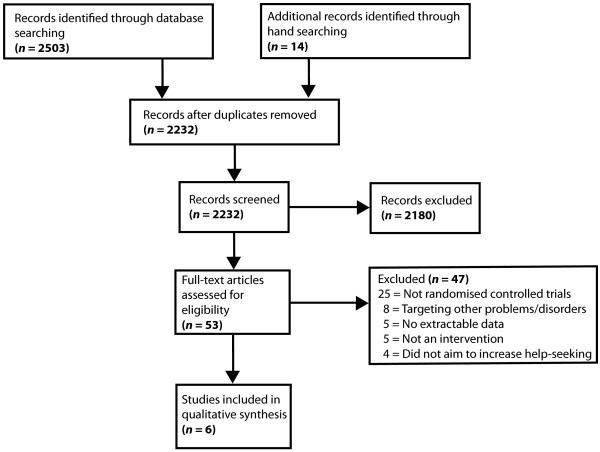
- Searches were run in PubMed, PsycINFO, and the Cochrane Library in November 2011; after screening and hand-searching, 6 studies met inclusion criteria.
- Data extraction was done independently by 2 authors, with Cohen’s d calculated for post-test and follow-up comparisons; study quality was rated with the 9-item EPOC risk of bias tool.
## Limitations
- The paper states that help-seeking measures varied across studies, making comparison difficult, and that only one study examined actual help-seeking behavior.
- It also states that searching only 3 databases, restricting inclusion to English-language published journal papers, and relying on published studies only may have introduced bias.
- Evident from the text: the evidence base was small (6 studies), outcomes were heterogeneous, and the authors note that many interventions combined multiple components, making it difficult to isolate which component caused the effects.
Model-written summary. Check it against the paper before relying on it.
Integrity signals
Registry
Cites
Statistics
Figures
Verification
Claims the paper makes
40 Valid · 9 Not valid · 25 Not checked · 45 Own results and interpretations
At least one cited source doesn’t support this claim or points to a different paper, and none confirmed it — see the verdicts below.
In the paper
“Six published studies of randomised controlled trials investigating eight different interventions for help-seeking were identified.”
- Also stated in: § Search methodology and inclusion criteria · plain
“This left a total of six relevant studies [37,40-44].”
§ A systematic review of help-seeking interventions for depression, anxiety and general psychological distress > Abstract > Results
What the sources say
- Disputedcites [37] Christensen H Leach LS Barney L Mackinnon AJ Griffiths KM The effect of web based depression interventions on self reported help seeking: randomised controlled trial BMC psychiatry 2006 6 13 16595018 PMC1501008 sourceExperimental — accuracy not yet measured
The Background (page unavailable) says there had been very little research on interventions to increase help-seeking and identifies one randomised controlled study, not six published randomised trials investigating eight interventions. The eight treatments listed in Methods > Measures are items participants could report using, not eight help-seeking interventions tested across trials. (LLM, conf=0.82)
Checked by a reasoning model — may be wrong.
- Could not verifycites [40] Costin DL Mackinnon AJ Griffiths KM Batterham PJ Bennett AJ Bennett K Christensen H Health e-cards as a means of encouraging help seeking for depression among young adults: randomized controlled trial Journal of medical Internet research 2009 11 4 e42 19850549 PMC2802564 sourceExperimental — accuracy not yet measured
The Introduction (page not available) says that three randomized studies had investigated depression information interventions and their effects on help-seeking. The Results report this paper’s own trial. Neither passage establishes the claimed count of six published trials investigating eight help-seeking interventions; searches for those counts found no supporting passage. The narrower count of three does not rule out six trials across a broader range of interventions. (LLM, conf=0.72)
- Not checked — no full text of the sourcecites [41] Donohue B Dickens Y Lancer K Covassin T Hash A Miller A Genet J Improving athletes’ perspectives of sport psychology consultation: a controlled evaluation of two interview methods Behav Modif 2004 28 2 182 193 14997947 source
- Not checked — no full text of the sourcecites [42] Han DY Chen SH Hwang KK Wei HL Effects of psychoeducation for depression on help-seeking willingness: biological attribution versus destigmatization Psychiatry and clinical neurosciences 2006 60 6 662 668 17109699 source
- Not checked — no full text of the sourcecites [43] Sharp W Hargrove D Johnson L Deal W Mental health education: An evaluation of a classroom-based strategy to modify help-seeking for mental health problems J Coll Stud Dev 2006 47 4 419 438 source
- Not checked — no full text of the sourcecites [44] Buckley GI Malouff JM Using modeling and vicarious reinforcement to produce more positive attitudes toward mental health treatment J Psychol 2005 139 3 197 209 15945515 source
plain- Asserted: passes — The authors put it forward as true.
- Checkable: passes — It can be checked against evidence.
- Load-bearing: passes — The paper’s conclusions depend on it.
- Based: passes — The paper gives a reason why it holds.
- Also stated in: § Search methodology and inclusion criteria · plain
Some cited sources support this claim and some don’t — read each source’s verdict below.
In the paper
“Help-seeking behaviour was measured for three interventions [37,40,43], but no differences between the control and experimental condition were found for help-seeking behaviour at post-test for the interventions delivering information targeting mental health literacy.”
§ A systematic review of help-seeking interventions for depression, anxiety and general psychological distress > Results > Trial outcomes
What the sources say
- Disputedcites [37] Christensen H Leach LS Barney L Mackinnon AJ Griffiths KM The effect of web based depression interventions on self reported help seeking: randomised controlled trial BMC psychiatry 2006 6 13 16595018 PMC1501008 sourceExperimental — accuracy not yet measured
The Results and Discussion (page not provided) report differences in help-seeking behaviour between BluePages, the information intervention, and the control condition at post-test. BluePages participants reported less use of music, less help-seeking from family and friends, and fewer everyday treatments. The paper found no increase in seeking specific evidence-based treatments, but that narrower finding does not support the claim of no help-seeking differences. (LLM, conf=0.90)
Checked by a reasoning model — may be wrong.
- Supportedcites [40] Costin DL Mackinnon AJ Griffiths KM Batterham PJ Bennett AJ Bennett K Christensen H Health e-cards as a means of encouraging help seeking for depression among young adults: randomized controlled trial Journal of medical Internet research 2009 11 4 e42 19850549 PMC2802564 source
The Results section (Primary Outcome: Help-Seeking Behavior; page not provided) reports no significant intervention effect on formal or informal help seeking up to six weeks after the intervention. This supports the claim for the intervention studied in this paper; the other two interventions are attributed to separate citations. (LLM, conf=0.94)
- Not checked — no full text of the sourcecites [43] Sharp W Hargrove D Johnson L Deal W Mental health education: An evaluation of a classroom-based strategy to modify help-seeking for mental health problems J Coll Stud Dev 2006 47 4 419 438 source
plain- Asserted: passes — The authors put it forward as true.
- Checkable: passes — It can be checked against evidence.
- Load-bearing: passes — The paper’s conclusions depend on it.
- Based: passes — The paper gives a reason why it holds.
- Disputed
Every source the paper cites for this claim was checked and supports it.
In the paper
“One trial involved an indicated intervention [37] and included participants with high levels of psychological distress only (K-10 scores above or equal to 12).”
§ A systematic review of help-seeking interventions for depression, anxiety and general psychological distress > Results > Sample and participant characteristics
What the sources say
- Supportedcites [37] Christensen H Leach LS Barney L Mackinnon AJ Griffiths KM The effect of web based depression interventions on self reported help seeking: randomised controlled trial BMC psychiatry 2006 6 13 16595018 PMC1501008 source
The Methods > Participants passage says people scoring below 12 on the Kessler Psychological Distress Scale were ineligible. The Methods > Design passage describes the web-based interventions to which eligible participants were randomized. Together, these support describing the trial as an indicated intervention involving participants with K10 scores of at least 12. (LLM, conf=0.91)
plain- Asserted: passes — The authors put it forward as true.
- Checkable: passes — It can be checked against evidence.
- Load-bearing: unclear — It is unclear whether the paper’s conclusions depend on it.
- Based: passes — The paper gives a reason why it holds.
- Supported
The sources with a verdict support this claim; the rest weren’t checked yet, have no full text we could read, or their verdicts aren’t rated yet.
In the paper
“Five out of the six trials involved universal interventions [40-44].”
§ A systematic review of help-seeking interventions for depression, anxiety and general psychological distress > Results > Sample and participant characteristics
What the sources say
- Supportedcites [40] Costin DL Mackinnon AJ Griffiths KM Batterham PJ Bennett AJ Bennett K Christensen H Health e-cards as a means of encouraging help seeking for depression among young adults: randomized controlled trial Journal of medical Internet research 2009 11 4 e42 19850549 PMC2802564 sourceExperimental — accuracy not yet measured
The Methods (Participants and Flow; page not provided) describe a trial recruiting young adults from the community without requiring depression or elevated distress. Both high-distress and low- or no-distress participants were included, supporting this paper’s identification as a trial involving a universal intervention among those cited collectively. (LLM, conf=0.88)
- Not checked — no full text of the sourcecites [41] Donohue B Dickens Y Lancer K Covassin T Hash A Miller A Genet J Improving athletes’ perspectives of sport psychology consultation: a controlled evaluation of two interview methods Behav Modif 2004 28 2 182 193 14997947 source
- Not checked — no full text of the sourcecites [42] Han DY Chen SH Hwang KK Wei HL Effects of psychoeducation for depression on help-seeking willingness: biological attribution versus destigmatization Psychiatry and clinical neurosciences 2006 60 6 662 668 17109699 source
- Not checked — no full text of the sourcecites [43] Sharp W Hargrove D Johnson L Deal W Mental health education: An evaluation of a classroom-based strategy to modify help-seeking for mental health problems J Coll Stud Dev 2006 47 4 419 438 source
- Not checked — no full text of the sourcecites [44] Buckley GI Malouff JM Using modeling and vicarious reinforcement to produce more positive attitudes toward mental health treatment J Psychol 2005 139 3 197 209 15945515 source
plain- Asserted: passes — The authors put it forward as true.
- Checkable: passes — It can be checked against evidence.
- Load-bearing: unclear — It is unclear whether the paper’s conclusions depend on it.
- Based: passes — The paper gives a reason why it holds.
- Supported
The cited sources support only part of this claim — read each source’s verdict below.
In the paper
“Despite the severity of these consequences, it is estimated that up to one-half of those with depression [16-18] and only one third to one-half of those affected by anxiety disorders [8,16] seek professional help.”
§ A systematic review of help-seeking interventions for depression, anxiety and general psychological distress > Background > Help-seeking for anxiety and depression
What the sources say
- Not checked — no full text of the sourcecites [16] Andrews G Hall W Teesson M Henderson S The mental health of Australians 1999 Commonwealth Department of Health and Aged Care, Mental Health Branch, Canberra source
- Not checked — no full text of the sourcecites [17] Bland RC Newman SC Orn H Help-seeking for psychiatric disorders Can J Psychiatry 1997 42 9 935 942 9429063 source
- Partly supportedcites [18] Roy-Byrne PP Stang P Wittchen HU Ustun B Walters EE Kessler RC Lifetime panic-depression comorbidity in the National Comorbidity Survey. Association with symptoms, impairment, course and help-seeking Br J Psychiatry 2000 176 229 235 10755069 sourceExperimental — accuracy not yet measured
Table 3 (Discussion; page not given in our copy) reports past-year service use of 35.5% for major depression alone and 34.4% for panic disorder alone, supporting the point that many people in those groups did not seek help. The paper examines panic disorder, not anxiety disorders generally, and reports 55.2% service use among people with both conditions. (LLM, conf=0.85)
- Supportedcites [8] Andrews G Issakidis C Carter G Shortfall in mental health service utilisation Br J Psychiatry 2001 179 417 425 11689399 source
The Mental disorders section reports that 66.8% of people with a current principal affective disorder consulted, meaning about one-third did not. It also says people with anxiety disorders were less likely to consult than those with affective disorders. This supports the attributed point that many people with depression or anxiety disorders do not seek professional help. (LLM, conf=0.90)
hedged- Asserted: passes — The authors put it forward as true.
- Checkable: passes — It can be checked against evidence.
- Load-bearing: passes — The paper’s conclusions depend on it.
- Based: passes — The paper gives a reason why it holds.
42 more claims · 9 with their cited sources checked
Create a free account to see all 119 claims and to verify the 1 reference still open.
- Probably not a substantial claim. 43
- It may state two separate claims as one. 38
Claims other papers make about this one
Each is checked against this paper’s own text: does it say what the citing paper says it does?
The cited source doesn’t support the claim as written.
In the citing paper
“This is in line with previous studies suggesting that teens who are most in need are less likely to seek help [1, 11, 15].”
From What are the barriers, facilitators and interventions targeting help-seeking behaviours for common mental health problems in adolescents? A systematic review (2020) · cites this paper as [1]
Checked by a reasoning model — may be wrong.
Experimental — accuracy not yet measuredThe cited source doesn’t support the claim as written.
In the citing paper
“However, most interventions that have previously attempted to increase treatment receipt have only increased people's intention to seek treatment, rather than their behaviour (Gulliver et al., 2012).”
From Translating the Intention to Seek Treatment into Action: Does Symptom Monitoring Make a Difference? Results from a Randomized Controlled Trial (2019) · cites this paper as Gulliver et al., 2012
Checked by a reasoning model — may be wrong.
Experimental — accuracy not yet measuredThe cited source doesn’t support the claim as written.
In the citing paper
“The review concluded that these interventions had a positive impact on intention to seek treatment but little effect on actual treatment seeking, with the exception of the computerized CBT intervention (Christensen et al., 2006), which could arguably be considered treatment in and of itself.”
From Translating the Intention to Seek Treatment into Action: Does Symptom Monitoring Make a Difference? Results from a Randomized Controlled Trial (2019) · cites this paper as Gulliver et al., 2012
Checked by a reasoning model — may be wrong.
Experimental — accuracy not yet measuredThe source backs part of the claim, not all of it — or backs it for a different population, condition or comparison.
In the citing paper
“Teens who are most in need of mental health attention are reluctant to seek help.”
From What are the barriers, facilitators and interventions targeting help-seeking behaviours for common mental health problems in adolescents? A systematic review (2020) · cites this paper as [1]
Experimental — accuracy not yet measuredThe source backs part of the claim, not all of it — or backs it for a different population, condition or comparison.
In the citing paper
“However, none of the studies identified in this review analysed results according to gender and none were tailored to address the gender-based attitudes and perceived norms thought to drive male help-seeking behaviour.”
From Silence is deadly: a cluster-randomised controlled trial of a mental health help-seeking intervention for young men (2017) · cites this paper as [10]
Experimental — accuracy not yet measured
12 more claims about this paper
Create a free account to see every claim other papers make about this one.
Citations
Cites
The theory of planned behavior
Ajzen, I. (1991) · Organizational Behavior and Human Decision Processes · doi:10.1016/0749-5978(91)90020-t · Cited by 134,657
Statistical Power Analysis for the Behavioral Sciences
Muller, K. (1989) · Technometrics · doi:10.1080/00401706.1989.10488618 · Cited by 99,167
Preferred Reporting Items for Systematic Reviews and Meta-Analyses: the PRISMA statement
Moher, D., Liberati, A., Tetzlaff, J., Altman, D. G., & for the PRISMA Group (2009) · BMJ · doi:10.1136/bmj.b2535 · Cited by 83,823
Statistical power analysis for the behavioral sciences
(1990) · Computers, Environment and Urban Systems · doi:10.1016/0198-9715(90)90050-4 · Cited by 65,269
Preferred reporting items for systematic reviews and meta-analyses: the PRISMA Statement.
(2009) · PubMed Central · Cited by 44,859
Kessler, R. C., Chiu, W. T., Demler, O., & Walters, E. E. (2005) · Archives of General Psychiatry · doi:10.1001/archpsyc.62.6.617 · Cited by 12,052 · cited 1×
“Depression and anxiety are highly prevalent mental disorders with an estimated 12-month prevalence of 14-18% for anxiety disorders, and 4-7% for depressive disorders in high income countries worldwide [9-11].”
BackgroundRevisiting the Behavioral Model and Access to Medical Care: Does it Matter?
Andersen, R. M. (1995) · Journal of Health and Social Behavior · doi:10.2307/2137284 · Cited by 9,831 · cited 3×
“Theories of help-seeking predict that attitudes and beliefs influence behaviour [22,24,26,27,31].”
BackgroundMethodLopez, A. D., Mathers, C. D., Ezzati, M., Jamison, D. T., & Murray, C. J. (2006) · The Lancet · doi:10.1016/s0140-6736(06)68770-9 · Cited by 5,630
The size and burden of mental disorders and other disorders of the brain in Europe 2010
Wittchen, H. U., Jacobi, F., Rehm, J., Gustavsson, A., Svensson, M., Jönsson, B., Olesen, J., Allgulander, C., Alonso, J., Faravelli, C., et al. (2011) · European Neuropsychopharmacology · doi:10.1016/j.euroneuro.2011.07.018 · Cited by 3,754
Societal and Individual Determinants of Medical Care Utilization in the United States
ANDERSEN, R., & NEWMAN, J. F. (2005) · The Milbank Quarterly · doi:10.1111/j.1468-0009.2005.00428.x · Cited by 3,611 · cited 3×
“Theories of help-seeking predict that attitudes and beliefs influence behaviour [22,24,26,27,31].”
BackgroundMethod
Research works printed but not linked: 3
- Andrews G Hall W Teesson M Henderson S The mental health of Australians 1999 Commonwealth Department of Health and Aged Care, Mental Health Branch, Canberra
- Deane FP Ciarrochi J Wilson C Rickwood D Anderson S Do high school students’ intentions predict actual help seeking from school counselors? In 8th Annual Conference of Suicide Prevention 2001 Sydney, Australia
- EPOC resources for review authors [ http://epoc.cochrane.org/epoc-resources-review-authors Archived by WebCite® at http://www.webcitation.org/5uxiODnqX]
Cited by
Clement, S., Schauman, O., Graham, T., Maggioni, F., Evans-Lacko, S., Bezborodovs, N., Morgan, C., Rüsch, N., Brown, J. S. L., & Thornicroft, G. (2015) · Psychological Medicine · doi:10.1017/s0033291714000129 · Cited by 3,152
“A systematic review of randomized controlled trials (RCTs) of interventions aiming to increase help-seeking reported that of two out of three anti-stigma interventions improved help-seeking attitudes (Gulliver et al. 2012).”
The Impact of Mental Illness Stigma on Seeking and Participating in Mental Health Care
Corrigan, P. W., Druss, B. G., & Perlick, D. A. (2014) · Psychological Science in the Public Interest · doi:10.1177/1529100614531398 · Cited by 1,642
Werner-Seidler, A., Perry, Y., Calear, A. L., Newby, J. M., & Christensen, H. (2017) · Clinical Psychology Review · doi:10.1016/j.cpr.2016.10.005 · Cited by 773
Self-citationAguirre Velasco, A., Cruz, I. S. S., Billings, J., Jimenez, M., & Rowe, S. (2020) · BMC Psychiatry · doi:10.1186/s12888-020-02659-0 · Cited by 736
“Previous systematic reviews on interventions targeting help-seeking reveal some promising results in regard to enhancing mental health literacy [16] and a significant positive overall effect of these interventions in improving help-seeking for mental health problems [17].”
Davies, E. B., Morriss, R., & Glazebrook, C. (2014) · Journal of Medical Internet Research · doi:10.2196/jmir.3142 · Cited by 499
“Measurements of help-seeking intentions and behavior, as well as aspects of mental health literacy, would be highly useful in future research as online interventions are often promoted as an alternative to seeking face-to-face help or preventing onset of ill mental health [23].”
BackgroundMethodInfluentialByrow, Y., Pajak, R., Specker, P., & Nickerson, A. (2020) · Clinical Psychology Review · doi:10.1016/j.cpr.2019.101812 · Cited by 345
Do online mental health services improve help-seeking for young people? A systematic review
Kauer, S. D., Mangan, C., & Sanci, L. (2014) · Journal of Medical Internet Research · doi:10.2196/jmir.3103 · Cited by 339
“A recent meta-analysis demonstrated that interventions with a focus on mental health literacy significantly improved help-seeking intentions, although no effect was found for help-seeking behaviors [86].”
BackgroundMagaard, J. L., Seeralan, T., Schulz, H., & Brütt, A. L. (2017) · PLOS ONE · doi:10.1371/journal.pone.0176730 · Cited by 317
Torous, J., Linardon, J., Goldberg, S. B., Sun, S., Bell, I., Nicholas, J., Hassan, L., Hua, Y., Milton, A., & Firth, J. (2025) · World Psychiatry · doi:10.1002/wps.21299 · Cited by 323
“Since few people with depression or anxiety have access to specialized psychological treatments 113 , apps that are grounded in an evidence based framework and offer credible skills, resources or tips have the potential to represent an ac cessible, cost effective and viable option for users to…”
Xu, Z., Huang, F., Kösters, M., Staiger, T., Becker, T., Thornicroft, G., & Rüsch, N. (2018) · Psychological Medicine · doi:10.1017/s0033291718001265 · Cited by 252
“This is consistent with the observation of Gulliver et al. (2012) that help-seeking behaviours would be expected if individuals experience symptoms and thus are likely to perceive the need for professional help.”
Hammer, J. H., Parent, M. C., & Spiker, D. A. (2018) · Journal of Counseling Psychology · doi:10.1037/cou0000248 · Cited by 207
Cristancho-Lacroix, V., Wrobel, J., Cantegreil-Kallen, I., Dub, T., Rouquette, A., & Rigaud, A.-S. (2015) · Journal of Medical Internet Research · doi:10.2196/jmir.3717 · Cited by 205
“Nevertheless, their reluctance to face-to-face services was also described [49-51].”
Bø, K., Artal, R., Barakat, R., Brown, W., Davies, G. A. L., Dooley, M., Evenson, K. R., Haakstad, L. A. H., Henriksson-Larsen, K., Kayser, B., et al. (2016) · British Journal of Sports Medicine · doi:10.1136/bjsports-2016-096218 · Cited by 206
“161 As in the general population, the prevalence of depression is higher in female athletes than in male athletes.”
BackgroundBrijnath, B., Protheroe, J., Mahtani, K. R., & Antoniades, J. (2016) · Journal of Medical Internet Research · doi:10.2196/jmir.5463 · Cited by 159
“Currently, many MHL interventions are embedded within other interventions and it is difficult to disentangle the efficacy of each component of the intervention from the others (for review of interventions see [6,15]).”
BackgroundTreatment gap and help-seeking for postpartum depression in a rural African setting
Azale, T., Fekadu, A., & Hanlon, C. (2016) · BMC Psychiatry · doi:10.1186/s12888-016-0892-8 · Cited by 126
Suicide Prevention Media Campaigns: A Systematic Literature Review
Pirkis, J., Rossetto, A., Nicholas, A., Ftanou, M., Robinson, J., & Reavley, N. (2019) · Health Communication · doi:10.1080/10410236.2017.1405484 · Cited by 109
Adams, C., Gringart, E., & Strobel, N. (2022) · Systematic Reviews · doi:10.1186/s13643-022-02034-y · Cited by 115
“In recent years, researchers have attempted to address this gap [20–22], and a number of theories have been applied to mental health help-seeking [23].”
BackgroundA Systematic Review of Parent and Caregiver Mental Health Literacy
Hurley, D., Swann, C., Allen, M. S., Ferguson, H., & Vella, S. A. (2019) · Community Mental Health Journal · doi:10.1007/s10597-019-00454-0 · Cited by 147
“There was a preference 394 for parents and caregivers, regardless of mental health status, to seek and use help from informal sources of 395 support in line with previous research (Gulliver et al., 2012; Reardon et al., 2017).”
ResultEbert, D. D., Franke, M., Kählke, F., Küchler, A., Bruffaerts, R., Mortier, P., Karyotaki, E., Alonso, J., Cuijpers, P., Berking, M., et al. (2019) · International Journal of Methods in Psychiatric Research · doi:10.1002/mpr.1754 · Cited by 105
“These findings are comparable with previous studies in other target groups showing that it may be possible to increase the intention to seek help (Albada et al., 2009; Brouwers et al., 2011; Curry et al., 1993; Gonzales et al., 2002; Gulliver et al., 2012; Hadlaczky et al., 2014; Hovick et al., 2014; Riper et al., 200…”
ResultShorey, S., Ng, Y. P. M., Ng, E. D., Siew, A. L., Mörelius, E., Yoong, J., & Gandhi, M. (2019) · Journal of Medical Internet Research · doi:10.2196/10816 · Cited by 97
“Similarly, O’Mahen et al reported a significant decline in both PND and PNA scores for mothers at 3 months postpartum using an 11-week technology-based intervention involving weekly phone calls from coaches and Web-based information [73].”
BackgroundInfluentialThe relationship of perceived campus culture to mental health help-seeking intentions.
Chen, J. I., Romero, G. D., & Karver, M. S. (2016) · Journal of Counseling Psychology · doi:10.1037/cou0000095 · Cited by 97
Obstacles to Help-Seeking for Sexual Offenders: Implications for Prevention of Sexual Abuse
Levenson, J. S., Willis, G. M., & Vicencio, C. P. (2017) · Journal of Child Sexual Abuse · doi:10.1080/10538712.2016.1276116 · Cited by 92
Barriers to accessing support for mental health issues at university
Cage, E., Stock, M., Sharpington, A., Pitman, E., & Batchelor, R. (2018) · Studies in Higher Education · doi:10.1080/03075079.2018.1544237 · Cited by 130
“Gulliver et al. (2012) also found that people were more likely to seek help from informal sources who provide social support rather than professionals.”
BackgroundNagai, S. (2015) · Japanese Psychological Research · doi:10.1111/jpr.12091 · Cited by 132
Psychosocial correlates of college students’ help-seeking intention: A meta-analysis.
Li, W., Dorstyn, D. S., & Denson, L. A. (2014) · Professional Psychology: Research and Practice · doi:10.1037/a0037118 · Cited by 83
Newman, H. J. H., Howells, K., & Fletcher, D. (2016) · Frontiers in Psychology · doi:10.3389/fpsyg.2016.00868 · Cited by 118
“Consistent with the literature that has identified a reluctance to engage with mental health services (Gulliver et al., 2012), help-seeking was delayed by many of the athletes’ as a result of their internalization of the notion that as elite athletes at the height of their careers they should not…”
BackgroundShahwan, S., Lau, J. H., Goh, C. M. J., Ong, W. J., Tan, G. T. H., Kwok, K. W., Samari, E., Lee, Y. Y., Teh, W. L., Seet, V. A. L., et al. (2020) · BMC Psychiatry · doi:10.1186/s12888-020-02960-y · Cited by 146
“These interventions include [13]: educational interventions (to increase mental health literacy), de-stigmatisation (which is aimed at reducing the stigma sur-”
BackgroundInfluentialKhan, K., Hall, C. L., Davies, E. B., Hollis, C. P., & Glazebrook, C. (2019) · Journal of Medical Internet Research · doi:10.2196/13478 · Cited by 85
“All interventions used different content and modalities of delivery, which could have affected participant interaction and consequently, effectiveness [49].”
BackgroundClark, L. H., Hudson, J. L., Rapee, R. M., & Grasby, K. L. (2020) · Journal of Anxiety Disorders · doi:10.1016/j.janxdis.2020.102292 · Cited by 102
Improving access to dementia services for people from minority ethnic groups
Mukadam, N., Cooper, C., & Livingston, G. (2013) · Current Opinion in Psychiatry · doi:10.1097/yco.0b013e32835ee668 · Cited by 75
Attygalle, U. R., Perera, H., & Jayamanne, B. D. W. (2017) · Child and Adolescent Psychiatry and Mental Health · doi:10.1186/s13034-017-0176-1 · Cited by 114
“Studies indicate that in general, mental health literacy improves help seeking attitudes [2, 3].”
BackgroundSheikh, A., Payne-Cook, C., Lisk, S. C., Carter, B., & Brown, J. S. L. (2024) · European Child & Adolescent Psychiatry · doi:10.1007/s00787-024-02520-9 · Cited by 112
“However, CBT alone may not be sufficient in improving help-seeking attitudes, according to previous research [61].”
Help-seeking behaviors for mental health problems during the COVID-19 pandemic: A systematic review
Yonemoto, N., & Kawashima, Y. (2022) · Journal of Affective Disorders · doi:10.1016/j.jad.2022.11.043 · Cited by 101
Determinants of access to health care for depression in 49 countries: A multilevel analysis
Araya, R., Zitko, P., Markkula, N., Rai, D., & Jones, K. (2018) · Journal of Affective Disorders · doi:10.1016/j.jad.2018.02.092 · Cited by 68
Men’s depression and suicide literacy: a nationally representative Canadian survey
Oliffe, J. L., Hannan-Leith, M. N., Ogrodniczuk, J. S., Black, N., Mackenzie, C. S., Lohan, M., & Creighton, G. (2016) · Journal of Mental Health · doi:10.1080/09638237.2016.1177770 · Cited by 83
“In turn, improving mental health literacy can increase well-being and help-seeking attitudes for depression and/or suicidal behaviors (Gulliver et al., 2012).”
BackgroundHurley, D., Allen, M. S., Swann, C., Okely, A. D., & Vella, S. A. (2018) · Journal of Child and Family Studies · doi:10.1007/s10826-018-1071-y · Cited by 78
“Anxiety literacy and depression literacy The Anxiety Literacy questionnaire (A-LIT; Gulliver et al. 2012) and the Depression Literacy questionnaire (D-LIT; Griffiths et al. 2004) contain 22 statements measuring disorder specific knowledge and attitudes.”
BackgroundLawrence, P., Fulbrook, P., Somerset, S., & Schulz, P. (2017) · Journal of Psychiatric and Mental Health Nursing · doi:10.1111/jpm.12420 · Cited by 63
Navrady, L. B., Ritchie, S. J., Chan, S. W. Y., Kerr, D. M., Adams, M. J., Hawkins, E. H., Porteous, D., Deary, I. J., Gale, C. R., Batty, G. D., et al. (2017) · European Psychiatry · doi:10.1016/j.eurpsy.2016.12.012 · Cited by 64
Patel, P. C., & Rietveld, C. A. (2020) · Journal of Business Venturing Insights · doi:10.1016/j.jbvi.2020.e00206 · Cited by 71
Siegel, J. T., Lienemann, B. A., & Rosenberg, B. D. (2017) · Social and Personality Psychology Compass · doi:10.1111/spc3.12322 · Cited by 65
Johnson, J. A., Sanghvi, P., & Mehrotra, S. (2022) · Indian Journal of Psychological Medicine · doi:10.1177/02537176211034578 · Cited by 60
“16,17 Systematic reviews have examined help-seeking interventions for men, 18 common mental health disorders in particular, 19 and mental health concerns in general.”
BackgroundSelf‐stigma and the intention to seek psychological help online compared to face‐to‐face
Wallin, E., Maathz, P., Parling, T., & Hursti, T. (2018) · Journal of Clinical Psychology · doi:10.1002/jclp.22583 · Cited by 60
MacLean, L., & Law, J. (2022) · Psychology in the Schools · doi:10.1002/pits.22648 · Cited by 108
“Prevalence rates of mental health problems among adolescents have been found to be the highest when compared to any other stage of life (Gulliver et al., 2012), with the WHO (2012) reporting that up to 20% of adolescents are likely to experience some form of mental health problems, with depression…”
BackgroundTomczyk, S., Schmidt, S., Muehlan, H., Stolzenburg, S., & Schomerus, G. (2019) · The Journal of Behavioral Health Services & Research · doi:10.1007/s11414-019-09662-8 · Cited by 68
“Nevertheless, Gulliver et al.(21) showed that literacy-based interventions are able to increase attitudes and intentions, but not behaviour.”
BackgroundGoldstein, T. R., Merranko, J., Krantz, M., Garcia, M., Franzen, P., Levenson, J., Axelson, D., Birmaher, B., & Frank, E. (2018) · Journal of Affective Disorders · doi:10.1016/j.jad.2018.04.049 · Cited by 55
Mason, R. J., Hart, L., Rossetto, A., & Jorm, A. F. (2015) · Psychiatry Research · doi:10.1016/j.psychres.2015.03.036 · Cited by 72
“, 1997) is thought to be an important influence on helpseeking attitudes and behaviours (Burns and Rapee, 2006; Gulliver et al., 2012; Smith and Shochet, 2011); adolescents must recognise the nature of their problem and the benefits of receiving professional help before seeking such help.”
BackgroundHeinig, I., Wittchen, H.-U., & Knappe, S. (2021) · Community Mental Health Journal · doi:10.1007/s10597-020-00767-5 · Cited by 54
“Interventions targeting mental health literacy (Gulliver et al. 2012) are thus needed to inform the public about the symptoms, treatable nature and types of interventions for AD, to decrease stigma and to generate realistic expectations towards mental health and mental health treatments.”
BackgroundGoetz, C. J., Mushquash, C. J., & Maranzan, K. A. (2022) · Psychiatric Services · doi:10.1176/appi.ps.202100503 · Cited by 79
“Subject and Medical Subject Headings terms included those used in the review mentioned earlier (24), along with additional ones found within the selected databases that were deemed relevant.”
Eggenberger, L., Fordschmid, C., Ludwig, C., Weber, S., Grub, J., Komlenac, N., & Walther, A. (2021) · Behavioral Sciences · doi:10.3390/bs11060083 · Cited by 57
Lin, C., Oveisi, S., Burri, A. V., & Pakpour, A. H. (2017) · Epilepsy & Behavior · doi:10.1016/j.yebeh.2017.01.010 · Cited by 57
O’Dea, B., Subotic-Kerry, M., KING, C. A., Mackinnon, A. J., Achilles, M. R., Anderson, M., Parker, B., Werner‐Seidler, A., Torok, M. H., Cockayne, N. L., et al. (2021) · The Lancet Regional Health - Western Pacific · doi:10.1016/j.lanwpc.2021.100178 · Cited by 57
Self-citationHelp-seeking for mental health concerns: review of Indian research and emergent insights
Sanghvi, P. B., & Mehrotra, S. (2021) · Journal of Health Research · doi:10.1108/jhr-02-2020-0040 · Cited by 62
Bifftu, B. B., Takele, W. W., Guracho, Y. D., & Yehualashet, F. A. (2018) · Depression Research and Treatment · doi:10.1155/2018/1592596 · Cited by 60
Bonsaksen, T., Grimholt, T. K., Skogstad, L., Lerdal, A., Ekeberg, Ø., Heir, T., & Schou‐Bredal, I. (2018) · BMC Public Health · doi:10.1186/s12889-018-5990-8 · Cited by 55
Kingston, D. E., McDonald, S., Tough, S., Austin, M., Hegadoren, K., & Lasiuk, G. C. (2014) · BMC Pregnancy and Childbirth · doi:10.1186/1471-2393-14-67 · Cited by 72
“Although health literacy is only one factor that impacts help-seeking behavior [39,45,46], our study demonstrated that it was the most prominent influence driving respondents’ acceptability of treatments.”
BackgroundAbelson, S., Lipson, S. K., & Eisenberg, D. (2022) · Higher education · doi:10.1007/978-3-030-76660-3_6 · Cited by 83
Yang, X., Hu, J., Zhang, B., Ding, H., Hu, D., & Li, H. (2024) · Frontiers in Psychology · doi:10.3389/fpsyg.2024.1356435 · Cited by 111
Han, J., Batterham, P. J., Calear, A. L., Wu, Y., Xue, J., & van Spijker, B. A. J. (2018) · Internet Interventions · doi:10.1016/j.invent.2017.11.002 · Cited by 47
“5 (Cohen's d) suggested by previous findings (Gulliver et al., 2012; Taylor-Rodgers and Batterham, 2014) with alpha = 0.”
BackgroundTomczyk, S., Muehlan, H., Freitag, S., Stolzenburg, S., Schomerus, G., & Schmidt, S. (2018) · Journal of Affective Disorders · doi:10.1016/j.jad.2018.05.059 · Cited by 46
Addressing anhedonia to increase depression treatment engagement
Khazanov, G. K., Forbes, C. N., Dunn, B. D., & Thase, M. E. (2021) · British Journal of Clinical Psychology · doi:10.1111/bjc.12335 · Cited by 50
Werlen, L., Gjukaj, D., Mohler-Kuo, M., & Puhan, M. A. (2020) · Epidemiology and Psychiatric Sciences · doi:10.1017/s2045796019000544 · Cited by 45
van den Broek, M., Gandhi, Y., Sureshkumar, D. S., Prina, M. A., Bhatia, U., Patel, V., Singla, D. R., Velleman, R. D. B., Weiss, H. A., Garg, A., et al. (2023) · PLOS Global Public Health · doi:10.1371/journal.pgph.0002302 · Cited by 71
“Gulliver et al. [81] for example, found two interventions conducted online (i.e., via email and a website plus telephone contact) both of which successfully increased formal help-seeking while Xu et al. [21] found no effectiveness for internet-based interventions and only short-term effects for…”
Higginbottom, G. A., Safipour, J., Yohani, S. C., O’Brien, B., Mumtaz, Z., & Paton, P. (2014) · Midwifery · doi:10.1016/j.midw.2014.09.009 · Cited by 64
Finucane, M. L., Beckman, R., Ghosh‐Dastidar, M., Dubowitz, T., Collins, R. L., & Troxel, W. (2021) · Landscape and Urban Planning · doi:10.1016/j.landurbplan.2021.104264 · Cited by 45
Sagar-Ouriaghli, I., Godfrey, E. L., Graham, S., & Brown, J. S. L. (2020) · International Journal of Environmental Research and Public Health · doi:10.3390/ijerph17144965 · Cited by 63
“At the time, there was only one systematic review that summarised six interventions targeting help-seeking for depression, anxiety, and general psychological distress for both males and females across multiple age groups [28].”
BackgroundInfluentialDi Consiglio, M., Merola, S., Pascucci, T., Violani, C., & Couyoumdjian, A. (2021) · International Journal of Environmental Research and Public Health · doi:10.3390/ijerph18189897 · Cited by 42
“According to the high percentage of students that accepted psychological therapy, it seems to be an efficacious strategy [45].”
BackgroundMethodProcess evaluation of a district mental healthcare plan in Nepal: a mixed-methods case study
Luitel, N. P., Breuer, E., Adhikari, A., Kohrt, B. A., Lund, C., Komproe, I. H., & Jordans, M. J. D. (2020) · BJPsych Open · doi:10.1192/bjo.2020.60 · Cited by 41
Peyton, D., Goods, M., & Hiscock, H. (2022) · Journal of Medical Internet Research · doi:10.2196/28771 · Cited by 48
“Data extracted included study design; number of participants; type of comparison (where relevant); setting; recruitment; age and sex of participants and their children; the intervention, including the theoretical basis (a factor that may influence the success of a help-seeking intervention) [42] and measures of DHI us…”
Siegel, J. T., & Thomson, A. L. (2016) · The Journal of Positive Psychology · doi:10.1080/17439760.2016.1221125 · Cited by 48
Li, J. J., Appleton, S., Wittert, G., Vakulin, A., McEvoy, R. D., Antic, N. A., & Adams, R. (2014) · SLEEP · doi:10.5665/sleep.3500 · Cited by 47
Predicting help-seeking behavior: The impact of knowing someone close who has sought help
Disabato, D. J., Short, J. L., Lameira, D. M., Bagley, K., & Wong, S. J. (2018) · Journal of American College Health · doi:10.1080/07448481.2018.1440568 · Cited by 46
“A meta-analysis of eight different help-seeking interventions suggested that learning about help seeking for a psychological problem or hearing about a stranger’s help-seeking experience may not be enough to promote help-seeking behavior in young people.(10) There was virtually no average standardized mean difference…”
BackgroundTait, R. J., McKetin, R., Kay-Lambkin, F., Carron-Arthur, B., Bennett, A., Bennett, K., Christensen, H., & Griffiths, K. M. (2014) · JMIR Mental Health · doi:10.2196/mental.3278 · Cited by 37
“A recent review has found that it is difficult to change help-seeking, even where this is a specific aim of the intervention, at least among samples with common mental health disorders (eg, depression, anxiety) [34].”
Self-citationRossetto, A., Jorm, A. F., & Reavley, N. J. (2014) · SAGE Open · doi:10.1177/2158244014537502 · Cited by 47
Calear, A. L., Morse, A. R., Batterham, P. J., Forbes, O., & Banfield, M. (2021) · Suicide and Life-Threatening Behavior · doi:10.1111/sltb.12703 · Cited by 44
Xie, Z., Tanner, R., Striley, C. W., & Marlow, N. M. (2021) · Journal of Affective Disorders · doi:10.1016/j.jad.2021.12.040 · Cited by 40
Rushing, S. C., Kelley, A., Bull, S. S., Stephens, D., Wrobel, J., Silvasstar, J., Peterson, R., Begay, C., Dog, T. G., McCray, C. J., et al. (2021) · JMIR Mental Health · doi:10.2196/26158 · Cited by 39
“Previous research in other populations suggests that help-seeking interventions are most effective when an individual is symptomatic and felt the need to ask for help [34].”
BackgroundTheurel, A., & Witt, A. (2022) · Creative Education · doi:10.4236/ce.2022.132025 · Cited by 41
“…interventions appear to be more effective in improving help-seeking attitudes in young DOI: 10.4236/ce.2022.132025 444 Creative Education adults (Gulliver et al., 2012), it is to be noted that interventions that use strategies of destigmatisation are effective in terms of improving attitudes to…”
BackgroundInfluentialHelp-Seeking for Mental Health Issues in Professional Rugby League Players
Kola, S., Lewis, K., Rodriguez, A., & Kola-Palmer, D. (2020) · Frontiers in Psychology · doi:10.3389/fpsyg.2020.570690 · Cited by 45
Hurley, D., Allen, M. S., Swann, C., & Vella, S. A. (2020) · Child Psychiatry & Human Development · doi:10.1007/s10578-020-00998-3 · Cited by 45
Li, W., & Reavley, N. J. (2019) · Social Psychiatry and Psychiatric Epidemiology · doi:10.1007/s00127-019-01799-3 · Cited by 42
Wadman, R., Webster, L. A. D., Mawn, L., & Stain, H. J. (2018) · Mental Health & Prevention · doi:10.1016/j.mhp.2018.11.003 · Cited by 42
“There have been calls for further research examining help-seeking behaviours (rather than intentions) and also predictors of help-seeking in clinically distressed samples (e.g. utilising clinical cut-offs for symptom measures) (Eisenberg et al., 2007; Gulliver et al., 2012; Vogel et al., 2007).”
BackgroundEvans-Lacko, S., Hahn, J. S., Peter, L.-J., & Schomerus, G. (2022) · Current Opinion in Psychiatry · doi:10.1097/yco.0000000000000788 · Cited by 32
“including cognitive, attitudinal and structural aspects [5,12].”
MethodRomero-Mas, M., Ramon‐Aribau, A., de Souza, D. L. B., Cox, A. M., & Gómez‐Zúñiga, B. (2021) · International Journal of Alzheimer s Disease · doi:10.1155/2021/8817491 · Cited by 38
“However, literature describes caregivers’ reluctance to participate in faceto-face services too [43].”
BackgroundRyan, B., Bohan, J. K., & Kneebone, I. (2019) · International Journal of Language & Communication Disorders · doi:10.1111/1460-6984.12476 · Cited by 36
Calear, A. L., Banfield, M., Batterham, P. J., Morse, A. R., Forbes, O., Carron-Arthur, B., & Fisk, M. (2017) · BMC Public Health · doi:10.1186/s12889-017-4845-z · Cited by 31
“53), particularly in young people [10].”
Coates, D., Saleeba, C., & Howe, D. J. (2018) · Community Mental Health Journal · doi:10.1007/s10597-018-0270-8 · Cited by 33
Moore, C. D., Schofield, C., van Rooyen, D. R. M., & Andersson, L. M. C. (2015) · SpringerPlus · doi:10.1186/s40064-015-1109-1 · Cited by 30
“Different models have been developed to understand help-seeking behavior in general (Ajzen 1991; Andersen 1995) and for mental illness in particular (Biddle et al. 2007; Gulliver et al. 2012; Rickwood et al. 2005).”
MethodMüller, C. P., Schumann, G., Rehm, J. T., Kornhuber, J., & Lenz, B. (2023) · Molecular Psychiatry · doi:10.1038/s41380-023-02074-3 · Cited by 45
“Depression: Depression is a mental disorder against which various pharmacological and non-pharmacological self-management measures are taken [114].”
BackgroundHurley, D., Swann, C., Allen, M. S., & Vella, S. A. (2019) · Psychology of sport and exercise · doi:10.1016/j.psychsport.2019.101635 · Cited by 44
Identification Reduces Stigma of Mental Ill‐Health: A Community‐Based Study
Kearns, M. L., Muldoon, O. T., Msetfi, R. M., & Surgenor, P. W. G. (2017) · American Journal of Community Psychology · doi:10.1002/ajcp.12220 · Cited by 34
“Stigma of mental ill-health is acknowledged as one of the strongest barriers to engaging with professional mental health services (Gulliver et al., 2012).”
Suka, M., Yamauchi, T., & Yanagisawa, H. (2018) · BMJ Open · doi:10.1136/bmjopen-2017-020823 · Cited by 28
Straszewski, T., & Siegel, J. T. (2018) · Applied Psychology Health and Well-Being · doi:10.1111/aphw.12122 · Cited by 36
Samlan, H., Shetty, A., & McWhirter, E. H. (2020) · Journal of College Student Psychotherapy · doi:10.1080/87568225.2020.1734133 · Cited by 33
Roberts, T., Shidhaye, R. R., Patel, V., & Rathod, S. D. (2020) · BMC Health Services Research · doi:10.1186/s12913-020-05162-0 · Cited by 27
Turetsky, K. M., & Sanderson, C. A. (2017) · Journal of Applied Social Psychology · doi:10.1111/jasp.12489 · Cited by 33
Batterham, R. W., Beauchamp, A., & Osborne, R. H. (2016) · Elsevier eBooks · doi:10.1016/b978-0-12-803678-5.00190-9 · Cited by 41
Tulloch, C., Browne, M., Hing, N., Rockloff, M., & Hilbrecht, M. (2023) · Journal of Behavioral Addictions · doi:10.1556/2006.2023.00036 · Cited by 31
“This result is consistent with research that has found that without adequate support, ongoing psychological distress can lead to lower work productivity, increased healthcare visits, and more serious physical and mental health problems (Gulliver et al., 2012).”
InfluentialCasañas, R., Castellví, P., Gil, J.-J., Torres-Torres, M., Barón, J., Teixidó, M., Sampietro, H. M., López, M. D., Fernández, R., de Oraa, R. S. M., et al. (2022) · BMC Public Health · doi:10.1186/s12889-022-14558-y · Cited by 31
A thematic analysis of the personal factors influencing mental health help‐seeking in farmers
Vayro, C., Brownlow, C., Ireland, M. J., & March, S. (2022) · The Journal of Rural Health · doi:10.1111/jrh.12705 · Cited by 31
Psychological support in general population during the COVID-19 lockdown in France: Needs and access
Alleaume, C., Verger, P., Peretti‐Watel, P., & the COCONEL Group (2021) · PLoS ONE · doi:10.1371/journal.pone.0251707 · Cited by 29
Metadata
- Authors
- Gulliver, A., Griffiths, K. M., Christensen, H., & Brewer, J. L.
- Affiliations
- Australian National University (AU)
- Corresponding author
- Gulliver, Amelia
- Venue
- BMC Psychiatry
- Published
- 2012-07-16
- Volume
- 12
- Issue
- 1
- Pages
- 81-81
- ISSN
- 1471-244X (ISSN-L)
- PMC
- PMC3464688
- OpenAlex
- W2115880456
- Semantic Scholar
- 1f00fcaac175d71835b436db06f3d36ce1cfdec4
- Cited by
- 342
- References
- 58
- Citations by year
- 2026: 22 · 2025: 37 · 2024: 23 · 2023: 30 · 2022: 36 · 2021: 41 · 2020: 24 · 2019: 21 · 2018: 31 · 2017: 21 · 2016: 18 · 2015: 13 · 2014: 18 · 2013: 4 · 2012: 3
- FWCI
- 1.70
- Type
- journal article
- Language
- en
- Open access
- gold
- doi.org
- Licence
- Locations
- BMC Psychiatry (publishedVersion, cc-by)
- Europe PMC (PubMed Central) (publishedVersion, cc-by)
- PubMed Central (publishedVersion, cc-by)
- PubMed (publishedVersion)
- DOAJ (DOAJ: Directory of Open Access Journals) (submittedVersion)
- ANU Open Research (Australian National University) (submittedVersion, cc-by)
- Funders
- Australian National University
- Australian Institute of Sport
- National Health and Medical Research Council (525413, 525411)
- Topics
- Health Sciences › Medicine › Psychiatry and Mental health › Mental Health Treatment and Access
- Social Sciences › Psychology › Clinical Psychology › Suicide and Self-Harm Studies
- Social Sciences › Psychology › Experimental and Cognitive Psychology › Anxiety, Depression, Psychometrics, Treatment, Cognitive Processes
- Keywords
- help-seeking, help-seeking attitudes, help-seeking intentions, depression, anxiety, psychological distress, stigma reduction, young adults
- MeSH terms
- Anxiety Disorders, Depressive Disorder, Humans, Mental Health, Patient Acceptance of Health Care, Psychotherapy, Stress, Psychological, Health Literacy
About these checks
Registry, retraction, Cites and statistics results are computed, not judged, with one exception: a printed reference that no index lists is read once by a model before it counts as a citation error. Claims are extracted by a model and kept only when their quote appears verbatim in the text; each cited source is then checked, with a model’s help, for whether it says what the claim relies on. Those verdicts can be wrong — read the claim’s quote and the cited source before relying on one.
The claim verdicts this report counts are experimental: their accuracy is not yet measured.
A language model drew the claims from the paper on 2026-09-29, under version 3 of the claim definition (model deepseek-v4.1-flash, prompt extract-v3).
A second model labelled each claim on 2026-09-29 (model jev-1.13-20260917, definition revision gold-guideline-v0.2).
Cited sources are checked with a language model’s help (gpt-6-sol).
Statistics and arithmetic are recomputed, not judged.
Confidence bands are shown only for fields calibrated on our annotated test set. None is calibrated yet, so no band is shown.
What counts as a claim ›How we measure confidence ›How we check this ›
Are you an author, or do you see a problem with this page? Request a review
Data sources
Bibliographic data: Semantic Scholar, OpenAlex, Crossref.
Contains information from the Semantic Scholar Academic Graph Datasets, made available under the ODC Attribution License (ODC-BY 1.0).
Semantic Scholar’s data is described in: Kinney, R., et al. (2023). The Semantic Scholar Open Data Platform. arXiv:2301.10140.
